Chapter 1: THE BOY NOBODY CAME TO WATCH – 041
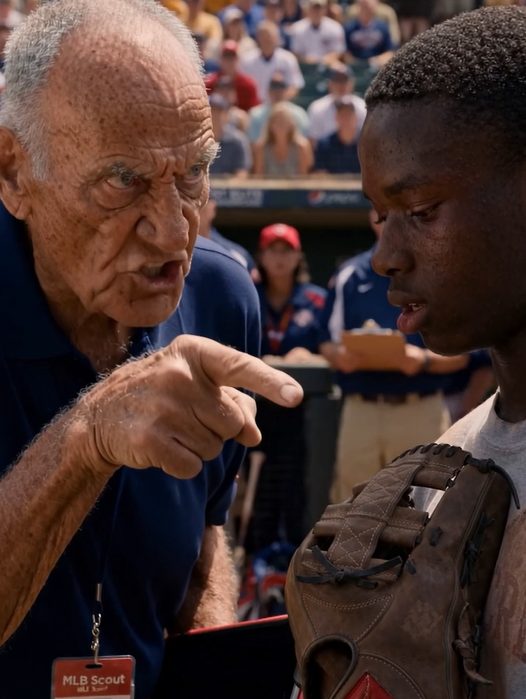
The first time an MLB scout noticed me, he laughed so loudly that people all across the baseball field turned to see what was wrong with me.
I was fourteen years old, wearing a faded gray FIELD CREW shirt, holding a glove I had repaired with black shoelace, and standing in the middle of a stadium filled with boys whose families had spent more money on baseball than my mother earned in a year.
And the worst part?
I had given that scout a reason to laugh.
Because I had told the truth.
“I could throw it there without a bounce.”
Seven words.
That was all it took to turn me from the invisible ball boy into the afternoon’s entertainment.
But I should start with what happened before those words escaped my mouth.
My name is Micah Dawson.
That summer, I worked at the Midwest Elite Baseball Showcase, just outside Indianapolis.
It was the kind of event where college recruiters, professional scouts, private coaches, and wealthy parents gathered to decide which young athletes deserved a future in baseball.
The stadium wasn’t enormous, but to me it might as well have been Yankee Stadium.
Rows of green seats curved around the diamond.
Fresh white chalk marked the baselines.
The outfield grass was cut in perfect alternating stripes, and the warning track stretched beneath a dark green wall that seemed impossibly far away from home plate.
Every morning, I arrived before the players.
I carried equipment bags, collected loose baseballs, filled plastic buckets, cleaned the dugouts, and made sure the practice stations had everything the coaches needed.
I knew which scouts preferred sitting behind home plate and which wanted to watch from the first-base side.
I knew which players liked extra batting practice and which complained when their favorite bat wasn’t waiting beside the cage.
Most of those players didn’t know my name.
To them, I was the kid in the gray shirt.
“Hey, ball boy.”
“More baseballs.”
“Grab my bag.”
“Move that bucket.”
I answered every request the same way.
“Yes, sir.”
“Right away.”
My mother had taught me to be respectful, even when people forgot to return the favor.
She had also taught me something more important.
“Never confuse somebody overlooking you with somebody knowing your worth.”
I thought about that sentence whenever I watched the players warm up.
Some wore brand-new cleats that cost hundreds of dollars.
Others carried customized gloves embroidered with their names.
Their uniforms matched perfectly, and their private instructors stood nearby, correcting every movement.
I had one glove.
It had belonged to me for three years.
The pocket was stretched, the leather was cracking, and one of the original laces had snapped during a neighborhood game.
I couldn’t afford a replacement, so I used a piece of black shoelace to repair it.
It wasn’t pretty.
But it worked.
At home, my mother kept our grocery receipts in a kitchen drawer.
Sometimes I saw her spreading them across the table, studying the numbers as though rearranging them might make the total smaller.
She never complained.
That somehow made it worse.
When I told her I had found a summer job at the showcase, she smiled and said, “Baby, you’re fourteen.
You don’t have to worry about taking care of me.”
I told her I wasn’t worried.
We both knew I was lying.
Baseball had always been the one thing that made the rest of the world disappear.
I loved the sound of a ball meeting leather.
I loved the smell of freshly cut grass, the roughness of the seams beneath my fingertips, and the moment when a runner rounded third and everything depended on one throw.
Especially the throws.
Other kids wanted to hit home runs.
I wanted to throw somebody out at the plate.
I studied outfielders whenever I could, watching how they positioned their feet, transferred the ball from glove to hand, and used their entire bodies to generate power.
I practiced in whatever open space I could find.
Sometimes that meant a public field with uneven grass.
Sometimes it meant throwing against an old wooden backstop.
And sometimes it meant spending an hour simply repeating my footwork without releasing a baseball.
I couldn’t afford private lessons.
But I could pay attention.
And I paid attention to everything.
That afternoon, the showcase was packed.
Professional scouts occupied several rows behind home plate, their tablets and notebooks resting on their knees.
Parents gathered along the fences while coaches directed players between stations.
A man announced that the outfield throwing competition was beginning.
I immediately headed toward center field to collect the baseballs after each attempt.
This was my favorite event.
The players would catch a simulated fly ball near the warning track and attempt to throw home with enough accuracy and speed to prevent a runner from scoring.
It was one of the hardest plays in baseball.
Distance alone wasn’t enough.
A high throw might travel far, but it gave the runner time.
A low throw might arrive quickly, but if the arm angle or release point was wrong, the ball could die in the grass.
I had spent years thinking about that exact problem.
The first prospect stepped forward.
He was tall, broad-shouldered, and wearing a spotless uniform.
His father stood behind the fence with a camera mounted on a tripod.
The player caught the ball and launched his throw.
It bounced once before reaching the catcher.
Several scouts nodded approvingly.
“Good arm,” someone said.
The second prospect threw farther but lost accuracy.
His ball skipped twice and pulled the catcher several feet away from the plate.
The third threw too high.
The fourth sent a powerful throw that took one bounce directly into the catcher’s glove.
A scout beside the dugout whistled.
“That’s the best one so far.”
I stood near the edge of deep center field, holding a bucket against my leg.
From where I was standing, I could see exactly what each player had done wrong.
One opened his shoulders too early.
Another planted his front foot across his body.
A third wasted half a second adjusting the ball inside his glove.
I wasn’t trying to judge them.
I was studying.
The way I always did.
Then somebody near the third-base line asked whether anyone thought the throw could be made without touching the ground.
Several adults laughed.
“Not from that distance.”
“Maybe in a video game.”
“Not by these kids.”
I looked toward home plate.
The distance was enormous.
But I pictured the angle.
The footwork.
The release.
And before I could stop myself, I whispered, “I could throw it there without a bounce.”
I hadn’t meant for anyone to hear.
Unfortunately, veteran MLB scout Gary Rollins was standing a few steps behind me.
“What was that, kid?”
My stomach dropped.
Gary was a heavyset man with gray hair, a navy polo shirt, and a tablet tucked beneath one arm.
I recognized him because he had been evaluating players all afternoon.
“Nothing, sir.”
He narrowed his eyes.
“Didn’t sound like nothing.”
I tightened my grip on the bucket.
“I was just talking to myself.”
Gary looked toward home plate, then back at me.
“You saying you could make that throw?”
I should have said no.
I should have apologized and returned to collecting baseballs.
But I remembered the countless afternoons I had spent practicing on empty fields.
“Yes, sir.”
For one second, Gary simply stared at me.
Then he burst out laughing.
He laughed so hard that another scout walked over to see what was happening.
“What’s so funny?”
Gary pointed at me.
“Our ball boy thinks he’s got a major-league arm!”
The second scout looked at my glove.
Then at my worn cleats.
A few nearby parents began listening.
Gary raised his voice.
“You seriously think you can throw a baseball from deep center field all the way home without one bounce?”
I could feel heat rising into my cheeks.
“Yes, sir.”
“Have you ever played in a showcase like this?”
“Private instructor?”
“Travel team?”
I hesitated.
Gary spread his hands as though presenting a joke everyone should appreciate.
“Well, there you go.”
The laughter spread.
A player near the dugout shook his head.
Someone muttered that I was trying to get attention.
I wished the ground would open beneath my cleats.
Gary stepped closer.
“Listen, kid.
These boys have spent years training with professional coaches.
Their families have invested serious money in their development.”
He glanced at my shirt.
“Your job is collecting baseballs.
Not trying out.”
The words hurt more than I wanted to admit.
Not because he doubted my arm.
People had doubted me before.
But because he looked at what I wore, learned what I couldn’t afford, and decided that was enough to know everything about me.
I lowered my eyes.
“I’m sorry, sir.”
I turned toward the loose baseballs scattered across the grass.
I had almost taken my first step when a voice rang out from the third-base line.
“Hey, kid!”
“Come here!”
The speaker was Frank Delaney, the veteran professional coach coordinating the baserunning drills.
I had watched him work all week.
Unlike some of the other coaches, Frank didn’t shout just to prove he was in charge.
When he corrected a player, he explained why.
When someone made a mistake, he expected effort rather than excuses.
He stood beside a bucket of baseballs, holding a long fungo bat.
I walked toward him.
“What’s your name?” he asked.
“Micah Dawson, sir.”
“Micah, did I hear you say you could make that throw?”
I glanced toward Gary.
The scout was still smiling.
I swallowed.
“Yes, sir.”
Frank studied me.
“From deep center?”
“Yes, sir.”
“On the fly?”
“Yes, sir.”
Frank looked at my glove, but unlike Gary, he didn’t laugh.
He examined the repair for a moment.
“You do that yourself?”
“Yes, sir.”
“Does it hold?”
“Every time.”
Something changed in Frank’s expression.
He turned toward the outfield.
“Grab your glove, Micah.”
“Head to deep center field.”
Gary immediately stepped forward.
“Frank, come on.
The kid’s fourteen.”
Frank ignored him.
My heart began hammering.
I looked toward the warning track.
Then toward the crowd of scouts.
I had dreamed about throwing in front of people who understood baseball.
But never like this.
Never with dozens of adults waiting for me to fail.
Frank raised his voice.
“Jace Holloway!”
A seventeen-year-old prospect near third base turned.
Jace was one of the fastest players at the showcase.
Earlier that afternoon, I had watched him beat three different runners in timed sprints.
Frank pointed at third base.
“Think you can score on a fly ball to deep center?”
Jace laughed.
“Easily, Coach.”
Get ready to tag up.”
Gary threw his hands into the air.
“Frank, what exactly are you trying to prove?”
Frank rested the fungo bat against his shoulder.
He looked toward me.
Then toward the warning track.
Finally, he faced Gary.
“Whether the boy can back up his words.”
Gary shook his head.
“You’re putting a fourteen-year-old ball boy against the fastest runner here?”
Frank’s voice remained calm.
“Then let the baseball prove it.”
The laughter faded.
I stood frozen, realizing what he had just done.
Frank wasn’t asking me to demonstrate a trick.
He was giving me one chance to prove that everything these people believed about me might be wrong.
And now, with an entire stadium watching, there was nowhere left to hide.
✓ Lynn R. Adams
The first time an MLB scout noticed me, he laughed so loudly that people all across the baseball field turned to see what was wrong with me. I was fourteen years old, wearing a faded gray FIELD CREW …