Chapter 1: The Bowl Nobody Wanted 251
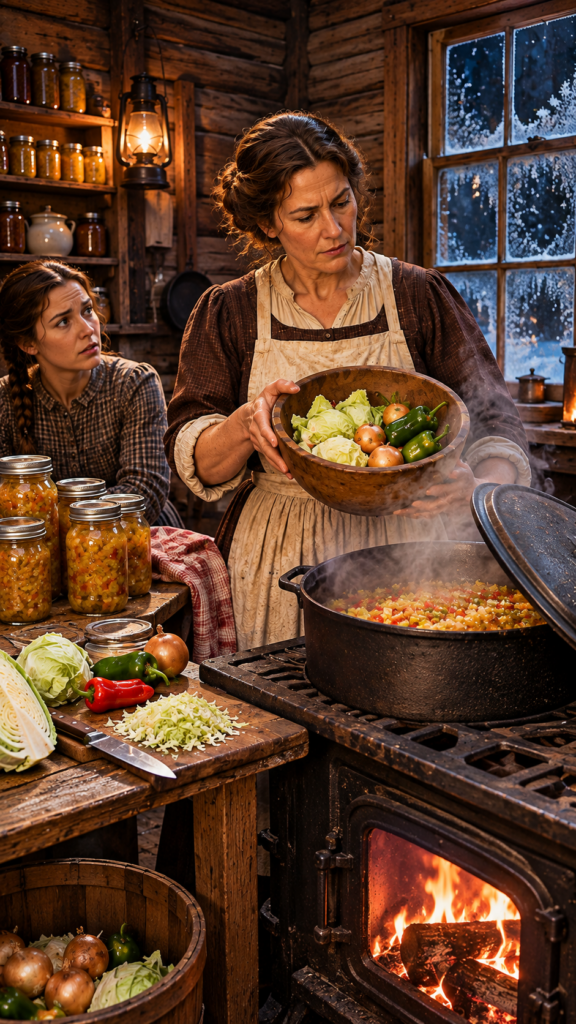
The first time my neighbor called my supper garbage, I was standing beside the kitchen window with the last crooked green pepper of November in one hand and a knife in the other while the wind came down from the Appalachian ridges hard enough to rattle the shutters.
“Why waste your time saving vegetables nobody wants?” she asked, leaning toward the wooden bowl on my table as though the torn cabbage leaves, marble-sized onions, and twisted peppers might somehow offend her simply by still existing.
I looked through the window at the mountains glowing gold and rust beneath a sky already turning the pale gray that meant winter was gathering itself somewhere beyond the ridge, and I thought about how quickly beauty disappeared once the frost arrived.
“Because winter doesn’t care how pretty your supper looks,” I told her.
She laughed loudly enough for the sound to fill our little cabin, but I kept cutting because I had heard people laugh at thrift before, and laughter had never filled a hungry child’s stomach.
The finest tomatoes from our garden had already been canned in neat rows, the beans hung drying from the rafters, our potatoes rested in cool storage, and the corn had been pulled weeks earlier, so what remained on my table was everything other families considered too ugly to bother preserving.
Some of the cabbage leaves were ragged from insects, several peppers curved around themselves like bent fingers, and the smallest onions looked hardly worth peeling, yet every one of them represented soil turned in spring, weeds pulled in summer, rain prayed for during dry weeks, and hours of work beneath an unforgiving sun.
I had learned long ago that the mountain did not reward people for caring about appearances, because a straight pepper and a crooked pepper filled a spoon exactly the same way once they had been chopped, seasoned, and preserved.
My neighbor shook her head while I drew another cabbage leaf across the cutting board and sliced it into thin ribbons.
“You’ll spend half the day chopping scraps that should have gone to the chickens,” she said.
I smiled because she was not entirely wrong about the work, but she was wrong about the value.
Outside, the first hard wind of the afternoon swept dead leaves across the yard, and their dry scratching against the cabin wall sounded almost like fingernails brushing the logs.
By December the garden would be nothing but dark frozen earth, by January the road through the hollow might disappear beneath snow, and once the weather closed the mountains there would be no wagon coming over the ridge with fresh vegetables for anyone who regretted what they had thrown away.
I gathered the chopped cabbage into a bowl, added the crooked peppers piece by piece, and peeled each tiny onion until my fingers smelled sharp and sweet.
Nothing edible escaped my knife.
Near the stove, a heavy iron pot warmed above the fire while another pair of hands in my family arranged clean glass jars across the table, checking each rim and setting them within easy reach.
I poured vinegar into the iron pot, followed it with sugar and the familiar measure of spices that generations before me had used when autumn gardens gave up their final vegetables.
The smell changed almost immediately.
Sharp vinegar rose first, stinging my nose, then sweetness softened it, and finally the warm fragrance of spices spread through the cabin until even my skeptical neighbor stopped talking long enough to breathe it in.
“What are you making?” she asked.
“Chow-chow,” I answered.
She looked toward the bowl again as though she could not understand how vegetables she had dismissed as worthless might become anything worth naming.
I tipped the cabbage, peppers, and onions into the simmering mixture, and the colors brightened beneath the steam until the scraps no longer looked like scraps at all.
They looked like food.
That difference mattered to me more than anything.
My children had never known the deepest hunger I remembered from harder winters, but I knew the particular silence that came into a house when parents began counting every potato before supper and measuring flour with frightened hands.
I knew how quickly a pantry that seemed full in November could look bare after weeks of snow.
I knew that meat could run short, that flour could disappear, that firewood could become precious, and that a family who wasted food in autumn sometimes paid for it in February.
My neighbor watched me stir the pot and finally pulled her shawl tighter around her shoulders.
“You really think those little jars matter that much?” she asked.
I rested the spoon against the side of the pot and looked directly at her.
“I think every meal we save before winter is one meal winter can’t take from us.”
For a moment she did not laugh.
Then the wind slammed against the shutters, and something in her expression changed before she quickly looked away.
We filled the jars carefully, spooning the hot relish inside until each one held a mixture of pale cabbage, green pepper, onion, and spice glowing beneath the glass.
In the dim cabin light, they looked almost beautiful.
I carried the first finished jar to the pantry and placed it beside the preserves already waiting there, then another, and another, until a new row began forming along the wooden shelf.
To anyone else they might have been jars of inexpensive vegetables.
To me they were January meals.
They were beans made brighter, cornbread made less plain, and cold evenings given one small reminder that summer had once covered the mountains.
By late afternoon my neighbor left for home, still unconvinced enough to shake her head as she crossed the yard.
“Don’t blame me when you realize you spent all day saving garbage,” she called.
I stood in the doorway while the wind pulled at my apron.
“I won’t,” I called back.
The sun disappeared behind the ridge earlier than it had the week before, and darkness came down with the cold so quickly that frost began silvering the grass before we had finished cleaning the kitchen.
Inside, we wiped the table, stacked the remaining empty jars, and moved the filled ones into the pantry while the iron pot continued bubbling quietly.
I thought the work was nearly finished.
Then, as I reached for the broom, I noticed something pushed beneath the far side of the table.
A wooden bowl.
I bent down and pulled it into the firelight.
Inside were the very last pieces of our garden.
Several torn cabbage leaves lay beneath a handful of tiny onions, and two crooked peppers rested on top, both scarred and bent enough that even I had forgotten them during the afternoon’s work.
Someone behind me sighed.
“We’ve done enough,” came a tired voice from my family.
I picked up one of the peppers.
“Throw those away,” the voice added.
For reasons I could not explain at first, I remained perfectly still.
The frost was thickening across the windowpanes, the fire cracked beneath the iron pot, and the jars we had already filled gleamed along the table like little lanterns.
I looked down at the forgotten bowl and suddenly heard my grandmother’s voice as clearly as if she were standing beside me.
She had spoken those words during a winter when snow had buried the mountain roads and nearly every family in our hollow had learned how quickly abundance could turn into fear.
I lifted the heavy lid from the iron pot.
A cloud of fragrant steam rolled upward.
Everyone in the room turned toward me.
I brought the forgotten bowl onto the table and reached for my knife.
“No,” I whispered.
The room fell quiet.
“These may be the most important ones of all.”
My fingers closed around the knife handle, but before I made the first cut, I looked at the faces around me and realized it was time to explain the lesson my grandmother had taught me about the final scraps of a harvest.
✓ Lynn R. Adams
The first time my neighbor called my supper garbage, I was standing beside the kitchen window with the last crooked green pepper of November in one hand and a knife in the other while the wind came do…