Chapter 1: PART 1 – They Laughed At The Boy Mowing Their Baseball Field—Until One Throw Silenced Every Parent a243
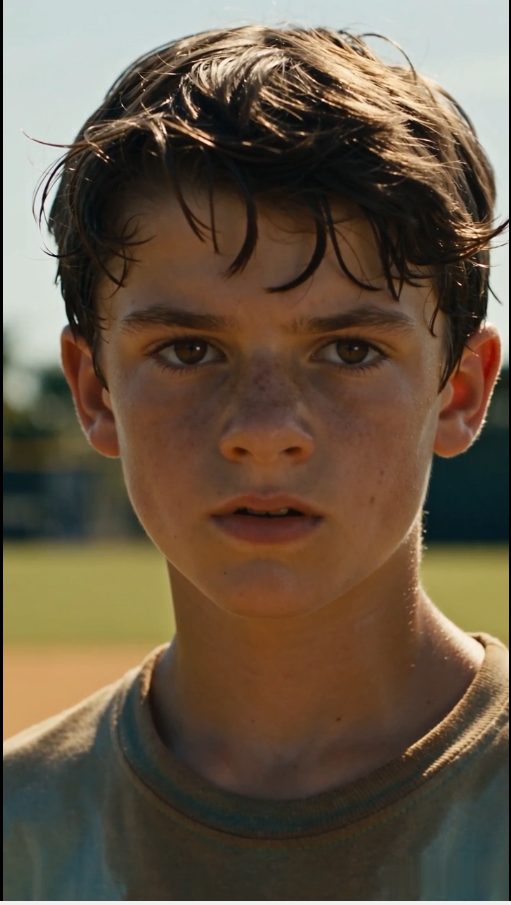
PART 1: The Boy Behind the Fence
The first time I made a baseball field go silent, I was wearing work gloves too big for my hands and standing beside a lawn mower that barely ran.
Five minutes earlier, the richest kid at Gulf Coast Premier had called me lawn boy in front of half the town, and his friends had laughed as though being poor were something I had chosen.
I was fourteen, my name was Caleb Turner, and the only reason I was allowed near those invitation-only tryouts was that somebody had to cut the grass beyond the left-field fence.
My uncle Ray had made that part very clear before the first truck arrived that morning.
“Finish the work, keep your head down, and remember we aren’t here for them,” he had told me while checking the mower’s fuel cap.
I had nodded because arguing with Uncle Ray never got me anywhere, especially when he was worried about losing another groundskeeping contract.
Still, when he turned away, I looked through the chain-link fence toward the perfect white chalk lines and felt the familiar ache of wanting something that seemed to belong to everybody except me.
The Florida sun was already high enough to burn the back of my neck, and the air above the infield shimmered as if somebody had lit a fire beneath the dirt.
Under enormous white tents, parents sat in folding chairs with expensive coolers, sports drinks, and cameras pointed toward their sons.
The boys wore crisp uniforms in Gulf Coast Premier colors, and some of their gloves looked softer and newer than anything I had ever owned.
I watched a shortstop field a ball with his weight too far back, and I imagined how much faster he could throw if he planted his right foot before bringing the ball across his chest.
Nobody had taught me to notice details like that in a classroom, because baseball had never been an official part of my life.
I had learned from the wrong side of fences, from abandoned practice balls, and from the quiet hours when paying customers finally left the field.
Uncle Ray had been helping raise me since I was six, when my father disappeared from our lives and my mother began accepting overnight nursing shifts to keep the lights on.
My mother never complained about the work, but I heard her shoes scrape the kitchen floor when she came home exhausted just before sunrise.
I also heard her counting bills some evenings, whispering numbers as though making them quieter might make them smaller.
We were not looking for sympathy, and we certainly were not looking for a fight with people who paid to use the grounds.
Yet the moment those teams arrived, their presence made me feel as though the entire place had been divided into two worlds by a fence.
Inside were boys whose futures seemed mapped out in neat lines toward high school championships and college scholarships.
Outside was me, with a faded green shirt sticking to my back and a mower that sputtered whenever the grass got thick.
“Keep moving, Caleb,” Uncle Ray called from beside the equipment shed, where he was replacing a damaged sprinkler fitting.
I raised one hand to show I had heard him and forced the mower through a stubborn patch of weeds.
For nearly an hour I kept my eyes mostly on the ground, but every sharp crack of bat against ball pulled my attention back toward the field.
Ray had taught me to watch more than the ball, because, according to him, every good play began in a player’s feet.
On evenings when the gates were locked and the bleachers empty, he used to stand by the pitching screen with one knee bent awkwardly and toss me a scuffed baseball.
“Show me what your body remembers,” he would say, as if my arms and legs held a secret my head had not yet discovered.
I would throw until the sky turned purple and the security lamps came on, and he would say very little unless I tried too hard.
“Don’t throw angry,” he always warned when frustration made me grip the ball until my knuckles hurt.
“Throw honest.”
The first voice that dragged me out of those memories belonged to Preston Weller.
“Hey, lawn boy!” he shouted from beside the dugout, loud enough for the nearest parents to turn.
I recognized him because Ray had pointed out his father earlier, explaining that Mr Weller helped sponsor two tournament teams and had plenty of opinions about how the facility should look.
Preston was blond, broad-shouldered, and wore a silver chain that flashed in the sunlight whenever he moved.
“You mowing grass or taking baseball lessons through the fence?” he asked.
A few of the other boys laughed, and I kept walking because Ray’s warning was still fresh in my mind.
Preston stepped closer to the railing and raised his voice again when he realized I was not going to answer.
“Watch out, guys, because he might tell the grass about us!”
This time the laughter spread across the dugout, quick and ugly, until even a parent near the water cooler gave a small amused snort.
I stared at the strip of grass ahead of the mower and tried not to let them see how badly it hurt.
Something about being laughed at while I was actually working, though, made my throat tighten with a shame I could not swallow.
I wanted to tell Preston that my uncle’s work was the reason his expensive cleats had a beautiful field to stand on.
I wanted to ask whether he had ever spent a Saturday earning grocery money instead of spending it.
Instead, I shoved the mower forward, because Uncle Ray needed this paycheck and my pride was not worth costing him the job.
Coach Darren Pike stood near the third-base line with mirrored sunglasses and a clipboard, directing players between stations as if the whole complex belonged to his voice.
When Preston yelled again, Pike turned his head and looked straight toward the fence.
He adjusted his sunglasses, glanced at his clipboard, and returned to the drill without saying a word.
That hurt worse than anything Preston had shouted, because it showed me that I was not important enough even to defend.
I heard the mower’s blade rattle beneath me, and I concentrated on the vibration in my palms until my cheeks stopped burning.
At the end of the strip, Ray waved me over for water, and I cut the engine before walking to the shed.
“What happened?” he asked.
“Nothing,” I said, drinking too fast.
He glanced toward the boys gathering beside the dugout and did not look convinced.
“Nothing can take up a lot of room in a boy’s chest,” he said quietly.
I almost smiled, because he had a way of saying strange things that made sense later.
“They think it’s funny that I work here,” I admitted.
“There’s no shame in honest work, Caleb.”
“Knowing it isn’t always the same as feeling it.”
I crushed the empty paper cup and looked toward the gate where the best players were warming up.
“Sometimes I wonder what would happen if I got one chance,” I said.
Ray was quiet long enough that I turned back to him.
“A chance isn’t always handed to the person who earns it,” he finally answered.
“Then how do you get one?”
“You make sure you’re ready when a door opens, even if it only opens a crack,” he said.
I went back to work with that sentence repeating in my head, although I had no reason to believe a door would open that morning.
On the field, the coaches moved into a drill that sent balls across the diamond at different angles.
I heard Pike demand quicker releases and watched one third baseman hurry his motion before his feet were set.
The throw came out wild, flying over the first baseman’s glove and striking the fence near the bullpen.
It bumped against my dusty sneaker and stopped.
I stared at the white leather, which had picked up a thin green smear as it crossed the grass.
I could have nudged it toward the gate with my foot, or carried it closer and passed it through the opening.
The sensible part of me knew that was what Ray would expect, but I had spent years dreaming about the feel of a baseball in my hand while real players watched.
I switched off the mower, pulled one oversized work glove loose, and bent to pick up the ball.
“Throw it back, kid,” Coach Pike called from the infield.
His voice was impatient, the voice people used when the help was slowing them down.
“And be careful.”
Preston leaned over the dugout railing with a grin that told me he had been waiting for another chance to embarrass me.
“Don’t hurt yourself!” he shouted.
I glanced toward home plate, where the catcher had lifted his glove and was waiting without much interest.
It was a long throw from where I stood, especially for a boy nobody had ever seen play in an official game.
My heart began pounding, but it was not because I doubted I could reach him.
What frightened me was the thought of doing it in front of people who had already decided what I was.
I could feel their expectations pressing on me as strongly as the humid air.
If I bounced the ball or missed, the boys would laugh again and Pike would have another reason to dismiss me.
I looked down the foul line toward the equipment shed, searching for Uncle Ray.
He was standing beside a cart with a wrench in his hand, watching me through the fence.
He did not wave me closer or tell me to put the ball down.
Instead, he straightened his shoulders and gave one tiny nod.
I remembered the empty stands, the chipped practice balls, and his voice carrying through the darkness.
Don’t throw angry, throw honest.
The boys were still joking, but their voices seemed to fade as I turned my shoulders toward the catcher.
I placed my feet the way Ray had taught me, let my weight settle, and drew the ball back without showing off.
There was no long windup and no dramatic pause intended to impress anyone.
Then I threw.
The ball shot across the diamond, riding a straight line above the infield while the catcher lifted his glove a fraction too late.
It struck the leather with a crack so sharp that I heard it even from beyond the fence, and the force pushed his hand toward his chest.
Nobody laughed.
Preston’s grin disappeared, and a few players turned to look at the spot where my mower stood cooling in the grass.
Pike lowered his clipboard, his mirrored glasses aimed straight at me, and I suddenly became aware of how loudly my heart was beating.
I looked toward Uncle Ray, but his expression had gone still in a way I had never seen before.
Beyond the cluster of wealthy parents, an elderly man rose slowly from his folding chair, using the armrest to push himself upright.
His face was lined and sunburned, and he wore a faded cap that looked older than some of the boys on the field.
I had seen him watching the drills earlier, writing nothing and saying almost nothing while other adults talked.
Now he stepped out from behind the chairs, staring at me as if he had recognized something impossible.
Coach Pike opened his mouth to speak, but the old man raised one hand and stopped him.
“Don’t move that boy,” he said, his voice suddenly carrying across the silent diamond.
He walked to the fence, looked directly into my face, and asked a question that made Uncle Ray’s wrench fall from his hand.
“Caleb, who taught you to throw like that?”
✓ Lynn R. Adams
PART 1: The Boy Behind the Fence The first time I made a baseball field go silent, I was wearing work gloves too big for my hands and standing beside a lawn mower that barely ran. Five minutes earli…