Chapter 1: PART 1 – The Woman Oak Haven Had Condemned 031
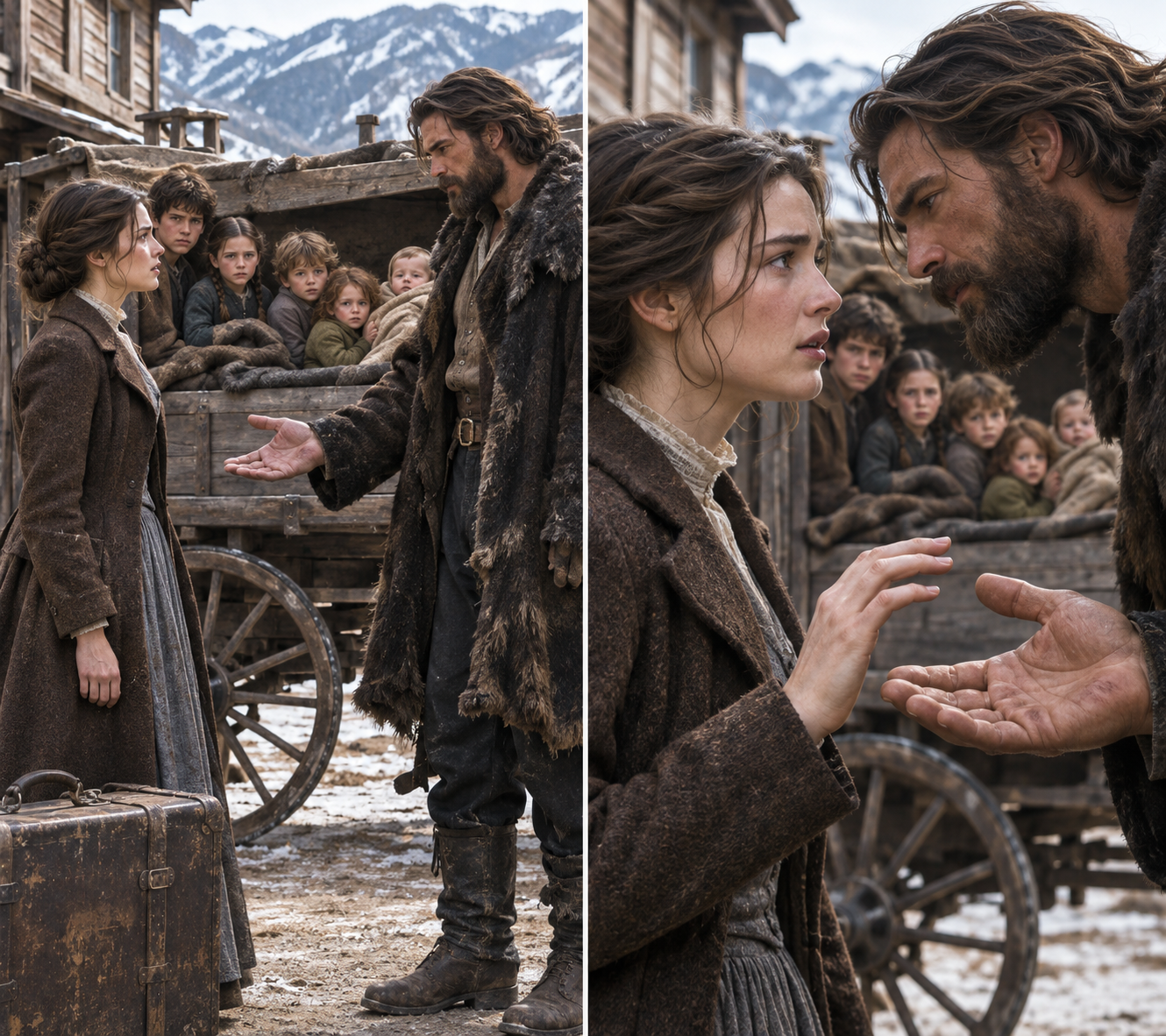
PART 1: The Woman Oak Haven Had Condemned
The day a stranger offered me the chance to become a mother to five children, the entire town was still convinced I wasn’t worth marrying.
My name is Cora Evans, and at twenty-six years old, I had already learned that a woman’s heart could keep beating long after everyone around her had declared her life meaningless.
For seven years, the people of Oak Haven had treated me like a broken piece of merchandise that no respectable man would ever take home.
They never said those things when they needed flour measured, cloth folded, or their purchases carried to the mercantile door.
They said them afterward, when they thought I was too busy working to hear.
“What use is a barren woman on a homestead?”
“No sensible man would marry her.”
“She’ll grow old without a family.”
I heard every word, even when I kept my eyes lowered and pretended to concentrate on my work.
Seven years earlier, scarlet fever had nearly carried me into the grave.
For weeks, I had drifted between life and death while a doctor struggled to bring down the terrible heat burning through my body.
When the fever finally broke, everyone called my survival a blessing.
Then the doctor explained that the illness had left me unable to bear children.
I had been nineteen years old when he delivered that judgment, young enough to believe that every beautiful possibility still lay ahead of me.
I remembered watching his lips move while the little room around me seemed to lose its shape.
I had imagined a husband returning home at sundown, a warm kitchen, and children sleeping beneath quilts I had sewn myself.
Afterward, those dreams became things I could scarcely bear to look at.
My neighbors began discussing my future as though I were already absent from the room.
At first, I fought their opinions with smiles, hard work, and the foolish hope that kindness might eventually silence cruelty.
By twenty-six, I understood that Oak Haven had no intention of changing its mind.
Every morning, I entered the mercantile before sunrise and worked until my back ached and my fingertips burned.
I carried heavy flour sacks, counted nails, measured calico, swept the floor, and answered every insult with the politeness expected of an unmarried woman.
Sometimes I caught myself watching mothers straighten their children’s collars or wipe crumbs from little mouths.
Those small gestures hurt more than the cruelest remarks because they reminded me of something I wanted desperately and believed I would never have.
I had stopped allowing myself to imagine marriage.
I had not managed to stop wanting someone to love.
On a bitter November afternoon, the store bell rang while I was measuring flour for a customer.
A gust of icy air swept through the doorway, scattering dust across the floorboards.
Then an enormous man stepped inside.
His shoulders nearly filled the entrance, and his buffalo-hide coat looked as though it had endured more winters than the building itself.
He had dark hair brushing his collar, a thick beard threaded faintly with gray, and a weathered face that seemed carved from mountain stone.
I recognized him immediately as Gideon Cole.
He lived beyond the timberline, where winter storms could close the trails for weeks and men sometimes disappeared beneath the snow.
I knew that his wife had died two winters earlier and that he had remained in their remote cabin with five children.
What I had not expected was to see those children following him through the mercantile door.
The oldest boy looked about thirteen, with guarded eyes and a jaw already carrying more responsibility than childhood should require.
Beside him stood a serious little girl whose dark braids hung over a worn shawl.
A restless seven-year-old boy stared at everything in the store without touching anything.
A toddler clung to Gideon’s leg, while the youngest child rested in a bundle of blankets against his broad chest.
Their clothing was worn, their faces wind-reddened, and their expressions painfully cautious.
The customers stared as though the children had brought the wilderness into the store.
I saw something entirely different.
I saw a family that had been holding itself together through sheer determination.
Gideon requested flour, lamp oil, needles, and a length of sturdy cloth.
His voice was deep and quiet, and the children seemed to listen for every word he spoke.
While I gathered his purchases, I noticed the oldest boy watching a small jar of peppermint sticks near the counter.
He looked away the moment he realized I had seen him.
I reached beneath the counter, counted five peppermint sticks, and placed them in his hand.
“Sugar for the road,” I told him.
His fingers closed around the candy as though he expected someone to take it away.
For one brief moment, the hardness in his face loosened.
He turned and divided the sticks among his brothers and sisters without keeping the largest one for himself.
Gideon watched the exchange without speaking.
When I looked up, his steel-blue eyes were fixed on me with an intensity that made my cheeks warm.
I returned to folding the cloth because I had forgotten how to stand comfortably beneath a man’s attention.
Then he removed a folded sheet of paper from inside his coat.
He smoothed it against the wooden counter with one enormous hand.
The writing was rough but unmistakably clear.
WANTED: A WIFE.
Must know how to work.
Must not mind the cold.
The store seemed to fall silent before laughter erupted near the shelves.
“Only a desperate woman would take that bargain,” someone remarked.
Another voice answered that five motherless children would be more than any sensible woman could endure.
Gideon did not turn toward either speaker.
He simply waited while I stared at the notice.
I thought of the children’s thin coats, the oldest boy’s protective expression, and the little bundle sleeping against their father’s chest.
Then I remembered every person who had told me I would never have a family.
My hand moved toward the paper before I realized what I was doing.
A woman behind me gave a sharp laugh.
“Surely you aren’t thinking of answering that, Cora.”
I withdrew my hand as though the counter had burned me.
Her next words came loudly enough for every person in the store to hear.
Cole ought to know there’s a reason no man in Oak Haven has married you.”
The oldest boy stopped unwrapping his peppermint stick.
Gideon’s expression changed.
Then he turned his enormous body toward the woman who had spoken.
And for the first time in seven years, someone looked ready to challenge the judgment Oak Haven had passed on me.
✓ Lynn R. Adams
PART 1: The Woman Oak Haven Had Condemned The day a stranger offered me the chance to become a mother to five children, the entire town was still convinced I wasn’t worth marrying. My name is Cora E…