Chapter 1: PART 1 – The Stranger at the Frozen Door 035
PART 1: The Stranger at the Frozen Door
The night I almost froze to death in the Wyoming wilderness, I discovered that the people my father had taught me to fear were the only ones standing between me and an icy grave.
My name is Thomas Garrett, and in November of 1887, I was twenty-four years old, unmarried, painfully inexperienced with women, and convinced that the safest life was one lived completely alone.
I owned three hundred acres of stubborn Wyoming land, a weather-beaten farmhouse, a barn held together by more repairs than original boards, and forty-three head of cattle that represented everything I had left.
Every fence post on that ranch had been set by my hands, every broken gate repaired with my labor, and every dollar earned through a kind of exhaustion that settled deep into my bones.
Five years earlier, fever had taken both my parents within eleven terrible days, leaving me with their land, their debts, and the hollow silence of a house that had once held a family.
My father had been a hard man who believed that strangers brought trouble and that a person survived by trusting nobody beyond his own blood.
He spoke especially harshly about Native people, repeating frightening stories that I had accepted as truth simply because I was too young and obedient to question him.
My mother had been gentler, but grief had taught her the same caution, and her final warning remained buried inside me long after I covered her grave.
“Keep your heart locked up tight, Tommy, because this world ain’t kind to those who feel too much.”
I had followed that advice so faithfully that people in the neighboring settlements eventually stopped inviting me to church socials, dances, or gatherings around their dinner tables.
Women sometimes smiled when I rode into town for supplies, but I always looked away before they could mistake my nervousness for an invitation.
I had never courted anyone, never held a woman’s hand with romantic intentions, and never kissed a woman beneath the stars the way other young men described with easy confidence.
The other ranchers called me the hermit, and although I knew they laughed behind my back, I preferred their jokes to the possibility of letting someone close enough to hurt me.
That afternoon began like countless others, with a thin November sun hovering over the plains and my faithful bay mare, Belle, carrying me toward the eastern pasture.
I stopped on the hill above the creek and counted my cattle twice, watching forty-three shaggy bodies gather around the last patches of grass before winter claimed the valley.
Their breath rose in white clouds, their hooves pressed dark holes into the frozen earth, and their restless movements told me they sensed something changing in the weather.
I looked north and felt my stomach tighten as a wall of heavy clouds swallowed the distant mountains with a speed that made the approaching darkness seem alive.
The birds had vanished, the air had turned strangely still, and even Belle seemed unwilling to stand beneath that bruised and threatening sky.
I had survived enough Wyoming winters to recognize the warning, and I knew a blizzard could kill a man before he realized he had made his final mistake.
The eastern valley offered some protection from the worst winds, so I turned Belle toward the herd and urged her forward before the storm could trap us on open ground.
The first flakes were wet and harmless-looking, but within minutes they became hard white needles driven sideways by a wind that struck like a fist.
I shouted to the cattle, trying to push them toward the trees, but the animals scattered into the gathering whiteness before I could turn the leading steers.
Belle stumbled when a sudden drift swallowed her front legs, and I caught the saddle horn just before the force of her movement threw me into the snow.
When she regained her footing, I looked behind us and discovered that the hill, the creek, and every familiar landmark had disappeared.
The world had become a spinning white emptiness in which the distance between safety and death could no longer be measured.
I turned Belle toward what I believed was home, but another blast of wind struck us so hard that she staggered sideways beneath me.
My hands grew numb inside their gloves, ice collected along my eyelashes, and my beard stiffened until moving my mouth became painful.
I could no longer tell whether I had traveled fifty yards or half a mile, and the thought of my farmhouse standing only three miles away seemed like a cruel joke.
I remembered stories of ranchers discovered frozen against their own fences, and for the first time I understood how quickly pride could become a death sentence.
I loosened the reins and bent close to Belle’s neck, trusting the instincts of the animal that had carried me through five years of hardship.
“Find us somewhere safe, girl,” I whispered.
Belle pushed forward through snow that rose above her knees, her dark mane whipping violently while my frozen fingers struggled to maintain their grip.
My thoughts began drifting toward the warm kitchen of my childhood, where my mother once baked bread and my father stood with his back to the fire.
I wondered whether dying felt like falling asleep, because an unnatural weariness had begun spreading through my body despite the terrible cold.
Then Belle stopped so abruptly that my chest struck the saddle horn.
Through the snow, a faint orange light flickered against a wall of dark rock, disappearing and reappearing as the wind drove white curtains across my vision.
I stared until my exhausted mind finally understood that the light came from a fire burning inside some kind of shelter.
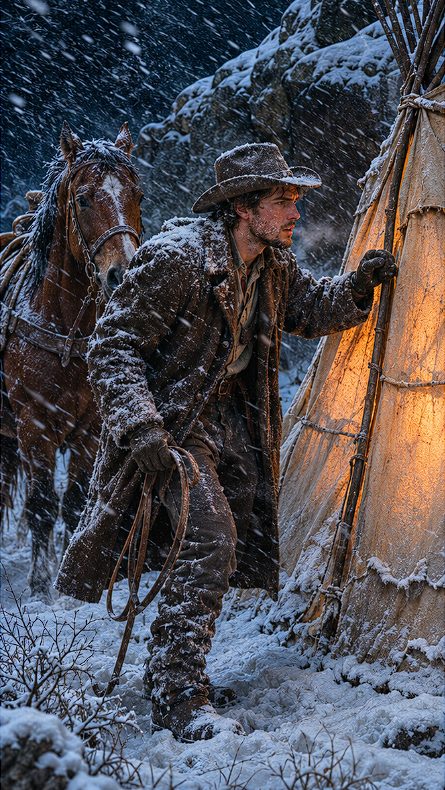
I slid from Belle’s back, nearly collapsing when my boots touched the ground, and stumbled toward the rocky outcrop with her reins wrapped around my stiff left hand.
A small tipi stood beneath the stone overhang, its hide covering glowing faintly with firelight while snow gathered around its lower edges.
My father had warned me all my life against approaching such a shelter, and his voice returned with such force that I stopped despite the freezing wind.
But Belle trembled beside me, and the cold had already begun stealing the feeling from my legs.
I remembered my mother’s other lesson, the one she taught whenever someone came to our door after dark.
“Always announce yourself, Tommy, because manners matter even at the edge of the world.”
I raised my gloved hand and knocked twice against the wooden support beside the hide entrance.
“Hello,” I called through lips so stiff that the word barely escaped.
No one answered, but I heard movement beyond the covering.
“I’m sorry to bother you, but I’m caught in the storm.”
The firelight shifted, and two shadows passed across the hide.
I swallowed hard and tried once more.
“Please, my horse and I won’t survive much longer out here.”
The entrance moved, and a narrow opening appeared beneath the edge of the hide.
A woman looked out at me with dark, guarded eyes, her black braids falling against the shoulders of a worn buckskin dress.
Behind her stood another woman, younger and visibly frightened, watching me from the warmth of the shelter.
They were Apache sisters, alone in the wilderness, and I was the stranger standing at their door with every prejudice I had inherited written across my frightened face.
The older woman’s gaze traveled from my frozen beard to Belle’s trembling body before returning to my eyes.
Then she tightened her grip on the entrance flap and asked the question that would decide whether I lived through the night.
“Why should we trust you?”
✓ Lynn R. Adams
PART 1: The Stranger at the Frozen Door The night I almost froze to death in the Wyoming wilderness, I discovered that the people my father had taught me to fear were the only ones standing between m…