Chapter 1: PART 1 – THE PURPLE FLOWERS OF PUBLIC HUMILIATION 035
PART 1: THE PURPLE FLOWERS OF PUBLIC HUMILIATION
The woman I had planned to marry abandoned me without stepping off the train, and the stranger who delivered her rejection would soon hold the fate of my eleven-thousand-acre ranch in her hands.
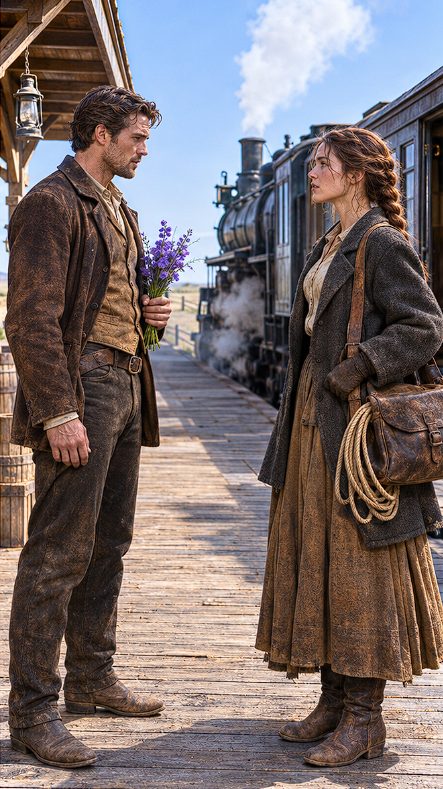
I stood on the railroad platform in Larkspur, Nebraska, gripping a bouquet of purple flowers while a young cowgirl studied me with the uncomfortable expression of someone carrying news that would destroy another person’s future.
“You bought the wrong bride,” she said, her voice steady despite the locomotive hissing behind her.
For several seconds, I could only stare at her because the words made so little sense that my mind refused to assemble them into anything resembling the truth.
I had spent six months corresponding with Constance Whitfield, a respectable woman from Boston who wrote beautiful letters about fresh beginnings, open skies, and the possibility of finding happiness somewhere far from everything she had always known.
That morning, I had risen before sunrise, washed more carefully than I had in months, and picked the purple larkspur growing along the road because I wanted her first memory of Nebraska to be something beautiful.
Instead, I found myself facing a twenty-six-year-old stranger dressed in a weather-beaten riding skirt, an oversized wool coat, and work gloves that had clearly seen more honest labor than most men in town.
A coiled lariat hung from her travel bag, her chestnut hair was braided down her back, and her hazel-green eyes held mine without the nervous fluttering I had expected from Constance.
“I’m not Miss Whitfield,” she explained, although I had already reached that conclusion.
I looked past her toward the dark passenger windows, searching for the woman whose handwriting I had come to recognize almost as intimately as my own.
“Is Constance sick?”
I asked, because illness seemed easier to understand than rejection.
The stranger hesitated just long enough to tell me that whatever came next would be worse than an ordinary disappointment.
“She saw Nebraska from the window and realized she couldn’t live here,” the woman answered.
The platform seemed to tilt beneath my boots as the meaning settled into my chest.
Constance had asked about the garden, the size of the house, the distance from town, and whether the winter winds were truly as terrible as people back east claimed.
I had answered every question honestly, describing the land I loved without pretending that ranch life was easier or more comfortable than it was.
Apparently, my words had painted a picture that the real Nebraska countryside could never satisfy.
“She’s going home?”
I asked, already knowing the answer.
The cowgirl nodded toward the train, where steam curled around the wheels like white smoke escaping from some enormous wounded animal.
“She wants you to know she’s sorry,” she said.
I glanced around the platform and saw enough interested faces to realize that my private humiliation was becoming the morning’s most entertaining spectacle.
A few people had watched me arrive carrying flowers, and now those same people were witnessing the collapse of an engagement they had assumed would end with a wedding.
For one miserable instant, I wanted to disappear into the open prairie and ride until nobody knew my name.
Then I looked at the woman standing before me and realized that she had done nothing to deserve whatever anger I might feel.
She had simply accepted the unpleasant responsibility of telling me something Constance could not bring herself to say.
I lowered the flowers and extended my right hand.
“Wyatt Calder,” I introduced myself, hoping my voice sounded steadier than I felt.
The stranger blinked, plainly surprised that I was offering a handshake rather than an accusation.
“You’re not angry?” she asked.
“I’m disappointed, but I don’t believe a woman owes me her life just because she once imagined sharing it,” I answered.
Something changed in her expression, and the guarded look around her eyes softened.
“Josie Farrow,” she replied, placing her gloved hand in mine.
Her handshake was firm, direct, and entirely without pretense, reminding me of the ranchers I had known who judged a person by the work they did rather than the clothes they wore.
She withdrew a folded letter from her coat and offered it to me.
“Constance asked me to give you this,” she explained.
I accepted the envelope but could not make myself open it while the train stood behind us and half the town waited to see how completely I had been rejected.
A woman’s face appeared briefly behind one of the passenger windows, and I knew immediately that Constance was looking out at the man she had almost married.
I considered lifting my hand in farewell, but before I could decide, her face vanished behind the glass.
The conductor called for passengers to board, and Josie adjusted the leather bag hanging against her hip.
“I’d better get to the stock pens because I’ve got forty head of cattle to sell,” she said.
I glanced at the lariat and asked whether she had brought the animals all the way from Texas.
“From my father’s outfit, and I’m handling the sale myself,” she answered with a confidence that suggested she had already dealt with men who doubted her abilities.
For the first time that morning, I felt something besides embarrassment and disappointment.
Here stood a woman who had crossed hundreds of miles with forty cattle, negotiated her own business, and faced a stranger with difficult news because somebody had to do it.
I nearly smiled, but then I remembered the date written into my father’s will.
May twenty-third.
My thirtieth birthday.
Twenty-nine days away.
Under the terms of the inheritance, I had to be married and maintaining a household before that date, or my cousin Cyrus would gain half the Anchor Ranch.
Constance had never known how much depended on our marriage because I had wanted her to choose me without feeling responsible for my inheritance.
Now the woman who might have saved my home was leaving Nebraska, and I was standing beside the one person who knew exactly how my plans had collapsed.
“Josie, would you consider having coffee with me after you finish your cattle business?”
She narrowed her eyes, immediately suspicious of an invitation that came only moments after my intended bride had abandoned me.
“Why would you want coffee with me?” she asked.
“Because I have a problem involving eleven thousand acres, my father’s will, and a deadline I can’t change,” I admitted.
Her expression sharpened, and I watched her curiosity overcome her understandable desire to keep moving.
“What kind of deadline?” she asked.
I forced myself to say the truth aloud.
“If I don’t marry before my birthday and establish a proper household, Cyrus Calder gets half my ranch,” I answered.
Josie looked toward the train, then back at the flowers in my hand.
“So that woman wasn’t just your fiancée,” she said quietly.
I swallowed the bitterness rising in my throat.
“She was also the only plan I had for keeping my father’s land together,” I admitted.
Josie studied me for a long moment before turning toward the stock pens.
“I came here to sell cattle, Wyatt, not marry a stranger,” she warned.
“I understand,” I replied.
She took another step, then stopped when I added the two words I probably should have kept to myself.
“Not today,” I said.
Her startled laughter cut through the terrible morning like sunlight breaking through storm clouds.
“You’re either the most desperate man in Nebraska or the most interesting,” she said.
“Right now, I suspect I’m both,” I answered.
She agreed to coffee, promising nothing beyond a conversation, and I watched her walk away with a strange feeling that my ruined morning had not finished changing my life.
Before she disappeared behind the station building, I called her name and held out the purple flowers.
“You picked those for another woman,” she observed.
“I did, but you’re the one who came to meet me,” I answered.
Josie accepted the bouquet with unexpected tenderness, looking down at the delicate blossoms as though nobody had ever offered her something beautiful without expecting a favor in return.
Then she raised her eyes and asked a question that made the approaching train whistle sound very far away.
“Wyatt, does your cousin know the bride he was counting on you to marry is leaving Nebraska?”
I looked toward the train, toward the station, and toward the future I had foolishly believed was secure.
“I don’t know,” I answered.
Josie’s expression became serious again.
“Then you’d better hope he doesn’t find out before we finish that coffee.”
✓ Lynn R. Adams
PART 1: THE PURPLE FLOWERS OF PUBLIC HUMILIATION The woman I had planned to marry abandoned me without stepping off the train, and the stranger who delivered her rejection would soon hold the fate of…