Chapter 1: PART 1 – THE PAPERS THAT BURIED ELIAS 035
PART 1: THE PAPERS THAT BURIED ELIAS
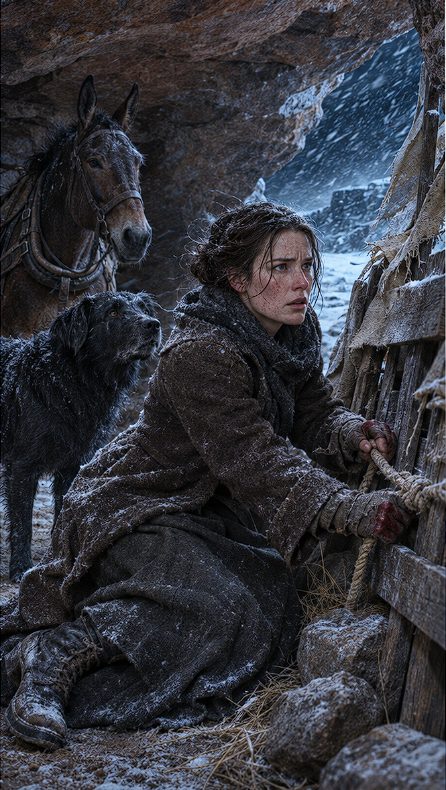
The first time I heard a little boy screaming for his life, I was trapped in a Wyoming blizzard behind a wall built from my broken wagon, with blood on my hands and a dead man’s letter pressed against my heart.
I had already lost my husband, my home, and nearly everything I owned, but nothing had prepared me for the moment a stranger’s voice came through that storm calling my father’s family name.
To understand why that frightened me more than the wind itself, you would have to understand what happened three months earlier.
My name is Winifred Ashcom, and I was thirty-one years old when my husband died and the world I trusted began falling apart.
Elias Ashcom had never been a wealthy man, but together we had built something that felt more valuable than money.
Our little trading post stood near the edge of a Wyoming settlement, where the roads turned rough and the prairie seemed to stretch forever.
The shelves held flour, coffee, lamp oil, blankets, nails, sewing needles, and the small necessities that helped frontier families survive.
I knew the regular customers by the sound of their boots on our wooden floor.
I knew which ranchers would pay their accounts before sundown and which freight drivers needed another week before settling what they owed.
Elias handled most of the larger purchases, while I balanced the daily accounts, ordered supplies, repaired harnesses, and kept our inventory from becoming a hopeless tangle.
We were partners in every way that mattered to me.
Sometimes, after closing the shutters, we would sit behind the counter with our supper between us and talk about growing old in that building.
Elias liked to imagine a porch across the front where we could drink coffee and watch the wagons arrive.
I liked imagining a day when every debt was paid and we could afford to close the shop for an entire Sunday.
Neither of us imagined how quickly those small dreams could disappear.
When Elias fell ill, I kept the business open while caring for him.
I learned to sleep in short stretches, waking whenever his breathing changed or he reached for water.
I remember holding his hand one evening while the fading sunlight made long rectangles across our bedroom floor.
He looked at me with tired eyes and tried to smile.
“You always knew how to keep things standing, Winnie,” he whispered.
I squeezed his fingers and told him he would be standing beside me soon.
He died before morning.
The doctor spoke gently, but I could barely hear him over the terrible silence that followed.
For three days, I moved through the trading post as if I were walking underwater.
I measured flour, counted coins, and answered customers because I did not know what else to do with my hands.
At night, I lay awake beside the empty half of our bed and listened to the building settle.
The floorboards sounded different without Elias moving across them.
Even the wind against the shutters seemed unfamiliar.
I believed grief would be the hardest thing I would ever endure.
Then Cornelius Vance arrived.
He appeared one gray morning wearing a dark wool coat and polished boots that looked too expensive for our muddy street.
He carried a leather briefcase and introduced himself as a representative of financial interests in Chicago.
His voice was quiet, his movements precise, and his expression so composed that I initially mistook him for a man bringing ordinary business.
Ashcom, I need to discuss your late husband’s outstanding obligations,” he said.
I asked him to sit while I fetched our account book.
He placed his briefcase on the counter and opened it before I returned.
Several documents lay arranged in a neat stack, along with a ledger bound in dark leather.
I recognized Elias’s name on the first page.
My heart began beating faster.
“What obligations?”
Vance folded his hands and looked at me with an expression that seemed almost sympathetic.
“I am afraid there has been a serious misunderstanding regarding your husband’s financial position,” he replied.
I leaned over the counter and studied the figures.
The amount at the bottom of the page was larger than anything our trading post had ever owed at one time.
I read it twice, wondering whether my tired eyes had betrayed me.
“That cannot be right,” I said.
Vance turned another page.
“The original loans, accumulated interest, and associated expenses are all recorded here,” he explained.
I recognized some entries as legitimate business purchases.
Others were unfamiliar.
Certain dates appeared out of sequence, and some figures had been written in ink darker than the surrounding entries.
I noticed signatures that resembled Elias’s handwriting, though several lacked the slight upward stroke he always made at the end of his surname.
My husband had signed thousands of receipts in front of me.
I knew the way his hand moved.
“Where did these figures come from?”
“From the records maintained by the creditors,” Vance answered.
“And why have I never seen them?”
He looked toward the shelves behind me.
“Your husband apparently conducted certain financial matters privately.”
The words struck harder than I expected.
Elias had sometimes worried about money, but he had never told me we were facing ruin.
I wanted to believe there was a simple explanation.
Perhaps a shipment had been recorded twice or an old balance had been carried forward incorrectly.
I reached for the ledger again.
Vance placed one hand over the page.
Ashcom, I have no wish to make this unpleasant,” he said.
I lifted my eyes toward his.
“Then let me examine the accounts properly.”
He studied my face for several seconds.
“You may review the information relevant to the outstanding obligations,” he said.
I pointed toward a charge written beside a date that meant nothing to me.
“What is this?”
“Interest.”
“And this one?”
“Associated expenses.”
I touched a signature that looked almost like Elias’s.
“And this?”
Vance closed the ledger.
The sharp sound made me flinch.
“Your husband’s estate is responsible for the debt,” he said.
I could hear a wagon passing outside and someone calling to a horse.
Life was continuing beyond our front door as if the ground beneath my feet had not just opened.
“How am I supposed to pay this?”
I whispered.
Vance straightened the papers and returned them to his briefcase.
“That is precisely why I came.”
He withdrew another document bearing the trading post’s description.
I saw our property mentioned, followed by language I struggled to understand through the pounding in my ears.
Then Vance laid the paper directly in front of me.
“Under the terms of these obligations, the property must be surrendered within thirty days.”
I stared at him.
“You’re taking my home?”
His expression did not change.
“I am enforcing the agreements your husband signed.”
I placed both hands on the counter to steady myself.
“Elias would never have agreed to that without telling me.”
Vance buttoned his coat.
“Then I am afraid your husband left you with a great deal you did not know.”
He pushed the notice toward me with two fingers.
I looked down at the paper and saw my life reduced to a deadline.
Thirty days.
And when I looked up again, Cornelius Vance was already reaching for the door as though destroying my future had been nothing more than an ordinary morning’s work.
✓ Lynn R. Adams
PART 1: THE PAPERS THAT BURIED ELIAS The first time I heard a little boy screaming for his life, I was trapped in a Wyoming blizzard behind a wall built from my broken wagon, with blood on my hands a…