Chapter 1: PART 1 – The Night Nobody Protected My Daughter 035
PART 1: The Night Nobody Protected My Daughter
At 10:02 on a Thursday night, a hospital nurse told me my eight-year-old daughter had been found hiding inside a drainage culvert during a violent thunderstorm, and the words nearly brought me to my knees.
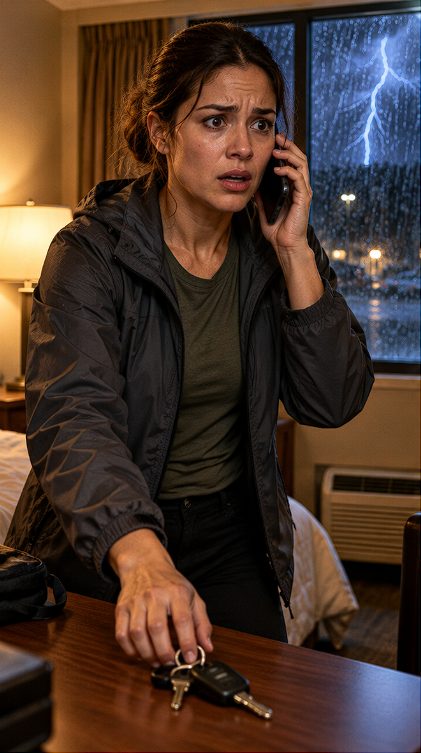
I stood in my hotel room near Pineville, Louisiana, with my phone pressed against my ear and my car keys lying on the table beneath my trembling hand.
“Is she alive?”
I asked, barely recognizing the desperate voice coming from my own mouth.
“She’s conscious, ma’am, and our medical team is treating her for exposure to the storm,” the nurse answered gently.
I closed my eyes, but instead of feeling relief, I imagined my little girl crouched inside a dark concrete pipe while rainwater rushed around her.
“Is she hurt?”
“She’s cold, exhausted, and frightened, but the doctors are examining her now.”
I grabbed my keys so quickly that they slipped through my fingers and struck the floor.
“I’m coming right now.”
I was already pulling on my jacket when the nurse repeated the hospital’s address and asked me to drive carefully.
My name is Jenna Cooper, and at thirty-one years old, I had spent my entire adult life learning how to stay calm when everything around me fell apart.
I was a first lieutenant in the United States Army, serving as a logistics officer responsible for coordinating supplies, equipment, and transportation under difficult conditions.
I had handled emergency deployments, interrupted supply routes, and situations where hesitation could create serious consequences for people depending on me.
But nothing had prepared me for hearing that my daughter had been discovered alone during a dangerous storm.
My parents believed I was still deployed in Qatar, thousands of miles away from the little house where Piper had been living under their temporary guardianship.
They had no idea I had returned to the United States two days earlier.
They certainly did not know that I had already started the legal process of removing my daughter from their care.
For months, something about our phone conversations had felt wrong, although I could never identify a single detail that explained everything.
Piper used to talk so quickly that I could barely interrupt her long enough to ask whether she had finished her homework.
She would tell me about her schoolwork, the funny things her cousin Austin said, and what adventures her gray stuffed rabbit Barnaby had supposedly experienced while I was gone.
Then our conversations became shorter.
Sometimes she answered my questions with nothing more than a quiet yes or no.
Whenever I asked whether something was bothering her, my mother’s voice would appear in the background, reminding Piper that I was busy and should not be troubled unnecessarily.
My father occasionally interrupted to say that children needed discipline rather than constant attention.
I had questioned those interruptions more than once, but my parents always insisted that everything was fine.
The problem was that I had heard those same words throughout my childhood.
My father considered himself a strict man who believed children owed adults obedience, gratitude, and unquestioning respect.
My sister Cheryl and I learned early that arguing with him only made things worse.
Our mother usually tried to smooth everything over afterward, explaining that he meant well even when his words left us crying.
For years, I had convinced myself that his behavior was old-fashioned rather than harmful.
When Piper was born, I desperately wanted to believe he would become a gentler grandfather.
Her father had abandoned us while she was still a baby, leaving me to raise her alone while building my military career.
For years, our little rental near Fort Polk had been the safest place either of us knew.
Piper loved Friday-night pancakes, drew pictures of animals wearing ridiculous hats, and refused to sleep unless Barnaby was tucked beneath her arm.
Whenever she was worried, she studied my face with enormous brown eyes, trying to decide whether her concerns were important enough to mention.
I knew her better than I knew myself, yet somehow I had failed to recognize how frightened she was becoming.
When my deployment orders arrived, I needed someone to care for her during what was expected to be an eighteen-month assignment.
My parents volunteered immediately.
Piper already knew their home, Cheryl lived nearby, and Austin was close enough in age to provide familiar company.
My mother promised that my daughter would have everything she needed.
My father assured me that he would keep her safe and teach her responsibility.
I wanted to believe them because trusting my parents seemed easier than accepting that the people who had raised me might not be suitable caregivers for my child.
There had been warning signs long before I deployed.
One Christmas, Austin received beautifully wrapped presents while Piper’s gift was handed to her inside a grocery bag.
My father explained that the wrapping did not matter because children should appreciate whatever they received.
At Thanksgiving, Piper was told to eat in the kitchen while Austin remained at the main table with the adults.
There were empty chairs available, but my father insisted she was better off somewhere she would not interrupt the conversation.
I remembered the expression on her face when she carried her plate away.
She had not complained, yet the embarrassment in her eyes stayed with me long after the meal ended.
Instead of confronting my father, I had accepted another of my mother’s explanations.
Now I wondered whether every small injustice I had excused had taught my parents that I would overlook something worse.
I had arranged regular monthly payments for Piper’s food, clothing, school supplies, and other necessities.
I packed her pajamas, crayons, family photographs, and Barnaby before leaving.
Inside her backpack, I tucked a card containing my military identification and contact information.
“If anything ever feels wrong, sweetheart, show this card to a grown-up and tell them your mommy is a soldier.”
She had giggled and wrapped both arms around my waist.
“Nothing’s ever going to be wrong, Mommy.”
Those words followed me through the pounding rain as I drove toward the hospital.
At the first red light, I called Captain Megan Cooper, an Army attorney and longtime friend who had already been helping me prepare the guardianship documents.
Megan listened as I explained the hospital call, the drainage culvert, and the frightening possibility that Piper had been left outside without supervision.
“Jenna, focus on being her mother tonight, and don’t confront your parents until we know exactly what happened.”
She instructed me to notify the county intake hotline and provide the address where Piper had been staying.
I followed her instructions before continuing through the storm.
When I finally reached the hospital, I ran through the entrance so quickly that my wet boots squeaked against the polished floor.
A nurse guided me toward a treatment room.
Piper was sitting on a hospital bed beneath a thick blanket, her damp hair clinging to her forehead and her small hands gripping the fabric.
The moment she saw me, her face crumpled.
I crossed the room and gathered her into my arms.
She began sobbing against my shoulder, clinging to my jacket as though she believed I might disappear if she loosened her grip.
“I’m here, baby, and I’m not leaving you tonight.”
For several minutes, she said nothing while I held her close and tried to hide my own tears.
Then she pulled back, searched my face, and whispered something that made my blood run cold.
“Mommy, please don’t make me go back to Grandpa’s house.”
I gently asked what had happened.
Her fingers tightened painfully around mine.
“Because Grandpa locked me outside, and he wouldn’t let me come back in.”
✓ Lynn R. Adams
PART 1: The Night Nobody Protected My Daughter At 10:02 on a Thursday night, a hospital nurse told me my eight-year-old daughter had been found hiding inside a drainage culvert during a violent thund…