Chapter 1: PART 1 – THE LOAF THEY LAUGHED AT 035
PART 1: THE LOAF THEY LAUGHED AT
The first time a man offered me twenty dollars for something I had made with my own hands, I was certain he was about to humiliate me worse than the women who had spent the afternoon laughing at my poverty.
I was twenty-five years old, nearly penniless, and standing inside a Wyoming church hall with snow melting through the broken seam of my left boot when Mr.
Reid walked toward my battered Dutch oven.
Thirty minutes earlier, I had been wondering whether I could survive another week without a proper meal, and now the most intimidating rancher in the county was examining the only loaf of bread I could afford to bake.
The room smelled of cinnamon, sweet pastry, polished wood, and expensive perfume, but beneath those pleasant things lingered the sharp scent of wet wool from coats hanging beside the entrance.
I had carried my heavy iron pot through the storm with both hands wrapped in scraps of sacking, stopping twice along the road because my arms trembled beneath its weight.
Every painful step had been measured against the folded eviction notice waiting on the washstand in my rented room above Mrs.
Pike’s boardinghouse kitchen.
Three dollars by Monday was all she wanted, but three dollars might as well have been three hundred when my purse contained only a few copper coins.
I had risen before daylight to coax a flame from my last kindling, feed the sourdough starter my mother had taught me to preserve, and knead the final flour from a nearly empty sack into a loaf that might save my room.
There had been no butter for the crust, no sugar for sweetness, and certainly no money for the pretty decorations the other women seemed to consider more important than food.
Still, when I lifted the finished loaf from the oven that morning, its dark crust had sounded hollow beneath my knuckles, and the fragrance had reminded me of the kitchen where my mother had once taught me that patience could turn the poorest ingredients into something worth sharing.
That memory had been enough to carry me through the snow.
It was not enough to protect me from Mrs.
“Careful with that filthy thing,” she said when I approached the long table, drawing back her burgundy sleeve as though poverty might rub off on her expensive dress.
I showed her the wooden board I had brought to protect the tablecloth, but she inspected my iron pot with an expression usually reserved for something discovered beneath a spoiled floorboard.
“I thought you understood that this was a baked-goods sale.”
“It is bread,” I answered.
Two women standing beside a beautifully decorated cake looked at each other and laughed softly.
Whitcomb tilted her head, studying my faded blue dress and worn apron with a smile that never reached her eyes.
“Yes, dear, I can see that.”
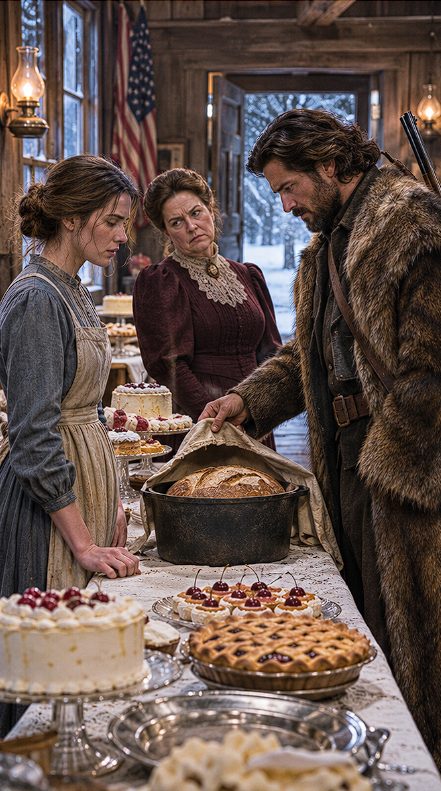
I lowered my Dutch oven onto the board at the far end of the table, where the white cloth ended and nobody would have to risk brushing against my belongings.
There were pies with carefully braided edges, little pastries crowned with preserved cherries, and cakes dusted so thickly with sugar that they looked like miniature snow-covered hills.
I had once dreamed of baking things that beautiful, but dreams required ingredients, and ingredients required money, and money was precisely what I did not have.
A little boy passed my corner while carrying an empty plate, and when I lifted the iron lid, he slowed at the smell of warm bread before his mother took his hand and guided him toward the desserts.
I told myself that somebody would return.
The first half hour disappeared into the cheerful ringing of coins, polite congratulations, and women praising each other’s recipes while my loaf sat untouched beneath its heavy lid.
I had written thirty cents on a scrap of paper, a price so low that selling the bread would barely replace the flour, but I hoped the sale might lead to someone asking me to bake another loaf.
Nobody asked.
Eventually, I turned the paper facedown because I could no longer bear looking at it.
Whitcomb approached again with two other women and glanced at the blackened oven.
“Perhaps next time you’ll bring something people can actually enjoy.”
I felt the insult rise into my throat, hot and sharp, but swallowing it seemed safer than creating a scene in the one place where I had hoped to find kindness.
I was bending to retie the cloth around the oven handles when the outer door suddenly struck the wall with a crash.
A gust of bitter wind swept across the floor, bending the lamp flames and sending loose paper fluttering beneath the tables.
The man who stepped through the doorway looked as though he belonged to the mountains rather than a church supper.
Reid stood well over six feet tall, broad-shouldered beneath a heavy wolfskin coat, with snow caught in his dark collar-length hair and a rifle strapped across his back.
Everybody in town knew his name, though few people knew anything about him beyond the fact that he owned a ranch north of town, paid what he owed, and rarely spoke more than necessary.
Whitcomb immediately straightened her posture.
Reid, we weren’t expecting you.”
He closed the door against the storm and surveyed the table without returning her smile.
His eyes passed over the sugar-covered cakes, the elaborate pastries, and the golden pies before stopping on my battered Dutch oven.
For one terrible moment, I wondered whether even this stranger had come to laugh at me.
Whitcomb hurried beside him.
“Oh, you don’t want that one,” she said, waving toward my pot with a dismissive little laugh.
“It’s practically a brick.”
Reid ignored her.
He picked up the folded cloth, lifted the iron lid, and studied the loaf beneath it with an expression I could not understand.
Then he broke off a piece of crust and put it into his mouth.
I watched him chew, wondering whether I should apologize for the darkness of the bread or explain that there had been no butter left to soften it.
Instead, he reached into his coat.
A heavy gold coin struck the wooden table with a sharp metallic clang.
Every nearby conversation stopped.
I stared at the coin, unable to make my thoughts obey me.
“Twenty dollars?”
Reid replaced the lid.
“That’s the one I’m taking home.”
I looked from the money to his face, searching for a smile that might reveal some cruel joke, but his expression remained completely serious.
“You make this?”
“Yes, sir.”
He glanced at the loaf again.
“Good bread, real food, not air and sugar.”
Whitcomb’s mouth tightened.
I should have thanked him, but twenty dollars for a loaf priced at thirty cents felt less like generosity than something dangerous I had not yet understood.
Reid, I can’t let you think—”
“You got a coat?”
I blinked at him.
The room had gone so quiet that I could hear the winter wind pressing against the frozen windows.
His steel-gray eyes met mine, and his answer changed the way every woman in that room looked at me.
“Because you’re coming with me.”
✓ Lynn R. Adams
PART 1: THE LOAF THEY LAUGHED AT The first time a man offered me twenty dollars for something I had made with my own hands, I was certain he was about to humiliate me worse than the women who had spe…