Chapter 1: PART 1 – The Girl Left Against the Wall 035
PART 1: The Girl Left Against the Wall
My father was preparing to sell me to a stranger, and the pistol he had polished that morning made it clear what would happen if I refused.
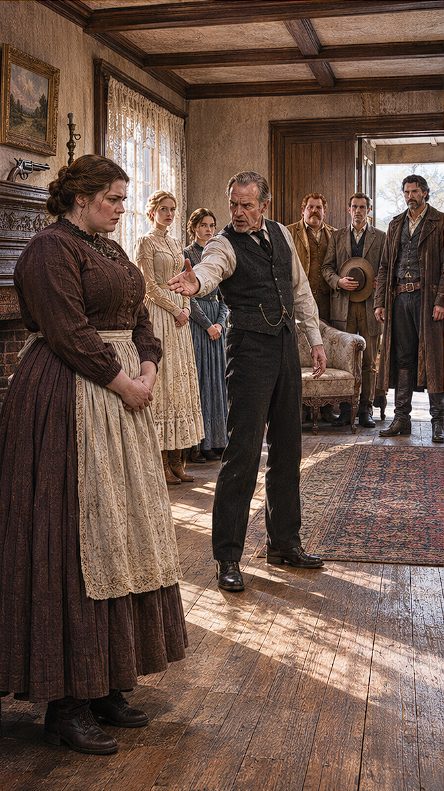
It rested on the fireplace mantel, its silver barrel catching the pale Montana sunlight while three women stood waiting to be chosen as wives.
I was one of those women, although my father had made certain I understood that nobody was expected to choose me.
“Stand straight, Clara,” Silas Vail snapped, adjusting his dark waistcoat without bothering to look directly at me.
I straightened my shoulders, even though my back was already aching from the work I had finished before sunrise.
“No man pays good money for a woman who looks defeated,” he added, his eyes sliding toward my body with familiar disgust.
I kept my hands folded against my stomach because trembling fingers were the one weakness I could not completely conceal.
At twenty-seven, I had grown accustomed to being treated as though my age were a crime and my size an unforgivable embarrassment.
My father considered me too large, too plain, and too old to deserve the ordinary happiness other women seemed permitted to expect.
He rarely used those exact words when strangers were listening, but he had spent years making certain I understood every one of them.
Beside the lace-curtained window stood Lily Bell, nineteen and golden-haired, looking like the kind of bride men dreamed about before falling asleep.
Her cream-colored dress caught the sunlight beautifully, and her nervous smile made her appear younger than she already was.
Near the sofa waited Anne Porter, barely eighteen, whose blue dress trembled whenever she nervously smoothed its skirts.
Both women had families who needed money, but neither had been made to feel quite so worthless as I had.
Lily’s parents needed help settling their obligations, while Anne’s widowed aunt could no longer comfortably support another person.
My father’s reason for participating in this arrangement was considerably simpler.
He wanted me gone, and he wanted to be paid for the inconvenience of having raised me.
Three weeks earlier, he had announced the marriage arrangement while I was kneading bread in our kitchen.
“Three respectable ranchers are seeking wives,” he had said, counting coins across the table while flour covered my apron.
I remembered wiping my hands slowly, hoping I had misunderstood what he intended.
“You will present yourself properly, accept whichever man chooses you, and thank me for finally arranging your future.”
I had wanted to ask whether love mattered, but the expression on his face told me that such a question would only provoke another lecture.
Instead, I had asked what would happen if nobody wanted me.
My father had looked at my waist, then at the dough beneath my hands, and laughed without the slightest amusement.
“Then you will continue earning your keep here, where at least your cooking is useful.”
I had not answered because the truth was already familiar enough to hurt without being spoken.
Since I was thirteen, I had washed his clothes, prepared his meals, scrubbed his floors, and nursed him through illnesses that frightened me more than they frightened him.
When his accounts became tangled, I corrected them, and when customers disputed his figures, I quietly discovered where the mistakes had occurred.
I had learned those skills from my mother before she died, when she still believed that an intelligent daughter could make a respectable life for herself.
My father rarely mentioned her without bitterness, as though losing his wife had somehow entitled him to punish the child she left behind.
Whenever I made a mistake, he said I had inherited her stubbornness, and whenever I succeeded, he claimed I had merely followed his instructions.
That morning, after cleaning the parlor, I had found him placing Lily and Anne near the window while indicating that I should remain beside the wall.
The placement was deliberate, and its meaning was unmistakable.
The prettier women would be displayed, while I would be tolerated until the visitors had finished choosing.
A cold wind rattled the windowpane as hoofbeats sounded outside, followed by heavy boots approaching the front door.
My father straightened his necktie, inspected the room one last time, and gave me a warning glance.
“Remember your position,” he murmured.
I lowered my eyes just as the first rancher entered.
Wade Harlan was broad and red-faced, with a booming laugh that seemed to arrive several seconds before the rest of him.
His gaze settled immediately on Lily, whose cheeks flushed so deeply that she looked toward the floor.
Peter Knox entered next, carrying his hat in both hands and appearing almost apologetic about the entire arrangement.
He was thinner and quieter, and his expression softened when Anne offered him a nervous smile.
I watched them with a strange combination of sadness and relief because neither man seemed likely to embarrass me by pretending interest.
Then the third visitor stepped through the doorway, and the entire atmosphere of the parlor changed.
Caleb Sterling was taller than the other men, broad-shouldered and dark-haired, with silver beginning to show near his temples.
He wore a weathered brown coat, and his deeply tanned face carried the stillness of someone accustomed to being obeyed without raising his voice.
Every person in Fairhaven knew his name, even those who had never seen him.
His cattle grazed from the Bitterroot foothills toward the Missouri breaks, and his wagons supplied beef to railheads across Montana Territory.
After the devastating fire of 1882, Sterling money had helped rebuild much of Fairhaven when other wealthy men refused to risk their fortunes.
People called him the cattle king, although others whispered that his wealth had brought him everything except peace.
His wife Rebecca had died three years earlier, and the loss had supposedly turned him into a man incapable of tenderness.
I expected him to inspect Lily, perhaps smile at Anne, and then look away from me as the others had done.
Instead, his eyes found mine almost immediately.
He did not smile, but neither did he look disgusted.
He studied my face with an intensity that made me suddenly conscious of every movement I made.
My father noticed the attention and quickly stepped between us.
“Gentlemen, I have gathered three respectable young women of excellent character and useful domestic ability,” he announced with practiced cheerfulness.
He introduced Lily as accomplished in music and needlework, then praised Anne’s gentleness and experience around children.
When he reached me, his voice lost its warmth.
“And this is my daughter Clara, who understands housekeeping, kitchens, sickrooms, and accounts well enough for a woman.”
I felt my cheeks burn, but I refused to lower my head.
Wade glanced briefly in my direction before turning back toward Lily, while Peter offered Anne another shy nod.
My father smiled as though everything were proceeding exactly as he had planned.
“Naturally, gentlemen, the younger ladies are more suitable for beginning families and establishing respectable households.”
Caleb Sterling remained motionless, his dark eyes fixed on me.
For one extraordinary moment, I wondered whether he had mistaken me for someone else.
Then he stepped forward, looked directly at my father, and spoke five words that shattered the room’s carefully arranged expectations.
“I’ll take your daughter.”
✓ Lynn R. Adams
PART 1: The Girl Left Against the Wall My father was preparing to sell me to a stranger, and the pistol he had polished that morning made it clear what would happen if I refused. It rested on the fi…