Chapter 1: PART 1 – My Daughter Sold Her $500,000 House, Then Her Husband Came For Mine a243
PART 1: The Night I Closed My Door
The hardest word I ever said to my daughter was no, and I said it while she stood on my porch with nowhere to sleep.
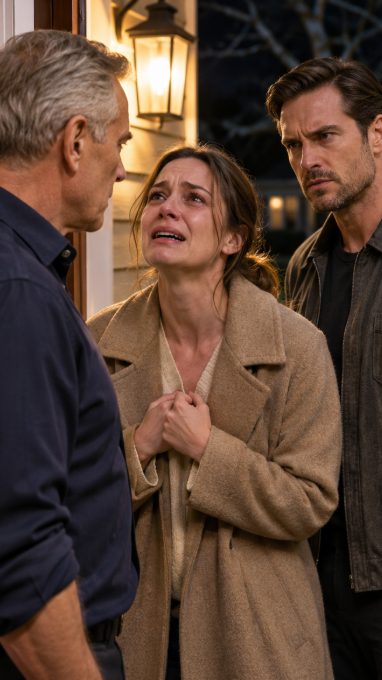
Leah was thirty-four, but beneath the yellow porch light she looked like the frightened little girl who once ran to me after a nightmare.
Her eyes were swollen, her dark hair was twisted into a loose knot, and she kept worrying the zipper of a coat too thin for the October cold.
Behind her stood Henry, her husband, with his hands buried in his pockets and an expression that made my own front door feel unfamiliar.
“Bruce, we need somewhere to stay,” he announced before I could invite them to explain why they had come so late.
I looked past him at their car, where two suitcases pressed against the back window and an empty fast-food bag lay on the dashboard.
“Where’s Emma?”
I asked, because the first thing I thought of was my eight-year-old granddaughter.
“At her friend’s house tonight,” Leah whispered, and her voice nearly disappeared beneath the sound of wind moving through the maple trees.
“The mother knows what’s going on?”
Leah nodded without meeting my eyes, which told me she was still capable of protecting her daughter even while everything else fell apart.
Henry shifted his weight and glanced at the upstairs windows as though he was already deciding which room would be his.
“It’s temporary,” he said, and I recognized the word because I’d heard it from him whenever a bill became a loan or a favor became a habit.
I am Bruce, sixty-two, a retired manufacturing-company owner in Ohio, and until that night I believed love meant keeping the door open.
The walls weren’t grand, but they were paid for, and I had promised myself that no one would ever gamble away my last safe place.
Years earlier, when Leah and Henry wanted to buy a home, I helped with their down payment without attaching conditions or demanding control.
Their house stood on a quiet street lined with maples, with four bedrooms, a fenced yard, and a wide porch where Emma took her first steps.
I remembered her crying with happiness on moving day while Henry lifted Emma, then a toddler, over the threshold like a tiny queen.
“You did this, Dad,” Leah said when she hugged me, but I corrected her because I wanted her to feel ownership rather than obligation.
“You and Henry will build the life inside it,” I told her, believing that the foundation beneath them was solid.
I still remember how Henry smiled that afternoon, bright and confident, while asking how much equity a house could build in five years.
What frightened me now was the speed with which that home had disappeared.
Two weeks earlier, Leah had called to tell me they had sold it to fund Henry’s new online business.
“The market is changing, Dad, and Henry knows digital marketing better than anyone,” she told me while I gripped my kitchen counter.
“What exactly does his company sell?”
I asked, trying to keep my voice even.
“Services for businesses, campaigns and growth systems,” she answered, repeating phrases I’d heard Henry use at Sunday dinners without ever explaining them.
When I asked where they planned to live, she said the business would be producing enough income to rent something better very soon.
“Soon isn’t an address, sweetheart,” I said, and she went quiet in the way she always did when Henry was listening nearby.
He took the phone a moment later and began talking about investors, platform partnerships, returns, and opportunities that could not wait.
His sentences were smooth enough to sound expensive, but he never once gave me a plain answer about where their money would go.
“I’ll send you the business plan,” he promised, although I had already asked him for one twice that summer.
No plan arrived, and Leah stopped answering my messages for several days.
She had once called me from a grocery store because a cashier gave her two dollars too much change and she wanted advice about returning it.
That careful, conscientious girl had apparently entrusted the sale of a half-million-dollar house to a man who refused to name his own clients.
The first warning came four days after the sale when Leah asked if I could lend them enough money for a short hotel stay.
“Why would you need a loan if the house money was available?”
I asked, only to hear Henry calling from the other side of the room.
I sent enough for three nights because Emma needed a roof, then asked Leah to send me a picture of the closing statement.
Instead, Henry called to tell me I was undermining his marriage by making his wife question perfectly ordinary business arrangements.
“I’m asking for a document, Henry, not a vote in your marriage,” I replied.
“You worked in factories, Bruce, so you don’t understand how online capital moves,” he said, making my retirement sound like a defect.
A week later Leah told me the business was experiencing a delay with an investment platform.
By Sunday night, the money was gone, the hotel payment had failed, and their suitcases were sitting in the car outside my house.
I stood in the doorway looking at my daughter, trying to reconcile the child I’d raised with the woman who kept searching her husband’s face before speaking.
Henry had not always looked so harsh, and I knew Leah remembered the man who once drove through a snowstorm to bring her medicine.
Even then, though, he had treated every disagreement as a contest someone needed to win.
At dinner he corrected Leah’s stories, interrupted her plans, and laughed when she apologized for forgetting details that had never mattered.
Now I could see what those small corrections had become.
“We only need the guest room for a few weeks,” Leah said, brushing rain from her eyelashes.
I wanted to pull her inside, warm some soup, and pretend that a night’s sleep would give us all a simpler problem in the morning.
I asked Henry for one thing that might have changed my answer.
“Show me where the house money went.”
His eyes hardened, and the change was so immediate that even Leah took a half step away from him.
“I don’t carry private business records around for your inspection,” he said.
“Then give me the company name and the bank that handled the transfers.”
“You wouldn’t understand the structure,” he replied, using the same sentence that had ended so many conversations.
I looked directly at Leah and asked whether she’d read the papers before signing the house away.
“Henry handled everything,” she admitted.
It was the answer I’d feared, yet hearing it in her own voice hurt more than any accusation could have.
I thought about the hours she spent comparing mortgage rates before buying that house, and the folders she kept for every small household expense.
I thought about Emma’s schoolbooks, the plants on the porch, and the birthday candles Leah had lit in the kitchen she no longer owned.
Then I thought about my guest room, the filing cabinet beside my desk, and the things Henry had casually asked about during his last visit.
He’d wanted to know whether I still kept the original papers from selling my manufacturing company, and whether my house was fully paid off.
I’d laughed and told him I trusted paper records more than an online password, but now the memory felt like a warning I had ignored.
“I’m sorry, Leah,” I said, keeping my voice low because anger would only give Henry another weapon.
“I love you, but the two of you cannot move in here.”
“You’re going to let your own daughter sleep in a car just to win an argument?” he asked.
“So you’re punishing us for taking a risk you were too old to understand,” Henry snapped.
“Emma won’t sleep in a car,” I said, keeping my gaze on Leah.
“I’ll make sure she’s safe, and I’ll help you find somewhere safe too, but I won’t hand Henry a key to my house.”
“We’re a family, Bruce, and we stay together.”
“A family doesn’t stop being a family because someone asks to see a bank statement,” I replied.
He stepped so close that the porch light threw his shadow across my shoes.
I held my ground and repeated, “Explain what happened to Leah’s money.”
The muscles in his face tightened, and for one second I wondered whether he would try to push his way past me.
Leah put a hand on his sleeve, quietly begging him to stop, but he shrugged her off without looking at her.
“You have no idea what you’re interfering with,” he said.
I heard the threat beneath the words and realized that opening the door would not have ended this confrontation, only moved it inside.
“Leave my property, Henry,” I said, surprised by how steady my voice sounded.
Leah began to plead, but Henry grabbed the suitcase handle and turned toward their car before she could finish.
She lingered on the first step, staring at me with tears gathering on her chin.
“Dad, I don’t know what to do,” she whispered.
“Call me when you can talk alone,” I told her, and I hated that it sounded like a secret between father and daughter.
She nodded once, then followed him into the darkness.
When the taillights disappeared down the driveway, I closed my door and stood in a hallway full of old family photographs.
I pictured Leah’s face when I said no and wondered whether Emma would one day hear the story as the night Grandpa turned her mother away.
But I couldn’t forget the way he’d looked over my shoulder at the rooms behind me, or his anger when I asked for proof.
My hands shook so badly that I had to sit before I could unlock my phone.
I called Emma’s friend’s mother, a kind woman named Denise, and she confirmed that Emma was asleep upstairs with her schoolbag beside the bed.
“She can stay here tomorrow too if she needs to,” Denise said, and I thanked her more times than she probably understood.
Then I called Leah twice, but both calls went unanswered.
I drafted a message offering to pick up her and Emma anywhere, without Henry, then hesitated over the words because I didn’t want to make a frightened woman feel forced to choose immediately.
I sent it anyway, because silence would have been a worse mistake.
I had dealt with bad suppliers during my working years, and the honest ones always showed their books when payments went wrong.
At last I found the contact for Robert Henley, my attorney of fifteen years, and pressed call before guilt could stop me.
Robert had handled my divorce, retirement papers, and the sale of my company, and he knew how carefully I’d arranged my remaining assets.
He answered on the fourth ring, sounding tired but alert when he heard my voice.
“Bruce, is everything all right?”
“I don’t think so,” I replied, and then told him about the house, the half-million dollars, the mysterious company, and the couple I’d turned away.
I described Henry’s refusal to produce records and the questions he’d asked about my property during his last visit.
When I finished, the silence on the line became so long that I thought the call had dropped.
I heard a drawer open, then the dry scrape of papers being moved across a desk.
“Bruce, I need you at my office tonight,” he said, and the calm in his voice frightened me more than shouting would have.
“It’s almost midnight, Robert, so what could be that urgent?”
“Something came across my desk involving Henry, your name, and a piece of property that should never have been part of his business.”
“What kind of property?”
“Come through the side entrance, bring your identification, and don’t tell Leah or Henry where you’re going.”
“Robert, you’re scaring me.”
“Good, because the document in front of me has your signature on it, Bruce, and I need you to tell me whether you’ve ever seen it before.”
✓ Lynn R. Adams
PART 1: The Night I Closed My Door The hardest word I ever said to my daughter was no, and I said it while she stood on my porch with nowhere to sleep. Leah was thirty-four, but beneath the yellow p…