Chapter 1: ONE PITCH AGAINST THE WORLD – 041
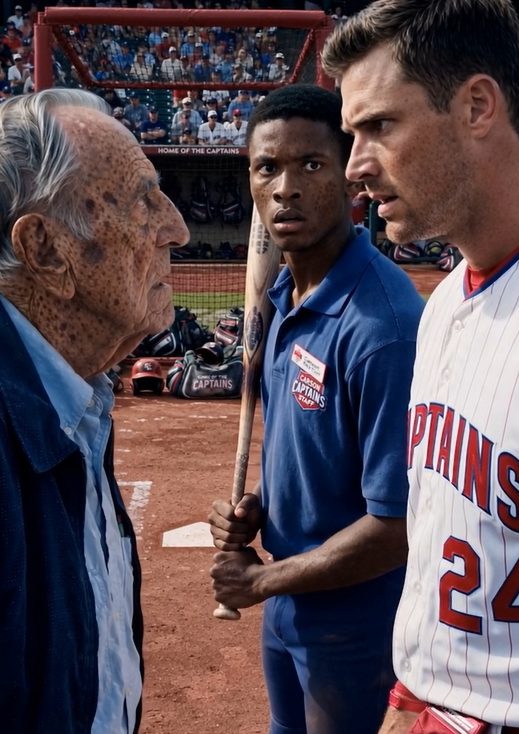
The first time Grant Holloway told me I didn’t belong on a baseball field, thirty thousand people were watching, and I was holding the bat that would eventually destroy his biggest secret.
I was fourteen years old.
He was thirty-two, worth more money than I could imagine, and famous enough that his face covered billboards across Harbor City.
And somehow, on that Tuesday afternoon at Carson Field, he decided that humiliating me would make him feel like a better baseball player.
My name is Malik Turner.
Back then, my official job title was stadium equipment assistant, although everyone called me a ball boy.
I collected loose baseballs, carried buckets, cleaned equipment, arranged batting helmets, and stayed out of the way of men whose salaries could have purchased our apartment building a hundred times over.
I earned barely above minimum wage.
Every paycheck mattered.
My mother, Renee Turner, drove a city bus six days a week and cleaned medical offices whenever she could get an evening shift.
Some nights, she came home with swollen ankles and fell asleep at our kitchen table before finishing dinner.
She never complained.
But I noticed everything.
I noticed when she watered down orange juice to make it last longer.
I noticed when she told me she had already eaten, although the only dirty plate in the sink was mine.
And I noticed how carefully she folded our electricity bills before placing them beneath the little wooden clock beside the refrigerator.
That was why I never complained about my job.
Not when players snapped their fingers at me.
Not when visitors treated me like furniture.
Not even when Grant Holloway called me “bucket boy” instead of learning my name.
I loved baseball too much to let those things ruin it.
Baseball was the one place where the world made sense to me.
A pitcher could lie with his eyes, but his shoulder usually told the truth.
A batter could pretend he wasn’t nervous, but his feet betrayed him.
And the smallest movement, something most people would never notice, could determine whether a baseball traveled forty feet or four hundred.
I had learned that by watching.
Some people studied books.
I studied swings.
Our apartment didn’t have cable sports channels, but the public library had computers, and Coach Ramirez at the neighborhood recreation center sometimes let me borrow old instructional DVDs.
I watched everything.
Professional games.
Minor league footage.
Batting tutorials.
Old recordings of hitters whose names most modern fans had forgotten.
Sometimes I practiced in front of our bathroom mirror with a wooden broom handle.
Mom would knock on the door and say, “Malik, if you break that light fixture, you’re buying the next one.”
I’d grin and promise to be careful.
But there was one swing I studied more than all the others.
It belonged to a man recorded on an old, scratched videotape Mom kept in a shoebox.
The picture was terrible.
The player’s face was difficult to see.
But his movement was beautiful.
His hands stayed low.
His front shoulder remained closed.
And when he finally turned into the ball, every movement seemed connected to one perfect, effortless decision.
I had watched that recording so many times that I could replay the swing in my head while lying in bed.
Mom rarely discussed the man in the video.
When I was younger, she simply said, “That was your father’s favorite way to teach hitting.”
Darius Turner.
The man who had disappeared from my life when I was four years old.
For years, I imagined meeting him somewhere unexpected.
At a bus stop.
Outside our apartment.
Maybe sitting in the stands at one of my school games.
But he never came.
Eventually, I stopped asking when he would return.
I never stopped wondering why he had left.
That afternoon, none of those memories seemed important.
All I wanted was to finish my shift, collect my paycheck on Friday, and catch the last bus home.
The Harbor City Captains were preparing to face the Denver Mustangs.
More than thirty thousand fans had already entered Carson Field.
Children leaned across the railings, waving baseballs for autographs.
Television crews crowded around the dugout.
And reporters followed Grant Holloway everywhere he walked.
Grant had hit forty-one home runs the previous season.
His reputation was enormous.
His confidence was even bigger.
But something had happened to his swing.
His batting average had fallen below .230, and opposing pitchers had discovered he struggled against fastballs thrown tight against the inside corner.
Instead of fixing the problem, Grant blamed everyone else.
The umpires were unfair.
The stadium lights were distracting.
His coaches were giving him bad advice.
Even the weather apparently had something against him.
I had listened to his complaints for weeks.
During batting practice, I stood beside the equipment cart and watched him crush several easy pitches into the upper deck.
The crowd cheered.
Grant smiled for the cameras.
Then the practice pitcher started working inside.
Suddenly, Grant couldn’t make solid contact.
The first fastball jammed him.
The second produced an ugly foul ball.
The third made him recoil so badly that his bat barely crossed the plate.
I knew what was happening.
His front shoulder was opening too early.
That movement pulled his hands away from the inside pitch, leaving him with no room to drive the barrel through the ball.
It wasn’t complicated.
At least, it didn’t seem complicated to me.
I leaned slightly against the equipment cart and watched his next swing.
Grant missed again.
Then he turned.
And caught me looking.
“What are you staring at?”
His voice carried across the batting cage.
I straightened immediately.
“Nothing, sir.”
He started walking toward me.
Several players stopped talking.
Grant removed his batting helmet and pointed his bat in my direction.
“You think you could do better?”
“Then why do you keep looking at me like you know something?”
I swallowed.
I knew better than to argue with a star player.
My mother had reminded me a hundred times that keeping a job sometimes meant keeping my opinions to myself.
But Grant wouldn’t let it go.
“Come on,” he snapped.
“Tell everybody what you’ve figured out.”
I glanced at hitting coach Dean Mercer.
He was standing near the cage with his arms crossed.
He looked curious.
Maybe that made me brave.
Or foolish.
“Your front shoulder opens too early,” I said quietly.
“Especially when they pitch inside.”
The laughter around the cage stopped.
Grant stared at me.
“Your front shoulder, sir.
It turns before your hands come through.”
Dean Mercer slowly lowered his clipboard.
Grant looked toward his teammates.
Then back at me.
“You carry baseballs for a living.”
I said nothing.
“Don’t stand there pretending you understand how to hit one.”
Heat rushed into my face.
A few players laughed nervously.
I looked down at my worn shoes.
“I only told you because you asked.”
That was the wrong answer.
Grant’s expression hardened.
He stepped toward the equipment cart, grabbed a bat, and shoved it against my chest.
“Then prove it.”
I caught the bat before it fell.
“One pitch.”
He raised his voice so everyone nearby could hear.
“Our hardest practice pitcher throws you a full-speed fastball.
If you even touch it, I’ll admit you’re right.”
Dean immediately stepped forward.
“Grant, that’s enough.”
But Grant ignored him.
I stared at the bat in my hands.
“And if I miss?”
Grant smiled.
“Then you stay out of my dugout.
Permanently.”
My stomach tightened.
The dugout wasn’t just where I worked.
It was where I learned.
It was where I heard coaches explain strategies, where I watched professional players prepare, and where I sometimes collected enough leftover sandwiches to bring one home for Mom.
Losing access meant losing everything I loved about the job.
Dean tried again.
“He’s fourteen, Grant.
You’re not turning batting practice into a circus.”
Grant shrugged.
“He thinks he knows more than the professionals.
Let him show us.”
I looked toward the stands.
A television camera had turned in our direction.
People were beginning to notice.
The smart thing would have been to hand the bat back.
I could have apologized.
I could have swallowed my pride and returned to collecting baseballs.
But then I remembered my father in that old recording.
The way his shoulders stayed still.
The way his hands waited.
And something inside me refused to move backward.
“Okay,” I said.
Dean stared at me.
“Malik, you don’t have to do this.”
Grant laughed.
“Well, would you look at that?”
I walked toward home plate.
The bat felt heavier than the broom handle I used at home.
My palms were damp.
My heartbeat was so loud that I could barely hear the stadium announcer.
Eddie Knox was warming up on the mound.
Eddie was one of the strongest practice pitchers in the organization, with a fastball that could challenge professional hitters.
He watched me approach with obvious discomfort.
“Kid,” he called, “you sure about this?”
He didn’t smile.
That made me respect him.
At least he understood that what was happening wasn’t a joke.
I stepped toward the batter’s box.
Then stopped.
Something wasn’t right.
Owen Brooks, the Captains’ starting left fielder, was standing around 280 feet from home plate.
I looked toward Grant.
“Could you tell your left fielder to move back?”
For a moment, nobody answered.
Then Grant threw back his head and laughed.
The other players joined him.
“You think you’re going to hit it over Owen’s head?”
I looked toward left field again.
“About twenty feet farther,” I replied.
“If the pitch comes where you promised.”
Grant’s laughter grew louder.
He turned toward Owen.
The bucket boy thinks he’s Babe Ruth!”
Owen shook his head but started retreating.
Then a voice came from behind home plate.
“You should listen to that boy.”
It wasn’t loud.
But something about it made the nearest coaches turn.
An elderly man had risen from a seat near the protective netting.
His hair was silver.
His face was deeply lined.
And his eyes were fixed directly on me.
I recognized him immediately.
Walter Sloan.
Seventy-four years old.
Nearly fifty years of scouting experience.
A man who had helped discover future All-Stars and whose reputation still carried enormous weight throughout professional baseball.
He hadn’t visited Carson Field in almost seven years.
Yet there he stood, looking at me as though he had seen a ghost.
Grant frowned.
“You know him?”
Walter didn’t take his eyes off me.
Something cold moved through my chest.
I had never met Walter Sloan.
But the way he watched me suggested that I reminded him of someone.
I turned toward the mound.
Eddie settled into position.
I widened my stance slightly.
Lowered my hands.
Relaxed my shoulders.
Everything around me seemed to become sharper.
The white seams on the baseball.
The rough dirt beneath my shoes.
The distant movement of Owen Brooks near the warning track.
I remembered a sentence from the old videotape.
Stay closed until the ball makes you turn.
Eddie began his delivery.
His front foot landed.
His arm whipped forward.
The baseball came screaming toward the inside corner.
And I swung.
For one perfect instant, I felt the barrel meet the ball exactly where it was supposed to.
The sound tore through Carson Field.
I didn’t need to watch the ball to know I had hit it hard.
My hands told me.
My shoulders told me.
But I watched anyway.
The baseball climbed toward deep left field.
Owen turned and started running.
Then he ran faster.
The crowd rose.
Owen reached the warning track, looked up, and stopped.
The ball slammed into the wall high above his head.
Almost four hundred feet from where I stood.
For a fraction of a second, the stadium was silent.
Then thirty thousand people exploded.
I stood frozen in the batter’s box.
The bat was still in my hands.
And Grant Holloway, the man who had tried to humiliate me, was staring toward left field with his mouth slightly open.
I thought that was the most unbelievable thing that would happen that afternoon.
I was wrong.
Because Walter Sloan had already started moving toward me.
And when he reached home plate, he looked past my shoulder, straight at Grant Holloway.
Then he said something that made the superstar’s face go pale.
“I’ve seen that swing before.”
✓ Lynn R. Adams
The first time Grant Holloway told me I didn’t belong on a baseball field, thirty thousand people were watching, and I was holding the bat that would eventually destroy his biggest secret. I was four…