Chapter 1: In the heart of a bitter winter, a fifteen-year-old orphan boy rode his mother’s old bicycle, rushing to complete his final delivery of the night, his only chance to keep a place to sleep. h102
“YOU’RE TOO LATE, NOAH!
ONE MORE MISSED DEADLINE AND YOU’RE OUT!”
Those words had been ringing in Noah Reed’s ears for nearly an hour.
Now, with the temperature dropping below zero and snow blowing sideways across the deserted streets of Bellwether, the fifteen-year-old boy pedaled his mother’s battered blue bicycle as though his life depended on it.
In a way, it did.
His fingers had gone numb inside his thin gloves.
Ice clung to his eyelashes.
The rear wheel squealed every time he pushed down on the pedals, and the little silver bell on the handlebar rattled with every bump.
His mother had called the bicycle Bluebird.
She had painted a small white star beneath its handlebars when Noah was seven.
“Whenever you feel lost,” she used to tell him, “look for that star.
It means you can always find your way home.”
Three winters had passed since Anna Reed died, and the bicycle was practically all Noah had left of her.
His father had died years earlier.
There were no grandparents willing to take him in, no savings, and no family photographs beyond the three he kept wrapped in a plastic sandwich bag.
His entire world fit inside one backpack.
And tonight, even that world was in danger.
Bell, the owner of the diner where Noah delivered food after school, had warned him that morning.
“Your room upstairs is already two weeks behind.
You finish every delivery tonight, or you find somewhere else to sleep.”
Noah had pleaded for another chance.
Bell had agreed to give him until nine.
At , Noah was still several blocks from his final destination.
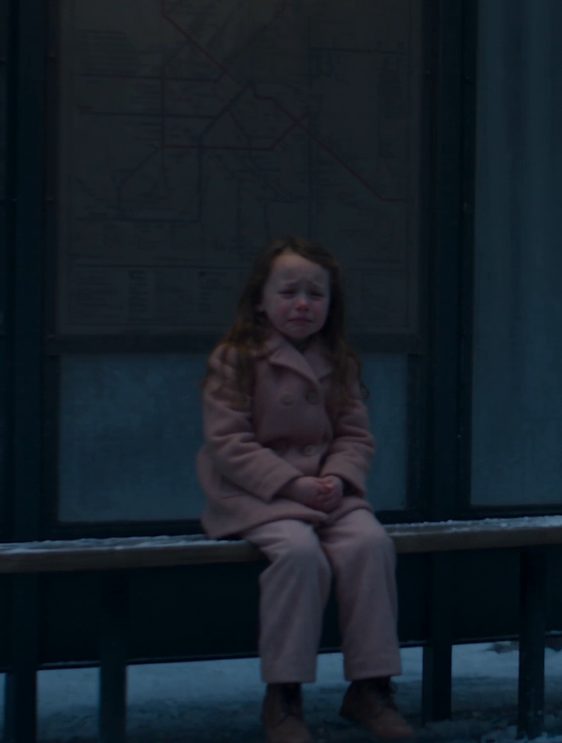
He was crossing Willow Street when he heard crying.
At first, he thought it was the wind moving through the empty bus shelter.
Then he saw her.
A little girl, perhaps seven years old, was sitting alone beneath the flickering bus-stop light.
She wore an expensive navy-blue winter coat, polished black boots, and a cream-colored scarf.
Her dark curls were damp with melting snow, and tears had frozen against her rosy cheeks.
Her little hands were trembling.
Noah slowed.
He looked at the clock above the pharmacy across the street.
Twenty-two minutes.
If he stopped, he could lose his room.
If he kept riding, the child might remain outside in the dangerous cold.
He had already passed the bus stop when her tiny voice reached him.
Does anybody know where my daddy is?”
Noah squeezed the brakes.
The bicycle skidded across the icy pavement.
He turned around.
“Hey,” he called gently.
“Are you okay?”
The girl shook her head.
“I got lost.”
“Where are your parents?”
“I was supposed to be with Daddy, but I got on the wrong bus.”
“Do you know your address?”
She shook her head again.
“What’s your name?”
“Okay, Sophie.
She studied his worn jacket, red nose, and shaking fingers.
“Are you cold?”
He nearly laughed.
“A little.”
“You look colder than me.”
“Probably because your coat costs more than my bicycle.”
For the first time, she smiled.
Then the smile disappeared.
“I need to go home.”
Noah checked his phone.
Its battery was almost dead.
He tried calling the number Sophie remembered, but the call would not connect.
“Do you know anything near your house?” he asked.
She thought carefully.
“There are two big stone lions outside.”
“Stone lions?”
“And a long driveway.
And a clock that plays music.”
Noah frowned.
There was only one property in Bellwether with stone lions guarding its entrance.
Vale House.
The largest private estate in the county.
It belonged to the Vale family, whose charitable foundation owned hospitals, shelters, schools, and half the old buildings downtown.
The estate stood nearly four miles away.
Noah looked at the delivery box strapped to his bicycle.
Then at the child.
“Can you ride on the back?”
She nodded.
He fastened the delivery box to his backpack, adjusted the bicycle’s small rear cushion, and helped Sophie settle onto it.
“Hold my jacket tight.”
“Are you taking me home?”
“Even though you’re busy?”
Noah swallowed.
“Some things are more important.”
They began moving through the snow.
For nearly forty minutes, Noah pedaled uphill through streets that grew emptier and darker.
Twice, he stopped to check that Sophie was warm.
Once, he wrapped his own scarf around her hands.
She kept talking to distract herself.
She liked drawing horses.
She hated Brussels sprouts.
Her father was always working.
And her mother, she explained quietly, had gone to heaven the previous spring.
“My daddy says she’s still watching me,” Sophie whispered.
Noah nodded.
“My mom too.”
“Does that mean they know each other?”
“Then maybe they’re friends.”
Noah smiled despite the cold.
“I hope so.”
Eventually, Sophie noticed the white star beneath his handlebars.
“That’s pretty.”
“My mom painted it.”
“So I wouldn’t forget how to get home.”
Sophie leaned forward.
“My mommy used to draw stars like that.”
Noah glanced back.
She nodded.
“Exactly like that one.”
He dismissed the coincidence.
Children liked stars.
Mothers drew them.
It meant nothing.
At , they finally reached the iron gates of Vale House.
Two enormous stone lions stood on either side, their granite faces dusted with snow.
Sophie clapped.
“That’s it!
That’s my house!”
Beyond the gates rose a mansion glowing with golden light.
Noah pressed the intercom.
I found a little girl.
She says she lives here.”
For several seconds, there was silence.
Then a woman gasped.
The gates opened immediately.
A security guard rushed toward them.
Behind him came a tall man in a dark overcoat, followed by an elegant silver-haired woman.
The man swept the girl into his arms.
“Where have you been?
We’ve been searching everywhere!”
“I got lost, Daddy.”
He held her tightly.
The silver-haired woman covered her mouth, visibly struggling to control her tears.
Noah stepped back, relieved.
The girl was safe.
His job was gone.
But at least he had done one thing right.
The man turned toward him.
“Did you bring her here?”
“Yes, sir.”
“What’s your name?”
“Noah Reed.”
The silver-haired woman suddenly went motionless.
“Reed?” she repeated.
Noah nodded.
“Who was your mother?”
“Anna Reed.”
The woman gripped the iron gate.
Her face drained of color.
The man looked sharply at her.
She ignored him.
Instead, she stared at Noah’s bicycle.
At the chipped blue paint.
At the little white star.
And finally, at the silver bell trembling beneath his frozen hand.
“Where,” she whispered, “did you get that bicycle?”
“It belonged to my mom.”
The woman seemed unable to breathe.
Sophie wriggled free from her father’s arms.
He has Mommy’s star!”
Then she grabbed Noah’s hand and pulled him toward the mansion.
“Come inside!
I want to show you something!”
Before anyone could stop her, Sophie led him into the enormous entrance hall.
A grand staircase curved beneath a crystal chandelier.
Oil paintings lined the walls.
At the far end of the room stood a silver-framed photograph.
Sophie pointed excitedly.
“That’s Mommy!”
Noah looked.
And the blood seemed to disappear from his body.
The photograph showed a young woman standing in a garden, smiling beside a baby wrapped in a white blanket.
The woman had dark hair.
Gentle eyes.
And the same crooked smile Noah remembered from every dream about his childhood.
It was Anna Reed.
His dead mother.
Sophie looked up at him innocently.
“Why,” she asked, “is your mommy holding me when I was a baby?”
Behind them, the silver-haired woman whispered something that made Noah turn.
“Because that photograph was never supposed to leave the locked room.”
✓ Lynn R. Adams
“YOU’RE TOO LATE, NOAH! ONE MORE MISSED DEADLINE AND YOU’RE OUT!” Those words had been ringing in Noah Reed’s ears for nearly an hour. Now, with the temperature dropping below zero and snow blowing…