CG-SHE WHISPERED, “HE’S ABOUT TO SIT HERE,” AND MADE ME DISAPPEAR FOR HER EX — THREE DAYS LATER, HE THREW HER OUT BEFORE SUNRISE, AND SHE CAME BEGGING AT MY DOOR An American Relationship Drama About Betrayal, Broken Trust, Second Chances, and the Moment a Man Finally Chooses Himself.
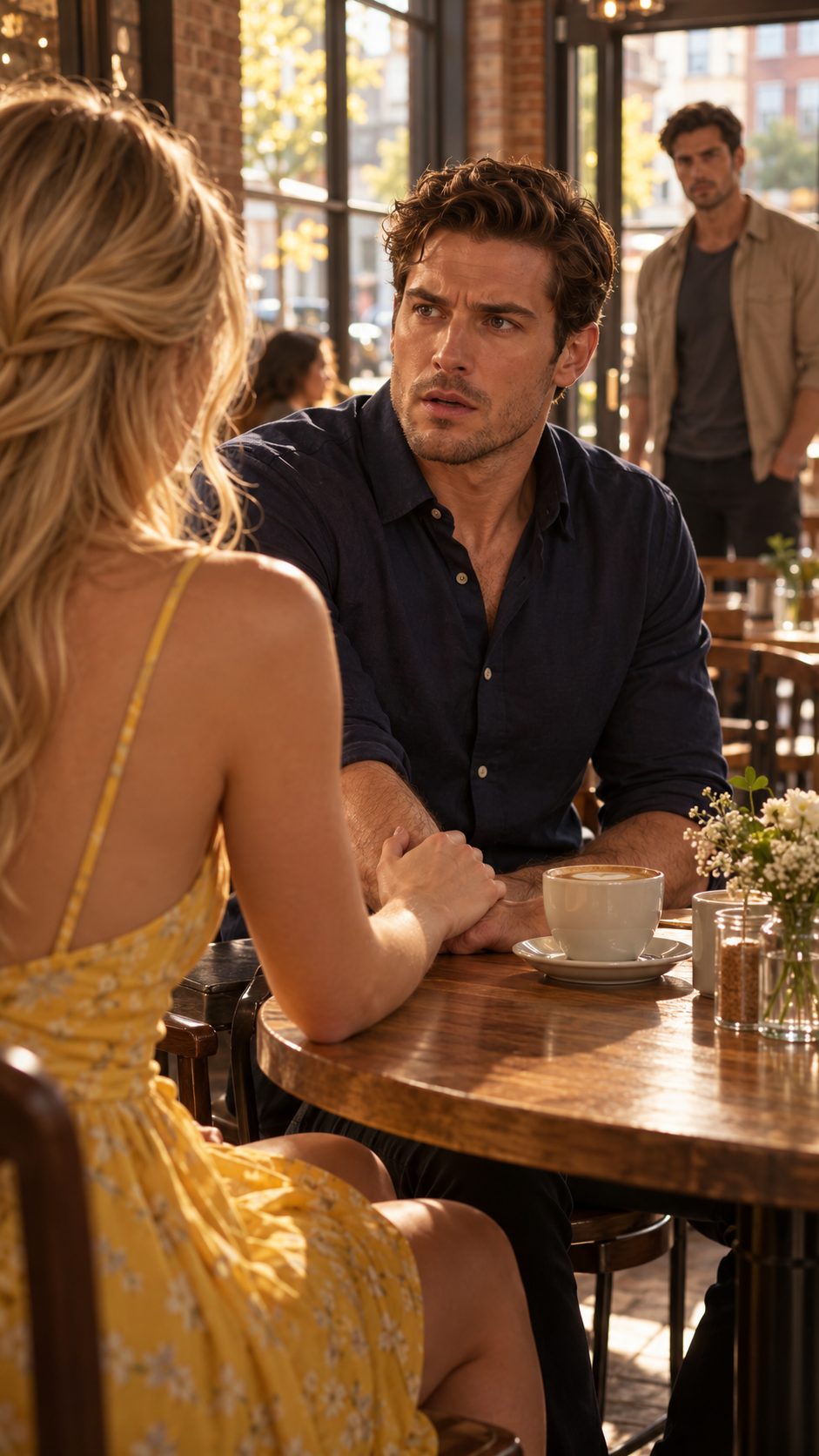
He’s about to sit here.”
Those seven words ended two years of my life.
Not immediately, of course.
There wasn’t a dramatic explosion.
Nobody threw a drink.
No one screamed across the restaurant or stood up to deliver the kind of speech people rehearse in the shower after an argument.
Instead, I sat in a sunlit booth at a trendy downtown café, staring at my girlfriend as though she’d suddenly started speaking a language I didn’t understand.
Jenna leaned closer.
“Move,” she whispered again.
He’s coming over here.”
Her fingers tightened around my forearm.
I looked down.
Her perfectly manicured nails were pressing hard enough into my skin to leave little crescent-shaped marks.
Then I looked back at her face.
She was beautiful that morning.
That was one of the details I hated remembering afterward.
Her golden hair fell in loose waves over the shoulders of the yellow sundress I’d bought her the previous summer.
The dress had tiny white flowers scattered across the fabric, and every time she wore it, I told her she looked like sunshine.
She used to laugh when I said that.
On this particular Sunday, she hadn’t laughed much at all.
We’d arrived at the café shortly after ten.
The weather was gorgeous, the kind of early-summer morning that made the entire city feel more forgiving.
Sunshine poured through the oversized windows, lighting up the exposed brick walls and polished wooden tables.
A couple near us was sharing pancakes.
Someone behind the counter was grinding coffee beans.
A server walked past carrying three plates of avocado toast.
Everything was painfully normal.
Jenna had suggested brunch three days earlier.
“Just us,” she’d said.
“We haven’t had a proper Sunday together in forever.”
I remembered feeling relieved.
She’d been distant all week.
She’d checked her phone during dinner, answered my questions distractedly, and canceled our Friday movie night because she said she needed time to decompress after work.
I thought brunch meant things were getting better.
I’d even made a reservation.
For the first twenty minutes, I did most of the talking.
I told her about a difficult client at work, a coworker’s upcoming wedding, and a bigger apartment I’d found online near Riverside Park.
She nodded at the right moments.
But her eyes kept drifting toward the entrance.
“Everything okay?”
I finally asked.
“You seem distracted.”
“Just tired.”
“Probably.”
She gave me a quick smile.
It looked convincing enough.
I wanted it to be convincing.
That’s something people rarely admit about relationships.
Sometimes we don’t believe the lies because they’re particularly good.
We believe them because the truth would require us to change our lives.
Then the front door opened.
A little brass bell rang overhead.
And Jenna changed.
It happened so quickly that I almost missed it.
Her shoulders straightened.
Her eyes widened.
The distracted expression she’d worn all morning disappeared.
A smile spread across her face.
Not the polite smile she’d been giving me.
Not the tired smile she used when I asked about her day.
This was different.
It was bright and immediate.
It was the kind of smile people give someone they’ve been waiting to see.
For a split second, I thought something wonderful had happened.
Maybe she’d spotted an old friend.
Maybe someone had surprised her.
Then I turned around.
A man had just entered the café.
Dark hair styled casually, as though he’d spent no time on it at all.
He wore a charcoal T-shirt beneath an open beige overshirt, with expensive-looking sneakers and a watch that caught the sunlight.
He wasn’t doing anything particularly remarkable.
Just walking.
But he walked with the calm confidence of someone who knew he was expected.
His eyes scanned the room.
Then they landed on Jenna.
And something in my stomach went cold.
I recognized him a moment before my mind supplied his name.
I’d seen photographs of him before.
The ex-boyfriend Jenna had mentioned casually during the early months of our relationship.
The man she’d once described as “complicated.”
The man she’d assured me she was completely over.
Mark started walking toward our booth.
Jenna’s hand shot across the table.
She grabbed my arm.
“What are you talking about?”
“He’s coming over.”
She gave me a look of pure frustration.
It was the first time she’d said my name that morning.
Not lovingly.
Not affectionately.
Like I was an employee refusing a simple instruction.
“Just go to the bathroom or something,” she whispered.
“I’ll explain later.”
I stared at her.
“You want me to go to the bathroom?”
“Because I need you to.”
I glanced toward Mark again.
He was perhaps fifteen feet away.
Still approaching.
Still smiling.
I turned back to Jenna.
“That’s Mark.”
Her expression tightened.
“Don’t do this right now.”
“Make a scene.”
I almost laughed.
I wasn’t raising my voice.
I wasn’t moving.
I was sitting in the seat she’d asked me to reserve, at the restaurant she’d chosen, trying to understand why my girlfriend wanted me to disappear because another man had arrived.
“Jenna,” I said quietly, “why is your ex coming to our table?”
She looked past me again.
Maybe less.
“I told you I’ll explain later.”
Then she pushed my arm toward the edge of the booth.
Actually pushed it.
“Go,” she hissed.
I looked into her eyes.
And there it was.
The answer.
She wasn’t embarrassed about what she was doing.
She wasn’t worried about how I felt.
She wasn’t even particularly interested in whether I understood.
She was anxious about one thing.
I was still sitting where she wanted Mark to sit.
For two years, I’d believed Jenna and I were building a future.
At that moment, I realized she was willing to make me invisible to protect a possibility with someone else.
I stopped asking questions.
Something inside me became very quiet.
I reached for my wallet.
Jenna’s eyes followed my hand.
I pulled out a twenty-dollar bill and placed it beside my untouched coffee.
Then I stood up.
For the briefest moment, Jenna looked surprised.
And then she sighed.
That was the expression that stayed with me.
Not fear that she was losing me.
She slid across the booth, smoothing her yellow dress.
Her hand went to her hair.
She straightened her shoulders.
She was making room.
Mark arrived beside the table just as I stepped into the aisle.
He looked at me.
Then at Jenna.
A faint smile tugged at the corner of his mouth.
I couldn’t have explained how I knew that, but I did.
He knew exactly who I was.
And he knew exactly why I was leaving.
I walked past him.
Past the hostess station.
Past the glass display filled with pastries.
Then through the front door into the bright Sunday sunshine.
The bell rang above my head.
I didn’t look back.
Behind me, I could still hear the ordinary sounds of the café.
Silverware.
Conversation.
Coffee machines.
A woman laughing.
The world continued as though nothing extraordinary had happened.
But something extraordinary had happened.
The woman I’d loved for two years had asked me to disappear.
And for the first time in our relationship, I’d finally listened to what her actions were telling me.
I met Jenna at a house party I hadn’t wanted to attend.
That was the first thing I remembered while driving away from the café.
Not the argument.
Not Mark’s smile.
A house party.
My friend Maya had invited me to celebrate her new apartment, and I’d spent half the evening pretending to be fascinated by a bowl of tortilla chips.
I wasn’t good at parties.
I could manage meetings, presentations, difficult clients, and a room full of strangers discussing business.
But put me in someone’s living room with loud music and people talking over each other, and suddenly I became the most socially awkward person alive.
Jenna noticed.
She approached the snack table with two plastic cups of soda.
“You look like you’d rather be filing your taxes,” she said.
I glanced at her.
Is filing my taxes an option?”
She laughed.
It was an incredible laugh.
Unrestrained.
A little too loud.
Completely genuine.
“I’m Jenna.”
“Nice to meet you, Ethan.
Are you always this excited about chips?”
“Only on special occasions.”
She handed me one of the cups.
There’s a balcony.
Much better view, significantly fewer people pretending to enjoy themselves.”
We talked outside for nearly an hour.
Then another.
Then another.
She told me about her job search, her terrible sense of direction, the dog she’d had growing up, and her dream of visiting the Pacific Northwest.
I told her about my work designing commercial interiors, the hiking trip I took every autumn, and my irrational dislike of people who stopped walking in the middle of crowded sidewalks.
She found that hilarious.
By midnight, most of the party had gone home.
Maya eventually stepped onto the balcony holding a trash bag.
“Are you two planning to move in out here?”
Jenna smiled at me.
Is the rent reasonable?”
Three days later, we went on our first date.
Two weeks later, she borrowed my favorite hoodie.
Two months later, I knew the exact way she liked her coffee.
At six months, we’d developed routines without ever discussing them.
Friday takeout.
Sunday grocery shopping.
A late-night phone call when one of us couldn’t sleep.
When her apartment’s heating system failed in the middle of winter, I spent an entire weekend helping her move.
It was January.
The sidewalks were icy.
The elevator in her new building had stopped working.
I carried boxes up four flights of stairs until my shoulders felt like someone had replaced my muscles with concrete.
At eleven that night, we sat on the floor of her new living room eating pizza from the box.
She rested her head against my shoulder.
“I don’t know what I’d do without you,” she said.
I kissed the top of her head.
“Probably hire movers like a normal person.”
She laughed.
I mean it.”
Then she looked at me with an expression so sincere that I never questioned it.
“You’re the best thing that’s happened to me.”
I carried those words around for months.
When she applied for a position at a marketing agency, she was terrified she’d embarrass herself in the interview.
So we practiced.
For three nights, I played the hiring manager.
I asked about her strengths, her weaknesses, difficult coworkers, long-term career goals.
The first night, she froze halfway through a question.
“I sound stupid,” she said.
“No, you sound nervous.”
“Same difference.”
“Not even close.”
We practiced until nearly two in the morning.
The next night, she was better.
By the third night, she was brilliant.
When she got the job, she called me from the parking lot before telling anyone else.
I nearly dropped my phone.
“What happened?”
“I got it!”
I could hear her crying.
I stood up from my desk.
“I knew you would.”
“No, you didn’t.”
“Yes, I did.”
She laughed through her tears.
Then she whispered, “I couldn’t have done this without you.”
There were a thousand moments like that.
Small things.
Ordinary things.
Things that don’t look impressive when you describe them individually.
I remembered going out in the rain to pick up medicine when she had the flu.
Remembered assembling her furniture.
Remembered helping her negotiate a raise.
Remembered driving forty minutes to bring her a charger because she’d forgotten hers before an important presentation.
I remembered the concert most clearly.
Her favorite band had announced a limited tour, and tickets sold out almost instantly.
I’d spent three hours refreshing a website that kept crashing.
When I finally got two seats, I nearly shouted in my office.
I didn’t tell her.
I waited until her birthday.
She opened the envelope at my kitchen table.
For a second, she didn’t move.
Then she covered her mouth.
She looked at the tickets.
Then at me.
Then back at the tickets.
“Ethan, how did you—”
“Trade secret.”
She threw her arms around my neck.
At the concert, when the lights dimmed and the opening chords filled the arena, she squeezed my hand so hard it actually hurt.
Tears rolled down her cheeks.
“This is the best night of my life,” she whispered.
I believed her.
More importantly, I believed I was part of the reason.
That belief became the foundation of everything I planned.
A bigger apartment.
A shared living room.
A couch we chose together.
She wanted a golden retriever.
I preferred a rescue mutt with a crooked tail and questionable judgment.
We joked about naming it Otis.
We discussed which side of the bed we’d sleep on, where we’d spend Thanksgiving, and whether our imaginary future children would inherit her green eyes or my inability to dance.
They were conversations, not commitments.
But I treated them like promises.
I started making decisions with an invisible second person standing beside me.
I stopped taking my annual mountain trip because she needed help moving.
I skipped a friend’s birthday weekend when she felt overwhelmed at work.
I canceled plans because her plans had changed.
Not every time.
Not because she demanded it.
Because I thought that’s what love was.
Showing up.
Making room.
Being someone another person could depend on.
And Jenna did show up for me sometimes.
That mattered.
She brought soup when I was sick.
She remembered my mother’s birthday.
She knew exactly how to make me laugh after a terrible day.
There were afternoons when she curled up beside me on the couch and the entire world felt simple.
I wasn’t inventing the good parts.
They were real.
That was what made Sunday so difficult to understand.
Real happiness and real betrayal can exist in the same relationship.
One doesn’t erase the other.
But as I drove away from the café, I finally began asking myself a question I’d avoided for a long time.
When had the relationship stopped being two people walking toward the same future?
And when had I become the only one still moving?
Mark first appeared in our relationship as a restaurant recommendation.
We’d been dating for several months when Jenna suggested an Italian place across town.
“Mark hated that restaurant,” she said casually.
I looked up from the menu.
“Who’s Mark?”
She shrugged.
“He always complained the pasta was overpriced.
I loved it.”
I didn’t think much about it.
Everyone has a past.
I certainly did.
I’d had relationships before Jenna, and I wasn’t interested in pretending otherwise.
A few weeks later, we were driving through a neighborhood near the river.
“Mark used to live around here,” she said.
Another time, when someone drove aggressively around us on the highway, she laughed.
“God, Mark drove exactly like that.”
Eventually, I learned the outline.
They’d been together for years.
It had ended badly.
He’d been inconsistent, jealous, and emotionally exhausting.
He’d disappear after arguments, then return with expensive apologies and promises.
According to Jenna, loving him had felt like waiting for a train that might never arrive.
“Then why did you stay?”
I asked once.
She was sitting on my couch, scrolling through her phone.
She went quiet.
“I thought if I loved him enough, he’d finally choose me.”
I remember that sentence now because of how closely it resembled the question I’d eventually ask about us.
At the time, I simply moved closer.
“You deserve someone who chooses you without making you beg.”
She rested her head against my shoulder.
Then she kissed me.
And I thought the matter was settled.
For a while, Mark’s name faded from our conversations.
I assumed it meant she’d moved on.
Looking back, I suspect I confused silence with healing.
The first sign came on a Thursday night approximately six months before the café incident.
We were watching a movie when Jenna’s phone lit up.
She glanced at the screen.
Something changed in her expression.
A tiny flicker of surprise.
Then excitement.
Then caution.
She turned the phone facedown.
“Everything okay?”
Just somebody from work.”
The movie continued.
Ten minutes later, she went to the bathroom with her phone.
Then I told myself I was being ridiculous.
A relationship without trust is a miserable place to live.
I didn’t want to become someone who monitored messages or demanded explanations for every notification.
But trust can become dangerous when you use it to excuse everything you don’t want to examine.
Over the next few months, Jenna developed little pockets of distance.
She began taking calls outside.
Sometimes she’d smile at a message, then quickly hide the expression when she realized I was looking.
Our conversations became shorter.
Our plans became less certain.
She was still affectionate.
Still funny.
Still capable of making me believe nothing had changed.
But there was a difference.
Before, she’d reach for my hand without thinking.
Now, I usually reached for hers.
Before, she’d tell me everything about her day.
Now, I had to ask.
And sometimes when I asked, she sounded irritated.
“Why do you need to know every little thing?”
That was the strange part.
I only wanted the things she’d once volunteered freely.
One Friday, we were supposed to have dinner at my place.
I’d bought groceries and started cooking.
At six thirty, she texted.
Can’t make it.
Something came up.
She didn’t answer.
An hour later, she wrote:
Work stuff.
I put the leftovers in the refrigerator.
The next morning, she appeared at my door carrying coffee and apologizing.
She kissed me.
We spent the day together.
I let it go.
That became the rhythm.
A little distance.
An explanation.
An apology.
A beautiful afternoon that made me question whether I’d imagined the distance in the first place.
There was also the way she began speaking about commitment.
For most of our relationship, she’d been enthusiastic about moving in together.
Then, suddenly, she wanted to wait.
“Maybe we should renew our leases separately one more time.”
I was disappointed.
But I told her there was no rush.
“I don’t want you to feel pressured.”
“I don’t,” she said quickly.
Then she looked away.
I convinced myself we were simply moving at different speeds.
That happens.
People need time.
But I didn’t understand that someone can need time for two very different reasons.
Sometimes they’re preparing to build something with you.
Sometimes they’re deciding whether they want to leave.
The week before brunch, Jenna was especially distracted.
On Wednesday evening, we were sitting in my kitchen when her phone buzzed.
She read the message.
Her face went pale.
Then she stood.
“I need to take this.”
She walked onto the balcony.
Through the glass, I watched her speak quietly.
At one point, she smiled.
Not broadly.
Just enough for me to notice.
When she returned, I asked who it was.
“A friend.”
“Everything okay?”
“Good friend?”
She frowned.
“Why are you asking?”
I raised both hands.
“No reason.”
We ate dinner.
We watched a television show.
She fell asleep against me.
And I sat there looking at the top of her head, thinking that maybe I’d been unfair to doubt her.
Two days later, she suggested brunch.
“Sunday morning?” she asked.
“There’s this place downtown I’ve been wanting to try.”
“Sounds good.”
“Ten thirty?”
She smiled.
That evening, I looked up the restaurant and made a reservation.
I didn’t know she’d been arranging another meeting.
I didn’t know Mark had been messaging her.
And I certainly didn’t know that the table I’d reserved for two would become the place where she’d ask me to surrender my seat.
In hindsight, the clues were everywhere.
But hindsight is cruel that way.
It gives ordinary moments meanings they never carried when you were living through them.
A hidden smile becomes evidence.
A canceled dinner becomes a warning.
A familiar name becomes the beginning of the ending.
I used to think I should’ve confronted Jenna earlier.
Maybe I should have.
But I no longer believe it was my responsibility to investigate my own relationship like a detective.
She knew what she was doing.
She knew what we had.
She knew the promises we’d made.
And by Sunday morning, she knew Mark was coming.
I was the only person at that table who didn’t.
I don’t remember driving home.
I know I did.
The café was about twelve minutes from my apartment, depending on traffic.
I must have stopped at red lights.
I must have turned onto familiar streets.
I must have found my usual parking space.
But those details never stayed in my memory.
What I remember is sitting behind the steering wheel after I’d arrived.
The engine was still running.
Both hands were gripping the leather so tightly my knuckles had gone pale.
I stared through the windshield at the brick apartment building across the street.
A woman walked past with a grocery bag.
A man jogged by wearing headphones.
Someone was watering flowers on a second-floor balcony.
Everything looked exactly as it had that morning.
I wanted the world to look different.
I wanted something to acknowledge the fact that my life had just broken open.
Instead, the dashboard clock changed from 11:17 to 11:18.
I turned off the engine.
Silence settled around me.
Then the memories began.
Not in order.
Not reasonably.
Just fragments.
Jenna asleep in the passenger seat during a road trip.
Jenna laughing in my kitchen.
Jenna wearing my hoodie.
Jenna crying at the concert.
Jenna saying she couldn’t imagine her life without me.
And then, over every memory, that voice.
I leaned forward until my forehead touched the steering wheel.
For a moment, I felt like I might be sick.
The worst part wasn’t imagining Jenna with Mark.
That came later.
The worst part was remembering her relief when I stood up.
I had wanted her to stop me.
Even after everything she’d said, some desperate part of me had expected her to grab my hand and whisper, Wait.
I’d expected her to realize what she was doing.
Instead, she’d adjusted her dress and made room for him.
My phone vibrated.
I looked toward the center console.
Her name appeared above the photograph I’d taken of her at the beach the previous summer.
She was laughing in that photograph.
Her hair was blowing across her face.
I’d always loved it.
The phone continued ringing.
I watched it.
Then I let it stop.
A minute later, a message appeared.
Where did you go?
I read it twice.
Where did I go?
I almost answered.
You told me to leave.
But I didn’t.
Another message came.
Ethan, seriously.
We need to talk.
You’re making this way bigger than it is.
I sat back.
There it was.
Not an apology.
Not concern.
An accusation.
I’d made it bigger.
Apparently, the appropriate response to being asked to disappear for her ex-boyfriend would’ve been to wait patiently in the bathroom until she decided I could return.
My phone rang again.
I silenced it.
Then I finally went upstairs.
My apartment looked painfully familiar.
Her shoes were near the front door.
A blue sweater she’d left the previous weekend was folded over the back of the couch.
Two coffee mugs sat in the drying rack.
One was hers.
A ridiculous ceramic mug shaped like a smiling strawberry.
She’d bought it at a street fair and insisted it had personality.
I stood in the kitchen staring at that mug for longer than I want to admit.
Then I put my keys on the counter.
I didn’t throw anything away.
I didn’t punch a wall.
I didn’t call Mark.
I simply sat down on the couch.
For nearly an hour, I did nothing.
At some point, my phone vibrated again.
He just wanted to talk.
You embarrassed me.
That message changed something.
I read it again.
You embarrassed me.
Not I’m sorry I hurt you.
Not I didn’t mean to make you feel replaceable.
She was upset because I had walked away without performing the role she’d assigned me.
I opened our message history.
Months of ordinary life filled the screen.
Good morning, handsome.
Did you eat lunch?
Can you come over?
I miss you.
I love you.
I scrolled until I reached a photo of the apartment we’d discussed renting together.
Underneath it, she’d written:
Imagine us here.
I remembered answering:
I already do.
That was the moment I cried.
Not dramatically.
Not loudly.
I simply sat on my couch while tears ran down my face.
I cried for the apartment.
For the dog.
For the plans.
For the man I’d been that morning, who’d walked into a café expecting pancakes and a relaxing Sunday with the woman he loved.
Around two, my friend Ben called.
I hadn’t spoken to him in several days.
Usually, he called to complain about his fantasy baseball team or convince me to join him for basketball.
I almost ignored him.
Then I answered.
“Jesus, man.
What’s wrong?”
I closed my eyes.
He knew me too well.
I told him.
Not all at once.
The story came out in pieces.
Jenna’s hand on my arm.
The bathroom.
The twenty-dollar bill.
Ben didn’t interrupt.
When I finished, he was quiet for several seconds.
Then he said, “You’re at home?”
I laughed bitterly.
“That’s your advice?”
That’s the first thing I needed to know.”
“Because I was about to drive over there.”
He exhaled.
“Listen to me.
You did the right thing.”
“It doesn’t feel like it.”
“Of course it doesn’t.
You love her.”
I stared at the sweater on the couch.
“That doesn’t mean you have to let her treat you like furniture.”
Something about that sentence made me laugh.
A short, ugly laugh.
Then I started crying again.
Ben stayed on the phone.
He didn’t give me a speech about being stronger.
He didn’t tell me to download a dating app.
He didn’t say that everything happened for a reason.
He just stayed.
Sometimes that’s what friendship is.
Not fixing the damage.
Just refusing to let someone stand alone inside it.
After we hung up, I looked at my phone.
Six missed calls.
Eleven messages.
The newest one said:
I can’t believe you’re ignoring me.
I typed a response.
Deleted it.
Typed another.
Deleted that too.
Finally, I wrote:
You asked me to leave so Mark could sit with you.
I understood what that meant.
I need space.
Please don’t contact me tonight.
I read it once.
Then pressed send.
Her reply came almost immediately.
You’re misunderstanding everything.
I placed the phone facedown.
For the first time in two years, I didn’t hurry to make her feel better.
And that silence, painful as it was, became the first decision I’d made entirely for myself in a very long time.
Monday arrived without permission.
My alarm went off at six thirty.
For a few seconds, everything felt normal.
Then I remembered.
I lay in bed staring at the ceiling while the events of Sunday replayed themselves with the terrible clarity of a scene I’d watched too many times.
Jenna gripping my arm.
Mark approaching.
The twenty-dollar bill.
Her relieved expression.
I reached for my phone.
There were fourteen new messages.
Three missed calls.
The messages had changed in tone overnight.
At first, she’d been angry.
You seriously walked out?
I told you I’d explain.
You always do this when you’re upset.
That last one almost made me laugh.
I’d never walked out on her before.
In fact, I’d spent two years doing the opposite.
I’d stayed.
Through disagreements.
Through canceled plans.
Through moments when I felt like I was asking for affection that used to come naturally.
But by midnight, her messages had become softer.
Ethan, please.
I didn’t mean to hurt you.
You know I love you.
At a.m., she’d sent:
Can we please just go back to how things were?
I stared at that sentence.
As though the previous day were a spilled drink.
An inconvenience.
Something we could wipe away and forget.
But I couldn’t go back.
Because I knew something now that I hadn’t known before.
I knew how quickly she could decide I didn’t matter when someone else entered the room.
I showered, got dressed, and went to work.
I worked for a commercial design firm on the fourth floor of an old brick building downtown.
Most days, I genuinely loved my job.
I liked the problem-solving, the precision, the satisfaction of watching an idea become something people could walk through.
That Monday, I couldn’t concentrate.
I opened a floor plan.
Stared at it.
Opened an email.
Read the same paragraph four times.
At ten, my manager, Denise, stopped beside my desk.
“You okay?”
She looked at me for a moment.
“Try again.”
I smiled weakly.
“Rough weekend.”
“Personal?”
She pulled up a chair.
Denise was in her fifties, divorced, and entirely unimpressed by anyone’s attempts to pretend everything was fine.
“Do you need to go home?”
I think being here helps.”
“Then don’t worry about the Franklin project today.
I’ll cover the client call.”
I looked up.
She gave me a small smile.
“Whatever happened, you don’t need to solve it before lunch.”
I wish I’d listened.
Instead, I spent most of that morning rehearsing imaginary conversations with Jenna.
In one version, I was angry.
In another, I was calm.
Sometimes she apologized immediately.
Sometimes she told me the whole thing had been a misunderstanding.
I imagined Mark was simply a friend she’d wanted to surprise.
I imagined she’d panicked because their history was complicated.
I invented explanations that made her behavior less devastating.
Then I remembered her hand against my arm.
I stopped inventing.
At noon, Maya called.
I answered from a small conference room.
“Ethan, Ben told me.”
I leaned against the wall.
“Of course he did.”
“He was worried.”
“I’m okay.”
“That’s not what I asked.”
I didn’t respond.
Maya sighed.
“I introduced you two.
I feel awful.”
“I had no idea she was talking to Mark again.”
I straightened.
There was a pause.
“What do you mean, again?”
Maya hesitated.
“I ran into her about a month ago.
She mentioned he’d reached out.”
The conference room suddenly felt smaller.
“What did she say?”
“That he’d apologized for how things ended.”
“That she was confused.”
I shut my eyes.
“Did she tell you we were having problems?”
“Did she tell you she wanted him back?”
“Not directly.”
Maya exhaled.
“She asked whether people could make a mistake with one person and still be meant for them.”
I stared at the floor.
“What did you say?”
“I told her that missing someone doesn’t mean you’re supposed to be with them.”
The silence stretched.
“Why didn’t you tell me?”
Maya’s voice softened.
“Because she told me it was something she was processing privately.
I thought she was just working through old feelings.
I didn’t know she was seeing him.”
I rubbed my forehead.
“I’m not blaming you.”
But I should’ve asked more questions.”
Maybe she should have.
Maybe I should have.
There were enough missed questions to keep all of us awake for months.
But the responsibility was still Jenna’s.
Not Maya’s.
Maya stayed quiet for a moment.
Then she said, “She asked me this morning whether I’d heard from you.”
“What did you say?”
“That she should talk to you honestly instead of asking other people to fix it.”
I almost smiled.
“Sounds like you.”
“Yeah, well.
She didn’t love that answer.”
After we hung up, I sat in the conference room for several minutes.
Then I made a decision.
I opened the notes app on my phone and wrote down what had happened on Sunday.
Not how I’d felt.
Not what I suspected.
Just the facts.
Jenna invited me to brunch.
She knew Mark was coming.
She asked me to move.
She told me to hide in the bathroom.
She pushed my arm.
She was relieved when I left.
Mark took my place.
I read the list.
It looked almost absurd.
The kind of thing someone might dismiss with, It’s just a seat.
But it wasn’t just a seat.
It was the entire relationship compressed into one moment.
I wrote one more sentence.
I deserve to be with someone who doesn’t need me to disappear.
That afternoon, Jenna called again.
I didn’t answer.
Instead, I sent one message.
I am not ready to talk.
We are not going to pretend yesterday didn’t happen.
Please respect that.
She replied:
So that’s it?
Two years and you’re just done?
I stared at the screen.
She’d found a way to make those two years sound like a debt I owed her.
As if my history with her required me to accept whatever happened next.
I didn’t respond.
That night, I ate dinner alone.
Vegetables I’d forgotten were in the refrigerator.
I watched half an episode of a show we’d started together.
Then turned it off because every character reminded me of her.
Before going to bed, I moved her strawberry mug from the kitchen counter into a cabinet.
It was a small thing.
Almost meaningless.
But the kitchen looked different afterward.
And for the first time, I understood that moving forward wasn’t going to happen through one heroic decision.
It would happen through hundreds of ordinary ones.
One unanswered call.
One quiet dinner.
One morning without reaching for her.
One familiar object placed out of sight.
Tuesday was worse than Monday.
Monday had been shock.
Tuesday was reality.
There is a particular kind of loneliness that arrives when you realize the person you’d normally call about your sadness is the person who caused it.
I wanted to tell Jenna how terrible I felt.
I wanted her to come over and sit beside me.
I wanted her hand in mine.
I wanted her to say something ridiculous and make me laugh.
The instinct was so powerful that I picked up my phone several times before remembering why I couldn’t call her.
It was almost physical.
Like reaching for a step that wasn’t there anymore.
That morning, I took the long route to work.
I drove past the park where we’d spent our first summer together.
Past the bookstore where she’d once insisted we buy matching notebooks.
Past a little bakery that made the cinnamon rolls she loved.
I hadn’t realized how thoroughly she’d become part of my map of the city.
Everywhere I went, there was evidence of us.
A restaurant.
A street corner.
A traffic light where she’d leaned across the console to kiss me.
I wondered how long it would take before those places became ordinary again.
At eleven, Jenna sent another message.
Can you at least tell me if we’re broken up?
I stared at it for several seconds.
She’d asked the question I’d been trying not to answer.
Because answering it would make things real.
Part of me still wanted to believe we were having a fight.
A terrible fight.
But a fight has two people arguing from the same reality.
Jenna and I weren’t even standing in the same world anymore.
She thought the problem was that I’d left the café.
I thought the problem was that she’d wanted me gone.
I don’t know how we come back from Sunday.
I need you to stop contacting me while I figure out what happens next.
Her response came almost immediately.
Mark and I didn’t do anything at brunch.
I sat very still.
That was the first time she’d offered a specific defense.
And it was telling.
She was defending what might have happened after I left.
Not what she’d done while I was still there.
That isn’t the point, I wrote.
Three dots appeared.
Disappeared.
Appeared again.
You don’t understand what he means to me.
I stared at the message.
Then I placed my phone on the desk.
A strange calm settled over me.
Because after two days of confusion, she’d finally said something honest.
Mark meant something to her.
Something significant.
Something powerful enough to make her treat me like an obstacle.
I could have asked how much.
I could have asked whether she loved him.
I could have demanded a detailed explanation of every message and every secret conversation.
But I already knew what mattered most.
She’d made a choice when it counted.
And I hadn’t been the one she’d protected.
Around lunchtime, Ben showed up with sandwiches.
He placed a paper bag on my desk.
Extra pickles.”
I looked up.
“Are you stalking me?”
“Your manager likes me.”
“Denise barely likes me.”
“Yeah, but I brought pastries.”
We ate in a courtyard behind the building.
For a few minutes, we talked about normal things.
Basketball.
A terrible restaurant he’d tried over the weekend.
Eventually, he looked at me.
“Have you talked to her?”
I told him.
He listened carefully.
Then he asked, “What do you actually want?”
I looked at him.
“What do you mean?”
“Forget what she wants.
Forget what Mark wants.
Forget what everyone thinks you should do.
What do you want?”
I opened my mouth.
Nothing came out.
It was an embarrassingly difficult question.
I knew what Jenna wanted for dinner.
I knew which coffee shop she preferred.
I knew the exact date of her next performance review.
I knew what kind of dog she wanted.
But I hadn’t spent much time asking myself what I wanted from the relationship lately.
“I wanted to marry her,” I finally said.
Ben nodded.
“I wanted the apartment.
All of it.”
“Do you still?”
I looked down.
“I don’t know.”
“That’s fair.”
I watched a leaf drift across the pavement.
“I just keep thinking maybe this was one terrible mistake.”
Ben chewed thoughtfully.
“Could be.”
I looked at him.
“You think so?”
People make terrible mistakes.”
“But that doesn’t mean you’re obligated to build your life around them.”
I didn’t answer.
He continued.
“Even if she regrets it, you get to decide whether you can trust her again.”
I sat with that thought.
For so long, I’d confused forgiveness with continuing.
As though loving someone meant giving them unlimited opportunities to hurt you.
But forgiveness and reconciliation were different things.
I could eventually forgive Jenna.
I could even wish her well.
That didn’t mean I had to put my heart back in her hands.
That evening, I cleaned my apartment.
Not because it needed cleaning.
Because I couldn’t stand sitting still.
I washed the sheets.
Vacuumed beneath the couch.
Organized the kitchen drawers.
Then I found a photograph tucked inside a book.
Jenna and me at the concert.
Her eyes were closed.
Her head rested against my shoulder.
I was smiling at her instead of the camera.
I sat on the edge of my bed holding it.
For a moment, I wanted to call her.
I wanted to ask whether that night had meant anything.
Whether all of it had been a performance.
But I knew that wasn’t fair either.
The good memories weren’t necessarily lies.
The person who’d loved me then might have been sincere.
People can love someone and still betray them.
People can make genuine promises and later break them.
I placed the photograph in a drawer.
At p.m., Jenna called.
I let it ring.
At 10:04, another message appeared.
I think I made a mistake.
Ethan, please don’t shut me out completely.
Then, shortly before midnight:
I really need someone right now.
I looked at that last message for a long time.
There was a version of me who would’ve put on his shoes, grabbed his keys, and driven across the city without asking another question.
That version would’ve been terrified she was hurting.
He would’ve rushed to comfort her.
He would’ve made her crisis more important than his own heartbreak.
I knew him well.
I’d been him for two years.
But this time, I turned off my bedside lamp.
I left the phone on the nightstand.
And I went to sleep.
At the following morning, someone started knocking on my apartment door.
The first knock was soft.
The second was louder.
By the third, I was awake enough to recognize that someone was standing outside my apartment.
I glanced at the clock.
For a moment, I assumed there was an emergency.
I pulled on a T-shirt and walked into the hallway.
Another knock.
Her voice sounded small.
Nothing like the sharp, impatient whisper I’d heard in the café.
“Ethan, please.
I know you’re in there.”
I stood motionless.
Part of me wanted to pretend I hadn’t heard.
Another part wanted to open the door immediately.
I checked the peephole.
She was standing beneath the dim hallway light, clutching an oversized gray cardigan around her body.
Her chestnut-brown hair was tangled.
Her makeup had smeared beneath her eyes.
She wore a white satin camisole, a short black skirt, and flats that looked entirely unsuitable for wandering around the city before dawn.
There were tears on her face.
I hadn’t seen her look that frightened since the night she’d learned her mother needed emergency surgery.
My hand hovered over the deadbolt.
“Ethan,” she whispered.
I opened the door.
Not all the way.
Just enough to see her clearly.
She looked up.
The moment our eyes met, her face crumpled.
“Oh, thank God.”
I didn’t answer.
She took half a step forward.
I stayed in the doorway.
Her movement stopped.
“Can we talk?”
I glanced at the clock on the wall behind me.
“It’s four in the morning, Jenna.”
“What happened?”
She wiped her face with the sleeve of her cardigan.
“I didn’t know where else to go.”
The sentence hit me harder than I expected.
Because once, hearing those words would’ve made me feel needed.
Now, I wasn’t sure whether she wanted me or simply wanted somewhere safe to land.
“What happened?”
I asked again.
She looked down.
I felt something inside my chest tighten.
“What about him?”
Her lips trembled.
“He kicked me out.”
I stared at her.
“Of his apartment?”
She nodded.
“About forty minutes ago.”
I glanced past her into the empty hallway.
“Are you hurt?”
She shook her head quickly.
He didn’t hit me or anything.”
“He just told me to leave.”
She swallowed.
“And he meant it.”
There was silence.
Outside the building, a car passed along the wet street.
Somewhere below us, the heating system clicked on.
Jenna hugged herself tighter.
“Can I come inside?”
I looked at her.
Then at the familiar doorway behind me.
Two days earlier, I’d stood in my kitchen holding her photograph and wondering how to survive without her.
Now she was here.
Asking to return.
A week earlier, I would’ve given anything to hear that request.
But everything had changed.
“Before we talk,” I said, “I need to know something.”
She nodded.
“Anything.”
“Why were you with Mark?”
She closed her eyes.
You don’t get to do that.”
She looked up.
“Say my name like I’m being unreasonable for asking.”
Her shoulders slumped.
“Then tell me the truth.”
She took a shaky breath.
“He started texting me again a few months ago.”
I nodded slowly.
“I figured.”
“At first, it was just checking in.
Then he apologized for everything that happened between us.”
I didn’t interrupt.
“He said he’d changed.
He said he regretted losing me.”
Her voice cracked.
“I wanted to believe him.”
“Did you love him?”
She looked away.
“I thought I was over him.”
“That’s not what I asked.”
She pressed her lips together.
“I think part of me still wanted him to choose me.”
There it was.
The truth I’d been trying not to see.
“Even while you were with me?”
She started crying harder.
“I never planned for any of this.”
I leaned against the doorframe.
“You planned brunch.”
She went still.
I watched her face.
“You chose the restaurant,” I continued.
“You chose the time.
You knew he was coming.”
She said nothing.
“Didn’t you?”
Finally, she nodded.
A slow, miserable movement.
I felt my stomach drop.
Some part of me had still hoped it had been a coincidence.
I don’t know why.
Maybe because the alternative was so much uglier.
“You invited him?”
“He asked to meet.”
“And you arranged it?”
I stared at her.
“Then why was I there?”
Her expression changed.
She opened her mouth.
I already knew I wasn’t going to like the answer.
She wiped her cheeks.
“I didn’t know if he was actually going to show up.”
For a moment, I couldn’t speak.
She continued quickly.
“He’d canceled on me before.
I thought maybe he was just playing games again, and I didn’t want to sit there alone feeling stupid.”
I stepped back slightly.
Not to let her in.
Just because I suddenly needed more distance.
“You brought me as backup?”
“No, Ethan, it wasn’t like—”
“Then what was it like?”
She started crying again.
“I wanted you there.”
“Until he arrived.”
She lowered her eyes.
I laughed once.
There was no humor in it.
“Unbelievable.”
“No, I don’t think you do.”
I looked at her.
“You told me you wanted a Sunday together.
I made the reservation.
I sat there listening to you tell me everything was fine.”
She covered her mouth.
“And the entire time, you were waiting for him.”
“I’m sorry.”
“You weren’t deciding whether you wanted to spend brunch with me.”
I could hear my voice starting to shake.
“You were waiting to see whether someone better showed up.”
She shook her head.
“You’re not—”
She fell silent.
“Don’t tell me I wasn’t good enough.
Don’t tell me I’m misunderstanding.
Just let me finish.”
Tears burned behind my eyes.
“Do you know what I kept thinking about after I left?”
She looked up.
I swallowed.
“Your face.”
Her expression crumpled.
Not the café.
Your face when I stood up.”
She pressed a hand against her chest.
“You looked relieved.”
She whispered, “I was panicking.”
“You looked relieved because I was finally out of the way.”
She started shaking her head again.
“Ethan, please.”
I looked straight into her eyes.
“You didn’t want me beside you.
You wanted me available in case he didn’t come.”
She had no answer.
And for a long moment, neither did I.
Then she said something I hadn’t expected.
“You’re right.”
I stared at her.
She looked completely exhausted.
“You’re right,” she repeated.
“I was selfish.
I was horrible.
I made you feel like you didn’t matter, and I knew exactly what I was doing.”
I stood very still.
Her apology didn’t make the pain disappear.
But it was the first honest acknowledgment she’d given me.
She reached toward my hand.
I moved it away gently.
Her face fell.
“Can you please just hear me out?”
I hesitated.
Then nodded.
She leaned against the opposite wall.
And standing there in the dim hallway, with the sky still dark beyond the stairwell window, she finally told me what had happened after I left the café.
According to Jenna, Mark sat down almost immediately after I left.
He ordered coffee.
Asked about her job.
Complimented her dress.
He behaved as though nothing unusual had happened.
For a while, she said, she’d felt exactly what she’d hoped to feel.
Mark had spent months telling her that he regretted their breakup.
He’d said she’d been the only person who truly understood him.
He’d sent messages late at night describing memories from their relationship.
Places they’d visited.
Conversations they’d had.
Songs he’d heard that reminded him of her.
“He made it sound like he’d spent all this time realizing he’d made a mistake,” she said.
I listened without interrupting.
“At brunch, he told me he wanted us to try again.”
I felt the familiar ache in my chest.
“So you did.”
She nodded.
The word hung between us.
I stared past her toward the stairwell.
I hadn’t actually expected a different answer.
But hearing it still hurt.
She continued.
They’d spent Sunday afternoon together.
Mark had taken her to a restaurant they used to visit.
They’d talked for hours.
He’d apologized again.
He’d told her he was finally ready for a serious relationship.
And she’d believed him.
On Monday, she went to his apartment after work.
On Tuesday, she stayed late again.
They’d been acting, she said, like people who’d picked up exactly where they’d left off.
I didn’t ask about the physical details.
I didn’t want them.
I knew enough.
“What happened tonight?”
Jenna hugged her cardigan more tightly.
“We had an argument.”
“About what?”
She hesitated.
“He started talking about moving to Seattle for work.”
“Apparently, he’s been considering it for months.”
“And when I asked what that meant for us, he acted like I was being ridiculous.”
She laughed bitterly.
“He said we’d only been spending time together for a couple of days.”
I watched her carefully.
“He said he didn’t understand why I was making everything so serious.”
Her voice broke.
“I told him he’d spent months saying he wanted another chance.”
“What did he say?”
She looked down.
“He said wanting to see me again wasn’t the same thing as promising me a future.”
I felt a strange, unwelcome flash of recognition.
Different words.
Different circumstances.
But the same feeling.
Discovering that someone had allowed you to build expectations they had no intention of fulfilling.
Jenna wiped her eyes.
“I asked him why he’d made such a big deal about seeing me if he wasn’t serious.”
“He said he wanted to know if we still had something.”
She looked at me.
“He said now he knew.”
Something in her voice made me understand what came next.
“What did he mean?”
She swallowed.
“He said he wasn’t sure he wanted a relationship after all.”
I exhaled slowly.
Jenna looked devastated.
“He told me I was being clingy.
That I was trying to turn a couple of dates into a commitment.
I got upset, and he told me to leave.”
She looked toward the floor.
“I said it was almost four in the morning.”
“He told me that wasn’t his problem.”
I closed my eyes briefly.
I didn’t like Mark.
I had very little reason to think well of him.
But this wasn’t a competition to see who could hurt Jenna more.
“What about your apartment?”
She looked confused.
“Your apartment.
You still have it.”
“Then why didn’t you go home?”
She stared at me.
For the first time that morning, her face changed from grief to something more complicated.
“I went there first.
I sat in my car outside for ten minutes.”
“Then why come here?”
She started crying again.
“Because I realized what I’d done.”
I looked at her.
She stepped closer, then stopped when I didn’t move.
“Ethan, you were always there for me.
Every time.
Even when I didn’t deserve it.”
I didn’t answer.
“And I threw that away for someone who made me feel like I was begging just to matter.”
Her voice cracked.
“I wanted him to choose me so badly that I stopped seeing the person who already had.”
For a moment, I couldn’t breathe properly.
Because that sentence was the closest she’d come to understanding what had happened.
She pressed her hands together.
“I know I don’t deserve another chance.”
I looked at her.
“But I’m asking anyway.”
Silence settled between us.
Then she whispered the words I’d once imagined hearing with relief.
“I love you, Ethan.”
I wanted those words to mean what they used to mean.
I wanted to be the kind of person who could open the door, hold her, and believe that regret had changed everything.
But I couldn’t.
Not anymore.
“Jenna,” I said quietly, “do you remember the night you got your job offer?”
She blinked.
“The interview we practiced for.
You called me from the parking lot.”
She nodded slowly.
“You were crying because you were so happy.”
Her face softened.
“I remember.”
“I told you I knew you could do it.”
A tear rolled down her cheek.
“And you said you couldn’t have done it without me.”
“I meant that.”
She looked confused.
I continued.
“I know you meant it.
That’s what makes this so difficult.”
I leaned against the doorframe.
“I don’t think every good moment we had was fake.
I don’t think you spent two years pretending to love me.”
She looked at me hopefully.
“But I also don’t think loving me stopped you from making the choice you made.”
Her hope faded.
“You didn’t accidentally hurt me,” I said.
“You knew what you were asking.”
She covered her mouth.
“You knew I was your boyfriend.
You knew we’d talked about living together.
You knew I’d been making plans with you.”
“And still, when Mark walked through that door, you treated me like something you needed to hide.”
Her shoulders began to shake.
“I’m sorry.”
“I believe you.”
She stared at me.
“I do,” I said.
“I believe you’re sorry.”
“Then please—”
“But being sorry doesn’t undo it.”
Her face crumpled.
I took a breath.
“I spent two years showing you I was someone you could count on.
And when the moment came for you to choose how to treat me, you chose to make me disappear.”
“I was confused.”
“I was stupid.”
“I was scared.”
“I believe that too.”
She looked at me desperately.
“Then why can’t we fix this?”
I didn’t answer immediately.
Because the truth wasn’t as simple as anger.
I still loved her.
That was the awful part.
Somewhere underneath the disappointment and humiliation, I still loved the woman who’d laughed with me on Maya’s balcony.
The woman who’d cried at the concert.
The woman who’d wanted a dog named Otis.
But loving someone isn’t the same as trusting them.
And trust wasn’t something I could summon just because she was standing in front of me crying.
“Because I don’t know how to be with you without wondering when you’ll ask me to move again,” I finally said.
She went silent.
The words seemed to reach her more deeply than anything else I’d said.
“I would never do that again,” she whispered.
I looked at her.
“Maybe you wouldn’t.”
“But I don’t want to spend the next two years waiting to find out.”
She stared at me.
A long silence passed.
Then she asked the question I’d known was coming.
“Are we over?”
My throat tightened.
I looked at the woman I’d imagined marrying.
I remembered the apartment near the park.
The imaginary dog.
The holidays.
The mornings we’d never have.
And I nodded.
She began crying so hard she had to sit on the hallway steps.
I didn’t close the door immediately.
I brought her a glass of water.
I asked whether her phone was charged.
When she said it was almost dead, I gave her a portable charger.
Then I offered to call her a ride.
She looked up through her tears.
“You’re really not going to let me come in?”
I shook my head.
“Not tonight.”
“You’re safe here until your ride comes.
But we’re not going to have this conversation inside my apartment.”
She lowered her head.
I sat on the top step, leaving space between us.
For nearly fifteen minutes, neither of us spoke.
It was one of the strangest experiences of my life.
We were two people who’d once known the smallest details of each other’s routines.
I knew she hated sleeping with socks on.
She knew I couldn’t fall asleep if a closet door was open.
I knew which songs made her cry.
She knew I always forgot to buy dish soap.
And now we sat a few feet apart like strangers waiting for an elevator.
Eventually, her ride arrived.
Her phone lit up with the notification.
She stood slowly.
At the stairs, she turned around.
“Did you ever really think we’d get married?”
The question nearly broke me.
“Every day,” I said.
She pressed a hand against her mouth.
Then she walked down the stairs.
I listened to her footsteps until they disappeared.
I went back into my apartment.
Closed the door.
Turned the lock.
And stood there in the silence.
I didn’t feel victorious.
There was no satisfaction.
No sudden rush of freedom.
Only grief.
But beneath the grief was something I hadn’t felt for months.
A small, unfamiliar sense of peace.
Because whatever happened next, I knew I hadn’t abandoned myself to make someone else comfortable.
The first week after Jenna came to my door was miserable.
People like to imagine that choosing yourself feels empowering.
Sometimes it does.
But sometimes it feels like eating dinner alone while the person you love is somewhere else.
Sometimes it feels like waking up at three in the morning and reaching across an empty bed.
Sometimes it means resisting the urge to call someone because you know hearing their voice would make you forget why you left.
I missed Jenna constantly.
I missed her laugh.
Her terrible singing.
The way she stole the crispy fries from my plate after insisting she wasn’t hungry.
I even missed the arguments about whose turn it was to choose a movie.
But whenever I began romanticizing our relationship, I remembered the café.
I remembered how quickly she’d made room for someone else.
That memory hurt.
It also kept me honest.
A few days after our final conversation, Jenna texted asking whether she could collect the things she’d left at my apartment.
I packed them carefully.
Her clothes.
A hairbrush.
A pair of earrings.
Three books.
The strawberry mug.
I placed everything in two cardboard boxes.
Ben came over while I was finishing.
He stood in the kitchen watching me wrap the mug in newspaper.
“That thing is hideous,” he said.
I looked down.
A bright red ceramic strawberry with a smiling face.
“She loved it.”
He leaned against the counter.
“You okay?”
I thought about lying.
Then shook my head.
“Fair enough.”
I put the mug in the box.
Ben helped me carry everything downstairs.
Jenna arrived shortly after noon.
She looked better than she had that Wednesday morning.
Still tired.
But steadier.
She wore jeans, sneakers, and a simple white blouse.
For a moment, seeing her in ordinary clothes on an ordinary afternoon made everything feel painfully familiar.
She glanced at the boxes.
“That’s everything?”
“I think so.
If I find anything else, I’ll let you know.”
She nodded.
“Thank you.”
We stood awkwardly beside her car.
Then she said, “I’m going to start seeing someone.”
My chest tightened before she finished.
“A therapist,” she clarified.
She gave a sad little smile.
That came out wrong.”
“It’s okay.”
“I think I need to understand why I keep chasing people who make me feel like I have to earn their attention.”
“That sounds worth understanding.”
She looked at me for a long moment.
“And why I hurt someone who was actually good to me.”
I didn’t know what to say.
So I simply answered, “I hope it helps.”
She looked down.
There was a pause.
Then she said, “I’m not asking you to wait for me.”
“But if someday…”
She stopped.
I watched her struggle to finish.
Finally, she shook her head.
“Never mind.”
I understood.
Maybe there had been a time when I’d have completed the sentence for her.
Maybe I’d have said we could try again someday.
But I was learning that not every silence needed to be filled with a promise.
She got into her car.
I watched her drive away.
Then I went upstairs and started changing my apartment.
Not all at once.
I wasn’t interested in pretending she’d never existed.
I simply wanted my home to feel like mine again.
I rearranged the living room.
Bought new bedding.
Replaced the framed picture above the couch with a print I’d liked for years but never purchased because Jenna thought it was too dark.
I started cooking meals she hadn’t enjoyed.
Spicy chili.
Grilled salmon.
A ridiculous amount of garlic.
I called friends I hadn’t seen in months.
I apologized for canceled plans.
Most of them didn’t demand an explanation.
They were just happy to hear from me.
One evening, Ben invited me to a basketball game.
We ate terrible stadium nachos and laughed at a man who kept trying to start a chant nobody wanted to join.
For two hours, I didn’t think about Jenna.
When I realized that on the drive home, I almost cried.
Not because I was sad.
Because I’d forgotten what it felt like to enjoy something without measuring whether she would’ve enjoyed it too.
A month later, I booked my annual mountain trip.
The one I’d skipped the previous year because Jenna needed help moving.
I invited Ben.
He couldn’t get the entire week off work.
So he joined me for the first two days.
We hiked through dense pine forests, cooked over a campfire, and argued about whether instant coffee counted as a crime against humanity.
Then Ben drove home.
And I stayed.
On the third morning, I woke before sunrise.
The cabin was cold.
The air smelled like pine and damp earth.
I made coffee and stepped onto the wooden porch.
Beyond the trees, the mountains were dark blue against the brightening sky.
No notifications.
No one asking me to be somewhere else.
Just the wind moving through the branches.
I sat in an old wooden chair and watched the first sunlight touch the peaks.
And for the first time since Sunday brunch, I felt genuinely happy.
Not distracted.
Not temporarily entertained.
It was quiet.
Almost unfamiliar.
I realized I’d spent so much time trying to become indispensable to someone else that I’d forgotten how to enjoy being myself.
I’d confused being needed with being loved.
I’d confused sacrifice with intimacy.
And I’d confused a shared dream with a shared commitment.
The apartment Jenna and I had imagined wasn’t going to happen.
Neither was the dog.
At least not the way we’d planned.
For a while, that thought had felt unbearable.
Now, looking at the mountains, I understood something.
Those dreams hadn’t belonged entirely to Jenna.
I was the one who wanted a home filled with laughter.
I was the one who wanted a dog waiting by the door.
I was the one who wanted ordinary Sunday mornings with someone who was happy to see me.
Losing Jenna didn’t mean losing those possibilities.
It meant accepting that she might not be the person I experienced them with.
Three months after the breakup, a letter arrived.
There was no return address.
But I recognized the handwriting.
I stood in the kitchen holding the envelope.
Then I opened it.
The letter was four pages long.
She didn’t ask me to come back.
She didn’t blame Mark.
She didn’t describe herself as a victim.
Instead, she wrote about the things she’d begun to understand.
How she’d mistaken uncertainty for excitement.
How she’d confused being pursued with being valued.
How she’d kept looking backward toward a relationship that had hurt her while taking for granted the one that had offered her stability.
One paragraph stayed with me.
I used to think the most important question was whether someone would choose me.
I never stopped to ask what kind of person I became while waiting for that choice.
At the café, I became someone who could hurt you just to feel wanted by him.
I will regret that for a very long time.
I sat down.
The letter continued.
You didn’t deserve what happened.
And you didn’t deserve to become the person who had to comfort me afterward.
I’m sorry I came to your door expecting you to fix the consequences of my decisions.
Then, near the end:
I hope you’re happy, Ethan.
Not because you’ve forgotten me, but because you deserve a life where love doesn’t require you to disappear.
I read the final sentence twice.
Then I folded the letter.
I didn’t cry.
Not because I felt nothing.
Because something in me had finally settled.
For the first time, Jenna’s apology wasn’t trying to pull me back.
It was simply acknowledging what she’d done.
I appreciated that.
I didn’t respond.
There was nothing left I needed to say.
By autumn, my life had become something I recognized again.
I was doing better at work.
I saw my friends more often.
I took weekend trips.
I learned to cook a few meals that didn’t involve pasta or frozen vegetables.
I even visited an animal rescue one Saturday.
I didn’t adopt a dog.
But there was a scruffy brown mutt with one floppy ear who followed me around the visiting area like we’d known each other for years.
His name was Walter.
I thought about him for days.
And when I caught myself smiling at the idea of bringing him home, I realized the future had started feeling exciting again.
Not because someone had promised to share it.
Because it was mine.
One Sunday, several months after the breakup, I found myself downtown.
I’d been walking for nearly an hour.
The weather was warm.
The sky was bright.
And without planning to, I ended up outside the café where everything had happened.
Through the oversized windows, I could see the familiar exposed brick walls.
The wooden tables.
The counter.
The booth where Jenna and I had sat.
Someone else was sitting there now.
A young couple.
They were laughing over their coffee.
The woman reached across the table to brush something from the man’s sleeve.
He smiled at her.
For a moment, I felt a sharp ache.
Then it passed.
I stood outside watching them for another second.
And I realized the café hadn’t taken anything from me.
It had revealed something.
That morning, I’d believed the worst possible thing was losing the woman I loved.
But there was something worse.
Losing myself while trying to keep her.
I’d spent two years believing love meant showing up, making sacrifices, and standing beside someone no matter what.
I still believed in those things.
I still believed love required generosity.
Commitment.
But I understood now that those qualities had to exist on both sides.
You couldn’t build a future alone.
You couldn’t make someone choose you by loving them harder.
And you couldn’t keep your dignity by pretending it didn’t hurt when someone treated you as replaceable.
I looked at the booth one final time.
The table was still there.
The seat was still there.
The world had continued.
And so had I.
I turned away and walked down the sidewalk.
My phone vibrated in my pocket.
It was Ben.
You still coming over for the game?
Picking up food now.
He replied:
Extra wings.
Don’t be cheap.
I laughed out loud.
Then slipped my phone back into my pocket.
There was no dramatic music.
No final confrontation.
No satisfying scene where Mark saw how happy I’d become.
No moment when Jenna begged me to take her back in front of a crowd.
I didn’t need any of that.
The ending was quieter.
I was walking through a city I loved, on a Sunday morning I had chosen for myself, heading toward people who wanted me there.
And somewhere along the way, I’d stopped wondering whether Jenna regretted losing me.
Because I no longer needed her regret to prove my worth.
Two years of love had ended with a whisper.
Three days later, she had stood outside my door begging for another chance.
For a long time, I thought those were the most important moments of the story.
But they weren’t.
The most important moment came afterward.
When the calls stopped.
When the apartment was quiet.
When there was nobody to impress, nobody to rescue, and nobody asking me to prove how much I loved them.
I had to decide who I was when I wasn’t trying to be someone’s everything.
And I discovered that I was still a good man.
Still capable of loving deeply.
Still capable of building a beautiful life.
Still worthy of someone who would look across a crowded room and smile because I was the person they wanted to see.
Not the person they needed to move.
I never learned whether Mark regretted what he’d done.
I never asked whether Jenna found someone new.
And I never returned to that café to reclaim the seat she’d given away.
Because I finally understood something.
The seat was never the thing I needed back.
It was my self-respect.
And that morning, when I placed twenty dollars beside an untouched cup of coffee and walked out into the sunlight, I hadn’t just left a table.
I’d taken the first step toward a life where I would never again have to make myself smaller to be loved.
✓ Lynn R. Adams
He’s about to sit here.” Those seven words ended two years of my life. Not immediately, of course. There wasn’t a dramatic explosion. Nobody threw a drink. No one screamed across the restaurant o…