CG-MY WIFE LAUGHED WHEN I CAUGHT HER CHEATING AND SAID SHE DIDN’T CARE ENOUGH TO STAY FAITHFUL—SO I INVITED HER LOVER TO DINNER, BUT WHEN THE DOORBELL RANG AT 7:03, SHE HEARD A SECOND MAN’S VOICE AND REALIZED I HAD KNOWN THE TRUTH ALL ALONG A Novel of Betrayal, Hidden Secrets, Marriage, and the Revenge Nobody Saw Coming
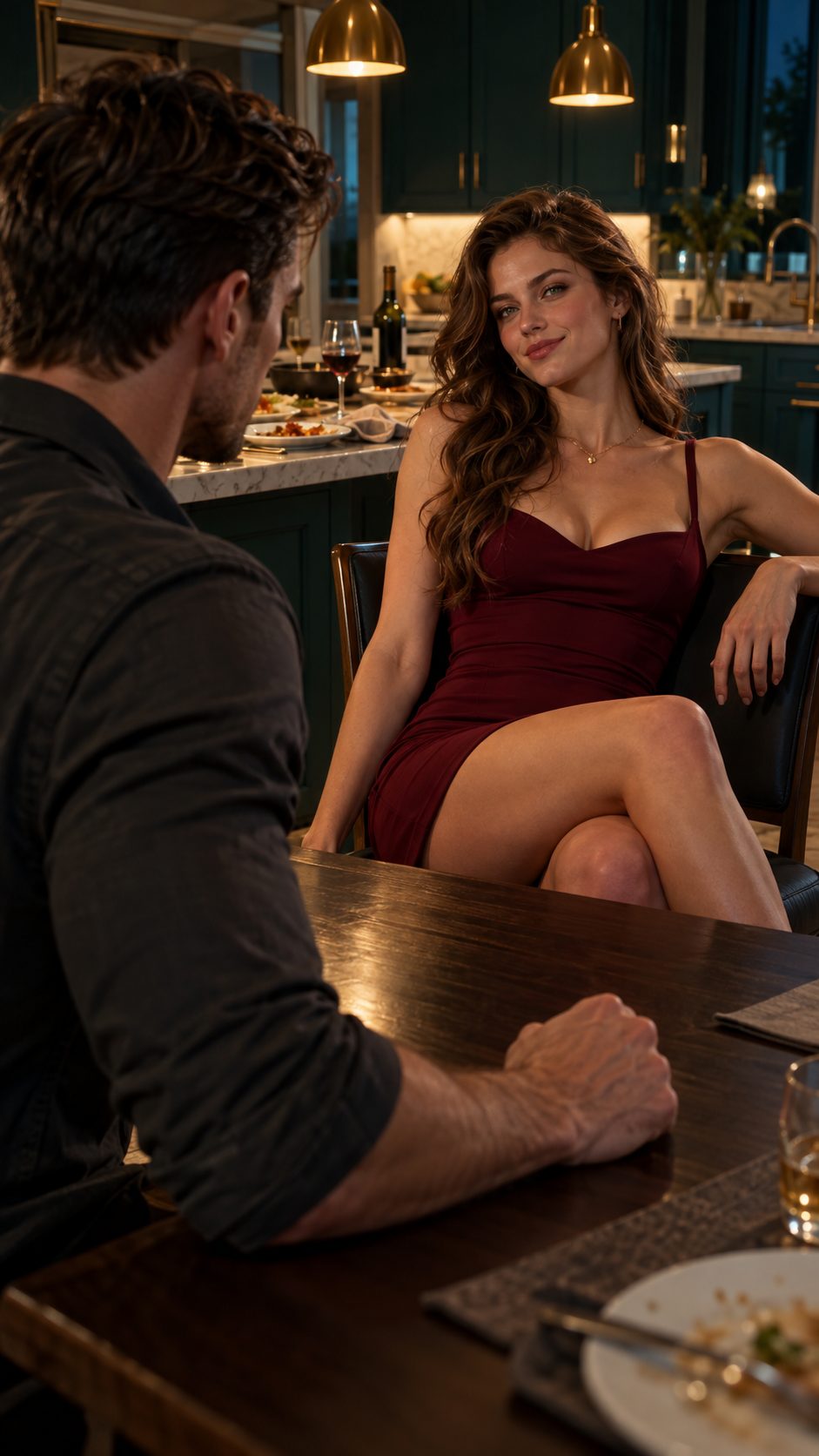
My wife didn’t even bother denying the affair.
She leaned back in her chair, crossed her legs, and laughed when she noticed my hands trembling.
“I never meant to hurt you, Daniel,” she said.
“I just didn’t care enough to stay faithful.”
For a moment, I wondered whether I’d heard her correctly.
Eleven years of marriage.
Eleven Christmas mornings.
Eleven anniversaries.
Countless birthdays, vacations, arguments, apologies, Sunday breakfasts, and quiet evenings spent believing we were building something that would last.
And she had just reduced all of it to a sentence.
I looked down at my hands.
They were shaking badly enough that the water in my glass trembled.
Lauren noticed.
Of course she noticed.
She had always been exceptionally good at noticing weakness in other people.
What I’d mistaken for emotional intelligence during the early years of our marriage had gradually become something else—an ability to recognize exactly where a person was vulnerable and press until they gave her what she wanted.
“You’re being awfully quiet,” she said.
It was Thursday evening in our suburban home outside Raleigh, North Carolina.
The dishes from dinner were still sitting on the kitchen counter.
A half-empty bottle of Cabernet stood beside the sink.
Through the window, I could see the American flag on our front porch moving gently in the October breeze.
Everything looked painfully ordinary.
That was what disturbed me most.
Our house hadn’t changed.
The lights were still warm.
The dishwasher was still waiting to be loaded.
The clock above the pantry still ticked with the same irritating rhythm.
Only my marriage had collapsed.
Lauren examined her perfectly manicured nails.
“Honestly, I expected a bigger reaction.”
I didn’t answer.
She sighed dramatically.
“Come on, Daniel.
Don’t do the whole silent-treatment thing.”
I looked at the woman sitting across from me.
Her long chestnut hair fell over one shoulder.
She was wearing a burgundy dress I’d bought her for our anniversary the previous year.
I remembered the afternoon she’d tried it on, turning in front of our bedroom mirror while asking whether the color made her eyes look greener.
I’d told her she looked beautiful.
She had kissed me.
Back then, I had believed the kiss meant something.
Now she was wearing that same dress while explaining why she felt entitled to sleep with another man.
“You’re acting like I’m leaving you,” she continued.
That finally caught my attention.
“You’re not?”
She smiled, apparently encouraged that I’d spoken.
“Of course not.
We have a good life.
I love this house.
I love what we’ve built together.”
“What about me?”
She looked genuinely surprised.
“What about you?”
“Do you love me?”
Lauren considered the question longer than any wife should have to.
Then she shrugged.
“In my own way.”
Something inside my chest went cold.
Not because I hadn’t expected the answer.
Because I had.
For three weeks, I’d been preparing myself to hear those words.
I’d imagined every possible version of this conversation during sleepless nights and long drives through Raleigh.
I’d expected anger.
I’d expected tears.
I’d expected a passionate defense of whatever remained of our marriage.
I hadn’t expected her to sound bored.
“Look,” she said, setting down her wineglass.
“You and I are comfortable.
We’re stable.
But sometimes I need something different.”
Something different.
That was what she called the man she’d secretly been meeting for almost six months.
Not betrayal.
Not an affair.
Something different.
“And you expect me to accept that?”
Lauren leaned forward.
“I expect you to be mature about it.”
I nearly laughed.
“Yes, Daniel.
Not everything has to turn into some dramatic confrontation.”
She reached across the table and briefly touched my wrist.
It was a gesture she’d used a thousand times before.
Usually when she wanted something.
“You know I’m not going anywhere,” she said softly.
“And deep down, I think you know you don’t want me to.”
There it was.
The certainty.
The assumption that no matter how badly she treated me, I would remain exactly where she’d left me.
For most of our marriage, that assumption had been correct.
I’d forgiven her moods, defended her decisions, paid the bills when her spending got out of control, and made excuses when she embarrassed me in front of friends.
I had confused loyalty with an obligation to endure anything.
Lauren had confused my patience with an inability to leave.
I looked toward the clock.
Three days until Sunday.
Three days until the meeting I’d spent weeks arranging.
I folded my hands together beneath the table.
“All right,” I said.
Lauren blinked.
“All right?”
“If you want to keep seeing him, I have one condition.”
She leaned back again.
Her smile returned.
“Oh, this should be interesting.”
I met her eyes.
“Bring him here Sunday evening.
Seven o’clock.”
The room became quiet.
For the first time that evening, Lauren seemed genuinely confused.
“I want you both sitting across from me.
I want you to explain exactly what kind of arrangement you expect me to accept.”
She stared for a second.
Then she burst out laughing.
Not a nervous laugh.
Not the kind people make when they’re uncomfortable.
She laughed with the delighted disbelief of someone who had just discovered she possessed more power than she’d imagined.
“Oh my God,” she said.
“You seriously want to meet him?”
She shook her head.
“You really can’t imagine living without me, can you?”
I didn’t correct her.
“Will he come?”
“Of course he’ll come.
He’s not afraid of you.”
“I didn’t ask whether he was afraid.”
Lauren rolled her eyes.
Sunday at seven.”
She picked up her phone and began typing.
I watched her fingers move across the screen.
She didn’t hide the phone.
She didn’t turn it away.
She didn’t even pretend to feel ashamed.
A few moments later, it vibrated.
Her smile widened.
“He says that’s fine.”
She stood, walked around the table, and stopped beside my chair.
For one ridiculous second, I thought she might apologize.
Instead, she kissed two fingers and pressed them against my cheek.
“There,” she whispered.
We can all be adults.”
Then she turned and walked upstairs, humming.
I remained at the kitchen table.
I waited until I heard the bedroom door close.
Then I reached beneath my placemat and removed a folded sheet of paper.
Three dates were written across the top.
September 17.
September 24.
October 11.
The first was the day I discovered my wife’s affair.
The second was the day I learned who the other man really was.
And the third—the coming Sunday—was the reason I’d asked Lauren to bring him into our home.
She knew about the first date.
She had no idea what had happened on the second.
And she certainly didn’t understand what was waiting for her on the third.
I looked toward the staircase.
My hands started trembling again.
But Lauren had misunderstood something very important.
I wasn’t shaking because I was afraid of losing her.
I was shaking because I’d spent three weeks holding back the truth.
And on Sunday evening, I was finally going to let it out.
Three weeks earlier, I still believed my marriage could be saved.
That’s the part of this story I sometimes find hardest to admit.
I wasn’t a suspicious husband.
I wasn’t checking Lauren’s location every afternoon or interrogating her about business lunches.
I trusted her.
Perhaps more accurately, I had trained myself not to question her.
We met in Raleigh when I was a young architect struggling to establish my own design studio.
Lauren was working in event planning for a local nonprofit.
She had a quick laugh, a remarkable memory for people’s names, and an instinct for making everyone in a room feel important.
She walked into a charity auction where I’d been persuaded to donate a design consultation, pointed at my uncomfortable tie, and said, “You look like somebody dressed you for a job interview you don’t want.”
She stole my drink.
We talked for two hours.
Three months later, she was spending most weekends at my apartment.
Two years after that, we were married in a small ceremony near the Blue Ridge Mountains.
I used to think the important moments in a marriage were the obvious ones.
The proposal.
The wedding.
The purchase of our first home.
I know better now.
A marriage changes in tiny increments.
A conversation postponed.
A question dismissed.
A resentment left unspoken.
An apology that never comes.
By the time you realize something is wrong, the relationship you remember may have disappeared years earlier.
Lauren had changed gradually.
Or perhaps she had simply become less interested in hiding certain parts of herself.
About a year before I discovered the affair, she began spending more time away from home.
There were networking dinners.
Professional conferences.
Last-minute meetings.
She’d recently taken on a larger client-relations role at my architecture firm, Reed Studio, and I initially welcomed her enthusiasm.
We had twelve employees and a growing reputation for restoring historic properties.
Our biggest project was the proposed redevelopment of Westbrook Mill, an abandoned textile complex just outside downtown Raleigh.
The plan was ambitious.
Affordable apartments.
Small retail spaces.
A community courtyard.
A preserved section of the original brick factory for local businesses.
It was the kind of project I’d dreamed of working on since architecture school.
My father-in-law, Thomas Whitaker, had invested in the studio years earlier and was helping us negotiate financing.
Thomas wasn’t merely wealthy.
He was respected.
He’d spent four decades building a regional construction business without acquiring the reputation for dishonesty that so often follows men in his industry.
I admired him.
And he had always treated me like family.
Lauren liked to joke that her father respected me more than his own daughter.
At the time, I thought it was harmless teasing.
Later, I wondered how much resentment had been hiding beneath the joke.
On September 17, I came home unexpectedly at in the afternoon.
A meeting with a municipal planning consultant had been canceled.
I’d planned to surprise Lauren with an early dinner.
Instead, I found a cream-colored receipt beside the printer in my home office.
It was from a boutique hotel in Charlotte.
Two nights.
A luxury suite.
Room service.
The total was a little over $1,800.
The reservation listed Lauren Reed.
The payment had been made using a card attached to our joint account.
I stared at the receipt.
At first, I assumed there was an innocent explanation.
Lauren had attended a marketing conference in Charlotte that month.
Maybe the hotel had upgraded her.
Maybe some expenses had been incorrectly charged.
But then I noticed the second name printed near the bottom.
Adrian Cole.
I didn’t recognize it immediately.
I sat at my desk and searched my memory.
The name sounded familiar.
I remembered hearing Lauren mention an Adrian once or twice, usually in connection with business dinners.
That evening, I asked her about the conference.
She was standing in the kitchen, pouring sparkling water into a glass.
“How was Charlotte?”
“Exhausting.”
“Good hotel?”
“Nothing special.”
“Did you have dinner with anyone?”
She paused.
Then shrugged.
“A few people from the conference.”
“Anyone I know?”
“Just making conversation.”
Lauren smiled, but it didn’t reach her eyes.
“Daniel, you know how these things are.
Everybody talks to everybody.”
Then I asked one more question.
“Who’s Adrian Cole?”
Her glass stopped halfway to her mouth.
Only for a fraction of a second.
But I saw it.
“Some investment guy,” she said.
“From the conference?”
“Probably.”
“Probably?”
She gave an irritated sigh.
“Do I have to remember every person I meet?”
“Then stop interrogating me.”
That was the end of the conversation.
Or at least, it was the end of the part she knew about.
The following morning, I checked our financial records.
I wasn’t looking for evidence of an affair.
I was trying to convince myself there wasn’t any.
Instead, I found six months of charges that suddenly looked different.
A restaurant in Durham on a night Lauren claimed to be attending a fundraiser.
Two hotel reservations in Charlotte.
A spa package for two.
An expensive gift purchased at a jewelry store I’d never visited.
And a series of transfers from her personal spending account that made little sense.
None of it proved infidelity by itself.
But together, it formed a picture I could no longer ignore.
I spent that Friday sitting in my car outside our office building, staring at a photograph of Lauren on my phone.
It was from our tenth anniversary.
She was smiling at me with her arms around my neck.
I remembered how happy we’d seemed.
How convinced I’d been that difficult years had only made us stronger.
I called my oldest friend, Marcus Bennett.
Marcus and I had known each other since college.
He listened without interrupting.
When I finished, he asked, “What do you want to do?”
“I want to know whether I’m wrong.”
“Then find out.”
“And if I’m not?”
There was a long silence.
“Then you’ll have to decide what kind of life you want, Dan.”
I went home that evening intending to confront Lauren.
But she arrived wearing a beautiful cream blouse, kissed my cheek, and asked whether I wanted Chinese takeout.
I looked at her.
She looked completely normal.
That frightened me.
If she could lie so naturally about something this important, what else didn’t I know?
I decided not to confront her until I understood what was happening.
At first, that decision was about protecting my marriage.
Within a week, it became about protecting something much larger.
Because Adrian Cole wasn’t simply a man having an affair with my wife.
He was connected to the most important business deal of my career.
And Lauren had been helping him.
September 24 began with a phone call from our outside accountant.
Her name was Evelyn Brooks, and she’d handled Reed Studio’s finances for almost seven years.
Evelyn rarely called me before nine.
When I saw her name on my phone at that morning, I answered immediately.
“Daniel, I need to ask you something.”
Her voice was unusually serious.
“What’s wrong?”
“Did you authorize someone to download the Westbrook cost files?”
I sat up in bed.
Lauren was already in the shower.
“What cost files?”
“The detailed remediation estimates.
The contractor bids.
The private contingency figures.”
There was a pause.
“Someone accessed the secure project folder last Thursday.”
Last Thursday.
September 17.
The same day I’d found the hotel receipt.
“The access was through Lauren’s credentials.”
For a moment, I didn’t speak.
Evelyn continued.
“I’m not accusing anyone.
Lauren’s authorized to review client material, but these files weren’t part of her usual work.
And the downloads happened after midnight.”
I rubbed my forehead.
“Can you tell where they went?”
“Not from the access log alone.
That’s why I’m calling.”
“Don’t mention this to anyone yet,” I said.
“Let me talk to our attorney.”
After hanging up, I remained motionless.
The shower was still running.
I could hear Lauren singing faintly behind the bathroom door.
Something about that sound made my stomach turn.
I already suspected she was sleeping with another man.
Now I had to consider the possibility that she was giving him confidential information from my company.
I called Maya Chen, our business attorney, before breakfast.
Maya was practical, direct, and remarkably difficult to impress.
When I explained what Evelyn had found, she didn’t ask about my marriage.
She asked about access permissions, contractual obligations, and whether I’d preserved the original records.
“Daniel,” she said, “do not start accusing people before we understand the evidence.”
“Lauren is my wife.”
“She’s having an affair.”
Maya went quiet.
Then she said, “I’m sorry.”
It was the first genuine expression of sympathy I’d heard since discovering the hotel receipt.
I nearly lost my composure.
But Maya continued.
“Those are two separate problems, even if they turn out to be connected.
We’ll handle them carefully.”
Over the next several days, Evelyn worked with an independent digital-forensics specialist to examine the company’s authorized systems.
I consulted a separate family-law attorney.
I didn’t want revenge.
I wanted facts.
I wanted to understand the scope of the damage before making decisions that could destroy my business and my marriage at the same time.
The evidence arrived in pieces.
Lauren’s work account had accessed files unrelated to her responsibilities.
Several confidential documents had been exported to an external storage location.
An internal project presentation had been opened from an unfamiliar device.
Then Evelyn found an email attachment in a company archive that made me stop breathing for a second.
It was a draft financial comparison showing the maximum price Reed Studio and our investment partners could afford to pay for Westbrook Mill.
A handwritten note had been added to the exported copy:
Their ceiling is lower than they think.
Use the environmental numbers.
The sender’s account belonged to Lauren.
The recipient was associated with a private domain connected to Larkspur Capital.
And one of Larkspur’s senior managing directors was Adrian Cole.
The same Adrian whose name appeared on the hotel receipt.
I searched the company’s website.
There he was.
Mid-forties.
Expensive suit.
Perfect smile.
A biography filled with phrases about strategic investments, complex acquisitions, and creating long-term value.
His photograph looked familiar.
Then I remembered.
Six months earlier, Thomas Whitaker had brought Adrian to a dinner at our house.
He’d introduced him as a sharp investment executive who might help Westbrook attract financing.
Lauren had spent most of that evening talking to Adrian near the patio doors.
I’d thought nothing of it.
Why would I?
She often handled introductions and client relationships.
That was part of her job.
I remembered Adrian complimenting our home.
I remembered Lauren laughing at one of his jokes.
And I remembered him shaking my hand before leaving.
“You’ve built something impressive here, Daniel.”
I’d thanked him.
Now I wondered whether he’d been talking about my company.
Or about the life he’d already decided to take apart.
By the afternoon of September 24, Maya had reviewed the initial findings.
She asked me to come to her office.
Evelyn was there.
So was the forensic specialist, Eli Warren.
Eli displayed a series of documents on a conference-room monitor.
“These files were copied over several sessions,” he explained.
“We can establish when they were accessed and which account was used.
We still need to verify who physically operated the device in every session.”
He moved to another page.
“But the external destination is associated with a company controlled by Larkspur.”
I leaned forward.
“Adrian Cole.”
Eli nodded.
Maya folded her hands.
“There is something else.”
I looked at her.
“Larkspur has been working through an affiliated investment entity to position itself for the Westbrook acquisition.”
“That’s public information.”
“The interest is public.
The structure isn’t.”
She slid a document toward me.
It was a draft agreement obtained through a legitimate review of our transaction files.
Adrian’s investment group was preparing an offer that would potentially gain control of the project at a price significantly below the value supported by our independent estimates.
If they knew our financing limits and the environmental risks we’d already investigated, they could use that information to pressure our partners.
The financial damage could be enormous.
But that wasn’t the worst part.
Maya pointed toward a paragraph in the agreement.
“If this transaction goes through as proposed, Reed Studio could lose its design role after the acquisition.”
I stared at the paper.
My company.
My employees.
Three years of planning.
The project that had nearly consumed my life.
All of it could be taken away.
And Lauren had apparently helped create the opportunity.
“Does Thomas know?”
“No,” Maya said.
Thomas had personally invested a substantial amount in our studio.
He was also one of the advisers helping coordinate the Westbrook financing.
He’d introduced Adrian to us.
His own daughter had used that introduction to begin an affair that now appeared connected to a threat against our business.
I felt sick.
“Do we know what Adrian promised her?”
“What do we do?”
Maya leaned back.
“We preserve everything.
We verify the remaining facts.
We notify the appropriate parties through counsel.
And we protect the project before anyone signs something they can’t easily undo.”
“When is the acquisition committee reviewing the final proposal?”
“Monday, October 12.”
I looked at the calendar on the wall.
Sunday was October 11.
A little more than two weeks away.
Something began taking shape in my mind.
At first, it wasn’t a plan.
It was a question.
What would happen if Adrian Cole were forced to explain his relationship with my wife while the people he’d deceived were present?
Would he deny it?
Would Lauren protect him?
Would either of them understand that the affair was no longer the only thing at stake?
Maya seemed to read my expression.
“Whatever you’re thinking, Daniel, talk to me before you do it.”
That afternoon, I drove home through a steady rain.
Lauren’s car was parked in the driveway.
Inside, I found her in the living room, laughing at something on her phone.
She looked up.
“Hey, handsome.”
I stopped in the doorway.
She smiled.
“What’s wrong?
You look exhausted.”
I studied her.
Eleven years.
Eleven years of knowing the sound of her laugh and the shape of her smile.
And suddenly I couldn’t tell whether I knew her at all.
“Long day,” I said.
She held out her hand.
“Come sit with me.”
She rested her head against my shoulder.
For a few seconds, we looked like any other married couple at the end of a difficult workday.
Then her phone vibrated.
She glanced at the screen.
And smiled.
I knew, without seeing the message, who had sent it.
That was the moment something inside me finally changed.
I didn’t move away.
I didn’t raise my voice.
I simply understood that whatever happened next, I could no longer make decisions based on the woman I remembered.
I would have to deal with the woman sitting beside me.
And I would need to be very careful.
The hardest part of keeping a secret is behaving normally around someone who thinks they know everything about you.
For two weeks, I went to work.
I attended design meetings.
I approved invoices.
I answered questions from contractors and argued with the city about parking requirements for Westbrook Mill.
At home, I made coffee.
I asked Lauren how her day had gone.
I listened to her complain about difficult clients and expensive salon appointments.
And every evening, I tried to imagine how I could have spent eleven years beside someone who could betray me so comfortably.
There were moments when I almost confronted her.
Once, I stood outside our bedroom while she talked on the phone in a low voice.
She was laughing.
I heard her say, “He doesn’t suspect anything.”
I remember placing my hand against the wall.
My first instinct was to walk in, take the phone, and demand an explanation.
Instead, I went downstairs.
I sat in the dark until she finished her conversation.
It wasn’t cowardice that kept me quiet.
It was the growing realization that an emotional confrontation might give Adrian time to protect himself.
And by then, I knew there was more at stake than my pride.
Maya had discovered additional irregularities in the project files.
Some of the confidential information Lauren had accessed was later reflected in an analysis prepared for Adrian’s proposed acquisition.
We couldn’t yet establish every step by which it had traveled.
But the similarities were specific enough to concern everyone reviewing the transaction.
Evelyn also found a draft presentation describing a future communications role connected to Larkspur’s redevelopment venture.
The document listed a candidate named Lauren Reed.
There was no evidence that the position had been formally offered.
But the implication was difficult to ignore.
Adrian might have promised Lauren a glamorous new career alongside a man she considered powerful and successful.
And she might have been willing to risk my company to get it.
I spent a sleepless night staring at that document.
It would have been easier if the affair had been only about sex.
Humiliating, painful, and devastating—but at least understandable.
This was different.
This required decisions.
Accessing files.
Sharing information.
Possibly jeopardizing the livelihoods of people who trusted us.
I thought about Nora, our office manager, who had recently returned from maternity leave.
I thought about Luis, one of our senior designers, whose wife was receiving treatment for a serious illness.
I thought about Marcus, who had helped me keep the studio alive during its first difficult years.
These weren’t names on a payroll spreadsheet.
They were people.
Lauren knew them.
She’d attended their birthday dinners and met their children.
And somehow, she’d persuaded herself that whatever Adrian promised was worth the risk.
The first person I told outside our professional advisers was Thomas Whitaker.
I met him at his office on Tuesday, October 6.
His secretary brought us coffee.
Thomas looked at the folder I’d placed on his desk.
“What’s this?”
“Something you need to see.”
He opened it.
I watched his expression change as he read.
At first, he appeared confused.
Then concerned.
Then deeply, painfully tired.
When he reached the section concerning Lauren, he removed his reading glasses.
“Are you certain?”
“We’ve verified the records we can.
Some questions are still unanswered.”
He looked down.
“She’s my daughter.”
He closed the folder.
For several seconds, he said nothing.
Then he asked, “Does she know you found out?”
“And Adrian?”
Thomas turned toward the window.
He had introduced Adrian to our family.
He’d vouched for his professional reputation.
He’d invited him into a project that represented years of effort and millions of dollars.
Now he was discovering that his judgment might have helped expose us to betrayal.
“I’m sorry, Daniel.”
I shook my head.
“You didn’t do this.”
“I brought him to your house.”
“You didn’t know.”
Thomas looked at me.
“Neither did you.”
Those four words nearly broke me.
Because they were true.
Thomas told me he was leaving for Asheville on business the next morning and would return Sunday afternoon.
He asked whether I wanted him to confront Lauren.
He studied me.
“What’s your plan?”
“I want to give her a chance to tell me the truth.”
“And if she doesn’t?”
“Then I need to stop pretending she’ll suddenly become someone else.”
Thomas nodded slowly.
“Whatever you decide about your marriage, I’ll support your right to make that decision.”
I appreciated the words.
But I also knew he was going to have to make decisions of his own.
The Monday acquisition review was approaching.
His endorsement carried weight.
So did mine.
We couldn’t allow the committee to evaluate a transaction while material concerns remained undisclosed.
Maya was already preparing formal notices and arranging for the relevant information to reach the right people.
The business side would proceed through proper channels.
The personal side remained unfinished.
By Thursday, October 8, I had reached a decision.
I would ask Lauren directly.
I would give her one opportunity to acknowledge what she’d done without inventing another lie.
And I would make sure Adrian understood that the husband he had underestimated was no longer willing to remain silent.
That was the evening Lauren laughed at me across our kitchen table.
That was the evening she admitted the affair.
And that was the evening I asked her to bring Adrian to our home on Sunday.
I didn’t tell her Thomas would be there.
I didn’t tell her that Maya had already advised me about the documents we needed to preserve.
I didn’t tell her how much I knew.
I simply asked for a meeting.
Lauren accepted immediately.
To her, my request sounded like surrender.
She thought I wanted to negotiate how often she could see another man.
She thought I loved her too much to contemplate divorce.
She thought the worst thing that could happen on Sunday was an uncomfortable conversation.
After she went upstairs, I sat alone for nearly an hour.
Then I wrote three names beneath the dates on the paper.
September 17 — Lauren.
September 24 — Adrian.
October 11 — Thomas.
I stared at the final name.
There was something terrible about the fact that Lauren’s own father would be present when she discovered what we knew.
I didn’t enjoy that part.
I didn’t want to humiliate her in front of him.
But Thomas was a financial stakeholder in the transaction, and he’d placed his trust in Adrian.
He deserved an honest conversation.
And Lauren had spent months avoiding one.
I folded the paper.
Then I made a decision that frightened me more than any business confrontation.
I called my divorce attorney.
“Sarah,” I said when she answered, “I think it’s time to prepare the separation papers.”
She was quiet for a moment.
“Are you sure, Daniel?”
I looked toward the staircase.
For eleven years, I’d measured my decisions by how they might affect Lauren.
That night, for the first time, I asked myself what remaining in the marriage would do to me.
“Yes,” I said.
“I’m sure.”
Friday morning, Lauren woke up happier than I’d seen her in months.
She was humming in the bathroom when I came downstairs.
By the time I finished making coffee, she’d already ordered breakfast delivery and started talking about the weekend.
“I booked a salon appointment,” she announced.
“And I need to pick up a dress.”
I looked at her.
“For Sunday.”
She said it so casually that I almost thought she was joking.
But she wasn’t.
She intended to dress up for a meeting between her husband and her lover.
“You don’t think that’s a little strange?”
Lauren laughed.
“Oh, Daniel.
Don’t start.”
She placed a hand on my shoulder.
“I actually think Sunday could be good for us.”
Once you meet Adrian, you’ll understand he’s not some terrible person.”
I set my coffee down.
“That’s what you’re worried about?
Whether I think he’s a terrible person?”
“He’s complicated.”
She gave me a dismissive smile.
“You’re dependable.
That’s different.”
There are sentences you hear once and remember forever.
That was one of them.
I had worked fifty- and sixty-hour weeks when our company was struggling.
I’d spent nights in hospital waiting rooms when her mother was sick.
I’d driven six hours through a snowstorm because Lauren was stranded after a conference.
I’d defended her when relatives criticized her decisions.
And somehow, all of that had become a single disappointing word.
Dependable.
She said it the way someone might describe a dishwasher.
A perfectly useful appliance that lacked excitement.
“I didn’t realize being dependable was such a problem,” I said.
Lauren looked annoyed.
“Don’t twist my words.”
“You’re acting wounded because I’m being honest.”
I looked at her.
“Honesty would have been telling me about Adrian six months ago.”
For the first time that morning, her expression hardened.
“Are we going to keep doing this?”
“Doing what?”
“Punishing me for being unhappy.”
I held her gaze.
“Did you ever tell me you were unhappy?”
“Daniel, I’m not going to give you a list of dates.”
I nearly smiled at the irony.
Dates were exactly what I had been collecting.
She picked up her handbag.
“I have an appointment.
I’ll see you tonight.”
Then she walked out.
I watched her car pull away.
The house became quiet.
I stood at the kitchen window and tried to remember the last time we’d had a conversation that wasn’t about what Lauren needed.
I couldn’t.
That afternoon, I met Maya.
We reviewed the latest financial records and the formal steps needed to protect Reed Studio.
Larkspur’s affiliated acquisition proposal had not yet been approved.
The committee reviewing the Westbrook transaction had authority to pause or reject it if material conflicts came to light.
Our job was to make sure the concerns were disclosed accurately, not dramatized.
Maya was firm about that.
“We deal in evidence,” she said.
“Not revenge fantasies.”
“Even if Adrian admits the affair, that doesn’t automatically prove the business allegations.”
“I understand.”
Because I know you’re angry.”
I looked at the folder.
“Angry isn’t the word.”
She waited.
“I feel like every ordinary memory has been rewritten.”
Maya’s expression softened.
“What do you mean?”
“I keep remembering things.
Phone calls.
The way Lauren talked about Adrian.
Every time she came home late.
Every time she told me I was being distant.”
“Now I don’t know which parts of my marriage were real.”
Maya leaned forward.
“Some of it was real, Daniel.
Betrayal doesn’t erase every good thing that happened before it.”
I looked at her.
“Then why does it feel like it does?”
She didn’t offer an easy answer.
I appreciated that.
That evening, Lauren returned carrying a large shopping bag.
She entered the bedroom while I was reading.
“Want to see what I bought?”
She pulled out a champagne-colored dress.
It was beautiful.
Expensive-looking.
She held it against herself and turned toward the mirror.
“What do you think?”
I studied her reflection.
“You look nice.”
She made a face.
That’s all?”
“What would you like me to say?”
She laughed.
“God, you’re impossible lately.”
I lowered my book.
“Lauren, why do you want me to meet Adrian?”
She turned.
“Because you asked.”
“That’s not what I mean.”
“Then what do you mean?”
“Why are you so excited about it?”
She hesitated.
For a moment, I thought she might say something honest.
Instead, she smiled.
“Because maybe once you see how harmless this is, we can stop making everything so difficult.”
I looked at the dress again.
“Does Adrian know what you expect after Sunday?”
“Of course.”
“Has he agreed to it?”
She raised an eyebrow.
“You sound jealous.”
“I’m asking a question.”
“Adrian understands the arrangement.”
“What arrangement?”
She waved a hand.
“Daniel, please.”
Then she walked into the bathroom and shut the door.
I sat motionless.
Adrian understands the arrangement.
That phrase stayed with me all night.
I wondered whether Adrian had told Lauren the same things she was telling me.
I wondered whether he had promised her a future.
A better job.
A better lifestyle.
A different version of herself.
Or whether he’d simply discovered she was useful.
Saturday morning gave me another glimpse of the truth.
Lauren was brushing her hair in front of the bathroom mirror when I walked past the doorway.
She glanced at me through the reflection.
“Don’t make things awkward tomorrow.”
“Adrian is actually a very successful man.”
Her brush froze.
“I said I know he’s successful.”
She turned slightly.
“How do you know?”
I met her eyes in the mirror.
“You’ve mentioned it several times.”
She studied my face.
Then her smile returned.
“Well, good.
I’m glad you’re being reasonable.”
But I noticed something.
The hand holding her hairbrush wasn’t quite steady anymore.
For the first time, Lauren seemed to sense that the conversation wasn’t going exactly as she’d planned.
She watched me for several seconds before asking, “You haven’t been talking to anyone about this, have you?”
I kept my voice neutral.
“About what?”
I looked at her reflection.
“Because our marriage is private.”
The words were so astonishing that I almost laughed.
Instead, I said, “It used to be.”
Lauren looked away.
And for the first time since she’d admitted the affair, she had nothing to say.
Saturday afternoon, I went to the office.
I didn’t have any meetings.
I simply needed to be somewhere that hadn’t been filled with lies.
Reed Studio occupied the second floor of a renovated brick building near downtown Raleigh.
We had designed the space ourselves.
High ceilings.
Exposed beams.
Long windows.
A large central worktable where our staff gathered to review drawings.
On the wall opposite my office hung a photograph of the studio’s first project.
A tiny neighborhood library renovation that had barely paid enough to cover our expenses.
Marcus was already there when I arrived.
He looked up from his laptop.
“Thought you’d be home.”
“I needed to finish something.”
He nodded toward my office.
“Want company?”
“Not really.”
I brought bad coffee anyway.”
I laughed for the first time in days.
We sat at the central table.
For a while, neither of us spoke.
Then Marcus asked, “How are you holding up?”
I stared at my coffee.
“I don’t know.”
“Sometimes I feel nothing.
Then something stupid happens, like I see her toothbrush beside mine, and suddenly I can’t breathe.”
Marcus didn’t interrupt.
“I keep thinking about how easy it seems for her.”
“Maybe it isn’t.”
“She laughed at me, Marcus.”
His expression changed.
“Thursday night.
When she admitted everything.”
He looked down.
“That’s cruel.”
For several minutes, we sat in silence.
Then he said something I hadn’t considered.
“You know you don’t have to win some dramatic battle to justify leaving.”
I looked at him.
“You don’t need her to understand.
You don’t need her to apologize.
You don’t even need her to regret it.”
“You can just decide you’ve had enough.”
I stared at him.
Somewhere deep down, I’d known that.
But hearing it said aloud felt strangely liberating.
“I think I’ve already decided,” I said.
“Then don’t confuse protecting the business with fixing your marriage.”
That distinction mattered.
The financial investigation wasn’t a substitute for divorce.
The upcoming confrontation wasn’t going to make Lauren faithful.
And whatever happened to Adrian, there was no outcome that would return us to the people we’d been before the affair.
I had to accept that.
Around four, Maya called.
The independent review had identified enough serious concerns for our counsel to notify the relevant transaction advisers and request that Monday’s decision be deferred pending examination.
No one had been found legally responsible for wrongdoing.
There were still unanswered questions about who had transmitted which information and what any participant knew.
But the deal could no longer be treated as routine.
Thomas had received the update.
He called me from Asheville.
“I’ll be back tomorrow afternoon,” he said.
“Are we still doing seven?”
“Daniel, you know I don’t have to come.”
“You invested in the company.
You introduced Adrian.
And Lauren is your daughter.”
“I know all that.”
“Then I think you should hear what they say.”
Thomas sighed.
“I’m not looking forward to it.”
“Neither am I.”
After hanging up, I spent another hour sorting through records.
By the time I left the office, the sun was beginning to set.
I drove past Westbrook Mill on my way home.
The building stood behind a chain-link fence, its old brick walls glowing copper in the evening light.
Weeds grew through cracks in the pavement.
Some of the windows were boarded up.
Others reflected the sky.
For years, people had driven past that place and seen an abandoned factory.
I’d seen apartments.
Children playing in the courtyard.
A place where people could begin again.
I pulled into a nearby parking lot and turned off the engine.
I had spent so much time trying to save the project that I’d almost forgotten why it mattered.
It wasn’t about impressing wealthy investors.
It wasn’t about proving myself to Thomas.
It certainly wasn’t about competing with Adrian Cole.
It was about building something useful.
Something that might remain standing long after I was gone.
And I wasn’t going to let someone else’s selfishness determine whether that vision survived.
When I got home, Lauren was sitting on the sofa, scrolling through her phone.
She barely looked up.
“You’re late.”
“I was at the office.”
“On a Saturday?”
She sighed.
“You’re going to have to learn how to relax, Daniel.”
I hung up my jacket.
She continued looking at her phone.
“Did you order the wine?”
“What wine?”
“For tomorrow.”
I stared at her.
She finally glanced up.
“The meeting.
“I remember.”
“Adrian likes good Cabernet.”
I looked at the woman I’d once imagined growing old beside.
She was asking me to purchase an expensive bottle of wine for the man she’d been sleeping with.
Not because she wanted to hurt me.
That would have required acknowledging my feelings.
She was asking because she genuinely believed her desires should determine the evening.
“There’s wine in the rack,” I said.
She rolled her eyes.
“Don’t be cheap.”
I walked toward the stairs.
Behind me, Lauren called, “Seriously, Daniel.
Don’t embarrass me tomorrow.”
For a second, I considered turning around.
I considered telling her everything.
I considered asking how she’d become someone who could say those words without hearing their cruelty.
But I didn’t.
Instead, I looked over my shoulder.
“You should get some sleep, Lauren.”
She frowned.
“Tomorrow might be a long night.”
Her eyes narrowed.
“What does that mean?”
I held her gaze.
“Good night.”
Then I went upstairs.
And behind me, for the first time all weekend, Lauren didn’t laugh.
Sunday arrived beneath a clear October sky.
I woke at six.
Lauren was still asleep beside me.
I lay there listening to her breathe, remembering mornings when that sound had made me feel safe.
Now it only reminded me how little I’d understood.
I got out of bed without waking her.
Downstairs, I made coffee and sat by the kitchen window.
The neighborhood was quiet.
Across the street, Mr.
Henderson was walking his golden retriever.
A delivery truck rolled past.
Someone was mowing a lawn two houses down.
The world had apparently decided to continue as usual.
At , Sarah, my divorce attorney, called to confirm that the initial paperwork was prepared.
Nothing was finalized.
There would be discussions about property, finances, and the legal steps required to separate our lives.
But the decision had been made.
For the first time in weeks, I felt strangely calm.
Around noon, Lauren appeared downstairs wearing a loose white sweater.
She looked cheerful.
“Big day,” she said.
She poured coffee.
“You’re not going to do anything embarrassing, right?”
“What would embarrass you?”
She gave me a warning look.
“I’m asking.”
“No shouting.
No accusations.
No dramatic speeches.”
I almost smiled.
“You seem very concerned about how I’ll behave.”
“Because I know you.”
I looked at her.
“No, Lauren.
I don’t think you do.”
She frowned.
But before she could respond, her phone vibrated.
She checked it.
Her expression softened.
“Adrian says he’ll be here a little after seven.”
“That’s fine.”
She looked relieved.
For a moment, I wondered whether she genuinely believed everything would return to normal after dinner.
Perhaps she imagined a strange arrangement in which she remained married to me while spending weekends with Adrian.
Perhaps she believed I would continue providing the home, the stability, and the respectable public life she enjoyed.
Whatever she expected, I knew it wouldn’t resemble what was about to happen.
At that afternoon, Thomas called.
He’d returned to Raleigh.
His voice sounded exhausted.
“Are you certain you want this meeting in your house?”
“We could do it at my office.”
“I want Lauren to understand what she’s done to our home, too.”
Thomas was silent.
Then he said, “All right.
I’ll be there.”
I hesitated.
“She’s still your daughter.”
“I don’t want you to stop loving her because of this.”
His answer came slowly.
“Daniel, loving someone doesn’t mean pretending they haven’t done something wrong.”
I closed my eyes.
“Thank you.”
“And you’re still family to me, whatever happens between you two.”
After the call, I sat at my desk for a long time.
Then I placed three items inside a plain manila envelope.
The first was a summary of the verified access records.
The second was a copy of the relevant transaction correspondence and conflict concerns prepared with counsel.
The third was a letter.
Not from Maya.
Not from Thomas.
I’d written it the night before.
It explained my decision to end the marriage.
I hadn’t written it to punish Lauren.
I’d written it because I knew that when the moment came, my emotions might make it difficult to say everything clearly.
By six o’clock, the house was immaculate.
Lauren had spent most of the afternoon getting ready.
At , I entered the dining room.
I placed three wineglasses on the table.
One for Lauren.
One for Adrian.
One for me.
Thomas wouldn’t be staying for dinner.
I set the sealed envelope beside my chair.
Then I checked my phone.
A message from Thomas.
I’m nearby.
I’ll wait until he arrives.
I put the phone away.
A few minutes later, Lauren came downstairs.
Her champagne-colored dress caught the light from the chandelier.
Her hair had been professionally styled.
She looked beautiful.
And entirely unaware.
“You’re really taking this seriously,” she teased.
“More than you know.”
She approached the table.
Then she noticed the glasses.
“It’s just going to be the three of us, right?”
I straightened the envelope.
She followed the movement of my hand.
“What’s that?”
“Something I need to discuss.”
Her smile weakened.
“Daniel, please don’t turn this into some legal drama.”
I looked up.
“Why would you think it’s legal?”
For a second, she didn’t answer.
Then she laughed.
“Because you’re acting like somebody died.”
I watched her.
“Something did.”
She rolled her eyes and walked toward the hallway mirror.
I heard her adjusting an earring.
At , a car pulled into the driveway.
Lauren hurried toward the front door.
Her smile returned.
“He’s here.”
I remained beside the dining-room entrance.
Then, at exactly , the doorbell rang.
Lauren reached for the handle.
And stopped.
Two male voices were speaking outside.
One belonged to Adrian Cole.
The other belonged to someone she knew very well.
Her hand froze against the brass doorknob.
The smile vanished from her face.
Slowly, she turned toward me.
“Daniel,” she whispered.
I’d never heard her sound like that.
“Who did you invite?”
I looked toward the envelope.
Then back at her.
“You agreed to the meeting, Lauren.”
She stared at me.
“I never promised he’d come alone.”
For several seconds, Lauren didn’t move.
She stood with her hand on the doorknob, staring at me as though I’d become a stranger.
Outside, Adrian spoke again.
“Thomas, I really think this is a misunderstanding.”
Then came the second voice.
“Then you shouldn’t have any trouble explaining it.”
Lauren closed her eyes.
“Oh my God.”
She recognized her father’s voice.
I could see it in the sudden color draining from her cheeks.
“Daniel,” she said quietly.
“What did you do?”
“I invited the people who need to hear the truth.”
“My father?”
“Why would you bring him into this?”
I studied her.
“You really think this is only about your marriage?”
Her lips parted.
She looked toward the dining room.
Toward the envelope.
And for the first time, I saw real fear in her eyes.
“What’s in there?”
Before I could answer, the doorbell rang again.
I walked past her and opened the door.
Adrian Cole stood on our porch.
He was exactly as I remembered him.
Perfectly tailored navy suit.
Expensive watch.
Polished shoes.
A confident expression that faltered when he saw my face.
Beside him stood Thomas Whitaker.
My father-in-law looked older than he had a week earlier.
His face was tired, and his jaw was set.
“Good evening, Daniel,” he said.
Adrian looked between us.
“I wasn’t aware this was going to be a business meeting.”
“It isn’t,” I said.
“Then perhaps we should discuss—”
“Come inside, Adrian.”
He hesitated.
Then stepped across the threshold.
Lauren stood several feet behind me.
“Is this some kind of setup?” she demanded.
Thomas looked at his daughter.
“Hello, Lauren.”
“Dad, why are you here?”
“Because Daniel asked me to come.”
“This is between me and my husband.”
Thomas’s expression tightened.
“I wish that were true.”
Lauren stared at him.
Then she looked at Adrian.
For the first time since I’d discovered the affair, I watched the two of them exchange a glance that wasn’t affectionate.
It was uncertain.
Almost accusatory.
Adrian straightened his jacket.
“Maybe everyone should calm down.”
I stepped aside.
“The dining room is ready.”
No one moved.
Then Thomas said, “Let’s hear what you came here to say, Adrian.”
We entered the dining room.
Lauren sat first.
Adrian took the chair beside her.
Thomas remained standing near the windows.
I sat across from them and rested my hands on the table.
Lauren was no longer smiling.
Adrian glanced at the three glasses.
Then at the envelope.
“Daniel,” he began, “I understand this is an emotionally difficult situation.”
I said nothing.
“I also understand that Lauren and I have developed a relationship.”
Lauren lowered her eyes.
Adrian continued.
“Adults sometimes find themselves in complicated circumstances.
Nobody intended to cause unnecessary pain.”
I stared at him.
That phrase.
Unnecessary pain.
As though there were an acceptable amount of pain one could deliberately cause another person.
“How long?”
He looked confused.
“I’m sorry?”
“How long have you been seeing my wife?”
He glanced at Lauren.
She remained silent.
“Several months,” he said.
He hesitated.
“Approximately.”
“And you knew she was married?”
“Of course.”
“And you knew who I was?”
“Daniel, I don’t think—”
“Did you know I was her husband when Thomas introduced you to us?”
Adrian shifted in his chair.
I looked at Lauren.
She was staring at her hands.
“Lauren,” I said.
“Is this what you wanted?
Both of us sitting here while Adrian explains how reasonable your affair is?”
She looked up.
Her eyes were wet.
“Please stop.”
I shook my head.
You wanted this meeting.
You agreed immediately.”
“I didn’t know Dad would be here.”
Thomas spoke quietly.
“Neither did I, until Daniel showed me some things I needed to see.”
Adrian’s head turned sharply toward him.
“What things?”
Thomas looked at me.
I reached for the envelope.
And Adrian’s expression changed.
It was subtle.
A slight tightening around the eyes.
A sudden stillness.
Or at least, he suspected.
For the first time that evening, the confident investment executive looked genuinely worried.
“Daniel,” he said carefully, “before you open that, perhaps we should speak privately.”
I held the envelope between my fingers.
“Privately?”
I looked at Lauren.
“Did you hear that?”
She said nothing.
“Six months ago, neither of you was particularly interested in privacy when it came to my marriage.
Now suddenly it’s important.”
Adrian leaned forward.
“You’re making a mistake.”
I met his eyes.
“Then explain what kind of mistake.”
He didn’t answer.
I placed the envelope on the table.
The room fell silent.
And I realized that the most important moment of the evening had finally arrived.
I opened the envelope slowly.
Not for dramatic effect.
Because my fingers had started trembling again.
Lauren noticed.
For one brief second, something resembling her old confidence returned.
“Daniel,” she said, “you’re getting yourself worked up.”
I looked at her.
Then I placed the first document on the table.
“No,” I said.
“I’m finally telling you what I know.”
I slid the paper toward Adrian.
It was a summary of the verified Westbrook file-access records.
Adrian glanced at it.
His face hardened.
“Where did you get this?”
“From our company’s records.”
He placed it down.
“I don’t know what you think this proves.”
“By itself?
It proves certain confidential files were accessed and exported through Lauren’s account.
We’re still reviewing who did what.”
Lauren looked at the document.
“What files?”
I turned toward her.
“Westbrook Mill.”
Her face went pale.
Adrian spoke immediately.
“Lauren, don’t say anything.”
Thomas stepped forward.
“Why shouldn’t she?”
Adrian looked irritated.
“Because this has become a legal matter, and I think everyone should have proper representation.”
Maya had already advised me not to mistake silence for guilt or an emotional reaction for proof.
I wasn’t interested in forcing a confession.
Still, Adrian’s sudden concern was revealing.
I placed the second document on the table.
“Your group was preparing to acquire Westbrook through an affiliated company,” I said.
“And the financial analysis we reviewed contains figures remarkably close to our confidential estimates.”
Adrian’s expression turned cold.
“Financial estimates can overlap.”
“Of course.”
“There’s nothing improper about exploring a business opportunity.”
He blinked.
I continued.
“That’s why the independent review matters.
That’s why the acquisition committee has been notified of the conflict concerns.
And that’s why your proposal is no longer being considered without additional scrutiny.”
Adrian stared at me.
“Notified?”
Thomas nodded.
For several seconds, nobody spoke.
Then Adrian turned toward Lauren.
“What exactly did you tell him?”
Lauren looked stunned.
“What did you tell Daniel?”
She stared at him.
His expression sharpened.
I watched them.
In that moment, the relationship she’d described as exciting and sophisticated began revealing its actual shape.
Adrian wasn’t looking at Lauren like a woman he loved.
He was looking at her like a potential liability.
Lauren seemed to understand it too.
She turned toward him.
“You said everything was legitimate.”
Adrian’s jaw tightened.
“You told me those documents were just background information.”
“Lauren, this isn’t the time.”
Thomas moved closer to the table.
“What documents did he ask you for?”
Lauren’s eyes filled with tears.
“What documents?”
She looked toward me.
I said nothing.
Finally, she whispered, “Some project files.”
Thomas closed his eyes.
Lauren started crying.
At first, I felt the familiar instinct to comfort her.
To put an arm around her shoulders.
To tell her we’d figure everything out.
For eleven years, whenever Lauren cried, I’d immediately assumed it was my responsibility to make things better.
I nearly stood.
Then I remembered the Thursday evening when she’d laughed at my trembling hands.
I stayed seated.
Adrian pushed back his chair.
“I think this conversation is over.”
Thomas turned toward him.
“You’re free to leave.”
Adrian stopped.
“But the review is proceeding,” Thomas continued.
“And I will be answering every question I’m asked about my introduction of you to this project.”
Adrian looked at me.
“You’ve damaged a relationship that could have been very valuable to your company.”
I held his gaze.
“If the relationship depended on my wife secretly giving you confidential information, it wasn’t valuable to us.”
His face reddened.
“Careful, Daniel.”
“No threats, Adrian,” Thomas said.
Adrian looked toward the older man.
Thomas continued.
“I trusted you.
I introduced you to my family.
You knew Daniel and Lauren were married.”
Adrian didn’t reply.
“You were welcome in this home,” Thomas said.
“And now there’s an investigation into information that may have passed through people connected to you.”
Adrian adjusted his jacket.
“I’m not discussing allegations without counsel.”
“That’s your right,” Thomas said.
Adrian turned to Lauren.
“Call me when this settles down.”
She stared at him.
“That’s it?”
“You’re leaving?”
“Lauren, this is serious.”
Her voice cracked.
“You told me we’d figure things out together.”
Adrian glanced at me, then at Thomas.
“Not here.”
“You promised me a position with the new company.”
The room went silent.
Adrian’s face changed.
“That was a preliminary discussion.”
“You said I’d be running communications for the redevelopment.”
“I said there might be an opportunity.”
Lauren stared at him.
“You said I was different.”
No one moved.
Adrian looked away.
“Lauren, please.”
She took a step toward him.
“You told me you were unhappy too.
You told me you wanted something real.”
His silence answered more than any explanation could have.
I watched Lauren’s face as she realized how little certainty she’d actually been given.
For months, she’d treated Adrian’s attention like proof that she deserved something better than our marriage.
Now the man she’d trusted was standing in our dining room, unwilling to promise her anything.
He walked toward the hallway.
Thomas followed him to the door.
I heard their footsteps.
Then the front door opened.
A moment later, it closed.
Adrian Cole was gone.
Lauren remained standing beside her chair.
She looked at me.
I didn’t answer.
She glanced at the remaining document.
“What’s that?”
I slid the final letter across the table.
Her name was written on the front.
She opened it.
As she read, her expression changed.
Then panic.
I watched her eyes move down the page.
“Daniel, no.”
“It’s my decision, Lauren.”
She shook her head.
“You said if I brought him here—”
“I said I had one condition if you wanted to keep seeing him.”
“You made it sound like—”
“Like I would accept it?”
She couldn’t answer.
I leaned forward.
“You assumed that because I loved you, there was nothing you could do that would make me leave.”
She began crying harder.
“Daniel, I made a mistake.”
I looked at her.
“A mistake is forgetting an anniversary.
A mistake is saying something cruel during an argument and regretting it.”
My voice remained quiet.
“Six months of lies weren’t a mistake.
Sharing confidential company information wasn’t a misunderstanding.
Laughing at me when I discovered the affair was a choice.”
She covered her mouth.
“I didn’t think you would leave.”
That was the saddest part.
She hadn’t believed I possessed the strength to walk away.
“I never wanted to lose you,” she whispered.
I looked toward the empty chair where Adrian had been sitting.
“You wanted to keep me while you figured out whether you liked someone else better.”
She started shaking her head.
“That’s not fair.”
“Neither was what you did.”
For a long moment, neither of us spoke.
Then she looked at the letter again.
“You really want a divorce?”
I felt a deep ache in my chest.
It would have been satisfying to tell her I no longer loved her.
But that wouldn’t have been true.
Love doesn’t always disappear when trust is destroyed.
Sometimes it remains, painfully and inconveniently, long after the relationship has become impossible.
“I don’t want the life you’re offering me,” I said.
Lauren lowered herself into the chair.
She looked smaller than she had on Thursday night.
Less certain.
Less powerful.
For the first time, she seemed to understand that she couldn’t control the outcome.
Thomas returned a few moments later.
He stopped when he saw his daughter crying.
“Dad,” she whispered.
He approached the table.
She looked up at him.
“Are you going to hate me?”
Thomas’s face tightened.
She began crying again.
He sat beside her.
“But I’m very disappointed in what you’ve done.”
“I didn’t mean for this to happen.”
He looked at her.
“Then you should have stopped making the decisions that allowed it to happen.”
Lauren stared at her father.
I had never heard him speak to her that way.
Thomas reached for her hand.
“I love you.
That isn’t going to change.”
She squeezed his fingers.
“But love doesn’t excuse dishonesty,” he continued.
“And it doesn’t make the consequences disappear.”
My chair scraped softly against the floor.
Lauren looked toward me.
“Where are you going?”
I need some space.”
“Daniel, please don’t go.”
I stopped at the doorway.
There was a time when those words would have brought me running back.
But that time was over.
“We’ll talk about the practical arrangements tomorrow,” I said.
“Tonight, I don’t have anything else to say.”
Then I walked upstairs.
Behind me, I heard Lauren crying.
Thomas spoke quietly to her.
I couldn’t make out the words.
For the first time in eleven years, I didn’t feel compelled to return and fix everything.
I closed the bedroom door.
And stood alone in the silence.
The next morning, Lauren knocked on the bedroom door at seven.
I was already awake.
I opened it.
She stood in the hallway wearing one of my old T-shirts.
Her eyes were swollen.
Her hair was tangled.
The glamorous woman who’d descended the staircase in her champagne-colored dress the previous evening seemed very far away.
“Can we talk?”
I stepped aside.
She entered the bedroom but didn’t sit.
For several seconds, she looked around.
At the photographs.
At the dresser we’d bought together.
At the framed picture from our honeymoon.
“I didn’t sleep,” she said.
“Neither did I.”
She nodded.
Then she looked at me.
“Adrian isn’t answering my calls.”
I said nothing.
“I called him five times.”
She started crying.
“I don’t understand how he could just leave.”
I looked at her.
And suddenly I understood something terrible.
Even now, part of her was still focused on Adrian’s rejection.
Not on what she’d done to our marriage.
Not on the people who might have been harmed by the business situation.
Not on the years we’d spent together.
She wanted to know why he hadn’t chosen her.
I sat on the edge of the bed.
“Lauren, I can’t help you understand Adrian.”
She wiped her cheeks.
“But you know him.”
“I know what I’ve learned about him.”
“Do you think he ever loved me?”
I looked down.
“I don’t know.”
She sat beside me.
For a moment, we were quiet.
Then she whispered, “I think I ruined everything.”
I looked at her.
“Maybe not everything.”
She turned toward me.
Hope appeared in her eyes.
I hated that I had to extinguish it.
“But our marriage is over.”
Her face collapsed.
“Please don’t say that.”
“It’s the truth.”
“I can change.”
“Maybe you can.”
“I’ll quit the company.
I’ll never speak to Adrian again.
I’ll go to therapy.
Whatever you want.”
I studied her.
Those promises might have meant something six months earlier.
Before the lies.
Before the confidential files.
Before the laughter.
Now they sounded like the desperate bargaining of someone who’d discovered that her choices had consequences.
“I hope you do change,” I said.
She reached for my hand.
I let her hold it.
“But if you change, it has to be because you want to become a better person.
Not because you’re afraid I’ll leave.”
She stared at me.
Then she slowly released my hand.
“You’re really not coming back from this.”
I shook my head.
She began crying again.
And for the first time, I cried too.
Not loudly.
Not dramatically.
Just tears that had been waiting for weeks.
We sat beside each other on the bed where we’d spent eleven years of our lives.
Two people who had once promised to grow old together.
Now trying to understand how they’d reached a place where goodbye was the only honest thing left to say.
The weeks that followed were not satisfying.
That’s something people rarely mention when they talk about revenge.
They imagine a dramatic confrontation followed by immediate relief.
They imagine the person who caused the pain finally understanding it.
They imagine that once the truth comes out, everything becomes simple.
It doesn’t.
The truth is exhausting.
There were calls with attorneys.
Financial disclosures.
Meetings with accountants.
Questions from our employees.
Difficult conversations with mutual friends.
And the painful process of separating two lives that had been intertwined for more than a decade.
Lauren eventually moved into an apartment near her father’s house.
I stayed in our home while we worked through the property arrangements.
I didn’t keep the house as some kind of victory.
In fact, I considered selling it.
For weeks, every room reminded me of something I’d lost.
The kitchen table.
The staircase.
The couch where Lauren used to fall asleep during movies.
The backyard where we’d planted a maple tree on our fifth anniversary.
But slowly, the memories began to change.
The house stopped feeling like a museum of our marriage.
It started feeling like somewhere I could begin again.
The business situation took longer.
The Westbrook acquisition review was paused while the relevant parties examined the conflict concerns and the handling of confidential information.
Adrian’s proposed transaction did not proceed on the original schedule.
His firm’s involvement became the subject of additional professional and legal scrutiny.
There were competing accounts of what had happened.
There were questions that had to be answered carefully.
I learned that discovering the truth and establishing legal responsibility are not the same thing.
Maya reminded me of that repeatedly.
We continued working with the appropriate advisers and investigators.
We preserved records.
We cooperated with the review.
And we made sure our employees weren’t left in the dark about matters that affected their jobs.
I didn’t make public accusations to damage Adrian’s reputation.
I didn’t post messages about Lauren on social media.
I didn’t try to turn our private humiliation into entertainment.
I had enough to rebuild without making my future depend on their destruction.
Three months later, Reed Studio secured a revised path forward for Westbrook Mill with new oversight and financing arrangements.
It wasn’t exactly the project we’d originally planned.
We had to reduce some of the commercial space and restructure several development phases.
But the affordable apartments remained.
So did the community courtyard.
One Friday afternoon, Marcus and I walked through the empty factory carrying updated plans.
Rain fell through a broken section of the roof.
The building smelled of wet brick and old timber.
Marcus stopped beside a large industrial window.
“You know,” he said, “six months ago I thought this place was going to kill us.”
“Three months ago, I thought everything was going to kill us.”
He grinned.
“Fair point.”
We stood looking at the drawings.
Then he asked, “How are you doing?”
For once, I didn’t automatically say I was fine.
I thought about the question.
“I’m getting better.”
“And sometimes I’m still angry.”
“Also fair.”
“I miss parts of my marriage.”
Marcus looked at me.
“Of course you do.”
I stared at the old factory floor.
“But I don’t miss the way I felt at the end.”
He didn’t answer.
He didn’t need to.
Lauren and I spoke occasionally during the separation process.
At first, she alternated between apologizing and blaming me.
Sometimes she said I’d neglected her.
Sometimes she said she’d felt invisible.
Other times she admitted she had liked the attention Adrian gave her and the future she’d imagined he could provide.
I listened when the conversations were constructive.
When they became accusations, I ended them.
Eventually, she began working with a therapist.
She sent me a letter several months after leaving the house.
It was six pages long.
I read it twice.
She wrote about how she’d gradually begun measuring her worth by attention, money, and status.
She admitted she’d mistaken excitement for happiness.
She acknowledged that she had wanted the security of our marriage without accepting the responsibilities that came with it.
And she admitted something I’d suspected from the beginning.
She had never seriously believed I would leave.
The final paragraph was the hardest to read.
You were the one person I thought would always be there.
I treated that as permission to hurt you instead of understanding it was something I should have protected.
I don’t know if I’ll ever forgive myself for that.
I sat at the kitchen table with the letter in my hands.
For a long time, I didn’t move.
Then I folded it and placed it in a drawer.
I didn’t reply immediately.
A week later, I wrote back.
I thanked her for acknowledging what she’d done.
I told her I hoped she continued doing the work necessary to build a better life.
And I told her that forgiveness, if it came, wouldn’t mean reconciliation.
We had both reached the point where we needed to move forward separately.
Our divorce was finalized after the required legal process.
There was no celebration.
No champagne.
No moment when I suddenly felt triumphant.
I walked out of my attorney’s office and sat in my car for nearly twenty minutes.
Then I drove home.
The house was quiet when I entered.
I placed my keys on the counter.
I opened the refrigerator.
I made myself a sandwich.
And I sat at the same kitchen table where Lauren had once laughed at my trembling hands.
For some reason, that ordinary moment affected me more deeply than the divorce hearing.
I was alone.
Not abandoned.
Not defeated.
Just alone.
And for the first time in years, the silence didn’t feel threatening.
It felt peaceful.
The following spring, Westbrook Mill finally broke ground on its first major construction phase.
The morning was cool and bright.
Our employees stood in hard hats beside the old brick building while a few city officials and community representatives gave short speeches.
Thomas was there.
He had continued supporting the studio through the review and the restructuring.
Our relationship had changed, of course.
He was no longer simply my father-in-law.
But he was still someone I trusted.
After the ceremony, he found me standing near the fence.
“Your father would have been proud of this,” he said.
My throat tightened.
My dad had died before I opened Reed Studio.
He’d been a carpenter who taught me that the best work was often the work nobody noticed—the framing behind the walls, the foundation beneath the floor, the joints that kept something standing after the paint began to fade.
“Thanks, Thomas.”
He looked toward the factory.
“Lauren asked about you.”
“How is she?”
“Better, I think.
Still figuring some things out.”
Thomas glanced at me.
“She knows you’re not coming back.”
He was silent for a moment.
Then he said, “For what it’s worth, I’m glad you didn’t let what happened make you cruel.”
I considered that.
There had been nights when cruelty sounded appealing.
Nights when I wanted Lauren and Adrian to feel every ounce of humiliation I’d experienced.
But eventually I’d realized that hurting them wouldn’t restore what I’d lost.
It would only keep me tied to them.
“I came pretty close,” I admitted.
Thomas gave a sad smile.
“Most of us do.”
We shook hands.
Then he returned to the crowd.
I remained by the fence for another few minutes.
Workers were moving equipment into position.
A crane stood against the blue sky.
Beyond the construction site, Raleigh stretched toward the horizon.
Life was moving forward.
And so was I.
That evening, I returned home just before sunset.
I opened the windows and let the spring air into the kitchen.
The American flag on the porch moved gently in the breeze.
I thought about the night everything had changed.
Lauren laughing.
My hands trembling.
Her confidence that I would never leave.
The meeting at seven.
The two voices outside the door.
The sealed envelope.
For a long time, I’d believed that Sunday evening was the moment I took back control of my life.
But standing in my kitchen, I understood something different.
The real turning point hadn’t been Adrian’s fear.
It hadn’t been Lauren’s tears.
It hadn’t even been the envelope.
It had been the moment I stopped asking whether Lauren would choose me.
And started asking whether the life she was offering was one I wanted to live.
I looked down at my hands.
They were steady.
Not because I’d won.
Not because she’d lost.
But because, after everything, I’d finally learned that loving someone didn’t require me to abandon myself.
Eleven years of marriage had ended.
The future I’d imagined was gone.
And still, standing there in the quiet house, I felt something I hadn’t experienced in a very long time.
I turned off the kitchen light and walked toward the front porch.
Outside, the evening was beautiful.
And for the first time, I wasn’t afraid to discover what came next.
✓ Lynn R. Adams
My wife didn’t even bother denying the affair. She leaned back in her chair, crossed her legs, and laughed when she noticed my hands trembling. “I never meant to hurt you, Daniel,” she said. “I jus…