CG-MY WIFE INVITED ME TO WATCH HER FILM A ROMANTIC BEDROOM SCENE WITH ANOTHER MAN SO I WOULD “STOP ACTING INSECURE”—BUT A SECRET 43-SECOND VIDEO EXPOSED HER AFFAIR, A CRUEL PLAN TO DESTROY OUR MARRIAGE, AND THE HOLLYWOOD LIES SHE NEVER THOUGHT I WOULD DISCOVER A Hollywood Betrayal, Marriage, Revenge, and Redemption Story
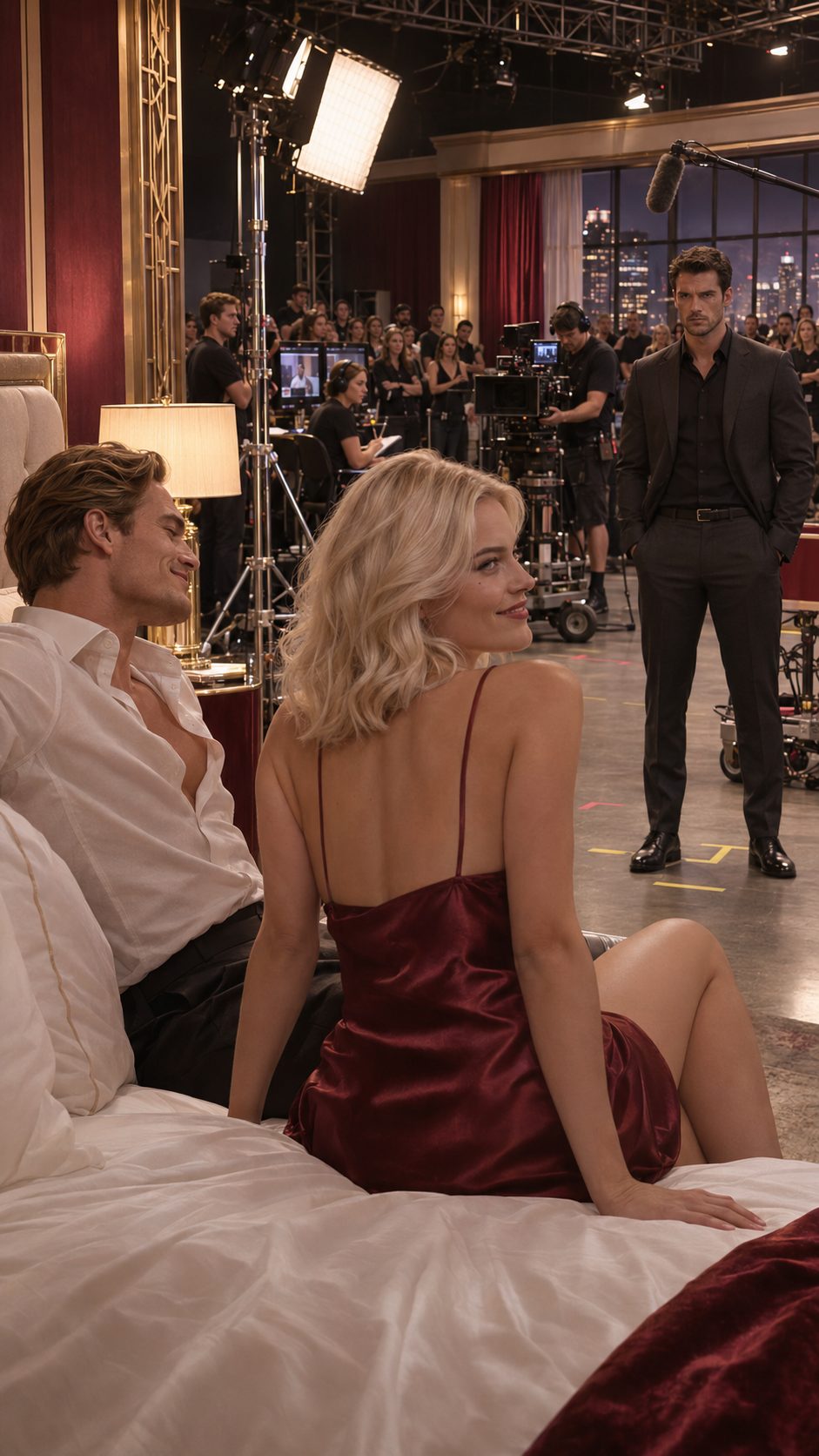
My wife invited me to watch her climb into bed with another man.
Then she laughed at me for being uncomfortable.
And thirty people laughed with her.
But the thing that destroyed our marriage wasn’t the bedroom scene.
It was a forty-three-second video that appeared on my phone less than an hour later.
A video I wasn’t supposed to see.
A video that proved my wife hadn’t invited me to the set to reassure me.
She had invited me there to destroy me.
My name is Noah Harper.
I was thirty years old, worked in documentary post-production, and had been married to one of Hollywood’s most recognizable young actresses for a little over a year.
Her name was Evelyn Vale.
To millions of Americans, Evelyn was the girl with the perfect smile.
She had started appearing in commercials as a teenager, landed her first major television role before finishing high school, and spent the following six years becoming what entertainment magazines loved to call America’s sweetheart.
She was beautiful, charming, and seemingly incapable of cruelty.
At charity events, she hugged children.
On talk shows, she talked about gratitude.
On red carpets, she held my hand and told reporters that marrying someone outside the spotlight had kept her grounded.
People believed every word.
I used to believe her, too.
That morning, I drove through the security gate of a studio lot in Burbank, California, with the uneasy feeling that I was walking into an argument that had already been rehearsed.
Evelyn had called me at seven.
“Come watch us film today,” she’d said.
I was making coffee in our Hollywood Hills kitchen.
“Because I’m tired of you making everything weird.”
I looked out at the morning sunlight spreading across the patio.
“Evelyn, I haven’t said anything about your scene.”
“You didn’t have to.
I saw your face when Carter texted me last night.”
Carter Wynn was her leading man.
Thirty-one.
Expensive smile.
He had the kind of career that Hollywood executives described as promising even when his movies underperformed.
For weeks, he’d been calling Evelyn late at night.
Their text conversations seemed to continue long after normal working hours.
Sometimes she’d leave the room to answer him.
Whenever I asked about it, she gave me the same response.
“It’s work, Noah.”
And whenever I pointed out that midnight seemed like a strange time to discuss a movie, she’d sigh.
“You’re being insecure.”
That word had become her favorite weapon.
Not concerned.
Not confused.
Not reasonably uncomfortable with another man calling my wife at one in the morning.
Just insecure.
So I agreed to visit the set.
I wanted to believe that seeing her work would help.
I wanted to remember the woman who used to laugh with me over terrible takeout and fall asleep with her head on my chest.
I still loved that woman.
Unfortunately, the woman waiting for me outside Soundstage 14 seemed determined to prove she no longer existed.
Evelyn stood beside a wardrobe trailer wearing a champagne silk robe over her costume.
Her platinum-blonde hair fell neatly around her shoulders.
She looked beautiful.
She always did.
But when she saw me, she didn’t smile like a wife greeting her husband.
She smiled like someone who’d just spotted an audience.
“Look who finally decided to show up.”
I checked my watch.
“I’m ten minutes early.”
I’m teasing.”
Before I could answer, a tall man stepped out of the trailer behind her.
He gave Evelyn a familiar look, then extended his hand toward me.
“Good to finally meet the husband.”
He emphasized the last two words.
Not Evelyn’s husband.
The husband.
I shook his hand.
He squeezed harder than necessary.
I didn’t return the gesture.
“Carter,” I said.
Hope you know it’s all professional.”
I hadn’t asked.
“Some guys have trouble separating the job from real life.”
Evelyn laughed.
Two production assistants standing nearby suddenly became very interested in their clipboards.
Something about that bothered me.
Not the handshake.
Not even the joke.
It was the way those assistants avoided looking at me.
As if they knew something I didn’t.
Evelyn touched Carter’s arm.
We’re blocking the scene.”
Then she looked at me.
“You can stand by the monitors.
Try not to look miserable.”
Inside Soundstage 14, an elaborate bedroom set had been constructed to resemble a luxury hotel suite.
Cream-colored walls.
Gold bedside lamps.
A king-sized bed covered in white sheets.
A fake nighttime skyline glowing beyond enormous windows.
Cameras sat on wheeled platforms.
Light stands towered above the furniture.
Crew members carried equipment back and forth beneath a jungle of cables.
The director, Philip Grant, introduced himself without looking away from a monitor.
“Glad you could make it, Noah.”
His tone suggested he already knew who I was.
A young production assistant pointed me toward a mark on the floor.
“Right here, please.”
I looked down.
A yellow tape mark had been placed exactly where she wanted me to stand.
“Why here?”
She hesitated.
“Best view of the action.”
I stepped onto the mark.
Only later would I understand why its position mattered.
Across the room, Evelyn removed her robe.
Underneath was a burgundy satin dress selected for the scene.
She walked toward the bed.
Carter was already sitting against the pillows in an open-collar white shirt.
He held out his hand to help her climb onto the mattress.
She took it.
Then Evelyn turned toward the crew.
And toward me.
“My husband needs to learn the difference between marriage and art.”
Her smile was flawless.
The laughter started near the camera department.
Then it spread.
A lighting technician chuckled.
Someone behind the director snorted.
Carter laughed the loudest.
Evelyn looked delighted.
I stood perfectly still.
The director watched me over the monitor.
For one strange second, I had the impression that everyone was waiting for something.
An argument.
A jealous outburst.
I gave them nothing.
Evelyn’s smile tightened.
“Seriously, Noah.
You can breathe.”
“I am breathing.”
A few people laughed again.
She tilted her head.
“You know we’re just acting, right?”
I looked at the bed.
Then at Carter.
Then back at my wife.
“I know what acting is.”
The room became quieter.
Evelyn rolled her eyes.
Philip clapped his hands.
“Okay, people.
Let’s reset.”
I moved beside the monitors.
The cameras started rolling.
Evelyn and Carter performed their scene.
They whispered scripted lines.
He brushed her cheek.
She looked into his eyes.
They lay beside each other beneath the soft lights.
It was a romantic scene.
And if that had been all it was, I could have lived with it.
I understood filmmaking.
I’d worked around actors, editors, directors, and sound crews for years.
I knew a camera could make two people appear deeply in love while thirty technicians stood six feet away eating sandwiches.
What bothered me wasn’t the performance.
It was what happened when the director called cut.
Carter left his hand beside Evelyn’s.
She didn’t move away.
He whispered something.
She laughed.
Not her public laugh.
Not the polished one she used on television.
This was smaller.
I had heard her laugh that way before.
Usually when we were alone.
Philip shouted again.
“That’s good.
Let’s take ten.”
Evelyn sat up and glanced toward me.
Still no reaction.
Her expression changed.
For the first time that afternoon, she looked irritated.
I almost felt sorry for her.
She had gone to so much trouble to make me uncomfortable.
And I simply wasn’t playing my part.
Then my phone buzzed.
An AirDrop request appeared on the screen.
A video file.
Private Rehearsal.mov
Across the room, Evelyn saw me looking at my phone.
Her expression went blank.
Then she stood.
I looked up.
Her gaze moved from my face to the screen.
“What’s that?”
“Someone sent me a video.”
She took a step toward me.
“I don’t know.”
“Don’t open random files.”
For the first time all day, she sounded genuinely afraid.
I looked back at the filename.
Then I pressed Accept.
And watched my wife’s perfect world begin to fall apart.
The video began with a shaky view of the bedroom set.
I recognized the angle immediately.
Someone had been standing near the headboard, probably filming rehearsal material on a phone.
The recording wasn’t professionally framed.
There were no titles.
No polished lighting effects.
Just Evelyn and Carter sitting on the bed between takes.
A man’s voice spoke somewhere behind the camera.
“Are we rolling on the second angle?”
Another voice answered.
Then Carter leaned toward Evelyn.
He lifted his hand over the microphone clipped near his collar.
And he smiled.
“He really believes this is acting?”
Evelyn laughed.
Not loudly.
Not for an audience.
She laughed like someone sharing a private joke with a person she trusted.
Then she said something I would remember for the rest of my life.
“Noah believes whatever I tell him.
That’s the best thing about him.”
I stopped breathing for a moment.
Carter grinned.
“Even after Palm Springs?”
Evelyn lowered her voice.
“He still thinks you had a production meeting.”
My thumb froze over the screen.
Palm Springs.
Three weeks earlier, Evelyn had spent two nights there.
She’d told me she was attending a private industry workshop.
She’d sent me a photograph of a hotel breakfast.
I’d replied with a picture of our dog sleeping on my shoes.
Wish you were here, I’d written.
She’d responded with a heart.
On the video, Carter leaned closer.
“So what’s the plan if he doesn’t get mad today?”
Evelyn shrugged.
“Then we push harder.”
“Diane said the reaction camera’s ready.”
Carter glanced toward the edge of the set.
“What if he just stands there?”
Evelyn’s smile became colder.
“Then we tell him about Palm Springs.”
Carter laughed.
“You really want him to lose it?”
“I want people to see what I’ve been dealing with.”
“But he hasn’t done anything.”
She leaned toward Carter.
“Once he loses his temper, everyone will understand why I needed to leave him.”
I felt a pressure behind my ribs.
Not exactly anger.
Something colder.
The horrible recognition that the conversation I was watching had taken place while I was standing only a few feet away.
Then Carter asked, “And after?”
Evelyn answered without hesitation.
“After, we stop hiding.”
There was a faint sound behind the camera.
A woman’s voice.
“Turn that second camera off.
He hasn’t agreed to be part of this.”
Another voice said, “Keep rolling.”
The camera shifted.
For less than two seconds, an older woman holding a clipboard appeared beside the bed.
She looked furious.
Then the recording ended.
Forty-three seconds.
That was all.
No explicit footage.
No dramatic confession made directly to me.
No photographs of my wife kissing another man in a hotel room.
Just ordinary conversation between two people who thought nobody important was listening.
I stared at the black screen.
My mind started assembling pieces that had never fit together.
The Palm Springs trip.
The late-night calls.
The expensive gifts Carter supposedly gave everyone on the cast.
Evelyn’s sudden obsession with describing me as jealous.
Her insistence that I attend the set.
The tape mark on the floor.
The way the director kept watching me.
They hadn’t invited me to understand her job.
They had positioned me in front of a camera.
They wanted a reaction.
Not any reaction.
A specific one.
The kind they could later show the world.
Evelyn reached me before I could put my phone away.
“What did they send you?”
I looked at her.
“Whoever sent that.”
“It was a rehearsal video.”
Her face lost color.
“Delete it.”
I didn’t answer.
“Noah, seriously.
That is private production material.”
“You can’t just keep confidential footage.”
I studied her expression.
She wasn’t worried about production confidentiality.
She was worried about what I’d heard.
“Did you watch it?” she asked.
Her eyes flickered.
“All of it?”
For a second, she looked like she’d forgotten how to speak.
Then her professional instincts returned.
Whatever you think you heard, you’re missing context.”
I almost laughed.
The favorite hiding place of people caught saying exactly what they meant.
“I should go,” I said.
“I’ve seen enough.”
She grabbed my forearm.
“Don’t do this here.”
I glanced at her hand.
“Make a scene.”
There it was.
Even after everything.
She still wanted to control the story.
I gently removed her hand.
“I’m not making a scene, Evelyn.”
I walked toward the exit.
Behind me, I heard her whisper something sharp to Carter.
Then footsteps.
“Babe, wait.”
I didn’t stop.
Outside, the California afternoon was impossibly beautiful.
Palm trees swayed above the studio buildings.
A golf cart rolled past carrying three people and a stack of costume boxes.
Someone laughed near the catering truck.
The world continued as though nothing had happened.
I sat in my car for nearly twenty minutes.
I wanted to drive.
I wanted to call somebody.
I wanted to throw my phone through the windshield.
Instead, I watched the recording once more.
This time, I paid attention to the edges of the frame.
To the reflection in a bedside mirror.
To the voices in the background.
To the woman with the clipboard.
There had been more than one camera recording that afternoon.
And someone had tried to stop it.
I saved the original file in two secure locations and wrote down the time I’d received it.
I didn’t know whether the file would ever matter in a legal proceeding.
But I’d spent enough years editing documentaries to understand one basic principle.
Never alter the original.
By the time I reached our house, Evelyn had called seven times.
I didn’t answer.
I walked into the kitchen, placed my phone on the marble island, and sat down.
Then I looked around.
Everything in that house reminded me of a marriage I suddenly wasn’t sure had ever existed.
The photographs on the walls.
The flowers she liked beside the window.
The wedding picture in the silver frame.
In that photograph, Evelyn was smiling at me.
Not at a reporter.
Not at a camera.
I’d believed that smile was different.
Now I wasn’t sure.
At p.m., she texted:
You’re completely misunderstanding what happened.
Please answer me.
Carter was joking.
It was a stupid joke.
You know I love you.
Please don’t do anything that could hurt my career.
That last message told me more than the previous eleven.
She didn’t ask whether I was hurt.
She didn’t ask what I needed.
She didn’t ask how to repair the marriage.
She asked me to protect her career.
By midnight, there were twelve messages.
I left them unanswered.
Then, at exactly a.m., my phone rang.
It wasn’t Evelyn.
It was her assistant.
Maya Torres.
And she was crying.
Maya’s voice shook so badly I barely recognized it.
I was sitting in my car in an underground parking garage near our building.
I’d left the house shortly after midnight because I couldn’t stand looking at the wedding photograph anymore.
“I’m here,” I said.
“Please don’t hang up.”
There was a muffled sound.
A door closing.
Then she whispered, “I’m so sorry.”
I closed my eyes.
“For what?”
“The file.”
I looked at the phone.
“You sent it?”
“I was supposed to transfer rehearsal clips to Philip and the publicity department.
Everyone was standing around.
I was moving too fast, and your phone showed up nearby.
I tapped the wrong name.”
She began crying again.
“I swear, Noah, I didn’t mean to send it to you.”
I thought about Evelyn’s expression when she saw my screen.
“Does she know it came from you?”
Maya hesitated.
“She wants me fired.”
That didn’t surprise me.
“Did you record it?”
“She asked me to record informal rehearsal footage.
She wanted some clips for her social media team.”
“Did she know you were recording?”
“She knew I had my phone out.
Carter was covering his microphone because he didn’t want the sound department picking up what he was saying.”
Maya took a trembling breath.
“I didn’t realize what they were talking about until he mentioned the other camera.”
“The camera pointed at me?”
I looked at the concrete wall beyond my windshield.
“Who ordered that?”
“I don’t know exactly.
I heard Philip discussing it with Carter.
I thought they were filming behind-the-scenes reactions.”
“Did Evelyn know?”
The word came out quietly.
There was no hesitation.
Maya continued.
“She told me you had a temper.
She said she’d been scared to leave you because you might embarrass her publicly.”
My fingers tightened around the steering wheel.
“Has she ever told you I hurt her?”
“Threatened her?”
“Yelled at her?”
“I’ve never heard you yell at her.”
“Then why did you believe it?”
Maya started crying harder.
“Because she was my boss.”
That answer hurt in a different way.
Not because Maya was cruel.
Because I understood.
Evelyn employed her.
Controlled her schedule.
Recommended her for future jobs.
Could end her career with a phone call.
Maya was twenty-six, working almost seventy hours a week, and trying to support her mother in Riverside.
She wasn’t powerful enough to challenge a movie star without consequences.
“I need to ask you something,” she said.
“Did you send the video to anyone?”
“Not a reporter?”
“Not a friend?”
She exhaled sharply.
“Then somebody else has it.”
My stomach tightened.
“What do you mean?”
“Diane called me an hour ago.
She said somebody contacted two entertainment blogs with part of the rehearsal footage.”
“They won’t tell her.”
I looked at the clock on the dashboard.
“Has anything been published?”
“Do you know what they received?”
“Only a shorter version.
Diane said someone cut out most of the conversation.”
I thought about the original file.
Forty-three seconds.
Enough to reveal an affair.
Enough to suggest a setup.
But a shortened version could tell a completely different story.
“What does Evelyn think?”
“She thinks you leaked it.”
I almost smiled.
Of course she did.
Her first instinct was to assume I would do to her what she’d been planning to do to me.
“Noah, she’s panicking.”
I said nothing.
“She keeps telling Diane to prepare a statement about you.”
That got my attention.
“What kind of statement?”
“Something about how your jealousy created tension on the set.”
I stared into the darkness.
They were still doing it.
Even after I found the video.
Even after I walked away peacefully.
They were still building the story they wanted.
“Maya, listen carefully,” I said.
“Don’t delete anything.
Don’t change anything.
If anybody asks you to make a statement you know is false, don’t do it.”
“I’m scared.”
“They’ll ruin me.”
“Not if people can establish what actually happened.”
I wasn’t certain I could protect her.
And I wasn’t going to make a promise I couldn’t keep.
But I could tell her one thing.
“You don’t have to lie for them.”
Maya went quiet.
Then she whispered, “There’s something else.”
“That woman who spoke at the end of the video?”
“The one who told them to turn off the camera?”
“Who was she?”
“Celia Grant.”
The name sounded familiar.
“She’s the intimacy coordinator?”
But you need to understand something.”
Maya lowered her voice.
“Celia wasn’t supposed to be on the set that morning.”
“Because she’d already complained about how they were handling the scenes.”
Before I could ask another question, I heard a loud knock on Maya’s door.
She gasped.
“Someone’s here.”
“I have to go.”
“Call me when you’re safe.”
The line went dead.
I sat there staring at the screen.
Then I opened the video again.
Near the end, Celia Grant appeared in the background, holding her clipboard.
She looked directly toward someone behind the camera.
“Turn that second camera off.
He hasn’t agreed to be part of this.”
I replayed those final seconds.
Three times.
The last voice was male.
“Keep rolling.”
It sounded like Philip Grant.
The director.
I looked at the photograph of Evelyn saved on my phone.
She was standing on a red carpet, smiling beneath a wall of camera flashes.
The caption beneath the picture read:
Evelyn Vale: Hollywood’s Most Authentic Star.
I turned off the screen.
And for the first time, I stopped wondering whether my marriage could be saved.
I started wondering how many people had helped my wife build a lie.
By sunrise, the first article was live.
I found it while making coffee in the kitchen.
The headline read:
HOLLYWOOD SWEETHEART EVELYN VALE CAUGHT MOCKING HUSBAND DURING INTIMATE FILM REHEARSAL.
A second outlet published a similar story fifteen minutes later.
Their video was twenty-one seconds long.
It showed Carter covering his microphone.
“He really believes this is acting?”
Then Evelyn laughing.
“Noah believes whatever I tell him.
That’s the best thing about him.”
The clip ended there.
No mention of Palm Springs.
No discussion of a reaction camera.
No admission that she wanted me to lose my temper.
No Celia Grant.
Just two actors laughing cruelly about a husband.
It was embarrassing.
But compared with what the full recording revealed, it was almost harmless.
I read the comments.
Some people defended Evelyn.
She’s an actress.
Her husband needs to relax.
Others were furious.
Imagine humiliating your spouse at work like that.
If that’s how she talks about him on camera, what does she say privately?
I closed the browser.
I didn’t feel victorious.
I felt exhausted.
At a.m., an unfamiliar number called.
I answered.
“Noah Harper?”
“This is Diane Ross.”
I recognized the name immediately.
Diane had represented Evelyn for years.
She had helped create the public image that made my wife millions.
I’d met her at premieres, charity dinners, and one particularly miserable holiday party where she’d spent most of the evening telling Evelyn which photographs to post.
“Good morning, Diane.”
“We need to talk.”
“About what?”
She paused.
“I assume you’ve seen the articles.”
“Did you send that footage to the press?”
“Are you certain?”
I almost laughed.
“Are you asking whether I remember sending it?”
“Don’t be difficult, Noah.”
“Then don’t accuse me of something I didn’t do.”
When she spoke again, her voice was different.
Less polished.
More afraid.
“Do you have the original recording?”
“All forty-three seconds?”
I heard paper moving on her end.
Then a door closing.
She was making sure nobody else could hear.
“Noah, I need to ask you something.”
“Go ahead.”
“Do you know who else was in that room when it was recorded?”
I thought about the woman with the clipboard.
“Celia Grant.”
Diane said nothing.
I continued.
“She told them to turn off a camera that was pointed at me.”
A long silence followed.
Finally, Diane whispered:
“Why does that matter?”
“Because Celia has already filed a report.”
I stood very still.
“What kind of report?”
“An independent workplace-conduct report.”
“About Evelyn?”
“About the production.
The director.
The way certain scenes have been handled.”
I looked toward the window.
The morning light made our kitchen look peaceful.
Nothing about my life felt peaceful anymore.
“Then she was doing her job,” I said.
“You don’t understand.”
“Explain it.”
Diane took a breath.
“Three weeks ago, a crew member complained that Philip was allowing unscripted changes to intimate scenes without proper consultation.
Celia raised concerns.
Someone tried to remove her from the production.”
Diane didn’t answer.
Still silence.
That was enough.
“Celia was brought back by the studio’s legal department,” Diane continued.
“Her presence on the set was supposed to be part of the corrective measures.”
“So why is everyone afraid of her?”
“Because she doesn’t work for Evelyn.
She doesn’t work for Carter.
And she isn’t going to destroy her professional reputation to protect either of them.”
I thought about the thirty people laughing on the soundstage.
The way two assistants had looked away.
The way Evelyn had smiled at the crew.
She’d believed everyone was on her side.
But Celia hadn’t laughed.
I remembered that now.
She’d stood near the bed, watching.
Diane spoke again.
“Celia says the production deliberately recorded an uninvolved visitor without obtaining an appearance release.”
“Her report also says there was an apparent attempt to provoke you into an emotional confrontation.”
I closed my eyes.
There it was.
In writing.
An independent witness had seen exactly what I had experienced.
“What are you calling me for, Diane?”
Another pause.
“Because Evelyn thinks you started this.”
“I didn’t.”
That surprised me.
“Then tell her.”
“Did she believe you?”
The answer came so quickly that I almost felt a strange sympathy for Diane.
She cleared her throat.
“Celia’s report names people who were present when that second camera was ordered to keep recording.
If the studio’s investigators obtain the complete footage, this becomes something much worse than a celebrity marriage scandal.”
“Worse for whom?”
“For everyone who participated.”
I looked at the wedding photograph on the counter.
Then I asked the question that had been growing in my mind since the previous afternoon.
“Diane, were you involved in planning this?”
The silence stretched.
Finally, she said, “I never agreed to anyone manufacturing evidence against you.”
That wasn’t an answer.
It was a carefully chosen sentence.
“You knew there would be a camera pointed at me.”
“I knew they wanted to document your visit.”
“You knew Evelyn wanted me to lose my temper.”
“Did you know?”
Her voice became very quiet.
I sat down.
It was strange.
I’d expected an admission like that to make me furious.
Instead, I felt something inside me settle.
There was no mystery left about why I had been invited.
Only the question of how far they had intended to go.
Diane said, “Please don’t speak to reporters until we can discuss this.”
“I’m not planning to speak to reporters.”
“I’m planning to speak to an attorney.”
She inhaled sharply.
“Noah, that could complicate everything.”
I looked at the phone.
“Diane, you people made my marriage into a production.”
Then I ended the call.
For the first time in twenty-four hours, I knew exactly what I needed to do.
I needed to stop playing the role they’d written for me.
And start protecting my own life.
Rebecca Shaw’s office was on the ninth floor of a building in Century City.
She was a litigation attorney who handled entertainment disputes, privacy issues, and the occasional marriage that had become a public relations disaster.
A former documentary producer I’d worked with had recommended her.
When I arrived at ten that morning, she was already waiting.
Rebecca looked to be in her early forties.
She wore a dark green suit, spoke carefully, and had the unnerving habit of remaining silent until people revealed more than they intended.
I told her everything.
The invitation.
Carter’s handshake.
The humiliating joke.
The second camera.
The AirDrop.
Maya’s call.
Diane’s admission.
When I finished, Rebecca folded her hands on the desk.
“Are you angry?”
I stared at her.
“That’s your first question?”
“It’s an important one.”
“Of course I’m angry.”
“Do you want to hurt your wife?”
I thought carefully.
“I want her to understand what she’s done.”
“That isn’t the same thing.”
She leaned forward.
“Because if you’re looking for revenge, the internet is full of people who will happily help you destroy her.
But those same people will move on to another scandal next week, and you’ll still have to live with the consequences.”
I looked down at my hands.
“What should I do?”
“Protect yourself.
Establish the facts.
Make decisions you can defend six months from now, when you’re no longer operating on adrenaline.”
She asked permission to examine the video.
I gave her a copy.
She watched it once without expression.
Then again.
The third time, she stopped the recording at the moment Evelyn mentioned the camera.
“Did you agree to be filmed for publicity purposes?”
“Did you sign anything when you entered the studio?”
“A visitor safety acknowledgment.”
“Do you have a copy?”
“I can request one.”
And don’t assume the document says what anyone claims it says until we’ve read it.”
She resumed the recording.
When Celia spoke, Rebecca paused again.
“Do you know whether this woman submitted her concerns before the clip was published?”
“Diane says she did.”
“That’s potentially important.
A report made before the scandal is harder to dismiss as a reaction to publicity.”
Rebecca made a note.
“Did Evelyn ever threaten you?”
“Not directly.”
“Did she ever tell people you were abusive?”
“I know she told Maya I had a temper.”
“Do you have evidence she said anything more?”
“Then we don’t claim anything more.”
I appreciated that.
For almost a day, everyone around Evelyn had been manufacturing a story.
Rebecca seemed determined that I not manufacture one in return.
She explained that the footage might raise several separate issues: use of my image, possible misrepresentation, the treatment of production employees, and whatever evidence might emerge about a planned campaign against me.
None of those questions had automatic legal answers.
Each would depend on facts, documents, contracts, and the conduct of the people involved.
“Most importantly,” she said, “don’t let a public argument become the substitute for an actual investigation.”
“Should I release the whole video?”
“Not even to correct the articles?”
It contains other people, confidential production material, and potentially relevant evidence.
Let us approach the studio properly.”
She watched me for a moment.
“Would you like to separate from your wife?”
The question struck harder than anything else she’d asked.
Until that moment, divorce had been an abstract possibility.
Something other couples did.
Something people discussed in interviews when they were trying to sound mature about terrible things.
I’d never pictured myself sitting across from an attorney, discussing the end of my marriage.
“I don’t know,” I admitted.
“Then you don’t have to decide today.”
I looked at the frozen image on her computer.
Evelyn and Carter smiling at each other.
The woman I’d married.
The person who had apparently planned to humiliate me, provoke me, and turn my reaction into evidence against me.
“I just need to know whether anything was real,” I said.
Rebecca’s expression softened.
“That may not be a question she can answer for you.”
For the first time since the studio visit, my eyes burned.
I looked away.
Rebecca handed me a glass of water and continued in a practical tone.
We would preserve the original file and messages.
She would send an appropriate request to the studio asking it to retain relevant footage, communications, and production records.
I would avoid discussing the allegations publicly until there was a clearer factual picture.
And if anyone pressured Maya or other crew members to lie, they should seek independent advice rather than rely on promises from me.
At the end of the meeting, Rebecca walked me to the door.
“One more thing, Noah.”
“Don’t confuse silence with weakness.”
I thought about Evelyn laughing at me in front of the crew.
“I haven’t.”
Rebecca nodded.
Because sometimes the most powerful thing you can do is refuse to become the person someone needs you to be.”
I carried that sentence with me all the way to the parking garage.
Then I drove home.
And found my wife waiting in our living room.
Before Evelyn became the woman sitting on my couch in expensive sunglasses, she was the girl who once cried because a stray dog followed her home.
We met two years earlier on an independent film in Los Angeles.
I was twenty-eight, working as a sound editor between documentary projects.
Evelyn was eighteen, already recognizable from television, but taking a small independent role because she wanted people to see her as more than a former child star.
The film had almost no money.
The air-conditioning failed twice.
Someone stole cables from the equipment truck.
On the third evening of shooting, a stray terrier wandered onto the location and refused to leave.
Evelyn bought him food.
Then she sat on the curb beside him until someone found a rescue organization.
She missed a promotional dinner that night.
Her manager was furious.
Evelyn didn’t seem to care.
“He was scared,” she told me when I brought her a bottle of water.
“I couldn’t just leave him.”
That was the first real conversation we ever had.
I liked her immediately.
Not because she was famous.
Fame had never impressed me much.
I’d spent too much time in editing rooms watching people behave differently when they thought cameras were rolling.
I liked Evelyn because she seemed willing to be inconveniently kind.
We began seeing each other after the film wrapped.
Our relationship moved quickly.
At first, I worried about the difference between our lives.
She was recognizable in grocery stores.
I was a man who could spend ten hours alone trying to make dialogue sound natural.
She attended movie premieres.
I preferred quiet restaurants where the servers didn’t recognize anyone.
But we made each other laugh.
She liked that I wasn’t interested in being photographed.
I liked that she could take off her makeup, pull on an oversized sweatshirt, and spend an entire Saturday watching terrible movies with me.
There were nights when she talked about how lonely her childhood had been.
How every mistake became an article.
How her mother had taken her to auditions before she was old enough to understand what rejection meant.
How she’d learned to smile on command.
“Sometimes I feel like there’s no real me left,” she confessed once.
We were sitting on the floor of my small apartment, eating pizza from the box.
I kissed her forehead.
“Then you can be real here.”
She looked at me for a long moment.
Then she whispered, “Promise?”
“I promise.”
For a while, I thought we’d built a place where she could stop performing.
We married the following spring in a small ceremony overlooking the Pacific Ocean.
There were forty guests.
No magazine exclusive.
No sponsorship deals.
No photographers except a woman my sister recommended.
Evelyn cried during her vows.
I believed those tears.
I still think they were real.
That was what made everything so difficult.
My marriage hadn’t been one uninterrupted lie.
There had been genuine happiness.
Genuine affection.
Moments when Evelyn was generous, funny, vulnerable, and loving.
But somewhere along the way, she’d started treating those moments as less important than the image of them.
Our house became a backdrop for sponsored photographs.
Our vacations turned into carefully planned publicity opportunities.
Even our anniversary dinner became content.
At first, it seemed harmless.
Then I noticed how often I was being instructed.
“Stand closer.”
“Don’t wear that shirt.”
“Don’t say anything about the restaurant.”
“Tell them I cooked breakfast.”
She hadn’t.
I’d cooked breakfast.
But that was the kind of detail nobody was supposed to question.
When I stopped attending every event, she began complaining that I wasn’t supporting her career.
When I attended, she complained that I looked uncomfortable.
I couldn’t win.
Carter entered our lives during the production of After the Rain, the romantic drama Evelyn hoped would make her a serious film actress.
His casting announcement created enormous publicity.
Two attractive stars.
An emotional screenplay.
A glamorous director.
An ambitious studio.
Within weeks, entertainment outlets were publishing photographs of Evelyn and Carter at restaurants.
Evelyn insisted it was promotional work.
I tried to believe her.
Then came the Palm Springs trip.
She said Carter wasn’t attending.
Later, a photograph appeared online showing Carter at the same resort.
When I asked her about it, she laughed.
“It’s a popular hotel, Noah.”
I accepted the answer.
Not because I was stupid.
Because marriage requires some willingness to trust the person you love.
But trust becomes dangerous when only one person is honoring it.
Now, sitting in our living room, Evelyn looked nothing like the girl who’d rescued the stray dog.
She wore a cream-colored designer sweater and dark sunglasses.
Her overnight bag sat beside the couch.
She’d come home, but she looked like someone visiting a place she’d already decided to leave.
“Where were you?” she asked.
“With an attorney.”
She removed her sunglasses.
“You did what?”
“I spoke to a lawyer.”
“Why would you do that without talking to me?”
I looked at her.
“Because I finally heard what you say when you think I’m not listening.”
“Noah, that video is out of context.”
I felt an almost physical weariness.
“Then give me the context.”
She crossed her arms.
“We were joking around.”
“About making me angry?”
She looked away.
“About how sensitive you’ve become.”
“About filming my reaction?”
“That wasn’t my idea.”
“Whose was it?”
She walked toward the windows.
“You don’t understand what it’s like to live with people watching your every move.”
I followed her with my eyes.
“I understand more than you think.”
“No, you don’t.
One bad rumor can destroy years of work.”
“And you were willing to create a rumor about me to protect yours?”
She turned sharply.
“Stop making everything sound sinister.”
I looked at her for a long time.
Then I asked, “Did you go to Palm Springs with Carter?”
Her face changed.
It was brief.
But unmistakable.
She opened her mouth.
Then whispered, “Noah…”
I didn’t need to hear anything else.
For months, I’d been waiting for a believable explanation.
Now I realized that I wasn’t waiting for an explanation anymore.
I was waiting for her to tell the truth.
And she still couldn’t do it.
Two days later, Rebecca called.
“The studio’s outside counsel has acknowledged our preservation request,” she said.
“They’ve also asked whether you’d be willing to participate in a formal interview.”
“About the footage?”
“About everything that happened during your visit.”
“Will Evelyn be there?”
The interview was scheduled for Friday morning at a neutral office in Santa Monica.
I expected attorneys.
I expected carefully worded questions.
What I didn’t expect was to see Celia Grant sitting across the conference table.
She looked to be in her fifties, with silver-streaked brown hair and the steady expression of someone who had spent years telling powerful people things they didn’t want to hear.
She introduced herself.
“Celia Grant.
I’m the intimacy coordinator on After the Rain.”
I shook her hand.
“I remember you.”
She nodded.
“I remember you, too.”
An independent investigator explained that Celia had been asked to provide her own account of the events.
The interview began.
I described my arrival, the yellow tape mark, Evelyn’s comments, the crew laughter, and the video.
Nobody interrupted.
When I finished, the investigator turned toward Celia.
“Would you describe what you observed?”
Celia opened a notebook.
“I was initially removed from the shooting schedule after raising concerns about unscripted physical contact and the handling of rehearsal material,” she said.
“By whom?” the investigator asked.
“Philip Grant recommended the change.
I was told Ms.
Vale supported it.”
My jaw tightened.
Celia continued.
“The studio’s legal department subsequently instructed the production to restore my involvement.
I returned to the set that morning.”
“Did you know Mr.
Harper had been invited?”
“I was informed a visitor would be present.
I wasn’t told that he was the actress’s husband until I arrived.”
She looked toward me.
“When I saw where he’d been positioned, I became concerned.”
“Because there was a secondary camera trained on the viewing area.
Its framing didn’t match any legitimate requirement for the scene.”
The investigator asked whether the camera could have been filming general behind-the-scenes footage.
“Possibly,” Celia answered.
“But if that was its purpose, the visitor should have understood what was being recorded and how it might be used.”
I remembered the yellow tape mark.
“Did anyone tell you why they wanted my reaction?”
Celia glanced at the investigator, who indicated she could answer.
“Not directly.
I heard Mr.
Wynn discussing the possibility that you might become upset.”
I stared at her.
“What did he say?”
“He asked whether the camera would be able to capture a confrontation if one occurred.”
The conference room became silent.
“What did Philip say?” the investigator asked.
“That the shot was covered.”
Celia turned a page.
Vale made the remark about marriage and art, several crew members laughed.
Harper did not respond angrily.
He remained stationary and did not approach either actor.”
She looked at me again.
“I remember thinking you looked hurt.”
That nearly broke me.
Of all the things people had said about me in the previous forty-eight hours, those five words came closest to the truth.
You looked hurt.
Not jealous.
Not insecure.
Not dangerous.
Celia continued.
“When filming paused, I overheard the conversation between the actors.
Wynn appeared to cover his personal microphone, but the production boom microphone had not yet been removed from the area.”
I lifted my head.
“The boom was still recording?”
“I don’t know whether the sound equipment was actively recording at that precise moment.
I know the microphone was present and the sound department had not fully cleared the set.”
The investigator made a note.
Celia continued.
“When I realized the discussion involved provoking Mr.
Harper, I instructed the crew to stop recording him.”
“Did they comply?”
“Not immediately.”
“Who refused?”
The investigator asked whether Celia had prepared written notes.
“Within twenty minutes of the incident.”
“Before any footage appeared online?”
Celia closed her notebook.
“I also informed the production manager that I believed the attempted filming of Mr.
Harper’s distress was inappropriate and outside the agreed requirements of the romantic scene.”
I sat quietly.
The investigator asked me a few final questions.
Then the formal interview ended.
Rebecca and I were gathering our things when Celia approached.
“I wanted to tell you something.”
“The people laughing that day weren’t all laughing because they thought it was funny.”
I looked at her.
“Then why?”
“Some were uncomfortable.
Some were afraid to be the only person who didn’t laugh.
Some simply followed the lead of whoever was most powerful in the room.”
She adjusted the strap of her bag.
“That doesn’t excuse it.”
“But I don’t want you thinking thirty people agreed with what happened.”
I looked down.
That mattered more than I expected.
Celia continued.
“I’ve worked on film sets for almost twenty-five years.
Most actors are professionals.
Most crews are decent people trying to do good work.”
She paused.
“What happened to you wasn’t part of making a movie.”
“It was someone using a movie to hurt another person.”
I swallowed.
“Thank you for saying something.”
She shook her head.
“I should have stopped it sooner.”
We stood in silence for a moment.
Then Celia said, “You know what’s strange?”
“Your wife kept watching you during the scene.”
“Of course she did.
She wanted a reaction.”
But when you didn’t give her one, she looked frightened.”
I remembered Evelyn’s tightening smile.
Celia continued.
“I think she’d convinced herself that if she could make you angry enough, it would justify everything she’d already done.”
That sentence stayed with me all afternoon.
Because it explained something I’d been struggling to understand.
Evelyn hadn’t simply wanted to leave our marriage.
She wanted proof that leaving me was necessary.
And when the proof didn’t exist, she’d tried to create it.
That Friday evening, Evelyn found me packing a suitcase.
I wasn’t leaving permanently.
But Rebecca had recommended that we establish separate living arrangements while we worked through the situation.
I’d rented a furnished apartment in West Hollywood for a month.
When Evelyn walked into the bedroom, she stopped in the doorway.
“What are you doing?”
“Where are you going?”
“Somewhere else for a while.”
She stared at the suitcase.
“You can’t just leave.”
I folded another shirt.
“Because we’re married.”
I looked up.
The irony of those words was almost unbearable.
“Yes, Evelyn.
She crossed the room.
“Can you please stop acting like this is some kind of courtroom drama?”
“You’ve got attorneys calling the studio.
Diane says the production is under review.
Carter’s agents are freaking out.”
I placed the shirt inside the suitcase.
“Sounds stressful.”
I looked at her.
“Don’t what?”
“Talk to me like you don’t care.”
I took a breath.
“I cared when you spent two nights in Palm Springs and lied about who was there.
I cared when you started calling me insecure because I asked questions.
I cared when you invited me to the set and made me a joke in front of everyone.”
Her eyes glistened.
“I’m sorry about the joke.”
“That’s not enough.”
“What do you want me to say?”
“The truth.”
She looked toward the window.
For a long time, neither of us spoke.
Then I asked:
“How long have you been sleeping with Carter?”
Evelyn shut her eyes.
The silence answered before she did.
“Since Palm Springs,” she whispered.
My stomach dropped.
Even though I’d suspected it.
Even though I’d heard the video.
Even though I’d spent days trying to prepare myself.
Hearing my wife finally say it made everything brutally real.
She shook her head.
“More than once.”
“How many times?”
“Noah, please.”
“How many?”
She sat on the edge of the bed.
“I don’t know.”
I looked at her.
“That’s an answer.”
She covered her face.
“It wasn’t supposed to happen like this.”
I laughed once.
Not because anything was funny.
Because I couldn’t believe the sentence.
“How was it supposed to happen?”
She wiped her eyes.
“I was going to talk to you.”
“After the movie wrapped.”
“About the affair?”
“About us.”
She looked miserable.
“I didn’t know how to tell you I wasn’t happy.”
I considered that.
Then I nodded.
“You could have said those words.”
“I’m not happy.
I want to separate.
I want a divorce.”
Her face crumpled.
“It wasn’t that simple.”
“It was simpler than setting up a camera to make me look dangerous.”
She stood abruptly.
“That wasn’t supposed to happen.”
“Then why did you know about the camera?”
She looked away.
I opened my phone and played the section of the recording.
Carter’s voice filled the bedroom.
Diane said the reaction camera’s ready.
Then Evelyn’s.
I want people to see what I’ve been dealing with.
Evelyn stared at the screen.
“Turn it off.”
I stopped the video.
“What exactly were you going to do with that footage?”
She said nothing.
“Were you planning to tell reporters I’d become unstable?”
“Were you going to say I scared you?”
Her eyes darted toward the door.
I felt sick.
She whispered, “Diane said we needed a plan.”
“What kind of plan?”
“If the divorce got ugly, the press would take sides.
Carter and I were already being photographed together.
People would assume I’d cheated.”
“Because you did.”
She flinched.
“Then why not admit it?”
“Because my entire career is built around people believing I’m a good person!”
The words exploded out of her.
She stared at me, breathing hard.
For a moment, neither of us moved.
Then I said quietly:
“And you thought destroying my reputation would protect yours.”
Tears ran down her face.
She didn’t deny it.
That was the worst part.
I sat on the opposite side of the bed.
“What did Diane actually suggest?”
Evelyn hesitated.
“She said we should document interactions if we thought the separation could become hostile.”
“Had I ever been hostile?”
“Then what were you documenting?”
She rubbed her eyes.
“Philip thought it might help to get your reaction to the scene.”
“And Carter?”
“He said you would probably lose your temper.”
I nodded slowly.
“So everybody was waiting for the angry husband.”
Evelyn whispered, “I didn’t think they’d use it unless something happened.”
“Something you were trying to make happen.”
She didn’t answer.
I closed the suitcase.
Evelyn reached for my hand.
“Please don’t leave.”
I pulled away gently.
“I don’t recognize you anymore.”
She began crying harder.
“I still love you.”
I looked at her.
For a moment, I remembered the girl sitting on a curb with a frightened dog.
The woman who had cried during our wedding vows.
The person who once told me she was afraid there was no real version of herself left.
And I wondered if I had been married to that person.
Or to the image she needed me to believe.
“Maybe you do,” I said.
She looked up hopefully.
“But whatever you feel for me wasn’t enough to stop you from doing this.”
Her expression collapsed.
I picked up my suitcase.
At the doorway, she said my name.
Her voice was small.
“Are you going to tell everyone about Carter?”
I looked at her for a long moment.
Even now, she was asking about publicity.
Not forgiveness.
Not my pain.
“You’re still asking the wrong question,” I said.
Then I walked out.
Behind me, I heard her start to cry.
I wanted to turn around.
Some instinct built during our marriage told me to go back, hold her, and make everything better.
But there was nothing I could fix without losing another part of myself.
So I kept walking.
And for the first time since meeting Evelyn, I let her solve her own problem.
For three days, the internet argued about me.
People I’d never met made videos analyzing my expression on the soundstage.
Some called me controlling.
Others said Evelyn had humiliated me.
A television commentator suggested I had probably arranged the leak myself because I wanted attention.
That accusation was almost funny.
I’d spent most of my adult life trying to stay away from cameras.
Now strangers were discussing my marriage as though it were a reality show they’d paid to watch.
Rebecca told me not to respond.
“Let the evidence develop,” she said.
It was good advice.
But it wasn’t easy.
On Monday afternoon, she called with something unexpected.
“The source of the leaked footage has contacted the studio’s investigator through an attorney.”
I stood up from my desk.
“Jules Reyes.
One of the camera operators.”
I remembered a young woman with dark hair standing near the secondary camera.
“The one filming me?”
“Why would she leak it?”
“Apparently, she didn’t like what she was being asked to do.”
Rebecca explained that Jules had been instructed to operate the camera covering my position near the monitors.
Initially, she’d been told it was for a behind-the-scenes feature.
But after overhearing Carter discuss the possibility of provoking me, she’d begun to suspect the footage might be used for something else.
She had objected quietly.
Her supervisor told her to keep working.
Then Evelyn made her joke.
The crew laughed.
And Jules watched me stand there without responding.
Later, someone from publicity requested access to the rehearsal footage, including the material recorded on Maya’s phone.
Jules was assigned to help organize the clips.
That was how she obtained a copy of the same forty-three-second recording I’d received by accident.
She watched it.
Then she watched the footage from her own camera.
According to Rebecca, the second recording showed me standing silently while the actors and crew laughed.
There was no outburst.
No threatening movement.
No confrontation.
Nothing that supported the story Evelyn had apparently wanted to tell.
Jules saved both files.
She struggled for hours with what to do.
Eventually, she anonymously sent a twenty-one-second excerpt to two entertainment reporters, together with a note:
You should ask why they invited her husband to this set.
“Why didn’t she send the full recording?”
“She says she was frightened.
She wanted journalists to start asking questions without exposing everything she had access to.”
“Did she know I had the original?”
I sat down slowly.
So there it was.
The answer to the question that had been hanging over everything.
I hadn’t leaked the footage.
Maya hadn’t leaked it.
The person who finally exposed the cruelty was a crew member who’d been asked to participate in it.
“Is she going to lose her job?”
“That’s one of the reasons she’s working with her own attorney.”
“Can I help?”
“Not by getting involved directly.
Let her lawyer protect her interests.”
I looked toward the apartment window.
Below me, traffic crawled along Santa Monica Boulevard.
For the first time, I felt something other than anger when I thought about the film set.
I felt grateful.
Not because Jules had made Evelyn look bad.
But because someone had seen what was happening and decided it wasn’t acceptable.
The next day, Rebecca received another call.
This one was from Diane’s attorney.
Diane was willing to cooperate with the studio’s investigation.
She had also authorized her counsel to inform us that relevant communications existed concerning the planned filming of my visit.
Those communications would be handled through proper legal channels.
I didn’t know exactly what they contained.
But several weeks later, after the studio’s investigation progressed, Rebecca shared a verified summary of the relevant findings.
There had been discussions about capturing my reaction to the bedroom scene.
Evelyn had known.
Carter had encouraged it.
Philip had agreed to provide camera coverage.
And Diane had participated in conversations about how public perceptions of our marriage might affect an eventual separation announcement.
The investigators did not conclude that every person involved had agreed to manufacture an abuse allegation.
The records did, however, establish something I already knew.
My visit hadn’t been an innocent invitation.
My reaction had been treated as a publicity opportunity.
And Evelyn had participated in arranging it.
That evening, Maya called again.
She sounded exhausted.
“I heard Jules came forward.”
“I’m glad.”
I leaned against the kitchen counter.
“How are you doing?”
She laughed weakly.
“I’ve had better weeks.”
“Are you still working for Evelyn?”
The studio moved me temporarily to another production while they investigate.
I’m trying to figure out what comes next.”
“I’m sorry.”
I should’ve said something that day.”
I thought about the way she’d stood beside Evelyn, smiling nervously while the crew laughed.
“You were afraid.”
But I still watched it happen.”
I said nothing.
Maya continued.
“I used to think working for famous people meant learning how success worked.
I thought if I did everything right, maybe one day I’d have a career like theirs.”
She paused.
“Now I just want a job where telling the truth doesn’t feel dangerous.”
I understood that feeling.
Before ending the call, Maya said something that surprised me.
“Evelyn asked whether you’d spoken to the press.”
“She doesn’t believe it.”
“She keeps saying you must be trying to ruin her.”
I looked at the dark television across the room.
“Then she’s going to be disappointed.”
“Because I’m not spending the rest of my life trying to ruin someone who already ruined our marriage.”
Maya was quiet for a moment.
Then she said, “I think that’s what scares her most.”
The story changed dramatically after the studio announced an independent review of the production.
The initial articles had focused on Evelyn’s cruel remarks.
The newer coverage focused on something far more serious.
Why had a film production invited an actress’s husband onto a soundstage and arranged to record his emotional reaction?
Why had a director continued filming after the intimacy coordinator objected?
Why had crew members been placed in a situation where refusing to participate might have threatened their jobs?
Those questions were harder to dismiss as gossip.
A respected entertainment journalist published a detailed investigation after speaking with several crew members and reviewing corroborating records.
The article did not publish the entire private rehearsal file.
Instead, it described the relevant portions, including the discussion of the secondary camera and the attempt to provoke a confrontation.
Celia’s contemporaneous report became an important part of the verified timeline.
Jules’s attorney confirmed that her client had supplied information to the studio’s investigation.
And the second-camera footage established that I hadn’t reacted aggressively.
The public response was enormous.
Evelyn’s management team released a statement asking for privacy.
It was met with skepticism.
Carter’s representatives claimed comments had been taken out of context.
Philip declined to comment while the studio reviewed the matter.
For the first time in years, Evelyn’s famous smile wasn’t enough to control the conversation.
One afternoon, I watched a short clip from a television entertainment program.
The host was discussing the investigation.
“What’s remarkable here,” she said, “isn’t simply that a celebrity may have been unfaithful.
Relationships end.
People make mistakes.
What’s concerning is the suggestion that an ordinary person’s emotional distress was deliberately being used to construct a public narrative.”
I turned off the television.
That was the first time anyone on a major platform had described what happened without turning it into a joke.
Not a scandal about a jealous husband.
Not a debate about whether actors should perform romantic scenes.
A story about someone attempting to manipulate another person’s pain.
The studio eventually suspended filming while the investigation concluded.
Philip was removed from his directing duties following the review.
The film’s producers began discussing reshoots and a revised schedule.
Carter lost a lucrative advertising campaign after the brand decided the controversy posed too much risk.
His career didn’t vanish overnight.
Hollywood rarely worked that way.
But the effortless confidence he had displayed on the soundstage disappeared from his interviews.
For several months, he avoided public appearances.
Evelyn’s situation was more complicated.
Her public image had been built on kindness, honesty, and empathy.
She was the actress who visited children’s hospitals without cameras.
The woman who talked about healthy relationships.
The star who insisted fame had never changed her values.
Now millions of people had watched her laugh about manipulating her husband.
A beauty company suspended a promotional campaign.
Her talent agency reassigned her representation during the fallout.
A planned magazine cover was postponed.
And after the studio review concluded, After the Rain was restructured without Evelyn and Carter continuing in their original roles.
I didn’t celebrate any of it.
I knew that productions employed hundreds of people who had nothing to do with the misconduct.
I knew delays cost money.
I knew ordinary crew members were affected by decisions made above them.
And I knew that the collapse of a career wasn’t the same thing as justice.
Accountability was supposed to establish what happened and protect people from being harmed again.
It wasn’t supposed to become a public sport.
Rebecca advised me to avoid making statements about matters outside my direct knowledge.
I did not hold a press conference.
I did not sell my story.
I did not post the original video.
When reporters approached me outside my apartment, I gave the same answer.
“My attorney is handling the matter.
I hope everyone involved is treated fairly.”
That was all.
Some people praised me.
Others accused me of secretly enjoying Evelyn’s downfall.
I couldn’t control what they thought.
And I was beginning to understand that I didn’t need to.
One evening, Diane called from her personal number.
I almost ignored it.
Then I answered.
Her voice sounded older.
“I’m leaving Evelyn’s publicity team.”
I leaned back against the couch.
“Because I should have stopped this before it happened.”
I said nothing.
She continued.
“I’ve spent years telling clients that perception is everything.
Protect the image.
Control the narrative.
Never give the public a reason to turn against you.”
“And somewhere along the way, I started treating truth as something that could be edited.”
I thought about the video.
The cameras.
The rehearsed smiles.
Diane exhaled.
“I knew Evelyn wanted out of the marriage.
I knew she was terrified of being seen as the person who’d broken it.
I told her we needed to be prepared for the public reaction.”
“You helped her build a story about me.”
The admission was quiet.
“I didn’t tell her to provoke you.
But I knew what she hoped would happen, and I didn’t put a stop to it.”
For a long moment, I looked at the ceiling.
Then I asked, “Did you ever think about what that would do to me?”
At least she didn’t lie.
“I thought about her career,” Diane said.
“I thought about the studio, the movie, the reporters.
I thought about every possible headline.”
She paused.
“I didn’t think about the man standing on that yellow mark.”
I closed my eyes.
There it was again.
The place where they’d wanted me to become the villain.
“Why are you telling me this?”
“Because you deserve an apology that isn’t written by a publicist.”
I sat in silence.
Then I said, “I accept that you’re apologizing.”
She waited.
“But that doesn’t undo what you helped plan.”
“And it doesn’t mean I forgive you.”
“I understand.”
After the call, I stood beside the apartment window for a long time.
The Los Angeles skyline glowed in the distance.
Somewhere beyond those buildings, Evelyn was probably meeting with attorneys and managers, trying to understand how a single video had changed her life.
I wondered whether she regretted what she’d done.
Or whether she only regretted being caught.
The answer arrived two weeks later.
In a letter.
Written by hand.
The envelope had no return address.
But I recognized Evelyn’s handwriting immediately.
She used to leave little notes around our apartment when we were dating.
Coffee’s in the kitchen.
Don’t forget lunch.
I love you, sound guy.
I kept some of those notes in a drawer for years.
I don’t know why I never threw them away.
Maybe because a part of me wanted proof that the good moments had existed.
I opened the envelope.
Inside were four pages.
The first sentence made me stop.
Noah, I don’t know whether I loved you badly or whether I was too selfish to understand what love required.
I sat on the couch.
She wrote about the pressure of growing up in Hollywood.
About learning to please casting directors before learning how to be honest with herself.
About the fear that every relationship might someday become a headline.
She wrote about Carter.
She admitted the affair had begun in Palm Springs and continued after they returned to Los Angeles.
She admitted she’d wanted a divorce but couldn’t bear the thought of being publicly blamed.
Then she wrote:
I convinced myself that if you looked jealous enough, people would understand why I was leaving.
I let myself believe that making you the problem would make me less guilty.
I stopped reading.
Outside, rain tapped against the window.
For a long time, I simply held the paper.
Eventually, I continued.
I knew you weren’t cruel.
I knew you weren’t dangerous.
I knew you trusted me.
I used those things against you because I thought you would never stop loving me.
My eyes burned.
That sentence hurt more than anything Carter had said.
Because it was true.
I had loved her enough to keep giving her the benefit of the doubt.
I’d loved her enough to question my own instincts.
I’d loved her enough to believe that if I stayed patient, eventually we’d find our way back to the marriage we’d promised each other.
She had mistaken that patience for weakness.
The final page was shorter.
I don’t expect you to forgive me.
I don’t expect you to protect me anymore.
I know that what happened to my career is my responsibility, not yours.
I am sorry for the affair.
I’m sorry for the lies.
But more than anything, I’m sorry I tried to make you ashamed of loving me.
You were never insecure for wanting honesty.
You were my husband.
And I treated you like an obstacle.
I folded the letter.
Then I cried.
Not because I wanted Evelyn back.
Because I finally understood that the person I’d loved had known exactly how much I trusted her.
And had chosen to use it against me anyway.
A month later, we met to finalize the remaining terms of our separation.
The larger legal issues concerning the studio had moved into their own process.
Rebecca had kept those matters separate from the divorce wherever possible.
Evelyn and I worked through property and financial arrangements with our attorneys.
There was no dramatic courtroom confrontation.
No sudden discovery that she had secretly stolen millions.
No judge delivering a speech about betrayal.
Mostly, there were documents.
Signatures.
Decisions about possessions that had once belonged to a shared life.
The process was painful in an ordinary, exhausting way.
On the day we signed the final agreement, Evelyn looked different.
She wore jeans and a simple gray sweater.
Her hair was pulled into a loose ponytail.
Without the expensive makeup and carefully controlled styling, she looked younger.
We sat across from each other in a conference room.
For several minutes, we discussed practical details.
Then she said, “Can I ask you something?”
“Did you ever consider giving me another chance?”
I looked at her.
There was no manipulation in her voice.
At least none I could hear.
Just sadness.
“Yes,” I said.
Her eyes filled with tears.
“For a while, I considered it.”
“What changed?”
I thought carefully.
“The video showed me what you were willing to do when you thought I couldn’t hear you.”
She lowered her eyes.
“But what really changed things,” I continued, “was everything you did afterward.”
She looked up.
“You kept trying to protect the story instead of telling me the truth.
Even after I left the studio, even after I saw the recording, even after you knew how badly you’d hurt me.”
Evelyn wiped her cheek.
“I was scared.”
“I thought I was going to lose everything.”
“You were losing me.”
She began crying.
“I know that now.”
I sat quietly.
Then she said, “Carter and I aren’t together.”
I hadn’t asked.
But somehow, I wasn’t surprised.
“He stopped calling after the studio announcement,” she continued.
“His agent told him to keep his distance from me.”
I looked down at the table.
The man who’d laughed the loudest had apparently disappeared when the consequences arrived.
“He told me he loved me,” she whispered.
I felt a dull ache.
Not jealousy.
Not satisfaction.
Just sadness that she had destroyed something real for something that had required no commitment.
“I’m sorry,” I said.
She gave a bitter little laugh.
“You don’t have to be.”
I looked at the papers in front of us.
Evelyn drew a breath.
“Do you hate me?”
I considered the question.
She looked surprised.
“I was angry,” I said.
“For a long time.
And I don’t trust you anymore.”
Her lips trembled.
“But I don’t want to spend the rest of my life hating you.”
She nodded slowly.
“I don’t know what to do with that.”
“You don’t have to do anything.”
A few days earlier, Evelyn had released a public statement through her attorney.
It acknowledged that I had not behaved abusively or threateningly during the studio visit, that I had not authorized or caused the leaked footage to be published, and that her own conduct had contributed to the situation.
It was the first public statement she’d made that didn’t try to turn me into a problem.
It didn’t restore her career.
It didn’t repair our marriage.
But it was a beginning.
Not for us.
Before leaving the conference room, Evelyn looked at me one last time.
“Did you really love me?”
I felt something twist in my chest.
“Every day.”
She covered her mouth.
“That’s why it hurt so much.”
Then I walked to the door.
This time, she didn’t ask me to stay.
And I didn’t look back.
Eight months later, I attended a film premiere.
Not at a luxurious Hollywood theater.
Not on a red carpet crowded with photographers.
There were no flashing cameras, designer gowns, or publicists whispering instructions.
The screening was held at a small independent theater in Los Feliz.
The seats were old.
The popcorn was overpriced.
One of the speakers made a faint buzzing sound before the show started.
I loved everything about it.
The documentary was called The People Behind the Frame.
I’d spent months creating it with a small team of filmmakers.
It was about the people whose work made movies possible but whose names rarely appeared in headlines.
Sound mixers.
Camera assistants.
Script supervisors.
Lighting technicians.
Production coordinators.
The people who arrived before the stars and went home after everyone else.
It wasn’t about Evelyn.
It wasn’t about Carter.
And it didn’t contain the leaked footage.
That story had already taken enough of my life.
Instead, I wanted to make something about the people who kept telling the truth even when nobody was listening.
Celia agreed to participate.
So did several professionals who had never worked on After the Rain.
We interviewed people about long hours, creative pride, workplace pressure, and the strange intimacy of making art with strangers.
Some talked about their favorite projects.
Others discussed the difficulty of raising concerns when one powerful person could affect their next job.
One older sound mixer told us something I never forgot.
“Everyone thinks movies happen because somebody famous says the lines.
But movies happen because a hundred people show up and do their jobs when nobody’s applauding.”
That sentence became the heart of the film.
At the premiere, Celia sat three rows behind me.
Maya came with her new boyfriend.
She was working as an assistant production coordinator on a smaller television project and seemed happier than I’d ever seen her.
Jules attended, too.
After the studio investigation, she’d found work on another production.
Her decision to come forward hadn’t made her life easy, but she’d received support from colleagues and people who understood why she’d spoken up.
Before the screening, she approached me near the concession stand.
“Hey, Noah.”
She looked nervous.
“I never really got to apologize.”
“For what?”
“For keeping the camera pointed at you.”
I studied her expression.
She wasn’t looking for praise.
She genuinely seemed ashamed.
“You were doing your job,” I said.
“I was doing what someone told me to do.”
“There’s a difference.”
She looked toward the theater doors.
“I keep thinking I should’ve stopped filming sooner.”
I thought about the day on the soundstage.
The laughter.
The tape mark.
The terrible feeling that I was standing in a room where everyone else knew the script.
Then I said, “You told the truth when it mattered.”
Jules nodded.
“Still wish I’d done better.”
“Then do better next time.”
She smiled.
“Fair enough.”
We shook hands.
When the lights dimmed, I sat near the back of the theater.
I watched the opening images appear.
A technician carrying cables through an empty soundstage.
A woman adjusting microphones before sunrise.
A camera assistant carefully checking a lens.
Ordinary moments.
Real people.
No manufactured drama.
No false smiles.
No one trying to create a villain.
When the final credits rolled, the audience applauded.
Not wildly.
Not like a Hollywood premiere.
But warmly.
I looked around the room.
For the first time in a long time, I felt proud of something that had nothing to do with my marriage.
My life was moving forward.
I’d moved out of the temporary apartment and rented a modest house with a small backyard.
I adopted a rescue dog named Charlie.
He was a scruffy brown terrier with one crooked ear and a habit of stealing socks.
Sometimes I wondered whether that was the universe’s idea of a joke.
The dog that had brought Evelyn and me together had been a frightened stray.
And now another rescued dog was helping me learn how to build a home again.
On quiet mornings, Charlie slept beside my desk while I edited footage.
I cooked breakfast without anyone photographing it.
I went grocery shopping without worrying about whether someone recognized me.
I spent time with friends I’d neglected during my marriage.
I called my sister more often.
I started sleeping through the night.
Those were small things.
But after months of living inside someone else’s manufactured crisis, small things felt enormous.
I occasionally saw Evelyn’s name in entertainment news.
She had stepped away from acting for a while.
A later interview described her efforts to address her conduct and rebuild relationships with people she had hurt.
I didn’t watch it.
Not because I wished her harm.
Because I no longer needed to monitor her progress.
Whether she changed was her responsibility.
Whether I healed was mine.
And those two things no longer needed to happen together.
One evening, almost a year after the studio incident, I received an email from her.
The subject line was simple.
I saw your documentary.
I stared at it for a while.
Then I opened it.
I watched your film tonight.
I didn’t know if I should contact you, but I wanted to tell you that it was beautiful.
You always saw the people other people ignored.
I think that’s one of the reasons I loved you.
I’m sorry it took losing you to understand how much that mattered.
You don’t have to answer.
I hope you’re happy.
I read the message once.
Then closed it.
I didn’t delete it.
I didn’t respond.
There was nothing left to argue about.
Nothing left to prove.
I looked across the room.
Charlie was sleeping on the rug.
The windows were open, and cool night air moved through the curtains.
My editing timeline was paused on the screen.
For the first time in months, I felt completely at peace.
Not because Evelyn had finally acknowledged what she’d done.
Not because the world knew I hadn’t been the villain.
And not because her career had suffered.
I felt peaceful because my happiness no longer depended on whether my wife told the truth.
I had my own life.
And I intended to live it.
People sometimes ask what I would do differently if I could go back to that afternoon in Burbank.
Would I refuse to visit the studio?
Would I confront Carter?
Would I tell Evelyn exactly what I thought when she made the crew laugh?
Would I expose the recording the moment it arrived?
The answer is no.
I would do exactly what I did.
I would stand there.
I would watch.
I would remain silent.
And when the truth appeared in front of me, I would believe what I saw.
For a long time, I thought my silence that day had been the result of shock.
But I understand it differently now.
Some people are so determined to control the way others see them that they begin trying to control reality itself.
They rewrite conversations.
They manipulate emotions.
They turn innocent questions into accusations.
They call reasonable boundaries insecurity.
They make cruelty sound like sophistication.
And when the people around them finally object, they point to that reaction as proof that they were right all along.
Evelyn needed me to be angry.
Not because anger would make her happy.
Because anger would make her innocent.
She needed a jealous husband.
A threatening husband.
A man she could point toward whenever someone asked why she’d cheated.
But I wasn’t any of those things.
I was simply a man who loved his wife and wanted her to be honest with him.
That wasn’t insecurity.
It was a perfectly reasonable expectation.
The forty-three-second recording didn’t create the truth.
It exposed a truth that had already been there.
The affair.
The manipulation.
The plan to turn my pain into publicity.
But there was another truth hidden in that recording, one I didn’t appreciate until much later.
Not everyone in the room had agreed to participate.
Maya had been frightened by what she recorded.
Celia had objected.
Jules had decided that keeping silent was worse than risking her job.
Those people reminded me that integrity doesn’t always announce itself dramatically.
Sometimes it appears as a quiet objection.
A preserved file.
An honest answer.
Or someone refusing to laugh when everyone else does.
My wife once told a room full of people that I needed to learn the difference between marriage and art.
She was right about one thing.
There is a difference.
In a movie, people can rehearse their feelings.
They can perform love.
They can make promises they don’t mean.
They can start a scene over when something goes wrong.
And when the director calls cut, they can walk away from the consequences.
Marriage doesn’t work that way.
There are no second takes for certain betrayals.
No lighting trick can turn a deliberate lie into the truth.
No editor can remove the damage from a relationship and leave the rest untouched.
You have to live with what you’ve done.
And sometimes, the only way to move forward is to admit that the story you wanted isn’t the story you have.
Evelyn spent six years perfecting a smile the whole world believed.
In the end, she lost me because she thought that smile could make me doubt my own eyes.
But I learned something far more valuable than how to recognize a lie.
I learned that I didn’t need to win the argument.
I didn’t need to embarrass her the way she embarrassed me.
I didn’t need the internet to declare me innocent.
I needed to know the truth.
I needed the courage to act on it.
And I needed to walk away before loving someone else meant abandoning myself.
That afternoon, my wife laughed while another man sat beside her on a movie set.
Thirty people watched me.
They were waiting for me to lose control.
Instead, I walked out with the truth.
And eventually, I found something they hadn’t thought to take from me.
✓ Lynn R. Adams
My wife invited me to watch her climb into bed with another man. Then she laughed at me for being uncomfortable. And thirty people laughed with her. But the thing that destroyed our marriage wasn’t…