CG-MY WIFE CALLED ME PATHETIC FOR WANTING HER LOVE—FIVE WEEKS LATER, SHE ANNOUNCED SHE WAS PREGNANT, BUT THE SECRET MY DOCTOR REVEALED MADE HER TERRIFIED OF THE ONE QUESTION I ASKED
CHAPTER 1: THE PREGNANCY ANNOUNCEMENT THAT DESTROYED EVERYTHING
“I’m pregnant, Adrian.”
Those three words should have been the happiest words of my life.
For six years, I’d imagined what it would feel like to hear my wife say them.
I’d pictured myself laughing, lifting her into my arms, maybe crying a little even though I wasn’t the kind of man who cried easily.
I’d imagined us standing together in the kitchen, staring at a pregnancy test, making nervous jokes about diapers and sleepless nights.
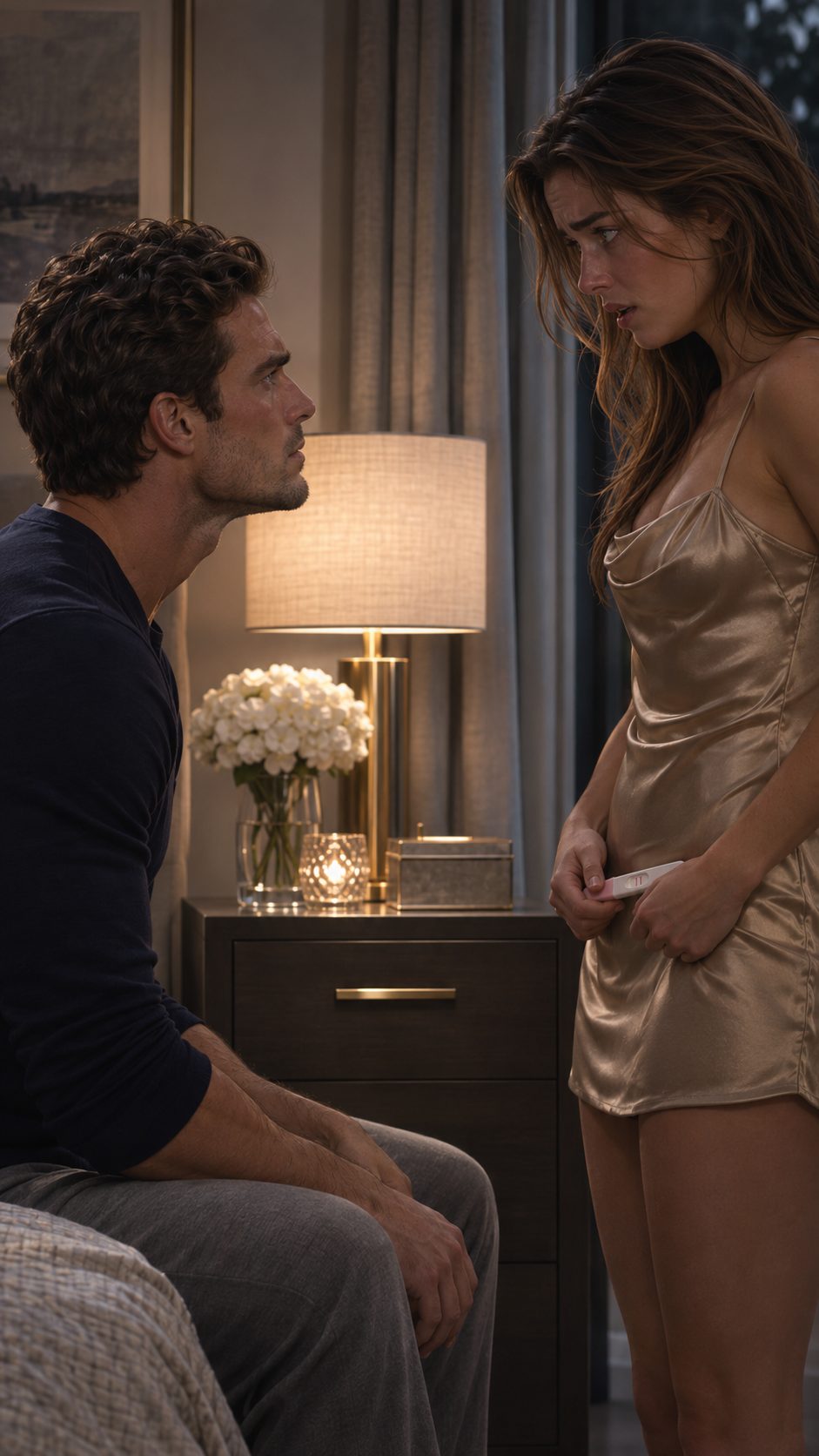
Instead, I was sitting alone on the edge of a guest bedroom bed, looking at the woman I’d married as though she were a complete stranger.
Vanessa stood in the doorway, holding a white plastic pregnancy test between her fingers.
She was wearing the burgundy satin nightdress I’d bought her for our fifth anniversary.
Her long brown hair fell loosely over her shoulders, and there was a nervous little smile on her face.
“I’m pregnant,” she repeated, a little more softly.
I looked at the test.
Two pink lines.
Then I looked at her.
“Who’s the father?”
Her smile disappeared.
For a moment, she didn’t move.
“Who’s the father, Vanessa?”
She gave a short, incredulous laugh.
“Adrian, that’s not funny.”
“I’m not joking.”
She looked at me as though I’d slapped her.
“Are you seriously accusing me of something right now?
I’m standing here telling you we’re having a baby, and your first response is to insult me?”
I didn’t answer.
That seemed to frighten her more than an argument would have.
Vanessa had always been good at arguments.
She knew how to raise her voice at precisely the right moment.
She knew how to turn a question into an accusation and make me feel guilty for asking it.
For years, I’d mistaken that talent for confidence.
Now I simply watched her.
“Say something,” she demanded.
“I already asked you a question.”
“You’re unbelievable.”
I nodded slowly.
She shifted her weight in the doorway.
“What’s wrong with you?”
I glanced toward the bedside drawer.
Inside was a small notebook containing something I hadn’t told anyone.
Not my wife.
Not my closest friend.
Not even my brother.
Three weeks earlier, my doctor had called me with the results of a medical examination.
That conversation had changed the way I understood my own future.
But what frightened Vanessa that night wasn’t simply the possibility that I knew something.
It was the possibility that I knew everything.
“My doctor called three weeks ago,” I said.
Her expression changed so suddenly that I almost felt sorry for her.
“What doctor?”
“Because I had some tests done.”
“What kind of tests?”
I studied her face.
The woman who had spent five weeks treating me like an unwanted guest in my own home was suddenly desperate to keep me talking.
“Before we discuss that,” I said, “I need you to answer something.”
She swallowed.
“When exactly did you find out you were pregnant?”
Her fingers tightened around the plastic test.
“Why does that matter?”
“Because I want the truth.”
She opened her mouth.
Then closed it again.
I could see her thinking.
Calculating.
Searching for the safest possible answer.
Finally, she whispered, “About three weeks ago.”
I felt something cold settle in my chest.
Three weeks.
Exactly when she’d started bringing me coffee.
Exactly when she’d suddenly decided our marriage was worth saving.
Exactly when she’d begun wearing the perfume she knew I loved.
I lowered my eyes.
“Three weeks ago.”
“And you waited until tonight to tell me?”
“I was scared.”
She didn’t answer.
I looked toward the bedside drawer again.
And for the first time since we’d been married, I realized that the most dangerous thing a person can do isn’t always telling a lie.
Sometimes it’s believing the other person will never discover it.
To understand how we ended up in that room, though, you need to understand who Vanessa had been before she became the woman standing in my doorway.
And who I’d been before I learned that loving someone doesn’t make them honest.
My name is Adrian Mercer.
I was thirty years old, living outside Scottsdale, Arizona, and working as a project manager for a commercial development company in Phoenix.
On paper, my life was exactly what I’d wanted.
I had a stable career, a reliable income, and a comfortable two-story house with a backyard overlooking a quiet stretch of desert landscaping.
My wife, Vanessa, worked in marketing for a hospitality group.
She was beautiful, ambitious, intelligent, and effortlessly charming.
People noticed her wherever we went.
Restaurant hosts remembered her name.
Strangers complimented her smile.
My coworkers told me how lucky I was.
For a long time, I agreed with them.
We had been married for six years.
Our wedding photographs still hung in the upstairs hallway, showing two people who looked completely certain about their future.
I remembered that day vividly.
The flowers.
The way Vanessa had squeezed my hand during our vows.
She’d looked directly into my eyes and said, “I promise I’ll always choose you.”
That sentence had meant everything to me.
I never imagined I’d eventually spend nights wondering whether she’d stopped choosing me long before I noticed.
The changes began quietly.
They usually do.
At first, Vanessa was simply busy.
Her company had taken on several major clients, and she was spending longer hours at work.
I understood.
My own job wasn’t exactly nine to five.
Sometimes I worked weekends, reviewed contracts after dinner, or took late calls with clients on the East Coast.
Marriage required flexibility.
I knew that.
But there was a difference between being busy and being absent.
Vanessa gradually stopped asking about my day.
When I spoke, she sometimes continued scrolling through her phone as though she hadn’t heard me.
If I suggested dinner together, she said she was exhausted.
If I mentioned taking a weekend trip, she had another commitment.
Our evenings became increasingly silent.
I would cook, and she would eat in front of the television.
I would ask if she wanted to watch something together, and she’d say she wasn’t in the mood.
Eventually, I stopped suggesting things.
But what hurt most wasn’t the silence.
It was the way she began reacting when I tried to get close to her.
One evening, I came home after a particularly difficult meeting.
She was standing at the kitchen counter, looking at her phone.
I walked behind her and gently placed my hands on her shoulders.
She immediately stepped away.
“Adrian, don’t.”
I withdrew my hands.
I didn’t realize you were busy.”
She sighed.
“It’s not that.”
“Then what is it?”
But it wasn’t nothing.
A few nights later, we were lying in bed when I reached for her hand.
She pulled it away.
“Can you not?”
I rolled onto my back.
“Vanessa, have I done something?”
“Then why does it feel like you don’t want me anywhere near you?”
She turned toward me.
“Why does everything have to be about you?”
The question caught me off guard.
“I’m asking about us.”
“You’re always asking about us.”
“Because something feels wrong.”
“Maybe you’re imagining things.”
I wanted to believe that.
I really did.
For several weeks, I tried convincing myself that we were simply going through a difficult period.
Every marriage had those.
Stress changed people.
Work changed people.
Sometimes love became quiet instead of passionate.
I told myself all those things because the alternative was frightening.
Then came the night that changed how I saw my wife forever.
It was a Thursday.
I remember because I’d gotten home early and picked up dinner from her favorite Italian restaurant.
I’d set the table, opened a bottle of sparkling water, and even put fresh flowers in the kitchen.
Vanessa arrived almost an hour later than expected.
She barely glanced at the table.
“I’m tired.”
“I thought we could have dinner together.”
“I already ate.”
I looked at the untouched food.
She started walking upstairs.
She stopped.
“Can we talk tonight?”
She closed her eyes.
“About what now?”
I hated the exhaustion in her voice.
Not because she was tired.
Because she sounded exhausted by me.
“About what’s happening between us.”
“Nothing is happening.”
“That’s the problem.”
She turned around.
I tried to explain.
I told her I missed spending time together.
I missed holding her hand.
I missed feeling like her husband instead of someone who happened to share her address.
I wasn’t demanding physical intimacy.
I wanted to understand why affection had become something she seemed determined to avoid.
She stared at me for several seconds.
Then her face hardened.
“Stop begging for intimacy, Adrian.
It’s pathetic.”
The words hit harder than I expected.
I stood there, unable to speak.
“You heard me.”
“I’m not begging.”
“Then stop acting like you can’t survive without attention.”
I felt my face grow hot.
“I just want my wife to talk to me.”
She gestured toward the hallway.
“If you can’t handle rejection, sleep somewhere else.”
Some part of me expected her to soften.
To apologize.
To say she’d spoken out of frustration.
Instead, she turned away.
“Good night.”
I stood alone in the bedroom for several minutes.
Then I opened the closet, grabbed a pillow and blanket, and walked down the hallway.
The guest bedroom was at the opposite end of the second floor.
I’d never slept there before.
That night, I closed the door and sat on the unfamiliar mattress.
I stared at the wall until nearly three in the morning.
I wasn’t angry.
I was hurt.
And in some ways, that was worse.
Because I still loved her.
The next morning, Vanessa acted as though nothing had happened.
I came downstairs around seven.
She was sitting at the kitchen island drinking coffee.
“Morning,” she said without looking up.
I waited for an apology.
I made myself breakfast.
She left for work.
That was it.
By the third night, I realized she had no intention of asking me to return to our bedroom.
By the end of the first week, my clothes were hanging in the guest closet.
By the second week, we’d developed separate routines.
She woke up earlier than I did.
I stayed at the office later.
Sometimes we went an entire evening without exchanging more than three sentences.
The silence became a kind of agreement neither of us had actually made.
I would pretend not to notice how distant she’d become.
She would pretend there was nothing to explain.
And our marriage would continue existing as a legal arrangement rather than a relationship.
I began spending more time with my younger brother, Lucas.
Lucas was twenty-seven and worked as a firefighter in Mesa.
He was the kind of person who could tell something was wrong before you said a word.
One Saturday, we met for breakfast.
He watched me move eggs around my plate.
“You look terrible.”
“I’m serious.”
“Just tired.”
He leaned back.
“Is it Vanessa?”
I looked up.
“What makes you say that?”
“Because every time somebody mentions her, you get this expression.”
“What expression?”
“Like you’re trying to swallow a broken bottle.”
I almost laughed.
Instead, I told him we’d been having problems.
Not everything.
Just enough.
When I repeated what Vanessa had said about intimacy, Lucas stopped eating.
“She called you pathetic?”
“She was angry.”
“That’s not what I asked.”
He set down his fork.
“Adrian, you understand that’s not okay, right?”
I looked out the window.
Lucas lowered his voice.
“Wanting affection from your wife doesn’t make you pathetic.”
“I wasn’t trying to pressure her.”
“I know you weren’t.”
“I just wanted to understand.”
“Then stop apologizing for asking questions.”
I carried those words home.
But I didn’t confront Vanessa.
I wasn’t ready.
A part of me still hoped things would improve naturally.
Then her late nights began.
At first, it was once a week.
Then twice.
Sometimes she said she was having dinner with coworkers.
Other times there were networking events, client presentations, or last-minute meetings.
I didn’t question the legitimacy of her work.
I knew she had a demanding job.
But there were details I couldn’t ignore.
She started keeping her phone facedown.
She took calls outside.
She changed her passcode.
And when I entered a room unexpectedly, she sometimes stopped typing so quickly it looked like a reflex.
One Friday evening, I came downstairs around midnight.
Vanessa was sitting on the living room sofa.
Her phone illuminated her face.
She was smiling.
Not politely.
Not casually.
She was smiling in a way I hadn’t seen directed at me in months.
When she noticed me, the smile disappeared.
She turned the screen facedown.
“You’re still awake?”
“Just answering a work message.”
“At midnight?”
She looked annoyed.
“Some of us have demanding jobs, Adrian.”
I let the comment pass.
She watched me head toward the kitchen.
Then she said something unexpected.
“Why are you acting weird?”
“I’m getting water.”
“You keep looking at me like you’re suspicious.”
I turned toward her.
“Should I be?”
She laughed sharply.
“That’s unbelievable.”
I said nothing.
“You know what?
I’m going to bed.”
She walked past me without another word.
A moment later, I heard our bedroom door close upstairs.
I stood beside the refrigerator, listening.
Something inside me had begun changing.
I no longer felt simply rejected.
I felt excluded from a life my wife was living while I remained in the background.
I didn’t know whether another man existed.
I didn’t have evidence.
And I refused to become the kind of husband who searched through someone’s personal belongings because he couldn’t tolerate uncertainty.
Instead, I began paying attention to something I’d neglected for months.
My own life.
That decision led me to a medical appointment I’d originally scheduled for an entirely different reason.
And eventually, to a phone call that would change everything.
Several months earlier, I’d visited my primary care physician after experiencing persistent fatigue.
My job was stressful, and I assumed I wasn’t sleeping enough.
After reviewing some bloodwork and discussing our history of trying to conceive, my doctor recommended additional testing.
Vanessa and I had talked about children on and off throughout our marriage.
We’d never consistently pursued fertility treatment, but we’d also never been particularly careful about preventing pregnancy.
After years without conceiving, I’d started wondering whether there was a medical explanation.
My primary care physician referred me to Dr.
Michael Reynolds, a urologist who specialized in male reproductive health.
I completed the initial tests and then became distracted by work.
When the clinic contacted me about a follow-up, I was in the middle of a major project deadline.
I rescheduled.
Then rescheduled again.
Eventually, the results were discussed over a phone call.
It was a Wednesday afternoon.
I was standing beside my car outside our Phoenix office, trying to decide whether I had time to grab lunch.
My phone rang.
This is Dr.
“Hi, Doctor.”
“Do you have a few minutes to discuss your results?”
I leaned against my car.
He began carefully.
“Your semen analysis showed no sperm in the sample.”
“I’m sorry.
What does that mean?”
“The term is azoospermia.”
I repeated the word silently.
“Azoospermia?”
It means we didn’t detect sperm in the sample that was tested.”
I glanced across the parking lot.
People were getting into cars.
Someone was laughing near the office entrance.
The ordinary world continued moving.
“So you’re saying I can’t have children?”
“I’m saying we need further evaluation before drawing conclusions about fertility.
We should repeat the analysis and investigate the underlying cause.”
I pressed a hand against the car door.
“Could the result be wrong?”
“Collection issues, temporary factors, and laboratory variations are among the reasons we confirm a result.
There are also different causes of azoospermia, and some have treatment options.”
He continued explaining possible causes and follow-up testing.
I heard most of it.
But one phrase kept repeating in my mind.
No sperm detected.
When we finished talking, I didn’t immediately get into my car.
I stood there in the desert heat with my phone in my hand.
A few minutes earlier, I’d been thinking about lunch.
Now I was thinking about fatherhood.
About the conversations Vanessa and I had shared.
About the little room downstairs we’d once discussed turning into a nursery.
I wasn’t ashamed.
But I was grieving something I hadn’t even fully understood yet.
And I didn’t know how to tell my wife.
Especially my wife as she was now.
The woman who had called me pathetic.
The woman who hadn’t slept beside me in weeks.
The woman who acted as though my need for affection were a character flaw.
I imagined telling her about the test.
I imagined her looking at me with pity.
Or worse, contempt.
I couldn’t bear either.
So I told myself I’d wait until I had more information.
I scheduled additional testing.
I wrote down everything Dr.
Reynolds had explained in a small black notebook.
Then I placed it in the bedside drawer of the guest bedroom.
The next week, I returned for another semen analysis and bloodwork.
I also completed a detailed medical history, and the doctor discussed potential hormonal and obstructive causes.
While waiting for those results, I found myself thinking about one particular conversation with Vanessa from almost a year earlier.
We’d been watching a family at a restaurant.
A little girl had been standing beside her father’s chair, trying to show him a drawing.
Vanessa had smiled.
“Do you ever wonder what ours would look like?”
“Constantly.”
She’d leaned against my shoulder.
“I hope she gets your eyes.”
I’d kissed her forehead.
“And your smile.”
For a while, those memories were almost unbearable.
But I also realized something.
My medical condition wasn’t proof that I was worthless.
It wasn’t a verdict on my masculinity.
And it wasn’t something I needed to apologize for.
Reynolds had been clear: the findings required confirmation and further investigation.
Whatever happened, I would deal with it.
What I didn’t know was that my wife was already dealing with a very different secret.
And that within days, she would begin behaving like the woman I remembered marrying.
The first sign was coffee.
A small thing.
Almost embarrassingly small.
I came downstairs one morning and found a mug waiting beside my usual seat at the kitchen island.
Vanessa stood by the espresso machine.
“Morning,” she said brightly.
I looked at the mug.
“What’s this?”
“I can see that.”
She smiled.
“Made it how you like it.”
Two shots of espresso.
A little steamed milk.
She remembered.
For some reason, that hurt more than if she’d forgotten.
“Thanks,” I said.
She watched me take a sip.
Then she moved around the island.
Her fingers brushed my shoulder as she passed.
It was the first affectionate touch I’d received from her in weeks.
I stared into my coffee.
Something had changed.
I just didn’t know what.
That evening, she cooked my favorite dinner.
Chicken Parmesan.
Homemade sauce.
Even garlic bread.
When I entered the kitchen, she turned toward me with a smile.
“Surprise.”
I looked at the stove.
“What’s the occasion?”
“Does there have to be one?”
She stepped closer.
“I thought we could have dinner together.”
We ate at the dining room table.
For the first time in weeks, she asked about my job.
She listened when I answered.
She laughed at a story about one of my coworkers.
For a moment, I saw the woman I’d fallen in love with.
And I wanted desperately to believe she’d returned.
But something about her timing bothered me.
Three days later, she mentioned our favorite restaurant near Old Town Scottsdale.
“Remember that little patio where we had dinner for our anniversary?”
“Of course.”
“Maybe we could go this weekend.”
I looked up from my laptop.
“You want to go out together?”
She frowned.
“Why do you sound so surprised?”
“Because you’ve barely wanted to spend time with me.”
Her expression softened.
It was the first acknowledgment she’d made of the distance between us.
She sat beside me.
“I’ve been thinking about things.”
“What things?”
I closed the laptop.
She looked at her hands.
“I haven’t been fair to you.”
“I’ve been stressed.
And I’ve taken it out on you.”
“You called me pathetic.”
She winced.
“That wasn’t stress, Vanessa.
That was cruel.”
Tears filled her eyes.
“You’re right.”
I didn’t know what to say.
I’d been waiting so long for her to admit she’d hurt me that hearing it felt almost unreal.
“I’m sorry,” she whispered.
I looked at her.
She reached for my hand.
“Because I don’t want to lose you.”
For a brief moment, I believed her.
Or perhaps I simply wanted to.
That weekend, we went to the restaurant.
She wore an ivory dress and the perfume I’d loved when we first started dating.
She held my hand across the table.
She asked whether I remembered our honeymoon.
She brought up funny stories from our first apartment.
But every time I tried to discuss what had gone wrong, she became vague.
“I think we should focus on moving forward.”
“I need to understand what happened.”
“I was in a bad place.”
“Because of work?”
“Was there something else?”
She looked away.
“Adrian, can we please just enjoy dinner?”
I let the question go.
But I noticed.
Whenever our conversation approached the past, Vanessa redirected it toward the future.
Home renovations.
Family plans.
Things we could do together.
It was as though she were trying to move us into a new chapter without allowing me to read the previous one.
On the drive home, she rested her hand on my leg.
I didn’t pull away.
But I couldn’t relax.
My doctor’s words returned to me.
No sperm detected.
I wondered whether Vanessa would still be trying to repair our marriage if she knew.
I considered telling her that night.
Then decided to wait until my follow-up appointment.
Three days before the pregnancy announcement, she came into the guest bedroom while I was reading.
She sat beside me.
“I think we can fix this.”
I lowered the book.
“What does fixing it look like?”
She thought for a moment.
“Starting over.”
“That’s not really an answer.”
She smiled weakly.
“Maybe we could talk about counseling.”
That surprised me.
“You’d do that?”
“Of course.”
I studied her.
She leaned forward and kissed my cheek.
“Good night, Adrian.”
Then she left.
I watched the doorway long after she disappeared.
I wanted the apology to be genuine.
I wanted the warmth to be real.
I wanted my marriage back.
But I couldn’t escape the feeling that Vanessa wasn’t trying to rebuild something we’d lost.
She was trying to prepare me for something I hadn’t discovered.
Three nights later, she appeared in my doorway with a pregnancy test.
And I finally understood why she’d been so desperate to make everything feel normal.
“When exactly did you find out you were pregnant?”
Vanessa stood motionless in my doorway.
“About three weeks ago,” she said.
I looked at her.
“Three weeks ago.”
“Before the coffee?”
She blinked.
“Before the dinners?
Before the restaurant?
Before you suddenly decided we could fix our marriage?”
Her cheeks flushed.
“Adrian, that’s not fair.”
“Is it true?”
She looked toward the hallway.
“Why are you interrogating me?”
“Because I want to know why you waited.”
“I needed time.”
“Time for what?”
She pressed the pregnancy test against her stomach.
“To figure things out.”
She took a small step backward.
That movement stayed with me.
I’d never raised a hand to my wife.
I’d never threatened her.
But she seemed frightened because she could no longer control the conversation.
“Vanessa,” I said quietly, “were you trying to get me back because you found out you were pregnant?”
Her eyes filled with tears.
“Of course I wanted you back.”
“That’s not what I asked.”
She wiped at her cheek.
“I love you.”
I took a breath.
“Then tell me the truth.”
For several seconds, neither of us spoke.
Then I opened the bedside drawer.
She watched every movement.
“What are you getting?”
“My notes.”
“About what?”
“My appointment with Dr.
I removed the black notebook and set it on the bed.
Vanessa stared at it.
“What does that have to do with anything?”
“Three weeks ago, he told me my semen analysis showed no sperm.”
She went pale.
I continued carefully.
“He said I needed more testing.
I went back, and I’m still waiting to finish the evaluation.”
She looked at the notebook.
Then at me.
“You’re infertile?”
“I don’t know yet what my long-term options are.”
“But you can’t have children?”
“That’s not what I said.”
She started shaking her head.
“Adrian, medical tests aren’t always right.”
“You could still be the father.”
“Possibly.”
My answer seemed to confuse her.
She had expected an accusation.
She had prepared to defend herself against certainty.
But I wasn’t going to pretend my medical results proved something they didn’t.
A diagnosis of azoospermia could have several causes.
Doctors needed to confirm it.
And even confirmed infertility didn’t establish that every prior sexual encounter had been incapable of resulting in a pregnancy.
What mattered wasn’t simply a medical report.
It was the timeline.
And Vanessa knew that.
I looked at her.
“There’s something else.”
She swallowed.
“You and I haven’t been intimate in more than five weeks.”
Her lips parted.
“And you found out you were pregnant three weeks ago.”
She looked down.
“That doesn’t mean anything.”
“Then explain it to me.”
She began pacing.
“Pregnancy timing isn’t exact.”
“I know that.”
“Doctors count weeks differently.”
“I know that too.”
“Then why are you making this into something terrible?”
“Because you’re refusing to tell me when you last had a positive test, when you last had a period, or whether you’ve seen a doctor.”
She stopped pacing.
“You’re acting like a detective.”
“I’m acting like someone whose wife just announced a pregnancy after weeks of telling him she didn’t want him touching her.”
She covered her face.
Eventually, she lowered her hands.
“Adrian, please.”
“Please what?”
“Don’t destroy our marriage over a misunderstanding.”
I felt a sharp pain in my chest.
“Our marriage?”
She nodded.
“We’ve been doing better.”
“I thought so.”
I looked toward the empty hallway.
Then back at her.
“Vanessa, I need you to answer one question.”
She said nothing.
“Have you been with someone else?”
Her eyes shifted.
Toward the floor.
That was enough to make my stomach twist.
But I still needed to hear it.
“Yes or no.”
She began crying.
And when she finally spoke, her words were barely audible.
“It wasn’t supposed to happen.”
For several seconds, the room felt completely silent.
I heard the air conditioner switch on.
I heard a car pass outside.
I heard my own breathing.
Then I asked the question that somehow hurt even more.
She shook her head.
“Who, Vanessa?”
She pressed her lips together.
Then whispered a name.
I stared at her.
Ryan Caldwell.
Her coworker.
The man whose name appeared in casual stories about office meetings.
The man who’d once stood in our kitchen drinking beer with me during a barbecue.
The man Vanessa had assured me was “just a friend.”
I sat down.
Vanessa stepped toward me.
“Adrian, please listen.”
I raised my hand.
Not in anger.
Just to stop her.
“Don’t touch me.”
I looked at the pregnancy test.
Then the notebook.
Then the woman I’d loved for six years.
“How long?”
She looked away.
“How long?”
Her voice broke.
“A few months.”
I closed my eyes.
The world I’d known had ended long before that night.
I was only now discovering it.
Ryan Caldwell was thirty-four.
He worked in business development for Vanessa’s hospitality group.
I’d met him twice.
The first time was at a company holiday party.
He was loud, charming, and the kind of man who treated every conversation like an opportunity to perform.
The second time was at our house.
Vanessa had invited several coworkers over for a barbecue.
Ryan brought expensive whiskey.
He shook my hand, complimented the backyard, and asked what I did for work.
I remembered thinking he was friendly enough.
Nothing more.
Now, sitting on the edge of my guest bed, I tried to understand how a man I’d welcomed into my home had become part of the reason my marriage was collapsing.
“Tell me everything,” I said.
Vanessa remained by the doorway.
“Can we do this tomorrow?”
“I’m exhausted.”
She wrapped her arms around herself.
“It started after a company event.”
“In April.”
I stared at her.
Months earlier.
“We had drinks afterward,” she continued.
“A few of us went to a hotel bar.
Everyone left eventually.”
“Except you and Ryan.”
She nodded.
I looked away.
She kept talking.
“We’d been getting close.
Talking about work.
Personal things.”
“Personal things like what?”
She hesitated.
“Our marriage.”
I laughed once.
A bitter, disbelieving sound.
“You discussed our marriage with him?”
“I didn’t mean it like that.”
“What did you tell him?”
She stared at the carpet.
“That we were having problems.”
“We weren’t having those problems in April.”
She said nothing.
“I felt disconnected.”
“And instead of talking to me, you talked to him?”
“He listened.”
Those two words did something to me.
Not because I doubted that Ryan had listened.
I imagined he’d listened very carefully.
I imagined he’d agreed with every complaint.
I imagined he’d told her she deserved better.
It was easy to sound understanding when you didn’t have to share bills, responsibilities, or the ordinary difficulties of a real marriage.
I looked at my wife.
“So what happened?”
“We kissed.”
She wiped away another tear.
“We ended up going upstairs.”
I stared at the floor.
I didn’t ask for more details.
I didn’t need them.
“Did it happen again?”
She nodded.
“How many times?”
“I don’t know.”
“Adrian, please.”
“How many times?”
“I don’t know exactly.”
I closed my eyes.
That answer told me enough.
It hadn’t been one mistake.
It hadn’t been one drunken evening.
It had been a relationship.
A secret life.
“Did you love him?”
She shook her head immediately.
“Did you tell him you loved him?”
She hesitated.
My chest tightened.
“Sometimes.”
I looked at her.
“Sometimes?”
“It didn’t mean the same thing.”
I almost laughed again.
Words had apparently become flexible things in Vanessa’s world.
Love meant one thing when she said it to me.
Something else when she said it to Ryan.
Faithfulness meant whatever she needed it to mean.
And marriage was apparently something she could return to when circumstances changed.
“Was that why you stopped wanting me near you?”
She looked ashamed.
“I was confused.”
“About which man you wanted?”
“That’s not fair.”
I stared at her.
She began crying harder.
“I’m trying to explain.”
“Then explain why you called me pathetic.”
She looked at me.
“I was angry.”
“Because I wanted affection from my wife?”
“Because I felt guilty.”
I went still.
She lowered her voice.
“Every time you tried to be close to me, I remembered what I was doing.
And I hated myself.”
“So you made me hate myself instead.”
Her face crumpled.
“That’s what happened.”
She shook her head, but she couldn’t deny it.
I looked at the pregnancy test again.
“Does Ryan know?”
She said nothing.
“Vanessa, does he know you’re pregnant?”
My throat tightened.
“When did you tell him?”
“Three weeks ago.”
I stared at her.
The same three weeks.
The coffee.
The dinners.
The apology.
The restaurant.
I understood the sequence now.
“You told him before you told me.”
She closed her eyes.
“What did he say?”
“He was shocked.”
“And then?”
“He said he needed time.”
I watched her carefully.
“Time for what?”
“To think.”
I nodded slowly.
“And that’s when you decided to fix our marriage.”
She didn’t answer.
She didn’t have to.
“Was he going to leave his wife?”
Vanessa’s head jerked up.
“How do you know he’s married?”
I stared at her.
“I met his wife at your company party.”
She looked toward the floor.
Her silence told me Ryan’s marriage had been another part of the situation she’d chosen to ignore.
“What did he promise you?”
“He said things were complicated.”
“Of course he did.”
“He said he cared about me.”
“Did he tell you he’d leave his wife?”
“At first.”
“And after you told him you were pregnant?”
She began crying again.
“He said he couldn’t.”
I sat there, feeling something inside me finally become clear.
Vanessa hadn’t returned to me because she’d suddenly remembered our vows.
She’d returned because Ryan had backed away.
Because the future she’d been imagining with him had disappeared.
Because I had become the safer option.
I looked at her.
“Did you plan to let me believe the baby was mine?”
She covered her mouth.
And that was the moment I knew there was no misunderstanding left to resolve.
“Answer me, Vanessa.”
She lowered her hand.
“I didn’t know what to do.”
“That isn’t an answer.”
She sat on the edge of the chair near the door.
“I thought maybe if we could get close again…”
Her voice faded.
I watched her.
“If we could get close again, what?”
She started crying.
Eventually, she whispered, “Maybe you wouldn’t question the timing.”
I felt as though the floor had disappeared beneath me.
There it was.
Not all of it, perhaps.
But enough.
“You wanted me to think I was the father.”
She nodded.
“And you were going to let me raise Ryan’s child without telling me?”
She looked up quickly.
“Please don’t say it like that.”
“How should I say it?”
“I was scared.”
“That doesn’t make it different.”
“No, Vanessa.
I don’t think you do.”
My voice remained quieter than I expected.
Maybe I was too exhausted to shout.
Maybe the deepest kind of heartbreak leaves you without enough energy for anger.
She reached toward me.
I moved away.
Her hand fell into her lap.
“I love you, Adrian.”
I looked at her.
For six years, those words had been enough to make me forgive almost anything.
Not anymore.
“Or do you love knowing I’ll be here when everything else falls apart?”
She shook her head.
“That’s not true.”
“Then why did you come back only after Ryan rejected you?”
She didn’t answer.
I stood and walked toward the window.
Outside, the street was quiet.
Our neighbors’ porch lights glowed across the cul-de-sac.
Somewhere in the distance, a dog barked.
It was an ordinary Sunday night.
And I was trying to understand how my life could fall apart without the world noticing.
Behind me, Vanessa whispered, “What happens now?”
“I don’t know everything yet.”
Her eyes widened.
“What does that mean?”
“It means I need space.”
“Are you leaving?”
“For tonight.”
“Adrian, please don’t.”
I walked toward the closet.
She followed me.
“We can go to counseling.”
“Maybe counseling could help us separate without destroying each other.”
She began crying.
“Don’t say separate.”
I removed a duffel bag from the closet.
“Vanessa, you had months to decide whether you wanted this marriage.”
“I made a mistake.”
I looked directly at her.
“You made decisions.
Over and over again.”
She stepped backward.
“You chose to have an affair.
You chose to lie.
You chose to humiliate me when I asked what was wrong.
And when Ryan wouldn’t leave his wife, you chose to come back and pretend our marriage was healing.”
Her face collapsed.
I continued.
“You were going to let me believe I was becoming a father.”
“I didn’t want to hurt you.”
I shook my head.
“You wanted to avoid the consequences.”
She lowered her eyes.
I packed enough clothes for a few days.
Then I picked up my notebook.
Vanessa watched me place it in the bag.
“Are you going to tell everyone?”
It was a revealing question.
Not Are you okay?
Not How can I make this right?
Not even Can you forgive me?
She wanted to know who would find out.
“I haven’t decided what I’m going to tell anyone.”
“What about my parents?”
“Vanessa, I’m not thinking about your parents right now.”
She started crying again.
I walked downstairs.
She followed me to the front door.
“Please don’t go.”
I turned toward her.
For one moment, I saw the woman I’d married.
The frightened expression.
The familiar eyes.
The small tremble in her mouth.
I wanted to hold her.
That instinct startled me.
After everything she’d done, some part of me still wanted to comfort her.
Then I remembered the night she’d called me pathetic.
I remembered lying alone in the guest bedroom.
I remembered wondering what was wrong with me.
I remembered how many nights she’d allowed me to blame myself for a distance she’d created to conceal her affair.
I opened the door.
“I’ll call you tomorrow.”
She began sobbing.
“Adrian, I love you.”
I looked back one last time.
“I loved you enough to believe you when you told me nothing was wrong.”
Then I stepped outside.
And for the first time in five weeks, I wasn’t sleeping in the guest bedroom.
I was leaving the house entirely.
Lucas opened his apartment door at 12:43 a.m.
He looked at my duffel bag.
Then at my face.
“Who do I need to punch?”
Despite everything, I almost smiled.
He stepped aside.
I sat on his couch and told him what had happened.
Not every intimate detail.
Just the facts.
Vanessa was pregnant.
She’d admitted to an affair.
The other man was married.
She’d known about the pregnancy before trying to repair our relationship.
And my medical results had raised questions I could no longer ignore.
Lucas listened without interrupting.
When I finished, he sat silently for a moment.
Then he said, “You’re staying here as long as you need.”
He leaned forward.
“What are you going to do?”
“I don’t know.”
“Do you want a divorce?”
I stared at the floor.
“I think so.”
“I never wanted one.”
“Six years, Lucas.”
I rubbed my face.
“I keep thinking about everything we built.”
“The house?”
“Everything.”
He leaned back.
“Adrian, you didn’t destroy that.”
I looked at him.
“Maybe I should’ve noticed sooner.”
He shook his head.
“Trusting your wife isn’t a mistake.”
That sentence stayed with me.
The next morning, I called my office and requested two personal days.
Then I called Dr.
I explained that something had changed in my personal circumstances and asked whether I could review my results and complete the remaining testing.
His office scheduled me for a consultation.
Later that day, Vanessa began calling.
I didn’t answer immediately.
Instead, I sent a message.
I need space.
Please don’t come to Lucas’s apartment.
We can discuss practical matters tomorrow.
She responded within seconds.
I’m so sorry.
Then another message.
Please don’t throw away six years.
Then another.
I know I messed up.
I want to make it right.
I placed the phone facedown.
For the first time, I understood what it felt like to be the person who didn’t answer.
The difference was that I wasn’t withholding affection as punishment.
I simply needed time to think.
That afternoon, Lucas and I went for a long drive into the desert.
We barely talked.
I watched the mountains stretch across the horizon.
Arizona had always felt enormous to me.
That day, the open space was comforting.
I wasn’t trapped inside the house.
I wasn’t trapped inside Vanessa’s explanations.
There were roads leading away from everything I’d known.
The following morning, I met with a family law attorney named Sarah Whitmore.
She was direct, calm, and careful.
I explained what had happened.
She listened, took notes, and asked about our marriage, finances, and the pregnancy.
When I mentioned my medical results, she stopped me.
“Adrian, I want to make one thing very clear.”
“Your test results are not a substitute for determining biological paternity.”
“I understand.”
“Depending on the circumstances and timing, there may be legal presumptions concerning children born during a marriage.
We need to handle this properly.”
“What should I do?”
“Do not sign documents acknowledging paternity without understanding their legal effect.
If a child is born, we’ll discuss appropriate testing and procedures under Arizona law.”
She continued.
“Also, keep your communication with Vanessa civil.
Don’t threaten her, don’t post private details online, and don’t make decisions in anger.”
I appreciated that.
Sarah didn’t treat my situation like entertainment.
She treated it like something that could affect several lives.
Including a child who hadn’t asked to become part of any of this.
That night, Vanessa sent another message.
Ryan says he’ll talk to you.
I stared at the screen.
Then typed:
I don’t need to talk to Ryan.
You and I need to discuss our marriage.
A minute later, she called.
This time, I answered.
Her voice sounded exhausted.
“Hi, Vanessa.”
“Can we meet?”
“Tomorrow.”
“At the house?”
Somewhere public.”
There was a pause.
We agreed to meet at a quiet coffee shop near Scottsdale.
Before hanging up, she whispered, “Do you hate me?”
I closed my eyes.
It would have been easy to say yes.
It might even have felt satisfying.
But the truth was more complicated.
“No,” I said.
She began crying.
“Then maybe we still have a chance.”
I looked out Lucas’s apartment window.
“Not hating you doesn’t mean I can trust you.”
She went silent.
And for once, she didn’t have an answer.
Vanessa arrived at the coffee shop ten minutes early.
I knew because I waited in my car until the exact time we’d agreed to meet.
When I walked inside, she was sitting near the back window.
Her eyes were red.
She wore a simple cream blouse and jeans.
There was no dramatic makeup.
No carefully chosen perfume.
She looked younger than I’d remembered.
And very tired.
“Hi,” she said.
I sat across from her.
She reached for my hand.
I kept mine beneath the table.
She noticed.
Her eyes filled.
“How are you?”
I almost laughed at the question.
“Not great.”
She nodded.
“Me neither.”
We sat silently.
Then I took a breath.
“I need you to tell me whether there’s anything else I don’t know.”
She looked down at her coffee.
“About Ryan?”
“About everything.”
She hesitated.
And in that hesitation, I felt my chest tighten again.
“What else, Vanessa?”
She rubbed her forehead.
“I told him about the pregnancy before I told you.”
“And I asked him what we were going to do.”
“I know that too.”
She looked up.
“He told me he couldn’t leave his wife.”
“I got scared.”
“So I started thinking about our marriage.”
I looked directly at her.
“Did you actually want to be with me?”
She began crying.
“Before you found out you were pregnant?”
She didn’t answer immediately.
“I didn’t know what I wanted.”
There it was again.
The word she’d used to explain months of deliberate secrecy.
I leaned back.
“I think you knew what you wanted.
You just didn’t know what was going to be available to you.”
She covered her face.
“That’s cruel.”
What’s cruel is making someone believe he’s the problem while you’re having an affair.”
She lowered her hands.
“I know I hurt you.”
“I wish I could undo it.”
For a moment, we were both quiet.
Then she said, “I need to tell you one more thing.”
My stomach tightened.
“Ryan’s wife knows.”
I stared at her.
“Since when?”
“Since Monday.”
The day after I’d left.
“Ryan told her.”
Vanessa looked down.
“Because I told him I was going to be honest with you.”
I thought about that.
At least the other woman had been told.
“Does she know about the pregnancy?”
“She told him to leave.”
Vanessa wiped her face.
“He’s staying at a hotel.”
I studied her.
“Are you still talking to him?”
“Only about the baby.”
“Does he believe he’s the father?”
She hesitated.
“He thinks it’s possible.”
“Then paternity needs to be established properly.”
She lowered her eyes.
I took a breath.
“Vanessa, I’m going to file for divorce.”
“I’ve spoken with an attorney.”
Her face crumpled.
“Adrian, please.”
“I’ve made my decision.”
“We can go to therapy.”
“I think individual counseling would be good for both of us.”
“We can rebuild.”
I looked at her for a long moment.
“I don’t know how to rebuild something when I don’t believe the person handing me the bricks.”
She covered her mouth.
“I love you.”
I nodded slowly.
“I believe you feel something for me.”
“That’s not fair.”
“I think you loved the stability of our home.
I think you loved knowing I’d be there.
And maybe some part of you still loved me.”
She began shaking her head.
“But you didn’t love me enough to be honest.”
Tears slid down her cheeks.
“I can change.”
“I hope you do.”
She looked up.
“Then why won’t you give me another chance?”
I thought carefully before answering.
“Because changing doesn’t erase what happened.
And forgiving someone doesn’t require staying married to them.”
She stared at me.
I continued.
“I can eventually forgive you without pretending I can trust you again.”
She began crying harder.
I felt terrible.
But I didn’t change my answer.
She wasn’t a monster.
She was a person who’d made profoundly selfish decisions and hurt people who trusted her.
That distinction mattered.
I didn’t need to turn her into a villain to acknowledge what she’d done.
I didn’t need revenge.
I needed freedom from a relationship that no longer felt safe.
After a long silence, Vanessa whispered, “What about the baby?”
I looked at her.
“The baby deserves the truth.”
She nodded.
“And when we know who the biological father is, the adults involved need to act responsibly.”
She wiped her face.
“Would you hate the child?”
The question surprised me.
Her eyes widened.
“Vanessa, the child hasn’t done anything wrong.”
She started crying again.
I leaned forward.
“But I’m not going to agree to be someone’s father because we concealed the truth.”
She nodded slowly.
“I understand.”
She looked up at me.
“Is this really goodbye?”
“For our marriage?
She began crying.
I walked toward the door.
Then I stopped and looked back.
She raised her eyes.
“I hope you tell the truth from now on.”
I stepped outside.
The afternoon sun was bright.
Cars moved along the street.
People passed carrying coffee and shopping bags.
Nothing in the world looked different.
But I was no longer the man who’d walked into that restaurant believing love meant enduring whatever someone else chose to do.
The divorce process wasn’t dramatic in the way people imagine.
There were no screaming confrontations in courtrooms.
No public accusations.
No satisfying moment where someone stood up and declared that I’d been right all along.
There were documents.
Financial statements.
Appointments.
Conversations about the mortgage.
Questions about the house.
And countless small decisions that reminded me of how thoroughly two lives can become intertwined.
Vanessa stayed in the house temporarily while we worked through the practical arrangements.
I continued living with Lucas until I found a rental apartment in north Scottsdale.
For a while, she sent messages every evening.
Some were apologies.
Some were memories.
Occasionally, she sent photographs from our wedding.
I stopped responding to those.
Not because I wanted to hurt her.
Because every photograph was an invitation to return to a version of our marriage that no longer existed.
I also continued my medical evaluation.
Reynolds arranged additional testing and reviewed my results with me.
The repeat semen analysis again showed no sperm in the sample.
Further investigations were needed to determine the underlying cause and what treatment options might be available.
He explained that the results strongly suggested a significant fertility problem, but he was careful not to make claims beyond the evidence.
I appreciated his precision.
I had enough uncertainty in my personal life.
I didn’t need false certainty from medicine.
At one appointment, I told him what had happened with Vanessa.
He listened quietly.
Then said, “I’m sorry you’re going through that.”
“Is it strange that I don’t know which part hurts more?”
“What do you mean?”
“The marriage.
Or the possibility that I might never have a biological child.”
He leaned forward.
“Those are two different losses to process.
And neither one defines your worth.”
I looked down.
He continued.
“We’ll address the medical questions carefully.
But I hope you won’t turn the result of a test into a judgment about who you are.”
I sat there for a moment.
Then nodded.
It was something I needed to hear.
Months passed.
Vanessa’s pregnancy progressed.
She attended prenatal appointments and began making plans for the baby.
Ryan’s marriage was also unraveling.
I knew little about the details, mostly because I made a deliberate effort not to become involved.
But one evening, I received a message from a number I didn’t recognize.
Adrian, this is Emily Caldwell.
Ryan’s wife.
I know we don’t know each other well, but I’d like to ask you something.
I stared at the message.
Then replied:
What would you like to know?
Her response arrived a few minutes later.
Did Vanessa tell you the truth about when the affair started?
I sat down.
I could have ignored her.
Instead, I answered carefully.
She told me it began in April.
I don’t know whether that’s accurate.
Emily replied:
Ryan told me June.
I looked at the screen.
Another lie.
Not one directed at me this time.
But part of the same pattern.
Emily sent another message.
I’m sorry for what happened to you.
I stared at the words.
Then typed:
I’m sorry too.
We didn’t become friends.
We didn’t team up.
We didn’t spend evenings discussing how terrible our spouses were.
We were simply two people trying to understand the destruction left behind by decisions we hadn’t made.
Months later, Vanessa gave birth to a healthy baby boy.
She named him Noah.
I learned about the birth through a brief message.
Noah arrived this morning.
He’s healthy.
I wanted you to know.
I sat with the message for several minutes.
Then replied:
I’m glad he’s healthy.
I hope you’re both doing well.
That was all.
Through the appropriate arrangements, biological paternity was tested after the birth.
The results established that Ryan was Noah’s biological father.
I remember receiving the information through my attorney.
I was standing in my new apartment, looking at a stack of unopened mail.
For a long moment, I didn’t move.
There was relief.
And something I couldn’t immediately name.
The medical findings had raised questions.
Vanessa’s confession had revealed the affair.
But the DNA result settled the biological question.
Ryan was Noah’s father.
Sarah called shortly afterward.
“Adrian, we’ll make sure the necessary legal issues are addressed correctly.”
I nodded, though she couldn’t see me.
“Thank you.”
“How are you feeling?”
I looked around the apartment.
At the boxes I’d unpacked myself.
At the kitchen table I’d bought secondhand.
At the framed photograph of Lucas and me on a hiking trail.
“Strange,” I said.
She waited.
“I spent months afraid of knowing the truth.”
“Now I’m glad I do.”
After the call, I sat at the kitchen table.
I thought about Noah.
A little boy who had entered the world surrounded by adult complications he couldn’t possibly understand.
I hoped Ryan would become the kind of father Noah deserved.
I hoped Vanessa would learn to put her child’s needs ahead of her own fear.
And I hoped, someday, Noah would grow up knowing that none of this had been his fault.
I didn’t know what would happen to Vanessa and Ryan.
I didn’t need to.
Their story was no longer mine to manage.
The divorce was finalized the following year.
By then, I’d begun learning how to live alone again.
At first, everything felt unfamiliar.
Shopping for one person.
Cooking dinner without wondering whether someone else would be home.
Spending Saturday mornings doing exactly what I wanted.
I hadn’t realized how much of my life had become organized around Vanessa’s moods.
If she was happy, I relaxed.
If she was distant, I worried.
If she was irritated, I searched for something I’d done wrong.
Living alone revealed just how exhausting that had become.
For the first time in years, my home was quiet without feeling hostile.
I started running in the mornings.
Not to transform myself.
Not to prove Vanessa had lost something.
I simply liked being outside before the desert heat became unbearable.
I began hiking with Lucas on weekends.
I reconnected with friends I’d gradually stopped seeing.
I started cooking again.
And eventually, after months of hesitation, I began seeing a therapist.
Her name was Dr.
Elena Brooks.
During our first appointment, she asked what I wanted from therapy.
I thought about it.
Then answered honestly.
“I want to stop wondering why I wasn’t enough.”
She watched me carefully.
“Enough for what?”
“For my wife to stay faithful.”
She nodded.
“Do you believe her choices were caused by your inadequacy?”
I hesitated.
“Sometimes.”
“Let’s talk about that.”
Over the following months, we did.
We talked about trust.
About self-blame.
About the difference between responsibility and guilt.
I learned that my desire for affection hadn’t been shameful.
That respecting someone’s right to refuse intimacy didn’t require accepting contempt.
That a spouse could be unhappy without being entitled to deceive.
And that the failure of my marriage didn’t mean I had failed as a man.
Those lessons weren’t immediate.
Some days I felt strong.
Other days I remembered something Vanessa had said and spent an hour wondering whether I’d misunderstood our entire relationship.
Healing wasn’t a straight line.
It was a long series of ordinary days.
Some painful.
Some peaceful.
Some surprisingly good.
About eight months after moving into my apartment, I ran into Vanessa at a grocery store.
It was a Saturday afternoon.
I was standing in the produce section comparing avocados when someone said my name.
There she was.
She looked different.
Not dramatically.
Just older somehow.
More tired.
Her hair was pulled back.
She wore jeans and a loose sweater.
A shopping cart stood beside her.
Noah was asleep in the infant carrier.
For a moment, neither of us spoke.
Then she smiled faintly.
“Hi, Vanessa.”
She looked at the avocados in my hand.
“Still making guacamole?”
I almost smiled.
“Sometimes.”
She laughed softly.
Then the silence returned.
“How have you been?” she asked.
She looked surprised.
“I’m glad.”
I glanced toward Noah.
“How’s he doing?”
Her face softened.
“He’s good.
He keeps me up all night.”
I smiled slightly.
“I hear that’s part of the job.”
She laughed.
Then looked at me.
“Adrian, I wanted to tell you something.”
“I’ve been going to counseling.”
“That’s good.”
“I’ve learned a lot about why I handled things the way I did.”
She took a breath.
“I blamed you for things that weren’t your fault.”
I looked at her.
Tears filled her eyes.
“I was selfish.”
I said nothing.
“And you didn’t deserve what happened.”
For a moment, I remembered the woman in the guest bedroom doorway.
The pregnancy test.
The trembling hands.
Then I looked at the woman standing in front of me.
She wasn’t asking for another chance.
She wasn’t demanding forgiveness.
She was simply acknowledging the harm.
“Thank you for saying that,” I replied.
She wiped at her eye.
“I really am sorry.”
“I believe you.”
She looked relieved.
Then she asked, “Do you think you’ll ever forgive me?”
I considered the question.
“I think I’m getting there.”
She smiled sadly.
“That’s more than I expected.”
I glanced at my watch.
“I should get going.”
“Of course.”
I started walking away.
Then she called my name again.
“I hope you find someone who makes you happy.”
I looked at her.
Then answered with something I genuinely meant.
“I hope you learn how to be happy without hurting the people who love you.”
She nodded.
I walked toward the checkout.
And for the first time since the marriage ended, seeing Vanessa didn’t make my chest tighten.
I felt sad for what we’d lost.
But I didn’t want it back.
That was how I knew I was healing.
Two years after that Sunday night in the guest bedroom, I bought a small house in north Scottsdale.
It wasn’t as large as the home Vanessa and I had shared.
It didn’t have the expensive kitchen cabinets or the carefully landscaped backyard.
But it had big windows, a quiet patio, and a view of the mountains.
And it was mine.
I chose every piece of furniture myself.
I painted the walls.
I planted rosemary near the patio.
I built a bookshelf in the living room.
It was a simple life.
And I loved it.
My career continued improving.
I took on larger projects.
I spent more time with my family.
I became the kind of person who could enjoy a quiet evening without interpreting silence as rejection.
I also continued working with my doctors.
My fertility situation remained complicated, and I learned to accept that my future might not look exactly the way I’d once imagined.
But I no longer saw that uncertainty as a personal failure.
There were many ways to build a meaningful life.
And many ways to become a family.
One evening, Lucas came over for dinner.
We sat on the patio as the sun disappeared behind the mountains.
He looked around.
“You know, this place is pretty good.”
“Pretty good?”
“For a guy who used to burn frozen pizza.”
He took a sip of his drink.
Then looked at me.
“Can I ask you something?”
“Do you ever wish you’d never found out?”
I looked toward the mountains.
For a moment, I remembered everything.
The quiet rejection.
The nights alone.
The doctor’s phone call.
The sudden kindness.
The pregnancy test.
And the look on Vanessa’s face when I asked her who the father was.
I thought about the six years we’d shared.
The good memories were still real.
So were the bad ones.
I couldn’t change either.
Finally, I shook my head.
Lucas waited.
“I wish she hadn’t done it,” I said.
“I wish we’d been honest with each other long before things got that bad.”
“But I don’t wish I still believed the lie.”
We sat quietly for a while.
Then Lucas smiled.
“You’re different now.”
“Hopefully in a good way.”
“Definitely.”
I looked at the warm light spilling from my living room.
“I used to think being a good husband meant never giving up.”
Lucas glanced at me.
I considered the answer.
“Now I think it means knowing the difference between fighting for a marriage and fighting to be loved by someone who keeps choosing to hurt you.”
He nodded slowly.
“That’s a pretty good answer.”
The desert air was cool.
For once, there was nothing I needed to prove.
Nothing I needed to investigate.
Nothing I needed to forgive before I was ready.
I didn’t need Vanessa to understand everything she’d done.
I didn’t need Ryan to apologize.
I didn’t need the entire world to know the truth.
And that was enough.
Sometimes people imagine that betrayal ends with a dramatic confrontation.
A door slamming.
A suitcase being thrown onto the sidewalk.
A devastating final speech.
But mine ended much more quietly.
It ended when I stopped believing that another person’s dishonesty was evidence of my inadequacy.
It ended when I understood that wanting affection hadn’t made me pathetic.
And it ended when I finally accepted that I deserved a marriage built on truth rather than fear.
Vanessa once told me I was pathetic for wanting intimacy.
Five weeks later, she stood in my doorway holding a positive pregnancy test, hoping I’d welcome a future she hadn’t been honest enough to explain.
She hadn’t expected me to ask who the father was.
She hadn’t expected me to know about my medical results.
And she certainly hadn’t expected me to walk away.
But the most important thing I learned had nothing to do with the pregnancy test.
It was something much simpler.
I hadn’t been pathetic for wanting my wife to love me.
I’d only been wrong to believe I had to accept humiliation to keep that love.
And when I finally understood the difference, I didn’t just leave a broken marriage.
I got my life back.
✓ Lynn R. Adams
CHAPTER 1: THE PREGNANCY ANNOUNCEMENT THAT DESTROYED EVERYTHING “I’m pregnant, Adrian.” Those three words should have been the happiest words of my life. For six years, I’d imagined what it would f…