CG-MY SON ASKED IF THE MAN HOLDING HIS MOTHER WAS KEEPING HER WARM—BUT ONE QUESTION ABOUT THEIR PAST REVEALED A BETRAYAL THAT HAD BEEN HIDDEN FOR YEARS A Complete American Family Drama About Infidelity, Marriage, Betrayal, Fatherhood, and the Truth That Changed Everything
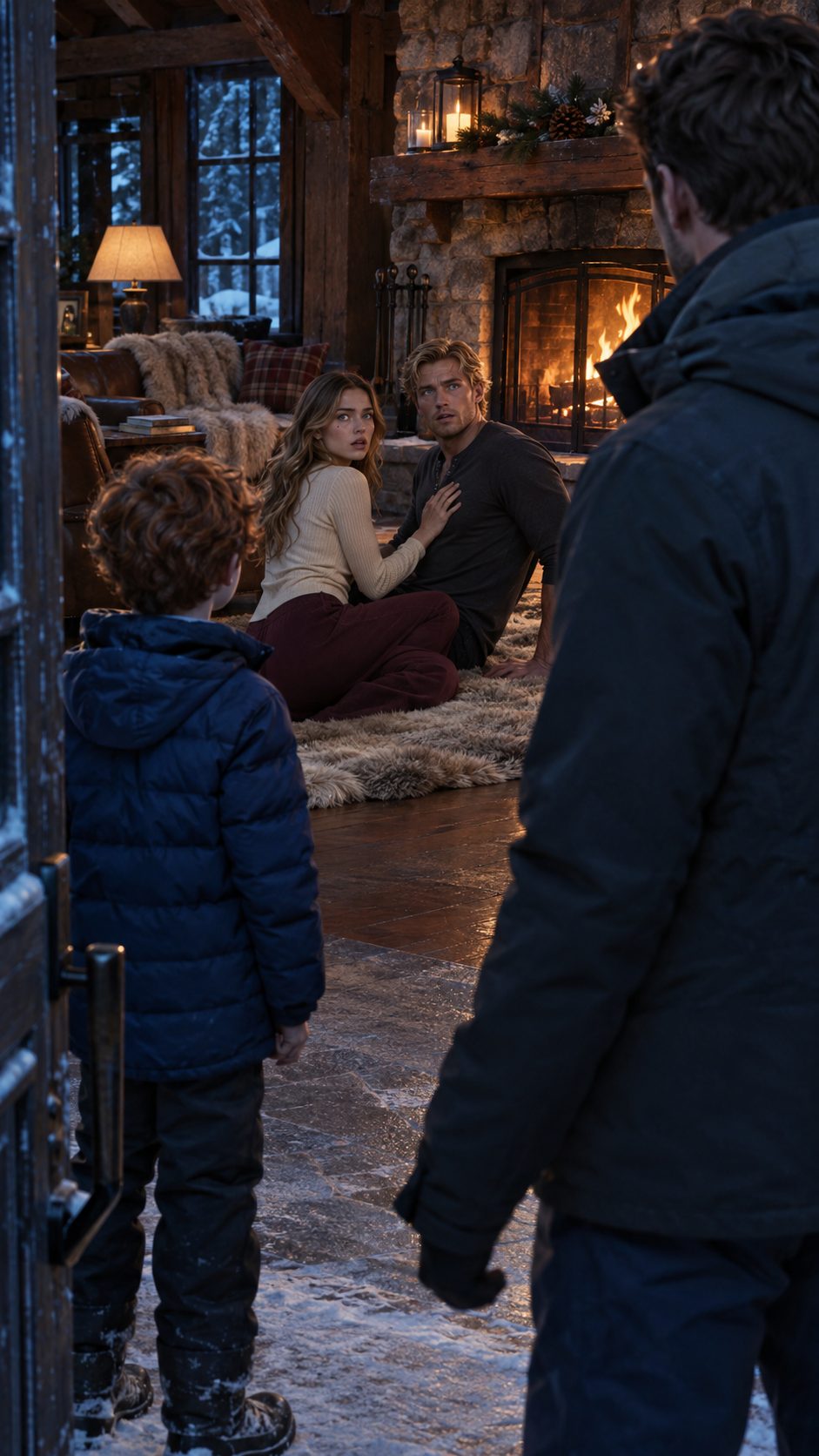
“Mom, was he keeping you warm?”
My eight-year-old son asked that question while staring at his mother sitting against another man beside the fireplace.
And somehow, those six innocent words hurt more than anything I was seeing.
There are moments in life when your mind refuses to accept what your eyes are telling you.
You stand there, looking directly at the truth, and some desperate part of you keeps searching for another explanation.
That’s what happened to me that afternoon in Aspen.
I was standing in the doorway of our rented cabin with snow melting off my boots, my son Noah beside me, and my wife Megan on the living room rug with a man who wasn’t her husband.
His name was Caleb Brooks.
He was the ski instructor she’d been taking private lessons with all week.
His dark shirt had been discarded near the fireplace.
Megan’s cream thermal top was rumpled at the waist, and her hand rested against his chest with a familiarity that made my stomach twist.
They weren’t kissing when we walked in.
Somehow, that made it worse.
They looked comfortable.
Not like two people who had made a sudden, reckless mistake, but like two people who had spent enough time together to stop feeling nervous about being close.
Megan noticed us first.
Her eyes moved from Noah to me, and the color drained from her face.
Caleb turned a second later.
For several heartbeats, nobody moved.
The fire crackled behind them.
Snow blew against the windows.
Somewhere in the kitchen, the refrigerator hummed.
Ordinary sounds.
The kind of sounds you never notice until your entire world falls apart around them.
“Ethan,” Megan whispered.
I didn’t answer.
I was looking at her hand.
She hadn’t even realized it was still touching him.
Then Noah spoke.
“Mom, was he keeping you warm?”
Megan pulled away from Caleb as if his skin had burned her.
“Oh, sweetheart…”
She stopped.
She looked at me again, and I saw something in her expression that frightened me more than guilt.
Calculation.
She was trying to determine how much I’d seen, how much I knew, and whether there was still a version of this situation she could explain away.
I had seen enough.
Noah hadn’t.
He was standing in his oversized blue winter jacket, his red curls damp from the snow, trying to make sense of something no child should have to understand.
We weren’t supposed to be home.
That was the first thing I kept thinking.
We weren’t supposed to be back for another two hours.
That morning, we’d left the cabin shortly after breakfast.
Megan had announced that she needed the afternoon to rest because her legs were sore from skiing.
I believed her.
I took Noah to the beginner slopes.
Around noon, the weather started turning ugly.
Heavy clouds moved over the mountains, and Noah complained that his ski boots were pinching his toes.
By one o’clock, he was limping.
So I told him we’d call it a day.
He’d been delighted.
“Can we make hot chocolate when we get home?”
“Absolutely,” I’d said.
I remembered smiling as we drove back through the snow.
I remembered thinking how lucky I was.
A beautiful wife.
A healthy son.
A family vacation in the mountains.
A life that, despite its ordinary problems, still felt like something worth being grateful for.
Twenty minutes later, I was looking at a stranger wearing my wife’s affection.
“Ethan, please,” Megan said.
Caleb reached for his shirt.
“Listen, man—”
I didn’t shout it.
I barely recognized my own voice.
Caleb stopped moving.
Megan stood slowly, adjusting her clothes.
She looked toward Noah, then at me.
“This isn’t—”
“Don’t finish that sentence.”
Her mouth closed.
I felt Noah’s little hand searching for mine.
He looked up at me.
“It’s okay, buddy.”
But I couldn’t tell him that.
I couldn’t tell him that the woman who had taught him how to tie his shoes, who sang to him when he was sick, who kissed his forehead every night, had just shattered something I didn’t know how to put back together.
The room suddenly felt unbearably hot.
I walked to the enormous window overlooking the mountains, flipped the brass latch, and shoved it open.
Freezing air rushed inside.
Snow scattered across the hardwood floor.
Behind me, Megan gasped.
“Ethan, it’s freezing.”
I turned around.
For the first time since entering the cabin, I looked directly into her eyes.
“Pack your things.
She stared at me.
“Please don’t do this in front of Noah.”
I almost laughed.
Not because anything was funny.
Because she’d said it as if I were the one who had brought our son into this nightmare.
I looked at Caleb.
He had finally pulled his shirt on.
He stood awkwardly near the fireplace, avoiding my eyes.
I could have hit him.
I could have screamed.
I could have demanded to know what kind of man got involved with another man’s wife.
But I didn’t.
Whatever Caleb had done, he hadn’t stood beside me eleven years earlier and promised to love me through everything life could throw at us.
“Noah,” I said, “let’s go upstairs.”
He hesitated.
“Is Mom coming?”
I couldn’t answer.
Megan started crying.
And that was when I understood something terrible.
Until that moment, I hadn’t believed my marriage was broken.
Not really.
I had believed we were tired.
Maybe a little distant.
But broken?
I had never imagined that.
I led Noah toward the stairs, one hand resting protectively on his shoulder.
Halfway up, he stopped and looked down.
“Yeah, buddy?”
“Did I do something wrong?”
I knelt in front of him.
The question hit harder than the scene downstairs.
“No,” I said, forcing the words past the tightness in my throat.
“You didn’t do anything wrong.
Not one thing.”
“Then why is Mom crying?”
I swallowed.
“Sometimes grown-ups make mistakes that hurt other people.”
He looked confused.
“Like when I broke your phone?”
Despite everything, I almost smiled.
“No, buddy.
Not like that.”
“Is she in trouble?”
I pulled him against me.
“I don’t know yet.”
For a long moment, he rested his forehead against my shoulder.
Then he whispered something I would remember for the rest of my life.
“Can we still have hot chocolate?”
I closed my eyes.
“Of course we can.”
Because whatever happened to my marriage, I was still his father.
And I was going to find a way to keep that promise.
Even if every other promise in the house had just been broken.
Before Aspen, I would have told anyone who asked that Megan and I had a good marriage.
Not a perfect marriage.
I wasn’t naive enough to believe those existed.
But a good one.
We’d been married eleven years.
We lived in a two-story house outside Denver with a small backyard, a kitchen that desperately needed remodeling, and a garage filled with things we kept promising to organize.
We had a mortgage.
Two aging cars.
A son who believed dinosaurs were more interesting than almost anything else in the universe.
And a marriage that had survived more than a few difficult seasons.
We’d gone through years when money was tight and every unexpected bill felt like a threat.
We’d survived my father dying suddenly when Noah was three.
We’d dealt with Megan’s career changes, my long hours at work, and the kind of exhaustion that settles over parents who spend most of their lives taking care of everyone except themselves.
We argued sometimes.
Of course we did.
Usually about ordinary things.
Household responsibilities.
Whether I worked too much.
Whether Megan spent too much time answering emails after dinner.
But we always found our way back.
Or at least I thought we did.
I worked as a project manager for a commercial construction company.
It wasn’t glamorous, but I liked the work.
I liked creating something real and watching empty ground become a building.
Megan worked in fundraising and events for a medical foundation.
She was good at it.
Really good.
She could walk into a room filled with strangers and make everyone feel like they’d known her for years.
When we first met, that was one of the things I loved about her.
She had this ability to make ordinary moments feel exciting.
We met at a friend’s birthday party.
I was standing near the kitchen, wondering how soon I could politely leave, when she walked over and asked whether I always looked so miserable at parties.
I told her I was practicing for old age.
She laughed.
I loved that laugh.
For years, I would do almost anything to hear it.
When Noah was born, I thought I’d never loved her more.
She was exhausted and pale, holding this tiny, furious baby against her chest, and she looked at me with tears in her eyes.
“We made him,” she whispered.
“Pretty incredible work,” I said.
She laughed again.
For a long time, that memory was one of the safest places in my mind.
After Aspen, even that memory hurt.
The first real changes began several months before our vacation.
They were small enough that each one seemed harmless.
Megan started working later.
She’d always had evening events, but suddenly there were more of them.
Donor dinners.
Planning meetings.
Last-minute problems.
Sometimes she’d get home after Noah was asleep.
I’d ask how her night went.
“Long,” she’d say.
Then she’d kiss my cheek and disappear upstairs.
At first, I barely noticed.
We were both busy.
Then her phone became something she guarded like a secret.
It used to sit on the kitchen counter while she cooked.
Now it stayed beside her.
At dinner, she’d turn it facedown.
If a message came in while we were watching television, she’d glance at the screen and sometimes leave the room before answering.
Once, I picked up her phone because it was ringing while she was in the shower.
I wasn’t trying to look through it.
I just wanted to silence the call.
She came out of the bathroom faster than I’d ever seen her move.
“What are you doing?”
I looked up.
“Your phone was ringing.”
“Don’t touch my stuff.”
I stared at her.
She stared back.
Then her expression softened.
Work’s been insane.”
I accepted the apology.
I even apologized for touching her phone.
That memory embarrassed me later.
Not because trust was foolish.
But because I had begun confusing trust with refusing to ask questions.
There were other changes.
She stopped asking about my day.
She became irritated when I suggested date nights.
If I leaned over to kiss her while she was reading in bed, she’d sometimes turn her cheek.
“I’m tired, Ethan.”
So I’d roll onto my side and tell myself marriage had seasons.
That was a phrase I used a lot.
Marriage has seasons.
People get tired.
Feelings change.
Love isn’t always fireworks.
I believed all of those things.
I still do.
But I know now that those truths can become excuses when you’re afraid to look more closely at what’s happening.
Three weeks before Aspen, Megan surprised me at breakfast.
“We should take a family trip.”
I looked up from my coffee.
Noah’s old enough to really enjoy skiing now.”
I raised an eyebrow.
“You hate skiing.”
“I don’t hate it.”
“You once called ski boots medieval torture devices.”
She smiled.
A real smile.
The kind I hadn’t seen in weeks.
“Maybe I’ve changed.”
I was so relieved to see her excited about something that I didn’t question it.
We looked at rental cabins that evening.
She found one tucked into the mountains, with enormous windows, exposed timber beams, and a stone fireplace that stretched almost to the ceiling.
It was expensive.
More than I’d planned to spend.
But Megan kept showing me pictures.
“Look at this place, Ethan.
Imagine the three of us there.”
I looked at Noah, who was sitting on the floor building a Lego spaceship.
I imagined him drinking hot chocolate beside the fireplace.
I imagined Megan laughing again.
I imagined us finding our way back to each other.
“Book it,” I said.
She kissed me.
And for one hopeful second, I thought things were getting better.
I didn’t know that the cabin had already become part of someone else’s plans.
I didn’t know Megan had been speaking to Caleb before she’d ever mentioned the trip.
And I certainly didn’t know that the most painful week of my life had begun with me trying to save a marriage my wife had already stepped outside of.
The first three days in Aspen almost convinced me that I’d imagined the distance between us.
Noah loved everything.
He loved the snowbanks taller than his head.
He loved the little shops downtown.
He loved the gondola ride, even though he spent most of it asking whether the cables could break.
Megan seemed happier too.
She laughed at dinner.
She took pictures of Noah.
She suggested we spend one evening walking through town with hot chocolate.
I remember looking at her under the streetlights as snow settled in her hair.
She looked beautiful.
And for the first time in months, I reached for her hand without wondering whether she’d pull away.
She let me hold it.
I took that as a sign.
Looking back, I wonder whether guilt sometimes resembles affection.
Or whether she was trying, in her own confused way, to remember what loving me had felt like.
On our second morning, she mentioned private ski lessons.
“I think I’d feel more confident with an instructor.”
“Sure,” I said.
“Whatever makes it fun for you.”
“I found someone recommended by the resort.”
“His name’s Caleb.”
I barely registered the name.
Why would I?
He was a ski instructor.
A stranger.
Someone we were paying to help my wife avoid falling down a mountain.
I had no reason to believe he was anything else.
That afternoon, Megan returned to the cabin with rosy cheeks and an energy I hadn’t seen in her for months.
“Caleb says I’m finally getting my turns right.”
“Look at you.
Next thing I know, you’ll be competing in the Olympics.”
She laughed.
The following evening, Caleb came up again.
“Caleb says I lean too far back when I get nervous.”
Then again.
“Caleb says I should practice on the intermediate slopes tomorrow.”
By the third day, his name seemed to appear in every conversation.
At dinner, Megan was explaining something about her technique when I set down my fork.
“Does Caleb come with a frequent-flyer program?”
She frowned.
“I think I’ve heard more about him this week than I’ve heard about your coworkers all year.”
Noah giggled.
Megan didn’t.
“I’m just telling you about my lessons.”
I’m kidding.”
“Well, it’s not funny.”
The table went quiet.
I looked at Noah, who was pushing peas around his plate.
“Hey, buddy,” I said, changing the subject, “what was your favorite part of today?”
“The chairlift.”
“Even though you thought we’d fall?”
“I only thought that the first time.”
Megan remained silent.
Later that night, I tried to talk about it.
We were getting ready for bed.
“Did I upset you at dinner?”
She pulled a sweater from her suitcase.
“You embarrassed me.”
“About Caleb?”
“You made it sound like I was doing something wrong.”
I stared at her.
“I was teasing you.”
“Well, don’t.”
I could have asked why she was defending a ski instructor so intensely.
Instead, I apologized.
The next morning, she left for another private lesson.
When she came back, she went straight upstairs to shower.
It wasn’t unusual to shower after skiing.
But she’d only been gone two hours, and she hadn’t been sweaty or exhausted.
Still, I didn’t question it.
That evening, she said she was tired and skipped dinner.
Noah and I ate leftover pizza by the fireplace.
He asked whether Mom was sick.
“Just worn out,” I said.
We watched an animated movie, and he fell asleep against my side.
When I carried him upstairs, Megan was sitting on our bed with her phone.
She quickly locked the screen.
“Everything okay?”
“You missed dinner.”
“Not hungry.”
I watched her for a moment.
She wouldn’t look at me.
Something inside me stirred.
A small, uncomfortable suspicion.
But I pushed it away.
I didn’t want to become the kind of husband who saw betrayal in every unanswered text message.
I didn’t want to punish my wife for being tired.
Mostly, I didn’t want to be right.
The night before everything happened, I woke a little after midnight and reached across the bed.
Megan wasn’t there.
Her pillow was cold.
I sat up and listened.
The room was quiet.
I checked the bathroom.
I walked to the bedroom door just as she appeared at the end of the hallway.
She was carrying a glass of water.
“Couldn’t sleep?”
She startled.
Then smiled.
I looked at the glass.
She followed my eyes.
We got back into bed.
She turned away from me.
I lay awake for nearly an hour.
I remember staring at the ceiling and hearing the wind push against the windows.
I remember wondering whether I should ask her what was happening between us.
But every possible conversation seemed to lead somewhere I didn’t want to go.
So I closed my eyes.
The next morning, Noah complained about his ski boots.
The weather changed.
And we came home early.
Sometimes I think about how ordinary those decisions were.
If Noah’s boots hadn’t hurt, we would have stayed on the mountain.
If the snowstorm had arrived later, we might have gone for lunch.
If I’d stopped for gas, we might have missed them.
Megan would have had time to fix her clothes.
Caleb would have left.
The fireplace rug would have looked exactly as it always did.
And I might have gone to sleep beside my wife that night still believing we had a future.
That thought haunted me.
Not because I wished I’d remained ignorant.
But because I realized how much of my life had depended on timing rather than honesty.
After I took Noah upstairs, I stayed with him in the small bedroom overlooking the woods.
He changed out of his ski clothes and climbed onto the bed.
I helped him remove his socks.
There were angry red marks around his ankles.
“You should’ve told me sooner your boots were hurting,” I said.
“I didn’t want to ruin the day.”
I sat beside him.
“You didn’t ruin anything.”
He studied me carefully.
Children notice more than adults like to believe.
Even when they don’t understand what they’re seeing, they understand the feelings around it.
“Are you mad at Mom?”
I looked toward the door.
“Really mad?”
He thought about that.
“Are you going to get divorced?”
The question caught me completely off guard.
“Where did you hear that word?”
“Oliver’s parents got divorced last year.”
I remembered.
Oliver was one of Noah’s classmates.
His mother had moved into an apartment across town.
“Does that mean you won’t live together anymore?”
Noah asked.
“I don’t know what’s going to happen yet.”
He twisted the edge of his blanket.
“Will I still see both of you?”
I put my arm around him.
Your mom and I both love you.”
He leaned against me.
For several minutes, we sat quietly.
Then I heard footsteps outside the room.
A soft knock followed.
I felt my entire body tense.
I looked at Noah.
“Stay here for a minute, buddy.”
I stepped into the hallway and closed the door most of the way behind me.
Megan stood several feet away.
She had changed into jeans and a sweater.
Her hair was tied back, and her eyes were red.
But her voice was strangely steady.
“Can we talk?”
“Are your things packed?”
“That’s the only thing I want to know.”
She folded her arms across her chest.
“Please don’t make me leave without explaining.”
I looked at her.
“What explanation would make this different?”
She swallowed.
“I know what you saw.”
Her eyes filled again.
“Then what do you think there is to explain?”
She glanced toward Noah’s bedroom.
“Can you send him somewhere else?”
“Ethan, please.”
“I’ll take him out when you finish packing.”
She stood very still.
Then she said something that changed the direction of everything.
“Before you leave, you need to ask Caleb one question.”
I stared at her.
“There’s something you need to know.”
I felt a bitter laugh rise in my throat.
“You think?”
She shook her head.
Just ask him.”
“What question?”
She looked past me, toward the staircase.
For a moment, I thought she was going to change her mind.
Then she whispered, “Ask him how long he’s known me.”
I didn’t move.
The words seemed to hang between us.
How long he’d known her.
Not how long they’d been sleeping together.
Not whether they loved each other.
Not whether it had happened before.
How long he’d known her.
My pulse began pounding in my ears.
“What does that mean?”
She closed her eyes.
She opened them.
“Please ask him.”
“Why can’t you just tell me?”
“Because I don’t think you’ll believe me.”
I stared at the woman I’d slept beside for eleven years.
The woman who knew how I took my coffee.
The woman who could tell when I was worried about money without me saying a word.
The woman who had watched me cry at my father’s funeral.
And I realized I no longer knew whether anything she said could be trusted.
I walked past her.
“Stay with Noah,” I said.
She reached toward me.
I stepped away.
“Don’t touch me.”
Downstairs, Caleb was standing near the front door with his jacket over one arm.
He looked up when I entered.
“I’m leaving,” he said quickly.
He stopped.
I crossed the room slowly.
The window was still open.
Snow had collected along the floor, and the fire had burned lower.
I looked at him.
“How long have you known my wife?”
He went pale.
For a second, he said nothing.
Then he looked toward the stairs.
That glance told me almost as much as the answer.
“How long?”
I repeated.
He ran a hand through his hair.
“Ethan, I really think Megan should—”
“I’m not asking Megan.”
His jaw tightened.
I took one step closer.
“I’m asking you.”
He looked down at his jacket.
“We met in Denver.”
I felt something cold settle inside my chest.
He hesitated.
“Nineteen months ago.”
I stared at him.
Nineteen months.
Not one week.
Not one vacation.
Nineteen months.
My thoughts moved backward through the calendar.
Last Christmas.
Our anniversary.
Noah’s eighth birthday.
The summer barbecue at my sister’s house.
All those ordinary days when I’d believed my wife and I were building a life together.
“At a fundraising event.”
I knew exactly which one.
Megan had organized a charity auction for the medical foundation the previous spring.
I’d attended.
I’d worn a suit.
I’d helped carry decorations into the venue because the delivery company had arrived late.
I’d stood beside Megan while she thanked sponsors and posed for photographs.
I remembered leaving around nine because Noah was tired.
Megan had stayed until midnight.
I suddenly couldn’t breathe properly.
“You met her at the foundation auction?”
Caleb nodded.
“I was there with a group sponsoring an outdoor program.”
I stared at him.
“And you’ve been with her since then?”
“Not right away.”
“Answer the question.”
He looked at me.
“About fourteen months.”
Fourteen months.
I repeated the words silently.
Fourteen months.
More than four hundred days.
More than a year of birthdays, holidays, family dinners, and conversations in our kitchen.
I felt my hands begin to shake.
Caleb noticed.
“Ethan, I know this is terrible.”
I looked at him.
He swallowed.
“I never meant for Noah to see anything.”
Something inside me snapped.
Not violently.
Not loudly.
Just a sudden, absolute loss of patience.
“You knew about my son?”
He looked stunned.
“Of course.”
“You knew we were married?”
“You knew we were still living together?”
He said nothing.
I took another step.
“Answer me.”
I nodded slowly.
That was the worst part.
He hadn’t been lied to about my existence.
He hadn’t believed Megan was single.
And he’d done it anyway.
I pointed toward the door.
“Get out of my house.”
He didn’t argue.
He pulled on his jacket, opened the door, and walked into the snow.
I stood there until his car disappeared down the narrow mountain road.
Then I turned around.
Megan was standing at the bottom of the stairs.
She had heard enough.
I looked at her.
“Nineteen months?”
Tears rolled down her cheeks.
“Ethan, I’m so sorry.”
I shook my head.
She stopped.
“Don’t apologize yet.”
My voice sounded far away.
“Because I haven’t even begun to understand what you’ve done.”
Megan left the cabin shortly before six.
By then, the snowstorm had gotten worse.
She stood near the front door with a suitcase in one hand and her winter coat hanging open.
I’d spent the previous hour helping Noah build a small Lego dinosaur on the bedroom floor.
I needed something ordinary to focus on.
Something with instructions.
Something where the pieces went together the way they were supposed to.
When Megan came upstairs to say goodbye to Noah, I followed her into his room.
She knelt beside him.
“Hey, sweetheart.”
He looked up from his dinosaur.
“Are you going somewhere?”
She nodded.
“I’m going to stay somewhere else tonight.”
He frowned.
Her eyes moved toward me.
I said nothing.
She looked back at Noah.
“Mom and Dad need some time to figure things out.”
“Because you were with Caleb?”
Her face crumpled.
I watched her struggle for an answer.
Finally, she nodded.
“Yes, honey.
That’s part of it.”
Noah looked down.
“Are you mad at me?”
She immediately took his hands.
Oh, Noah, no.
This has nothing to do with you.”
He studied her.
“Then why are you leaving?”
Megan began crying.
And I hated that part of myself still wanted to comfort her.
Eleven years of loving someone don’t disappear in a single afternoon.
Your body remembers habits your mind no longer trusts.
I wanted to put my arms around her.
I wanted to tell her everything would be okay.
I wanted to wake up and discover that none of this had happened.
But I stood by the door and watched.
Megan kissed Noah’s forehead.
“I love you more than anything.”
“Love you too, Mom.”
She held him for a moment longer.
Then she stood.
She looked at me.
“Can I call tomorrow?”
I nodded once.
“For Noah.”
She understood.
At least I hoped she did.
When the front door finally closed behind her, the cabin became impossibly quiet.
Noah and I stood at the upstairs window and watched her rental car disappear through the falling snow.
He leaned against my side.
“Is she coming back?”
I looked down at him.
“I don’t know when she’ll come back here, buddy.
But you’ll see her again.”
Then he asked, “Can we make the hot chocolate now?”
I’d forgotten.
We went downstairs.
The living room looked almost normal.
I’d closed the window and cleaned up the snow.
Caleb’s shirt was gone.
Megan’s things had disappeared from the couch and the hallway.
But the rug was still there.
The fireplace was still burning.
I couldn’t look at either without seeing them together.
So I turned off the gas fireplace and took Noah into the kitchen.
We heated milk on the stove.
He insisted on adding six marshmallows.
I told him four was the official legal limit.
He told me I wasn’t a police officer.
For one brief moment, we laughed.
Then he looked toward the empty living room.
“Dad, why were you so mad when we came home?”
I stirred my coffee, though I hadn’t added anything to it.
I thought carefully before answering.
“Because Mom broke an important promise to me.”
“What promise?”
“A promise about how husbands and wives are supposed to treat each other.”
He frowned.
“Did she lie?”
I looked at him.
He thought about that.
“I lied once when I broke the lamp.”
“I remember.”
“You were mad.”
“But you forgave me.”
I felt something tighten in my chest.
“Sometimes forgiveness is complicated, buddy.”
“Are you going to forgive Mom?”
I stared at the steam rising from my mug.
“I don’t know yet.”
He accepted that answer more easily than I expected.
Children can be surprisingly comfortable with uncertainty when adults are honest about it.
He drank his hot chocolate.
A little marshmallow stuck to his upper lip.
I wiped it away with a napkin.
We watched a movie in the upstairs bedroom because I couldn’t bear to sit near the fireplace.
By nine, Noah had fallen asleep.
I stayed beside him for another hour.
Then I went downstairs.
The cabin was dark except for the kitchen light.
I sat at the dining table and opened my phone.
There were seventeen messages from Megan.
Please answer.
I know you hate me.
I need to explain.
This wasn’t supposed to happen like this.
Please tell me Noah is okay.
I stopped at that one.
Then I typed:
He’s asleep.
She replied immediately.
A minute passed.
Then another message appeared.
Can we talk when you get home?
I stared at the screen.
I wanted to write a hundred things.
I wanted to ask how she could look me in the face every morning.
I wanted to know whether she’d kissed Caleb before kissing Noah goodnight.
I wanted to ask whether she’d ever laughed about me with him.
But I knew there were questions whose answers would only create images I’d never be able to forget.
So I wrote:
Tomorrow, I want the truth.
Not a version designed to make you look better.
She replied:
I put the phone down.
For the first time all day, I cried.
Not loudly.
Not dramatically.
I sat at the table with my head in my hands and let everything I’d been holding back finally reach me.
I cried for the marriage I thought I had.
For the years I couldn’t get back.
For Noah, who had walked into a room and watched the adults he trusted most become strangers to each other.
And I cried because I still loved Megan.
That was the cruelest truth.
I hadn’t stopped loving her when I opened the cabin door.
I’d simply discovered that loving her hadn’t protected me.
Sometime after midnight, I went upstairs.
Our bedroom smelled faintly of her shampoo.
Her pillow was still on the bed.
I lay down on my side, as I’d done thousands of nights before.
Only this time, there was no one beside me.
I reached toward the empty space without thinking.
Then I pulled my hand back.
And the silence felt heavier than anything I’d ever carried.
We drove home two days later.
The storm had closed part of the mountain road, so Noah and I stayed in Aspen until conditions improved.
Megan didn’t return to the cabin.
She called Noah each evening.
I gave him privacy during those conversations, sitting far enough away that he didn’t feel watched but close enough that he knew I was there.
On the drive back to Denver, he fell asleep before we’d reached the highway.
I drove in silence.
Usually, long drives were where Megan and I talked the most.
We talked about bills, weekend plans, Noah’s school, the future.
Sometimes we argued.
Sometimes we made ridiculous plans about retiring somewhere near the ocean.
Now the passenger seat was empty.
I kept glancing toward it.
When we arrived home, my sister Nora was waiting.
I’d called her from Aspen.
Nora was three years older than me and had never been particularly sentimental.
She loved Megan.
They’d been friends for years.
But when I told her what happened, she’d gone quiet.
Then she’d asked one question.
“Did Noah see?”
“Okay,” she said.
“Then we’re taking care of him first.”
I loved her for that.
Nora met us at the front door and hugged Noah so tightly he protested.
“Aunt Nora, you’re squeezing me!”
“That’s my job.”
She’d brought groceries.
She’d stocked the refrigerator.
She’d even made lasagna.
More importantly, she didn’t ask me to explain anything in front of my son.
When Noah went upstairs to unpack, she looked at me.
I sat on the kitchen chair.
“Fourteen months.”
She stared.
“She’d been seeing him for fourteen months.”
Nora covered her mouth.
Then she sat opposite me.
“Oh, Ethan.”
I shook my head.
“Don’t what?”
“Don’t look at me like that.”
She reached across the table.
“Like what?”
“Like I’m someone whose entire life just fell apart.”
Her eyes filled with tears.
“But it did.”
I looked away.
That evening, Nora took Noah to her house for dinner and a sleepover with his cousins.
I stayed home.
Megan had agreed to meet me at seven.
She arrived five minutes early.
I heard her car outside.
For a moment, I considered pretending I wasn’t home.
Then the doorbell rang.
She stood on the porch wearing jeans and a gray coat.
Her hair pulled into a loose ponytail.
She looked exhausted.
“Can I come in?”
I stepped aside.
She walked into the house we’d bought together eight years earlier.
Her eyes moved around the hallway.
Family pictures lined the wall.
Noah’s kindergarten photograph.
A picture from our wedding.
A photograph of the three of us at Yellowstone.
I wondered whether she was seeing them differently too.
We sat at the kitchen table.
She put a folder in front of me.
“What’s this?”
“The timeline.”
I looked at her.
“You made a timeline?”
“You asked for the truth.”
I opened the folder.
Inside were several printed pages.
A written account.
She’d organized her betrayal like one of the fundraising events she planned for work.
Part of me wanted to tear the pages in half.
Instead, I started reading.
She met Caleb at the foundation auction nineteen months earlier.
He’d been helping represent an outdoor recreation nonprofit that partnered with the foundation.
They’d talked during the event.
He’d made her laugh.
He’d asked about her job.
She’d told him about Noah.
At the end of the night, he’d offered to help with a future fundraising project.
They exchanged numbers.
“Was that when it started?”
She shook her head.
“Not physically.”
I looked at her.
“That wasn’t my question.”
She swallowed.
We started texting after the event.”
“About work?”
“At first.”
“And then?”
She stared at her hands.
“And then it became personal.”
I looked back at the pages.
Five months after meeting, they’d begun seeing each other secretly.
Sometimes during lunch.
Sometimes after work.
Sometimes when Megan told me she was attending meetings.
The dates continued down the page.
I recognized some of them immediately.
My birthday.
The weekend we’d taken Noah camping.
The night of Nora’s anniversary party, when Megan had said she was too sick to come.
I stopped reading.
“You were with him on my birthday?”
She looked down.
“I saw him that afternoon.”
I remembered the dinner she’d made that evening.
Grilled salmon.
Roasted potatoes.
My favorite chocolate cake.
Noah had decorated the kitchen with paper streamers.
Megan had kissed me and told me she hoped the next year would be good to us.
I pressed my palms against the table.
“How did you do that?”
She looked up.
“Come home.
Make dinner.
Smile at me.”
She started crying.
“I don’t know.”
I shook my head.
“You do know.”
She covered her mouth.
“You made choices.
You chose to answer his messages.
You chose to meet him.
You chose to come home and pretend nothing happened.”
Her shoulders shook.
“And you let me believe our marriage was okay.”
“Stop saying that.”
She went silent.
I turned another page.
There was an apartment listed near the bottom.
An address in Boulder.
I looked at it.
“What’s this?”
She closed her eyes.
“A place I looked at.”
“Last September.”
Last September.
Months before Aspen.
“You were going to leave?”
“I thought about it.”
“Did you sign a lease?”
“Did Caleb know?”
She nodded.
I sat back.
I couldn’t believe there were still new ways for this to hurt.
For months, she’d been quietly considering a life without me while I was saving money for a family vacation.
“Was Aspen supposed to be goodbye?”
She looked stricken.
“Then what was it?”
She rubbed her eyes.
“I thought maybe getting away would help me figure out what I wanted.”
I stared at her.
“You wanted to figure out whether to stay married to me while secretly seeing him on our vacation?”
She couldn’t answer.
I closed the folder.
There was nothing left on those pages that could explain what she’d done.
Only evidence of how long she’d been doing it.
“I need you to leave.”
“Ethan, please.”
“I can’t do this anymore tonight.”
She stood too.
“Can we at least talk about what happens next?”
I looked at the family photograph hanging above the kitchen counter.
The three of us smiling at the camera.
A moment that had once seemed permanent.
Then I looked at her.
“Tomorrow.”
She nodded.
At the door, she turned around.
“I did love you.”
I felt my chest tighten.
“Don’t say that like it’s past tense.”
She started crying again.
I opened the door.
“Because I don’t know what hurts more.
The idea that you stopped loving me, or the idea that you loved me and did this anyway.”
She left without another word.
Three days later, I finally asked Megan the question I couldn’t stop thinking about.
We could have stayed home.
We could have gone to a beach.
We could have taken Noah to visit his grandparents.
But she’d insisted on Aspen.
She’d chosen the cabin.
She’d chosen the dates.
She’d booked the ski lessons.
She’d arranged every detail.
And Caleb had been waiting there.
We met at a quiet coffee shop near our house.
I picked a table in the back.
I didn’t want neighbors walking in and recognizing us.
Megan arrived wearing sunglasses despite the cloudy weather.
She took them off when she sat down.
Her eyes were swollen.
I didn’t ask whether she’d slept.
I no longer knew what I was entitled to ask.
“Why Aspen?”
She looked at me.
“I told you I wanted us to have a family vacation.”
“That wasn’t the whole reason.”
She wrapped both hands around her coffee cup.
“Caleb was working there for the season.”
“He knew when we were coming?”
“Before we booked?”
She hesitated.
I stared at her.
“So you planned to be near him.”
She shook her head quickly.
“Ethan, it wasn’t that simple.”
“Then make it simple.”
She looked toward the window.
“I’d been trying to end things.”
“I told him I couldn’t keep doing it.
That I needed to make a decision.”
“What decision?”
“About our marriage.”
I felt my jaw tighten.
“Our marriage wasn’t a group project, Megan.
You didn’t get to make decisions about it with him.”
“You keep saying that.”
She wiped her cheek.
“Because I don’t know what else to say.”
For a moment, neither of us spoke.
Then she continued.
“Caleb said if I came to Aspen, we’d have a chance to talk.
He said we needed to decide whether what we had was real.”
I looked at her.
“And you brought our son?”
Her eyes filled.
“I thought if I spent time with you and Noah, if we had a good week together, maybe I’d remember what I was risking.”
I stared at her.
I could barely understand the selfishness of it.
She hadn’t brought us to Aspen because she wanted to repair our marriage.
She’d brought us because she wanted to compare two possible lives.
One with me.
One with Caleb.
And somehow, she believed that made sense.
“You used our family vacation to test your feelings for another man.”
She lowered her head.
I sat back.
The coffee shop around us seemed suddenly too loud.
Someone laughed near the counter.
A blender started.
A little girl begged her mother for a cookie.
Normal life continued while I tried to understand how my wife had turned our marriage into a decision she could evaluate over a ski weekend.
“What about the cabin?”
“What about it?”
“Did you invite him there before that afternoon?”
She hesitated.
“Once when you and Noah were at the children’s ski school.
Once when you went into town.”
I remembered both days.
I remembered calling Megan from the mountain.
She hadn’t answered.
I remembered bringing home cinnamon rolls because she’d mentioned wanting them.
She’d kissed my cheek when I handed her the bag.
I looked down at my coffee.
“Was there anything real about that week?”
She started crying.
“Which parts?”
She couldn’t answer.
I leaned forward.
“Tell me which parts were real, Megan.
Because right now, I don’t know.”
She covered her face.
I watched her for a moment.
Then I asked something else.
“Why did you tell me to ask Caleb how long he’d known you?”
She looked up slowly.
“Because I knew I couldn’t keep lying.”
“Then why didn’t you tell me yourself?”
“Because I was terrified.”
“Of losing me?”
She shook her head.
“Of seeing what the truth would do to you.”
I stared at her.
“You saw what it did to me anyway.”
“And you made our son see it too.”
That broke her.
She began crying so hard that people glanced toward our table.
I didn’t move to comfort her.
Finally, she whispered, “I never wanted Noah to be part of this.”
I leaned back.
“But he is.”
She nodded.
“He is,” I repeated.
“And that’s the part you don’t get to undo.”
For a while, we sat silently.
Then Megan said something I hadn’t expected.
“Caleb and I are over.”
I looked at her.
“The day after you caught us.”
I felt nothing like relief.
I had imagined, during those first terrible nights, that hearing those words might help.
She looked ashamed.
“Because when he asked me to come back to Aspen with him after you left, I realized…”
She stopped.
“I realized he still thought this was about us.”
I looked at her.
“And it wasn’t?”
She shook her head.
“It was about what I’d done to my family.”
I studied her face.
For the first time, she seemed to understand something I had understood the moment Noah asked his question.
This wasn’t a story about two adults choosing between love and temptation.
It was a story about a family being destroyed by dishonesty.
Megan reached across the table.
I moved my hand away.
She withdrew hers.
“I’ll do whatever it takes,” she whispered.
I looked at her.
“To do what?”
“To fix us.”
I thought about our wedding day.
The promises.
The countless ordinary mornings when I’d woken up believing we were on the same side.
Then I said the hardest thing I’d ever said to her.
“I don’t know if there’s an us left to fix.”
For the first few weeks after Aspen, we tried to keep Noah’s life as normal as possible.
It was harder than either of us expected.
Megan moved into a furnished apartment fifteen minutes from our house.
I stayed home with Noah.
We agreed that he would see her regularly and that neither of us would speak badly about the other in front of him.
It sounded simple.
In practice, it meant learning to swallow anger at moments when anger felt like the only honest emotion I had.
The first time Megan came to pick Noah up for dinner, he ran to the door before she knocked.
He threw his arms around her.
She hugged him tightly.
I stood in the hallway watching them.
For one painful second, I felt jealous.
Not because I wanted Noah to love me more.
Because he could still run into her arms without remembering every lie.
I envied that innocence.
Then I felt ashamed of myself for envying it.
Megan looked at me over Noah’s shoulder.
I nodded toward his backpack.
“His homework’s done.
He has a spelling test Friday.”
“He ate a snack an hour ago.”
We sounded like coworkers exchanging information about a project.
Noah looked between us.
“Are you guys friends?”
Neither of us answered immediately.
Megan knelt beside him.
“Your dad and I are figuring some things out.”
He looked at me.
“Do you still like Mom?”
I crouched down.
“Your mom will always be important to me.”
It was the most honest answer I could give.
He seemed satisfied.
But the questions didn’t stop.
A week later, his teacher called.
Noah had been unusually quiet in class.
He’d stopped raising his hand.
He’d become upset when another child mentioned divorce.
Then he told his teacher he was worried his mom might disappear.
I sat in my office after that phone call, staring at the construction schedules spread across my desk.
Buildings made sense to me.
There were plans.
Measurements.
Inspections.
If something was damaged, you could identify the problem and work out how to repair it.
I wanted someone to hand me a blueprint for my son’s heart.
Instead, I called Megan.
She answered immediately.
“Is Noah okay?”
I told her what the teacher said.
There was a long silence.
Then she whispered, “Oh, God.”
“We need help,” I said.
She agreed.
We found a family therapist who specialized in helping children through separation.
Her name was Dr.
She had a small office with soft chairs, shelves full of children’s books, and a box of toys beside the window.
At our first meeting, she asked Noah to draw his family.
He drew three stick figures standing in front of our house.
Then he drew a smaller house off to the side.
“What’s that?”
Harris asked.
“Where Mom lives now.”
“And how do you feel about having two houses?”
He shrugged.
“I don’t like it.”
“What don’t you like?”
He thought for a moment.
“Sometimes I forget which house I’m supposed to go to.”
I felt my throat tighten.
Harris nodded.
“That sounds confusing.”
He looked at her.
“Did Mom leave because Dad got mad?”
Megan started crying.
Harris gently asked whether Noah wanted to hear an answer from both of us.
I looked at my son.
“Mom and I are living separately because of choices and problems between us.
You didn’t cause them.”
Megan wiped her cheeks.
“And none of it is your responsibility,” she added.
Noah looked at her.
“Even when you were with Caleb?”
The room went still.
Megan nodded.
“Even then.”
“Were you cold?”
I closed my eyes.
The question from Aspen had returned.
Megan leaned forward.
“No, sweetheart.”
“Then why was he holding you?”
She took a shaky breath.
“Because I was making a choice I shouldn’t have made.”
Noah looked at his hands.
“Did Dad not hug you enough?”
I felt something tear inside me.
Megan shook her head immediately.
Dad didn’t do anything to deserve what happened.”
I looked at her.
For the first time since Aspen, I was grateful for something she said.
Noah stayed quiet.
Then he asked, “Can you be married again?”
Neither of us answered.
Harris gave us a moment.
Finally, I said, “We don’t know, buddy.”
Then he picked up a blue crayon and started drawing clouds above the two houses.
That night, after Megan took him home, I sat alone in my kitchen.
I kept thinking about his drawing.
Two houses.
Three people.
One family that no longer fit inside a single picture.
I called Nora.
She answered on the second ring.
“How’s my favorite brother?”
“I’m your only brother.”
“Still my favorite.”
I tried to laugh.
It came out wrong.
She heard it.
“What happened?”
I told her about therapy.
About the drawing.
About Noah asking whether Megan had needed more hugs.
Nora listened quietly.
Then she said, “Ethan, you can’t protect him from every sad thing.”
I looked toward the refrigerator, where Noah’s school artwork still hung.
“But you can show him how people survive sad things.”
I sat with that.
She continued.
“You don’t have to pretend you’re okay.
You just have to make sure he knows he’s loved.”
After we hung up, I looked at the family calendar on the wall.
Soccer practice.
School meetings.
Dentist appointments.
Ordinary things that still needed to happen.
And I realized something important.
Our marriage might be ending.
But Noah’s childhood wasn’t.
It was still happening, one day at a time.
I couldn’t give him the family life I’d imagined.
But I could give him a father who kept showing up.
That became my promise.
And unlike the promises that had been broken in Aspen, it was one I intended to keep.
Six months after Aspen, Megan asked me to meet her at the park where we used to take Noah when he was little.
It was early fall.
The trees were beginning to turn gold.
Children ran across the playground while parents watched from benches.
We sat near the duck pond.
For a long time, neither of us spoke.
Megan looked healthier than she had in months.
She’d been seeing a therapist regularly.
She’d changed jobs.
She’d stopped drinking at the fundraising events that used to keep her out late.
And as far as I knew, she hadn’t spoken to Caleb since February.
I believed that last part.
Mostly because, by then, I had stopped organizing my life around whether I believed her.
My own therapy had taught me that uncertainty wasn’t something I could solve by interrogating her.
There would always be details I didn’t know.
Some were probably insignificant.
Others might be devastating.
But I couldn’t spend the rest of my life digging through the past and expecting every answer to bring peace.
Eventually, I had to decide what kind of future I wanted.
“I wanted to thank you,” Megan said.
I looked at her.
“For what?”
“For how you’ve handled Noah.”
I stared toward the pond.
“He’s my son.”
“That doesn’t make me special.”
“No,” she said quietly.
“But you could’ve made this so much harder for him.”
I thought about all the things I’d wanted to say when I was angry.
All the names I’d wanted to call her.
All the times I’d imagined telling Noah exactly what she’d done.
I hadn’t done those things.
Not because Megan deserved protection from the truth.
But because Noah deserved protection from the ugliness between us.
“He already has enough to carry,” I said.
Megan nodded.
We watched a little boy chase a duck until his father called him back.
Then she reached into her bag.
“I brought something.”
She handed me an envelope.
Inside was a letter.
Several pages.
I looked at her.
“What’s this?”
“Things I should’ve said a long time ago.”
I didn’t open it immediately.
“Did your therapist tell you to write it?”
“She suggested it.”
I almost smiled.
“Of course she did.”
Megan gave a small, sad laugh.
Then she grew serious.
“I know I can’t make you trust me again.”
I said nothing.
“And I know saying I’m sorry doesn’t change what I did.”
She took a breath.
“But I need you to know that I understand it now.”
I looked at her.
“What do you understand?”
“That I didn’t fall into an affair.”
Her voice trembled.
“I chose it.
Over and over.
I told myself I was unhappy.
I told myself you didn’t notice me anymore.
I told myself I deserved to feel wanted.”
She swallowed.
“But none of that gave me the right to betray you.”
I watched her carefully.
She continued.
“I had a husband who loved me.
I had a son who trusted me.
I had a chance to be honest before any of it happened.”
Tears filled her eyes.
“And instead, I built a second life and made everyone else pay for it.”
For a long time, I couldn’t speak.
Those were the words I’d wanted from her for months.
No excuses.
No blaming our marriage.
No pretending it had just happened.
And hearing it made me sadder than I’d expected.
Because I could see the woman I’d loved sitting beside me.
Not the stranger on the fireplace rug.
Not the liar with the hidden phone.
The woman who had once danced barefoot with me in our kitchen.
The woman who’d spent three nights awake beside Noah’s hospital bed when he had pneumonia.
The woman who knew every version of me I’d been since my twenties.
I still loved parts of her.
Maybe I always would.
But love wasn’t the only thing a marriage needed.
And whatever trust we’d built over eleven years had been damaged in places I didn’t know how to repair.
“I forgive you,” I said.
She turned toward me.
For a moment, hope flashed across her face.
I held up my hand.
“Not because what you did was okay.”
She nodded slowly.
“And not because I want to start over.”
Her expression changed.
I looked toward the pond.
“I forgive you because I can’t keep carrying this much anger.
I can’t let what happened in Aspen become the center of every day I have left.”
She began crying quietly.
“I understand.”
I looked back at her.
“But I don’t think I can be your husband anymore.”
The words hurt.
Even after months of considering them, they hurt.
Megan pressed her fingers against her mouth.
Then she nodded.
“I was afraid you’d say that.”
She wiped her cheeks.
“Are you sure?”
I looked across the park.
Noah was there with Nora and his cousins, running toward the swings.
He was laughing.
For a moment, I watched him without answering.
Then I said, “I’m sure enough to stop asking myself the question every morning.”
Megan followed my gaze.
We watched our son.
The distance between us felt enormous.
But it was no longer filled entirely with anger.
There was grief.
And something that might eventually become acceptance.
We agreed to move forward with the divorce.
Not as enemies.
Not as friends pretending nothing had happened.
But as two people who had once built a family together and still owed their child the best versions of themselves.
Over the following months, there were meetings with attorneys.
Financial disclosures.
Discussions about the house.
Schedules for holidays.
Arguments about things I never imagined we’d have to negotiate.
Who would have Noah on Christmas morning?
How would we handle birthdays?
What happened if one of us wanted to move?
There were nights when I doubted my decision.
Not because Megan had done enough to earn my trust back.
But because losing a marriage is also losing the future you’d imagined inside it.
I grieved the retirement trips we used to talk about.
The quiet evenings we’d never share.
The version of Noah’s teenage years I had pictured, with Megan and me sitting beside each other at football games or school concerts.
I grieved the small things most.
The sound of her singing in the shower.
The way she always stole fries from my plate.
The fact that, for eleven years, she had been the first person I wanted to tell whenever something funny happened.
Eventually, I had to learn that a person could still be alive, still living in the same city, and still become someone you missed.
When the divorce was finalized the following spring, I expected a dramatic feeling.
Maybe even happiness.
Instead, I sat in my truck outside the courthouse and stared at the steering wheel.
Eleven years of marriage had ended with paperwork.
I took off my wedding ring.
It left a pale circle on my finger.
For a moment, I held it in my palm.
Then I put it in the small compartment beside the gearshift.
I didn’t throw it away.
I didn’t need to.
Some things become part of your history without remaining part of your future.
Nearly a year after Aspen, Noah asked if we could go skiing again.
We were sitting at the kitchen table on a Saturday morning.
He was eating waffles.
I was reviewing paperwork for a project at work.
Outside, snow was falling lightly over the backyard.
“Can we go back to the mountains?”
I looked up.
“What mountains?”
My stomach tightened.
I hadn’t been back since that trip.
I’d avoided pictures of the cabin.
I’d avoided the resort’s s.
For months, even seeing a stone fireplace in a furniture catalog could make me feel sick.
“Why Aspen?”
Noah shrugged.
“I liked skiing there.”
I watched him carefully.
“And the hot chocolate.”
I smiled faintly.
“Of course.”
He took another bite of waffle.
“Do you hate Aspen now?”
The question surprised me.
I put down my pen.
“You never talk about it.”
I looked toward the window.
He was right.
I’d treated the entire place as if it belonged to what happened there.
As if the mountains themselves had betrayed me.
“Some things about that trip were sad,” I said.
Noah nodded.
“Because of Mom and Caleb.”
He looked down at his plate.
“Do you still get sad?”
I thought about it.
“Sometimes.”
Then he said something that made me smile.
“Maybe we can make better memories.”
I looked at my son.
Eight years old when everything happened.
A little taller.
A little more serious.
Still obsessed with dinosaurs, though he had recently developed a fascination with sharks.
He’d had a difficult year.
He’d cried on nights when he missed his mother.
He’d asked questions I couldn’t always answer.
He’d occasionally gotten angry for reasons neither of us understood until we sat down and talked.
But he was doing better.
He laughed more.
He was getting comfortable moving between two homes.
He had learned that his mother and father could disagree without disappearing from his life.
And he still believed good memories were possible.
Maybe that was something I needed to learn from him.
“Okay,” I said.
His face lit up.
“Can we get a cabin?”
I hesitated.
Then nodded.
“A different one.”
He grinned.
“With a fireplace?”
“Yeah, buddy.
We can get one with a fireplace.”
Two weeks later, we were back in Aspen.
Not at the same cabin.
Not even in the same neighborhood.
This one was smaller.
It had two bedrooms, a little wooden deck, and a fireplace in the corner of the living room.
The kitchen was cramped.
The furniture didn’t match.
And the view wasn’t nearly as spectacular as the one Megan had chosen.
But when we arrived, Noah walked inside and announced, “This is awesome.”
I carried our bags upstairs.
Then we went outside and built a snowman beside the driveway.
Its head kept falling off.
Noah insisted the problem was my engineering.
I told him he was welcome to hire another contractor.
He laughed so hard he fell into the snow.
That evening, we made spaghetti.
I burned the garlic bread.
Noah told me Mom never burned garlic bread.
I said Mom was clearly more qualified to operate an oven.
He giggled.
There was no tension in the conversation.
No awkward silence after her name.
Megan was still his mother.
She always would be.
I no longer needed to erase her from our lives to make peace with what had happened.
She called at seven.
Noah answered on speaker.
We’re in Aspen!”
“I know, sweetheart.
Dad told me.”
“I went down a blue run today!”
“Seriously?”
And I didn’t fall!”
I raised an eyebrow.
He covered the phone.
“Only twice, Dad.
That doesn’t count.”
Megan heard me.
For a brief moment, there was a familiar warmth in her voice.
“It sounds like you two are having fun.”
“We are,” Noah said.
“Dad burned dinner.”
“Hey,” I protested.
“Only the bread.”
Megan laughed.
It was the same laugh I’d loved when I was young.
I noticed that.
But it no longer tore me apart.
We talked for a few minutes about Noah’s skiing.
Then she asked whether she could speak to me.
Noah handed me the phone and went to finish building a model spaceship.
“Hey,” I said.
There was a pause.
“Thanks for taking him,” she said.
“He wanted to come.”
I think it’s good for him.”
I looked toward the window.
Snow drifted down through the dark.
“Yeah,” I said.
“I think so too.”
She was quiet for a moment.
Then she asked, “How are you doing?”
I knew what she meant.
Not the weather.
The place where our lives had changed.
I thought about the last year.
The therapy.
The divorce.
The sleepless nights.
The mornings when I had to force myself out of bed.
And all the ordinary days since then when life had slowly started feeling possible again.
“I’m doing okay,” I said.
For the first time, it was completely true.
She let out a breath.
“I’m glad.”
We said goodbye.
I set down the phone.
Noah looked up from his spaceship.
“Mom okay?”
“Yeah, buddy.”
He went back to his project.
And that was that.
No big speech.
No dramatic moment.
Just a child checking on someone he loved and returning to his toys.
Later that night, we made hot chocolate.
Six marshmallows for Noah.
Two for me.
We sat on the rug in front of the fireplace.
The flames cast warm light across the room.
Outside, snow pressed against the windows.
Noah rested his head against my shoulder.
For a while, we didn’t speak.
Then he looked at the fire.
“Remember last time?”
I felt my chest tighten.
“Last time in Aspen?”
“When I asked Mom if Caleb was keeping her warm?”
I stared at the flames.
Of course he remembered.
I’d spent a year wishing I could erase that moment from his mind.
But memories don’t disappear just because they’re painful.
“Yeah,” I said.
“I remember.”
He was quiet.
Then he asked, “Was that a bad question?”
I turned toward him.
“No, buddy.”
“Mom got really sad.”
I put my arm around him.
“Your question wasn’t bad.
You were trying to understand what you saw.”
He looked relieved.
For a moment, we watched the fire.
Then he said, “I think I understand something now.”
“What’s that?”
“Being warm isn’t just about the fireplace.”
He shook his head.
“It’s when you feel safe.”
I looked down at him.
“Where’d you learn that?”
He shrugged.
Harris said people feel better when they know someone will take care of them.”
I swallowed.
He leaned closer.
“I feel safe with you, Dad.”
For a moment, I couldn’t speak.
I pulled him into a hug.
“I love you, buddy.”
“Love you too.”
We stayed like that for a while.
The fire burned steadily.
Snow fell outside.
And I realized that this cabin, this moment, and the boy beside me mattered more than the memories I had spent months trying to escape.
I’d believed that losing my marriage meant losing the life I’d built.
But I hadn’t lost everything.
I still had my son.
I still had people who loved me.
I still had work that challenged me, friends who made me laugh, and a future I hadn’t yet imagined.
My life was different.
Not the life I’d planned.
But still a life worth living.
The next morning, Noah woke me before sunrise.
He was standing beside my bed in his pajamas, holding his ski gloves.
“Dad, come on!”
I opened one eye.
“What time is it?”
“Adventure time.”
He laughed.
Then he said, “You promised we’d go skiing.”
I looked at him.
He was right.
I had promised.
And there was something beautiful about waking up to a promise I could still keep.
So I got out of bed.
We ate breakfast.
I checked his boots twice to make sure they fit.
He rolled his eyes.
“Dad, they’re fine.”
“I’m not taking any chances.”
He grabbed his helmet.
We stepped outside into the cold mountain air.
The sky was clear.
Sunlight touched the snow-covered peaks.
I watched Noah run toward the car, leaving a trail of small footprints behind him.
He stopped and turned.
“Hurry up!”
“Coming, buddy.”
And as I followed him through the snow, I thought about the man I’d been when I first arrived in Aspen a year earlier.
He had believed love meant trusting someone completely.
He’d believed that keeping a family together was the same as keeping it happy.
He’d believed that if he worked hard, stayed loyal, and did his best, the life he’d built would remain safe.
I no longer believed those things in quite the same way.
I knew now that trust wasn’t guaranteed.
That people could make choices you never imagined they were capable of making.
That love, by itself, couldn’t protect a marriage from dishonesty.
And that sometimes, the bravest thing a person could do was stop trying to rebuild a life that no longer had a safe foundation.
But I also knew something I hadn’t understood before.
A broken marriage didn’t have to create a broken child.
A betrayal didn’t have to turn someone bitter.
And losing the future you’d imagined didn’t mean losing the possibility of happiness.
Noah opened the car door and climbed inside.
I brushed snow from my jacket and followed him.
As we drove toward the slopes, he began singing along to the radio.
Very badly.
I joined in.
He laughed and told me to stop.
I sang louder.
And somewhere along that snow-covered road, I realized I was happy.
Not pretending.
Not distracting myself.
Not waiting for everything to go back to the way it had been.
Actually happy.
I knew there would still be difficult days.
There would be birthdays when the empty chair hurt.
Holidays that felt different.
Questions from Noah as he grew older and began to understand more about what happened.
There would be moments when I remembered Megan and felt the ache of everything we’d lost.
But those moments no longer defined the whole story.
For months, I’d thought of Aspen as the place where my marriage ended.
The place where my son asked a question that shattered me.
The place where the woman I trusted most became someone I no longer recognized.
Now, as Noah sang beside me and sunlight spilled across the mountains, I understood that Aspen could be something else too.
It could be the place where I learned that I was stronger than what had happened to me.
The place where I stopped confusing forgiveness with forgetting.
The place where I began building a future that didn’t depend on pretending the past had been different.
And the place where my son, without even realizing it, taught me the meaning of love again.
Because love wasn’t about grand gestures.
It wasn’t about luxury vacations or expensive cabins or promises made in front of a hundred wedding guests.
It was about the ordinary moments.
Showing up.
Telling the truth.
Keeping your word.
Making someone feel safe even when the world around them had changed.
My son had asked whether another man was keeping his mother warm.
At the time, I thought those words would haunt me forever.
Maybe part of them always would.
But one year later, sitting beside my boy in a car headed toward the mountains, I finally understood what mattered.
I couldn’t control who Megan chose.
I couldn’t change what Caleb had done.
I couldn’t recover the years spent believing a marriage was something it wasn’t.
But I could decide who I would be after the truth.
I could choose not to let betrayal become my entire identity.
I could choose to raise my son with honesty, kindness, and courage.
And I could choose to keep my heart open to a future I hadn’t expected.
Noah reached over and turned up the radio.
“Dad, this is my favorite song!”
“Of course it is.”
He grinned.
Outside, the mountains stretched endlessly beneath the winter sun.
For the first time in a long time, I wasn’t looking backward.
I was looking at the road ahead.
And I was ready to see where it led.
✓ Lynn R. Adams
“Mom, was he keeping you warm?” My eight-year-old son asked that question while staring at his mother sitting against another man beside the fireplace. And somehow, those six innocent words hurt mor…