CG-I LEFT FOR THREE MINUTES TO GET MY GIRLFRIEND A GLASS OF WATER—WHEN I CAME BACK, SHE WAS KISSING ANOTHER MAN IN FRONT OF EVERYONE, AND THE SMILE ON HER FACE TOLD ME THE WHOLE THING WAS PLANNED A Story of Betrayal, Manipulation, Broken Trust, and the Man Who Refused to Fight for a Woman Who Had Already Thrown His Love Away
CHAPTER 1: THREE MINUTES, TWO GLASSES OF WATER, AND THE SMILE THAT ENDED EVERYTHING
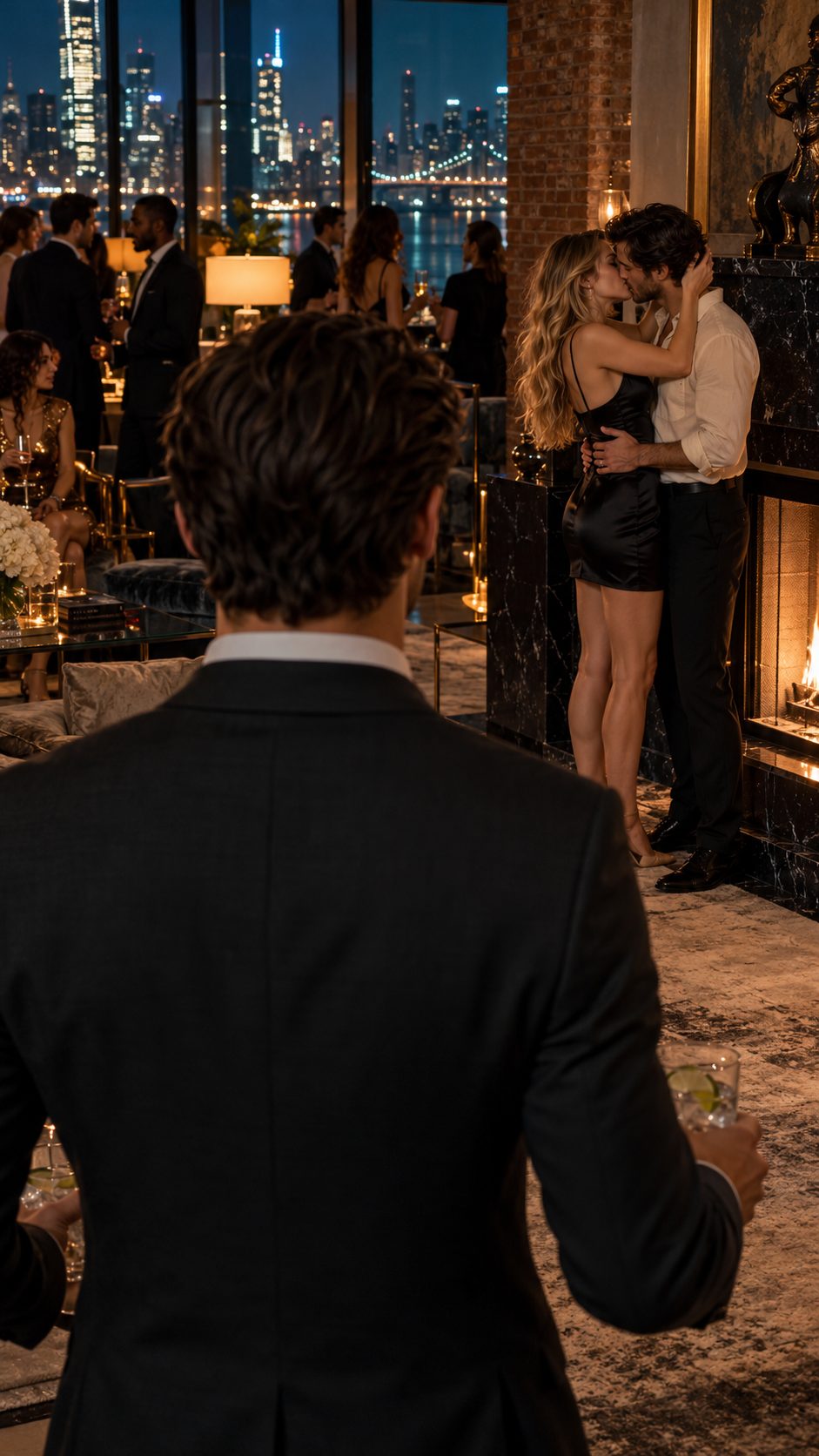
I was holding two glasses of water when I watched my girlfriend kiss another man.
There are details about that night I wish I could forget.
The laughter.
The soft golden light spilling across the hardwood floors of Marcus Bell’s downtown apartment.
The way the ice shifted inside the glasses when my hands stopped moving.
But the one thing I’ll remember for the rest of my life is her smile.
Because Sloane Avery wasn’t embarrassed when she saw me.
She wasn’t surprised.
She wasn’t even sorry.
She smiled like she’d won something.
And that was how I learned the woman I’d loved for two years had turned our relationship into a game without bothering to tell me the rules.
My name is Elliot Marsh.
I’m thirty-three years old, and until that Saturday night, I thought I understood what it meant to be a good partner.
I didn’t think love required grand gestures every week.
I didn’t think trust meant keeping track of every person your girlfriend spoke to.
And I certainly didn’t think a relationship should feel like an endless audition for a role you’d already been given.
I believed in consistency.
In being there when someone needed you.
In remembering the small things.
Sloane always liked her water with ice and fresh lime.
She said lemon made everything taste like cleaning products.
It was a ridiculous little preference, the kind you learned after spending hundreds of ordinary evenings with another person.
And that night, when I noticed she’d been drinking more champagne than usual, I decided to get her some water.
Not because she’d asked.
Because I loved her.
The kitchen was separated from the living room by a narrow hallway.
Someone had left an empty wine bottle on the counter.
A bowl of sliced citrus sat beside a silver ice bucket.
I found two clean glasses.
Filled them with ice.
Added lime.
Then I checked my phone while the water ran.
A message from my coworker, Jonah, had arrived about our Monday morning project review.
I answered with a quick thumbs-up, dried my hands, and picked up the glasses.
I couldn’t have been gone more than three minutes.
Three minutes.
That’s how long it took for something I’d spent two years building to become unrecognizable.
When I returned to the living room, Sloane was beside the fireplace.
Marcus had both hands around her waist.
Her fingers were tangled in his dark hair.
And they were kissing.
Not a drunken peck.
Not an accidental brush of lips.
A slow, deliberate kiss.
The kind of kiss people share when they’re comfortable being close.
When they aren’t worried about getting caught.
Except they were standing in the middle of a crowded party.
And my girlfriend knew I was there.
I knew she knew because the moment they separated, her eyes searched the room.
They found me almost immediately.
Then she smiled.
A small, satisfied curve of her lips.
Almost playful.
Like a magician waiting for applause after revealing the final trick.
I stood frozen with the two glasses in my hands.
Around me, life continued.
A woman near the couch laughed at something her friend said.
Someone called for another bottle of wine.
The bass from the speakers vibrated through the floor.
I could see everything.
I could hear almost nothing.
My attention was fixed on Sloane.
I waited for her to come toward me.
For her expression to change.
For some explanation to appear that could make what I’d just witnessed anything other than what it was.
But she didn’t move.
Instead, she leaned against Marcus’s chest.
And watched me.
Marcus looked over his shoulder.
When he saw me, his mouth lifted into the faintest smile.
That was the second thing I noticed.
He wasn’t surprised either.
At the time, I didn’t understand what that meant.
I just knew something was terribly wrong.
I looked down at the glasses.
Two identical tumblers.
Clear water.
Lime slices floating among the ice.
The stupidest things become important during the worst moments of your life.
I remember thinking I shouldn’t let the glasses fall.
I remember noticing a bead of condensation rolling down my thumb.
I remember wondering whether Sloane would still want the water.
That thought lasted less than a second.
Then something inside me shifted.
Not explosively.
Not dramatically.
It was more like a door quietly closing.
I walked to the side table and placed both glasses down.
One beside the other.
I picked up my jacket from the armchair near the entrance.
Then I turned toward the front door.
I didn’t yell.
I didn’t ask Marcus what he thought he was doing.
I didn’t demand an explanation from the woman who had just kissed him.
I simply started walking.
Because whatever explanation existed, it wouldn’t change what I’d seen.
I was halfway down the hallway when I heard her voice.
I kept walking.
“Elliot, wait.”
There was an edge to her voice now.
Impatience.
It sounded like someone calling after a dog that had wandered too far from its leash.
I stopped with one hand on the door handle.
For one final moment, I let myself hope.
Maybe she’d say she was sorry.
Maybe she’d finally look ashamed.
Maybe she’d tell me there was something I didn’t understand.
I turned around.
Sloane stood beneath the hallway lights, arms crossed, her black dress catching the warm glow.
Marcus was several steps behind her.
She tilted her head.
“Seriously?” she asked.
That was her first word to me after kissing another man.
Not please.
And somehow, that hurt more than the kiss.
The first time I met Sloane Avery, she spilled coffee on my shoes.
It happened at a small bookstore café on a rainy Thursday afternoon.
I’d stopped there after work because I needed somewhere quiet to review a project schedule before heading home.
She was standing in line ahead of me, arguing cheerfully with the barista about whether their cinnamon latte deserved to be called the best in the city.
She turned too quickly.
Her paper cup tilted.
And suddenly there was coffee across the toes of my brown leather shoes.
“Oh my God.”
She stared at the damage.
Then at me.
Then she started laughing.
Not because she thought it was funny that she’d ruined my shoes.
Because she was embarrassed, and laughing seemed to be the only way she knew how to handle it.
“I’m so sorry,” she said.
“I promise I’m not usually this much of a disaster.”
I looked down.
Then back at her.
“Good thing they’re waterproof.”
“They don’t look waterproof.”
“They aren’t.
I’m trying to make you feel better.”
She laughed harder.
There was something magnetic about her.
Sloane was beautiful in the kind of effortless way that made people turn their heads even when she wasn’t trying to attract attention.
Long blonde hair.
Bright blue-gray eyes.
A smile that seemed to arrive a moment before she spoke.
She had an expressive face, one that could communicate an entire conversation without words.
Before I left, she insisted on buying me another coffee.
Then she asked for my number so she could repay me for the shoes.
I told her the coffee was enough.
She said, “That wasn’t really why I asked.”
We went on our first date four days later.
A small Italian restaurant near the river.
She talked about everything.
Her job coordinating events for a marketing company.
Her favorite movies.
The cities she wanted to visit.
The childhood dog she’d named after a character from a television show.
I listened.
Not because I didn’t have anything to say.
Because I genuinely liked hearing her talk.
At one point, she stopped in the middle of a story and studied me.
She smiled.
“You’re different.”
“Different how?”
“Most guys spend the whole date trying to impress me.
You actually listen.”
I shrugged.
“Seems like a better way to get to know someone.”
She reached across the table and touched my hand.
“I like that.”
For a long time, I believed that was the foundation of our relationship.
She brought excitement into my structured life.
I brought stability into hers.
Sloane loved last-minute plans.
I liked reservations.
She could walk into a room full of strangers and leave knowing half their names.
I was happiest talking to three people I knew well.
She listened to loud music while cooking.
I measured ingredients.
Or at least, I thought it did.
During our first year together, she used to tell her friends I was the calmest man she’d ever dated.
“Nothing rattles him,” she’d say, smiling proudly.
“It’s like dating a human emergency exit.”
Everyone would laugh.
I’d laugh too.
It seemed affectionate.
She called me her safe place.
When work overwhelmed her, she came to my apartment and curled against me on the couch.
When her mother criticized her choices, I listened without trying to tell her how to feel.
When she got sick, I drove across town at midnight with medicine and soup.
When she forgot her car keys at a restaurant, I drove back to retrieve them.
I never considered these sacrifices worth mentioning.
They were simply part of loving someone.
And Sloane noticed.
At least in the beginning.
One night, about six months into our relationship, she fell asleep with her head on my shoulder while we watched a movie.
Just before drifting off, she whispered, “You make everything feel easy, Elliot.”
I kissed the top of her head.
I meant it.
I wanted loving me to be easy.
I wanted her to know she didn’t have to earn my attention through drama.
But somewhere along the way, something changed.
It happened so gradually that I couldn’t identify the exact moment.
A complaint here.
A comment there.
Little disappointments that seemed harmless on their own.
One evening, we were at a restaurant when a stranger sent Sloane a drink.
The waiter explained that the man at the bar had offered to pay for it.
Sloane looked at me.
I looked at the drink.
Then at the waiter.
“That’s kind of him,” I said.
“But she can decide whether she wants it.”
The waiter left.
Sloane stared at me.
“That’s it?”
“You’re not even curious who sent it?”
I glanced toward the bar.
A man in a gray jacket raised his glass.
I gave him a polite nod.
Sloane looked offended.
“You’re seriously not jealous?”
“Should I be?”
“He was obviously flirting with me.”
“And you don’t care?”
I set down my fork.
“Of course I care about you.
I just trust you to handle someone flirting.”
She looked away.
“Sometimes it’s nice to feel wanted.”
I reached across the table.
“You are wanted.”
She didn’t take my hand.
At the time, I thought we were simply having one of those conversations couples have when their expectations don’t quite match.
I didn’t recognize it as the beginning of a pattern.
A month later, she mentioned a coworker who kept complimenting her appearance.
I told her I was sure she got compliments all the time.
She looked disappointed.
Another time, she asked what I’d do if someone tried to steal her away.
“I’d remind you that you’re not an object anyone can steal,” I said.
She rolled her eyes.
“You’re impossible.”
“That’s one opinion.”
She didn’t smile back.
Eventually, her complaints became more direct.
“You’ve gotten too comfortable.”
“You never get jealous.”
“You don’t fight for me anymore.”
I tried to understand.
I asked if she wanted more dates.
More affection.
More time together.
I surprised her with concert tickets.
Planned a weekend trip to a lakeside cabin.
Brought flowers home for no reason.
But nothing seemed to address the thing she was actually upset about.
One Sunday afternoon, after another argument about my supposed lack of passion, I called my friend Jonah.
Jonah had known me since college.
He was the kind of person who could make a joke out of almost anything, but he also had an unnerving ability to identify problems before I did.
I told him what Sloane had said.
He was quiet for a moment.
Then he asked, “Does she want you to love her, or does she want you to prove other guys can’t have her?”
“That’s a dramatic way to put it.”
“She’s just feeling insecure.”
“Could be.”
“Just don’t confuse reassuring someone with auditioning for them.”
I remembered that sentence later.
Much later.
At the time, I thought Jonah was being cynical.
I loved Sloane.
I believed she loved me.
And I assumed the differences between us were things we could work through.
I didn’t know she’d already decided that my trust was a weakness.
Or that she was willing to humiliate me publicly to see whether she could break it.
Marcus Bell was the kind of man who seemed to have been born in the middle of a party.
He always knew the right thing to say.
Always had a story ready.
Always made people feel as though they were the most interesting person in the room.
His downtown apartment was beautiful in a way that practically demanded an audience.
Exposed brick.
Tall windows.
Expensive artwork that looked deceptively simple.
A fireplace he’d mentioned cost more to install than I’d spent on my first car.
He worked in commercial real estate, or at least that was how he described his career.
Whenever someone asked what he did, he gave a different answer depending on how much he wanted to impress them.
Sloane adored him.
“Marcus is hilarious,” she’d say after events where he’d been present.
“Marcus knows everyone.”
“Marcus could sell sand in the desert.”
I never minded.
Marcus was part of her social circle.
They’d known each other through friends before she met me.
He hosted parties, arranged weekend getaways, and seemed to know every trendy restaurant in the city before it became impossible to get a reservation.
He was also flirtatious.
With everyone.
At least, that was what Sloane told me.
I remembered one dinner when Marcus had greeted her with a long hug and an exaggerated kiss on the cheek.
He’d turned to me afterward.
“You’re a lucky man, Elliot.”
I shook his hand.
Something about the smile stayed with me.
But I hadn’t considered it important.
I was confident in my relationship.
I didn’t believe every man who noticed my girlfriend was automatically a threat.
That Saturday, Sloane spent almost an hour getting ready for Marcus’s party.
We were supposed to arrive at seven thirty.
At seven twenty, she was still standing in front of the bedroom mirror.
She’d tried on three dresses.
A silver one.
And finally, a fitted black dress that hugged her figure and ended above her knees.
She turned sideways.
“What do you think?”
I looked up from my phone.
“You look beautiful.”
She frowned.
“That’s all?”
I put the phone down.
“What else do you want me to say?”
“I don’t know.
Something.”
I stood and walked toward her.
“You look incredible.”
I kissed her shoulder.
She studied my reflection in the mirror.
“Would you be jealous if guys stared at me tonight?”
I rested my hands lightly at her waist.
Her expression changed.
“I’d understand why they were looking.”
“That’s not an answer.”
I met her eyes in the mirror.
“You’re beautiful, Sloane.
People are going to notice.
That doesn’t bother me.”
She turned away.
“Sometimes I wonder if anything bothers you.”
There it was again.
That strange disappointment whenever I failed to react the way she expected.
I stepped back.
“Are we okay?”
She opened a drawer and searched for earrings.
“Of course.”
“Because you seem upset.”
“I’m not upset.”
She exhaled.
“I just wish you’d be a little more passionate sometimes.”
I considered responding.
Instead, I looked at the clock.
We’re already late.”
She smiled suddenly.
The mood changed as quickly as it had arrived.
She slipped her hand into mine.
That was another thing about Sloane.
An argument could disappear from her face in seconds.
I used to admire her ability to move on.
Later, I began wondering whether she had simply learned that unresolved tension could be useful.
The party was already crowded when we arrived.
Music drifted into the hallway before Marcus opened the door.
He greeted Sloane first.
Of course he did.
“There she is.”
He opened his arms.
She laughed and stepped into the hug.
Marcus held her a second longer than necessary.
Then he looked at me.
Good to see you.”
“Thanks for inviting us.”
“Absolutely.
Make yourselves at home.”
He glanced at Sloane.
“Black was definitely the right choice.”
She beamed.
“You think?”
“Oh, I know.”
I didn’t think anything of it.
Inside, the living room was filled with people.
A bartender had been hired to work behind the kitchen island.
Groups gathered near the windows.
Someone was taking photographs beside a wall of expensive artwork.
The entire apartment smelled like perfume, candles, and the citrus garnish from the drinks.
For the first hour, things seemed normal.
Sloane floated from conversation to conversation.
She was in her element.
I caught up with a few acquaintances from previous gatherings.
I talked to a software consultant about a project that had gone over budget.
I listened to a man explain why he’d recently quit his corporate job to open a cocktail bar.
Every so often, I glanced across the room and found Sloane.
She was laughing.
Enjoying herself.
And I felt happy watching her.
I didn’t need to occupy every second of her attention.
I liked that she could have fun without holding onto me.
At one point, Marcus appeared beside me.
“She’s having a good night.”
I followed his gaze.
Sloane was laughing at something a woman near the fireplace had said.
“Looks like it.”
Marcus took a sip of his drink.
“You ever worry she gets bored?”
I looked at him.
“Nothing serious.”
“She’s got a lot of energy.”
“She does.”
“Some guys can’t keep up with that.”
I studied his face.
“Good thing she’s dating me, then.”
He laughed.
“Fair enough.”
He clapped me on the shoulder and walked away.
I remember thinking it was a strange conversation.
Not threatening.
Just strange.
A little later, I noticed Sloane had finished another glass of champagne.
Her cheeks were flushed.
She was laughing louder than usual.
When I approached, she was standing with Marcus and two other guests.
“Having fun?”
She slipped an arm around my waist.
“Of course.”
“You’ve had a few drinks.”
“I’m fine.”
I brushed a loose strand of hair away from her face.
“Want some water?”
She gave me an exaggerated look.
“Are you monitoring me now?”
I’m offering you water.”
Marcus chuckled.
Sloane smiled at him.
Always taking care of me.”
It should have sounded affectionate.
Instead, there was an edge to it.
One of the guests changed the subject.
Someone mentioned a restaurant opening the following week.
I leaned toward Sloane.
“I’ll grab us some water.”
She barely looked at me.
“Sure, babe.”
I kissed her cheek.
She didn’t return the gesture.
I walked toward the kitchen.
And while I searched for clean glasses, the people I’d left behind made a decision that would change my life.
I didn’t see Marcus move closer to her.
I didn’t see who suggested the kiss.
I didn’t know whether they’d discussed it that afternoon or weeks earlier.
All I knew was that when I returned, everything was different.
Later, I would learn how deliberate it had been.
But in that moment, all I could see was the woman I’d trusted standing in another man’s arms.
And smiling as though she wanted me to suffer.
“Seriously?”
Sloane’s voice echoed down the hallway.
I stood beside the front door, my jacket hanging from one arm.
For a moment, I just looked at her.
She still had that irritated expression.
As if I had embarrassed her.
As if walking out was somehow worse than what she’d done.
“You’re just going to leave?”
I stared at her.
“You kissed Marcus.”
She rolled her eyes.
“Oh my God.
Behind her, Marcus shifted his weight, slipping one hand into his pocket.
A few guests had wandered closer.
I noticed someone lower the music.
The room was becoming quieter.
Sloane noticed too.
And instead of lowering her voice, she spoke even louder.
“I just wanted to make you jealous.”
For a second, I thought I’d misunderstood.
I looked from her to Marcus.
Then back again.
“You wanted me jealous?”
She said it like the answer should have been obvious.
“Because you’ve been taking me for granted.”
I almost laughed.
Not because anything was funny.
Because I had no idea how to respond to something so completely disconnected from the relationship I thought we had.
“Taking you for granted?”
She crossed her arms.
“You don’t act like you care anymore.”
My eyes moved toward the table near the entrance.
The two glasses of water were still sitting where I’d left them.
“I brought you water,” I said.
Sloane frowned.
I saw you’d had a few drinks, so I brought you water.”
She exhaled impatiently.
“Elliot, that’s not what I’m talking about.”
“I remember how you like your coffee.”
“Seriously?”
“I know your favorite restaurants.
I know you hate cilantro and love those ridiculous lavender cookies from that bakery across town.”
Someone near the living room went very still.
I continued.
“When you have a bad day, I listen.
When you’re upset, I ask what you need.
When you’re sick, I show up.”
Sloane looked uncomfortable, but not in the way I’d hoped.
She seemed annoyed that the conversation wasn’t going where she wanted.
“I know all that.”
“Then what exactly have I been taking for granted?”
She threw her hands into the air.
“Those are habits.”
The word hit me harder than I expected.
That was what she called the small things I’d done because I loved her.
Not devotion.
I stood there trying to reconcile the woman in front of me with the woman who used to fall asleep against my shoulder and call me her safe place.
Sloane continued speaking.
“I’m talking about passion.
I’m talking about making an effort.”
“I do make an effort.”
“Not like you used to.”
“What does that mean?”
She gestured toward Marcus.
“You see another man interested in me, and you don’t even react.”
I looked at Marcus.
Then he stepped forward and placed his hand on Sloane’s lower back.
The gesture was slow.
Deliberate.
He knew I was watching.
He wanted me to see it.
And suddenly, the entire situation became clear.
“This was planned,” I said.
Nobody answered.
I looked at Sloane.
“Wasn’t it?”
Her expression changed for a fraction of a second.
A flicker of surprise.
Not because I’d accused her of something untrue.
Because I’d understood it sooner than she’d expected.
“Did you and Marcus decide to do this?”
She glanced at him.
He gave a careless shrug.
“Man, don’t make this bigger than it is.”
I turned toward him.
He raised his eyebrows.
“Don’t what?”
“Don’t talk to me like I’m the one making this strange.”
His smile faded slightly.
I wasn’t shouting.
That seemed to bother him.
He took another step closer to Sloane.
“Look, nobody’s trying to hurt you.”
I stared at him.
“You kissed my girlfriend in front of forty people.”
He opened his mouth.
I continued.
“And apparently, she wanted you to.”
He said nothing.
I looked at Sloane again.
“So what exactly am I supposed to do?”
She watched me carefully.
I could almost see her waiting for the reaction she’d imagined.
“Punch him?”
Her eyes flickered.
“Elliot, you’re being dramatic.”
“Compete for you?”
There it was.
Something lit up in her expression.
Just for a moment.
But it was enough.
She stepped toward me.
“You could start by acting like it matters that another man kissed your girlfriend.”
I nodded slowly.
“It does matter.”
“Then why are you just standing there?”
“Because I’m trying to understand why someone I love would deliberately hurt me to see what I’d do.”
She looked away.
For the first time, she seemed to have trouble finding words.
Then she recovered.
“Because I’m tired of feeling like you’re comfortable.”
“Comfortable.”
I looked at the people watching us.
Some stared openly.
Others pretended to study their drinks.
Near the fireplace, a woman I’d met earlier looked at Sloane with visible disbelief.
I turned back to my girlfriend.
“You’re right about one thing.”
Sloane folded her arms.
“What’s that?”
“I was comfortable.”
She seemed pleased.
Finally, an admission.
“I was comfortable because I trusted you,” I said.
“I thought that was the point.”
Her expression hardened.
“You’re twisting my words.”
I’m listening to them.”
“Elliot, I just wanted to see that you’d fight for me.”
“Against Marcus?”
She glanced over her shoulder.
Marcus lifted his chin, as if waiting to be acknowledged.
“Against anyone,” she said.
I let the silence settle.
Then I asked a question that seemed to confuse her.
“Why would I fight another man for someone who’s already decided to stand beside him?”
Sloane blinked.
“Because I’m your girlfriend.”
“You’re my girlfriend because we choose each other.”
“We do choose each other.”
“You just kissed someone else to humiliate me.”
“It wasn’t like that.”
“Then explain how it was.”
She opened her mouth.
Then spoke the sentence that made everything click into place.
“You weren’t supposed to leave.”
I stared at her.
She took another step closer.
“You were supposed to compete.”
A few people exchanged glances.
Someone behind Marcus muttered something under his breath.
But I barely noticed.
Because I was looking at Sloane, and for the first time in two years, I understood exactly what she wanted from me.
Not reassurance.
A performance.
She wanted me angry.
She wanted me desperate.
She wanted to see me lose control in front of an audience so she’d know she had the power to make it happen.
And when I wouldn’t give her that, she felt cheated.
The realization was devastating.
But it was also strangely clarifying.
I no longer had to wonder whether I was doing enough.
There was no amount of kindness that could satisfy someone who measured love by how much chaos they could create.
I looked at Marcus.
Then at Sloane.
My hands had stopped trembling.
My breathing was steady.
And the terrible pressure I’d felt in my chest began to loosen.
Not because I was suddenly happy.
Because I had made a decision.
“Sloane,” I said quietly, “I love you.”
Her eyes softened.
For a moment, I saw relief.
She thought she’d won.
Then I continued.
“But I won’t stay with someone who thinks love is a competition.”
Her expression changed.
“What does that mean?”
“It means we’re done.”
She laughed once.
A sharp, unbelieving sound.
“Don’t be ridiculous.”
I picked up my jacket properly.
“I’m going home.”
I turned toward the door.
“Elliot, stop.”
I rested my hand on the handle.
She called after me again.
“You’re seriously breaking up with me over one kiss?”
I looked back.
“It’s not just the kiss.”
“Then what?”
“You planned to hurt me.
You did it in front of everyone.
And when I tried to leave, you told me I was reacting the wrong way.”
She shook her head.
“You’re unbelievable.”
I looked at her one last time.
“Congratulations, Sloane.”
She frowned.
“You didn’t make me jealous.”
I opened the door.
“You made me single.”
For a moment, nobody spoke.
Sloane stood motionless.
Marcus’s smile vanished.
I stepped into the hallway and closed the door behind me.
And for the first time that night, I heard nothing.
No laughter.
No voices demanding that I become someone else.
Just the quiet hum of the elevator waiting at the end of the corridor.
I walked toward it.
And I didn’t look back.
I made it to the elevator before my phone started ringing.
Her name filled the screen.
For two years, seeing it had made me happy.
Now it made my stomach tighten.
I let the call go unanswered.
A second call came before I reached the lobby.
Then a third.
When the elevator doors opened, I switched my phone to silent.
Outside, the city was moving like nothing had happened.
Cars rolled through intersections.
People laughed outside restaurants.
A couple stood beneath the awning of a hotel, kissing while they waited for a taxi.
I looked away.
It was a ridiculous reaction.
An hour earlier, I wouldn’t have noticed them.
Now the sight of two strangers being affectionate made something ache behind my ribs.
I ordered a ride home.
The driver arrived in four minutes.
“Evening,” he said.
“Good night?”
I almost laughed.
“Not particularly.”
He glanced at me in the rearview mirror.
“Sorry to hear that.”
Then he turned up the radio slightly and left me alone.
I appreciated him more than he could have known.
Halfway home, I checked my phone.
Eleven missed calls.
Seven messages.
The first few were predictable.
Sloane: Where are you going?
Sloane: Elliot, answer me.
Sloane: You’re seriously making a huge deal out of nothing.
Then the tone changed.
Sloane: You embarrassed me in front of everyone.
I stared at that one.
I embarrassed her.
Not the man who’d kissed her.
Not the plan she’d apparently helped create.
Because I hadn’t played my assigned role.
Another message arrived.
Sloane: I didn’t think you’d actually leave.
I read it twice.
There was something painfully revealing about it.
She hadn’t considered the possibility that I might choose myself.
Not really.
In her mind, I was predictable.
A fixed point.
No matter how hard she pushed, I would remain right where she’d left me.
It occurred to me that she’d mistaken my willingness to stay through difficult times for an inability to leave.
Those were two very different things.
When I reached my apartment, I unlocked the door and stood in the dark.
Everything looked exactly as it had that afternoon.
Sloane’s pink ceramic mug sat beside the coffee machine.
A pair of her shoes was tucked under the hallway bench.
Her favorite throw blanket lay across the couch.
There was a photograph of us on the bookshelf.
We’d taken it at the lake the previous summer.
Sloane was laughing at something just outside the frame.
I had one arm around her waist.
I remembered that day.
The weather had been beautiful.
We’d rented a small boat.
She’d insisted on steering even though she had no idea what she was doing.
We’d ended up drifting in circles until I gently took the wheel.
She’d called me her hero.
I picked up the photograph.
For a moment, I could almost hear her laughing.
Then I remembered her smile beside Marcus.
And the memory changed.
I placed the picture facedown.
I wasn’t ready to throw it away.
I wasn’t ready to look at it either.
I went to the kitchen and poured myself a glass of water.
Without thinking, I reached for a lime.
My hand stopped in midair.
I stared at the fruit bowl.
Then I laughed.
A short, broken sound.
Two years of loving someone had trained my hands to remember things before my mind caught up.
I set the lime down.
Drank the water plain.
And sat at the kitchen table.
The silence was enormous.
At Marcus’s apartment, everything had happened too quickly for me to feel the full weight of it.
Now there was no noise to hide behind.
No confrontation to concentrate on.
No door to walk through.
And the fact that my relationship was over.
I pressed my palms against my eyes.
I had expected anger.
Instead, what came first was grief.
I missed her.
That was the cruelest part.
I missed the woman who’d kissed someone else an hour earlier.
I missed her terrible singing in the kitchen.
I missed how she’d steal my sweatshirts and insist they looked better on her.
I missed her calling me at the end of a bad day.
I missed the person I’d believed she was.
And I hated that missing her made me feel weak.
My phone vibrated.
For one foolish second, I hoped she’d finally sent a sincere apology.
It was Jonah.
Jonah: Hey.
I stared at the message.
Then called him.
He answered immediately.
“Hey, man.”
I tried to speak.
Nothing came out.
Jonah’s tone changed.
“What’s wrong?”
I looked at Sloane’s mug beside the coffee machine.
“She kissed Marcus.”
There was silence.
Another pause.
“Are you serious?”
“At his party.
Right in front of me.”
“What the hell?”
I told him the story.
Not dramatically.
I explained what I’d seen, what she’d said, and why I’d left.
Jonah listened without interrupting.
When I finished, he asked, “Are you home?”
“Are you alone?”
“I’m coming over.”
“You don’t have to.”
“Elliot, I’m bringing food.
You sound like you haven’t eaten in a week.”
I looked at the clock.
It was almost eleven.
“You have work tomorrow.”
“So do you.”
Twenty-five minutes later, Jonah arrived carrying two paper bags from an all-night diner.
He didn’t give me a speech.
He didn’t call Sloane names.
He didn’t tell me I should have punched Marcus.
He put the food on the table, grabbed two plates, and sat across from me.
We ate in silence for a while.
Then he said, “I know you loved her.”
“And I know this hurts.”
I looked down.
He continued.
“But being hurt doesn’t mean you made the wrong decision.”
I swallowed.
“I keep wondering if I should’ve said more.”
“Like what?”
“I don’t know.
Asked why she did it.
Tried to understand.”
Jonah considered that.
“Maybe you’ll understand more later.”
He took a sip of water.
“But you don’t have to understand every reason someone hurts you before you’re allowed to leave.”
I sat with that.
Then I asked the question I’d been trying not to think about.
“Do you think I was too calm?”
Jonah stared at me.
“Too calm?”
“Maybe she needed to see I cared.”
He put down his fork.
“Elliot, you went to get her water because you noticed she’d been drinking.”
I said nothing.
“That was you caring.”
He leaned forward.
“She didn’t want proof you cared.
She wanted proof she could make you lose control.”
I looked away.
Because deep down, I knew he was right.
After Jonah left, I went to bed.
I couldn’t sleep.
At a.m., my phone lit up again.
One final message from Sloane.
Sloane: We need to talk.
This wasn’t supposed to happen.
I stared at those words in the darkness.
This wasn’t supposed to happen.
I knew exactly what she meant.
She wasn’t talking about the kiss.
She was talking about me leaving.
I turned the phone facedown.
And for the first time in two years, I let her fall asleep without a goodnight message from me.
Sunday morning arrived too brightly.
Sunlight came through the bedroom curtains.
A garbage truck rumbled down the street.
Somewhere outside, a dog barked.
I woke up reaching for my phone.
That was our routine.
Sloane usually sent me something in the morning.
A photograph of her coffee.
A complaint about traffic.
A ridiculous video.
Sometimes just a message saying she missed me.
For a few seconds, still half-asleep, I forgot.
Then the memory returned.
The fireplace.
My stomach felt hollow.
There were twenty-three new messages waiting.
I didn’t open them immediately.
Instead, I showered, made coffee, and stood by the window while the machine finished brewing.
It was a habit I’d developed years earlier.
When I felt overwhelmed, I focused on what I could control.
Deal with the next problem.
But there was no clean way to organize heartbreak.
I finally opened the messages.
The first several were from Sloane.
Sloane: Can we please talk?
Sloane: You’re blowing this out of proportion.
Sloane: I didn’t sleep at all.
Sloane: You made me look horrible.
Sloane: I can’t believe you’d throw away two years over something so stupid.
Then one arrived that made my jaw tighten.
Sloane: If you actually loved me, you wouldn’t give up this easily.
I set the phone down.
There it was again.
The same impossible test.
If I stayed, I proved I loved her.
If I left, apparently I never had.
The actual betrayal didn’t matter.
Only whether I responded in a way that reassured her.
A little after ten, my phone rang.
It was Rachel Bennett, a friend we’d both known for over a year.
I’d met her through Sloane, but we’d become friends independently.
Rachel worked as a graphic designer and had a habit of being painfully direct.
I answered.
“Please tell me you didn’t punch Marcus.”
She exhaled.
“Okay, good.
Because there are some very strange versions of last night going around.”
My chest tightened.
“What versions?”
“That Sloane kissed Marcus as some kind of joke, you got furious, threatened him, and stormed out.”
I closed my eyes.
“I didn’t threaten anyone.”
“I didn’t think you did.”
“Who said that?”
“Marcus has been telling people you took it personally.”
I almost laughed.
“Took it personally?”
“His words, not mine.”
I sat down.
Rachel continued.
“Sloane’s been saying she was trying to get your attention because you’ve been emotionally distant.”
I looked toward the kitchen.
Sloane’s mug was still sitting there.
“Rachel, I was gone for three minutes getting her water.”
“And when I came back, they were kissing.”
“I know that too.”
“Then you know why I left.”
Rachel was quiet.
Then she said, “Elliot, I was there.”
That stopped me.
“I didn’t realize you saw it.”
“I was near the windows.”
She lowered her voice.
“It didn’t look spontaneous.”
I felt cold.
“What do you mean?”
“Before you came back, Sloane and Marcus were talking by the fireplace.
I couldn’t hear everything, but I heard her ask whether he thought you’d actually get angry.”
I stared at the table.
Rachel continued.
“Marcus laughed.
Then she said something about you finally having to show some emotion.”
I didn’t respond.
“Afterward, when you walked away, she looked stunned.”
I swallowed.
“She wasn’t stunned when I saw the kiss.”
“No,” Rachel said.
“She was smiling.”
There was a long silence.
Then Rachel added, “I’m sorry.
I should’ve said something last night.”
“You didn’t know what they were doing.”
“Maybe not.
But I knew something felt off.”
I leaned back in my chair.
“What happened after I left?”
Rachel hesitated.
“Sloane argued with Marcus.”
That surprised me.
“About what?”
“I don’t know exactly.
But she kept saying he should’ve stopped you.”
I closed my eyes.
Even after I’d left, she was looking for someone else to fix what she’d done.
“Marcus didn’t seem particularly interested,” Rachel continued.
“He went back to talking with people.”
I let out a humorless laugh.
“That sounds like him.”
Rachel sighed.
“Look, I don’t want to get involved in your relationship.
But I also don’t want you thinking everyone believes whatever they’re saying.”
“And Elliot?”
“You didn’t look weak walking out.”
I didn’t answer.
“You looked done.”
After we hung up, I sat in silence for a long time.
I wasn’t surprised that Sloane was trying to justify herself.
I was surprised by how deeply it hurt to hear that she was making me responsible for the consequences of her own choices.
By noon, I had received messages from three different people asking whether I was okay.
One asked if Sloane and I had broken up.
Another wanted to know whether the kiss had been staged.
I didn’t want our relationship to become entertainment.
I didn’t want to spend the next week defending myself to people who had watched it happen.
So I wrote one simple response for anyone who asked.
Sloane and I are no longer together.
She kissed Marcus at the party, and she told me it was intentional.
I’m not interested in discussing the details publicly.
Then I put my phone away.
I spent the afternoon cleaning.
I washed dishes.
Changed the sheets.
Took out the trash.
At some point, I opened the bathroom cabinet and found the expensive face cream Sloane always complained cost too much.
Her toothbrush stood in the cup beside mine.
I picked it up.
For several seconds, I held it in my hand.
Then I placed it gently inside a small cardboard box.
I added her face cream.
Her spare hairbrush.
A bottle of perfume.
A bracelet she’d left on the bathroom counter.
I wasn’t angry enough to throw her things away.
But I couldn’t keep pretending she was still coming home.
I put the box in the closet.
Then I sat on the edge of my bed.
For the first time that morning, I cried.
Not loudly.
Not dramatically.
Just the quiet, exhausted tears of someone mourning a future that would never happen.
Because I hadn’t only lost Sloane.
I’d lost the trips we’d planned.
The apartment we’d talked about renting together.
The possibility of a family.
The ordinary Tuesdays I’d imagined spending beside her for years.
And the hardest part was knowing those possibilities hadn’t disappeared because I hadn’t loved her enough.
They’d disappeared because she had decided my love needed to be tested by humiliation.
That evening, she called again.
This time, I answered.
Her voice was softer than before.
“Can we please talk?”
I closed my eyes.
“What do you want to say?”
She was quiet.
Then she asked, “Can I come over tomorrow?”
I looked toward the closet.
At the box containing the small pieces of her life that still occupied mine.
“Tomorrow evening,” I said.
She exhaled in relief.
“Thank you.”
“Bring your key.”
A long silence followed.
Then she whispered, “Okay.”
Sloane arrived Monday evening at seven fifteen.
She was wearing jeans, a cream sweater, and the delicate necklace I’d given her for our first anniversary.
I noticed that immediately.
I didn’t know whether she’d chosen it deliberately.
I suspected she had.
She looked tired.
Her makeup was lighter than usual, and dark shadows showed beneath her eyes.
For the first time since the party, I felt an instinctive urge to ask whether she’d eaten.
The impulse was so familiar it almost made me smile.
Then I remembered why she was standing at my door.
“Hey,” she said.
She stepped inside.
Her gaze moved around the apartment.
She seemed to notice the missing photograph on the bookshelf.
Then the empty hook where she usually hung her coat.
Then the absence of her shoes beneath the hallway bench.
Her expression tightened.
“You moved my stuff?”
“I packed what you’d left here.”
I gestured toward the box on the coffee table.
Sloane stared at it.
I closed the door.
She turned toward me.
“Can we sit?”
I nodded toward the couch.
She sat on the cushion she always used.
I took the chair opposite her.
That seemed to bother her.
“You can sit next to me, Elliot.”
“I’m okay here.”
She pressed her lips together.
For a while, neither of us spoke.
Then she took a deep breath.
“I think this whole thing got completely out of hand.”
“I didn’t expect you to leave.”
“And when you did, everyone started asking questions.”
I said nothing.
She rubbed her hands together.
“It was humiliating.”
I studied her face.
“Yes,” I said quietly.
She looked up.
For a moment, I thought she understood.
Then she said, “You could’ve handled it privately.”
I felt something inside me sink.
“Sloane, you kissed someone else in the middle of a party.”
“In front of our friends.”
“Then you told me you did it to make me jealous.”
She looked away.
“I was upset.”
“About what?”
She hesitated.
“You’ve just been so different lately.”
“Different how?”
She shook her head.
“Everything is so predictable with you.”
I leaned back.
“Predictable.”
“You go to work.
You come home.
We have dinner.
We watch something.
We go to sleep.”
“We also go out.
We spend time with friends.”
“That’s not what I mean.”
“Then tell me what you mean.”
She looked frustrated.
“I wanted to feel like you couldn’t stand the thought of losing me.”
I considered her words.
“And kissing Marcus was supposed to accomplish that?”
She swallowed.
“I knew you’d be upset.”
She looked at me.
“I mean, I thought you’d be angry.”
“That’s not the same thing.”
She seemed confused.
I leaned forward.
“You thought I’d be angry because another man kissed you.
But did you ever consider how it would actually feel for me to watch it?”
She opened her mouth.
Then closed it.
“Did you think about what it would do to my trust?”
Her eyes began to shine.
“Or was the point just to see how loudly I’d react?”
She wiped at one eye.
“I wasn’t thinking about it that way.”
I believed her.
And that was part of what made it so painful.
She hadn’t thought about me as a person with feelings.
She’d thought about me as someone whose reaction she could control.
I waited until she looked at me again.
“Tell me what happened with Marcus.”
She stiffened.
“What do you mean?”
“How did you decide to kiss him?”
She stared at her hands.
For several seconds, she said nothing.
Then she whispered, “We talked about it.”
I felt my stomach turn.
“Earlier that night.”
“Before I went to the kitchen?”
She nodded.
I looked toward the window.
Even though I’d suspected the truth, hearing her admit it was different.
“Who suggested it?”
She hesitated.
“Marcus joked that you never seemed bothered by anything.”
I remained quiet.
“And I said sometimes I wished you were.”
“He said maybe you needed a little competition.”
I looked back at her.
“And you agreed?”
She rubbed her forehead.
“I didn’t think it would become such a big thing.”
“You chose to kiss him.”
She met my eyes.
“In front of me.”
She nodded.
“Because you wanted to see what I’d do.”
“And when I walked away, you were angry.”
Her mouth trembled.
“Because I thought you’d come back.”
There it was.
The truth without excuses.
She had expected me to chase her.
I exhaled slowly.
“Did you want to kiss him?”
Her head snapped up.
“Then why did you?”
“Because I thought it would work.”
The answer was almost worse than yes.
If she’d been attracted to Marcus, if she’d lost control for a moment, at least I could understand the basic human weakness behind the betrayal.
But she was telling me that she’d used physical intimacy with another man as a tool.
A way to manipulate my emotions.
She didn’t even need to want Marcus.
She only needed to want a reaction from me.
“Have you done anything like this before?”
She hesitated.
“Not like this.”
I watched her.
“What does that mean?”
She looked toward the window.
“Sometimes I’d mention guys flirting with me because I wanted to see what you’d say.”
I thought about the restaurant.
The drink from the stranger.
The coworker she kept bringing up.
Suddenly, those conversations seemed different.
“All those times you asked whether I was jealous?”
She nodded.
“I wanted to know you still cared.”
I looked down.
“I told you I cared.”
“I showed you.”
“Then why wasn’t that enough?”
She began crying.
“I don’t know.”
For the first time since the party, I saw something that looked like genuine regret.
Not simply frustration that her plan had failed.
Something deeper.
And despite everything, I felt compassion for her.
Sloane was sitting on my couch, crying because she’d done something cruel and couldn’t reverse it.
I still loved her enough to wish she hadn’t made that choice.
But love wasn’t the same as permission.
I waited until she had wiped her face.
Then I spoke.
“I think you wanted to feel important.”
She looked at me.
“And somewhere along the way, you started measuring how important you were by how much pain you could cause.”
She shook her head.
“I never wanted to hurt you.”
“You did want me to hurt.”
Her face crumpled.
I continued gently.
“You wanted me jealous.
You wanted me scared.
You wanted me to think I might lose you.
Those feelings hurt, Sloane.”
She covered her mouth.
“I didn’t think about it like that.”
“I love you.”
I closed my eyes.
There were words I’d once dreamed of hearing for the rest of my life.
Now they felt impossibly far away.
“I love you too,” I said.
Her expression changed.
Hope appeared.
She leaned forward.
“Then we can fix this.”
I shook my head.
“We can’t fix it just because we still have feelings.”
“Because I don’t trust you.”
She looked stunned.
I continued.
“And I can’t build a future with someone if I’m always wondering whether the next crisis is real or another test.”
She reached toward me.
I didn’t move.
“Please,” she whispered.
“Just give me another chance.”
For a moment, I wanted to.
I wanted the entire nightmare to disappear.
I wanted to wake up on a Saturday morning with her asleep beside me, the party still a week away, and the future unchanged.
But I knew what accepting her back would mean.
I’d spend months questioning every conversation she had with another man.
I’d wonder whenever she mentioned someone flirting.
I’d study her expression whenever she accused me of not caring enough.
I’d become suspicious.
Controlling.
Exactly the kind of man I never wanted to be.
And even then, she might still decide I wasn’t passionate enough.
I looked into her eyes.
“Do you remember what you said on our first date?”
She frowned through her tears.
“You told me you liked that I listened.”
A tear slid down her cheek.
“You said I made you feel safe.”
She nodded.
“I remember.”
“That’s the man I am, Sloane.”
My voice tightened.
“I don’t want to become someone else just to prove I’m worth loving.”
She cried harder.
We sat there for a long time.
Eventually, she stood.
She picked up the box.
At the door, she turned back.
“Are you really never going to change your mind?”
I looked at her.
“I don’t know what I’ll feel in a year.”
Her eyes brightened.
“But I know what I’m choosing now.”
The hope faded.
She reached into her purse and removed my apartment key.
She placed it on the small table beside the door.
The sound it made against the wood was painfully ordinary.
A tiny metallic click.
And yet it felt like the final punctuation mark at the end of two years.
Sloane looked at me one last time.
“I’m sorry,” she whispered.
This time, I believed she meant it.
But believing someone’s apology didn’t mean I had to give them another opportunity to hurt me.
“I know,” I said.
She walked out.
I closed the door.
Then I stood there in the quiet.
It hurt just as much as the first time.
But I didn’t open it again.
The first week after Sloane left was harder than I expected.
I had imagined that making the right decision would eventually make me feel better.
Instead, I felt terrible.
I woke up reaching toward the empty space beside me.
I caught myself checking the time when I knew she’d normally finish work.
Every evening, I resisted the impulse to call and ask how her day had been.
Sometimes I missed her so much that I forgot why we weren’t together.
Then the memory of the party would return.
And the pain would start all over again.
At work, I buried myself in schedules and spreadsheets.
I was leading a software migration project for a regional healthcare company, and we were approaching the most difficult part of the implementation.
There were vendor delays.
Conflicting requirements.
A growing list of problems that needed decisions.
Normally, I enjoyed that kind of work.
Problems had causes.
Causes had solutions.
If you examined the facts carefully enough, you could usually find a way forward.
Heartbreak didn’t operate like that.
There was no spreadsheet that could explain why someone who said she loved me had deliberately humiliated me.
No meeting that could reverse the damage.
No project plan that could tell me when I’d stop missing her.
On Wednesday afternoon, Jonah appeared in my office carrying two cups of coffee.
He set one on my desk.
“You’re doing that thing again.”
I looked up.
“What thing?”
“Pretending you’re perfectly fine while looking like you haven’t slept since Saturday.”
I leaned back.
“I’m working.”
“I can see that.”
He pulled up a chair.
“You want to talk?”
“Not really.”
He opened his coffee.
Then sat there.
After a minute, I sighed.
“You’re not going away, are you?”
I smiled for the first time that day.
We talked for nearly an hour.
Not just about Sloane.
About the future I’d imagined.
About how strange it felt to lose someone who was still alive, still working, still posting photographs, still going to restaurants we’d once visited together.
“That’s the part nobody tells you,” Jonah said.
“Sometimes you have to grieve someone who’s still walking around.”
He studied me.
“Have you talked to her since Monday?”
I gave him a look.
He raised his hands.
“Not because I hate her.
Because you need space to figure out what you want without her telling you what you should feel.”
I knew he was right.
That didn’t make the silence easier.
Two days later, Marcus contacted me.
His message arrived at on Friday morning.
Marcus: Hey, man.
I think we should clear the air.
I stared at it.
Then locked my phone.
Twenty minutes later, another message arrived.
Marcus: Things got out of hand Saturday.
Nobody wanted it to go that far.
I almost ignored him.
Then I decided there was one thing I wanted to understand.
Elliot: What did you think was going to happen?
He answered almost immediately.
Marcus: Honestly?
Thought you’d get mad.
Maybe come over and pull her away.
That’s what she wanted.
I read the message twice.
Then typed:
Elliot: And you were comfortable being part of that?
Several minutes passed.
Marcus: I thought everyone understood it wasn’t serious.
I shook my head.
He was describing my relationship like a party game.
Like something to experiment with between drinks.
I typed one final response.
Elliot: You knew she was my girlfriend.
You knew what you were doing.
There’s nothing to clear up.
Then I blocked his number.
I didn’t threaten him.
I didn’t post screenshots.
I didn’t call his employer or try to damage his reputation.
I simply decided I didn’t want him in my life.
That evening, Rachel called.
She told me the story was circulating among people who’d attended the party.
Not because I’d talked about it.
Because several guests had witnessed enough to form their own opinions.
Apparently, Sloane had initially insisted the kiss was meaningless.
Then, when people asked why she’d done it, she admitted she’d wanted to provoke me.
Marcus had tried to laugh the whole thing off.
But the joke wasn’t funny anymore.
One woman had asked Sloane why she needed to kiss another man to make her boyfriend jealous.
Another had pointed out that my leaving was probably the most reasonable response anyone could have had.
Sloane hadn’t handled those conversations well.
She’d gotten defensive.
Then upset.
Then withdrawn.
Rachel hesitated before telling me the last part.
“She’s really struggling, Elliot.”
I closed my eyes.
I didn’t want Sloane to suffer.
That was what made everything complicated.
Even after what she’d done, I didn’t enjoy hearing that she was unhappy.
“Is she okay?”
“I think she’ll be okay.”
Rachel was quiet.
Then she said, “You know, you don’t have to make her the villain to know she was wrong.”
I looked out the window.
“That’s what I’ve been trying to figure out.”
“How to remember the good things without pretending the bad thing didn’t happen.”
She exhaled softly.
“Maybe both can be true.”
I thought about that for a long time.
Sloane hadn’t been cruel every day of our relationship.
She’d made me laugh.
She’d supported me when my father was hospitalized.
She’d celebrated my promotion more enthusiastically than I had.
She’d once driven across town in a snowstorm because I mentioned I wasn’t feeling well.
Those moments had been real.
But so was the kiss.
So was the plan.
So was the smile.
A person could genuinely love you and still treat you badly.
And you could love them back without accepting that treatment.
That realization helped more than any angry speech ever could.
I didn’t need to rewrite our entire relationship as a lie.
I only needed to accept that the relationship I’d known was no longer one I could safely return to.
That night, I opened my phone and found the last photograph Sloane and I had taken together.
We were smiling outside a small restaurant.
She had her arms around my neck.
I was looking at her instead of the camera.
For the first time, the picture didn’t make me angry.
It made me sad.
And I let myself feel that sadness without trying to turn it into something else.
Then I moved the photograph into a private folder.
Not because the memory was worthless.
Because I no longer wanted it to be the first thing I saw every morning.
People like to say that walking away is the ultimate act of strength.
Sometimes it is.
But they rarely mention what happens afterward.
They don’t talk about the empty side of the bed.
The restaurant you can’t visit because you know exactly what the person who hurt you would have ordered.
The song that suddenly becomes unbearable.
The way your body remembers someone long after your mind has accepted that they’re gone.
For several weeks, I kept finding pieces of Sloane in ordinary places.
A receipt from a dinner we’d shared.
A hair tie beneath the couch.
An old grocery list in her handwriting.
Once, I found a birthday card she’d given me the previous year.
On the front, she’d written a joke about me getting older.
Inside, beneath her signature, she’d added something that stopped me cold.
Thank you for always making me feel safe.
I read that sentence several times.
Then I sat on the floor beside the storage box where I’d been sorting old papers.
I wondered when being safe had stopped being enough.
I wondered whether I could have done something differently.
Maybe I’d been too predictable.
Maybe I should have planned more spontaneous trips.
Maybe I should have complimented her more.
There it was.
The familiar trap.
I was searching for ways to make myself responsible for a decision she had made.
I could accept that our relationship hadn’t been perfect.
Maybe I’d become less romantic over time.
Maybe I’d let work consume too many evenings.
Maybe I hadn’t fully understood what she meant when she asked for more excitement.
Those were legitimate problems we could have discussed.
But they did not explain away what happened at Marcus’s party.
There had been a hundred ways for Sloane to tell me she was unhappy.
She could have asked for counseling.
She could have told me she needed more romance.
She could have said our relationship wasn’t fulfilling her anymore.
She could even have ended things.
Instead, she arranged a public betrayal and called it a test.
That was a choice.
And it wasn’t mine.
Once I understood the difference, I began making small changes.
Not because I wanted to transform myself into the kind of man Sloane had demanded.
Because I’d realized how much of my life had gradually narrowed around trying to keep her happy.
I started running again.
I hadn’t run regularly since college.
The first morning, I barely made it two miles.
By the end, my lungs burned and my legs felt ridiculous.
But when I got home, I realized I hadn’t thought about the party for almost twenty minutes.
It was the longest break my mind had given me in weeks.
I started seeing friends I’d neglected.
Jonah and I went to a baseball game.
Rachel invited me to a board-game night.
I visited my parents for a weekend and helped my father repair a broken fence.
He noticed I was quieter than usual.
We were working in the backyard when he asked how I was doing.
I told him the truth.
“Not great.”
“That makes sense.”
I stared at the wooden post I was holding.
“Sometimes I think I should’ve fought harder.”
My father lowered his hammer.
He considered that.
“There’s fighting for someone, and there’s fighting with someone.”
I looked at him.
“They’re not the same thing.”
He leaned against the fence.
“Your mother and I have been married thirty-seven years.
We’ve fought plenty of times.
We’ve disappointed each other.
We’ve said things we regretted.”
“But neither of us ever tried to make the other feel worthless just to see if they’d come running.”
I looked down.
“She said I was too comfortable.”
He smiled faintly.
“Son, comfort isn’t the enemy of love.”
He picked up his hammer.
“Sometimes it’s what love looks like when it doesn’t have to prove itself every five minutes.”
I thought about that on the drive home.
For two years, Sloane had gradually taught me to doubt the very qualities she’d once said she loved.
My patience.
My steadiness.
My willingness to trust.
After the breakup, I had started wondering whether those qualities were actually flaws.
But my father reminded me of something important.
I didn’t need to become angry to prove I had feelings.
I didn’t need to become controlling to prove I was committed.
And I didn’t need to compete with other men to prove I had value.
If I ever loved someone again, I wanted to bring the same patience and kindness into that relationship.
The difference was that I would pay closer attention to whether those qualities were respected.
I would take complaints seriously without accepting cruelty as a form of communication.
I would set boundaries earlier.
And when someone asked me to prove my love by abandoning my self-respect, I would recognize the warning.
A couple of months passed.
Sloane stopped calling.
Then the messages stopped too.
I heard through mutual friends that she and Marcus hadn’t become a couple.
Apparently, whatever spark they’d used to stage the kiss hadn’t survived the consequences.
I wasn’t surprised.
But I didn’t feel triumphant.
I didn’t particularly care what happened between them.
For a while, I had imagined that knowing Sloane regretted losing me would make everything better.
Her regret couldn’t give me back the trust I’d lost.
It couldn’t return the months I’d spent wondering why I wasn’t enough.
And it couldn’t change the fact that I’d watched her smile after hurting me.
Eventually, I stopped looking for updates about her.
I didn’t need to know whether she was dating anyone.
Whether she still went to Marcus’s parties.
Whether she missed me.
Those questions had stopped being useful.
One Saturday morning, I went to the bookstore café where we’d first met.
I hadn’t been there since the breakup.
I stood outside for a moment, looking through the window.
Then I went inside.
The place smelled exactly as I remembered.
Coffee beans.
Warm pastries.
The same little tables stood beside the windows.
I ordered a cappuccino and sat in the corner.
At first, it hurt.
I could almost picture Sloane turning toward me with coffee spilling down the side of her cup.
I could hear her laughing.
But then a family entered, and a little girl raced toward the display of children’s books.
An elderly man sat nearby reading a newspaper.
A college student opened a laptop and began typing.
The café was full of lives that had nothing to do with my heartbreak.
And slowly, the room became a café again.
Not a monument to my failed relationship.
Just a place I liked.
I finished my coffee.
Bought a book.
And walked home under the afternoon sun.
It wasn’t a dramatic breakthrough.
Nobody applauded.
There was no swelling music.
But something had changed.
I had taken back a small piece of my ordinary life.
And for once, ordinary felt like something worth celebrating.
Six months after Marcus Bell’s party, I saw Sloane again.
It happened on a Thursday evening in early spring.
I was leaving a small charity event at an art gallery downtown.
Rachel had invited me because one of her friends was exhibiting photographs, and I’d agreed to come.
It had been a good evening.
I’d talked to interesting people.
Donated to a cause I cared about.
And spent several hours without thinking about the past.
I was standing near the coat check when someone said my name.
I knew the voice immediately.
Sloane stood a few feet away.
She wore a dark green dress beneath a beige coat, and her blonde hair fell loosely around her shoulders.
She looked beautiful.
That hadn’t changed.
But something about her was different.
There was a hesitation in the way she stood.
A carefulness I didn’t remember.
For a moment, neither of us spoke.
Then she smiled.
Not the smile from the party.
A small, uncertain one.
She glanced toward the gallery entrance.
“I didn’t know you’d be here.”
“Rachel invited me.”
She nodded.
Silence settled between us.
It was strange seeing her in person again.
For months, I’d imagined what I would say if we crossed paths.
Sometimes I pictured myself being cold.
Sometimes I pictured telling her exactly how deeply she’d hurt me.
Other times, I worried that seeing her would bring all my old feelings rushing back.
But standing there, I felt something I hadn’t expected.
Not indifference.
I remembered everything.
I could still picture the fireplace, the glasses of water, Marcus’s hand on her waist.
I still felt a trace of sadness.
But the memories no longer controlled my breathing.
Sloane studied my face.
“You look good.”
She tucked a strand of hair behind her ear.
“How have you been?”
She raised an eyebrow.
I considered the question.
Her eyes lowered.
“I’m glad.”
A woman behind the coat-check counter called someone’s name.
People moved around us.
For a moment, I thought the conversation was over.
Then Sloane spoke again.
“I’ve wanted to talk to you.”
I looked at her.
“About what?”
She took a breath.
“Everything.”
I didn’t move.
She glanced toward a quieter corner of the lobby.
“Could we talk for a minute?”
I considered it.
Six months earlier, I wouldn’t have trusted myself to have that conversation.
Now I felt ready to hear whatever she wanted to say.
We moved away from the entrance.
A large window overlooked the street, where headlights passed across the wet pavement.
Sloane stood beside it.
She didn’t look at me immediately.
“I owe you an apology.”
“A real one.”
Her voice trembled slightly.
“I’ve thought a lot about what happened.”
I said nothing.
“I kept telling myself you overreacted.”
She laughed bitterly.
“I told everyone that.
I told myself that.
I thought if I said it enough times, maybe it would become true.”
She looked at me.
“But you didn’t overreact.”
I felt my chest tighten.
Not with hope.
With recognition.
For months, I’d known that.
It was still strange to hear her say it.
Sloane continued.
“I was angry because you didn’t do what I expected.
And instead of admitting I was wrong, I tried to make you feel guilty.”
She wiped a tear from the corner of her eye.
“I didn’t understand how cruel that was until later.”
I looked toward the street.
“Why later?”
She took a breath.
“Because I kept thinking about what you said.”
“What part?”
“That you didn’t want to become someone else just to prove you loved me.”
I turned back toward her.
She looked embarrassed.
“I’ve spent most of my life thinking love should feel intense all the time.
Like if someone wasn’t afraid to lose me, they must not care enough.”
She paused.
“I thought jealousy meant passion.”
I listened.
“And when you wouldn’t get jealous, I started trying harder to make it happen.”
She swallowed.
“The thing is, you were never cold, Elliot.”
My throat tightened.
“You were always there.”
I didn’t respond.
She continued.
“I wanted drama because I didn’t know how to recognize something good when it was quiet.”
For a moment, we simply stood there.
I could hear muffled conversation coming from the gallery.
A car horn sounded outside.
Then Sloane looked up.
“I didn’t want Marcus.”
I studied her face.
She blinked.
“You told me.”
She looked down.
I need you to understand that it wasn’t about wanting him.”
I took a slow breath.
“Sloane, that doesn’t make it better.”
She nodded immediately.
“No, I mean that.”
I kept my voice gentle.
“If you’d developed feelings for Marcus, it would’ve hurt.
But at least there would’ve been something real we needed to talk about.”
She listened.
“You kissed him because you wanted to see how much pain you could cause me.”
Her eyes filled.
“That was the part I couldn’t get past.”
She nodded.
“I understand.”
I believed her.
And surprisingly, that was enough.
I didn’t need to make her cry harder.
I didn’t need to punish her with words.
I didn’t need to win the conversation.
I’d already chosen my life.
Sloane looked at me for a long moment.
“Do you ever think about us?”
I smiled sadly.
“Of course.”
She glanced down.
“I do too.”
“There were good times.”
“Really good times.”
Her voice became very quiet.
“Sometimes I wish we could go back.”
I looked at her.
There was a time when those words would have been everything I wanted to hear.
I would have crossed a room to hold her.
I would have promised we could fix whatever was broken.
But something had changed in me.
I no longer confused wanting the past back with believing the future could work.
“I understand that,” I said.
She looked hopeful for a moment.
Then I continued.
“But we can’t go back.”
Her eyes filled again.
“Because you don’t love me anymore?”
I considered the question.
Love doesn’t always disappear neatly.
Sometimes it changes shape.
Sometimes it becomes a memory you carry without wanting to return to it.
“I care about you,” I said.
“And I probably always will, in some way.”
She waited.
“But I don’t want our relationship back.”
The words hung between us.
She looked toward the window.
Then nodded.
I could tell it hurt.
But she didn’t argue.
She didn’t accuse me of giving up.
She didn’t tell me I needed to prove anything.
And I hoped that meant she’d begun to understand.
After a moment, she turned toward me.
“I really am sorry, Elliot.”
“I believe you.”
She let out a shaky breath.
“Thank you.”
We stood in silence for a few more seconds.
Then she asked, “Can I ask you one last thing?”
She looked almost embarrassed.
“That night, when you walked out…”
“Did you really know immediately that it was over?”
I thought about the question.
About those two glasses of water.
About the way Marcus smiled.
About Sloane watching me as though I were supposed to become someone else.
“No,” I admitted.
She looked surprised.
“I didn’t know immediately.”
“At first, I was just hurt.”
Her eyes lowered.
“And then?”
“Then you told me it was a test.”
I looked directly at her.
“And I realized I didn’t want to spend the rest of my life taking tests I never agreed to.”
She covered her mouth.
A tear slipped down her cheek.
For a moment, I remembered the woman who’d spilled coffee on my shoes.
The woman who’d made me laugh during a terrible week at work.
The woman who’d curled against me on the couch and whispered that I made her feel safe.
I wished things had been different.
I truly did.
But wishing didn’t change what had happened.
And loving someone didn’t obligate me to let them keep hurting me.
Sloane wiped her face.
“I hope you find someone who appreciates you.”
“Thank you.”
She gave a small, sad laugh.
“I should’ve.”
I didn’t answer.
There wasn’t anything left to say.
We walked back toward the gallery entrance.
I collected my coat.
She lingered beside the door.
“Goodbye, Elliot.”
I looked at her one final time.
“Goodbye, Sloane.”
Then I stepped outside.
The rain had stopped.
Streetlights reflected across the pavement, and the city smelled clean and cool.
I walked a few blocks before stopping at a small café that was still open.
The place was nearly empty.
A young employee stood behind the counter, wiping down the espresso machine.
“Hey,” he said.
“What can I get you?”
I looked at the menu.
“Just water, actually.”
“Still or sparkling?”
“Want ice?”
He reached for a glass.
“Any lemon or lime?”
For the briefest moment, I was back in Marcus’s kitchen.
Two glasses.
Fresh lime.
The sound of ice.
A woman I’d loved waiting in another room.
I remembered the first terrible hours after the party, when I’d wondered whether remembering someone else’s preferences had been foolish.
Whether kindness was weakness.
Whether being dependable made me boring.
I thought about the months afterward.
The loneliness.
The difficult conversations.
The mornings I’d forced myself to get out of bed.
The friends who’d shown up.
The quiet moments when I’d begun feeling like myself again.
Then I looked at the employee.
“Lime’s good,” I said.
He dropped a fresh slice into the glass.
I paid, took the water, and sat by the window.
Outside, people moved along the sidewalk.
A couple hurried toward the subway, sharing an umbrella.
A group of friends laughed outside a restaurant.
A man carried flowers wrapped in brown paper.
Ordinary people, living ordinary lives.
Six months earlier, I’d thought ordinary love was what I had to offer.
And for a while, Sloane had made me believe that wasn’t enough.
But sitting there, watching the city move beyond the glass, I finally understood something.
There is nothing weak about treating someone well.
There is nothing boring about keeping your promises.
And there is nothing unromantic about making another person feel safe.
Love doesn’t become more meaningful because someone is afraid.
Trust doesn’t become stronger because it’s repeatedly attacked.
And commitment isn’t measured by how much disrespect you’re willing to endure.
I had loved Sloane.
Not perfectly.
Not extravagantly.
But sincerely.
I’d remembered her coffee order.
I’d listened when she was upset.
I’d celebrated her victories.
I’d held her when she cried.
I’d made room for her dreams beside my own.
And yes, I’d brought her water when I thought she needed it.
Those things had mattered.
Even if she hadn’t understood their value.
I took a sip of the water.
The lime tasted fresh.
I smiled to myself.
For a long time, I’d wondered whether I should have stayed at that party.
Whether I should have confronted Marcus.
Whether I should have shouted.
Demanded answers.
Fought for Sloane.
But I finally understood that walking away hadn’t meant I didn’t care.
I’d cared enough to be devastated.
I’d cared enough to grieve.
And I’d cared enough about the person I was becoming to refuse a relationship that demanded I abandon my self-respect.
That night, Sloane had expected me to compete for a woman who had publicly humiliated me.
She expected anger.
Possessiveness.
Desperation.
A performance that would make her feel powerful.
Instead, she got something she hadn’t planned for.
A consequence.
I finished the water and set the glass on the table.
Then I stood, put on my coat, and walked toward the door.
I didn’t know who I would love next.
I didn’t know when I’d be ready.
But I knew I would love again.
And when I did, I wouldn’t apologize for being steady.
I wouldn’t mistake chaos for passion.
I wouldn’t confuse jealousy with devotion.
I would offer the same patience, kindness, and honesty I’d always believed in.
Only this time, I’d make sure the person receiving them understood that love was something we both had to protect.
I stepped into the cool night air.
Behind me, the café door closed softly.
And I thought, one final time, about the night that had changed everything.
I’d left for three minutes to get my girlfriend some water.
When I returned, she was kissing another man.
She smiled because she thought she’d finally found a way to make me fight for her.
She never imagined I would walk away.
And for a long time, I believed that night was the story of how I lost the woman I loved.
But it wasn’t.
It was the story of how I stopped losing myself.
She wanted me to prove I couldn’t live without her.
Instead, I learned that I could.
And that was the one outcome she had never expected.
✓ Lynn R. Adams
CHAPTER 1: THREE MINUTES, TWO GLASSES OF WATER, AND THE SMILE THAT ENDED EVERYTHING I was holding two glasses of water when I watched my girlfriend kiss another man. There are details about that nig…