CG-I Canceled My Business Trip After Hearing My Wife Whisper to Another Man at 2 A.M.—But When He Unlocked Our Front Door the Next Morning, Six Words Exposed the Terrifying Secret Behind Our Marriage A Domestic Psychological Thriller About Infidelity, Family Betrayal, Hidden Identities, and the Devastating Price of Trust
At a.m., I heard my wife whisper something to another man that made me cancel my business trip without telling her.
“I’ll swallow it all, so you won’t even need a tissue to clean up.”
Then she laughed.
Not loudly.
Not carelessly.
It was the soft, intimate laugh of someone who believed she was completely alone.
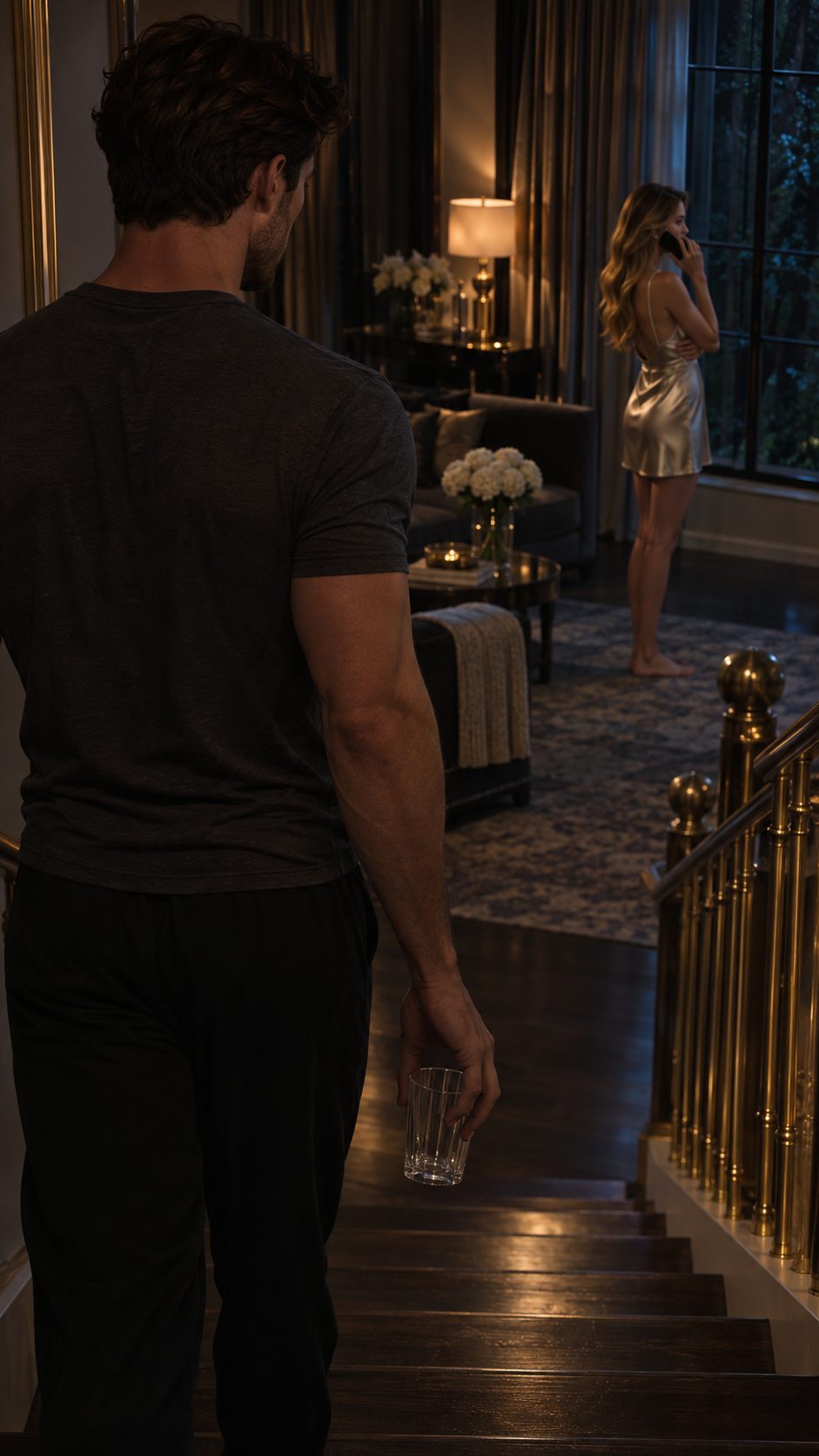
I stood barefoot in the dark hallway of our suburban home outside Columbus, Ohio, holding an empty water glass.
For several seconds, I forgot how to breathe.
My name is Daniel Vale.
I was thirty years old, married for fourteen months, and until that moment, I believed I had a good marriage.
Not a perfect marriage.
I wasn’t that naïve.
But a good one.
My wife, Lauren, was twenty.
She had long honey-blonde hair, emerald-green eyes, and a tiny beauty mark beneath her left eye.
She was the kind of woman strangers noticed before she even entered a room.
I used to think the way she looked at me was different from the way she looked at everyone else.
That night, I discovered how little I understood about the woman sleeping beside me.
Lauren stood near the living room window in a champagne-colored satin nightdress, holding her phone against her ear.
The blue light from the backyard security lamp outlined her slender figure.
I could see her reflection in the glass.
She was smiling.
Then a man’s voice came through her phone.
“I’ll come over tomorrow morning, like always.”
Like always.
Those two words hurt worse than everything else.
They weren’t making plans for some reckless first encounter.
They had a routine.
A schedule.
An arrangement that existed inside my marriage without my knowledge.
Lauren lowered her voice.
“Are you sure he won’t find out?”
The man’s answer was too quiet for me to understand.
She listened, glanced toward the staircase, and said, “He leaves at seven.
You’ll have plenty of time.”
I stepped backward before she could see me.
The water glass felt unusually heavy in my hand.
That was exactly when my car service was scheduled to collect me for a flight to Chicago.
I was supposed to attend a two-day business meeting with an attorney named Grant Whitcomb.
We were finalizing a restructuring agreement involving my family’s development company.
Lauren had reminded me about the trip twice during dinner.
She had even offered to pack my suitcase.
At the time, I thought she was being thoughtful.
Now I wondered whether she had been counting the hours until I left.
I climbed the stairs without making a sound.
In our bedroom, my suitcase stood beside the dresser, zipped and ready.
My wedding photograph hung above the fireplace.
Lauren was laughing in that picture, her face turned toward mine.
I remembered the scent of gardenias at our wedding, the warmth of her hand in mine, and the quiet way she had whispered, “I never thought someone like you would choose me.”
I had told her I was the lucky one.
I sat on the edge of our bed and opened my airline app.
My Chicago reservation appeared on the screen.
I canceled it.
Then I sent a short email to Grant.
An unexpected personal matter has come up.
I need to postpone our meeting.
I almost called Lauren’s number.
I almost marched downstairs.
I imagined demanding her phone, asking for the man’s name, and forcing her to explain everything.
But something stopped me.
Not patience.
Not forgiveness.
It was curiosity, sharpened by humiliation.
I wanted to see the man who believed he could walk into my house the moment I boarded a plane.
I wanted to look him in the eye.
I wanted to know whether he was a stranger or someone who had shaken my hand across my own dinner table.
So I put my phone away, climbed beneath the covers, and closed my eyes.
Lauren entered the bedroom eleven minutes later.
I heard the soft click of the door.
The mattress shifted as she sat beside me.
For a long moment, she didn’t lie down.
Instead, she watched me.
I could feel it.
Then she reached out and brushed my dark hair away from my forehead.
“Daniel?” she whispered.
I remained still.
She waited.
Finally, she leaned closer and pressed her lips gently against my temple.
“I’m sorry,” she murmured.
My chest tightened.
I wanted to grab her wrist and ask what she was sorry for.
The fact that tomorrow morning, someone else would be drinking coffee in my kitchen?
But I stayed silent.
Lauren turned off the bedside lamp and settled beside me.
Within minutes, her breathing became slow and even.
I lay awake until dawn.
Every small noise in the house seemed louder than usual.
The refrigerator humming downstairs.
A car passing outside.
The occasional movement of Lauren’s hand beneath the sheets.
At a.m., she rolled toward me and placed her arm across my chest.
It was something she did almost every morning.
For the first time, her touch made me feel like a stranger in my own bed.
At , she got up.
At , I heard the shower.
At , my phone vibrated with a notification from the canceled car service.
Lauren apparently heard nothing.
By , the smell of fresh coffee drifted upstairs.
I got dressed in a navy shirt and dark trousers, then sat in my study with the door partly open.
At , I heard Lauren move between the kitchen and the front hallway.
At , two ceramic mugs touched the marble counter.
At , she checked her phone.
Then, at exactly a.m., I heard something that made my stomach turn.
A key was sliding into our front door.
And whoever held it knew exactly how to unlock my house.
I didn’t move for three seconds.
Morning sunlight spilled across the hardwood floor, creating narrow golden stripes through the window blinds.
Somewhere across the street, a lawn mower hummed.
A dog barked twice.
Our neighborhood looked exactly as it always did.
Comfortable.
Except someone was letting himself into my home.
I walked toward the kitchen.
Lauren stood beside the marble island wearing an ivory camisole and a pale-green skirt.
Her blonde hair fell loosely over one shoulder.
Two coffee mugs waited in front of her.
She was expecting exactly one guest.
When I entered, she was looking toward the hallway.
“You’re up early,” I said.
Lauren jumped.
Coffee spilled over the rim of the mug she was holding.
She stared at me.
For one brief moment, she looked as though she had seen a ghost.
“I thought you were leaving for Chicago.”
“I changed my plans.”
“Something came up.”
Her green eyes searched my face.
Then they moved toward the front door.
That tiny glance told me more than a confession could have.
The door opened.
A man stepped inside and closed it behind him.
I heard the familiar metallic sound of keys dropping into the ceramic bowl on the hallway console.
My stomach tightened.
He knew about the bowl.
Lauren and I kept our spare keys there because she always misplaced hers.
That bowl wasn’t visible from the front door.
You had to know where to look.
This man knew.
Lauren stepped toward me.
“Daniel, please.”
I looked at her.
“Please what?”
She swallowed.
“Whatever happens, don’t make a scene.”
I almost laughed.
“Whatever happens?”
“Just listen to me first.”
“Listen to what?
The explanation you’ve been practicing all morning?”
Her face turned pale.
From the hallway, a man’s voice called casually, “Lauren?”
Neither of us answered.
“Coffee ready?”
He sounded comfortable.
Too comfortable.
Like a man who knew where the cups were kept and which floorboards creaked.
I glanced at the second mug.
“How many mornings?”
Lauren shook her head.
“How many times has he walked through my front door with his own key?”
“You don’t understand.”
“Then explain it.”
“I can’t explain it like this.”
“Like what?”
“With you already deciding what this is.”
I pointed toward the coffee.
“You made him breakfast coffee.”
“That doesn’t mean what you think.”
“I heard you last night.”
Lauren froze.
For a moment, every expression disappeared from her face.
“What did you hear?”
Her lips parted.
I lowered my voice.
“I heard what you told him you’d swallow.”
She stared at me.
Then something strange happened.
I expected shame.
Maybe anger.
Maybe an outrageous explanation about an old friend or a misunderstood conversation.
Instead, Lauren looked frightened.
Not embarrassed.
“You heard that?” she whispered.
“Every word.”
I shook my head.
“That’s all you’ve got?”
She stepped closer.
“Daniel, I need you to trust me for five minutes.”
“Trust you?”
“Lauren, there’s another man in my house who has his own key.
You were making intimate promises to him at two in the morning, and you want me to trust you?”
Her eyes filled with tears.
“I know what it looks like.”
“Then tell me how I’m supposed to look at it.”
She opened her mouth.
Nothing came out.
Footsteps sounded in the hallway.
Lauren immediately grabbed my wrist.
“Don’t do anything until he explains.”
I stared at her hand.
“Until he explains what?”
She didn’t answer.
The footsteps came closer.
Then stopped.
Lauren was staring over my shoulder.
Her expression changed again.
It wasn’t the fear of a woman caught cheating.
It was the fear of someone waiting for a disaster she had known was coming.
I turned around.
A tall man stood in the kitchen doorway.
He wore a brown jacket over a black shirt.
His dark hair was swept back, and a faint scar crossed his left eyebrow.
I recognized the scar before I recognized his face.
My anger vanished.
For one impossible second, I was eighteen years old again, standing in a hospital corridor beside the only person who knew how badly our father could hurt us.
I whispered.
The man didn’t smile.
He didn’t apologize.
He didn’t even look surprised to see me.
“Hello, Danny.”
Nobody had called me Danny in years.
I stared at him.
My older half-brother stood in my kitchen.
The brother I had cut out of my life six years earlier.
The brother my father had taught me to hate.
Lauren released my wrist.
Mason looked at her, then back at me.
“We need to talk.”
I stepped forward.
“You’ve got some nerve coming into my house.”
“With my wife?”
“You think you can just walk back into my life like nothing happened?”
His calmness infuriated me.
I pointed toward the front door.
Mason reached inside his jacket.
Lauren whispered, “Please.”
He pulled out a small envelope and walked toward our dining table.
Inside the envelope was a photograph.
He placed it beneath the chandelier.
I looked down.
The image showed an older man sitting outside a coffee shop, wearing dark sunglasses and a gray wool coat.
At first, my brain refused to recognize him.
Then I saw the familiar shape of his nose.
The deep crease beside his mouth.
The silver hair.
I felt the room shift beneath my feet.
“No,” I whispered.
Mason looked directly at me.
Then he said six words.
“Your father is still alive, Daniel.”
My father had been dead for six years.
I had attended his funeral.
I had carried his coffin.
And the photograph in front of me had been taken eight days ago.
For a long time, nobody spoke.
I kept staring at the photograph.
My father, Richard Vale, had supposedly died of a heart attack in October 2020.
He had been sixty-one.
The funeral had taken place at a small church outside Dublin, Ohio.
I remembered the gray sky, the smell of wet leaves, and the polished wooden coffin beneath a spray of white lilies.
I remembered standing beside Lauren’s future wedding photographer—then just an acquaintance of the family—and feeling the strange emptiness that comes when someone you both love and fear disappears forever.
Now Mason was telling me my father hadn’t disappeared at all.
I picked up the photograph.
“Where did you get this?”
Eight days ago.”
“That’s impossible.”
“I thought so too.”
My father looked older, but unmistakably alive.
He was seated outside a small café beside a woman I didn’t recognize.
The date was printed on the back, along with an address.
I studied his left hand.
There was a pale scar below his thumb.
I knew that scar.
He had gotten it when I was eleven, after breaking a glass in the kitchen during an argument with my mother.
“No,” I said again.
Mason pulled out a chair.
“Sit down, Danny.”
“Don’t call me that.”
He stopped.
I looked between him and Lauren.
“You expect me to believe Dad staged his own death?”
“Yes,” Mason said.
“And you’ve known this how long?”
“About three months.”
I laughed once.
It wasn’t a pleasant sound.
“Three months.
You’ve known our father is alive for three months, and the first time you tell me is after I catch you sneaking into my house to see my wife?”
Lauren flinched.
Mason looked down.
I felt something tighten in my chest.
“Answer me.”
“We were trying to get proof,” Mason said.
“Proof of what?”
“That he’s been using your name.
Your company.
Your marriage.”
I stared at him.
“My marriage?”
Lauren closed her eyes.
I turned toward her.
“What does he mean?”
She said nothing.
“Daniel, please let him finish.”
You’ve had your turn to tell me what I don’t understand.
Now I’m asking you a question.”
She looked as though she might collapse.
Mason placed a second item on the table.
It was a bank document bearing my signature.
Except I had never signed it.
The date was six weeks earlier.
The amount was $2.8 million.
I stared at the signature.
It looked perfect.
Every letter.
Every little hesitation in the pen stroke.
Even the way I crossed the last letter of my surname.
“Where did this come from?”
“A private lender in Delaware.
The loan was issued against a company your mother’s trust controls.”
I looked at Mason.
“My mother left me those shares.”
“They can’t be used without my authorization.”
Mason’s expression darkened.
“That’s what Dad wants you to believe.”
I felt suddenly cold.
The development company had been my family’s business for nearly forty years.
My mother, Evelyn, came from a family that had owned commercial properties throughout central Ohio.
She had inherited a controlling interest in the business long before she married my father.
Her will placed those assets in a trust until I turned thirty.
That birthday had passed two months earlier.
For years, my father had told me that control meant responsibility.
Now I wondered whether he’d spent those years preparing to steal everything she had left me.
“Why would he do this?”
I whispered.
Mason gave me a bitter look.
“You really still want to ask that?”
I looked away.
My father had never been an easy man.
He believed in discipline, loyalty, and keeping family problems inside the family.
He called criticism disrespect.
He called obedience love.
He had spent my childhood making everyone in our house afraid of disappointing him.
But I had never imagined him capable of this.
Lauren moved closer to the table.
“Daniel, your Chicago meeting—”
She stopped.
I pointed toward her.
“I haven’t forgotten why we’re standing here.”
Her face crumpled slightly.
I turned back to Mason.
“Are you sleeping with my wife?”
The room went silent.
For the first time that morning, Mason couldn’t meet my eyes.
That was enough.
I felt a strange pressure behind my ribs.
He swallowed.
The word hung between us.
Lauren began to cry.
I didn’t look at her.
“How long?”
Mason rubbed a hand across his face.
“Six weeks.”
I nodded slowly.
Forty-two days.
Forty-two mornings and evenings during which I’d kissed Lauren, asked about her day, and believed we were building something together.
“Six weeks,” I repeated.
“It wasn’t supposed to happen,” Mason said.
That sentence nearly made me hit him.
I stepped forward.
He rose from the chair.
You don’t get to say that.”
He held still.
“You knew what you were doing.”
“You knew she was my wife.”
“And you did it anyway.”
Mason looked directly at me.
At least he didn’t insult me with another excuse.
I looked toward Lauren.
“Did you love him?”
She wiped her face.
“I don’t know.”
Somehow, that answer hurt more than yes.
I turned away.
The sunlight across the dining table looked obscenely cheerful.
Outside, our neighbor was washing his car.
A delivery truck rolled past.
Life was continuing without noticing mine had just split in half.
“I want you both out,” I said.
Mason nodded.
“I understand.”
He gathered the bank document, but left the photograph on the table.
Before he could walk away, Lauren spoke.
“If he goes to Chicago, they’ll destroy him.”
I looked at her.
She swallowed.
“Your father’s people.”
Mason stopped walking.
Lauren glanced between us.
“You need to tell him everything.”
Mason’s jaw tightened.
“Everything.”
I stared at my wife.
Something in her voice made me forget my anger for one moment.
“What haven’t you told me?”
She sat down.
Her hands were trembling so badly that she had to press them against her knees.
Then she whispered something I would remember for the rest of my life.
“Daniel, I didn’t meet you by accident.”
I met Lauren at a charity fundraiser in downtown Columbus.
It was a Thursday evening in early spring.
I had been invited by a client and hadn’t wanted to attend.
The ballroom was filled with expensive suits, polished smiles, and people who managed to talk for twenty minutes without saying anything meaningful.
Lauren stood near a display of donated artwork, wearing a simple blue dress.
She looked nervous.
When I approached, she asked whether I thought the painting beside her was supposed to represent a storm or an explosion.
I told her I thought the artist had probably spilled coffee.
She laughed.
It was the first thing about her I fell in love with.
That story had become part of our marriage.
We told it at dinner parties.
Lauren’s mother mentioned it during our wedding.
I had always believed it was the beginning of something beautiful.
Now Lauren sat across from me, crying, and told me the encounter had been arranged.
“A woman named Vivian contacted me before that fundraiser,” she said.
“Vivian who?”
“Vivian Hart.
She said she worked for a private philanthropic foundation.”
I shook my head.
“Never heard of her.”
“She knew about my mom.”
Lauren’s mother, Diane, had been seriously ill when we met.
Her medical bills had nearly bankrupted the family.
Lauren had been working two jobs while taking community college classes.
I knew she’d struggled.
I had never realized someone had used that struggle against her.
“Vivian offered to help with my mother’s expenses,” Lauren continued.
“She said the foundation sometimes sponsored young women who wanted careers in nonprofit management.”
“What does that have to do with me?”
Lauren looked down.
“She asked if I’d attend the fundraiser.
She gave me your name.”
I stared at her.
“She told you to meet me?”
Lauren nodded.
“She said you were generous.
That you donated to community programs.
That you might be willing to help with fundraising connections.”
“And that’s all?”
“At first.”
“After we started dating, she asked questions.”
“What kind of questions?”
“About your company.
Your schedule.
The people you worked with.”
My stomach tightened.
“She wanted to know what documents you brought home.
Whether you kept business records in your study.
When you traveled.”
I felt an unfamiliar kind of anger.
It wasn’t explosive.
It was cold and spreading.
“And you told her?”
Lauren nodded, tears falling onto her hands.
“How long?”
I stood up and walked toward the window.
Beyond the glass, our backyard looked peaceful.
The maple tree we’d planted after our wedding was beginning to lose its leaves.
I remembered Lauren standing beside that tree in the rain, laughing while we tried to straighten it.
Had she reported that moment to someone too?
“Did you know she worked for my father?”
“Not then.”
“When did you find out?”
“After we got married.”
Mason had returned to the table.
“She found a payment trail,” he said.
I looked at him.
“Stay out of this.”
He lowered his eyes.
Lauren continued.
“Vivian transferred money to my mother’s medical account.
At first, I thought it was part of the foundation’s support.
Then she started reminding me what I owed her.”
“How much?”
Lauren hesitated.
“Almost a hundred and twenty thousand dollars.”
“You could have told me.”
“I would have paid it.”
“Then why didn’t you?”
Her voice broke.
“Because by then I was afraid you’d find out why I came into your life.”
I sat down slowly.
That was the moment the room began to feel unfamiliar.
The photographs on the wall.
The furniture we’d picked together.
The little notes Lauren used to leave in my lunch bag.
How many of those things had been real?
How many had been part of an assignment?
“Did you ever love me?”
Lauren looked up sharply.
I didn’t answer.
“Daniel, I love you.”
“Don’t say that right now.”
“It’s true.”
“You married me while reporting information about me to people I didn’t know.”
“I stopped.”
“Last spring.”
I stared at her.
Only a few months earlier.
“Because Vivian asked me to photograph some papers in your study.
I did it, but afterward I read what I’d sent.”
“What papers?”
“Documents about a construction project that had been closed years ago.”
Mason looked at her.
“The Redfield development.”
The name meant something to me.
Redfield Park was an industrial redevelopment project outside Cincinnati.
A retaining wall had collapsed there in 2019, killing two contractors and injuring several workers.
Our company had been involved in the project.
My father had claimed the engineering subcontractor was responsible.
He’d always insisted the company had done nothing wrong.
Lauren continued.
“The paperwork didn’t match the reports in the news.
And one authorization had your name on it.”
“I wasn’t involved in Redfield.”
That’s what scared me.”
She reached for my hand.
I pulled it away.
Her expression collapsed.
“After that, I stopped sending information.
Vivian threatened to expose everything.”
“And to my mom.”
I looked at Mason.
“That’s when she contacted you?”
“Eleven weeks ago.”
“How did she find you?”
“Your mother left a letter with an attorney before she died.
Lauren found a copy while she was looking through old company records.”
I stared at him.
“What letter?”
Mason paused.
“Evelyn had started asking questions about Dad’s financial dealings.
She wanted me to help her.
Before she could finish, she had her stroke.”
My mother had died in 2014.
I had never known she’d been investigating anything.
For years, my father told me Mason had tried to steal money from the family after her death.
I had believed him.
Mason leaned forward.
“Dad framed me, Danny.
The missing money, the falsified statements, everything.
I tried telling you.”
“You had no proof.”
“I had enough to make him afraid.”
I stared at the table.
The memory of our last argument returned with painful clarity.
Mason standing beside my father’s coffin, telling me something was wrong.
Me calling him a thief.
Him leaving the church without saying goodbye.
“What happened after Lauren contacted you?”
Mason glanced at her.
“We started investigating.
We found accounts connected to a man named Martin Keene.
We followed the payments until we found him.”
“And the affair?”
Mason looked ashamed.
“That happened later.”
I turned toward Lauren.
She shook her head.
“I was scared.
I was lonely.
We were spending so much time trying to figure out what was happening, and I—”
She stopped.
“Being scared doesn’t explain sleeping with my brother.”
“Being lonely doesn’t excuse lying to your husband.”
I looked at both of them.
Whatever they’d uncovered, they had also made choices.
Choices that belonged to them.
I wasn’t going to let a larger conspiracy erase a smaller betrayal.
Then Mason’s phone vibrated.
He checked the screen.
His face changed.
He turned the phone toward me.
It displayed a message from an unknown number.
Your brother was supposed to be on a plane.
Below it was a photograph.
It showed the three of us sitting around my dining table.
The picture had been taken less than a minute earlier.
From inside my own house.
For several seconds, I couldn’t understand what I was seeing.
The photograph on Mason’s phone showed our dining room from above.
Lauren sat on the left.
Mason stood near the table.
I was facing the window.
The angle was high enough to show the tops of our heads.
I slowly looked toward the ceiling.
A brass chandelier hung over the table.
Beyond it was a small white smoke detector.
I had walked beneath that detector hundreds of times.
I had never given it a second thought.
Mason followed my gaze.
“Don’t touch it,” he said.
I looked at him.
“Because whoever’s watching already knows we found it.”
Lauren covered her mouth.
“Oh, my God.”
Mason held up his phone again.
A second message appeared.
Tell Daniel to come to Chicago.
My pulse hammered.
I walked toward the hallway.
“Where are you going?”
Lauren asked.
“To find out what else is in my house.”
Mason caught up to me.
“Daniel, we need to be careful.”
I turned on him.
Someone is watching my dining room.
Someone knows when I leave for work, when my wife is home, and apparently every conversation we have.”
“No, you don’t.
This is my house.”
He held my stare.
“I know exactly whose house it is.”
We searched together.
I hated every second of it.
I hated working alongside the brother who had betrayed me.
I hated that he knew more about the danger than I did.
And I hated that Lauren followed us from room to room, pointing out places where unfamiliar maintenance workers had been during the previous year.
The first device was inside the smoke detector.
The second was hidden behind a decorative air vent in my study.
The third had been installed near the front hallway.
Each was small, connected to a wireless transmitter, and positioned to capture a part of our daily lives.
Mason photographed the devices without removing them.
“We’ll need someone independent to document this,” he said.
“Who installed them?”
Lauren leaned against the wall.
“Last December, a company came to inspect the security system.”
I remembered that visit.
The technician had worn a gray uniform.
He’d told me the annual inspection was included in our home warranty.
I’d been busy with a work call.
Lauren had let him inside.
“Who scheduled it?”
She looked miserable.
I laughed bitterly.
“Of course.”
We stood in silence.
Then I remembered something.
Mason looked at me.
“What about it?”
“You have a key to my house.”
He reached into his pocket and placed it on the table.
A silver key.
The same kind Lauren and I used.
“Lauren gave it to me,” he said.
“Three weeks ago.”
“To get into the house while you were out.”
I turned toward Lauren.
She lowered her eyes.
“Daniel, I thought we could find the original documents your father was looking for.”
“By letting my brother search my house?”
“While I was working?”
I stared at the key.
A key was supposed to mean trust.
It meant someone could come inside without knocking.
It meant you had given that person permission to enter your private life.
My wife had given that permission to another man.
And before that, apparently, she had given it to a surveillance technician working for someone who was supposed to be dead.
I picked up Mason’s key.
“Who else has one?”
Neither of them answered.
She looked at me.
“Vivian asked for a duplicate when the security system was installed.”
My fingers closed around the metal.
“So my father has a key.”
“I don’t know for sure.”
“But he could.”
I suddenly remembered waking one morning to find the side door unlocked.
I remembered a framed photograph in my study sitting at a different angle.
I remembered the time Lauren insisted she’d heard footsteps downstairs while I was away, and I told her the house was settling.
Those moments returned one after another.
My home had become a place I no longer recognized.
Mason walked toward the study.
“There’s something else.”
He opened the lower drawer of my desk and removed an old wooden picture frame.
Inside was a photograph of my mother.
She stood on the porch of our childhood home, wearing a yellow summer dress.
I had kept the picture since her funeral.
Mason turned the frame over.
Behind the backing was a thin piece of folded paper.
“Where did that come from?”
“Lauren found it when she was looking for estate documents.
We left it where it was because we thought someone might notice.”
He handed it to me.
It was a letter in my mother’s handwriting.
The opening line made my throat close.
My dearest Daniel,
If you are reading this, something has gone terribly wrong.
I sat down.
The letter was dated six months before her death.
My mother wrote that she had discovered unusual transfers from the company into accounts controlled by my father.
She had asked questions.
He had refused to answer.
She believed he’d begun using employee benefit funds to cover losses on private development deals.
She had tried to protect the company without destroying our family.
Near the end, she wrote:
Your father believes control is the same thing as love.
You must never let someone convince you that loyalty requires silence.
I reread those sentences three times.
For years, my father had told me Mason was disloyal.
That asking questions was an act of betrayal.
That family business should remain private.
Now I wondered whether my mother’s last months had been filled with the same fear I was experiencing.
I folded the letter.
“What do we do?”
Mason looked surprised.
It was the first time I’d spoken to him without anger since he’d arrived.
“We go somewhere he can’t hear us.”
I looked at Lauren.
She was standing near the doorway, crying quietly.
I wanted to comfort her.
That instinct was still there, even after everything.
But I couldn’t bring myself to move.
“Get your coat,” I said.
She nodded.
“Where are we going?”
“To find someone who knew my mother before my father taught everyone to be afraid of him.”
Helen Brooks lived in a small brick house near German Village.
She was sixty-seven, a retired attorney with silver hair, a sharp memory, and a habit of speaking as though every unnecessary word cost money.
My mother had trusted her.
My father had not.
That alone made her the first person I wanted to see.
When Helen opened the door, she looked at me, then Mason, then Lauren.
Her expression tightened.
“Well,” she said.
“I wondered when this day would come.”
I stared at her.
“You knew?”
“I knew there were unanswered questions.”
She stepped aside.
Helen led us into a study filled with books and old legal files.
A framed photograph of my mother stood on a shelf.
Seeing it there almost broke me.
Helen noticed.
“She was one of the bravest women I ever represented,” she said.
I swallowed.
“She left me a letter.”
Helen’s expression changed.
“Do you have it?”
I handed it to her.
She read silently.
When she finished, she removed her glasses.
“Evelyn was preparing to confront Richard about financial irregularities.
We had arranged a meeting with outside accountants.”
“What happened?”
“She became ill before the meeting could take place.”
My mother had suffered a massive stroke.
She died eleven days later.
For years, I had believed it was simply a tragedy.
Now I wondered what she’d been carrying alone.
“Did Dad know about the investigation?”
Helen nodded.
“He knew she had asked questions.
He didn’t know how much she’d discovered.”
Mason laid the fraudulent loan document on her desk.
Helen studied it.
“Where did this come from?”
“A lender who thought Daniel had authorized it,” Mason said.
Helen looked at me.
She examined the signature.
“Who else had access to your signature samples?”
“Company legal counsel.
My assistants.
My father used to keep old files.”
“And your wife?”
Helen asked.
I felt Lauren stiffen beside me.
“Yes,” I said.
Helen looked at her without judgment.
Then she turned back to the document.
“We need an independent forensic examination.
And we need to establish who authorized the transfer.”
I leaned forward.
“What happens if that signature is accepted as mine?”
“Potentially, a great deal of damage.”
She explained that my mother’s trust had included a complicated structure designed to prevent any one person from gaining control before I turned thirty.
Once I reached that age, I could authorize certain transactions myself.
The Chicago agreement would effectively transfer management and voting authority over the trust’s largest assets to an outside investment vehicle.
A vehicle whose ultimate owners I didn’t know.
Mason handed her a folder.
“Martin Keene controls it.”
Helen glanced through the documents.
“Martin Keene?”
“Richard’s current identity.”
She looked up slowly.
For the first time, the calm attorney seemed shaken.
“You’re telling me Richard is alive?”
Mason showed her the photograph.
Helen studied it for a long time.
“Good God.”
I watched her face.
“You recognize him?”
No hesitation.
No uncertainty.
“That’s Richard.”
Something inside me sank.
Until then, part of me had secretly hoped Mason was wrong.
That the photograph showed a distant relative.
That some elaborate misunderstanding would explain everything.
Helen’s certainty destroyed that hope.
“Why would he fake his death?”
She folded her hands.
“Your father was facing serious financial exposure after the Redfield collapse.
A number of transactions were being investigated.
His supposed death interrupted several proceedings and complicated the recovery of assets.”
Mason leaned forward.
“He had help.
Someone arranged false identification, moved money through shell companies, and created a trail that made it look like the debts ended with him.”
Helen nodded.
“That would explain a great deal.”
“Can you prove it?”
And we need to distinguish what we suspect from what the evidence establishes.”
Her answer steadied me.
For the first time that morning, someone wasn’t asking me to trust them blindly.
Helen wanted proof.
She contacted an attorney she knew who specialized in financial fraud.
Then she called a detective named Ana Morales, who had previously worked on complex fraud investigations.
Within an hour, we had arranged to preserve the messages, photographs, banking records, and surveillance devices.
Helen also warned me not to sign anything Grant Whitcomb sent.
My phone rang almost immediately afterward.
I stared at the screen.
Helen motioned for me to answer.
I put it on speaker.
“Daniel,” Grant said brightly.
“I received your email.
Is everything all right?”
“Personal matter.”
“I understand.
But we do have some time-sensitive paperwork.”
“Can’t it wait?”
“Unfortunately, the financing window closes tomorrow.”
“What happens if I don’t sign?”
Another pause.
“Your company could face significant complications.”
“What kind?”
“We can discuss that in Chicago.”
“I’m not in Chicago.”
My eyes met Helen’s.
Grant continued.
“Perhaps we can arrange a private meeting closer to home.”
“How close?”
“I’ll be in Columbus tomorrow.”
It was too convenient.
I looked toward Mason.
He was watching me carefully.
“Fine,” I said.
“Send me the address.”
“Excellent.
And Daniel?”
“It would be wise not to involve people who don’t understand the situation.”
The line went dead.
Nobody spoke.
Then Helen said, “That sounded less like legal advice and more like a warning.”
My phone vibrated.
A message appeared from an unknown number.
You should have taken the flight.
Below it was a photograph of my wife.
It showed Lauren outside a grocery store two days earlier.
She was standing beside her car.
Someone had photographed her from across the parking lot.
A second message followed.
You can’t protect everyone, son.
I stared at those words.
After six years in the grave, my father was speaking to me again.
And he sounded exactly as he always had.
My father called at that afternoon.
I was sitting alone in Helen’s back garden.
Lauren had gone inside to speak with Detective Morales.
Mason was in the study reviewing company records.
I had stepped outside because I needed five minutes without looking at either of them.
My phone vibrated.
Unknown number.
I answered.
For a moment, there was only silence.
Then a voice said, “You always did make things harder than necessary.”
My blood went cold.
I knew that voice.
I had heard it through bedroom walls when I was a child.
At football games, when I failed to make a catch.
Across dinner tables, when my grades weren’t good enough.
Beside my mother’s hospital bed, when he told me crying wouldn’t help her.
“Hello, Daniel.”
I gripped the phone.
“You’re alive.”
I waited for shock to turn into joy.
“That’s a complicated question.”
“Six years.
You let me bury you.”
“I did what was necessary.”
“You let me stand at your grave.”
“There were circumstances you didn’t understand.”
I closed my eyes.
There it was.
The same sentence he’d used throughout my childhood.
You don’t understand.
It had been his favorite way of ending an argument.
“Who did we bury?”
“Someone who was beyond help.”
I opened my eyes.
“What does that mean?”
“It means I handled a difficult situation.”
I felt sick.
There would be questions about the remains, the death certificate, the funeral, and everyone who’d helped him.
But at that moment, one question mattered more.
“Why my wife?”
He didn’t answer immediately.
Then he said, “Lauren is a remarkable young woman.”
“Don’t say her name.”
“She had potential.
She was intelligent, ambitious, and struggling.
I gave her an opportunity.”
“You sent her to meet me.”
The simplicity of his answer was almost unbearable.
“You arranged my marriage?”
“I arranged an introduction.
The rest was your decision.”
“You paid her.”
“I assisted her family.”
“You made her report on me.”
“I asked her to help protect our interests.”
I stared at the grass beneath my feet.
Every word sounded rehearsed.
He had probably been preparing this explanation for years.
“Did you tell her to marry me?”
I wanted to believe that.
Then he added, “I knew you’d fall in love with her.”
My chest tightened.
“You were lonely, Daniel.
You’d spent years working.
You wanted someone who made you feel needed.”
I said nothing.
“And she wanted stability.
There’s nothing shameful about that.”
“You manipulated both of us.”
“I understood both of you.”
You used us.”
His voice hardened.
“Be careful how you speak to me.”
The old fear rose automatically.
For a moment, I was fourteen again.
Then I looked at Helen’s house.
I thought of my mother’s letter.
And I realized something.
He could still frighten me.
But he could no longer make me obey.
“Where are you?”
“That isn’t important.”
“It is to me.”
“Your attorney will send the details.
I suggest you sign the restructuring documents tomorrow.”
“Because the alternative will be unpleasant.”
“For whom?”
“Lauren has made some very unfortunate choices.”
I felt my stomach turn.
“Leave her out of this.”
“I didn’t put her in this position.”
“You hired her.”
“I gave her a chance.
She’s the one who became involved with your brother.”
My hands went numb.
Of course he knew.
There were cameras in my house.
There were people following Lauren.
And there were probably more secrets I hadn’t discovered.
“You’ve been watching us,” I said.
“I’ve been protecting my investment.”
“I’m your son.”
And I expect you to behave like one.”
Something inside me finally broke.
“What did you say?”
“I said no.”
“I spent my entire life trying to make you proud.
I believed you when you said Mason was a thief.
I believed you when you said Mom didn’t understand business.
I believed you when you said loyalty meant keeping quiet.”
He didn’t interrupt.
“But you aren’t protecting this family.
You’re destroying it.”
His answer was quiet.
“Meet me tomorrow and sign, or you’ll discover just how much damage I can still do.”
The call ended.
I stood in the garden for several minutes.
Then I went inside.
Mason looked up when I entered.
“What happened?”
“Dad called.”
Lauren went pale.
“What did he say?”
I looked at her.
“He knows about you and Mason.”
She lowered her head.
“He threatened to expose everything.”
I shook my head.
“He’s already exposed it to me.
What he wants now is for me to be afraid of everyone finding out.”
Helen came into the room.
I told her about the call.
She listened carefully.
Then she asked, “What do you want to do?”
It was such a simple question.
But it startled me.
My father had spent my whole life telling me what to do.
Lauren and Mason had spent months making decisions without me.
Now someone was asking what I wanted.
I looked around the room.
At my wife.
At my brother.
At the people who had lied to me.
And at the woman who had trusted my mother enough to keep her photograph on a shelf for twelve years.
“I want him stopped,” I said.
Helen nodded.
“Then we’ll do it carefully, and we’ll do it with evidence.”
I took a breath.
“And after that, I’m going to decide what happens to my marriage.”
Lauren began crying again.
I couldn’t comfort her.
I wasn’t even certain I wanted to.
But for the first time since two in the morning, I knew exactly what I was going to do next.
That night, none of us went home.
Helen arranged for us to stay in separate rooms at a small hotel while the police documented the surveillance system in my house.
I sat alone on the edge of a bed, staring at the wedding ring on my finger.
At 11:36 p.m., someone knocked.
It was Lauren.
She stood outside wearing a borrowed cardigan over her dress.
Her blonde hair was tied back, and her green eyes were swollen from crying.
“Can we talk?”
I considered saying no.
Then I stepped aside.
She entered but stayed near the door.
“I gave Detective Morales everything,” she said.
“The messages from Vivian.
The payment records.
The calls with Mason.”
“And I told her about the affair.”
She flinched at my answer.
I sat down.
Lauren remained standing.
“I don’t know how to make you understand how sorry I am.”
“You can’t.”
She looked at me.
“There’s no sentence you can say that makes those six weeks disappear.”
Tears slid down her face.
“Then stop trying to find one.”
She wiped her cheeks.
“I wasn’t going to ask you to forgive me.”
“What were you going to ask?”
“That you believe one thing.”
“When I married you, I loved you.”
I looked away.
“I don’t know what that means anymore.”
She approached the bed but didn’t sit.
“I should have told you everything.
Your father.
All of it.”
“I thought I could fix it before you found out.”
“And somewhere along the way, you started sleeping with my brother.”
She closed her eyes.
Her answer came slowly.
“Because he understood what your father was doing.
Because I was afraid.
Because he was there when I didn’t know who else to talk to.”
I looked at her.
“Those are reasons you spent time together.
They’re not reasons you had an affair.”
She nodded.
“You’re right.”
For the first time, she didn’t try to defend herself.
“It was selfish.
It was wrong.
I crossed a line, and then I kept crossing it because I was too cowardly to face what I’d done.”
I studied her face.
This was the woman I had imagined growing old beside.
The woman who knew how I liked my coffee.
Who laughed at terrible movies.
Who cried whenever she saw a dog waiting outside a grocery store.
All those things were real.
So were her lies.
That was what made betrayal unbearable.
It didn’t erase the person you loved.
It forced you to recognize that the person you loved had also been capable of hurting you.
“Do you want to stay married?”
Lauren looked startled.
“Even after everything?”
“Because I love you.”
I took off my wedding ring.
Lauren stared at it.
I placed it on the bedside table.
“Then for once, love isn’t going to be enough.”
She covered her mouth.
I wanted to take the words back.
Not because they weren’t true.
Because I could see what they did to her.
But I had spent too much of my life protecting other people from the consequences of their choices.
I couldn’t do it anymore.
Lauren left quietly.
A few minutes later, another knock came at my door.
Mason stood outside.
“I won’t stay long,” he said.
I leaned against the doorframe.
“What do you want?”
“To apologize.”
“You already did.”
“Not properly.”
He looked older than he had that morning.
“I spent six years believing Dad took my brother away from me.
When Lauren found me, I thought I finally had a chance to fix what happened.”
I said nothing.
“Then I betrayed you myself.”
He lowered his eyes.
“There’s no excuse.”
“I won’t ask you to forgive me.”
He turned to leave.
He stopped.
I stared at him.
“Why did you keep helping her after the affair started?”
He considered the question.
“Because whatever we’d done, Dad was still coming after you.”
“And that makes you a hero?”
He looked directly at me.
“It makes me someone who did one decent thing after doing something terrible.”
I closed the door without answering.
The following morning, Helen called.
The forensic accountant had connected several suspicious transfers to companies controlled by Martin Keene.
The bank had preserved the disputed signature records.
A company employee had also provided archived emails showing that Grant Whitcomb had helped coordinate the financial restructuring long before my supposed business trip.
Investigators had obtained additional records.
My father’s carefully constructed identity was beginning to unravel.
But he still expected me to appear at Grant’s office.
Helen advised me not to go alone.
Together with the investigators, we arranged a controlled meeting intended to document his demands and preserve additional evidence.
I wasn’t going there to negotiate.
I wasn’t going there to sign.
And I wasn’t going there to hear another lecture about family loyalty.
I was going there to make sure that when my father finally told the truth, other people would hear it too.
Grant Whitcomb’s office occupied the nineteenth floor of a glass building in downtown Columbus.
I arrived at 10:47 a.m.
The receptionist greeted me by name and directed me toward a private conference room.
My father was already inside.
He stood beside the window wearing a charcoal suit and a silver watch.
For one moment, I could only stare.
He looked older.
His face had narrowed, and there were deeper lines around his mouth.
But his posture was unchanged.
Straight back.
Hands clasped behind him.
The same expression of controlled disapproval he’d worn throughout my childhood.
I didn’t answer.
He approached.
“I thought you might be glad to see me.”
I looked at him.
“You let me believe you were dead.”
“Are we really going to start with that?”
Something inside me went still.
He spoke as though I’d complained about a missed birthday.
“You staged your funeral.”
“I did what I had to do.”
“You abandoned your sons.”
“Mason chose his own path.”
I stared at him.
“You framed Mason.”
His expression tightened.
“Mason has always had difficulty accepting responsibility.”
I almost smiled.
Even after everything.
He still couldn’t resist rewriting the past.
Grant entered carrying a leather folder.
“Gentlemen,” he said.
“Perhaps we should focus on the transaction.”
He placed several documents on the table.
I recognized the structure.
The same restructuring agreement I’d been scheduled to sign in Chicago.
Only now the signature page was separated from the supporting financial disclosures.
“Sign here,” Grant said.
I didn’t pick up the pen.
“What happens after I sign?”
My father sat down.
“The business moves forward.”
“And the debt?”
“Restructured.”
“Under whose name?”
Grant shifted.
“Daniel, the documents explain—”
“I’ve read them.”
I looked at my father.
“They put the Redfield liabilities under entities I’m responsible for.”
He studied me.
“You’ve been speaking with Helen Brooks.”
“That woman has been causing trouble for our family for years.”
“She represented Mom.”
“Your mother never understood the sacrifices required to build something.”
I felt anger rise.
“Don’t talk about her like that.”
His eyes narrowed.
“Lower your voice.”
Grant stepped back slightly.
My father stared at me.
Then he leaned forward.
“I have spent six years keeping this business from collapsing.
Do you have any idea what that requires?”
“Apparently fake identities, forged signatures, and cameras in my house.”
His expression flickered.
Only for a second.
But I saw it.
“You should be careful with accusations,” he said.
“Did you have someone install those cameras?”
He said nothing.
“Did you have a key to my house?”
My father looked toward Grant.
Then back at me.
“I needed to know what was happening.”
“So you admit it.”
“I admit that you were surrounded by people who couldn’t be trusted.”
I thought of the photograph taken from above my dining table.
Lauren crying beneath the smoke detector.
Mason dropping his key into our ceramic bowl.
My father watching everything from somewhere outside our lives.
“Was there ever a moment,” I asked, “when I was allowed to make my own decisions?”
He looked impatient.
“Of course.”
“Did I choose my wife?”
His expression changed.
He hadn’t expected the question.
“Lauren made her own choices.”
“You paid the woman who recruited her.”
“I helped a struggling family.”
“You had her report information about me.”
“She was supposed to keep you focused.”
“On building something worthwhile.”
I leaned forward.
“You wanted access to Mom’s trust.”
His silence answered me.
Then he said, “That money belongs to the company.”
“It belonged to her.”
“And I spent a lifetime building that company.”
“So that’s it?”
He looked up.
“You’ve reached an age where you think every disagreement is a moral crisis.”
I reached an age where I finally understand what you’ve been doing.”
Grant closed the folder.
“Perhaps we should take a break.”
My father ignored him.
“You’re making a mistake, Daniel.”
“If you refuse to sign, the consequences won’t stop with you.”
I looked at him.
“Are you threatening Lauren?”
He smiled faintly.
“Her behavior would interest quite a few people.”
My stomach tightened.
He had already hurt her.
And now he wanted to use her shame as a weapon.
“Whatever she did,” I said, “is between her and me.”
“That’s a generous attitude toward adultery.”
It’s a boundary.”
He stared at me.
“You don’t decide what happens inside my marriage.”
My father stood.
“After everything I’ve done for you—”
I interrupted him.
“You didn’t build my life, Dad.
You built a cage around it.”
For the first time, he looked genuinely angry.
“You ungrateful—”
The conference room door opened.
Detective Ana Morales stepped inside with another investigator.
Grant went pale.
My father turned toward them.
“What is this?”
Morales identified herself and explained that investigators were examining suspected fraud, identity-related offenses, unlawful surveillance, and the transactions connected to Redfield.
The evidence recovered over the previous days had supported further legal action.
An arrest warrant had been issued in connection with the financial investigation and his use of a fraudulent identity.
My father looked at me.
“You did this?”
I met his eyes.
I shook my head.
“You did this.
I finally stopped helping you hide it.”
For a moment, he looked as though he might shout.
Instead, he straightened his jacket.
Then he turned toward the investigators.
“I want my attorney.”
Grant had already stepped away from the table.
As my father was escorted toward the door, he stopped beside me.
“You’ll regret this.”
I looked at the man I had feared for thirty years.
And for the first time, I felt something other than fear.
I felt sadness.
Not for what was happening to him.
For everything he’d stolen from us while convincing us it was love.
“I already regret a lot,” I said.
“But telling the truth isn’t one of those things.”
He looked at me one final time.
Then he was gone.
I remained beside the conference table.
The unsigned documents lay in front of me.
I picked up the pen Grant had offered.
For a moment, I simply held it.
Then I set it down.
I walked out without signing anything.
Six months passed before I could walk through my old neighborhood without feeling sick.
My father’s case became more complicated than anyone expected.
Investigators uncovered additional fraudulent transactions, evidence that his death had been deliberately misrepresented, and a network of individuals who had helped him move money through companies operating under different names.
The circumstances of the funeral were still being investigated.
I tried not to think about the coffin I had carried.
Grant Whitcomb faced his own legal problems.
Several transactions involving my mother’s trust were frozen or challenged while investigators and the courts determined what had happened.
The financial damage was substantial.
There were employees who had trusted the company.
Families connected to the Redfield tragedy who still deserved answers.
My father’s arrest didn’t repair any of that.
It only made repair possible.
I spent months working with new attorneys and independent accountants to separate legitimate company operations from the fraudulent transactions.
I resigned from several boards.
I sold properties I’d once considered untouchable.
I learned more about my mother’s business in six months than my father had allowed me to learn in twelve years.
Everywhere I looked, I found evidence of the same lesson.
Control could look like protection.
Secrecy could look like loyalty.
And sometimes the people who spoke most passionately about family were the ones willing to sacrifice everyone else to preserve their own power.
Lauren and I separated.
There was no dramatic final argument.
No broken dishes.
No screaming in the driveway.
We sat across from each other in a quiet attorney’s office and discussed practical matters.
Our savings.
The furniture.
The photographs.
She cried when we signed the first separation documents.
Not because I wasn’t hurting.
Because I’d already cried more than I knew how to explain.
Lauren cooperated fully with investigators.
Her testimony helped establish how Vivian had approached her, how information had been collected, and how my father had used financial assistance to pressure her.
Her cooperation didn’t erase what she’d done.
It didn’t change the affair.
But I wanted her to have a chance to build a life that wasn’t controlled by Richard Vale.
A few weeks before the divorce became final, she asked me to meet her for coffee.
I almost refused.
Then I agreed.
We met at a small café near the river.
Lauren wore a simple white sweater and jeans.
Her blonde hair was pulled back, and she looked tired.
For the first time since I’d known her, she seemed completely uninterested in whether anyone noticed her beauty.
She handed me a small envelope.
Inside was a photograph from our wedding.
I looked at it.
“Why are you giving me this?”
“Because I don’t want you to think none of it mattered.”
I studied her face.
“I know it mattered.”
She swallowed.
“Do you believe I loved you?”
I considered lying.
It would have been kinder.
Instead, I said, “I believe there were moments when you did.”
Her eyes filled.
“That’s fair.”
I set the photograph down.
“Lauren, I don’t know which parts of our marriage were real anymore.
Maybe someday I’ll understand.
But I can’t keep living inside that question.”
She nodded.
“I wish I could change what happened.”
For a moment, we sat quietly.
Then she reached into her bag and handed me a silver house key.
“I should have given you this months ago.”
I looked at it.
It was her key.
The last one she had kept.
I placed it on the table.
“Thank you.”
For a moment, I thought she might reach for me.
She didn’t.
“Goodbye, Daniel.”
“Goodbye, Lauren.”
I watched her walk away.
I felt grief.
I felt anger.
I felt the memory of every good thing we’d shared.
But I didn’t follow her.
Some marriages end because love disappears.
Mine ended because I could no longer tell love apart from the damage done in its name.
And I finally understood that I didn’t need to solve every mystery to know when it was time to leave.
Mason and I didn’t magically become brothers again.
There were too many years between us.
Too many lies.
And one betrayal that would always exist.
But we began speaking.
At first, our conversations lasted only a few minutes.
We talked about the investigation.
Then about work.
Then about our mother.
One Sunday afternoon, Mason brought me a box of photographs from the house where we’d grown up.
We sat at my kitchen table, looking through pictures neither of us had seen in years.
There was one of us fishing beside a small lake.
I was nine.
Mason was fourteen.
He had his arm around my shoulders.
I remembered that day.
My father had become angry because I lost a fishing lure.
Mason told him it was his fault.
He took the punishment for me.
I stared at the photograph for a long time.
“You always did that,” I said.
Mason looked over.
“Did what?”
“Stepped in when Dad was angry.”
He gave a sad smile.
“Someone had to.”
I looked at him.
“I should have believed you after the funeral.”
He shook his head.
“Dad spent years making sure you wouldn’t.”
“That doesn’t mean I didn’t hurt you.”
“No,” Mason said.
“It doesn’t.”
We sat in silence.
Then he added, “I hurt you too, Danny.
I can’t undo it.”
For the first time in six months, I didn’t correct him for calling me Danny.
That was all I could give him.
For now, it was enough.
Eventually, I sold the house Lauren and I had shared.
Before leaving, I walked through every room.
The kitchen where she’d made two cups of coffee.
The living room where I’d heard her whisper into the phone.
The bedroom where I’d pretended to sleep while my marriage quietly collapsed around me.
The front hallway where Mason had dropped his key into our ceramic bowl.
I stood beside that bowl for a long moment.
It was empty.
I’d had every lock changed after the investigation.
The surveillance devices were gone.
The damaged walls had been repaired.
But I knew I’d never feel comfortable living there again.
I packed the last of my belongings and moved into a smaller home on the other side of Columbus.
It had three bedrooms, a narrow front porch, and a backyard filled with old trees.
Nothing about it was especially impressive.
That was part of why I liked it.
For the first time in my adult life, I owned a place that had nothing to do with my father’s company.
Nobody had chosen it for me.
Nobody had arranged the purchase.
Nobody had stood behind a curtain, silently planning what I would do next.
On my first night there, I unpacked a box of books and found my mother’s letter.
I sat on the floor and read it again.
You must never let someone convince you that loyalty requires silence.
I traced the faded handwriting with my thumb.
Then I placed the letter inside a frame.
I hung it near the front door.
At a.m., I woke to the sound of rain.
For one horrible moment, I thought I heard Lauren downstairs.
My heart started racing.
Then I remembered.
I was alone.
No one was whispering into a phone.
No one was waiting for another man to arrive.
No one was secretly watching me from behind a smoke detector.
I got out of bed and went downstairs for water.
The kitchen was quiet.
I filled a glass and stood beside the window, watching raindrops slide down the pane.
Six months earlier, I’d held an empty glass in a dark hallway while listening to the woman I loved betray me.
That moment had seemed like the end of my life.
In some ways, it had been.
It ended the marriage I thought I had.
It ended the version of my father I’d spent thirty years trying to love.
It ended the belief that being a good husband or a good son meant accepting everything and asking nothing.
But standing there in my new kitchen, I finally understood something.
I hadn’t canceled that Chicago flight because I was brave.
I’d canceled it because I was hurt.
Because I wanted proof.
Because part of me still hoped there was an explanation that would make everything all right.
What I found was much worse than an affair.
I found a dead father who was alive.
A brother I’d wrongly abandoned.
A wife whose love had been tangled with lies from the beginning.
And a house filled with people who had keys to doors I never knew existed.
But I also found something I’d never had before.
The right to decide who entered my life.
I drank the water.
Washed the glass.
Set it upside down beside the sink.
Then I turned off the kitchen light and went upstairs.
Before I reached the bedroom, I stopped.
For a moment, I listened.
There were no footsteps.
No whispered promises.
No keys turning in a lock.
Only rain against the windows.
And for the first time in a very long time, the silence didn’t frighten me.
It felt like freedom.
✓ Lynn R. Adams
At a.m., I heard my wife whisper something to another man that made me cancel my business trip without telling her. “I’ll swallow it all, so you won’t even need a tissue to clean up.” Then she laugh…