Billionaire Watched His Lover Humiliate His Wife—Then One Entrance Silenced The Entire Room
At a private donor lunch, my billionaire husband’s 24-year-old mistress looked at my cream blouse and asked whether the staff were allowed to sit with the guests. I gave my husband one chance to defend me after ten years of marriage. Instead, he laughed, squeezed her arm, and told me to sit down. I left without lunch, but I wasn’t going home…
Three days before our annual charity gala, Vincent Thorne came into our breakfast room in Knightsbridge already angry about what I might wear. I had a cup of tea beside my book, and he had his phone in his hand, ready to show me another picture of the woman he was sleeping with. “Please tell me you’re not wearing that gray thing again,” he said.
“It was charcoal,” I told him. “And it was Lanvin.” He called it a shroud. Then he said the Royal Opera House would be full of photographers from Vogue and reporters from The Times, and he needed me to look like a billionaire’s wife instead of a village librarian.
There had been a time when his opinion could have ruined my whole morning. We’d been married ten years, and I remembered the young man I met when he was an ambitious partner at a small investment firm, talking earnestly about everything he hoped to build. I had believed I was helping him build a life, not merely giving him somewhere to stand.
My name is Audrey Sterling Thorne, although people around London had mostly stopped using the Sterling part. My family was old money: land, art, and trusts that existed long before anyone had heard of Thorne Capital. We lived in a 20,000-square-foot penthouse overlooking Hyde Park, but the property belonged to the Sterling family trust, a detail Vincent rarely bothered to remember.
He preferred being called a self-made billionaire. Thorne Capital was described as a $14 billion empire, and his face appeared in business magazines often enough that he seemed to mistake a flattering profile for proof of character. Our foundation held charitable assets my family had entrusted to his stewardship. I attended its board meetings quietly, while he accepted the applause.
I liked cream blouses, cashmere cardigans, sensible loafers, and the small pearl earrings my grandmother would have recognized. Vincent liked chrome, spectacle, and someone entering a room just behind him to make sure everyone looked. He’d once found my quietness reassuring. Lately, he seemed to consider it a personal insult.
Nova Reyes was twenty-four, a social media influencer with thirty million followers, and she’d become a very public part of my marriage without ever having made a promise to me. Vincent bought her expensive jewelry and cars, and she photographed the gifts. I knew about the affair; pretending otherwise would have made my silence a lie, and my silence was something I chose for reasons of my own.
At breakfast, Vincent turned his phone toward me. Nova was in another designer outfit, dazzlingly bright, surrounded by the kind of attention he thought money ought to purchase. “Call her stylist,” he said. “She knows how to make an entrance. You just look comfortable.”
I put my book down carefully. “I’ll dress appropriately for the evening.” That irritated him more than shouting would have. He said I always sounded like his accountant, told me to try looking as though I were married to him, and walked out before I could answer.
I sat with my tea until the room was quiet again. I didn’t cry, and I didn’t call a stylist. I called Marcus Torres, the principal counsel for my family’s office, and asked for the final audit by four o’clock. We had been examining figures that refused to make sense, and the gala was approaching faster than I liked.
Marcus confirmed that our contacts at The Times were ready to review the substantiated findings and that the proper financial authorities had been alerted. I told him to make sure the arrangements for gala night were in place, and to contact Paris about a dress. What I did not tell Vincent was that I had spent years listening while he mistook my restraint for disinterest.
Later that week, the foundation held a private donor lunch at Balthazar in Covent Garden. About fifty influential supporters would be there, people who funded museums, hospitals, and work the public seldom noticed. Vincent considered these gatherings his natural stage; I considered them occasions to listen carefully to the people who had trusted us.
I came alone, wearing a fawn-colored pleated Loro Piana skirt, a cream silk blouse, my wedding band, and my pearl studs. I’d put my hair in a simple chignon. I wasn’t trying to disappear, although I knew exactly how easy it was for people to look straight at a quietly dressed woman and see nothing at all.
Vincent was already seated at the central table. Beside him, where a serious donor or trustee might have sat, was Nova in a tight red Balmain dress with enormous gold buttons. A diamond serpent necklace circled her throat. I recognized it from photographs of Vincent’s recent gifts, and for a second my eyes stayed on it longer than I intended.
A few faces tightened as I approached. Vincent looked up, visibly startled, then arranged a smile. “Audrey, you made it.” I said hello and waited for someone to make room, because I had been invited to the lunch my own foundation was hosting.
Nova leaned toward him, but she made no effort to lower her voice. “Is she serious?” she asked, looking me over. I felt every person nearby trying not to stare. Vincent muttered her name in warning, though he didn’t move away from her.
Then she turned to me with a little sympathetic smile. “Sweetheart, I didn’t realize they let the staff sit with the guests.” She waved her ring-covered hand toward my blouse and skirt. “My grandmother wouldn’t even garden in that. Richie needs to give you a better clothing allowance.”
Nobody laughed. One older woman across the table set down her glass, and a man who’d been talking about a museum grant suddenly found his napkin fascinating. Nova seemed pleased with herself. Perhaps she’d expected me to argue, giving her the kind of scene she knew how to turn into a clip.
I looked at Vincent. We were not strangers trapped at an awkward party; we were a married couple who’d shared a home for a decade. He knew how much my family had supported his ambitions, and he knew Nova was humiliating me in front of people whose trust mattered to us both.
He glanced around at the donors, then back at Nova. I could almost see him calculating which discomfort would be easiest to escape. He gave a short, forced laugh, squeezed her arm, and said, “Nova, you’re terrible.” Then he looked at me. “Audrey, you know what she’s like. Just sit down. Have some wine.”
I don’t remember being surprised. What I remember is that he was offering me a chair at my own table as if it were a favor, while asking me to make his cruelty convenient. A woman at the far end of the table looked away, and I realized I had been waiting for a defense he had no intention of giving.
“No, thank you,” I said. “I’ve lost my appetite.” Nova’s smile widened, probably because she thought she’d won. I looked at her red dress and said, “It’s interesting what people choose to wear when they’re desperate for a seat at the table. They forget that price isn’t the same as cost.”
Her expression faltered. I turned back to Vincent, told him to enjoy his lunch, and walked toward the door at an ordinary pace, even though my hands felt strangely cold. Behind me I heard a chair scrape and Vincent begin saying my name, but I didn’t turn around.
Outside, my driver opened the door of our discreet black Audi. I had not made a scene, and I had not agreed to be treated that way again. I gave him an address Vincent would never have thought to ask about, and we pulled away from Covent Garden. Part 2…..
IF FACEBOOK BROUGHT YOU HERE, HERE’S THE CONTINUATION YOU’VE BEEN WAITING FOR. ENJOY! 👇 I didn’t go back to the penthouse. The Audi stopped outside a glass office tower in central London, and I took the private elevator to the fifty-fourth floor, where the Sterling family office occupied an entire level. The people working there knew me by my family name, not by my husband’s idea of what I was good for.
Marcus met me near the conference room. “You’re early,” he said. “Vincent brought Nova to the donor lunch,” I answered, taking off my cardigan. Marcus’s face tightened, but I wasn’t there to discuss her manners. “Tell me what the figures show.”
Sarah, one of our analysts, handed me a tablet. For months our accountants and lawyers had been tracing questionable transfers through seven shell companies, comparing account records with the foundation’s restrictions and the transactions Vincent had authorized. We had enough records to justify a formal referral, though investigators would have to establish what laws had been broken and who had known about it.
The picture was worse than I’d hoped. Assets meant to support our charitable work had been pledged against high-risk positions connected to his personal investments. Money had flowed toward a Monaco apartment, a McLaren P1, and jewelry from Graff, among other purchases. The same endowment that helped keep Thorne Capital standing was one Vincent had never been allowed to borrow against.
“The Sterling trust was written to prevent precisely this,” Marcus said. My father had warned me that Vincent might confuse access to our money with ownership of it. I had defended my husband then. Looking at the figures, I wished I could tell my father how seriously I finally understood that warning.
One set of transfers particularly bothered me. The money had been earmarked for a pediatric oncology program, and the trail ran through a company associated with Nova’s gifts. I thought of the serpent necklace resting against her neck at lunch. I wasn’t ready to decide what Nova knew, but I knew I couldn’t leave the spending unchallenged.
Marcus confirmed that our evidence had gone to the relevant authorities and that The Times had independently reviewed enough material to prepare its report. The foundation board would receive the complete audit and a proposal to suspend Vincent as chairman pending its own formal decision. I wanted every move documented, because a charity doesn’t become safe simply because a different person takes the microphone.
“There is one other matter,” Marcus said, and led me into a climate-controlled room. On a mannequin stood a sculpted sapphire-blue gown from Valerius, the reclusive Parisian designer my family had known for years. It was elegant and severe, without a single unnecessary flourish, and it had been waiting for the right occasion longer than Vincent had been making jokes about my clothes.
In a velvet case beside it lay the Sterling family necklace, a stream of diamonds ending in the hundred-carat blue Sterling Star. My great-grandmother had worn it at the coronation of King George V, and it had not appeared in public since. I touched the clasp carefully, thinking of all the women who had kept our family’s work going without demanding attention.
The following evening, Vincent arrived at the Royal Opera House with Nova on his arm. I saw the photographs later: his proud smile, her glittering, nearly transparent gown, and the same expensive necklace. When someone asked where I was, he told the press I wasn’t feeling up to the evening and preferred privacy. He’d written my absence into his story before checking whether I intended to be absent.
At eight o’clock, while Vincent addressed his guests about generosity and responsibility, The Times published its investigation into the foundation’s funds. Phones began lighting up around the ballroom. Marcus, already inside, sent me a brief message that the report was circulating and that board members were reading it. I waited at the entrance until the staff opened the doors.
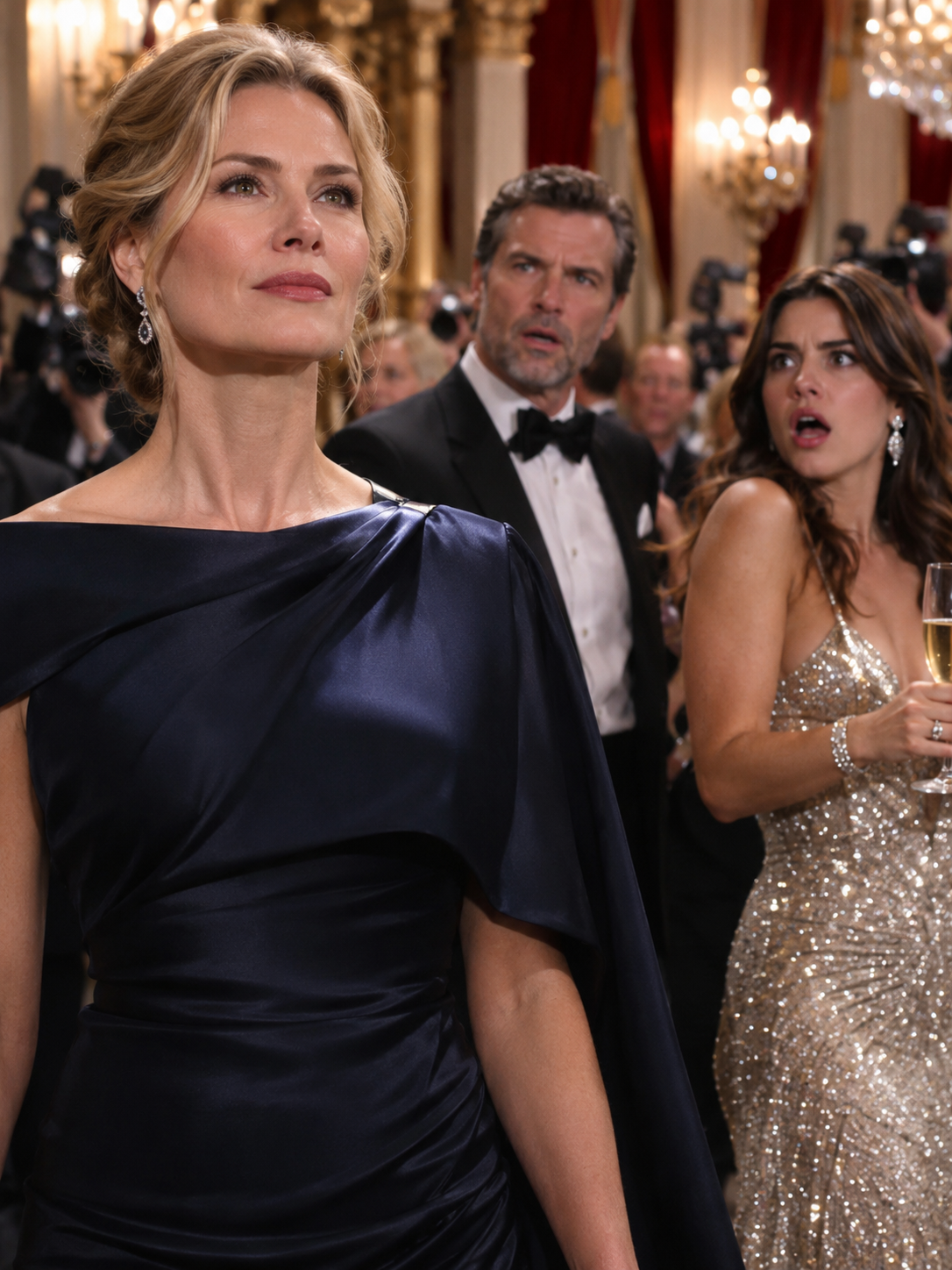
At p.m., I stepped into the hall wearing the sapphire gown and the Sterling Star. Marcus came forward to meet me, and Adrian Price, a senior prosecutor familiar with the inquiry, was among the officials nearby. Cameras turned, but what I saw first was Vincent across the room, staring as though he had been introduced to his wife for the first time.
Part 3 A glass slipped from Vincent’s hand and broke against the floor. He looked from my necklace to Marcus and then toward the guests checking their phones. Nova was still beside him, and she looked at my gown with a mixture of confusion and anger that made me remember her expression at Balthazar.
“What’s going on?” Vincent asked when I drew close enough to hear him. His publicist was trying to show him the newspaper report, but he kept looking at me. Reporters nearby were asking about an alleged £90 million taken from the foundation and about whether his lenders were reviewing their credit arrangements.
“Tell me this isn’t you,” he said. I could hear the fear under his anger. “You used the foundation’s money as though it belonged to you,” I answered. “I’ve asked independent investigators and the trustees to look at what you’ve done. That isn’t something I can undo for you.”
He started insisting that the assets were his and that the board would stand behind him. Marcus handed the chairman a bound copy of our findings and explained how the 1940 Sterling trust prohibited the use of its charitable assets as personal collateral. A board could debate leadership; it couldn’t rewrite the restrictions because its chairman liked taking risks.
Vincent called it a setup. I remembered the years I’d spent asking for clearer financial reports, the meetings he’d dismissed as boring, the questions he’d answered with a joke about my lack of business sense. “You signed the authorizations,” I told him. “You don’t get to call the records a trap because someone finally read them.”
Nova moved nearer to Vincent. “Richie, what are they talking about?” she asked. I looked at the diamond serpent at her throat, the same one she’d displayed at lunch. “The records show that shell-company money paid for gifts, including that necklace,” I told her. “One of those accounts received funds intended for children’s cancer care.”
She pressed a hand to the stones. “He said they were presents.” For the first time, she seemed less interested in being seen than in finding somewhere to hide. I had no proof she had understood the origin of those purchases, and I wasn’t going to pretend otherwise simply because she had been cruel to me.
Adrian Price spoke with the officers handling the inquiry, and Metropolitan Police approached Vincent. They told him he was being arrested on suspicion of financial offenses linked to the foundation and explained his rights. It was not a verdict, nor was it an order I had the power to give, but seeing him led toward the doors was still harder than I expected.
When Vincent jerked toward me, my security team moved between us without striking him. He shouted that I had ruined his life. I stayed where I was, holding the little satin bag that matched my gown, and watched the man I’d married leave with the officers. I had imagined feeling triumphant; instead, my shoulders ached with the effort of staying upright.
Nova was asked to come for questioning about the purchases. She called after Vincent, but he wouldn’t meet her eyes. The guests watched her go, her beautiful borrowed diamonds suddenly more conspicuous than anything else she wore. I reminded myself that a police interview would determine facts, not the whispers filling that ballroom.
For a moment I thought I might walk out too. Then I saw the director of one of the museums the foundation supported, his face drawn with worry, and I remembered the programs that relied on us. The work had been there long before Vincent’s applause and would have to continue after it.
Part 4 I went to the podium and asked for the microphone. “I’m sorry for the disruption,” I began. “There are serious questions about the management of money placed in our care. The trustees have received the audit, and the proper authorities will do their work. Tonight I can tell you what we’re doing to protect the people those funds were meant to serve.”
William Sanchez stood near the front, looking furious and frightened. His fund had a billion pounds exposed to Thorne Capital. “What happens to our money?” he asked. It was a fair question, even if I didn’t have an answer he would like.
“I won’t promise you a recovery I can’t guarantee,” I said. “The valuation Vincent promoted depended on financing tied to assets he had no right to pledge. His lenders and administrators will have to establish what’s recoverable. My family’s endowment will pursue its own assets through the proper channels.”
He sat down slowly. Around him, people began making calls and speaking in low voices. I could not repair their investments with a speech, and I wasn’t prepared to pretend I could. I had spent too long watching a man confuse confidence with certainty.
I told the room that I would ask the foundation trustees to restore the original name, the Sterling Family Endowment for the Arts and Sciences, and to install independent oversight. The next morning they would meet at our office, review the audit, and vote on interim leadership and safeguards. The trustees, not an audience at a gala, would make those decisions.
Then I looked toward Mr. Hoven, who was waiting to hear whether the museum’s work would survive. Vincent had promised £50 million from funds whose position was now uncertain. “My family will honor that pledge through verified, available Sterling resources,” I said, “and we’re prepared to increase our commitment to £100 million, subject to the necessary agreements and controls.”
His shoulders lowered. People applauded, though the sound wasn’t the roar Vincent had always wanted from a room. I was relieved by that. For once, the important thing wasn’t how many people admired a donor; it was whether the donation would actually reach its purpose.
I told them that my family had supported London’s arts and sciences for generations and had preferred to work without fanfare. “I thought keeping my married name at the front was part of being a partner,” I said. “But partnership requires trust. We owe the people who rely on this foundation something steadier than a headline or a promise made from a stage.”
My voice nearly caught on the word partner. I set the microphone down for a second, then added that the evening’s programs and the people depending on them would remain our priority. I asked the orchestra to continue when it was ready, and the staff began serving the dessert that had been waiting behind the doors.
Beatrice Astor Lennox, an elderly trustee who’d known my grandmother, found me as I stepped away. She took both my hands and asked if I was all right. That question almost broke me more than anything Vincent had said, because she’d asked it quietly, with no audience to impress.
Marcus and Sarah moved among the trustees with details for the eight o’clock meeting at Sterling Tower. Isabella, the Vogue editor, approached and recognized the Valerius gown. “How did you get him to make it?” she asked. “He is my godfather,” I told her. “He made it for my thirtieth birthday, ten years ago.”
I’d kept his note with it all that time: “You’ll know when it’s time to wear it.” Isabella glanced at the Sterling Star, and I saw her recognize what my great-grandmother had once worn. We talked briefly about the news, not the best-dressed list. I wanted the reporting to stay focused on what had happened to the foundation’s money.
Less than half an hour after Vincent was taken away, I left the gala. I hadn’t eaten dessert or taken a victory photograph. Outside, the black Audi waited at the curb, and Marcus joined me once he’d made sure the trustees had what they needed. “Eight o’clock tomorrow?” I asked. He nodded.
I rested my head against the seat for a minute, careful of the heavy necklace. “Coffee,” I said at last. “And then we get back to work.” There were accounts to secure, grants to protect, and people who were about to discover that a charming speech from a billionaire had never been a substitute for oversight.
Final The next morning was not a coronation. It was hours of financial reports, independent legal advice, hard questions from trustees, and calls to program directors who needed to know whether their payments would arrive. The board suspended Vincent from his foundation responsibilities and approved interim stewardship under my leadership while the investigation proceeded.
Thorne Capital’s lenders pulled back, its reported value unraveled, and administrators began the slow work of tracing liabilities and recoverable assets. The story led the news, and my photograph in that blue gown appeared everywhere. What frightened me most was that people talked about my dress almost as eagerly as they talked about missing charitable funds.
The programs affected by the misuse did not all return to normal with a vote. We had to separate legitimate grants from questionable transfers, secure replacement funding, and answer people who had every right to feel betrayed. Sarah and the accountants stayed late most evenings. I did too, often changing back into the cardigan Vincent had hated.
Nova was questioned and later cooperated with investigators. The jewelry, car, and property purchased with contested funds became part of the recovery process, and the brands that had courted her began dropping her. I heard she went back to her hometown and was working on a memoir she called Glitter and Treason. I never learned how much she knew when she accepted those gifts, and I stopped trying to guess.
Vincent’s position worsened as records from overseas accounts came under scrutiny. Months later, Marcus told me his lawyers were discussing a plea arrangement: possible exposure to twenty-five years across the charges, with a proposed ten-year term if Vincent helped recover overseas assets. No court had approved it, and I refused to build my peace around predicting what a judge would do.
By then, Forbes had put me on its cover, this time for the family business rather than as someone’s wife. I had taken over the day-to-day leadership of Sterling Consolidated while continuing to oversee the endowment’s recovery. Neither job felt like the triumph people imagined; both involved early mornings, difficult decisions, and much less glamour than a gala photograph.
Six months after that night at the opera house, the Hyde Park penthouse no longer looked like Vincent’s showroom. His cold chrome furnishings were gone, replaced by art my family had lived with for generations and chairs comfortable enough to read in. In the home office, the park was visible through the windows, and I could hear traffic below if I opened one.
Marcus arrived with a small stack of files while I was reviewing a paper about biotechnology. He said Vincent’s legal discussions were still moving ahead and that Nova had agreed to give evidence in return for immunity. Then he laid down the last folder. The final divorce paperwork was complete.
I signed the final acknowledgment with the name I had always owned: Audrey M. Sterling. For ten years I’d thought loving someone meant making room for his ambition and asking very little attention for my own. I didn’t regret having loved Vincent once. I regretted how long I had let his version of our marriage stand in for the truth.
“Anything else?” Marcus asked. I closed the folder and picked up the biotechnology paper again. “Yes,” I said. “I want to look more closely at this company before we make any decisions.” He smiled and took a seat, and we went back to talking about work I hoped would matter long after anyone forgot what color my gown had been.
THE END. I’ve shared the complete story, and I truly hope it touched your heart. If this story moved you, please , like, and share the post. Thank you for reading! ❤️
✓ Lynn R. Adams
At a private donor lunch, my billionaire husband’s 24-year-old mistress looked at my cream blouse and asked whether the staff were allowed to sit with the guests. I gave my husband one chance to defen…