Before the subdivision existed, Nathan Cole had bought twenty acres outside Denver
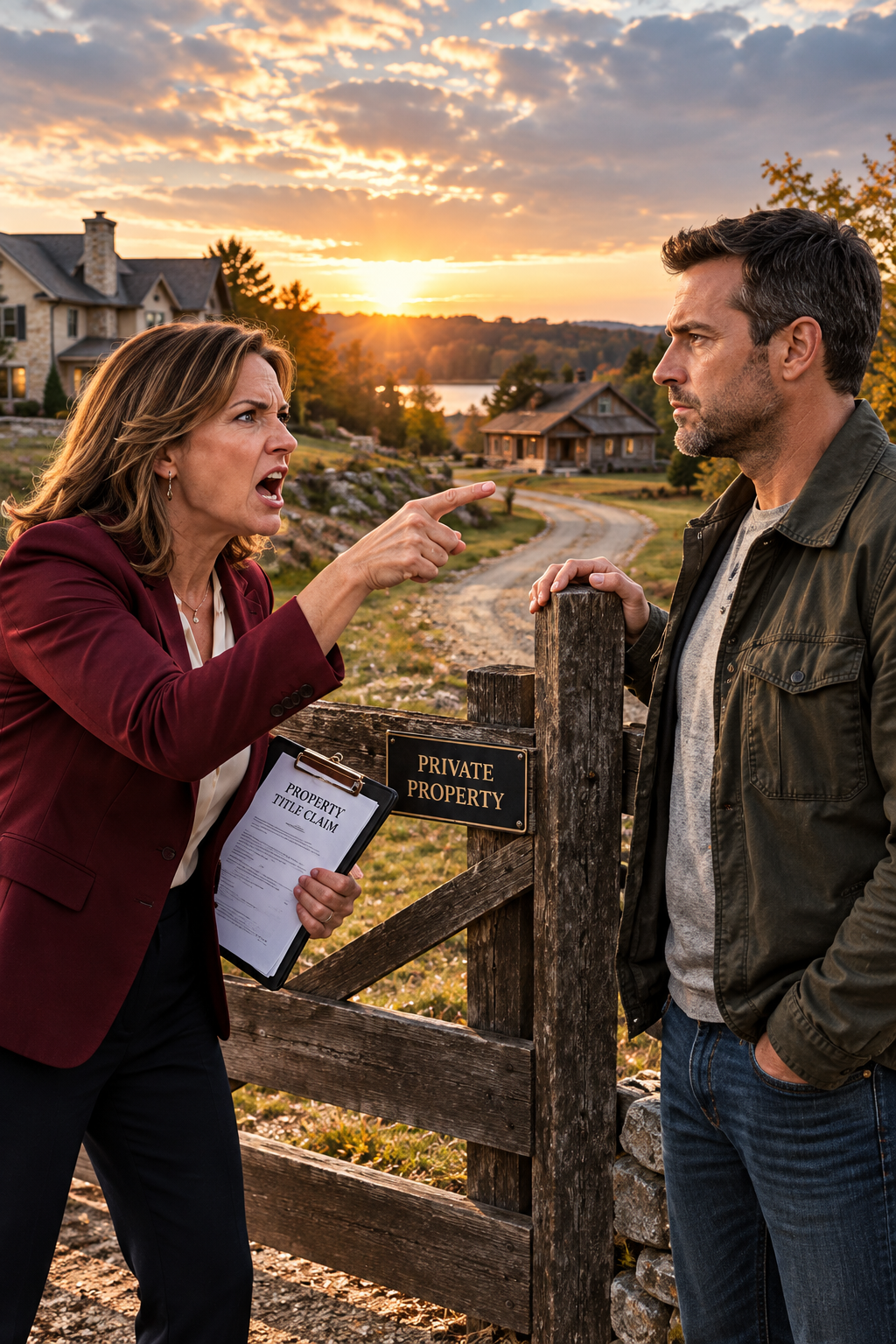
Part 2: Karen mistakes her HOA title for ownership of private land
The next few visits came with new explanations. Karen said she needed to inspect a drainage easement, though no such easement appeared in county records. She claimed residents had complained about branches crossing a boundary, but no complaint had been filed. On another day, she brought a contractor to measure a proposed fence that had nothing to do with Nathan’s property. Each time she opened the gate, stepped onto his land, and left without an apology. Soon she was directing landscaping crews to trim trees she believed interfered with the HOA’s sightlines, even though the trees had stood untouched for thirty years.
Nathan did not meet those visits with a shouting match. He installed cameras to cover the gate, driveway, and tree line, then added motion sensors that recorded when and how long someone was near the boundary. When unfamiliar vehicles appeared by the fence, he launched drones to capture the activity from above. The recordings carried timestamps and GPS data, and he organized them as carefully as he once organized construction plans. Every evening, he added the day’s events to a spreadsheet: who had come, what they claimed to be doing, how long they stayed, and where they had walked.
At first, Karen seemed unaware that her actions were being recorded. She rarely came alone, as if the presence of a board member could make an unauthorized visit look official. She measured distances from markers that shifted a little farther onto Nathan’s land each time. She tied orange ribbons to trees and said they interfered with views the association was responsible for protecting. Her justifications grew more elaborate, but never more credible. Nathan noticed the contradictions, saved the letters she sent, and replied with calm references to the deed, survey records, and property laws.
His silence became part of the neighborhood’s story, though it was not the story he would have chosen. Karen began telling residents that Nathan was hostile, secretive, and dangerous to the community. Linda Foster, a longtime ally, repeated those claims in driveway conversations and book-club gatherings. Rumors grew as they passed from one neighbor to another: Nathan photographed houses, threatened delivery drivers, and was building something suspicious behind the tree line. None of it was true, and nobody had verified it. But people who barely knew Nathan found it easier to believe the rumors than to ask him what had happened.
Karen took the whispers as evidence that the neighborhood stood behind her. During one visit, she told Nathan that everyone eventually fell in line. He thanked her for coming and asked her to leave. He had already spoken with a lawyer, and his office computer held a growing archive of her visits. He did not need Karen to know it. Every time she returned, she added another piece to a record that was becoming difficult to explain away as a misunderstanding.
Part 3: A bulldozer destroys the grove Nathan planted himself
The turning point came in October, on a warm afternoon when the leaves along the ridge had begun to turn gold. Karen hired a landscaping company to clear what she called an overgrown strip along the property line. She did not request a survey or check the county map. She pointed toward the trees and told the crew they were in the association’s common area. The workers trusted her confidence and started early the next morning with chainsaws, a wood chipper, and a small excavator. By the time Nathan returned from a meeting in Denver, nearly half an acre of his forest had been cut down.
Mature trees lay in sections across the ground, their trunks stacked near the chipper. The excavator had scraped away native grass and churned the soil. The roots that had held the hillside in place were exposed, and the drainage slope Nathan had built to manage spring runoff had been altered. In the middle of the damage stood Karen, directing the crew toward another section of trees. Nathan’s cameras had recorded her instructions, while the drones had captured the work from above. Even the boundary stakes were visible in the footage, standing just beyond the equipment she had sent across them.
Nathan stood at the edge of the cleared ground with his phone in his hand. He felt the loss of the grove as more than a financial injury; he had planted some of those trees and watered them through their first dry summers. Still, he did not shout at Karen or stop the workers in the middle of their job. He filmed the scene, photographed each stump and track mark, and walked the damaged acreage until the light began to fade. His anger was real, but he knew that anger would not establish where the property line lay or what restoration would cost.
That evening, he called David Morales, a surveyor he had worked with years earlier. David listened to the description and told Nathan to leave everything exactly as it was. He arrived the next morning with a crew, GPS equipment, and historical records from the county archive. For two days, they walked the boundary, checking every measurement against the deed and the original survey markers. David explained that ordinary disputes often involved a few feet of misplaced fence or an overgrown hedge. What he found here was a pattern: the landscaping crew had crossed more than sixty feet past the actual boundary in places.
The survey confirmed unauthorized excavation and widespread destruction of vegetation. Nathan then walked the damaged section alone, marking affected areas with small flags so the appraiser would not miss anything. He wanted the final account to be accurate, not inflated. Each tree was assessed by species, age, and replacement value. The damaged soil, disturbed drainage, and labor needed to restore the hillside were calculated separately. For Nathan, precision was more important than outrage. If the dispute reached a courtroom, he wanted every number to have an answer behind it.
Part 4: A legal demand turns a neighborhood quarrel into a case
Rebecca Sloan, an attorney with fifteen years of experience in property disputes, reviewed the survey and the footage. She did not rush to file a lawsuit. Instead, she worked with Nathan to assemble the record and identify each separate incident. By the time she was done, she had documented fifteen major trespasses over six months, each supported by video, photographs, GPS logs, or survey evidence. Nathan had recorded more than thirty visits in all, but Rebecca focused on the clearest incidents and the strongest proof. Her goal was to make the pattern impossible to dismiss.
Karen received a formal cease-and-desist letter and returned to the property less than a week later. She unlocked the gate herself and brought another contractor, this time to install drainage piping along land she continued to call association property. Nathan was not home. His cameras captured Karen walking through the gate and telling the contractor where to dig. To Karen, his absence seemed like surrender. To Rebecca, it was evidence that the cease-and-desist notice had been ignored. She was already preparing a detailed demand letter.
The letter arrived by certified mail on a crisp Tuesday morning in early November. It listed the fifteen incidents, their dates and locations, and the evidence supporting each one. David’s survey cost $2,800. Legal work amounted to $6,700. Replacing trees and restoring the grove was estimated at $9,600, while repairing the scraped and compacted soil would cost $5,900. Security upgrades and documented administrative expenses added another $3,500. The total was $28,500, supported by invoices, expert assessments, photographs, and survey records. Rebecca had checked each figure to make sure the amount could stand up to scrutiny.
Karen read the demand while Linda Foster was visiting. She laughed, tore the letter in half, and threw it on the counter. She called the amount absurd and said the HOA would never pay for what she considered routine community maintenance. She believed a judge would side with the association because Nathan had refused to join it. She also seemed to believe that her position as president offered protection from consequences. Nathan did not answer her dismissal with an argument. He instructed Rebecca to file the case in civil court.
The lawsuit named Karen individually and the HOA because the board had authorized and funded several of the landscaping jobs. Karen hired the law firm the association had used for years, a firm accustomed to disputes about fences and paint colors. The case was more complicated than those disputes, and the evidence was more extensive. Nathan did not expect the court to accept a claim simply because he felt wronged. He expected it to weigh what had happened, what had been damaged, and what the records could prove. His file was ready.
Part 5: The survey and camera footage leave no room for confusion
The trial began on a gray morning in late November. Neighbors, board members, and a few local reporters filled the courtroom. Judge Emily Brooks presided with the calm precision for which she was known. Karen arrived dressed sharply and sat beside her attorney as if she still believed the lawsuit was an overreaction. The HOA’s lawyer argued that the crews might have made an honest mistake about the boundary and that Nathan’s damages were exaggerated. For a moment, Karen seemed reassured by the argument. Then Rebecca began showing the evidence.
She started with David’s survey, walking the judge through the legal descriptions and the distance between the true boundary and the places where the crews had worked. The drone footage showed the property markers from above. Ground-camera footage showed Karen opening the gate and directing the contractors. GPS logs lined up with the video timestamps, creating a timeline that matched the locations of the damage. No single clip had to carry the whole case. Together, the records showed the same boundary being crossed again and again.
David testified that his survey found unmistakable encroachment, in places extending more than sixty feet beyond the property line. He showed how the historic deed records and original survey markers predated the HOA by decades. There was no easement granting the association access, and no agreement from Nathan allowing the crews to enter. The landscaping contractor also testified. He said Karen personally instructed the crew where to cut and clear, never expressed uncertainty about the boundary, and spoke with the confidence of someone who believed she had authority. Several survey stakes had been visible on the day of the work. The crew had passed them.
Rebecca then addressed the damages. Each tree, patch of soil, and affected drainage area had been assessed by independent professionals. The invoices matched the work needed to restore the property. The security expenses were documented. The legal costs were itemized. Karen’s attorney argued that the numbers were too high, but Rebecca answered each challenge with a receipt, a report, or a signed estimate. The courtroom grew quieter as the line items appeared on the screen. It was harder to call the demand inflated when each figure had an identified source.
Several board members testified that Karen had told them the land was part of a shared easement and that Nathan had verbally agreed to inspections. Neither claim held up. No easement appeared in the public record, and Nathan had never given permission. The association’s own lawyer admitted he had never examined the boundaries before advising the board; he had relied on Karen’s description. His answer weakened the defense’s claim of good faith. By the time Rebecca replayed the timeline of fifteen incidents, the pattern was plain: Karen had treated her title as permission to use someone else’s land.
Part 6: The judge rules that an HOA title grants no trespass rights
After a short recess, Judge Brooks addressed Karen directly. She asked why Karen believed that being HOA president gave her authority to enter private land without permission. Karen answered that she had been trying to protect the neighborhood and that everyone had always trusted her judgment. The judge listened, then explained that a private association’s title did not grant control over property the association did not own. There was no easement, Nathan had never joined the HOA, and the boundary had been marked. Property law did not bend to community politics.
Karen began speaking over her attorney. She insisted that she had only wanted to maintain order and protect property values. Her voice rose as she described years of service, neighborhood standards, and residents who depended on her. For the first time, the confidence that had carried her through the dispute began to crack. She had expected the courtroom to respond to her title as the neighbors had. Instead, the judge was asking what right she had to enter the land, and the records supplied the answer.
Judge Brooks ruled that both Karen and the HOA were liable. The findings covered trespass, property damage, and unauthorized entry. The court ordered them to pay the full $28,500 outlined in Rebecca’s demand, along with Nathan’s litigation costs. It also required a formal written apology acknowledging the repeated trespasses and the harm caused to his property. Karen sat motionless while the judge read the ruling. Behind her, Linda stared down at her hands. The claims she had repeated about Nathan had been built on a story that the evidence had now dismantled.
The ruling changed the neighborhood quickly. Within a week, the HOA board held an emergency meeting and removed Karen from the presidency. Several residents who had quietly accepted her leadership for years finally spoke up about unreasonable fines and intrusive decisions. When the board discussed its share of the judgment, the financial cost made the consequences impossible to ignore. Karen argued that the lawsuit had been a personal attack, but the records and the court’s findings were already public. The vote to remove her passed by a wide margin.
Nathan did not attend the meeting. He had no interest in watching Karen lose her position or in hearing the board debate what it should have considered before the damage was done. He spent the week arranging the restoration of the damaged hillside. A small crew replanted native trees and treated the compacted soil. Nathan repaired the drainage slope and strengthened the fence where the gate had been left open repeatedly. He chose trees that would take years to mature, because the land was his to care for long after the neighborhood had moved on to another dispute.
Part 7: Neighbors reconsider the rumors they once believed
The first neighbor to come apologize arrived a few weeks after the verdict. She had believed the stories about Nathan being difficult and dangerous, though she admitted she had never spoken to him directly. She stood at the gate for a moment before explaining that she had signed a petition questioning his presence in the neighborhood. Nathan listened without interrupting. He thanked her for coming and offered her coffee. They talked about the weather and the changing light across the valley, not the lawsuit. By the time she left, the conversation had done something that a court order could not: it had begun to replace assumption with acquaintance.
More neighbors followed. Some apologized awkwardly; others spoke with genuine regret. They admitted that they had judged Nathan based on stories passed between driveways and meetings. He accepted each apology without gloating or reopening the details of the case. He did not need to remind them that the court had found in his favor. The survey, the footage, and the ruling were already part of the public record. He simply thanked them for taking the time to understand what had happened.
Linda Foster took longer. She arrived on a cold morning in early December, breath visible in the air, and admitted that she had spread stories about Nathan without checking a single one. She had done it out of loyalty to Karen, she said, not because she truly believed he posed a danger. Nathan listened, then told her gently that words continued to carry consequences long after the person who spoke them had moved on. Linda nodded and left quietly. Their exchange did not erase what she had said, but it marked the end of a story she had helped spread.
One afternoon, a neighbor asked Nathan why he had not confronted Karen sooner. Why had he waited for a lawsuit instead of stopping her visits immediately? He considered the question before answering. A community built around control, he said, could not be trusted to respect quiet boundaries just because someone asked nicely. People needed clear proof of what had happened and what their authority did not allow. Real respect could not be demanded with a clipboard. It had to be demonstrated, and sometimes the only way to demonstrate a boundary was to defend it with facts.
The new HOA president took a different approach. She was a quieter woman who had lived in the community for more than a decade, and at her first meeting she said the association’s authority ended where private property began. The board focused on actual maintenance issues and reviewed the policies that had allowed Karen to operate without meaningful oversight. Residents still disagreed about paint colors and lawn care, but decisions were no longer delivered as personal commands. The neighborhood grew calmer, more careful about where its authority ended. Karen, once a constant presence at meetings and community events, largely disappeared from view.
Part 8: Restored trees mark the beginning of a quieter chapter
Restoring the hillside took longer than the lawsuit. The new trees looked small against the open ground where the older ones had stood, and the disturbed soil needed careful treatment before it could hold water properly again. Nathan checked the drainage after each rain and adjusted the channels where runoff moved too quickly. He replaced the broken sections of fence and added a stronger lock to the gate. The cameras stayed in place, though most of their new footage showed deer moving through the underbrush or wind shaking the branches.
The court’s judgment covered the documented damages and the legal costs, but money could not instantly return the grove to its former shape. Nathan had known that when he insisted on an independent appraisal. The point was not to turn the loss into a windfall. It was to make the damage visible, restore what could be restored, and establish that Karen and the HOA could not simply call the destruction “community maintenance.” Each sapling was a promise that the land would continue beyond the dispute. The trees would grow at their own pace, indifferent to the arguments that had surrounded them.
The HOA’s new leadership sent Nathan the required written apology. It acknowledged the repeated unauthorized entries and the damage to his land. He read it once, placed it with the court documents, and went back outside. He did not need a letter to tell him what the ruling had already established. Still, he understood why the court required it. An apology did not undo the trespass, but it forced the association to state plainly what had happened instead of hiding behind the language of routine maintenance.
The neighborhood also began learning what it meant to ask instead of assume. Residents who needed to discuss drainage or access came to the gate and waited for permission. Contractors stopped at the boundary markers rather than following whoever carried a clipboard. People who had once taken Karen’s word as authority began checking records and asking for written approval. The changes were modest, but they mattered. Boundaries became something the community could see and respect rather than something it expected Nathan to defend alone.
Nathan kept the old spreadsheet and evidence file archived in his office. He did not revisit them every evening anymore. The case had been heard, the judgment entered, the damages paid, and the HOA reorganized. But he kept the records because documentation was not only useful when a dispute began. It was a way of remembering exactly what had happened, especially when rumors and confident explanations tried to soften it. The file no longer occupied his days. It simply remained available, a quiet reminder that patience had not meant surrender.
Part 9: Accountability restores the boundary and changes the community
By early winter, the neighborhood had settled into a version of itself that felt more measured than it had in years. The HOA handled maintenance without treating every disagreement as a challenge to its authority. Residents paid attention to the actual boundaries around their homes. Stories about Karen’s downfall faded into a cautionary example, repeated whenever someone suggested that an association could simply take control of whatever land it wanted. Her name appeared less often at meetings. Her old certainty had been replaced by the court’s written record.
Nathan stood by the restored hillside one afternoon as the last golden leaves drifted from the trees. The new plantings were young, and the scars in the earth had not vanished, but the slope was stable again. He could see the camera at the gate and, beyond it, the road where Karen’s contractors had once arrived. Nothing about the property looked dramatic now. That was the point. He had wanted a quiet home, not a courtroom victory. The quiet had taken work to protect, but the land was returning to the life he had planned for it.
He thought about the $300 fine that Karen had sent for what she called his failure to cooperate. He had not answered it with another angry letter. He had sent a legal invoice for $28,500, supported by the survey, the restoration assessments, the videos, and the costs of defending his property. She had laughed at the demand and torn it in half. A judge had later reviewed the same evidence and ordered the association and Karen to pay. The fine had been an attempt to make him submit; the invoice became the beginning of accountability.
The case changed more than a line on a map. It forced residents to question the stories they had accepted and the power they had allowed one person to exercise. Some neighbors apologized; others simply became more careful. The new board understood that an association could serve a community without owning it. Nathan had not wanted to lead the HOA or punish every person who had believed Karen. He wanted his land left alone and the damage repaired. In the end, that simple boundary became a lesson the whole neighborhood had needed.
As evening settled over the ridge, wind moved through the new trees and carried the smell of cold earth from the restored slope. Nathan rested a hand against the gate he had rebuilt. The cameras remained, but he no longer watched them with the same urgency. If they caught anything now, it would likely be a deer crossing the grass or a neighbor stopping to ask permission before stepping inside. He had learned that property was protected by more than fences. It was protected by patience, careful records, and the willingness to let facts speak when someone with authority expected silence.
Nathan returned to his porch as the last light faded over the Denver hills. The house he had built stood behind him, and the land he had bought before the subdivision existed stretched quietly around it. He had not won because he was louder, wealthier, or more influential than Karen. He had won because he knew where the boundary was, proved each time she crossed it, and trusted that evidence would matter when it reached the right people. For the first time in months, he let himself smile. The land beneath his feet, and the life he had built upon it, were his again.
✓ Lynn R. Adams
Part 2: Karen mistakes her HOA title for ownership of private land The next few visits came with new explanations. Karen said she needed to inspect a drainage easement, though no such easement appear…