At the Whitmore Gallery reopening, my husband stood beside the woman he’d been secretly seeing
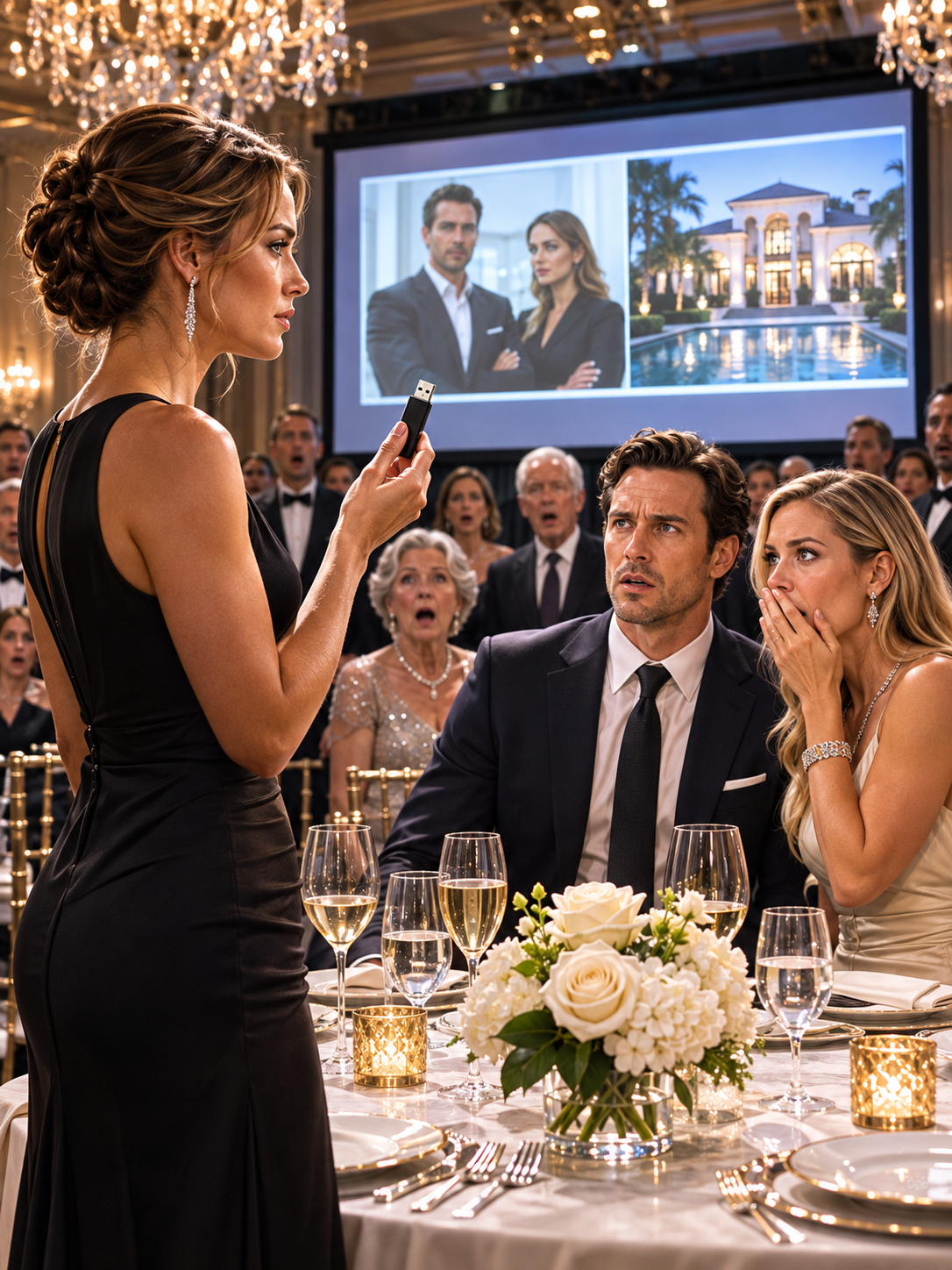
IF FACEBOOK BROUGHT YOU HERE, HERE’S THE CONTINUATION YOU’VE BEEN WAITING FOR. ENJOY! 👇 The next slide was a wire transfer confirmation. It showed two hundred thousand dollars moved from the studio’s operating funds through transactions described as infrastructure reserves toward an account that wasn’t the studio’s. The documents on the screen were a summary of what our accountant had traced so far, not a completed legal finding.
Someone near the bar whispered. Sterling stared at the projection, then looked toward the AV booth as though someone there could make the last minute disappear. Bianca looked at him, at the screen, and back again. I’d spent months learning to keep my face steady when the truth was much uglier than the conversation happening around me.
Slide fourteen displayed the draft restructuring agreement. The proposed sixty-percent stake for Sterling and twelve percent for Bianca were visible, alongside the revision history linking Sterling to the document. It wasn’t a signed change to our ownership; it was evidence of what he’d been preparing to ask me to sign. That difference mattered to Donna, and it mattered to me.
Sterling left the podium and stood beside Bianca at the end of the front row. Patricia Ash, the gallery’s executive director, moved toward the back, where several board members had gathered. I could see them exchanging quiet words. I didn’t pretend their first concern would be my feelings; they had a major commissioned project and an institution to protect.
I walked down the center aisle in the black dress I’d bought for my father’s retirement dinner. It was the most composed thing I owned, and I’d pinned up my hair because I wanted nothing to fuss with. When I reached the space between the screen and the guests, I asked to speak and waited until the room settled.
“I designed this commission,” I said. “The Whitmore first approached me four years ago because of my work on the Leland Library restoration. I want that clear while everyone decides how to describe what they’re seeing.” My voice stayed level, though the handle of my bag had left an indentation in my palm.
I turned toward the financial slide. “There are serious questions about studio operating funds being used for personal expenses. Our forensic accountant’s summary and the supporting records will go to the appropriate governing and lending parties for review.” One board member said my name as if he wanted me to stop. “I know it’s a lot,” I replied.
Bianca stood and walked out. I didn’t watch her go. Whatever she did next would be hers to explain, and I couldn’t separate her responsibility from Sterling’s by chasing her down a hallway. My task was to make sure the people whose work and money were involved understood what I had documented.
Sterling came toward me, his face flushed. “You’re going to regret this,” he said quietly, close enough that only I heard. We’d stood that close during difficult conversations for fourteen years, his voice controlled and mine carefully chosen. I knew the posture as well as I knew the floor plan of our house.
“I regretted it when you put a paper in front of me that would have made my majority stake disappear,” I told him. “I regretted it when you promised Bianca twelve percent of a business I built. And I regretted seeing hotel charges treated as client entertainment while you were telling me there was no room in the budget.”
“Not here,” he said. I looked past him at the guests still sitting in rows. “You’ve been making these decisions in front of me for months,” I answered. “I’m correcting the record in front of the people affected by them.” I wasn’t proud of having turned a celebration into a difficult night, but letting him deliver the presentation unchallenged would have been another decision with consequences.
I told him Donna had prepared the necessary legal steps to protect my ownership interest while the dispute was reviewed. Our existing partnership agreement remained in force; the draft he’d made did not replace it. He shook his head as though he could deny those documents into being something else.
I picked up my evening bag and left before the room could settle on a reaction. In the elevator, my phone vibrated. Lily had heard from Donna and wanted to know whether I was all right. “I’m standing up,” I said, leaning my head against the wall. “That’s the same thing,” she replied.
For several minutes I stood in the building’s quiet lobby, hearing muted sounds from upstairs. I wanted to call the gallery’s craftspeople one by one and tell them I hadn’t done any of this to diminish their work. Instead I sent Patricia a short note promising to cooperate with an orderly review and to make sure the restoration records remained available.
By the time I reached home, I was tired enough to feel almost numb. I hung up the black dress, put the USB drive in the folder Donna had told me to preserve, and sat at my drafting table. There were still drawings for the next week’s work on it. I moved the legal papers aside so I wouldn’t spill anything on the plans.
Part 3 The next two weeks were full of documents, phone calls, and decisions that couldn’t be made in a ballroom. Donna took the protective steps she had prepared to put the ownership dispute on record and notified the appropriate parties. The accounting records went to the studio’s outside advisers, and communication with Sterling’s lawyer went through her office.
Sterling moved into the Whitfield Arms. I noticed the hotel name and didn’t know whether to laugh at the irony or feel sick about it. I stopped answering his calls and asked for supervised access to the firm’s filing systems while the records were being reviewed. I was still an owner, but ownership suddenly required more paperwork than it ever had before.
Bianca retained an attorney and sent an internal statement saying she had acted in good faith on instructions from senior leadership. I read it at my desk. She’d attended the restructuring meetings and accepted the idea of a stake in the firm, knowing Sterling was married to me. Her explanation was for the process to evaluate, not a request I had to accept.
I didn’t dismiss her myself. Donna reminded me that I could be the person harmed without also becoming judge, investigator, and employer in every proceeding. That was a relief. For years I’d been the one who softened Sterling’s language after an angry client call and repaired the promises he made before checking whether the work could be done.
The gallery didn’t suspend the restoration. Patricia called me the morning after the event and told me the commission was my work, and that the Whitmore intended to credit it accordingly. I thanked her, then sat in my parked car long after the call ended. It was surprisingly hard to accept a sentence I’d wanted someone to say for years.
I went back to the studio because the twelve people working there still had deadlines and livelihoods. Some were afraid the firm would collapse. I couldn’t promise what the lawyers and accountants would find, so I told them what I could: the projects remained real, their work mattered, and I would keep them informed about decisions that affected them.
Our forensic accountant’s final review widened the total beyond the preliminary transfer we’d shown at the gallery. The report identified $231,000 in questioned draws over twenty-two months. It examined the entries categorized as infrastructure reserves and traced the records behind them. Sterling’s lawyer responded with a settlement offer, but the first figure didn’t answer all the questions.
I read the offer, set it aside, and went back to a set of drawings. That surprised me. Earlier in our marriage, Sterling’s version of any crisis would have dictated the shape of my entire day. Now I could let my lawyer review his proposal while I did the work I was actually good at.
There were ugly days, too. Sometimes the sight of a hotel invoice in the evidence folder made my stomach drop. Sometimes I’d remember a dinner when he’d said nothing was wrong and realize the date corresponded to one of the weekends on the receipts. I didn’t become invulnerable because I’d spoken into a microphone.
Lily visited more often, usually without asking whether I wanted to talk about Sterling. She brought takeout, asked about the gallery, and listened when I complained about a supplier or a difficult specification. Once she said, “You don’t have to turn every conversation into a report that you’re doing fine.” I put down my fork and admitted I wasn’t fine that evening.
As the legal process continued, Donna explained each step without pretending a good argument guaranteed a perfect result. Our original partnership agreement was twelve years old, and it had never been properly replaced. The restructuring draft was not a completed transfer. Whatever else happened with our marriage, my ownership couldn’t simply be reassigned by Sterling’s announcement.
The eventual settlement hearing was six months after the gallery opening. Lily offered to come with me, but I chose to attend without her. I wanted to stand in that room on my own behalf, not because I doubted her support, but because I’d spent too many years waiting for someone else to tell the world I belonged in my own work.
Final The courthouse smelled of floor wax and old paper. Sterling arrived with two attorneys, looking thinner than he had behind the gallery podium. I had Donna beside me for the legal work, but the decision to agree to the final terms was mine.
The settlement preserved my fifty-three-percent partnership interest and left the proposed restructuring without effect. A portion of the disputed transfers was returned through the marital asset division; the remainder was left for a separate proceeding. It wasn’t a grand reversal in which every dollar or every hurt returned neatly to its proper owner. It was a legal resolution with terms I could live with.
When the order was signed, I didn’t feel triumphant. I felt the way I do when a difficult room is finally finished and the furniture fits its actual dimensions. There was no longer a need to keep shifting things around to disguise the shape of it.
Sterling caught up to me in the corridor. Donna stayed nearby while he tried to find the words. “I told myself you only cared about the design,” he said. “I made up a version where you weren’t really involved in running the business, because that was easier for me.”
“You said it so often I nearly started believing it,” I answered. He admitted I’d built the work we were known for. I said yes, not to wound him, but because the fact had been missing from our conversations for too long.
“I don’t know what I thought would happen,” he said. “You thought I’d sign the paper,” I told him. He nodded. “I might have, if I hadn’t opened that folder. But your failure to tell me what was in it wasn’t the same thing as my agreeing.”
I walked toward the elevator before he found anything else to say. For years, ending a conversation before Sterling was finished had felt rude. That morning it felt like moving in the direction I needed to go. Lily had already texted to ask how it went, and I replied, “Done. Dinner tonight.” She wrote back that she’d booked my favorite place.
Eight months after the Whitmore opening, I hosted a dinner at the studio for our twelve employees. The table was crowded with plates and someone had brought an expensive bottle of wine that everyone pretended not to recognize. Lily came and spent much of the evening talking with a young designer about workload and learning when to push back on unrealistic deadlines.
Marcus, my project director, stood to make a toast. I’d promoted him three months earlier after learning how much he’d been carrying without proper recognition. “To the Whitmore,” he said, raising his glass, “and to the person whose name is actually on it.” I looked around at the people who had kept showing up to work and raised mine, too.
After dessert I stood by the studio window, watching headlights pass over wet pavement. Lily joined me and asked if I was really okay, or merely giving her my usual “I’m fine.” I considered it. “Really okay,” I said. “The kind that’s almost boring.” She smiled as though boring deserved more respect.
She told me Sterling had called to ask whether I was seeing anyone. I almost laughed at how little he’d changed; he was still measuring my life by who might be standing beside me. “What did you tell him?” I asked. “That you were busy,” Lily said. “And that busy looks good on you.”
“He traded a foundation for a feeling,” she said after a moment. I looked down at the ordinary street below. “Some people don’t understand the difference until they’re standing in an empty room,” I answered. Lily slipped her arm through mine, and we watched the traffic without needing to say anything else.
Behind us someone knocked over a water glass, another person went for a towel, and the conversation carried on. The studio was full of people whose names belonged on their work, with no one having to disappear so another person could be admired. I’d spent fourteen years making room for Sterling by taking up less of it myself. I wasn’t doing that anymore.
THE END. I’ve shared the complete story, and I truly hope it touched your heart. If this story moved you, please , like, and share the post. Thank you for reading! ❤️
✓ Lynn R. Adams
IF FACEBOOK BROUGHT YOU HERE, HERE’S THE CONTINUATION YOU’VE BEEN WAITING FOR. ENJOY! 👇 The next slide was a wire transfer confirmation. It showed two hundred thousand dollars moved from the studio’s…