At the Veterans Day luncheon, I told an older man that the officers’ line was reserved and sent him toward the registration table. When a young specialist gave him her own seat after I threatened her volunteer position
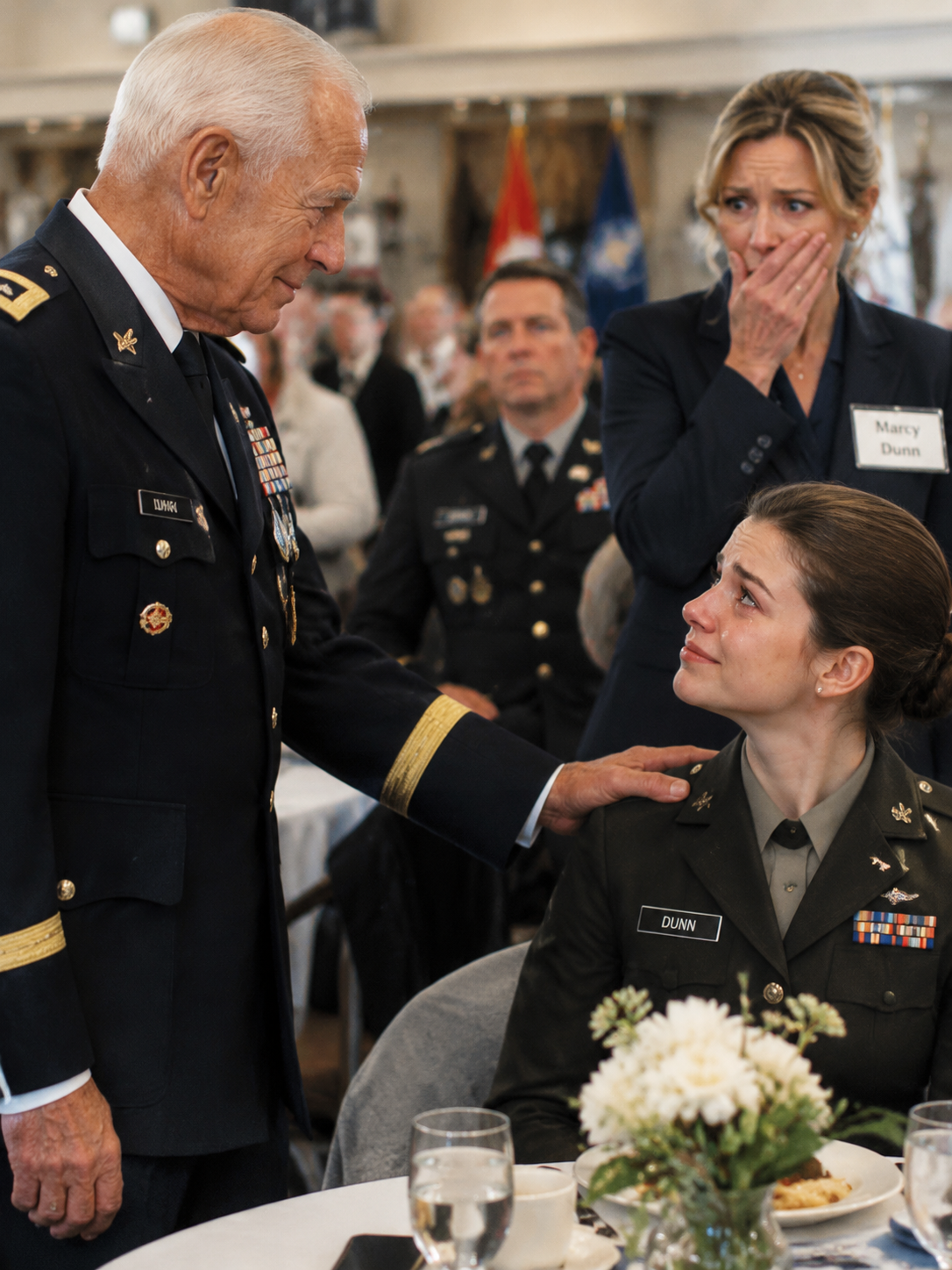
At the Veterans Day luncheon, I told an older man that the officers’ line was reserved and sent him toward the registration table. When a young specialist gave him her own seat after I threatened her volunteer position, I thought she had embarrassed me in front of the staff. Then the stranger looked at my father’s photograph and called him Walt…
I was standing beside the registration tables when an older man approached the line marked for officers and invited guests. Neatly dressed and carrying a small book, he looked as though he had come alone. “Sir, that line is for officers only,” I told him; “enlisted personnel, family members, and civilians register over there. The colonel was very clear.”
“I’m sorry,” he said. “I only need a name tag.” I pointed him toward the other table, and he nodded without arguing. I was focused on keeping the Veterans Day luncheon running according to plan.
The event was being held to dedicate a room in honor of my father, Walter Dunn. The photograph outside the room showed him in uniform, and the program described him as Colonel Walter Dunn, a battalion commander. That was how most people knew him. I wanted the dedication to feel proper.
The guest list had been finalized weeks earlier. Every seat had a place card, officers and invited guests had their own registration line, and volunteers had been assigned tables near the kitchen. When the older man reached the registration desk, the young specialist checking names looked through her list twice.
“Thomas Hale,” he told her when she asked for his name, then added, “Take your time. I’m in no hurry.” She searched twice and apologized; his name wasn’t on her list. I heard him say he had come alone for the dedication, so I stepped over.
I asked whether there was a problem; the specialist said she couldn’t find Mr. Hale on her list. I turned to him and explained that the luncheon was invitation-only and every seat had been reserved weeks earlier. He said he understood and didn’t want trouble, but I was ready to ask him to leave when she glanced toward the volunteers’ table.
There was an empty chair, and she offered it to him, saying she would stand. I told her the seat was for working volunteers, but she answered quietly, “It’s my seat, and I’d like him to have it.” I reminded her that giving it away would cost her place on the volunteer roster and that I would call her first sergeant.
She listened, then repeated that the offer still stood and invited Mr. Hale to the back table beside the kitchen doors. He warned that she could get herself in trouble; she calmly promised she would manage. He thanked her and accepted.
I watched him walk toward the back of the room while the specialist stayed on her feet. I told her I hoped she understood what she had just done. She said she had given a guest a seat. I returned to my duties, telling myself the seating plan mattered.
A little later, I noticed the book on the table: an officer candidate school preparation guide. I asked whether she planned to become an officer; she said she was trying and that her board was in three weeks. She studied whenever she could, but still needed a field-grade recommendation.
Mr. Hale asked whether she had spoken with her chain of command; she said the only major she knew signed her leave forms. He seemed to understand and encouraged her not to give up on the board. She thanked him and pointed out the coffee urn and table near the kitchen doors, while I remained focused on the seating chart.
When the luncheon began, Mr. Hale left the back table and walked toward the dedication room. I found him standing near the glass doors, looking at my father’s photograph. I went over at once.
“Who is the gentleman in that picture?” he asked. I told him it was my father, Colonel Walter Dunn, and that the room was being named for him. He studied the photograph and asked whether the plaque would include my father’s rank; I said it would not, because my father had never cared much for titles, though I thought his rank belonged in his story.
“No,” he said softly. “Walt never did.” When I asked whether he knew my father, he said he had known a Walt Dunn many years ago. I told him I doubted it was the same man; my father had commanded a battalion, and this stranger seemed to be remembering someone else.
I told him to return to his table and warned I’d call security if he wandered in again; he said he understood, but stopped as he turned away. “You won’t need to call anyone, Miss Dunn. You asked me to tell him, Walt. I promised you I would.”
I didn’t know what he meant. He looked once more at the photograph, then murmured that Walt deserved the truth but had asked him not to hurt me, and he was trying to honor both requests. I stood there, unsettled.
He had called my father Walt, not Colonel Dunn, and spoke as if they had shared something I had never been told. Before I could ask what promise he meant, he walked back toward the luncheon; I followed and tried to concentrate on the program. The specialist was still standing near the volunteers’ table, and Mr. Hale was seated where she had placed him.
Then a member of Colonel Voss’s staff came looking for the guest of honor and asked whether I had seen him at the head table. When I said no, he pointed toward the back and said the colonel was about to speak and we should find him. I followed his gaze; Mr. Hale sat beside the kitchen doors, listening quietly with his book closed.
A moment later, Colonel Voss stepped to the microphone and began the dedication. I expected him to introduce the guest of honor and thank the families. Instead, he paused and said the man who had made the dedication possible was there with us. Then he announced, “Please welcome Lieutenant General Thomas Hale, United States Army, retired.”
The room rose into applause. The man I had sent away, the man I had told was not on the list, was the guest everyone had been waiting for. And the specialist who had given him her seat was the only person in the room who had treated him like he belonged before she knew his rank.
I watched Colonel Voss reach the back table and greet him: “General Hale, it’s good to see you again, sir.” “Good to see you too, Rick,” Mr. Hale replied. Voss looked around the crowded room and asked why he was sitting back there; the general said the young soldier had been kind enough to make room for him.
“The entire room has been waiting for you, sir,” Colonel Voss said. General Hale rose carefully and glanced toward me before following him. I could not look away: I had been certain I was protecting the event and my father’s memory, yet the guest of honor was walking toward the microphone from the chair I had insisted he could not have.
The applause continued, but I barely heard it. I was trying to understand why a retired lieutenant general had known my father by a name I had spent years avoiding. I didn’t know what he would tell the room, but the dedication was no longer the ceremony I had planned. Part 2…..
IF FACEBOOK BROUGHT YOU HERE, HERE’S THE CONTINUATION YOU’VE BEEN WAITING FOR. ENJOY! 👇 Final When the room settled, General Hale thanked Colonel Voss and asked everyone to sit, joking that his knees disliked standing. He said he had been asked to keep his remarks short because Walt would have appreciated that; my father had never wanted attention, only to do his job.
Then he held up a small bundle of old uniform stripes. “These belonged to Walter Dunn, a master sergeant.” He told us he had been twenty-two when he met my father, fresh out of training and convinced he knew more than he did. Walt taught him to read a map in the dark, when to keep his mouth shut, and, above all, to put his soldiers first.
One night in Vietnam, their position was overrun, and General Hale was wounded and unable to walk. My father carried him eight hundred meters through a rice paddy, though Walt was wounded too. At the hospital ship, my father was still bleeding; he cut the stripes from his uniform, put them in Hale’s hand, and told him never to forget who did the real work.
General Hale said the Army had offered Walt a commission twice, but he turned it down both times because he believed there were already plenty of officers and never enough good sergeants. He looked down at the stripes and said my father had never been a colonel or wanted to be one; he was Master Sergeant Walter J. Dunn, the finest soldier Hale had ever known.
Someone near me whispered, “Marcy, I thought your father was a colonel.” I couldn’t answer; I had spent years repeating that story, and now the truth was being spoken in the room named for him. When I stepped away, Colonel Voss began to continue the dedication, but General Hale asked him to wait so he could speak with me first.
When he found me, I asked whether he had known who I was. He said he had suspected because Walt spoke about me often. I asked why he had let me turn him away; he asked whether I would have treated him differently if I had known he was a general, and I admitted I would. “That’s the problem, Marcy,” he said.
I told him I had been fourteen when I first lied. The officers’ children lived up on the hill while we lived near the motor pool, and I wanted to fit in, so I told a girl my father was a colonel. My father knew what I was saying and never corrected me; I had convinced myself it was harmless and let it become the version of him I presented to others.
General Hale told me Walt had written to him about the lie and thought he had somehow disappointed me. My throat tightened; I said my father had never disappointed me. “Then you should have told him that,” Hale replied, and I wished I had; I apologized for how I had treated him and for what I had done to the young specialist.
He told me I had not insulted him for being a general; I had insulted him because I thought he wasn’t, and I needed to remember how that felt. I promised I would. Colonel Voss joined us and said the board would need to address what had happened; General Hale left that decision to him but requested that the plaque carry my father’s full rank and that the two registration lines be removed that afternoon.
Colonel Voss told me I would be relieved of event duties effective Monday. I accepted; there was no fair defense for what I had done, and I had no wish to make one. The specialist had risked her place on the volunteer roster to offer a stranger her seat, and I had threatened her for doing something decent.
Before General Hale returned to the dedication, he called the specialist over; she stood uncertainly, still wondering whether she was in trouble. He said he understood she had an officer candidate board in three weeks and needed a field-grade recommendation, and he offered to provide it. He told her she had made room for someone when nobody else would: “Pass that board, Specialist. That’s all the thanks I need.”
“Thank you, General,” she said. “I’ll do my best.” He told her he believed she would. She had given him a chair without knowing his rank, and he offered her encouragement without making her kindness sound like a transaction.
Later, I looked at my father’s photograph and thought about the plaque: it should read Master Sergeant Walter J. Dunn. That could not erase the years I had pretended or give me back the chance to tell my father what I should have said while he was alive. But I finally understood that my father had not needed a higher rank to be worthy of honor.
THE END. I’ve shared the complete story, and I truly hope it touched your heart. If this story moved you, please , like, and share the post. Thank you for reading! ❤️
✓ Lynn R. Adams
At the Veterans Day luncheon, I told an older man that the officers’ line was reserved and sent him toward the registration table. When a young specialist gave him her own seat after I threatened her …