At the Army ball, my mother-in-law had my name card removed and called military police
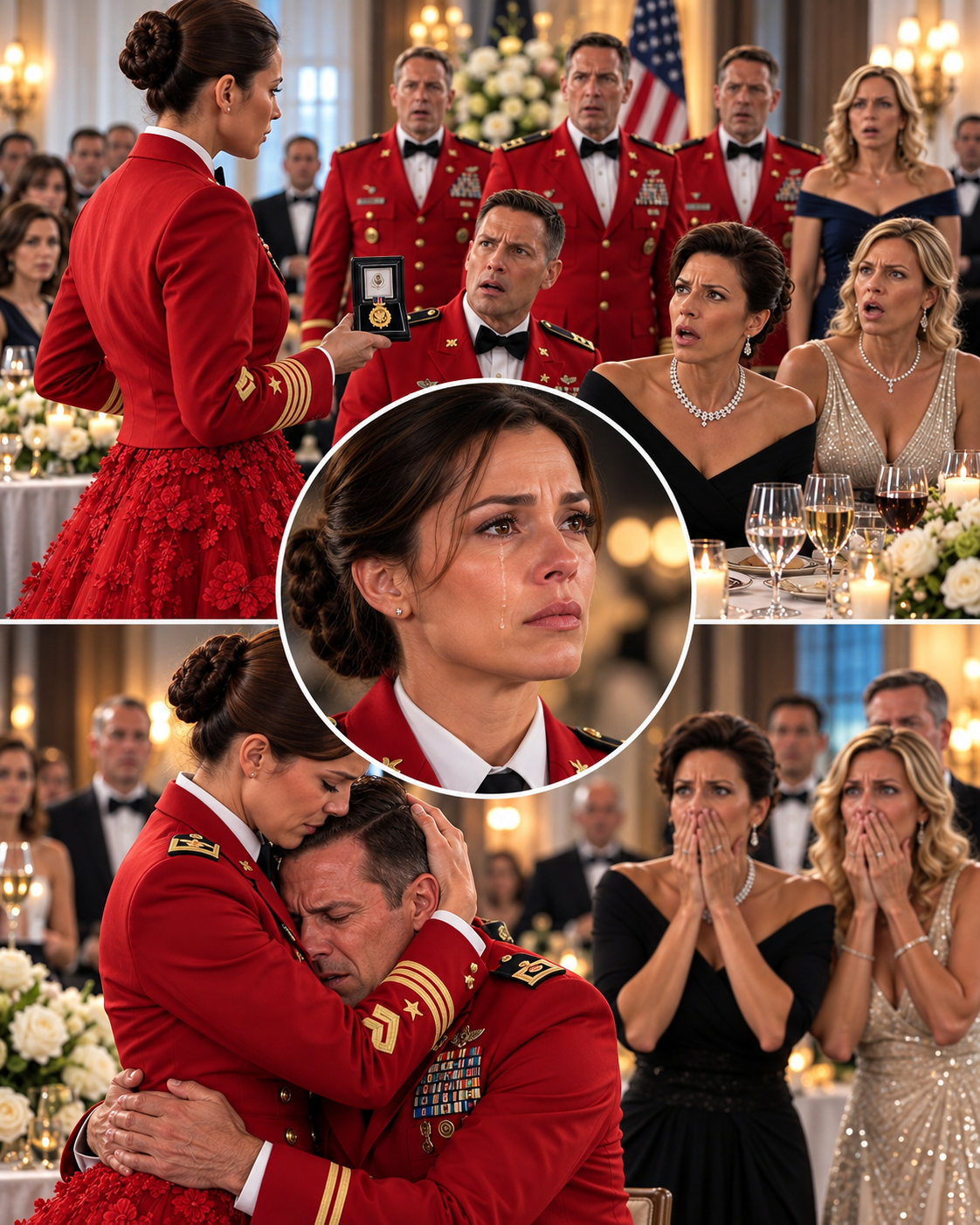
Part 2: My restricted credential changed the room’s entire hierarchy
Daniel walked away with Caroline, leaving me beside the empty place. Victoria watched them go with open satisfaction, then told me that sometimes supporting a husband meant knowing when to stay out of his way. I set my clutch on the table and said, “Supporting him isn’t the same as disappearing for him.” Her smile vanished. She warned me not to make a scene during one of the most important nights of her son’s career. “Then stop creating one,” I replied. Nearby conversations faltered, and a colonel from an interagency briefing glanced over with a flicker of recognition.
Victoria noticed the attention and waved two military police officers over. “This woman is refusing to leave a restricted command table,” she announced. The first officer approached carefully and asked to see my identification. I opened my clutch and removed the credential I rarely carried outside secure duties. He read it, looked at me, and straightened so abruptly that his partner copied the movement before seeing the card. Officers at nearby tables noticed; one colonel stood, then another. Lieutenant General Hayes stopped speaking near the receiving line and turned toward us. The MP returned my credential with both hands.
“Ma’am, why weren’t we informed that Deputy Director Rachel Monroe was attending tonight?” he asked. The room seemed to inhale. Victoria remained frozen, while Daniel looked across the ballroom and went pale. General Hayes walked toward us, his expression changing as he revised his assumptions. When Victoria asked what I directed, he answered before I could: Defense Strategic Counterintelligence Coordination. My office coordinated investigations involving compromised military networks, foreign intelligence approaches, and security vulnerabilities crossing service boundaries. The position was not classified, even though much of my work was.
Daniel stepped closer and whispered, “Rachel, you never told me.” I reminded him that I had told him I worked in defense intelligence. “That isn’t the same thing,” he said. “No,” I answered, “it was simply the part I was allowed to tell you.” Victoria stood, claiming the entire situation could have been avoided if I had been honest with the family. A lieutenant colonel nearby nearly choked on his water. General Hayes told Victoria my obligation to protect classified information outranked her curiosity. Then he asked the event coordinator to explain why my approved seating assignment had been changed.
The major responsible for protocol looked terrified as he explained that the official chart placed me beside Daniel under a restricted title. My clearance had been confirmed days earlier. “Who changed it?” General Hayes asked. Victoria admitted that she had. She said she thought I was a civilian employee, as if that made public humiliation acceptable. Hayes replied that she had altered an approved seating plan because she decided I was socially inappropriate for the table. Caroline had not returned to her chair. She was standing by the receiving line, watching us with a sharpened attention that did not look like embarrassment.
I turned toward Daniel and asked where his military ID was. He checked his jacket pocket, then the other side, and his expression changed. Caroline laughed softly and said surely I was not accusing anyone. “I haven’t accused anyone,” I replied, watching her hand tighten around her silver clutch. General Hayes noticed and ordered her to put the bag on the table. She stared at her father and said, “Dad.” He repeated the command. At that moment, an MP touched his earpiece, listened, then announced a security alert in the east administrative wing.
Part 3: Caroline’s escape turned an awkward ball into a security crisis
The alert concerned restricted archive access. The MP checked the report and said the credential used belonged to Captain Whitmore. Daniel shook his head and insisted he was standing right there. General Hayes asked where his card was, but Daniel had already searched his pockets twice. Caroline began backing away. When Hayes called her name, she turned and ran. She knocked over a waiter, sending champagne glasses across the polished floor. The chandeliers went dark before the MPs reached the ballroom doors.
Seven seconds later, emergency lights came on. Caroline had vanished, and so had Daniel. Victoria shouted her son’s name as General Hayes began issuing orders, sealing the installation and sending security teams toward the east wing. I used a secure phone to contact my duty officer and ordered a controlled communications lockdown at Fort Kingston. Victoria stared at the device as though it offended her. She said I could not seriously think Daniel was involved. I answered that his credentials had been used in a restricted archive, and he had disappeared during a blackout.
Within ten minutes, the ballroom had become an investigation scene. Guests were separated according to access level, officers with sensitive assignments surrendered their electronics for screening, and MPs covered every exterior door. The orchestra packed under guard while waiters answered questions about movement near service corridors. Then two MPs brought Daniel through the east entrance, his dress jacket open and a mark near his hairline. He was not handcuffed, but a security captain walked close enough to make the distinction meaningless. When I asked where Caroline was, Daniel said he had lost her.
The security captain interrupted to say surveillance footage showed Daniel voluntarily handing Caroline his credential twenty-six minutes before the breach. Daniel looked as if he had stopped breathing. He explained that Caroline had said she was preparing an application for a strategic liaison position and needed to verify his active-duty status. General Hayes asked why he had given a civilian his military identification. Daniel said she only wanted to photograph it. Then the captain mentioned biometric confirmation at the archive terminal. Daniel fell silent. I asked if Caroline had made him authenticate something, and he nodded.
Daniel said Caroline had told him he was signing into a secure personnel portal. He believed her because she said General Hayes had approved his candidacy. Hayes answered that he had approved nothing. Victoria then admitted Caroline had spoken for months about Daniel’s career, defense-industry dinners, private investment opportunities, and the importance of joining the right social circles. She had warned Victoria that Daniel’s marriage to an unknown government employee made him appear less connected than his competitors. The seating change had not been a spontaneous insult. Caroline had cultivated Victoria’s resentment and used it to draw attention away from her own movements.
A security analyst arrived with worse news: the intruder had tried to open a protected deployment package for an operation called Silver Bridge. The soldiers assigned to it were scheduled to move within seventy-two hours to recover an American intelligence source targeted by a foreign network. The terminal had isolated after forty-one seconds, but analysts did not know how much data had been copied. The encrypted relay matched a private contractor my office had investigated for eighteen months: Orion Meridian Group. Victoria whispered that she had invested in the company. General Hayes turned toward her. She admitted Caroline had arranged it. The ballroom went quiet again as she confessed that the investment was nearly nine hundred thousand dollars.
Part 4: A stolen credential connected Victoria to a hidden network
Victoria insisted her investment had been legitimate. Caroline had shown her quarterly statements, private-sector projections, and photographs from conferences attended by former generals and executives. Orion Meridian looked respectable because respectability was part of the operation. Behind its consulting contracts, my office suspected it connected corrupt insiders with foreign buyers. I asked Victoria what information Caroline had requested. “Nothing secret,” she replied, but that was not an answer. She admitted Caroline had asked about Daniel’s assignments, travel, procurement contacts, and whether he knew officers involved in transportation planning.
General Hayes explained that those details could create targeting patterns, even if none seemed classified alone. Victoria’s voice cracked as she said Caroline had called it investment research. I told her she had wanted it to be research because the story flattered what she already believed: that Daniel was important, connected, and destined for power. For years, Victoria had treated his career as family currency. Promotions were status, commanders were contacts, and every military event was a chance to measure Daniel against other people’s sons. Caroline understood that weakness. Daniel’s ambition had made him easy to persuade when someone promised him recognition.
Then Daniel looked at me and said Caroline had understood my weakness too: secrecy. I asked what he meant. He said she knew I would attend quietly, knew Victoria would provoke me, and knew a public confrontation could force me to reveal my executive credentials to security personnel. I looked toward the MPs. The second officer who had checked my credential was missing. I asked where Sergeant Mercer was. The remaining MP said he had been an event-augmentation officer. A minute later, the answer came back: no Sergeant Paul Mercer existed in Fort Kingston’s military police records.
The false MP had stood within three feet of my credential and watched its security markings. He might have scanned it. The breach had been layered: Daniel’s card for the archive, my credential for executive access. General Hayes ordered authentication systems suspended, but a black sedan with government plates had already left the north service road using a duplicated clearance certificate. The stolen certificate carried my identity. Daniel whispered my name. I looked at the exit log and understood the ballroom scene had been designed to make me reveal exactly what I carried. Then my secure phone rang on an encrypted channel I did not recognize.
Caroline’s voice came through. She said I had responded faster than expected and that my office had spent eighteen months looking for Orion Meridian. I told her she had compromised an active operation. “I exposed one,” she replied. She claimed Silver Bridge was not a rescue mission but a cleanup operation designed to bring a source into custody before he could publicly connect senior American personnel to Orion Meridian. I said that was not what our intelligence showed. “It’s what your intelligence was designed not to show,” she answered. When I asked who the source was, she gave me a name that tore open eleven years of grief.
“Major Thomas Monroe,” she said. My brother. Dead for eleven years, according to every official report I had received. I told her Thomas had died in Syria. Caroline said he had disappeared there. The room around me seemed to fall away. General Hayes looked away, and I saw knowledge in his face. I turned toward him and asked how long he had known. He said nothing at first. Then he answered, “Seven months.” I had stood beside an empty coffin at Thomas’s memorial, watched a folded flag placed in my mother’s hands, and spent a decade learning to live around grief that never became smaller.
Part 5: My dead brother was the secret command tried to bury
General Hayes said a joint intelligence team had located a man matching Thomas’s biometrics in Eastern Europe. He had been secretly brought to an underground debriefing facility beneath Fort Kingston and had refused to cooperate with standard interrogators. Thomas claimed senior officials had compromised intelligence systems and repeatedly asked to contact me. His requests were denied because command feared he might have been manipulated during captivity. I asked Hayes if he confirmed my brother’s identity. He said yes. I asked why he never told me. He said Thomas was connected to hostile channels. I answered that he was an intelligence officer trapped overseas, not a rumor.
Before Hayes could respond, the analyst announced that the Silver Bridge deployment had been redirected to the installation’s internal detention level. The order said “complete containment.” I knew the phrase: destroy sensitive material and prevent unauthorized disclosure. “They’re going to kill him,” I said. Hayes insisted that was not the authorization he signed. The ballroom screens flickered, then displayed a concrete room with a metal table and one chair. A thin man sat beneath fluorescent lights, gray at his temples and older than the brother I remembered. Thomas lifted a paper toward the camera: RACHEL, TRUST NO ONE WITH STARS.
Daniel stepped toward me. I told him not to. He removed his wedding ring and twisted its inner band until a tiny black storage shard slid into his palm. He said his mother had introduced him to a man two years earlier who claimed to know something about Thomas. The man gave him the shard and threatened Thomas if Daniel told anyone. I stared at my husband. He had carried information about my brother for two years and said nothing. Daniel told me he had not known whether it was real. He said the man had shown him a video of Thomas using a private phrase we had invented as children.
“The river runs north when the moon forgets winter,” Daniel said. My knees almost weakened. Nobody outside our family knew the phrase. The shard held encrypted coordinates, financial records, and an audio file. Thomas’s voice filled the ballroom: “Rachel, if Daniel gives you this, Dominion has resurfaced. Orion Meridian is a financial shell. The real network lives inside command. Do not trust rank. Do not trust official orders. And if Silver Bridge activates, they’re coming for me.” Then an explosion shook the floor. The chandeliers swung, dust fell, and alarms screamed. Thomas’s detention level had been breached.
We moved through a corridor smelling of smoke and burned wiring. General Hayes, three security officers, Daniel, and Colonel Lena Foster followed me toward the underground level as medical teams came behind. Two guards lay unconscious near the access station; Thomas’s door had been blown inward, and the room stood empty. Blood marked the floor. We followed it into an old service passage. Daniel stayed close, though I reminded him he had violated protocol, concealed information, and followed Caroline into the breach. He knew he was under investigation. When I asked why he was still there, he said, “For once, I’m trying to do the right thing without checking who approves.”
The passage ended at a decommissioned records chamber. Thomas leaned against the wall, blood across his shoulder. I ran to him, and he looked up with a faint smile. “Still late,” he whispered. I laughed and cried at once. Then his expression hardened as he looked past me. Victoria stood in the corridor, two security officers unconscious behind her and a pistol trembling in her hands. Daniel whispered, “Mom.” Victoria said she had not known it would go this far. Thomas closed his eyes. “You always say that after the damage,” he told her.
Part 6: Victoria’s ambition helped create the conspiracy she feared
Victoria lowered the weapon slightly, but Daniel asked what she had done. She said she had not known Thomas was alive, but had helped Caroline. Thirty years earlier, before she became the socially ambitious mother I knew, Victoria had worked as a civilian analyst supporting defense-contract oversight. She helped build a confidential system to identify corruption between acquisition offices and private companies. Her husband, Colonel Arthur Whitmore, discovered that system and turned it into a network of leverage and profit called Dominion. Orion Meridian became its financial channel. What began as oversight had become a private marketplace for protected information.
Victoria said she thought the network was still protecting the family. Daniel stared at her. “Everything was about my future?” She cried and said she wanted him safe. He answered that she wanted him powerful. Thomas said Arthur ordered the Syria compound destroyed after he copied Dominion’s financial records. The operation that had nearly killed me, the explosion that separated us, and Thomas’s official death were all connected to Arthur’s decision. Victoria’s weapon sagged in her hand. I asked how Caroline had entered the family. Victoria admitted Caroline had contacted her after she learned Thomas survived.
Caroline had been the daughter of a local intelligence asset killed during the Syria operation. Arthur arranged her relocation under a false American identity and placed her near military families, intending to use her once she was old enough to recover Dominion evidence. General Hayes had raised her believing she was an orphan placed through a protected government program. He had not known she was tied to Arthur or the network. Daniel looked as if his childhood had turned poisonous. “My father built Caroline’s identity?” he asked. Victoria nodded. He asked if she had helped Caroline get near him. Victoria said she believed Caroline could secure his career.
Daniel stepped away from his mother. “You gave her my credentials.” Victoria tried to say she had only introduced opportunities. He reminded her she had removed my chair because Caroline asked her to provoke me. Victoria began sobbing. General Hayes took the pistol from her hand as Thomas tried to stand. Before anyone could move, Caroline’s voice came through the corridor speakers, thanking us for bringing everyone together. Steel doors slammed shut. Red lights flashed, and Thomas looked at the ceiling. “She has Dominion’s shutdown system,” he said. A countdown appeared on the wall: .
Caroline intended to erase everything beneath Fort Kingston, including the people trapped inside. Emergency doors sealed six underground sectors at once. She announced over the speakers that my duplicated executive certificate could initiate the containment sequence, but she needed me to confirm it. “Place your credential against the central reader,” she ordered. I refused. She said if the timer reached zero, every Dominion archive stored under the installation would be destroyed. Thomas smiled weakly. “She still thinks the archive is here,” he said. Caroline heard him and told him he had always been obsessed with rooms. He replied that information survived people who thought buildings owned it.
The real archive was in the shard hidden inside Daniel’s ring. Thomas had moved it there two years earlier, choosing Daniel because no intelligence service would search the jewelry of a junior captain eager to be noticed. The archive held financial trails, authorization logs, contractor records, and orders implicating officials across government and private industry. Caroline wanted it because releasing everything without context could expose legitimate operations alongside the corruption. Thomas wanted investigators to separate the evidence from protected missions. I wanted the truth. The countdown passed six minutes as Hayes found a manual ventilation route toward the ballroom service area.
Part 7: Daniel chose the right side when his career was already lost
The ventilation route could fit one person at a time. Thomas was injured, Victoria could barely walk, and Daniel looked at me and told me to take them. I refused a dramatic sacrifice. He said this was not about us, and I stopped because it was the first time he had said something without turning it back toward his image. Colonel Foster moved Victoria first, then Hayes helped Thomas toward the opening. Daniel connected the archive shard to a control terminal while I climbed through the narrow shaft. I emerged behind the ballroom stage, where officers and guests were being held under guard.
Caroline stood near the center of the room with a weapon trained on an event coordinator. “Bring me the archive,” she ordered, “or I expose every active identity it contains.” Thomas swore when he saw the screen. I asked Daniel if he could copy the full archive. He said no, not completely. I asked whether he could isolate the criminal records from the protected operational files. He looked at the code and said maybe. The countdown was under three minutes. “You have three minutes,” I told him. He glanced up and said I had always spoken to him like one of my analysts.
General Hayes entered from the opposite side of the ballroom. Caroline turned toward him and called him Dad. He said she had been his daughter. She answered that he had been assigned to be her father. He told her he had not known the truth. “None of you ever know,” she said. I stepped from behind the curtain and told her she was right about one thing: Arthur had used her before she was old enough to understand what revenge meant. She raised the weapon toward me and told me not to pity her. I said I did not pity her; I wanted her to stop protecting the people who had used her.
The ballroom screens came alive. Daniel had isolated the operational identities and transmitted the criminal archive to federal oversight. Names, transfers, orders, Arthur Whitmore, Orion Meridian, Dominion, and Victoria’s involvement appeared in sequence. Caroline stared at the evidence, her plan unraveling in front of the officers she had expected to manipulate. Daniel’s voice came through the speakers: “The criminal archive has been transmitted. Operational identities are isolated.” Caroline raised the gun toward me. Daniel came through the ballroom door and stepped between us. A shot rang out. He fell as the MPs rushed the room and disarmed Caroline.
I dropped beside Daniel and pressed my hand against his shoulder wound. He managed a broken smile and asked whether he had finally picked the right side. I told him yes, then added that it did not erase every time he had picked the wrong one. He closed his eyes and said he knew. Daniel survived; the bullet missed his lung and major arteries, though the injury weakened his left arm. Caroline was taken into federal custody and eventually cooperated after learning how extensively Arthur had manipulated her childhood. Her testimony and Thomas’s archive dismantled Orion Meridian and exposed more than twenty officials and contractors tied to Dominion.
Part 8: The empty chair became a place I reclaimed
General Hayes resigned from command. He had not participated in Dominion, but he admitted concealing Thomas’s recovery and authorizing an internal detention program without enough outside oversight. Before leaving, he visited my brother in the hospital. Thomas listened to his apology, then told him, “Secrecy protects missions. It should never protect institutions from accountability.” Victoria also faced consequences. Prosecutors could not prove she understood Arthur’s criminal expansion when Dominion began, but she had shared protected information, arranged unauthorized access, lied during questioning, and interfered with the operation. She pleaded guilty to several federal offenses.
Before sentencing, Victoria asked to see me. I nearly refused, then remembered the missing chair. She sat across from me in plain clothes, without emerald silk, pearls, or the certainty she had worn at the ball. She told me Caroline had asked her to remove my seat because public embarrassment might force me to reveal my identity. I said I knew. Then she admitted she had agreed because she wanted to embarrass me anyway. She had resented my independence and wanted Daniel married into a powerful military family. “You should have respected me before you knew my title,” I told her. Her face crumpled.
Daniel asked whether our marriage could survive. I told him no, and he did not argue. He admitted he had known the seating was wrong but wanted General Hayes to like him. He wanted his mother’s approval, and for a few minutes both mattered more than protecting his wife. He said he had spent his career thinking courage meant doing dangerous things. “I didn’t know cowardice could look so polite,” he said. That sentence nearly broke my heart because it arrived years too late. We divorced quietly. Daniel accepted discipline for surrendering his credential and concealing contact related to Thomas.
His cooperation spared him harsher prosecution, but his command career was over. He eventually left active duty and began working with a nonprofit that helped veterans recognize financial exploitation and foreign targeting. He became a better man, just not my husband. Thomas and I recovered the years we could. He moved to a small house in Virginia while completing medical treatment, then joined a congressional advisory group on intelligence accountability. Some nights we talked until sunrise. Other nights we did not mention Syria at all. A year after the ball, Fort Kingston held another formal ceremony, and Thomas insisted I attend.
The ballroom had been restored with new chandeliers and polished floors. At Table Nine, one chair waited in the center. My name card stood in front of it: Rachel Monroe, Director, National Defense Counterintelligence Coordination. Nobody had removed it. Daniel stood near the back in a plain dark suit, while Thomas sat beside me. When the senior commander approached the podium, the entire room rose. A year earlier, officers had stood because my identity surprised them. This time, they stood because they knew exactly who I was. The commander spoke about Dominion and the people whose courage had stopped sensitive operations from being sold for ambition.
After the ceremony, Daniel approached but kept a respectful distance. He said he was glad I looked happy. I told him I was. He glanced at Table Nine and said his mother had spent his life teaching him to chase important seats. Now he understood the seat did not make the person important. I told him it had taken him long enough, and he laughed before leaving. Thomas walked beside me toward the ballroom doors. “You know what the funniest part is?” he asked. I said I still hated formal dinners. He laughed and reminded me I had nearly brought down an international corruption network at one.
Outside, morning light spread across Fort Kingston. I looked back once at the place where Victoria had ordered military police to remove me. For years, I had believed silence protected the people I loved. Sometimes it did; other times, it gave insecure people space to rewrite my identity for their own comfort. Victoria called me unimportant because she needed Daniel to look powerful. Daniel minimized my work because he feared standing beside a wife whose accomplishments might exceed his. Caroline exploited both of them because ambition made them vulnerable to the future they thought they wanted.
I had spent years thinking the answer was patience. It was not. The answer was boundaries, truth, and the willingness to leave people who required my disappearance to feel important. Sometimes the person trying hardest to remove your chair is showing you that you have been sitting at the wrong table. My brother opened the door, and we stepped into the morning together.
✓ Lynn R. Adams
Part 2: My restricted credential changed the room’s entire hierarchy Daniel walked away with Caroline, leaving me beside the empty place. Victoria watched them go with open satisfaction, then told me…