At sixty-eight, Cecilia Marsh was left in a roadside motel with no wallet, no working phone
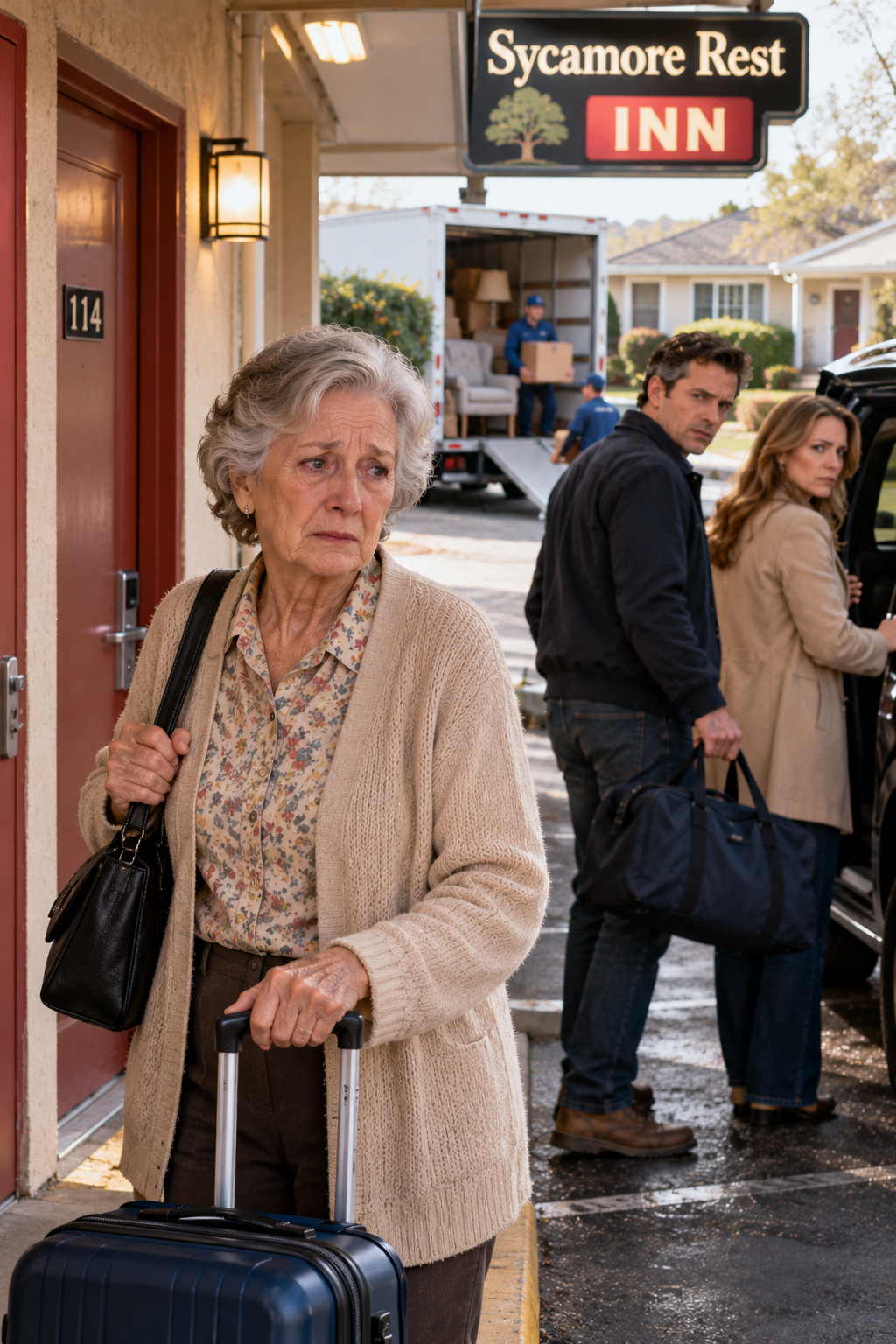
Part 2: My neighbor answers, and the moving truck is already there
The front desk clerk was about twenty-two, with the careful politeness of someone trained to manage problems without acknowledging how difficult they were. I explained that my phone had no signal and I needed to make a call. The lobby phone was supposedly for local calls, he said, but when he tried it himself, he confirmed there was no dial tone. He offered me his personal cell, and I thanked him before opening my notebook. I called Ruthanne, the neighbor who had lived across the street for twenty-two years. She answered on the second ring.
“Ruthanne, it’s Cecilia,” I said quietly. “I need you to listen, and I need you not to call Warren.” There was a brief pause, then she asked where I was. I told her the name of the motel and my room number, then explained that my wallet had disappeared and the phone did not work. Ruthanne said she would be there in twenty minutes. Before hanging up, she added that a moving truck had come to my house that morning, about an hour earlier. I closed my eyes. “I know,” I said, though I had not known for certain until she told me.
Ruthanne arrived in nineteen minutes, carrying her own phone, a thermos of coffee, and a look that could have dissolved concrete. She had been a paralegal for thirty years before retiring, and she listened as I told her about the false furnace story and the missing wallet. She did not interrupt or offer empty comfort. When I finished, she told me we were going to the police first, then the bank, then an attorney. I told her I was angry, but I was not undone. She nodded once, as if that settled something, and took my arm as we walked back through the motel lobby.
The officer at the station was professional and attentive, but I could see the skepticism that sometimes meets an older woman who says her family has stolen from her. I did not blame him. I gave the facts in order: the motel, the wallet, the dead phone, the moving truck, and the promises Warren had made before driving away. Ruthanne sat beside me and said little, which was more helpful than anything she could have added. I filed a report and received a case number. It was not a solution, but it was the first brick in a wall between me and the people who had tried to corner me.
At the bank, the branch manager, Teresa, had the careful expression of someone used to delivering bad news without flinching. She pulled up my account and told me a power of attorney had been filed four days earlier, giving Warren access. A significant transfer had already gone through. I asked to see the document, and she printed it. I had signed my name as Cecilia Marsh tens of thousands of times in my life. I knew the capital C, whose loop never closed, and the H in Marsh that always dipped slightly below the line. The signature on the power of attorney had a closed loop and a flat H.
“It isn’t mine,” I told her. I gave Teresa the police case number and said I had already reported the forgery. She excused herself and returned with someone from compliance. We spoke for forty minutes. By the time we finished, the bank had opened a fraud investigation and flagged all further activity. Teresa printed my remaining balance, and I saw that it was only a fraction of what should have been there. She asked if I had any funds available elsewhere. I told her about the separate savings account I had kept for thirty years at a small credit union, funded with money from my mother’s estate.
Part 3: A forged signature uncovers a larger plan against me
The credit union account was something I had never touched and had not mentioned to anyone—not even Gerald in any practical detail, and certainly not Warren. My mother had left the money to me, and I had kept it separate because she had said it was mine. Teresa looked relieved when I told her it existed. Ruthanne recommended an attorney named Adele Fontaine, whose office was above a dry cleaner downtown. Adele had a reputation for being the person you called when a situation was already serious. She saw me that afternoon, squeezed between two appointments, and began writing as soon as I finished telling her what had happened.
“The forged power of attorney is a felony,” she said. “The transfer compounds it, and leaving you without identification or money under a false pretext may constitute elder coercion.” She asked whether anyone had put the furnace story in writing. No, I said, and told her I had already called the heating company from Ruthanne’s phone. No repair had been scheduled, and no service request had been made. Adele nodded, then asked what I wanted. I told her I wanted my house back, my accounts restored, and an official record of what had happened so it could not happen again to me or someone else.
I told Adele I did not believe Warren was a bad person. I believed he was weak, and there was a difference, though it did not make him less responsible. Claudette had likely devised the plan, I said, but Warren had helped carry it out. Adele asked whether that changed what I wanted. It did not. That night, I slept in Ruthanne’s guest room with borrowed slippers and the clothes I had worn to the motel. I sat on the edge of the bed for five minutes and let myself feel the full weight of what had happened. Then I washed my face and went downstairs.
The grief was not only about losing money or being put out of my own home. It was the grief of recognizing what my son had become. I thought of the boy who sat at the kitchen table after his first divorce and cried in a way he had not since childhood. That boy had been real, but somewhere in the years since, he had become a man who looked at my house and saw an asset and looked at me as an inconvenience. I did not hate him. I was grieving the gap between the son I remembered and the man who had left me in a motel without my wallet. That grief did not change what I needed to do.
Adele filed for an emergency injunction the next morning, halting any sale or transfer of the property on Maple Grove Lane. She notified the county recorder and the real estate agency that had been preparing the house for sale. Ruthanne drove me past my home the following afternoon. Through the car window, I saw the azaleas I had planted the year Gerald died and the stone path we had laid together the summer he retired. A staging company’s van was in the driveway, and someone had put a lockbox on my front door. I asked Ruthanne to stop the car and stared at the house I had built my life in.
“The lockbox will be gone by Friday,” I said. Ruthanne did not ask how I knew; she simply put the car back in drive. Three days later, Warren called from a number I did not recognize. His voice was quieter than I had heard it in years. He said they had been drowning in debt from the business, Claudette’s surgery, and a second mortgage. He insisted he had panicked and thought he could get ahead of things, fix everything, and keep me from worrying. I let him finish before I said, “You forged my signature, Warren.”
Part 4: My son admits the lie, but the investigation continues
Warren said he knew. I told him he had taken my wallet and left me in a motel room with no money or way to call anyone. I told him a moving truck had arrived at my house while I was still trying to understand what was happening. He did not answer. Then he said he should have come to me and asked for help. “Yes,” I told him. “You should have.” He asked if there was anything he could do now. I said he could tell the truth to investigators and stop making the situation harder than it already was.
He asked whether there was a way to fix it without criminal charges. I told him I did not know, and that it was no longer entirely in my hands. Then I told him to understand something: I was not done. I had lived thirty years in that house after Gerald died and managed every bill, repair, and decision on my own. I had planted the azaleas the week of my husband’s funeral because I needed somewhere to put my hands. I had not survived all of that to disappear quietly because my son needed a down payment. He was silent for a long time before saying, “I’m sorry, Mom.” I told him I would need that apology in writing for the attorney.
The county assessor’s office had records of the attempted deed transfer. Adele obtained copies within two days. The notary stamp on the forged power of attorney belonged to Patricia Neal, whose notary license had been suspended eighteen months earlier after an unrelated investigation. Claudette had apparently found her through what Adele described as an inadvisable channel. When I heard that, something settled in my chest. It was not satisfaction. It was clarity. They had been hurried and careless, the way people are when they are trying to outrun their own conscience.
I had spent my life being careful. Every document I signed had been witnessed, and every major decision had been noted in writing. My will, advance directive, deed, and financial power of attorney were all current. My legal agent was Eleanor, my college roommate in Vermont, not Warren. Eleanor flew out on a Tuesday, bringing good coffee and a folder of documents. She sat across from me at Ruthanne’s kitchen table and said I should have called her sooner. I told her I had hoped it would not come to this. She looked at me steadily and said, “It always comes to something.”
We went to the bank together. With Eleanor’s documents and the open fraud investigation, we started the process of restoring my accounts. It would take months, Adele warned, but the money that remained was frozen and the transferred amount had been flagged for reversal. The day Adele filed the full complaint with the district attorney, I sat in her waiting room with bad coffee and my notebook open on my knee. I was making a list of things I would need to do once I was back home: fix the soft spot in the roof, repair the kitchen faucet, and replace the porch screen. Small, manageable things helped me stay focused.
Adele came out and told me the complaint had been filed. She studied me and said I was calm. I told her calm was what planning looked like. She almost smiled and asked if anyone had ever told me I was formidable. Gerald had, I said, and I had taken it as a compliment both times. The injunction held, and the staging company removed its equipment. On a bright Thursday, a county marshal cut the lockbox off my front door. I stood on the walkway, took out the original key I had carried for thirty-one years, and turned it in the deadbolt. The key still worked.
Part 5: I walk back into the house they tried to take
The staging company had replaced the interior locks, but they had not changed the old deadbolt. I pushed open the front door and stepped into a house that smelled wrong. They had plugged in artificial scents designed to smell like clean linen, but nothing about the place felt clean. The furniture had been rearranged, and several things were missing: the floor lamp Gerald and I bought at an estate sale, my mother’s quilt, and a framed photograph of us at a friend’s wedding in 1989. The walls were still ivory, and the kitchen was still pale yellow. The floorboards creaked in the same two places, just inside the back door and at the top of the stairs.
I stood in the kitchen and let the light fall across the counter. Then I took a paper bag from the pantry and began collecting the plug-in scent devices one by one. The furniture and my belongings had been stacked in the garage. Someone had boxed my books, photo albums, and Gerald’s coin collection, but nothing seemed broken. I opened every box and took an inventory, then carried the quilt back inside. I spent that first evening putting things where they belonged. Not everything, not all at once, but enough that when I made tea and sat in the living room, the room looked approximately like itself again.
Gerald’s coins were back on the mantel. The quilt lay across the sofa, and our wedding photograph rested on the side table where it had always been. I sat with my tea for a long time. Warren called again that night, but Adele had advised me not to speak to him directly, so I let the phone ring. There is a particular loneliness in loving someone who has done something unforgivable. The love does not disappear all at once, but trust can crack beyond repair. You look at what remains and know that, even if it still holds its shape, it may never feel safe again.
Two weeks after I moved back in, I called the detective to ask about the case. He had interviewed Warren and Claudette, and he said the evidence was significant: the forged power of attorney, the suspended notary, the bank transfer, Ruthanne’s account of the moving truck, the lockbox, and the staged listing. The district attorney was moving forward. That afternoon, a handwritten letter arrived from Warren. His letters were always too large, and the lines wandered downhill across the page. He wrote that he was sorry and had told himself he was protecting me when he was really protecting himself.
He admitted that he had believed I might not notice, or would accept what happened, or that his need somehow mattered more than my right. He wrote that Claudette had started the plan, but he had gone along with it because he was frightened and too weak to come to me honestly. “I thought you were fading,” he wrote. “I realize now I was the one who couldn’t see clearly.” I read the letter twice, folded it, and put it in the drawer with my important papers. I had not forgiven him, and I would not rush that decision in either direction, but I wanted to keep the letter because honesty had been in short supply.
Part 6: A courtroom puts my autonomy on the record
Claudette entered a plea agreement in exchange for full cooperation. Warren pleaded no contest to a reduced charge. The arrangement included restitution and other conditions, though he would not go to prison. I had complicated feelings about that, but I kept most of them to myself. Before sentencing, the detective asked whether I wanted to make a statement. I told him I did. I wanted the record to show that I had not been confused or incapable, and that I had not been ready for someone else to make decisions about my life. The harm was not only financial; it was the deliberate dismantling of a person’s autonomy.
The judge read my statement into the record. I sat in the courtroom and listened to my own words travel through the room, clear and deliberate. I did not want to be treated as a symbol or as a helpless older woman. I wanted the court to understand that the paperwork mattered because it was the only thing standing between a person’s rights and someone else’s intentions. I also wanted my experience to be useful in preventing the same thing from happening to another family. My voice shook once, but it did not break. When the judge finished reading, there was a moment of silence before the hearing continued.
The district attorney presented the forged power of attorney and the bank’s records. The document had been filed only days before I was taken to the motel, and the transfer had followed quickly. The house had been prepared for a sale while I was away, and the deed transfer had been attempted before the injunction stopped it. Ruthanne explained when she had seen the moving truck and how I had called her from the motel. The notary’s suspended license showed that the stamp had no legal standing. There was no furnace appointment, no repair request, and no legitimate reason for me to have been taken from my home.
The plea agreements did not erase what had happened, but they put responsibility where it belonged. Claudette admitted her role in arranging the documents and the move. Warren admitted he had signed and submitted the forged paperwork, knowing it would give him access to my accounts. He also acknowledged that he had told me a false story about the furnace so I would leave the house without asking questions. In the courtroom, I watched him say it aloud. He did not look at me until the end. I did not nod or signal forgiveness; I simply listened.
When the judge asked whether I had anything else to say, I told him I wanted to be clear that I had been fully capable of managing my life before the scheme and remained capable now. I wanted no one to mistake age for consent. The judge acknowledged my statement and ordered restitution proceedings to continue. Warren received conditions requiring him to stay away from my finances and property unless I expressly invited him. Claudette was also subject to restrictions and supervision. The case was not the dramatic ending some people might expect, but it established the facts and placed boundaries around the harm.
Part 7: I restore my garden and choose what forgiveness means
That spring, I planted new azaleas along the back fence, a variety I had been meaning to order for years. Ruthanne helped me dig the holes, and Eleanor drove down from Vermont for the weekend. We ate dinner on the back porch and talked for hours about nothing in particular and everything real. The first buds opened a few weeks later, bright against the green leaves. I remembered planting the original azaleas the week Gerald died, needing a task that gave my hands somewhere to go. These new flowers did not replace those memories; they grew beside them.
My granddaughter came to visit in April. She was nineteen, full of energy and questions, and sat cross-legged on the kitchen floor helping me sort a box of photographs I had put off organizing for a decade. She held up a picture of Gerald and me from 1971, when we were young in a way we had not yet learned to appreciate. “You look so happy,” she said. I told her we were, most of the time, happy enough. She studied me in the way young people do when they are trying to ask something carefully. “Are you okay? Like, really okay?” she asked.
I thought about the motel room, the dead phone, the missing wallet, and the orange sign blinking outside the window. I thought about sitting on the bed with my hands in my lap and realizing I had been set aside as if I were no longer useful. Then I thought about the notebook, my credit union account, Ruthanne’s number, and the habits I had kept for years without knowing they would become armor. “Yes,” I told her. “I’m okay.” She seemed to believe me, which meant it was probably true. After she left, I finished the photo box and placed the old picture of Gerald and me in a new frame.
In June, a woman I had never met sent me a letter after reading a short article about the case in the local paper. She wrote that her mother had experienced something similar and had not had the paperwork, the neighbor, or the separate account that helped me protect myself. She hoped I knew my actions mattered beyond my own story. I wrote back, and over the next few months we exchanged several letters. In August, she visited: a tall woman in her sixties with her mother’s eyes. We sat in the garden and talked about planning for the people who might one day try to manage you, and how to make sure the wrong ones could not.
I thought often about the word quiet. Warren and Claudette expected me to accept the motel, the missing wallet, the moving truck, and the locked door as the way things were now. They expected silence because they had already decided my voice was not worth the complication of hearing. I did not fight back because I was exceptional. I was a woman who gardened, kept a notebook, and had lived long enough to understand that documents, relationships, and small habits of paying attention mattered. I went back to my house, refilled the pantry, replanted the garden, and learned how to live without pretending the past had not happened.
Part 8: The house is mine again, and silence becomes preparation
The financial recovery took months. The bank reversed part of the transfer, and the rest was returned through the restitution process. I kept careful copies of every letter, every account statement, and every court document. Eleanor remained my legal agent, as she had been before, and Ruthanne checked in often without treating me like someone who needed to be watched. I did not surrender control of my daily life just because someone had abused my trust. Instead, I made sure the people who helped me were people I had chosen, and that every decision stayed in my hands.
Warren sent a few more letters over the following year. The first were full of explanations; the later ones contained fewer excuses. He wrote about the business failing, about being afraid to tell me, and about how Claudette had persuaded him that a quick transfer could solve everything. But he also admitted that he had known it was wrong. I read the letters when I was ready, never on a schedule and never because someone asked me to. I did not invite him back into my house. We exchanged brief calls through Adele for a while, keeping the distance that let me feel safe.
Eventually, Warren asked if he could meet me in a public place. I agreed to have coffee at a diner halfway between his home and mine, with Ruthanne nearby in case I wanted to leave. He arrived alone and apologized without asking me to make him feel better. He said he understood that I might never trust him the way I once had. I told him that was true. I also told him that if he wanted any relationship with me, he would have to build it slowly through actions, not promises. He accepted that, and we ended the conversation without an embrace.
That did not make us strangers, but neither did it restore the old closeness. I saw him occasionally, always by choice and always with clear boundaries. Claudette and I had no direct contact. She sent one brief written apology through her attorney, and I acknowledged receipt without replying. I no longer felt responsible for comforting people who had harmed me. Forgiveness, if it came, would be mine to decide, in my own time. What I could offer immediately was the truth: they had taken something that was not theirs, and I had survived the attempt to make me disappear.
In October, I sat on my own back porch with a cup of tea and watched the leaves come down from the oak tree Gerald had planted the year we bought the house. The house was quiet, but it was the quiet I had chosen. The kitchen was pale yellow, the azaleas were taking root, and my keys rested beside my notebook. I had not returned to the life I had before the motel; I had built a different one, with more care for my own safety and less willingness to mistake family for unquestioned trust. They thought my silence was surrender. It was not. It was preparation.
✓ Lynn R. Adams
Part 2: My neighbor answers, and the moving truck is already there The front desk clerk was about twenty-two, with the careful politeness of someone trained to manage problems without acknowledging h…