At six months pregnant, I begged…
At six months pregnant, I begged my older brother to let me stay, but he put my suitcase beside the car. Then Grandpa left me a ruined Montana ranch, and I found something beneath its floor….
When my brother Garrett carried my last suitcase out to the driveway, I was thirty-two, six months pregnant, and trying not to cry in front of him. He set it beside my old Chevrolet as if we were finishing a routine errand. I stood there with one hand against my aching back and asked, “Please, Garrett. Just until the baby comes.”
He wouldn’t meet my eyes. “I’ve made my decision, Willa. You need to leave.” Our younger brother, Beck, watched from the porch. I waited for him to say something, even just my name, but he looked down at his shoes. That silence stayed with me as I opened the car door.
The baby’s father had already walked away months before. I had $1,340 in savings, two suitcases, and a little knitted blanket I’d bought because I wanted my child to have something soft and new. I had nowhere else to stay. When the baby kicked, I pressed my palm to my stomach and whispered, “We’ll figure it out, sweetheart.”
I didn’t know if we would. I had spent so much time asking people to let me stay that I was beginning to believe I was a burden wherever I went. Then word came that my grandfather, Harlon Thorne, had died. Losing him hurt deeply.
At the reading of his will, Garrett learned he’d inherited $6.2 million. Beck received $5.1 million. I sat with my hands folded over my belly while the attorney, Adrien Witmore, announced what Grandpa had left me: an old brass key and the deed to Raven Creek Ranch, 112 acres tucked into the mountains near Red Lodge, Montana.
My brothers laughed at the difference. They saw a neglected property that would cost money to keep. I saw a chance, however small, to close a front door behind me and know I belonged on the other side. I also remembered Grandpa sitting by his fireplace when I was little, carefully mending a wooden chair. “Just because something’s broken, sweetheart, doesn’t mean it isn’t worth saving,” he’d told me.
After my parents died, that man had been one of the few people who could make me feel safe. I remembered the rocking horse he repaired when I was eight, the old country songs he sang, and the birthday cards written in his neat, sloping handwriting. At his funeral, I placed a white rose beside his coffin and said goodbye. I believed he had given me one last act of kindness.
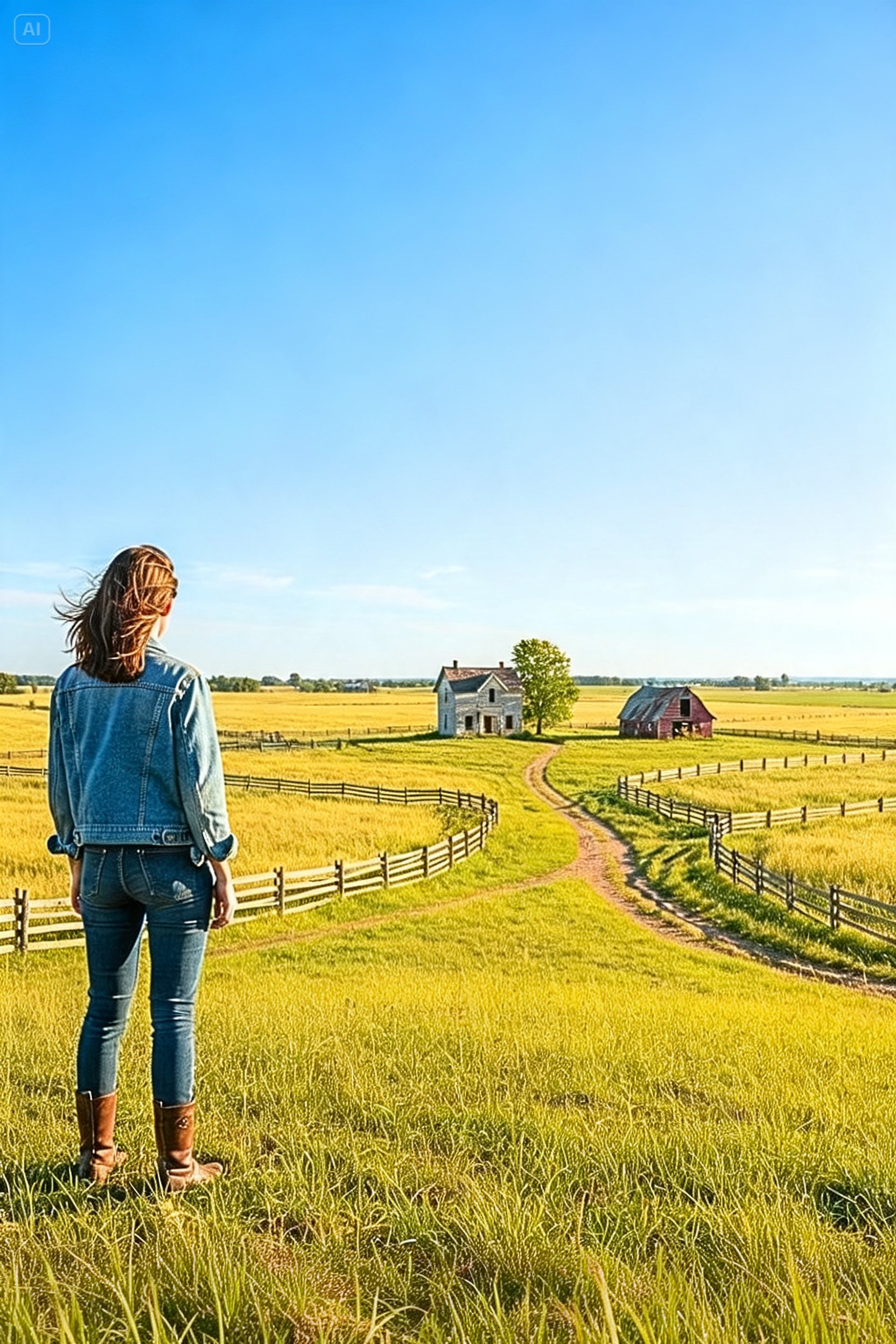
I drove the gravel road to Raven Creek through quiet fields and tall pine trees. The farmhouse looked tired: a sagging porch, dusty windows, a roof that had seen too many winters. Inside, the kitchen faucet sputtered and the floorboards complained under my shoes. But upstairs, a small bedroom faced the valley, and afternoon sunlight reached the wall where a crib might fit.
I stood in that room longer than I meant to, picturing a baby sleeping beside the window. For the first time since Garrett had put my things outside, I smiled without forcing myself to. The house needed work, but I was willing to work with it.
That first evening, while sweeping the kitchen, I noticed a muddy footprint near the pantry. I hadn’t made it. The mud was still wet enough to smear beneath my broom. I told myself a repairman must have come through before I arrived, washed the mark away, and went upstairs. I didn’t want a small mystery to spoil the first night I’d felt hopeful in months.
For the next two weeks, I woke before sunrise and walked from room to room with a notebook. I wrote down the leaks, the broken fixtures, the loose porch boards, and the upstairs windows that rattled when the wind picked up. There was more to do than I could afford, so I started with what I could fix myself and tried not to count the things I couldn’t.
Every evening, I carried my few baby clothes into that upstairs bedroom and folded them on the bed. Sometimes I’d hold up the little knitted blanket and wonder whether my child would ever understand how much I had wanted this home for us. “It’s not much,” I would say to my belly, “but it’s ours.” I was trying to make the words feel true.
One afternoon, a neighbor named Dela Winslow arrived with an apple pie. She was seventy, with silver hair and the easy kindness of somebody who didn’t need an invitation to notice another person’s trouble. She said she’d heard Harlon’s granddaughter was living at the ranch. I invited her in for coffee, embarrassed by the peeling paint and delighted to have company.
Dela looked around the kitchen while I cut the pie. “Your grandfather was a complicated man,” she said. “But he always kept this place in good condition. Strange to see it so run-down.” I asked what she meant. She hesitated, then said she used to notice lights burning down here late at night, even when everybody believed the house was empty.
Before I could ask which lights, or when she’d seen them, she changed the subject. I didn’t push her. After she left, though, I stood by the pantry remembering that footprint. A ranch that had supposedly been vacant shouldn’t have fresh mud inside it. I checked the back door twice before going to bed.
A few days later, I went into the basement looking for an old toolbox. A heavy wooden shelf stood against the far wall. I was almost certain it had been straight on my previous visit, but now one end tilted away from the concrete. When I tried to shift it, I found it was much heavier than it looked. I left it alone.
Then I started hearing things. Sometimes there was a soft metallic click beneath the kitchen. Other times I heard a long scraping noise, the sort made when somebody drags furniture across concrete. Once, just after midnight, three slow knocks seemed to come from below my feet. I lay still until the house went quiet.
I picked up my phone to call Garrett one night, then remembered him refusing to look at me in the driveway. Beck hadn’t defended me either. I put the phone down. Maybe I was being foolish, but I couldn’t bear to ask either of them for help and hear that I was causing trouble again. Instead, I checked the doors and told myself old houses make old-house noises.
On my seventeenth night at Raven Creek, a fierce storm crossed the mountains. Rain struck the roof hard enough to drown out the wind, and thunder shuddered through the windows. A little after nine, the power failed. Then I heard water dripping somewhere below the kitchen. The basement could flood, and I couldn’t afford repairs.
I took a flashlight and went down carefully, one hand along the stair rail. Halfway to the bottom, I heard the scraping again. It came from behind that crooked shelf. In the beam of my flashlight, fresh marks showed on the concrete, as though the shelf had been shoved back and forth. I called, “Hello? Is someone there?” No one answered.
I pressed against the shelf, stopping to catch my breath before trying again. It moved only a few inches, but that was enough. Behind it stood a thick steel door built into the foundation, with industrial hinges and a round locking wheel. My flashlight caught a dark shine along the lower hinge. I touched it and found fresh grease on my fingertips.
Grandpa had been buried twenty-six days earlier. Nobody was supposed to be living here, yet someone had been maintaining that hidden door. I thought of Dela’s lights, the footprint, the noises, and the shelf that kept moving. I should have gone upstairs and called for help, but then I heard something heavy scrape on the other side, and wondered if someone was trapped.
There was no phone signal in the basement. I turned the cold locking wheel until a mechanical click broke the silence. The steel door swung inward. Beyond it, narrow concrete steps disappeared into the dark—and at the bottom, a pale yellow light was already burning. Someone had been down there. Maybe someone still was. Part 2…..
I held the flashlight steady and walked down the narrow stairs, keeping my other hand near my belly. The space at the bottom wasn’t an ordinary cellar. It was a vast underground vault, with clean concrete walls, steel shelves, wooden crates stacked high, canvas bags, locked cabinets, and a heavy safe beneath a ventilation pipe. Everything was orderly, as if someone came here often.
I opened a crate whose lid hadn’t been secured. Inside were old silver coins wrapped in cloth, each bundle marked with dates and numbers. I couldn’t begin to guess their value. Garrett and Beck had laughed at the property I’d inherited, and I was standing beneath it surrounded by things that might be worth more than either brother had received. But I wasn’t excited. I felt watched.
On a desk lay several passports. I opened one and saw my grandfather’s photograph above a name I’d never heard. Another passport had a different name and country, but the same face. Then I found a leather journal with two fading gold words on the cover: “The truth.” I recognized the handwriting before I even opened it.
The first page addressed me. Grandpa wrote that the life I knew was only part of his story. For thirty-four years, he’d handled money for an organization called the Blackwood Syndicate. His transportation companies, real-estate holdings, and accounts had helped disguise illegal transactions worth millions. Federal investigators had begun closing in, and he had been preparing to vanish.
My hands shook as I read what he’d written about the will. The companies and assets left to Garrett and Beck were connected to the investigation. Their sudden wealth would draw questions toward them, away from this ranch and whatever Grandpa had hidden beneath it. My brothers had treated me terribly, but I wouldn’t have wished that burden on either of them.
Then I reached a page with my own name. Grandpa wrote that he’d chosen me because I understood hardship and had a good heart. He hoped I would understand someday. I held the journal against my chest, remembering the old man who repaired my toys and told me I mattered. “What have you done?” I whispered. That was when footsteps sounded on the staircase behind me.
I turned off my flashlight and slipped behind the crates. Two men descended, talking about how they should have moved everything earlier. One said there was still time, as long as “the girl” hadn’t found the journal. I knew his voice as surely as I knew my own. It was Grandpa’s—Harlon Thorne, the man whose funeral I’d attended twenty-six days before.
The overhead lights came on. I watched Grandpa approach the desk in a dark wool coat, his silver hair neatly combed. Beside him stood Adrien Witmore, the lawyer who had read the will. Adrien had a handgun in his hand. When he noticed the open journal, he stiffened. Grandpa looked toward the crates and said, “Willa, come out, sweetheart.”
I stepped into the light, unable to stop looking at his face. “I stood beside your coffin,” I said. “I said goodbye to you.” He didn’t come to hug me. His gaze went straight to the journal. “You weren’t supposed to find this place,” he said. I asked the only question I could form: “Did you leave me the ranch because you loved me?”
He laid his coat on the desk and said there had been “other considerations.” Federal agents were tracking his business dealings, he explained, and the funeral had made his disappearance believable. I pictured Garrett stiff beside the coffin, Beck wiping his eyes, and myself placing that white rose on the polished wood. The service had been real to us. Our grief had been real. Grandpa had watched it happen by design.
I asked about my brothers. He said he’d given them what they wanted. When I said they’d trusted him, he replied that they’d trusted the money. Then I asked why he’d chosen me. “You don’t chase money,” he answered. “You don’t ask questions. You endure.” He admitted he knew Garrett had thrown me out, knew I was pregnant, and knew I’d come to Raven Creek because I had nowhere else.
Suddenly the whole arrangement made sense. A quiet pregnant woman repairing an old farmhouse would make the property seem harmless. I’d be out in the yard, fixing windows and getting ready for a baby, while Grandpa used the hidden vault. “You didn’t give me a home,” I said. “You gave yourself a hiding place.” He answered that he’d given me something my brothers never would.
I wanted to remember him the way he had been with me as a child. I still could, which almost made it worse. He had also placed Garrett and Beck in danger and used my desperation as cover. When he insisted everything was for the family, I asked whether he’d ever use a child of his own the way he was using mine. He warned me to watch what I said. Adrien adjusted his grip on the gun.
Grandpa offered me the money below the house, enough to provide for my baby forever. For a moment I thought about hospital bills, the roof, the clothes my child would need. Then the baby moved beneath my hand. “You told me people mattered more than money,” I said. He looked away. I realized I could love the man he’d been to me and still refuse what he was asking me to do.
Then we all heard the steel door move above us. Footsteps came down the staircase, and a voice called, “Grandpa, we know you’re down there.” I looked up. Garrett was coming, and Beck was just behind him. For the first time, I saw fear cross Grandpa’s face.
Part 3 Garrett and Beck were soaked by the storm. Mud covered Garrett’s expensive coat, and Beck looked exhausted. Both stopped when they saw Grandpa alive. Garrett whispered that we’d buried him. Grandpa said he could explain, but Garrett wasn’t interested in explanations that left out an empty coffin and a family grieving a man who had never died.
Beck told us their bank accounts had been frozen and federal investigators had been asking about unfamiliar companies and documents connected to millions. The brothers had hired someone to examine old ranch records; construction plans had revealed something beneath the farmhouse. They had come looking for answers, never expecting to find our grandfather standing in front of them.
Garrett saw the passports, the crates, and the journal in my hands. I told them what I’d read about the Blackwood Syndicate and the companies connected to Grandpa’s money. Garrett shook his head and said Grandpa wouldn’t do that to us. “I didn’t think so either,” I told him. Grandpa insisted he’d given them money and opportunity. Garrett shouted that he’d given them a prison sentence waiting to happen.
Garrett surged toward him. Adrien lifted the gun and ordered everyone to stay where they were. I covered my belly, and Beck raised his hands slowly. Nobody moved. Adrien’s face had gone pale. He kept glancing at Grandpa, as though the man who’d promised to look after him would tell him what to do next. Grandpa barely acknowledged him.
I recognized that look. Grandpa had talked about all of us as if our lives were things he could arrange for his convenience. I wondered how long Adrien had been useful to him—and whether Adrien was starting to wonder the same. I asked the lawyer whether Grandpa had promised him money, a new identity, a way to disappear. Adrien told me to be quiet, but he didn’t say no.
“He lied to his grandchildren,” I said. “He let us bury an empty coffin. He put Garrett and Beck at risk without telling them, and he used me because I had nowhere else to go. What makes you think he’ll keep his promise to you?” Adrien slowly turned to Grandpa. He began asking about accounts and documents Grandpa had said were ready. Grandpa told him to lower the gun and discuss it later. Adrien didn’t obey.
The argument spread. Garrett demanded to know what the investigators had learned. Beck tried to keep everybody calm. I watched the staircase and remembered the electrical panel near its base. A little emergency light marked the steps, and the steel door above us had a mechanical lock. If I could cut the overhead lights, perhaps I could get out with the journal. I couldn’t leave the evidence behind.
Beck caught my eye as I edged along the wall. He looked at my stomach, then the gun. “Willa, I’m sorry,” he said quietly. I knew he meant the driveway. I couldn’t answer him then. Grandpa noticed me near the panel and held out his hand. “Give me the journal, sweetheart.” I stepped back. “I understand what I’m holding,” I told him.
As Adrien and Garrett demanded answers, I reached toward the switch. Grandpa saw my hand. “Willa, don’t touch that.” I hesitated just long enough to hear him use the gentle voice he’d used when I was small. “I’m trying to protect you,” he said. “You never once asked what I needed,” I answered. Then I pulled the switch.
Part 4 The overhead lights went out. Someone cried out, a crate struck the floor, and a gunshot cracked through the dark. I dropped to my knees, arms around my belly. I didn’t know where the shot had gone. All I could think was that I needed to get my baby away from that room.
The emergency light above the steps remained on. I kept low and moved toward it, the leather journal tucked beneath my arm. Men shouted behind me. Halfway to the staircase, someone caught my coat. It was Grandpa. In the weak light, his face looked older and more desperate than I’d ever seen it.
“There’s enough money here for you and the baby,” he said. “You won’t have to worry about bills again. Just give me the journal, and we can fix this.” I thought of the leaking roof, the empty nursery, and every night I’d lain awake wondering if I could afford groceries and diapers. He knew those fears because he’d counted on them when he gave me the ranch.
He’d taught me to repair broken furniture, to be patient with things others gave up on. But standing there, I understood that repairing the harm he’d done wasn’t my responsibility. “I’m thinking about my baby,” I told him. “I want my child to know that love isn’t something you have to earn by keeping somebody else’s secrets.” I pulled my coat free.
I climbed the stairs while Garrett shouted for Adrien to lower the gun and Beck called to ask whether I was hurt. I didn’t stop until I was through the steel doorway. I shut the heavy door and turned its locking wheel. I knew there was ventilation inside, and the lock could be opened mechanically by the responding crews. I wasn’t trying to settle a score. I needed everyone contained until help arrived.
Back upstairs, my phone found a signal. I called 911 and told the dispatcher my name, that I was at Raven Creek Ranch outside Red Lodge, and that four men were inside a hidden vault, one of them armed. I said my grandfather had faked his death and that I had a journal describing financial crimes. When the dispatcher asked whether I was injured, I looked down at my belly. The baby moved. “I don’t think so,” I said.
The dispatcher told me to move somewhere safe and stay on the line. I went to the covered porch. The rain was easing, and moonlight had begun to touch the hills beyond the trees. I sat with the journal pressed to my chest, waiting for the sound of vehicles on the gravel road. I didn’t know what would happen to the ranch or to my brothers. I only knew I had finally chosen not to let Grandpa choose for me.
The first deputies reached the farmhouse as the storm passed. Red and blue lights moved through the pines. An ambulance followed. A young deputy asked if I was Willa Thorne and whether I was hurt. I told him I was six months pregnant and that a shot had been fired. He arranged for me to be checked and listened while I explained where the basement door was and how the wheel lock worked.
Officers secured the house and brought the four men upstairs. Adrien came out in handcuffs. Garrett followed, shaken and exhausted; Beck was pale. Grandpa came last. He stood on the same porch where I’d imagined repairing boards for my baby’s first summer. He looked less like the man who’d controlled all our lives and more like an elderly man whose choices had finally caught up with him.
Final Garrett stopped beside me. “I didn’t know about any of this,” he said. I believed him. Then he looked at my belly and said, “I shouldn’t have thrown you out. You were pregnant, and you needed family.” I told him I’d needed him long before that night, and he hadn’t been there. He nodded. I wasn’t ready to forgive him because he was finally sorry.
Beck came to the porch with wet eyes. “I should’ve said something that day in the driveway,” he told me. “Yes,” I said. “You should have.” He didn’t argue or ask me to make him feel better. We were all going to have to live with the things we had done, and the things we’d failed to do.
As Grandpa passed, he paused and said the ranch had been his long before I was born. I looked back at the farmhouse, its crooked porch and all the repairs still waiting. “You used it to hide from the world,” I said. “I’m going to use it to build a life.” He had no answer for me, and for once I didn’t need one.
In the weeks that followed, federal investigators reviewed the journal and records and took custody of the hidden assets. Questions about the ranch’s ownership made me anxious; I knew I might lose the one place where I’d started to picture a future. After the legal review, I was allowed to keep Raven Creek Ranch. That didn’t mean there was a fortune for me. There wasn’t. It meant I still had a house to repair and a baby to prepare for.
Dela Winslow arrived one morning with a wooden crib her grandchildren had outgrown. I told her I couldn’t afford to pay, and she laughed gently. “Who said anything about paying?” A retired carpenter named Levi Bradock came by with a toolbox. He fixed the nursery window, made the porch steps safer, and showed me how to repair a kitchen drawer that always stuck.
I found part-time bookkeeping work in town. The pay was modest, and I still had to keep a careful list of expenses, but the money was mine to earn honestly. Little by little, the farmhouse changed. The kitchen began to smell of bread instead of damp wood. We hung clean curtains, painted the nursery a soft cream, and put Dela’s crib beside the upstairs window I’d loved the day I arrived.
One afternoon, Dela found me sitting on the nursery floor, overwhelmed. She asked what was wrong. “Nothing,” I said, then struggled to explain. “For so long, every time someone gave me anything, I wondered what they expected back.” She sat down next to me and said sometimes people helped because they remembered what it was like to need help themselves. I rested against her shoulder and let myself be comforted.
Later, I sat in the rocking chair with Grandpa’s old quilt across my knees and the little knitted blanket folded beside me. I could still remember the loving grandfather who fixed my toys. I could also remember the man in the vault who tried to purchase my silence. Both memories belonged to my life, but neither would decide what kind of mother I became.
My child would grow up in a home with an imperfect roof, a modest paycheck, and neighbors who knew how to show up when someone needed them. I couldn’t promise an easy life. I could promise I would never use my child’s trust as a bargaining chip. Looking at that empty crib, I put my hand on my belly and whispered, “You’ll never have to earn my love.”
I had once thought the greatest inheritance was enough money to protect a person from every hard day. Now I understood what Grandpa had forgotten: what we leave our children isn’t measured only in what we own. It’s measured in the hurt we refuse to pass along, and in how safely they can know they are loved.
THE END. I’ve shared the complete story, and I truly hope it touched your heart. If this story moved you, please , like, and share the post. Thank you for reading! ❤️
✓ Lynn R. Adams
At six months pregnant, I begged my older brother to let me stay, but he put my suitcase beside the car. Then Grandpa left me a ruined Montana ranch, and I found something beneath its floor…. When my…