At six in the morning, Calder stepped outside and found a drilling rig tearing into
Part 2: Marlene’s confident claims collapse when Calder examines the documents
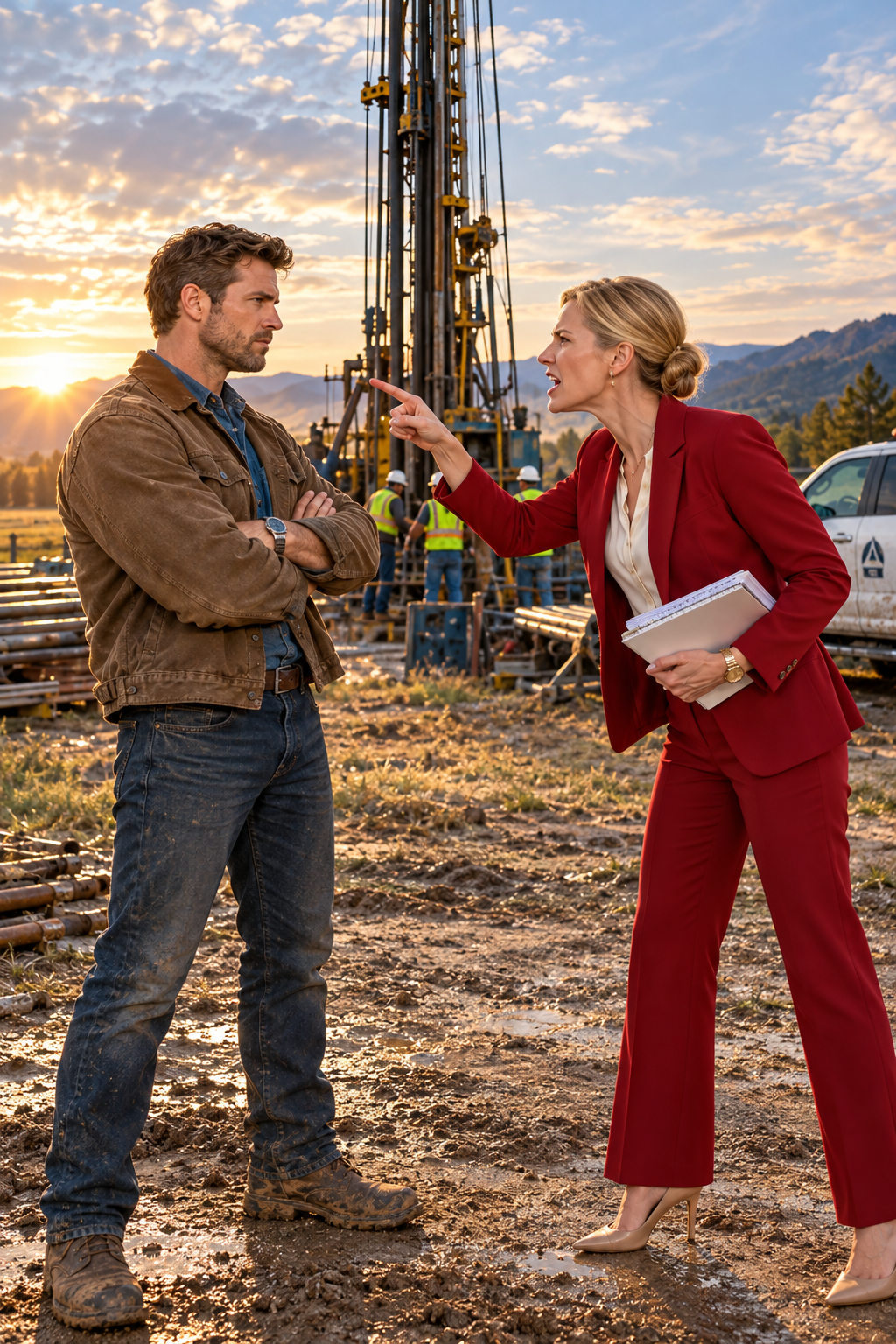
Calder walked back to the house, made coffee, and returned to the rig with a clearer head. He told the crew to stop drilling until they could establish who owned the land and who had authorized the work. Marlene was ready with a folder she had apparently prepared for exactly that challenge. She cited association rules about shared utilities, maintenance access, and resource development for community benefit. Calder read the pages carefully while she tapped her foot against the gravel, eager for him to reach the conclusion she had already reached.
The documents granted the association access to designated common areas, but nowhere did they authorize drilling on Calder’s privately deeded parcel. No amendment, easement, or recorded agreement gave the board rights to his land. He explained this calmly, but Marlene’s expression shifted from confidence to irritation. She accused him of selfishness and said the entire neighborhood would benefit from the well. A few residents who had wandered over nodded along, although none of them seemed to know what the association’s documents actually said.
Calder asked who had signed the drilling contract, and Marlene said the association had approved it. He asked who would own the water once it came out of the ground. She answered that it would belong to the community, as though repetition could turn an assertion into a legal right. “The water sits beneath my land,” Calder said. Marlene gave a short laugh and replied that the water did not belong to him simply because his house happened to be above it.
That sentence stayed with him. He asked her to put every claim, authorization, and legal basis in writing. Her patience finally broke, and she warned him that people who fought the association often found their lives made difficult. Calder nodded without arguing, adding the threat to the growing record in his mind. By late afternoon, an official notice arrived accusing him of interfering with association infrastructure. He read it twice, then laughed at the audacity of receiving a violation for objecting to a drilling operation on his own property.
Over the next several days, Calder put aside his regular consulting work and turned his attention to the ground beneath his home. He gathered county aquifer maps, historic well logs, groundwater permits, and survey records. The work felt familiar; for years, he had built conclusions by comparing technical details that others overlooked. He found no permit for high-volume extraction on his parcel. There was no approval for the association, no permit for the contractor, and no authorization for anyone to drill there.
Part 3: County records reveal the association’s hidden commercial water deal
The absence of a permit was only the first clue. In adjacent survey filings, Calder found the name of Red Mesa Development, a private company that had submitted paperwork for nearby land about eighteen months earlier. Its applications described water-supply feasibility studies, language that would mean little to most readers. Calder knew enough to understand that those studies mattered when a developer needed a reliable source before beginning a large project. He followed the corporate filings and public disclosures until a larger plan began to emerge.
Red Mesa was preparing a residential and commercial expansion beside the subdivision. The project had stalled because the company could not secure enough water for the proposed construction. A high-yield well on Calder’s land could solve that problem. If the association controlled the well, it could present itself as the supplier and earn money from an outside development. The arrangement might also increase property values for the people positioned to benefit from the expansion, while leaving Calder with a hole in his land and no say in what happened beneath it.
That night, Calder searched the county archive for the earliest planning documents connected to the subdivision. He found an old zoning survey with a thin red line crossing his property. Beside the line, a faded note read “private groundwater access zone,” a designation absent from his deed and every document he had received when he bought the land. A signature appeared below the notation, written in a small, looping hand. Calder leaned closer beneath the lamp and recognized Marlene Voss’s name, dated years before she became association president.
The old survey did not grant the association any right to drill, but it raised a question about how long Marlene had been planning to claim the water. Calder copied the document and contacted a water-rights attorney named Evelyn Strad. Her office sat above a hardware store and was lined with topographic maps, binders, and well records. Evelyn had spent decades handling groundwater conflicts and private-property disputes. She listened to Calder’s account without interrupting, then asked him to show her every document he had collected.
Evelyn confirmed that the association’s governing papers did not grant access to Calder’s parcel. She said the survey notation might become important, but the clearest evidence would be the drilling contract and any agreement with Red Mesa. Calder had not yet obtained those documents. Evelyn recommended that he request them formally and avoid confronting Marlene without a witness. She also warned him that people who believed they could claim someone else’s property often became more aggressive when challenged.
Part 4: A neighborhood meeting turns Calder into the apparent villain
Marlene called an emergency association meeting within days, describing it as a necessary discussion about the neighborhood’s future. Calder recognized the strategy: she intended to frame his refusal as an attack on every resident who had shown up. The rented hall was crowded with folding chairs and people eager for a dispute. Marlene sat at the front with two board members, a crooked community banner hanging behind them. Fluorescent lights buzzed overhead as she began listing accusations against Calder.
She said he had obstructed infrastructure, refused to cooperate, intimidated the drilling crew, and caused financial harm to the association. Several residents murmured their agreement, though few had seen the contract or read the governing documents. One man stood and said Calder was one person standing in the way of something that could benefit everyone. Scattered applause followed. Marlene seemed encouraged, as if volume and agreement could make the issue disappear.
Calder let the room settle before he spoke. He explained that the land was privately deeded and that the association documents did not grant drilling rights there. He said no vote at the meeting could override a recorded deed. The room grew quieter, but Marlene pushed forward a resolution demanding that he allow the drilling to continue. Calder refused to sign it. Marlene announced that the association would pursue legal action, expecting the threat to make him reconsider.
“Hire the best attorney you can find,” Calder said. “You’ll need one.” He left while the room buzzed behind him. Within two days, Evelyn had formally taken his case. She sent the association a notice demanding that all drilling stop, that no more water be extracted, and that the company preserve all records related to the operation. She also asked for a copy of the contract with Red Mesa and a full account of the association’s expenses.
The drilling crew continued working while the lawyers exchanged letters. Calder watched from his porch as the rig sank farther into the ground, each new length of pipe making the trespass harder to ignore. Evelyn filed for an emergency injunction, arguing that the association had no legal authority to drill on private land. Marlene responded by accusing Calder of trying to hold the neighborhood hostage. But when Evelyn asked the association to produce a permit authorizing the well, no one could provide one.
Part 5: A confidential contract exposes what the board wanted
The judge ordered the association to halt drilling while the dispute was reviewed. The rig went quiet, but Marlene’s campaign against Calder did not. She sent another letter warning that his actions could damage his standing in the community. Evelyn read it and placed it carefully in the case file. “She’s adding evidence for us,” she said. Calder asked how much the dispute might cost if it continued. Evelyn turned her laptop toward him, where an early estimate showed $684,000 before additional legal expenses.
The association filed a countersuit, demanding recognition of what it called a community right to shared water access. It asked the court to compel Calder to permit drilling and to award damages for delaying a critical infrastructure project. Marlene seemed to believe the lawsuit would frighten him into surrendering. Evelyn treated it as an opportunity to demand records the association had not voluntarily provided. She asked the court to require disclosure of the Red Mesa contract and to appoint an independent auditor to examine whether board members stood to gain personally.
At the preliminary hearing, the association’s attorney repeated Marlene’s claim that the groundwater served broader community interests. Evelyn asked him to produce any document giving the association a right to extract water from Calder’s property. He had none. She asked whether a permit authorized commercial-scale drilling there. Again, none. Then she asked whether the association had permission to sell water from a private parcel to an outside development company. The lawyer fell silent.
Evelyn placed the Red Mesa agreement before the judge. The room seemed to tighten as the contract was read. It showed that the association had planned to provide water for the development project in exchange for substantial payments. The well was not a modest community utility; it was part of a commercial arrangement that Calder had never approved. The judge asked Marlene why the association had promised to sell water drawn from land it did not own. Marlene opened her mouth, then closed it without answering.
Experts later assessed the damage to the soil and drainage, the amount of water already extracted, and the value of the water the association had tried to claim. The audit also traced projected revenue from the Red Mesa agreement. Meanwhile, board members began distancing themselves from Marlene. Some said they had never been told that the plan involved selling water to an outside developer. Others asked whether she had known about the commercial arrangement from the beginning. She had no clear answer for either question.
Part 6: Evidence turns the association against its own president
Evelyn’s team compared the contract with association minutes, financial records, and the old survey Calder had found in the county archive. The documents showed that Marlene had been involved in discussions about the groundwater long before the drilling began. An internal email written more than a year earlier said that controlling the aquifer could multiply the value of nearby development. The sentence left little room for her claim that the project had been conceived solely to help residents. Calder read the email quietly, then passed it back to Evelyn.
Marlene continued to say she had believed the association possessed the right to act. Evelyn repeated her answer during a deposition: belief was not a legal right. The association’s board grew divided as the evidence mounted. One member demanded to know why residents had been told about shared water access but not the proposed commercial sale. Another asked whether Marlene had received compensation connected to the deal. Her silence only deepened the mistrust in the room.
The association’s lawyers proposed a settlement, hoping to end the case before trial. The offer fell far short of the damages and costs documented by Calder’s experts. The next day, Marlene appeared unannounced at his property with a private proposal. She offered him $100,000 in exchange for rights to the water beneath his land. She called it generous and said it could help preserve some goodwill in the neighborhood.
Calder read the first page, folded the proposal, and handed it back. “No,” he said. He did not tear it up or raise his voice. He simply refused to sell a right she had never possessed. Marlene accused him of wanting to punish the entire association, but Calder said the association had brought the dispute upon itself by drilling without permission and hiding the contract from residents.
By then, several neighbors had privately apologized for supporting Marlene at the emergency meeting. They admitted they had trusted her confidence without reading the documents. Calder accepted their apologies, though he told them the association needed members willing to ask questions before approving major decisions. The dispute had taught him that a community could be misled when people confused certainty with evidence. Evelyn prepared for trial, arranging the case around the timeline: the unauthorized drilling, the secret contract, the warnings ignored, and the threats sent after Calder objected.
Part 7: The trial reveals the full cost of Marlene’s scheme
The trial took place in a small, wood-paneled courtroom. A few association members sat in the gallery, no longer certain whom they supported. Marlene sat beside her attorney with her hands folded tightly, avoiding Calder’s eyes. The association argued that its board had acted in good faith for the community and that groundwater should be treated as a shared resource. Evelyn answered with records, maps, and the contract itself. She did not need theatrics; the documents gave the story its force.
She walked the court through the deed that established Calder’s ownership, the absence of any recorded easement, and the lack of a drilling permit. She showed the judge photographs of the rig on Calder’s land and the notices Marlene had sent accusing him of interference. Then she presented the Red Mesa agreement, which linked the proposed well to a commercial development project. The association’s lawyer argued that the plan would benefit residents, but he could not explain why the arrangement had been concealed from them.
The most damaging evidence was Marlene’s email describing the value of controlling the aquifer. It had been written more than a year before the drilling began. Evelyn read the key line aloud, and no one in the room moved. The email showed that Marlene had viewed the groundwater as a financial asset before she ever called the project a shared community benefit. Her attorney tried to explain that the message had been taken out of context, but the contract and survey records supported Evelyn’s interpretation.
The court found the association liable across nearly all of Calder’s claims. The judgment accounted for damage to the property, the unauthorized extraction of water, the projected financial benefit tied to Red Mesa, land restoration, legal expenses, and penalties for the association’s conduct. When the final figure was announced, it came to $684,000. Marlene sat rigidly as the amount was read. Calder felt no triumph; the number represented a long, exhausting fight and damage that should never have happened.
The court ordered the association to remove the remaining equipment, restore the land, terminate its deal with Red Mesa, and pay the judgment and legal costs. Marlene resigned as president within days. The same signature she had once used to mark the old survey was now part of the record against her. The association elected new leadership and began reviewing how its board approved contracts. Calder had won the case, but he knew the money would not turn the ordeal into a windfall.
Part 8: Calder protects the aquifer and chooses a quieter victory
Before the well was sealed, Calder returned to the site with his survey instruments. He checked the depth, flow, and pressure out of habit, wanting to understand what the drilling had revealed. The formation ran wider and deeper than even the experts had estimated. The aquifer beneath his land held a substantial reserve, one that could have made him wealthy if he chose to sell access. Evelyn mentioned the possibility, but Calder declined without hesitation.
He used part of the judgment to restore the damaged drainage and stabilize the disturbed soil. Independent hydrological consultants helped evaluate the aquifer and recommend ways to protect it. Calder wanted the well sealed, not because the water had no value, but because he refused to let the association’s scheme dictate what happened to his property. The restoration crew filled and secured the borehole, then repaired the grass around it. Slowly, the field began to resemble the quiet land he had bought years before.
The new association leadership sent him a letter acknowledging that the previous board had acted without proper authorization. Several residents came by in person to apologize. Calder accepted their words and told them he hoped the neighborhood would be more careful about what it approved in the future. He did not seek a role on the board or ask for public recognition. He wanted his land respected and the association rebuilt on trust rather than pressure.
One afternoon, Evelyn brought him the final signed copy of the judgment. Calder glanced at the printed amount, folded the document, and tucked it under his arm. She asked whether he regretted fighting the association for so long. He looked across the property, where fresh grass covered the ground once scarred by machinery. “No,” he said. “I regret not checking the county records the first morning.”
They walked back toward the house as the late sunlight spread across the field. The sealed well stood quiet, and the fence line ran undisturbed toward the horizon. Marlene had believed a vote and a confident voice could convert someone else’s land into a community asset. The court had recorded what she had forgotten: authority granted by a committee could never replace ownership established by law. Calder’s ground remained his, and the water beneath it would not be taken simply because someone wanted it badly enough.
✓ Lynn R. Adams
Part 2: Marlene’s confident claims collapse when Calder examines the documents Calder walked back to the house, made coffee, and returned to the rig with a clearer head. He told the crew to stop dril…