At seventy-three, I thought the worst betrayal of my life was losing my husband and watching our family
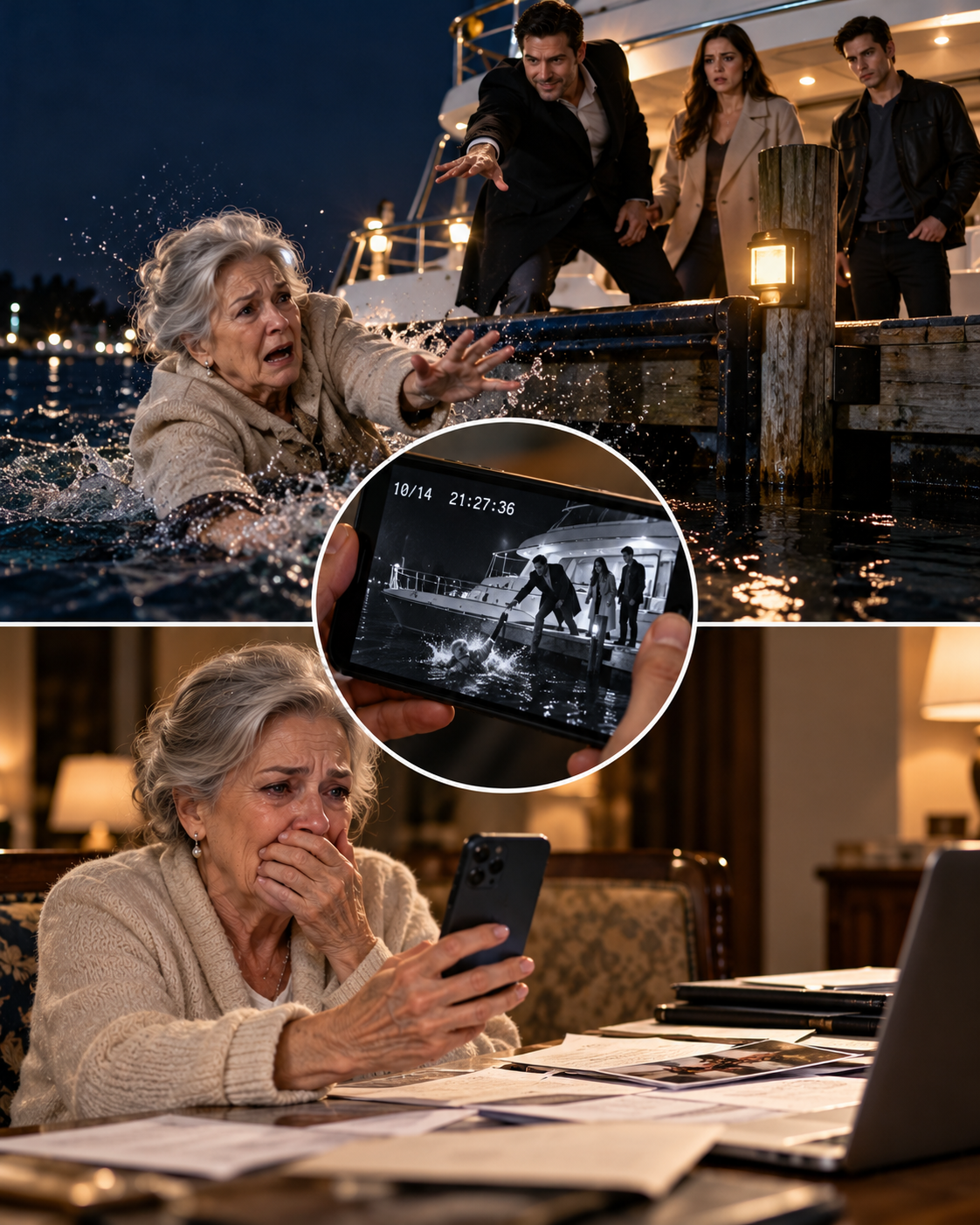
Part 2: The security footage revealed the truth my family wanted buried
By sunrise, I had slept less than two hours, and every muscle in my body felt as though someone had beaten me with a baseball bat. My first instinct was to call Nadine, because for forty-one years she had been the person I reached for whenever something frightened me. Then I remembered her silhouette above the water and the terrible absence of her voice when I needed her to save my life. I placed the telephone back on its cradle and opened Roland’s notebook, reading the details I had written while the memories were still fresh. At the bottom of the page, I added one sentence: “Find out whether the cameras were working.”
Our neighbor Doris had mentioned the marina’s new surveillance system several months earlier after a series of boat thefts caused trouble for local residents. She had complained that the cameras were so sensitive they recorded raccoons wandering across the dock after midnight. Prescott apparently believed they were seasonal, but I remembered Doris saying that the marina’s insurance company required year-round monitoring. That single detail gave me the first real hope I had felt since the water closed over my head. If the cameras had captured the push, Prescott’s carefully prepared story would collapse before he had a chance to tell it.
I returned to the marina shortly after eight, wearing dark sunglasses to hide the exhaustion around my eyes and a thick sweater to conceal the bruises forming across my arms. The office was a narrow wooden building that smelled of burnt coffee, damp rope, and engine oil, and behind the counter stood a man named Gil whom I vaguely recognized. When I asked to speak with whoever managed the security recordings, he studied my face and asked whether there had been a problem with my boat. I told him I had experienced a serious incident on the main dock the previous evening and needed to determine whether it had been recorded. Something in my expression convinced him not to ask unnecessary questions, and within minutes he introduced me to the marina manager, Doreen.
Doreen was a sturdy woman with silver hair, practical shoes, and the kind of direct manner that made me immediately trust her. She led me into a small office, entered a password, and began reviewing footage from the previous night while I sat beside her with my hands folded tightly in my lap. At first, we watched empty docks, shifting shadows, and a fishing boat returning after sunset. Then the borrowed pontoon boat appeared on the monitor, and I saw myself walking beside Prescott, completely unaware that I was approaching the most dangerous moment of my life. I watched him guide me toward the railing, glance over his shoulder at Christian, and place both hands against my back.
The push was unmistakable, violent enough to send my body forward in a sudden, unnatural movement. Doreen gasped, and I felt the blood drain from my face as the recording showed me disappearing into the water while Prescott stepped backward and adjusted his jacket. Christian leaned over the railing for a moment, then laughed nervously, and Nadine stood frozen near the cabin door. No one threw a life preserver, activated an emergency alarm, or attempted to help me. They remained there for several minutes before walking toward the parking lot, leaving the water completely undisturbed.
Doreen stopped the video and turned toward me with tears gathering in her eyes. “Ma’am,” she said carefully, “please tell me that woman in the water is not you.” I nodded, and for the first time since the attack, my composure cracked enough for me to begin shaking. She immediately offered to call the police, but I asked whether she could preserve the original recording and provide a copy for my attorney. Doreen agreed, explaining that the marina’s system retained the footage and that she would cooperate fully with investigators.
While she prepared the copy, I noticed something else on the monitor that made my stomach tighten. Prescott had arrived at the marina nearly an hour before I did, accompanied by Christian, and they had spent several minutes inspecting the dock before leaving and returning with Nadine. They had not chosen that location spontaneously, as Prescott had claimed during dinner. They had studied it, tested their route, and selected the place where they believed an elderly woman could disappear without witnesses. Whatever happened that night had not been a sudden act of anger; it had been planned.
I thanked Doreen, took the flash drive, and returned to my car with a feeling I could hardly describe. I was still frightened, but the fear had acquired direction, and that made it easier to bear. From the worn address book in my glove compartment, I found the telephone number of Patricia Shen, the attorney who had handled Roland’s estate. She answered after two rings, and when I explained what had happened, she interrupted only once to ask whether I was currently somewhere safe. Then she said, “Cecily, do not go home, do not contact your daughter, and come directly to my office.”
As I drove toward town, my telephone began vibrating on the passenger seat. Prescott’s name appeared on the screen, followed by a message asking why I had not answered his calls and whether I was feeling better after our supposedly wonderful evening. A second message arrived from Nadine, telling me that she loved me and hoped I had enjoyed the boat ride. I pulled into a gas station, stared at those words, and felt something inside me harden. They were not checking whether I was alive; they were trying to determine whether their plan had succeeded.
Part 3: My husband’s attorney uncovered years of calculated financial betrayal
Patricia Shen had been my husband’s attorney for nearly fifteen years, and Roland used to say she could detect a dishonest person before they finished introducing themselves. Her office occupied the second floor of an old brick building above a dry cleaner, and when I arrived, she was already standing at the top of the staircase waiting for me. She guided me into a chair, handed me a cup of coffee, and listened while I described the attack from beginning to end. Unlike Doreen, she did not gasp or interrupt when I explained that my daughter had watched me disappear beneath the water. She simply wrote everything down, then asked the question that would reveal another part of the conspiracy.
“Does Prescott still have power of attorney over your finances?” she asked, and I felt a cold heaviness settle in my stomach. Three months after Roland’s funeral, Prescott had brought several documents to my house and explained that signing them would make it easier for him to handle investments, insurance matters, and household expenses. I had been drowning in grief, barely sleeping, and struggling to understand the legal language surrounding the settlement. Nadine had sat beside me at the kitchen table, reassuring me that her husband only wanted to make my life easier. I signed because I trusted them, and that trust had given Prescott access to nearly everything Roland left behind.
Patricia immediately began preparing a formal revocation of the power of attorney and contacting the financial institutions involved. She explained that we needed to preserve records, notify the banks, and prevent Prescott from making further transactions while investigators examined his activities. I gave her every account number and document I could remember, along with the flash drive from the marina. When she watched the recording, her expression became so still that I knew she understood the seriousness of what she was seeing. “Cecily,” she said quietly, “this is not merely a family dispute over money; this is evidence of an attempted killing.”
For the next two hours, we worked through documents that should have been reviewed years earlier. Patricia discovered that several investment statements had been redirected to a private mailing address, while certain account notifications had been changed to an email address controlled by Prescott. There were transfers I did not recognize, management fees I had never authorized, and references to a consulting company whose name meant nothing to me. One transaction involved a substantial withdrawal described as an estate-planning expense, although I had never requested any new estate plan. Patricia copied everything and warned me that the full financial picture might be considerably worse.
Then she asked whether Prescott had recently pressured me to change my will. I remembered an uncomfortable dinner two weeks earlier when he had insisted that my estate documents were outdated and that Nadine should receive everything directly to avoid unnecessary complications. He had brought a folder containing revised paperwork, but I refused to sign because I wanted Patricia to review it first. Prescott had become visibly irritated, accusing me of treating him like a stranger after everything he had done for me. Three days later, he invited me to the marina for what he called a special family evening.
The connection was impossible to ignore, and Patricia immediately added the unsigned documents to our growing collection of evidence. She contacted someone she trusted at the district attorney’s office and arranged for me to give a formal statement the following morning. She also insisted that I seek medical attention, both because I had nearly drowned and because the injuries could help document the attack. A physician examined my bruises, assessed my breathing, and arranged appropriate follow-up care after the prolonged exposure to cold water. For the first time, I allowed myself to acknowledge how close I had come to dying.
That evening, Patricia told me not to spend another night alone in my house. I called Doris, my seventy-eight-year-old neighbor, who had been my friend for more than thirty years and had brought casseroles every week during Roland’s final illness. She answered immediately, and when I asked whether I could stay in her guest room for a few days, she told me to come over without asking for an explanation. Her house smelled of cinnamon, laundry soap, and the vegetable soup simmering on her stove. She took one look at my face, wrapped her arms around me, and said, “Whatever happened, you don’t have to face it alone.”
Later, lying beneath the yellow curtains in Doris’s spare bedroom, I thought about the daughter I had raised. Nadine had once rescued injured birds, cried whenever someone was treated unfairly, and insisted that nobody should ever feel abandoned. I wondered when she had learned to stand silently beside cruelty and convince herself that silence made her innocent. Perhaps Prescott had changed her slowly, or perhaps she had made choices I had refused to see because the truth was too painful. Either way, I could no longer protect her from the consequences of those choices without betraying myself.
Before turning off the bedside lamp, I opened Roland’s notebook and wrote down everything Patricia had discovered. Beneath the account numbers and dates, I added a question that had been growing inside me all day. If Prescott had already been stealing my money, why had he decided I needed to die? I suspected the answer was hidden somewhere inside the financial records, waiting for someone patient enough to find it. And I intended to live long enough to hear that answer spoken aloud.
Part 4: The arrests exposed the secret conspiracy behind my husband’s fortune
The following morning, I walked into the district attorney’s office wearing the gray wool blazer Roland had always said made me look like a United States senator. My hip still hurt, my hands trembled slightly, and I had to remind myself that courage did not require feeling fearless. Assistant District Attorney Evelyn Fremont met me in a quiet conference room and explained that investigators would need a detailed account of the attack and the financial circumstances surrounding it. Patricia sat beside me with a legal pad, occasionally offering a reassuring nod when I struggled to describe what I had seen. For nearly two hours, I told them everything, including details I had spent years pretending were unimportant.
I described how Prescott gradually took control of my bank accounts, how financial documents stopped arriving, and how he discouraged me from speaking directly with investment advisers. I explained Christian’s repeated requests for money, the sudden interest he had developed in my estate, and the uncomfortable family dinners where everyone seemed to know more about my finances than I did. Most painfully, I described Nadine’s silence on the boat and the fact that she had not attempted to save me. Evelyn listened carefully, making notes without offering promises about what charges might eventually be filed. When I finished, she told me that investigators would examine the evidence and pursue the case wherever the facts led.
Two days later, Patricia called Doris’s house shortly after breakfast and asked me to sit down. Prescott had been arrested at his office that morning, and Christian had been taken into custody at his downtown apartment several hours later. Investigators were examining potential charges related to attempted murder, conspiracy, financial exploitation, forgery, and fraud. Nadine had been questioned extensively but had not been arrested at that stage, although Evelyn made clear that her involvement remained under investigation. I listened without celebrating, because hearing that people I loved were facing serious criminal accusations felt more like attending another funeral than winning a battle.
The financial investigation quickly revealed a pattern far more extensive than the occasional unauthorized withdrawal I had suspected. Over three years, Prescott had allegedly diverted large sums from my accounts through a consulting company that existed primarily on paper. Some transactions were disguised as professional fees, others as investment expenses, and several appeared to involve signatures that did not match mine. Christian had received payments connected to the company, despite having no legitimate role in managing my finances. The investigators believed the money had been used to support Prescott’s failing business ventures, personal debts, and a lifestyle he could no longer afford.
Then Patricia told me something that made the entire scheme seem even more disturbing. Prescott had recently learned that an independent financial review was scheduled as part of a routine update to my estate arrangements. If that review exposed the unauthorized transactions, he could lose control of the accounts and face criminal investigation. The unsigned documents he had brought to dinner would have expanded his authority and made it harder for me to challenge certain transfers. When I refused to sign them, the people around me apparently began considering a different way to obtain the inheritance they expected.
I sat in Doris’s kitchen, staring at the sunlight falling across the table, and tried to understand how my life had become a collection of financial calculations. Roland’s settlement had represented years of suffering, medical treatments, lost wages, and a legal battle that nearly exhausted us both. Prescott saw only the balance, not the pain behind it, and Christian saw an opportunity to escape the consequences of his own decisions. Nadine, whether motivated by fear, greed, or dependence on her husband, had allowed herself to become part of something monstrous. The thought that they had discussed my death as though it were an inconvenient business problem made me physically ill.
That evening, my telephone rang while Doris was washing dishes, and Nadine’s name appeared on the screen. I watched it ring three times before answering, uncertain whether I wanted to hear another word from my daughter. Her voice was barely audible when she said that Prescott had been arrested and she did not know what to do. Then she began crying and insisted that she had never believed he would actually push me into the water. According to Nadine, Prescott had described the outing as an opportunity to frighten me into signing the revised financial documents.
I listened until she finished, then asked the question that mattered more than any explanation she could offer. “When you saw me fall, why didn’t you help me?” Nadine began sobbing harder and said she had frozen, that everything happened too quickly, and that she had been terrified of Prescott. I reminded her that I had remained in the water for several minutes and that she had walked away with the others. The silence that followed told me more than her excuses ever could.
Finally, she whispered, “Mom, I’m sorry,” and I felt a sadness so deep that anger seemed almost insignificant beside it. I told her that I believed she regretted what had happened, but regret could not erase the choice she made on that dock. She asked where I was staying and whether she could visit, but I refused to tell her my location. “Not yet, Nadine,” I said, trying to keep my voice steady, “because I need to learn how to feel safe around my own daughter again.” After hanging up, I cried for the child I remembered and the woman I no longer knew.
Part 5: My granddaughter helped me reclaim the life they nearly stole
Three days after Prescott’s arrest, I called my granddaughter Penelope, whom everyone in the family called Penny. She was twenty-seven, worked as a physical therapist, and had inherited Roland’s unusual ability to listen without interrupting or immediately offering advice. The moment she answered, she demanded to know where I had been because she had spent days trying to reach me. I explained that I was safe and staying with Doris, then asked whether she could come over that afternoon. She arrived two hours later carrying groceries, fresh bread, and an expression of determination that reminded me painfully of her grandfather.
We sat at Doris’s kitchen table while I told Penny the entire story, beginning with the invitation to the marina and ending with the arrests. She remained quiet through most of it, but when I described her mother’s silence on the boat, tears began sliding down her cheeks. I expected her to defend Nadine or demand explanations, because that was what families usually did when confronted with unbearable truths. Instead, she reached across the table, held my hand, and asked, “Grandma, what do you need from me right now?” That simple question nearly broke me, because nobody had asked what I needed without attaching a condition to it in years.
I told Penny that Patricia was handling the legal matters and that the police were investigating the attack. What frightened me most was the future, because I had spent decades building a life around people who now made me feel unsafe. My house contained thirty years of memories, but every room also reminded me of conversations I had misunderstood and warnings I had ignored. I no longer knew whether I wanted to remain there, sell it, or move somewhere nobody associated me with the nine-million-dollar settlement. Penny listened carefully, then suggested that I give myself permission to imagine a future that did not revolve around pleasing anyone else.
For the next several weeks, she helped me review practical decisions without pressuring me to make them quickly. We met with Patricia to discuss safer financial arrangements, including independent professional oversight and limited authority for emergencies. Penny insisted that I retain direct control of my accounts and receive copies of every important statement, even if she eventually assisted with routine matters. Her refusal to accept unrestricted access made me trust her more than any declaration of loyalty could have done. For the first time since Roland’s death, financial planning began to feel like protection rather than surrender.
One afternoon, Penny drove me back to my old house so I could decide whether I wanted to live there again. The front garden was overgrown, and fallen leaves covered the stone walkway Roland had built with his own hands. Inside, everything looked exactly as I had left it, including the framed wedding photograph on the mantel and the blue ceramic bowl Nadine made for me in elementary school. I walked from room to room, touching familiar objects and remembering birthdays, Christmas mornings, arguments, reconciliations, and ordinary evenings when life had seemed uncomplicated. Then I reached the bedroom window overlooking Roland’s oak tree and realized that the house had become a museum of a life I could never recover.
I did not want to erase the past, but I no longer wanted to live inside it. After discussing the financial implications with Patricia, I contacted a real estate agent and began looking for a smaller home outside town. I wanted a covered porch, enough room for Penny to stay overnight, and a kitchen where morning sunlight could reach the breakfast table. More importantly, I wanted a place Prescott had never entered and where Nadine could not appear without an invitation. The requirements sounded modest, but to me they represented a kind of freedom I had almost forgotten existed.
We found the cottage in early October, six miles beyond town on the gentle slope of a wooded hill. It had two bedrooms, white kitchen cabinets, a stone fireplace, and an east-facing window that filled the room with golden light every morning. The porch overlooked a narrow garden where lavender grew beside an old wooden fence, and a small creek ran behind the property. I sat outside for nearly an hour during our first visit, listening to the wind move through the trees. When Penny asked whether I liked it, I told her that for the first time in years, I could imagine waking up without feeling afraid.
The purchase was completed after Patricia reviewed every document, and I insisted on signing the papers myself. Penny drove me to the closing, held my hand while we waited, and celebrated afterward with coffee and apple pie at a roadside diner. I had expected starting over at seventy-three to feel humiliating, as though admitting that everything I built had somehow failed. Instead, it felt like reclaiming something I had surrendered slowly without realizing it. I was not beginning from nothing; I was beginning with everything experience had taught me.
On my first morning in the cottage, I unpacked Roland’s favorite coffee mug and placed it beside the kitchen window. The sunlight spread across the floor, illuminating unopened boxes and the old wooden table Penny had helped me move. I stood there holding a warm cup of tea and realized that I had spent years waiting for other people to decide what happened next. Now the decisions belonged to me, including the difficult ones that still waited in the courtroom. And although the trial was months away, I finally believed that the rest of my life could contain something other than fear.
Part 6: The courtroom testimony forced my daughter to face her silence
The trial began the following spring, and by then I had learned that surviving an attempted murder was not the same as recovering from it. I could sleep through most nights, but certain sounds still made my heart race, especially water splashing unexpectedly or footsteps approaching from behind. Penny helped me find a therapist experienced in trauma, and I began understanding that strength sometimes meant admitting how frightened I remained. Patricia prepared me for the possibility of difficult questions, aggressive cross-examination, and painful testimony about my family relationships. I told her I was ready, although the truth was that no mother could ever be completely prepared to describe her own child’s presence at an attempted killing.
The courtroom was smaller than I expected, with polished wooden benches, pale walls, and fluorescent lights that made everyone look exhausted. Prescott sat beside his defense attorney wearing an expensive navy suit, his hair carefully styled and his expression composed. Christian looked different, thinner and visibly nervous, frequently glancing toward the gallery where several relatives had gathered. Nadine sat near the back with her own attorney, her face pale and her hands clasped tightly in her lap. When our eyes met, she looked away, and I remembered the exact same movement on the dock.
The prosecution began by presenting the marina footage, and the courtroom fell completely silent as the recording appeared on the large screen. I watched myself approaching the railing, watched Prescott’s hands move against my back, and heard the faint gasps of spectators when my body disappeared into the water. The video continued, showing the three people who had accompanied me standing motionless before eventually leaving. Although the recording contained no clear audio of their conversation, the images made it impossible to mistake the push for an accidental fall. For the first time, my family’s private cruelty was exposed in a room where their explanations could be challenged.
When I took the witness stand, the prosecutor asked me to describe the events of that evening in my own words. I spoke slowly, explaining the invitation, the cold wind, Prescott’s promise of a better view, and the sudden force against my back. I described the shock of the water, the struggle to remove my coat, and the terrible realization that nobody intended to rescue me. Then I repeated the words I had heard about Nadine receiving nine million dollars. My voice trembled when I reached that part, but I refused to look down.
Prescott’s defense attorney attempted to suggest that I had misunderstood what happened because of my age, emotional distress, and the shock of nearly drowning. He questioned whether my memory could accurately distinguish between a push and an attempt to steady someone who had lost her balance. I listened until he finished, then explained that I remembered the pressure of both hands against my back and the deliberate movement that sent me over the railing. I also reminded him that the recording showed no attempt to rescue me after the fall. The attorney moved on to another question, and I felt Roland’s old advice echoing in my mind: the truth matters most when you can prove it.
The financial evidence proved equally damaging to Prescott’s defense. Investigators presented records of unauthorized transfers, suspicious consulting payments, altered account information, and documents bearing signatures that experts had questioned. The prosecution argued that Prescott faced growing financial pressure and believed my death would allow him and Nadine to gain control of the remaining estate. Christian’s involvement was supported by communications and payments linking him to Prescott’s business activities. Their attorneys challenged the interpretation of those records, but the overall pattern was difficult to explain as ordinary financial management.
Nadine eventually testified under an agreement negotiated with prosecutors, and watching her enter the witness stand was one of the hardest experiences of my life. She admitted that Prescott had pressured me over estate documents and that she knew he intended to frighten me during the marina outing. She insisted she had not known he would push me into the water, but acknowledged that she failed to call for help afterward. When asked why she walked away, she began crying and said she had been afraid of what Prescott might do if she opposed him. I listened without interrupting, knowing that her fear could be real and her failure to help me could still be unforgivable.
During a recess, Penny found me sitting alone near a courthouse window overlooking the parking lot. She brought me a bottle of water and asked whether I wanted to leave before the afternoon testimony resumed. I told her that I had spent too many years allowing other people to speak for me and that I intended to stay until the proceedings were finished. Penny smiled sadly and said her grandfather would have been proud of me. I looked at her and answered that I hoped he would have been proud of both of us.
By the end of the week, the jury had heard the central evidence concerning the attempted killing and the financial scheme. Prescott’s confident expression had gradually disappeared, replaced by the strained look of a man discovering that his explanations no longer controlled the room. Christian seemed increasingly overwhelmed, particularly when prosecutors presented messages showing his involvement in planning the marina outing. Nadine remained silent in the gallery after completing her testimony, and I wondered whether she understood that no verdict could restore the relationship we once shared. Whatever the jury decided, my family would never return to what it had been.
Part 7: The guilty verdict shattered their inheritance scheme and restored my freedom
The jury deliberated for nearly two days, and I spent most of that time at the cottage trying not to imagine every possible outcome. Doris visited with homemade soup, Penny stayed overnight, and Patricia called whenever there was information worth sharing. I had survived the water, the financial betrayal, and the humiliation of having my private life examined in court, but waiting for the verdict still made me feel powerless. I kept remembering Prescott’s face when he told me to move closer to the railing, how easily he had disguised cruelty as concern. The thought that he might escape accountability frightened me more than I wanted to admit.
When the call finally came, Patricia’s voice was steady as she told me the jury had reached its decision. We drove to the courthouse together, with Penny sitting beside me and holding my hand during the final few miles. Prescott stood as the jury entered, his jaw clenched and his shoulders unusually rigid. Christian stared at the floor, while Nadine sat motionless near the back of the courtroom. I focused on the judge because I could not bear to watch the expressions of people who had once shared Christmas dinner at my table.
The jury found Prescott guilty of attempted murder and several financial offenses, while Christian was convicted for his participation in the criminal plan and related fraudulent activities. Additional financial matters remained subject to separate proceedings, but the central verdict confirmed that what happened at the marina was no accident. Prescott closed his eyes as the findings were read, and Christian began crying quietly. I felt neither triumph nor satisfaction, only a profound exhaustion that seemed to settle into my bones. Justice had finally acknowledged what happened, but it could not give me back the years I had spent trusting them.
At sentencing several weeks later, the court imposed a lengthy prison term on Prescott and a shorter but substantial sentence on Christian, reflecting their different roles in the offenses. The judge also addressed restitution and the continuing effort to recover funds diverted from my accounts. Patricia explained that some of the money could be traced and potentially recovered, while other losses might never be fully restored. I understood that no legal judgment could guarantee the return of every dollar. What mattered most was that Prescott no longer controlled my money, my decisions, or my future.
Nadine’s situation remained complicated, both legally and emotionally. Prosecutors had examined her actions separately, and her cooperation had been considered in determining how to proceed with the charges related to her conduct. I did not ask Patricia to protect her from the consequences, nor did I attempt to persuade anyone to punish her more harshly. For the first time in my life, I accepted that loving my daughter did not require taking responsibility for her choices. Whatever happened next would have to begin with Nadine accepting that truth herself.
Several months after the trial, she sent me a handwritten letter. The envelope remained unopened on my kitchen table for three days because I was afraid that reading it would reopen wounds I had only begun to understand. Eventually, I sat beside the east-facing window with a cup of tea and carefully unfolded the pages. Nadine wrote about the years she had spent allowing Prescott to make decisions for her, the fear she felt whenever she challenged him, and the shame of realizing how much harm she had helped him cause. She did not ask me to excuse her, but she said she wanted to spend whatever time remained proving that she could become someone I might trust again.
I read the letter twice, then placed it in Roland’s notebook without answering immediately. A part of me wanted to embrace my daughter, tell her that everything was forgiven, and pretend the years of betrayal had been a terrible dream. Another part remembered the water filling my lungs and the silence above me while I struggled to survive. I knew that forgiveness, if it ever came, would not arrive simply because Nadine had found the courage to apologize. It would require honesty, boundaries, patience, and changes that continued long after the courtroom emptied.
That summer, I began volunteering twice a week at a community center that offered financial education and support services for older adults. I did not present myself as an expert, because I had learned painful lessons about how easily even careful people could be manipulated. Instead, I helped organize workshops where attorneys and financial professionals explained powers of attorney, estate planning, and warning signs of exploitation. Sometimes I shared parts of my experience, especially how grief had made me vulnerable to someone who appeared helpful. I wanted other people to recognize the danger before their trust became a weapon in someone else’s hands.
Penny often accompanied me to the center, and watching her interact with the older visitors filled me with quiet pride. She treated everyone as capable adults, offering assistance without assuming they were helpless or confused. One afternoon, an elderly gentleman thanked me for explaining why he should review financial documents before signing them, and I realized that something useful had emerged from my suffering. I could not change what Prescott had done, but I could help someone else ask the questions I had been too trusting to ask. For the first time, the story of the marina felt like something I could carry without allowing it to define every part of my life.
Part 8: One year later, I chose peace instead of another family betrayal
One year after the night at the marina, I returned to the water for the first time. Penny drove me to a quiet public beach on a bright October afternoon, and we sat on a wooden bench overlooking the Chesapeake while gulls circled above the waves. I had avoided lakes, docks, and even photographs of dark water for months, but I was tired of allowing that night to determine where I could go. The breeze smelled of salt and wet grass, and the afternoon sunlight scattered across the surface in thousands of shifting silver fragments. I watched the water for a long time before realizing that my hands were no longer trembling.
Penny asked whether I wanted to walk closer, and I nodded, although my heart began beating faster as we approached the shoreline. I removed my shoes, stepped onto the damp sand, and allowed a small wave to wash over my feet. The water was cold, but this time I had chosen to enter it, and that difference meant more than I could explain. I stood there until the fear loosened its grip, then turned toward Penny and smiled. She smiled back without saying anything, understanding that the moment did not need to be described to become important.
Life at the cottage had settled into a rhythm I once believed belonged only to other people. I woke early, made tea, tended the lavender beside the porch, and spent afternoons reading or helping at the community center. Doris visited every Thursday, bringing gossip from town and insisting that my garden needed more roses. Penny came whenever her schedule allowed, sometimes staying for dinner and sometimes simply sitting beside me while we watched the sunset. The house was small, but it held more peace than the large family home ever had during the final years of my marriage.
The financial recovery continued slowly, with Patricia supervising the remaining legal proceedings and ensuring that every important decision remained under my control. Some stolen funds were recovered through the sale of assets connected to Prescott’s fraudulent business activities, while other losses remained unresolved. I adjusted my plans accordingly, reducing unnecessary expenses and establishing clear arrangements for my estate. Penny was included in those discussions, but I never again surrendered unrestricted authority simply because someone claimed to love me. Trust, I had learned, was strongest when supported by transparency rather than blind obedience.
Nadine and I eventually began exchanging occasional letters, although I refused to rush toward reconciliation. She had separated herself from Prescott, sought counseling, and begun taking responsibility for the choices she had made while married to him. I appreciated those efforts, but I reminded her that personal growth did not entitle her to immediate forgiveness. Our first meeting took place in a public café, with Penny aware of where I would be and Patricia having helped me establish appropriate boundaries. Nadine looked older than I remembered, and when she saw me, she began crying before either of us spoke.
We talked for nearly an hour, mostly about ordinary things, because the extraordinary damage between us was too large to repair in a single conversation. She told me about her work, her apartment, and the quiet loneliness of rebuilding a life without Prescott. I told her about my cottage, the community center, and the roses Doris insisted on planting beside my porch. Eventually, Nadine reached across the table and asked whether I thought we could ever become mother and daughter again. I looked at her carefully and said, “We never stopped being mother and daughter, but we have to decide what kind of relationship we can safely build from here.”
She nodded, wiped her eyes, and accepted the answer without arguing. That mattered to me because Prescott had spent years treating every boundary as an obstacle to overcome. Nadine’s willingness to respect mine was a small beginning, nothing more, but I allowed myself to recognize it. We agreed to meet occasionally and continue writing, with no promises about how quickly trust might return. When I left the café, I felt sad but not defeated, and that was enough for the day.
On the anniversary of Roland’s death, I invited Penny and Doris to dinner at the cottage. We cooked his favorite roast chicken, opened a bottle of sparkling cider, and shared stories about the man who had once filled our lives with stubbornness, laughter, and unconditional devotion. I told them about the first time he taught me to balance a household budget and how he insisted that every receipt mattered, even when we had barely enough money to cover the groceries. Penny laughed because she remembered him saving old envelopes to write notes on their backs. For a few hours, the memories felt warm again instead of painful.
After dinner, Penny helped clear the dishes while Doris settled into the living room with a cup of coffee. I stepped onto the porch and looked toward the darkening hills, thinking about the woman I had been before that terrible October night. She had been loving, trusting, and determined to keep her family together, even when doing so required ignoring uncomfortable truths. I did not despise that woman, because she had survived grief and loneliness with the tools she possessed. But I was grateful that she had finally learned to protect herself.
The following morning, I woke before sunrise and carried my tea to the kitchen window. Golden light slowly spread across the floor, illuminating Roland’s old coffee mug and the framed photograph of Penny laughing in my garden. Somewhere beyond the hills, the Chesapeake continued moving beneath the changing sky, indifferent to the terrible secret it had once nearly kept. I thought about Prescott, Christian, Nadine, and the fortune that had exposed the worst parts of our family. Then I thought about the people who had helped me rebuild, and I understood that the true measure of my life had never been the money.
At seventy-three, I had believed the world was beginning to close around me, that my strongest years were behind me and my remaining purpose was to preserve what Roland had left. Now, approaching seventy-five, I understood that age had not taken away my right to begin again, make difficult choices, or demand respect. I had survived because my body remembered how to swim, but I had recovered because I finally learned when to stop carrying other people’s burdens. The woman who entered that dark water had spent years asking whether her family still loved her. The woman who emerged no longer needed their permission to love herself.
I finished my tea, opened the kitchen door, and stepped into the cool morning air. The garden needed watering, Penny was coming for lunch, and Doris had promised to bring another rosebush despite my objections. My life was not perfect, my family was not completely healed, and some losses would remain with me until my final day. But the sunlight was beautiful, my home was peaceful, and every decision waiting ahead belonged to me. They had pushed me into the water believing nine million dollars was worth more than my life, but they had been wrong about the one thing that mattered most: I was worth saving, even if I had to save myself.
✓ Lynn R. Adams
Part 2: The security footage revealed the truth my family wanted buried By sunrise, I had slept less than two hours, and every muscle in my body felt as though someone had beaten me with a baseball b…