At nineteen, I was pushed….
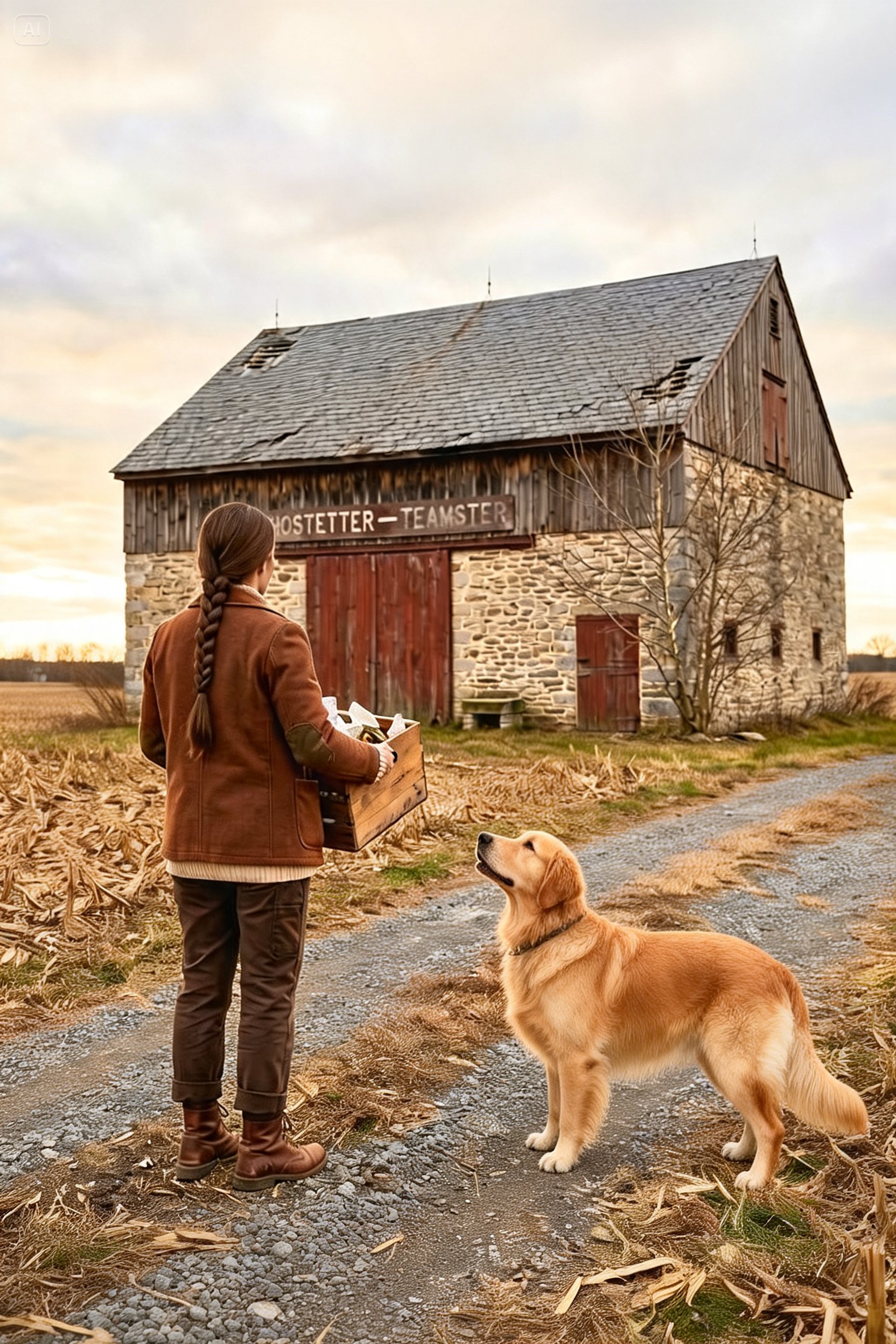
At nineteen, I was pushed out of my mother’s apartment and spent ten dollars on a condemned carriage house. I only wanted somewhere to hang my grandmother’s keepsakes, but one loose plank changed everything….
I was nineteen when my mother made it clear that there was no longer room for me in the apartment where I’d grown up. She didn’t throw my suitcases onto the sidewalk. She stood at our kitchen counter with her hands in bread dough and told me she wanted me to have a life of my own. I knew what she meant. Her new boyfriend wanted to move in, and I was the one who had to leave.
Our apartment was above a Hungarian bakery on Tilghman Street in Allentown, Pennsylvania. My mother, Marika Kovacs, had worked downstairs since she came from a village near Debrecen, Hungary, in 1996. The floors always smelled of yeast by four in the morning, and there were little pots of rosemary and parsley on every windowsill. My mother kept our rooms spotless, even after a long shift at the ovens.
My father, Endre Horvath, was a Hungarian-American mechanic who began disappearing from our lives when I was a baby. Eventually he simply stopped coming home. My mother put away his clothes, took his razor out of the bathroom, and raised me without him. She was good at making an impossible schedule look ordinary, though I didn’t understand the cost of it until much later.
The other person who raised me was my grandmother Anna. She came from Hungary when I was four, already eighty-one years old, because my mother needed help. Grandma moved into the little spare bedroom and spent her days cooking, walking me to school, and telling me about our family. Most of her stories were about her father, Vilmos Kovacs, who arrived in Bethlehem in 1919 with eleven dollars and a pastor’s letter.
Vilmos was a teamster. He drove four-horse beer wagons, then grain wagons, then a butcher’s delivery team until trucks made that work disappear. Afterward, he supervised workers at a textile mill, but according to Grandma, he never stopped talking about horses. He knew which one shied at bridges, which one leaned into a heavy load, and which one wanted a hand against its neck before a long morning.
Above Grandma’s twin bed hung a framed collection of thirty-one harness brasses. Each little bronze medallion had belonged to a particular horse. Grandma taught me every name, including Karoli, Istvan, Lajos, Yolan, Margit, and Erzsebet. By six, I could recite all thirty-one. By eleven, I could read pieces of Vilmos’s old Hungarian daybook, because Grandma had taught me words for driver, harness, stable, and oats.
I had never owned a horse, or even worked with a draft team. Still, those animals felt like relatives I’d heard about all my life. Grandma used to say that a Kovacs woman wasn’t finished with horses just because she hadn’t been given one. I didn’t know what to do with that advice. I only knew I wanted to keep the brasses safe.
Grandma died when I was eighteen. One Tuesday morning she didn’t wake up. At the funeral in Bethlehem, I read from a Hungarian Lutheran hymnbook, and when I came home, her room felt terribly quiet. Six weeks later, my mother introduced me to Randy Kiefer, a fifty-three-year-old contractor who had been married twice before. I wanted her to be happy. I truly did.
But Randy had conditions. He told my mother he could give her a more comfortable life if the household changed. On a Saturday evening, I asked her directly, “Do you want me to move out?” She kept kneading the dough and watched the rosemary in the window. After a long silence, she said she wanted her own life, too, and wanted a man in the apartment who would stay. I didn’t argue. I told her I’d be gone in three weeks.
I picked up every double shift I could at the diner on Hamilton Street, where I’d waited tables since I was sixteen. I sold my textbooks and bicycle for $218. I wrapped the thirty-one brasses separately in tissue paper and packed them in a wooden wine crate from the bakery. Grandma’s daybook went in my duffel beside a photograph of her standing with a bay team at age twenty-nine.
I left with two suitcases, the duffel, the wine crate, and $812 in savings. I spent $13 on a train ticket to Reading, where a cousin let me sleep on her couch. During the next three weeks, I applied for seventeen restaurant jobs. No one hired me. I began to worry less about where I’d live in a year and more about where I’d put my belongings next month.
One cold evening in November, I opened the Lancaster County surplus-property website. I’d bookmarked it without knowing why. The third listing showed a huge, weather-beaten carriage house on a back lane north of a small farming community called Stumptown Corners. It was built in 1892 by Emanuel Hostetter, a commercial teamster who hauled grain and brewery goods. His son Amos had kept teams there until 1963.
The building had been outside the Hostetter family since 1971, forfeited for taxes in 1994, and offered by the county for years without a buyer. Its roughly 3,800 square feet stood on 2.1 acres. There was a steep slate roof, oak siding, and limestone walls that had shifted in three places. The price was $10. I stared at the photograph for a long time, thinking about Grandma and those thirty-one names.
The next Monday I paid $22 for a train ticket to Lancaster. At the county office, a clerk named Hannah Zook pulled the file and looked at me over her glasses. She warned me there was no electricity, water, or septic system. Parts of the foundation were unstable, and slate was missing from the roof. “Do you understand what you’re buying?” she asked. I said I did, though I was frightened by how little I really knew.
When Hannah asked why I wanted it, I told her about my great-grandfather and his horses. “I’ve been carrying thirty-one of his harness brasses around in a wine crate,” I said. “I need a wall to hang them on.” She stopped shuffling papers. Her own grandfather, Abram Zook, had worked at a grain mill and remembered a Hungarian teamster from Bethlehem named Vilmos Kovacs. He’d called him “the honest Hungarian.”
Hannah stamped the deed and gave me an iron ring holding three keys. She explained which opened the stable, the hayloft, and the tack room. She mentioned a nearby farmer, Mr. Fisher, who helped neighbors when winter weather trapped them, and she wrote her phone number on the deed. It was the first kindness from a stranger I’d received in weeks that didn’t make me feel like a problem to be solved.
A $34 taxi took me from the train station toward Stumptown Corners and up the last stretch of farm lane. The driver waited below while I carried the crate to the building. The stable doors were a faded red, the limestone was cold beneath my hand, and a mounting block stood beside the entrance where drivers had once adjusted collars on enormous draft horses.
The biggest key finally turned. I dragged the central door along its stiff iron track and stepped into a broad aisle between six oak stalls. Every half door had old forged hinges, and each stall bore a wooden nameplate: König, Kaiser, Wolfgang, Augusta, Frida, and Hanna. I stood there reading them as carefully as Grandma had read our Hungarian names. Someone else had loved a team enough to remember every animal.
At the back of the aisle, a wooden staircase led to the hayloft. Dust rose in the weak afternoon sunlight as I crossed the broad plank floor. An old hay pulley still hung from the rafters. Against the north gable was a short wall of carefully fitted tongue-and-groove boards, the sort a carpenter might build to close off a little storage area. I almost turned away, but one seam looked different.
There were eleven boards. The gap between the seventh and eighth was wider, and I couldn’t see nails at the top or bottom of the eighth. I hooked my fingers into that seam and pulled. The board moved, then lifted free without breaking. Behind it was a shallow hidden compartment, lined with old oilcloth. I leaned closer, trying to understand why someone had made a wall that could be opened from exactly this spot. Part 2…..
Inside were four objects, each placed with a care that didn’t belong to a forgotten pile of junk. There was a large leather-bound account book with faded gold lettering, a drawstring grain bag heavy with metal, a small oak box with a brass clasp, and a cream-colored envelope sealed in brown wax. On the outside of the envelope, an old-fashioned hand had written a message for the next stable master.
I carried everything down the stairs and sat on the limestone mounting block beside Grandma’s wine crate. The afternoon light was going fast. I opened the account book first. It recorded the Hostetter team’s work from May 1892 through April 17, 1963: wagonloads of grain, brewery deliveries, feed bills, purchases, retirements, and visits from the farrier. Emanuel had kept it first, Amos afterward, and Emanuel’s brother Jacob had filled in briefly when a mare named Greta kicked Emanuel in the ribs.
The last entry was written in an unsteady hand. On April 17, 1963, Amos Hostetter had retired his final team. His mare Hanna had gone to a rescue in Ohio. He was sixty-six and had no idea what he would do the next day. He wrote that he and his father had worked out of that carriage house for seventy-one years, and that he was the last of them. I shut the book for a moment. I knew what it was to lose the shape of an ordinary day.
The bag held ninety-two silver dollars, Morgan and Peace coins mostly dated from the 1890s through the 1920s. I’d never seen that many silver coins together. I wasn’t thinking yet about selling them. I was wondering why anyone would hide so much money inside a wall and leave it there. I tucked the bag beside me and opened the little oak box.
Six harness brasses lay on old cotton padding. They were solid bronze, stamped with grain sheaves, wagon wheels, and plow blades, and each had a tiny oak-leaf mark on the back. There were six names, matching the six stalls inside: König, Kaiser, Wolfgang, Augusta, Frida, Hanna. I lifted Hanna’s brass, warm-looking even in the cold light. The name was so close to Grandma Anna’s that I had to swallow before setting it down.
Then I broke the wax seal on the envelope. It was a letter dated April 17, 1963, signed by Amos Hostetter. His father Emanuel had built the carriage house in 1892. Emanuel died in 1952. Amos had lost his only son, Eli, in the Pacific in 1945, when Eli was twenty, and his wife, Rebecca, to cancer in 1958. He had no surviving child to inherit the work. The letter was written on the very night he sent away his last horse.
Amos explained that he had built the false wall himself that week. He couldn’t bear to burn the daybook, put the family silver in a bank he didn’t trust, or surrender the brasses to a historical collection where people would admire them without knowing the horses’ names. He wanted a future stable master to find them and understand they weren’t merely decorations.
He described his last six horses so specifically that I could nearly see them in the stalls. König, a bay Belgian, and Kaiser, a chestnut Percheron, had come from the same Berks County farmer in 1949 and worked as a matched pair. Wolfgang was a patient gray Percheron gelding. Augusta, a strong-minded black Percheron mare, once refused a bridge that collapsed under another wagon three days later. Frida was small and gray and gave everything she had.
Hanna was his favorite: a bay Belgian mare, born in 1951, with a white blaze and four white stockings. She was gentle and young when the last working team was retired. Amos said sending her to Ohio had been the hardest act of his life. All morning I’d been thinking of a building with dangerous walls. Now I was holding the account of a man who had lost his family, his trade, and the animal he most loved.
In the letter, Amos wrote that he had made the eighth plank removable because he hoped someone observant would discover it. A good teamster, he said, noticed small changes before a horse could be hurt. The silver belonged to whoever found it; that person could spend it to save the building or use it for some other need. The brasses, though, belonged in memory to the horses who’d worn them. He asked only that their names be spoken.
I read the letter twice. For years, Grandma had made me repeat names I thought no one else would ever need. Here was another person, decades before I was born, asking a stranger to do the same thing. I looked toward the six stable doors. Then I said into the empty building, in the Hungarian Grandma taught me, “Köszönöm, Amos bácsi.” Thank you, Uncle Amos. “I’ll say their names.”
Much later, a specialist valued the silver content of the ninety-two coins at about $2,100 and their combined collector value at a little over $11,000. For the first time since leaving Allentown, I had money that could make a real difference. I also had a decision. I could leave that ruin behind and use the proceeds to rent somewhere safe, or I could take Amos at his word and try to keep the place standing.
Part 3 I chose the carriage house, though not by pretending it was ready to live in. Hannah’s husband, Enos Zook, was a carpenter in Stumptown Corners. He offered me a one-bedroom apartment over his woodworking shop for $85 a month while I figured out the repairs. His grandfather had known Vilmos on the old Lancaster feed runs. I accepted the room, and for the first time since my mother’s kitchen conversation, I slept in a bed that was mine to make each morning.
I wanted to fix the roof first because the missing slate was the damage anyone could see. Hannah had tucked inspection notes into the deed, though, and those notes made it plain that the east foundation was the real danger. Frost had pushed sections of limestone outward. If I ignored them, part of the stable wall might fail. I didn’t know a thing about masonry. I went to the Lancaster County Public Library and borrowed every useful book I could find about old Pennsylvania stone buildings.
Eventually I met Daniel Lapp, a seventy-one-year-old Pennsylvania Dutch mason who agreed to teach me over four weekends for $200. He showed me how to remove damaged mortar without ruining the stone, how to make careful repairs, and how to tell when the wall was trying to move again. I worked slowly. By June, I was repointing the three troubled sections myself while Daniel watched from a folding chair and called out corrections.
The foundation held through the first winter, then the next. Over the following years I used the rest of the coin money carefully. I patched the north roof with reclaimed slate from Ephrata, reglazed three high windows, and repaired the iron hinges on the six stall doors. None of it happened quickly. Some weeks I could afford materials but not help; other weeks I had a pair of working hands and nothing left to buy.
I turned the old tack room into a modest heated workshop. From reclaimed oak, I made protective display cases for Amos’s letter, the Hostetter account book, and Vilmos’s daybook. I mounted the six German-named horses’ brasses where people could see them and found a place for Grandma’s thirty-one Hungarian ones. There were thirty-seven names in that room, and I made sure I could say every one correctly.
In my second year, Daniel recommended me to a Mennonite heritage education program in Lititz. They needed someone who could work with old Pennsylvania Dutch and Hungarian teamster records. Twice a week I traveled there to read and translate daybooks. They paid me $22 an hour. I wasn’t wealthy, but I could pay the rent and keep the restoration moving without selling the objects that made the building worth saving.
The carriage house gradually became a small private museum of working-horse history. I never bought a draft horse; I had enough responsibility keeping the old stable standing. But families from the Lancaster countryside began to hear about the place, and so did Hungarian-American congregations in Bethlehem and Allentown. Sometimes school groups came on warm spring or fall days. I showed the children how a harness brass connected to a particular horse, not just a pretty design.
When a child asked whether I had known any of the thirty-seven animals, I said no. Then I told the stories anyway: the matched pair, the mare who refused the bridge, the horses my great-grandfather drove long before I existed. I let the children hold a polished brass when it was safe to do so. I hoped one of them might remember a name years later for no reason they could explain.
Final My mother came to visit in the second summer. Randy had moved out of the apartment above the bakery after fourteen months, and she arrived by Greyhound from Allentown with a suitcase and a paper bag of Hungarian pastries. She walked along the limestone aisle, reading the six original stall plaques one by one. Then she stood in the tack room, studying the thirty-one brasses her mother had cared for all those years.
“Your grandmother would be proud,” she told me. She said Vilmos would have recognized that his treasures had been passed to someone who understood them. She stayed four nights. We shared pastries in the workshop, talked about ordinary things, and once, without trying to explain herself, she apologized for asking me to leave. I accepted it. I didn’t need to pretend the hurt had never happened.
By the time I was twenty-three, the roof was sound and the limestone walls stood straight. One clear October evening, I sat on the old mounting block and watched sunlight fade across the field. Behind me were thirty-seven harness brasses on two cedar-paneled walls: thirty-one from my family’s Hungarian working teams, and six from the Hostetters’ Pennsylvania horses. The daybooks and Amos’s letter were preserved nearby.
I thought about Vilmos arriving in Bethlehem with eleven dollars, Grandma carrying his stories across the Atlantic, and Amos writing a letter to someone he could never meet. I thought about my mother getting on a bus with pastries because she couldn’t find a better way to begin making things right. Forgiving her hadn’t happened all at once. It had taken small acts over several seasons, much like repairing an old foundation one joint at a time.
When I was little, I thought Grandma was teaching me a list of horses. I understand now that she was teaching me how to pay attention and how not to let a life disappear simply because its work was finished. I bought a ruined carriage house for ten dollars because I needed a wall for her keepsakes. What I found there gave me a home, work I could be proud of, and a way to keep thirty-seven names alive.
THE END. I’ve shared the complete story, and I truly hope it touched your heart. If this story moved you, please , like, and share the post. Thank you for reading! ❤️
✓ Lynn R. Adams
At nineteen, I was pushed out of my mother’s apartment and spent ten dollars on a condemned carriage house. I only wanted somewhere to hang my grandmother’s keepsakes, but one loose plank changed ever…