At my Stanford Law graduation dinner, my mother slid a manila envelope across the table and said the decision came “from all of us.” My sister filmed while I read the papers cutting me out of the family inheritance
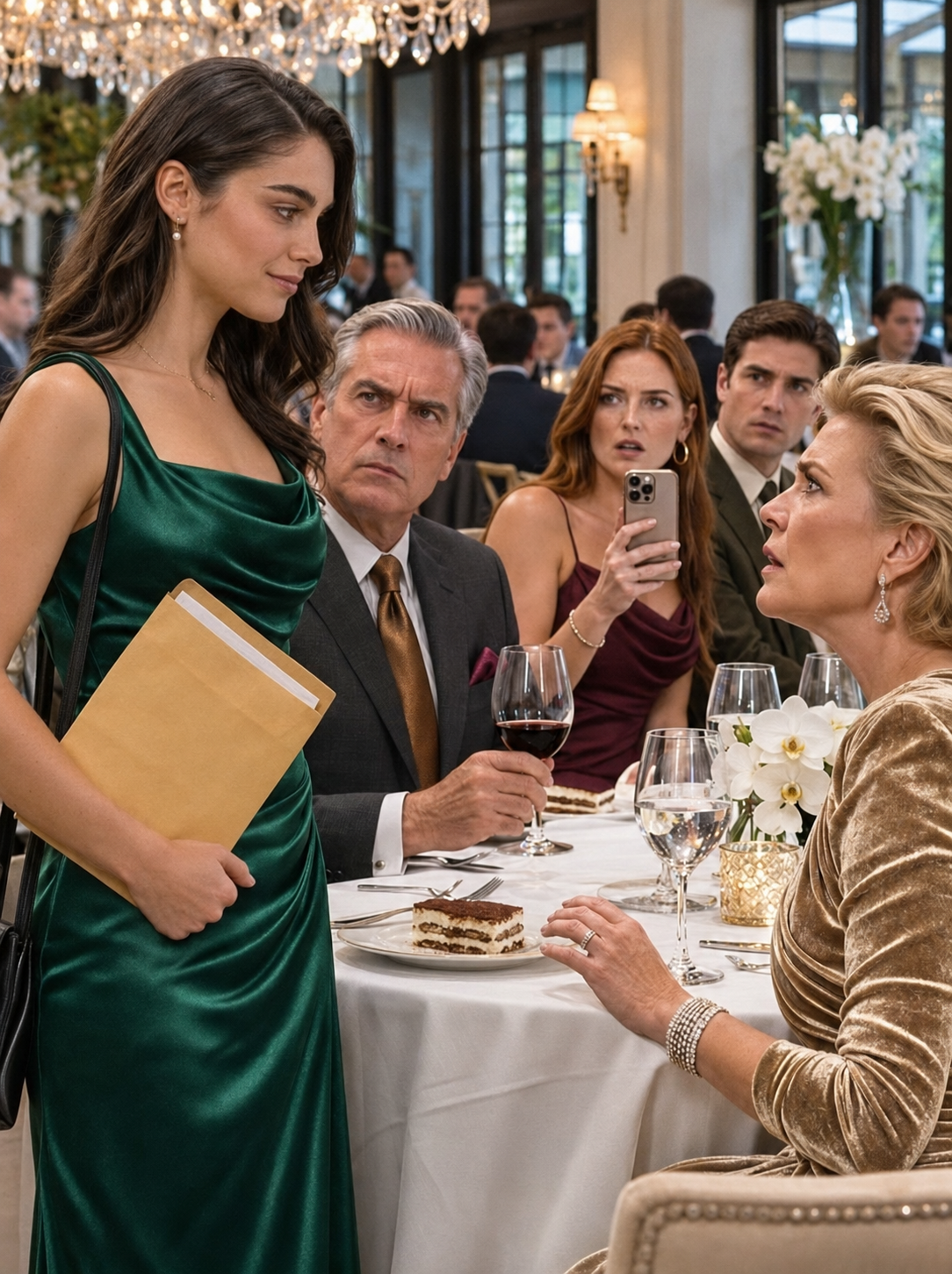
At my Stanford Law graduation dinner, my mother slid a manila envelope across the table and said the decision came “from all of us.” My sister filmed while I read the papers cutting me out of the family inheritance, but when I put the papers back and thanked them, she lowered her phone before I even reached the door…
My sister started filming before my mother took the envelope out of her purse. I remember that because the waiter had just set down the tiramisu, and for a second I thought Miranda wanted a picture of dessert. Then she tipped the phone up until it was aimed straight at me.
My mother, Claudia, had booked a table at Romano’s three months earlier. “We’re celebrating our Stanford Law graduate,” she’d told me. “The whole family will be there.” I’d graduated at the top of my class three days before the dinner, and the whole family had managed to miss the ceremony.
Mom had a charity luncheon, Dad had a golf tournament, and Miranda had a manicure. I went to dinner anyway, in a simple navy dress, because some part of me still wanted one of them to ask what it had felt like to graduate. I’d had my answer ready all the way to the restaurant.
My father, Raymond, wore his favorite navy suit and took the chair at the head of the table. Miranda sat beside Mom with her phone already in her hand, and her husband, Kentin, gave me an uneasy little smile when I sat down. Dad ordered an expensive bottle of wine while Mom talked about the Hamptons and Miranda complained that her interior designer still didn’t understand what she wanted for the pool house.
I pushed my pasta around my plate until the waiter took it away. Then came the tiramisu, the little red recording indicator on Miranda’s phone, and my mother’s hand going into her purse. “Sweetheart,” she said, “your father and I have been discussing your future.”
She set a thick manila envelope between us. Dad put down his glass and said it was time I learned to stand on my own two feet. “You’re a lawyer now, Yasmin,” he added, as though my diploma had settled every question about what I could afford. “You don’t need us anymore.”
Mom pushed the envelope closer and said their attorneys had prepared the papers. I was being removed from the family trusts and wills, my financial support was ending, and my access to family accounts was being revoked. “From all of us,” she added, looking around the table, and the diamonds on her bracelet caught the light when she lifted her hand.
Kentin looked down at his plate. Miranda shifted the phone to get a better angle, and at the next table somebody’s fork scraped against china. I opened the envelope and found a neatly arranged stack of papers with signatures and notary stamps. Whoever had put the stack together had taken considerable care.
“It’s for your own good,” Dad said, reaching for his wine. “You’ll thank us later.” I looked at his hand around the stem of the glass and remembered how tightly I’d held a glass of water the first time I heard him talk about cutting me loose.
It was Thanksgiving, three years earlier, during my first year at Stanford Law. Miranda had just gotten engaged to Kentin, whose family controlled a successful technology company in Austin. Mom was delighted by the match, right down to the grandchildren she was already imagining telling people about at the country club.
I’d gone downstairs for water that evening and heard my parents talking to Uncle Preston in Dad’s study. The door was partway open. Dad said Miranda would be taken care of once she married Kentin, then asked what prospects I had when all I did was study.
Mom brought up the Johnsons’ gala, where I’d spent the better part of the evening talking to their accountant about tax law. I’d enjoyed that conversation enough to remember it on the way home. Outside the study, I heard my mother laugh as she told it, and Uncle Preston guessed I’d end up making thirty thousand dollars a year as a public defender. That got all three of them laughing.
“Let’s wait until she graduates,” Dad said. “If she passes the bar, we’ll cut her loose.” I went upstairs with the water still in my glass and shut the door before I let myself cry.
I left for Stanford earlier than I’d planned and went straight to my academic adviser, Professor Sara Jenins, an accomplished corporate lawyer. I asked her to help me understand trusts, estate planning, corporate structures, and asset protection. When she said it sounded personal, I told her I needed to know how to build a life where nobody could control me through money. She gave me a time to come back. Monday morning at seven.
Over the next three years, Professor Jenins introduced me to people in corporate law, estate administration, and investment banking. One night my roommate, Tessa, found me still working after midnight and asked why I was pushing so hard when my family had money. “That’s their money,” I told her. After that, when she knew a professor, a Stanford alum, or a lawyer I ought to meet, she quietly put us in touch.
Those introductions helped me find consulting work in Silicon Valley. One assignment brought me to DataStream, a cybersecurity startup run by three Stanford dropouts whose software was already better organized than their company. They’d paid prestigious firms for agreements that read as though they could have been written for anyone. I spent three weeks going through their contracts, intellectual property protections, investor terms, and ownership arrangements.
Marcus Chen, the lead developer, read my work for ten minutes before he looked up and told me it was better than what the expensive firms had given them. When he asked why I hadn’t just quoted an hourly fee, I told him I believed in what they were building and explained how I wanted to share in its long-term success. “Are you crazy, or are you brilliant?” he asked. “Maybe both,” I said, and we shook hands.
I watched DataStream grow over the next two years. At home nobody asked who my clients were, and a week before graduation I asked my own attorney to prepare papers relinquishing any future claim to the family wealth. I’d meant to deliver them myself. Sitting at Romano’s with my parents’ paperwork in my lap, I realized they’d already done much of what I’d come to do.
“Well?” Dad asked. I folded the papers, put them back in the envelope, and said, “Thank you.” Mom asked me to repeat myself, so I did, then picked up my handbag and said I appreciated the trouble they’d gone to. Dad wanted to know whether I was going to make a scene.
“Why would I?” I tucked the envelope under my arm and told Mom she’d given me freedom from all of them. Miranda lowered her phone, Kentin finally looked up, and Dad clenched his jaw. Mom’s voice rose behind me as I walked out, and I kept going. There was an agreement on my laptop they knew nothing about, and that night, for the first time, I had a reason to sit down and do the math. Part 2…..
IF FACEBOOK BROUGHT YOU HERE, HERE’S THE CONTINUATION YOU’VE BEEN WAITING FOR. ENJOY! 👇 Final Back at my one-bedroom apartment in Palo Alto, I poured a glass of wine and sat by the window, where I could see the distant lights at Stanford. There were moving boxes all over the floor, though everything I owned could fit in my car. My phone rang before I’d taken more than a sip.
Miranda wanted to know if I thought I was smart for walking out. I put the phone down beside a cardboard box and folded a sweater while she told me I’d proved everything they’d said about me. In six months, she said, I’d come crawling back for Dad’s money.
“I guess we’ll find out,” I said. She told me I was nobody without the family name, and I looked down at the sweater I’d just folded and realized I’d folded it small enough to fit in a shoebox. “Good night, Miranda.”
I ended the call and blocked her number, then Mom’s, then Dad’s. I packed another box before I sat down at the laptop. For once, when the apartment went quiet, I didn’t catch myself listening for the phone.
I kept the DataStream records in a folder separate from my other work. The first agreement in it went back to when Marcus and the other two founders were still trying to get the company on its feet. I scrolled past it to the revised ownership agreement we’d negotiated and signed several months earlier, then stopped at the numbers beside my name.
With the envelope from Romano’s beside my laptop, I reached for my calculator and worked out how much of DataStream I owned under the revised terms. I ran the numbers a second time, the way I do whenever the answer matters. Then I took out my notebook and wrote down the bills I could cover from my consulting income, because a share in a company and money for next month’s rent are two different things.
The ownership calculation took up one line. Rent, groceries, and the rest took up most of a page. I’d spent three years building both sides of that little ledger, and there was no point on either side where I had to put down Dad’s name.
I slipped the envelope into the box with my own attorney’s papers and went back for the wine I’d left by the window. At dinner I’d walked out while Mom was still talking. Here, with the boxes still half packed and work waiting for me in the morning, I sat down and finished my glass.
THE END. I’ve shared the complete story, and I truly hope it touched your heart. If this story moved you, please , like, and share the post. Thank you for reading! ❤️
✓ Lynn R. Adams
At my Stanford Law graduation dinner, my mother slid a manila envelope across the table and said the decision came “from all of us.” My sister filmed while I read the papers cutting me out of the fami…