At my father’s retirement dinner, he raised a glass to my brother and joked that his forty-four-year-old
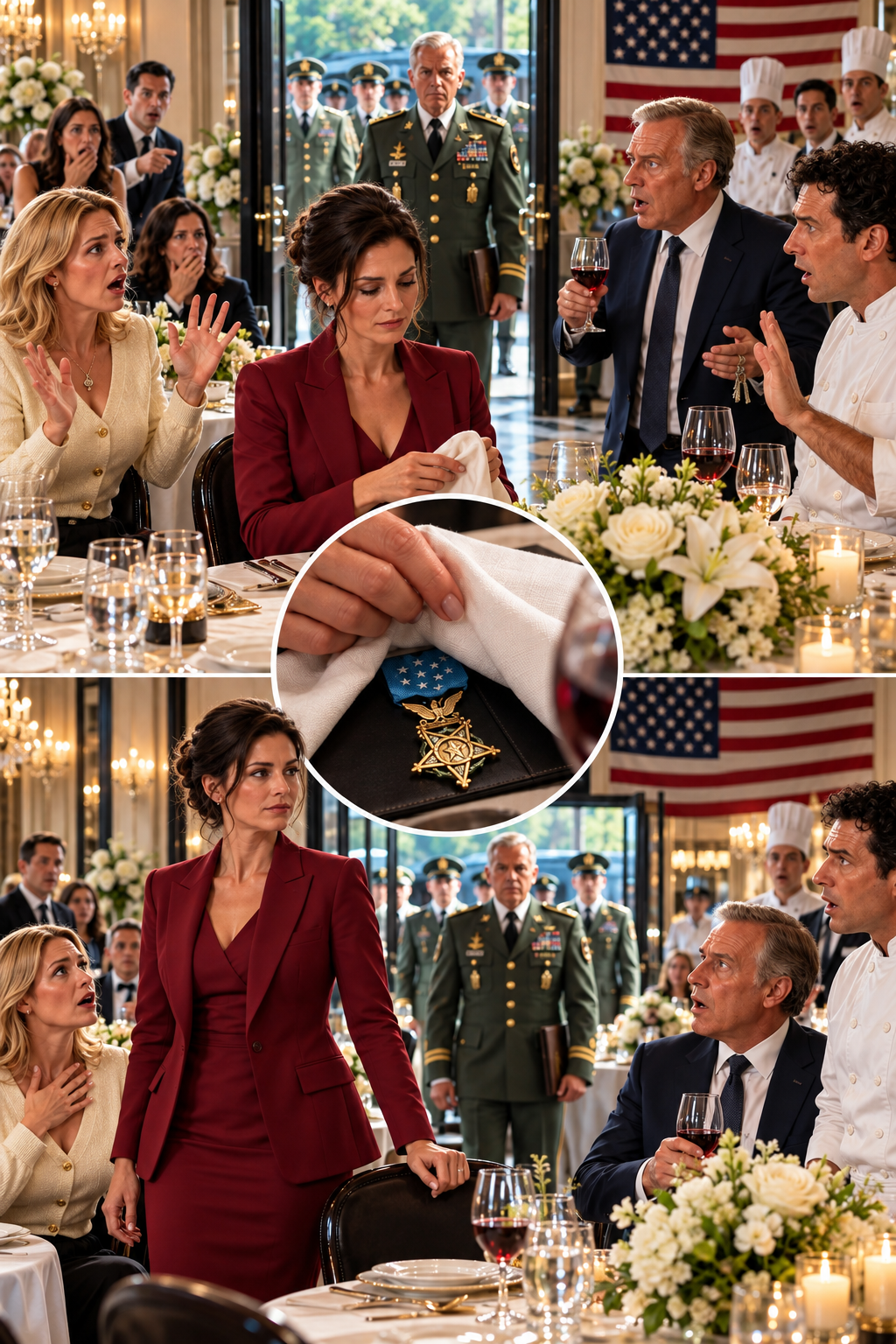
Part 2: The restaurant burns while Eli’s secret software becomes a weapon
The officers moved everyone into the concrete freezer room beneath the kitchen, where the walls were thick enough to protect us from the windows and the air smelled of old ice. I activated a signal jammer, counted the people who had made it inside, and checked the injuries before turning to Eli. The Army hubs had been breached with software connected to his company, and someone had just destroyed a government vehicle outside our family restaurant. “Tell me what you built,” I said. He looked at Dad, who was still standing between him and Mercer, and then finally looked at me.
Fourteen months earlier, Eli told us, a former defense contractor named Victor Dane had approached him at a Chicago software convention. Dane wanted to license Caldwell Hospitality’s inventory program through a systems integrator called Northstar Meridian. Eli’s software forecast demand, cut waste, and shifted stock between restaurant locations; Dane said it could be adapted for disaster recovery. He asked Eli to build a separate recovery layer with twelve divided permissions, a seed sequence, an author-verification device, and an emergency override. Eli insisted that Dane had promised no one could reconstruct the full system alone, but his voice weakened when I asked why a restaurant vendor needed military-grade safeguards.
He said he had never knowingly connected it to the Army, and I believed that he had not known the whole plan. But belief was not the same as innocence. Three weeks ago, Eli had found someone accessing an old development server and sent diagnostic logs to Dane, trusting the man who had paid him rather than reporting the intrusion. He thought he had stripped sensitive details from the logs, but he had never checked. “You didn’t know enough to understand what you were giving away,” I told him. “That’s different from not giving anything away.” He looked down, unable to argue.
When I asked where the original seed was, he said he had deleted it. I reminded him that the boy who kept every baseball card, broken neon letter, and receipt from his first computer would never destroy the first version of his most important program. Eli turned toward the freezer wall and pressed one loose block. Behind it sat our grandmother’s missing metal recipe box, the one Dad thought had disappeared during renovations. Inside were flash drives, handwritten architecture notes, and a black device holding the seed. Dad stared at the box as if it had just accused him of never knowing his own son.
A bomb technician reported a transmitter beneath the loading dock, and the restaurant’s gas alarm began shrieking. We evacuated through a rear exit into freezing rain as firefighters moved toward the building and police established a perimeter. “It wasn’t supposed to happen like this,” Eli whispered. I stopped and looked at him. He had known enough to fear that something might happen; he simply had not told us. Before I could press him, shots cracked from the tree line, and the armored vehicle waiting to take us away lost its windshield.
Part 3: My brother’s ambition leads us toward our parents’ buried past
Mercer drove us through a logging route toward Black Pine Ridge, where an abandoned Cold War communications station sat behind an overgrown access road. Dad knew the route without looking at a map, which I noticed but did not yet question. In the vehicle, I pushed Eli to explain the system’s keys. The first was the seed hidden in Grandma’s recipe box; Dane held the author key; the third was an emergency override Eli had given Dad for safekeeping. Eli had described it to our father as a backup drive, never explaining what it could unlock.
Dad’s face changed when I asked where the override was. He said it had been stored in the restaurant safe until three nights earlier, when the inventory computer failed and he connected the device to recover vendor invoices. That was the same evening the Army hubs went dark. We were no longer dealing with a software company that had accidentally supplied a military vendor. My brother’s program, Dad’s hidden device, and a key held by Dane had all converged on the same breach. Outside the vehicle, rain streaked past the windows while Mercer warned us that the attackers might still be following.
At Black Pine Ridge, the backup generator groaned awake beneath concrete walls and obsolete consoles. Mercer established an encrypted radio link while I inspected the room’s exits and the equipment’s power connections. Before we attached any of Eli’s devices, an old monitor flickered on. Victor Dane appeared on screen, calm and well lit, as if he were calling from an office instead of the middle of a national emergency. He told us the network now touched regional fuel depots, hospital supplies, emergency food distribution, and storm shelters.
A countdown appeared across four surveillance feeds: eight hours until the system began deleting its own routing credentials. Dane said the only way to stop it was for me to insert the seed and accept centralized command. I asked why he needed me when he already had the author key and Dad had activated the override. He answered by displaying an eleven-year-old Army document bearing my signature: Continuity Logistics Framework—Command Resilience During National Infrastructure Failure. I had designed that model after studying how essential supplies could keep moving when communications failed.
Dane explained that Eli’s software supplied prediction, my framework supplied command logic, and Dad’s override completed the architecture. The system would select a leader during a crisis, then give that person the authority to move resources without delay. It sounded like efficiency until I imagined a machine deciding who could receive food or medicine without asking anyone’s consent. The station door locked. A moment later, footsteps approached through the corridor, and Victor Dane entered in person, wearing my Army identification tag around his neck. He looked past me and faced Dad. “Tell her, Arthur,” he said. “Tell your daughter who wrote the first framework.”
Part 4: My father’s old oath explains why he feared my success
For several seconds, Dad said nothing. Then the restaurant owner who had always claimed his life began and ended with a grill admitted he had served as an Army supply officer in a classified continuity unit during the final years of the Cold War. He and Dane had helped design manual systems for moving food, fuel, medicine, and transport if ordinary command structures collapsed. Dad had left the project when Dane argued that emergency logistics should bypass elected leaders whenever they moved too slowly. Dad believed any system capable of feeding a city could also be used to control it.
Years later, when the Army asked me to modernize a continuity framework, Dad mailed me old project notes among family photographs and recipes. He never told me where the notes came from. I believed they were historical observations, not fragments from his classified work. He called it protection—a way to help me without reopening his past. I told him it was not protection to shape my career from the shadows while belittling the same skills at home. He had let me build on a foundation he hid, then watched me believe I had built alone.
The console scanned Dad’s thumb and displayed PRIMARY AUTHOR: ARTHUR CALDWELL. The line hung above us while every joke he had made about Army paperwork took on a different meaning. The system requested a successor and displayed my name beside Dane’s. Eli traced the cables beneath the console, using the tapping signal we had invented as children during busy restaurant shifts. Two taps meant ready. I selected Dane long enough to draw his attention, and Eli ripped the seed from the machine while I drove Dane against the console and Mercer seized the author key.
The interruption did not stop the crisis. It triggered a final selection protocol that began reviewing thousands of military and civilian leaders, ranking them by supply decisions, disaster response, casualties avoided, and resource allocation. My name rose above generals, governors, hospital directors, and transportation chiefs. Every convoy I had rerouted, every field hospital I had supplied, every shortage prevented without a headline had become data for a machine seeking its chosen commander. For the first time, I understood how the system could “recognize” my work and still be completely wrong about what that work meant.
Another name appeared beneath mine: General Thomas Vale, chairman of the National Emergency Logistics Council. Vale’s voice came through Mercer’s radio, ordering us not to interfere with the selection. Dane turned pale. He had not been directing the conspiracy; someone with more authority had been using him. Vale spoke as though the system were already his, describing a future where one command could overcome political delays and fragmented local control. The title of his argument was continuity. Its reality was the power to decide who received what, and when.
Part 5: I accept absolute power only long enough to destroy it
Vale told us he had allowed Dane to expose the network’s weaknesses because he believed the country faced too many cyberattacks, storms, infrastructure failures, and political standoffs to depend on committees. He called the selection system a safeguard, not a dictatorship. People who seek unchecked authority, I had learned, often choose a reassuring name before they choose their victims. Dane realized Vale had manipulated him and disabled the explosives he had placed at the station. His change of heart did not erase the danger he had created, but it gave us time to move my parents away from the building.
The network rejected manual shutdown commands. Destroying its hardware would also wipe out hospital access credentials, and a storm was already pushing families into local shelters. Vale had designed a trap with two terrible outcomes: accept the authority he wanted me to hold, or let people suffer while he blamed my refusal. A biometric needle unfolded from the console. The map showed fuel reserves, hospitals, food warehouses, military routes, and emergency shelters. I looked at it and knew that doing nothing could be as cruel as taking control.
I pressed my finger to the sensor. The system accepted my identity and gave me command. Vale welcomed me as though I had finally understood the necessity of his design. I used the access he wanted me to keep to issue one order: TERMINATE ALL CENTRAL COMMAND PRIVILEGES. RESTORE REGIONAL CIVILIAN AND MILITARY CONTROL. The system asked me to confirm. I did, and its authority began breaking apart across thousands of nodes.
For less than a minute, I thought we had won. Then an unmarked helicopter approached Black Pine Ridge, and Dane said the person aboard had taught Vale everything. Dr. Evelyn Shaw stepped out with an armed private team. She claimed to have founded the original continuity project, kept a mirrored copy of the network, and spent years using Arthur, Dane, Vale, Eli, and me in a test designed to identify the person who could command a national supply system. She spoke about people as though they were numbers in a spreadsheet she had every right to rearrange.
Dad recognized her with old grief. She had once been the project’s brilliant director, until she began arguing that shortages could pressure disobedient cities and medicine could become leverage. Mom stepped beside Dad and told Evelyn that a restaurant was its people, not its building. Evelyn offered me control of the mirror and threatened to restore it under Vale if I refused. Then she disabled the National Guard vehicles arriving along Dad’s logging road, proving she still had access to their fuel and ignition systems. Her power depended on mistrust, and the people she had used were finally done trusting her.
Part 6: My mother’s hidden mathematics breaks the machine’s hold
Dane stole the author key from Mercer and destroyed it against a rock rather than return it to Evelyn. She shot him; Mercer disarmed her; Guard soldiers surrounded the clearing. Medics rushed Eli away with a shoulder wound. Evelyn, being taken into custody, smiled and said the author key was never the only one. There had always been three authors, she claimed, and the third was my mother. Helen Caldwell—the woman who managed the restaurant books, remembered every birthday, and asked everyone else what they needed—finally told us what she had hidden.
She had met Dad through the continuity project. She was a civilian mathematician who designed the fairness model underneath its supply routes. Arthur and Dane had built the movement and command architecture, but Mom had set the priorities: hospitals before warehouses, children before institutions, and disaster zones before political centers. Her model was supposed to prevent powerful regions from taking resources simply because they had louder voices. She quit when government officials began asking whether fuel shortages could pressure rebellious cities and whether medical delays might force political compliance.
Mom buried her past so completely that Eli and I grew up believing her greatest technical achievement was balancing the Thursday produce invoice. Evelyn’s mirror still recognized Helen as the third author and would automatically pass authority to her if the current structure failed. She could control the system, Evelyn argued, because someone worse would otherwise take it. I told Mom that a system built around one indispensable person was already broken, no matter how kind that person was. Dad admitted his fear had led him to diminish both his children instead of trusting them.
Mom asked what we could do. We began with her original principle: if resources survived by being distributed openly, authority should be treated the same way. We would force the mirrored network to disclose its hidden servers, shell contractors, access paths, financial accounts, and government sponsors to the people whose institutions it had tried to control. Guard technicians isolated a connection. Mom placed her thumb against the sensor, and the console identified AUTHOR THREE: HELEN CALDWELL.
The quiet restaurant owner’s wife disappeared behind the focused mathematician who had designed justice into a system powerful people later twisted. She rewrote the core directive to forbid any single node from commanding another. Then she ordered every hidden access route disclosed and sent the evidence to civilian agencies, military inspectors general, state administrators, and federal investigators. Evelyn screamed that fragmentation would destroy decades of work. Mom pressed ENTER anyway. The network broke into thousands of independent local systems, revealed Vale’s credentials at the center of the project, and shut down permanently.
Dawn reached the ridge without alarms, but our relief lasted only until federal investigators examined Eli’s company records. They had found twelve million dollars in concealed payments linked to Dane. I carried the report to the hospital where Eli was being treated and saw the storm victims filling the hallways. The systems we had restored were already opening medicine cabinets and moving supplies again. That was what logistics was meant to do: serve people without asking them to applaud.
Part 7: Eli’s confession exposes the cost of being chosen
Eli admitted he had accepted twelve million dollars from Dane to stay quiet about modifications he knew went beyond restaurant customers. He insisted he had never understood the full breach, Vale’s involvement, or the threat to hospitals and shelters. The money was gone. He had secretly distributed most of it to restaurant workers facing medical debt, food banks, struggling diners, veterans opening kitchens, and military families starting small businesses. Giving it away did not make accepting it lawful. It did, however, show that even his worst choices were tangled with the role Dad had handed him.
“I was the dependable one,” Eli said. He had watched me leave town, travel, earn rank, and build a career that did not end at Caldwell’s grill. Everyone praised him for staying, he said, but nobody had asked if he wanted to inherit the person they had decided he should become. For most of my life, I had resented him because Dad chose him. Eli had resented me because I escaped. We had both mistaken the other person’s cage for freedom, and neither of us had been brave enough to say so.
Then he showed me a recording he had secretly made three weeks earlier. It captured Dane and General Vale discussing the breach, the selection protocol, and their plan to force my authentication. The recording could expose the conspiracy, but it also proved Eli had attended those meetings, accepted money, and withheld information while he decided whom to trust. I told him cooperating would not erase consequences. Dad would likely fight to protect him, I said, but I would stand beside him if he told the truth and faced the lawful outcome. Eli cried because support, in our family, had usually come with someone trying to rescue him from responsibility.
Vale was arrested in Washington. Evelyn entered federal detention, and Dane survived his wound and agreed to testify. News outlets called me a hero, but the word made me uncomfortable because it erased Mercer, Mom, the Guard technicians, hospital workers, drivers, mechanics, and ordinary people who kept the country functioning while public figures argued over command. Three days later, I stood with Dad in front of the burned shell of Caldwell’s Table. I expected him to mourn the building as if our family had died with it. Instead, cars began filling the lot.
Former employees, veterans, hospital workers, food-bank volunteers, and small-business owners arrived carrying tools, lumber, food, and checks. The money Eli had passed along had become ovens, chemotherapy payments, payroll rescues, and community kitchens across the state. “We should rebuild,” Dad said, looking at the charred sign. I proposed a different kind of place: a restaurant, emergency kitchen, food bank, veterans’ training program, disaster warehouse, and transparent version of Eli’s software. When Dad asked what to call it, I answered, “The Table. No family name, no chosen child. Just a place where everyone counts.”
Part 8: The final secret reveals why my father feared me
Just when I thought the family secrets had finally run out, Mercer called from the prison hospital where Dane was being held. Dane wanted to speak with me because the original system had selected me for a reason that was missing from its official records. Five minutes into the conversation, he told me Evelyn Shaw had given birth to a daughter forty-four years earlier. Arthur and Helen had left the project by then. Evelyn had refused to abandon her career, and my parents had privately adopted the six-day-old baby she surrendered.
The woman who manipulated the crisis was my biological mother. The parents I had spent years accusing of not understanding me had raised a child whose origins they feared might pull her back toward the world they had escaped. Evelyn had even embedded a hereditary continuity clause in an early version of the system because she believed leadership should remain near her bloodline. That explained why she watched me with something deeper than professional interest. It also made me certain that biology gave no one the right to own another person’s life.
I confronted Arthur and Helen that evening. I wanted to know why they had waited forty-four years to tell me. They admitted it had been fear, not a noble kind of protection, and Dad confessed he had often diminished my ambition because each year I became more independent, disciplined, and technically gifted. I reminded him of Evelyn, he said. He tried to make power sound small, hoping I would stay near home and never become what he feared. “I tried so hard to keep you from becoming her that I became the person who hurt you most,” he told me. This time, his apology did not contain a request that I erase what had happened.
I asked if he loved me differently because I was adopted. Dad said I had become his daughter before he knew how to hold me. He remembered walking circles through the restaurant kitchen while I screamed in a red blanket, while Mom slept beside the ovens because neither of them knew how to calm me. That history did not cancel their lie, but it changed its shape. I could understand that family might hold love, fear, failure, secrecy, repair, and responsibility at once, without one truth forcing the others to disappear.
Eli later pleaded guilty to unlawful disclosure, concealment, and financial offenses. His cooperation and the evidence against Vale reduced his sentence, but Dad wanted to fight until Eli reminded him that being protected from consequences had taught him to hide. I visited Evelyn once before her trial. She told me I had inherited her mind. I answered that neither blood nor talent defined me; Arthur and Helen had raised me imperfectly but chosen me every day, while she had repeatedly chosen her system. When she asked whether absolute command had ever tempted me, I said yes, then reminded her that every line on a logistics map represented someone waiting for medicine, fuel, food, shelter, or the safe return of a person they loved.
Part 9: The Table opens where no child is counted second
One year after the fire, The Table opened on the same foundation where Caldwell’s Table had stood. The new building held a commercial kitchen capable of producing five thousand emergency meals a day, a warehouse stocked with water, medicine, generators, blankets, and shelf-stable food, and classrooms for veterans and military spouses learning logistics and restaurant operations. A regional software system could route supplies during storms without hidden keys or centralized control. Every administrator could see how resources moved and challenge a decision that threatened the people it was meant to serve.
Eli came home three weeks before opening, thinner and quieter after serving the custodial portion of his sentence. Dad met him in the parking lot carrying the old, blackened restaurant keys. Eli looked at them and shook his head. “No more inheritance,” he said. “No more chosen son.” Dad opened his other hand and showed him four new keys: one for himself, one for Mom, one for Eli, and one for me.
I accepted mine, not because I wanted to own the restaurant, but because I finally understood that I belonged to the work without needing ownership to prove it. Opening night filled every table with neighbors, veterans, students, nurses, firefighters, drivers, mechanics, and families. Mom tracked county food donations while Eli supervised the software and Dad worked the grill. Mercer arrived in civilian clothes, looking almost uncomfortable without a uniform. I moved through the building checking staffing, inventory, routes, exits, and timing, the same way I had done during deployments.
Logistics had begun for me in a restaurant kitchen, carried me through war, and nearly become a weapon in the hands of people hungry for control. It had returned home as what it should have been all along: the quiet discipline of making sure people received what they needed when they needed it. Near the end of the evening, Dad tapped a spoon against a glass. For a moment, I remembered the old toast, the one where he gave Eli the keys and joked that his daughter could not manage a kitchen. This time, he looked at each of us before he spoke.
He said he had spent his life believing legacy meant choosing one person to inherit what another person built. Now he understood that legacy was not ownership, secrecy, blood, rank, or money. It was what people chose to rebuild together after the truth stripped away the stories protecting the old structure. Then he raised his glass toward me. “Colonel Marianne Caldwell, my daughter—this family stood because you did,” he said. I answered that none of us stood alone, because any system failed when it treated people as invisible parts instead of participants with voices and choices.
After the guests had gone, the four of us shared cold cherry pie at a corner table. Eli joked that Grandma would never forgive us for turning her recipe box into a national-security device. Dad placed the battered box between us; firefighters had recovered it from the freezer room. Beneath the damaged drives and destroyed seed hardware, our grandmother’s handwritten pie recipe had survived. Outside, dawn rose over the lake behind a sign bearing just two words: THE TABLE.
For the first time in my life, no family name claimed ownership, no chosen son stood above an underestimated daughter, and no secret algorithm decided who mattered. I did not need to prove to my father—or anyone else—that I could keep things running. We were already doing it together.
✓ Lynn R. Adams
Part 2: The restaurant burns while Eli’s secret software becomes a weapon The officers moved everyone into the concrete freezer room beneath the kitchen, where the walls were thick enough to protect …