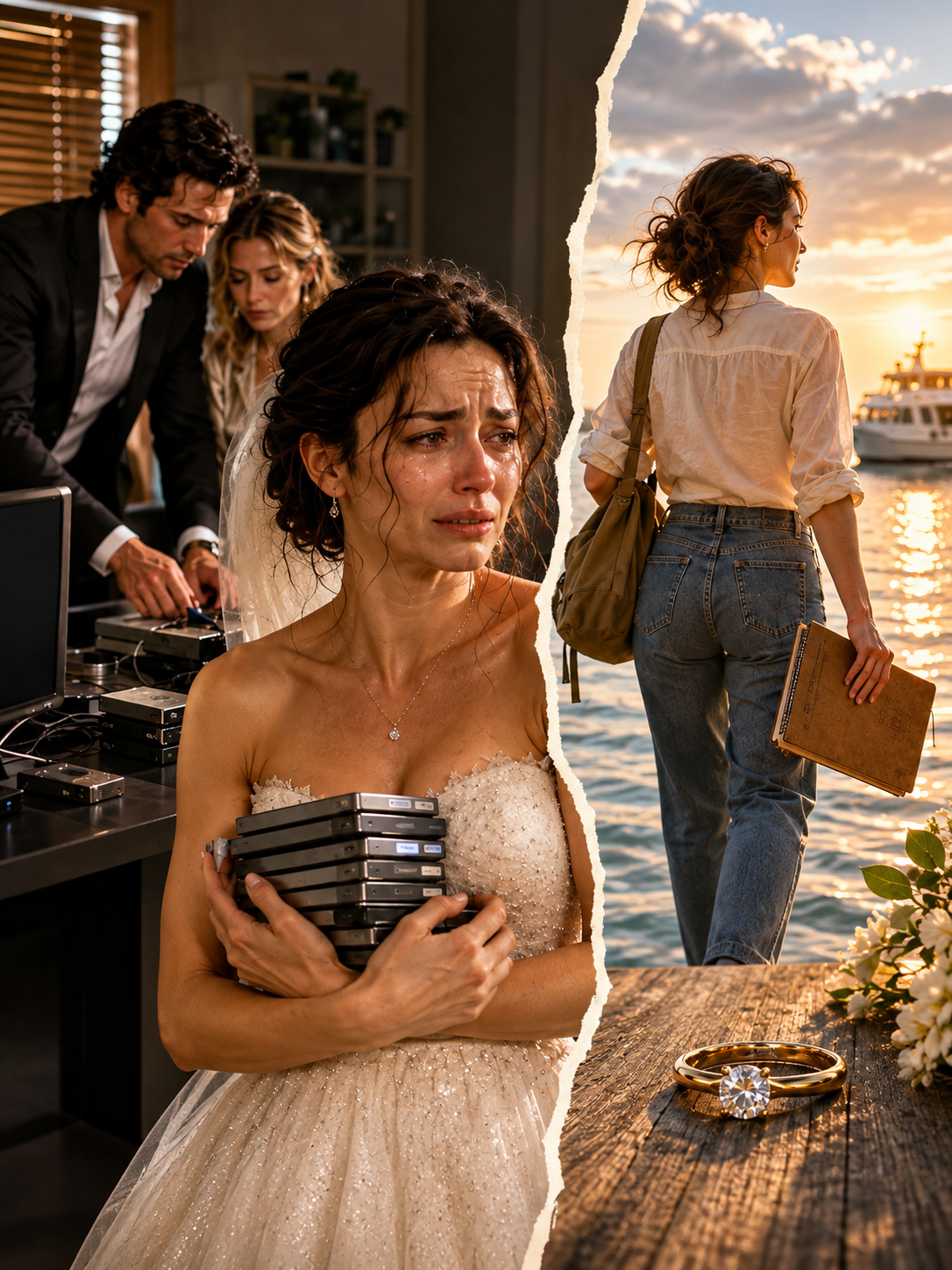
At 9:47 the night before the Pacific Conservation Summit, I found my billionaire husband and my closest
IF FACEBOOK BROUGHT YOU HERE, HERE’S THE CONTINUATION YOU’VE BEEN WAITING FOR. ENJOY! 👇 I called Nela before midnight. She had found a session abstract Tamsin submitted two weeks earlier, naming herself as presenter and Everett’s company as institutional partner. Four unpublished image sets from my research had been used as previews, with their embedded metadata removed.
“The originals still have everything,” Nela told me. I asked her to begin with the 2017 kelp corridor survey and assemble dive logs, authentication timestamps, certifications, and coordinates from before my marriage. There were eight years of records, and I needed the evidence to speak with more precision than I could manage that night.
On my third morning at the cottage, Bette mentioned a visitor at the gate: Ronan Adler, there for an appointment about a restoration proposal. Four months earlier, using my initials, I’d applied to consult on a project restoring native eelgrass in Saratoga Passage. Everett had called it volunteer work for people who couldn’t find real clients, so I hadn’t told him I submitted it.
I almost sent Ronan away. Bette poured coffee and asked whether I truly wanted him gone or simply wanted the world to stop for a while. I changed my sweater, tied back my hair, and went downstairs with my mother’s notebook in hand.
Ronan directed the Adler Coastal Land Trust, which had been restoring estuaries and shellfish beds across the Salish Sea for 15 years. He wasn’t a marine scientist and didn’t pretend to be. “I can read a budget and listen to a community,” he said. “Your proposal tells me what the water needs.”
I laid out my conditions: local contractors, honest publication credit, no donor spectacle, and no contact with Everett or the consortium. Ronan had seen the news about the summit’s changed presenter and the developing institutional review. He didn’t ask me to explain the humiliation; he asked whether I needed my location protected as well as my involvement kept confidential.
“Both, for now,” I said. He agreed, and the work began. By seven each morning, I was measuring salinity, examining sediment, and documenting eelgrass beds that development had damaged over decades. The passage needed patient attention, not glamorous photographs.
Ronan followed through on what he promised. When a donor wanted a tidy observation deck where uneven native plants were needed, he asked me to explain the ecological problem and backed my judgment. But he could misunderstand a shoreline map, and I had to take him outside and show him how a gravel spit changed the currents.
One evening he left a thermos of black coffee by my bag. When I asked how he knew what I drank, he mentioned the untouched sweet tea and the lemon wedges I took from water glasses. “Observation can become intrusion,” I warned. He met my eyes and said, “Tell me when it does.”
On my ninth day away, Everett sent a handwritten letter to the cottage. He admitted being afraid of what the summit meant for his business, claimed he’d ended things with Tamsin, and begged me to come home. He had included a photograph of my mother’s camera housing on his desk; at the edge of the picture sat Tamsin’s distinctive red equipment bag.
I sent the photograph to Nela and asked whether Tamsin was still presenting. She confirmed the morning session and Everett’s company as underwriter. I burned his letter in the kitchen stove, but I preserved the photograph and her reply.
I called nine dive partners and suppliers whose contributions appeared in Tamsin’s materials. I told them what had happened and left the decision to them. Seven withdrew permission for their work to be used; two didn’t, and I respected their choice.
Everett reached me from an unfamiliar number, furious that I was ruining a presentation he said took two years to build. I told him the kelp survey began before we met and that my mother’s dated notebook and external records could prove it. He wanted me back in Seattle to settle matters privately, but the public claim had been made without my permission.
When I ended the call, Ronan was waiting at the garden gate with sediment readings. He didn’t ask me to repeat the argument or offer to handle Everett. He asked if he could sit beside me for a while, and we watched fog drift across the water without making promises either of us was ready to keep.
Part 3 A week later, Ronan brought me a file from the land trust’s archived correspondence. Five months before my separation, Everett’s development company had proposed buying the Saratoga Passage coastal buffer land for a resort corridor. The letter described neighboring properties as likely to become available after a planned personal transition.
Ronan had written a refusal on the trust’s copy. The land was not for sale, the owners hadn’t been approached, and the trust wouldn’t help Everett contact them. But Ronan had known about the proposal before he met me as Delia Cain, and he hadn’t told me when our work began.
“You let me trust you without knowing my husband had tried to acquire this land,” I said. Ronan didn’t hide behind the fact that his refusal had protected the shoreline. At first, he said, he thought telling me about another threat would be cruel; later, my growing trust had made his silence more self-serving.
I asked whether the restoration project had been designed to keep me close. He said my proposal was chosen before the committee knew D. Cain was Everett’s wife and offered the selection records. I believed that, but I still needed him off the project for a week. He agreed and sent every relevant letter without editing what I would see.
I worked with the trust’s operations coordinator while I read the correspondence. Everett had written that I would eventually come around once marriage settled my priorities. Ronan had refused the acquisition before knowing who I was; he had also made a decision about information I deserved to possess. I couldn’t erase either fact.
During that week, I called my mother’s machinist, my graduate advisor, and the university data registry. The machinist had original drawings for the camera housing, my advisor could authenticate my 2016 research methods, and the registry held files uploaded years before I married Everett. I began organizing the testimony around dated, verifiable records, not personal grievances.
On the seventh evening, I drove to Ronan’s Portland office. I asked why protecting me had seemed to give him the right to choose when I learned the truth. “Because I’m good at seeing consequences,” he said, “and too willing to think that makes my timing right.” He apologized without asking for forgiveness on a schedule.
I told him I was going to the summit and wanted the trust represented as a preservation partner, not as my spokesman. He agreed not to negotiate with Everett or disclose the letters unless I requested it. When he asked if I’d missed him, I admitted that I had, more than I wanted to.
I also told him the divorce wasn’t final, and I would never start another relationship that required secrecy. He said he could want something while respecting the time it needed. I kissed him once, briefly, then stepped away; neither of us treated that moment as permission to rush the rest.
The summit was held in a restored pier building on Seattle’s waterfront. I arrived in a slate-gray dress made by a textile artist on Whidbey. Nela met me with the machinist, my former advisor, and a university registrar; Ronan remained near the back among preservation partners, where he’d said he would be.
My underwater photographs covered the walls under Tamsin’s name. In a display case was my mother’s handmade camera housing, labeled as consortium equipment developed in 2021. I stood in front of it and understood that Everett’s attempt wasn’t confined to a few photographs; he’d been trying to rewrite the origin of the tools themselves.
Tamsin began her presentation in a white blazer. She called the kelp corridor survey a five-year collaborative effort and described a reversed latitude marker in one central image as an artistic choice. I knew exactly where that marker came from, and I knew she didn’t.
Part 4 In November 2017, a compass malfunction during a difficult dive had left twelve minutes of footage facing south instead of north. My mother helped me reconcile the readings afterward over leftover pasta. In her field notebook, she’d drawn a small backward arrow and written, “Wrong way, but we were there.”
That mark remained in every original version of the survey. Tamsin had copied an error she couldn’t explain, and she’d turned it into a clever line for the audience. When the program chair invited questions, I was asked to address the room.
I walked to the front with my mother’s notebook. “I created this survey,” I said. “I’ll show you why the records agree with me.” My former advisor confirmed he’d supervised my methodology in 2016, before the company’s environmental partnership; the university registrar showed authenticated uploads dating to 2015.
Then I asked Tamsin to explain the reversed latitude. She started describing an interpretive element again, so I opened the notebook to my mother’s dated entry and let the projection camera show the arrow. I explained the compass failure and the exact dive it came from. People began comparing the dates on the screen instead of watching Tamsin’s expression.
Everett stood and spoke about the consortium’s investment. I acknowledged the six-month partnership that began in March 2021 and offered an accounting of everything produced during it. Seven photographs fell within that period, I said, and none were part of the presentation Tamsin was giving.
I held up the camera housing and identified my mother’s engineering drawings, receipts, and handwritten construction notes. It had never belonged to the consortium. Everett warned me that challenging the joint interpretation could damage my reputation. “My reputation is my work,” I told him. “This is my work.”
Tamsin turned toward him and said he’d assured her I had agreed to the co-authorship arrangement. She referred to a partnership amendment that supposedly carried my signature. I asked to see it. Everett didn’t produce one, and the silence between them made clear how little their accounts matched.
I formally withdrew the kelp corridor survey from consortium use and said I would provide the original authorship documentation to the organizations represented there. I returned the microphone to the chair. I had no interest in inventing a larger speech when the dated records had already done their job.
The summit’s scientific committee withdrew Tamsin’s presentation from its official record. Three important funding partners requested an independent audit before renewing support, while the Northwest Marine Heritage Council suspended the consortium’s conservation certification pending review. None of those decisions happened because I demanded a particular punishment; the organizations had their own obligations.
Near the waterfront doors, Everett’s mother, Carolyn Hargrove, approached me. She said Everett had told the family trust that we’d co-authored the survey and that I’d asked to have my name removed. Carolyn promised an independent review and said he would not represent the company while it proceeded.
I walked outside toward the pier, needing cold air more than congratulations. Ronan joined me later and asked whether I wanted to be near the water. We went to the end of the pier, where the lights shook in the black surface of Puget Sound and my hands finally began to tremble.
He held out his coat and waited until I asked him to put it around my shoulders. “I did it,” I said. “You did,” he answered. I thought I would feel victorious, but mostly I felt exhausted and furious and relieved to have something that belonged to me recognized as mine again.
Final My divorce was finalized four months later, on a Tuesday morning. Everett wouldn’t meet my eyes across the hall. Through his attorney he returned my mother’s notebook and engineering drawings, and the consortium eventually acknowledged in writing that the kelp corridor survey was my original work.
Everett kept his company and his considerable wealth. He didn’t keep the environmental credibility my work had helped lend it. The consortium’s conservation certification was revoked, and two anchor funding partners withdrew; the results were serious, but they didn’t turn his life into a neat moral lesson.
Tamsin’s professional arrangement with him ended the week after the summit. Her university affiliation underwent a misconduct review, three field partnerships declined to renew, and she had to explain the withdrawn presentation when she sought new work. I didn’t track her personal life or seek another confrontation. I asked Nela to bring me only information that affected our research or the legal record.
The Saratoga Passage eelgrass project opened its first public survey season in June. Children from island schools came to read the documentation boards, and an older shellfish farmer brought his grandson out in a flat-bottomed boat to see new growth. I could watch the shoreline change without wondering whose name would appear on the findings.
Ronan found me on the survey platform one afternoon and handed me black coffee with a strip of lemon peel against the rim. He still noticed the details. More importantly, when I disagreed with him or asked for distance, he listened without turning my answer into a negotiation.
By then, the divorce was behind me. I told him I didn’t want us to remain in the uncertain space we’d occupied for months, and he admitted he didn’t either. He asked if he could kiss me, and I answered by taking his face in my hands. It wasn’t a rescue, and I wasn’t returning to the woman I’d been before Everett. I was choosing a relationship in which I could remain the person I’d fought to be.
The kelp corridor photographs were eventually published under my name alone in three conservation journals. One journal placed the image with the backward latitude mark on its cover. The published caption explained the broken compass, the November dive, and my mother’s penciled words: “Wrong way, but we were there.”
I keep her camera housing above my desk at the cottage on Whidbey Island. Sometimes I look up from a new set of readings and see it there, plain and useful, exactly as she made it. I left my ring behind when I finally understood that marriage hadn’t given anyone ownership of my work. What I carried forward was everything that had always been mine.
THE END. I’ve shared the complete story, and I truly hope it touched your heart. If this story moved you, please , like, and share the post. Thank you for reading! ❤️
✓ Lynn R. Adams
IF FACEBOOK BROUGHT YOU HERE, HERE’S THE CONTINUATION YOU’VE BEEN WAITING FOR. ENJOY! 👇 I called Nela before midnight. She had found a session abstract Tamsin submitted two weeks earlier, naming hers…