At 7:43 on a Tuesday morning, a ruthless homeowners association president
Part 2: Behind beautiful suburban homes, one woman built an empire of fear
When Emily and I first visited Silver Creek Estates, the neighborhood looked like something from a real estate . Mature oak trees shaded winding streets, children rode bicycles past tidy lawns, and small American flags fluttered from front porches. The community had a clubhouse, walking trails, and a homeowners association that supposedly existed to protect property values and maintain shared spaces. We purchased a modest brick house on Elmwood Court, believing we had found somewhere to enjoy the quieter chapter of our lives. Nobody warned us that the neighborhood’s greatest problem lived three streets away in a house decorated with perfectly trimmed hedges and an oversized brass nameplate.
Linda Crawford had served as HOA president for three years, and she approached the position with the intensity of someone commanding a military operation. She attended every meeting carrying thick binders, quoted regulations from memory, and maintained detailed records of homeowners who questioned her decisions. Her adult son, Ethan, frequently accompanied her, presenting himself as an unofficial enforcement adviser despite holding no elected position on the board. Together, they created an atmosphere in which a minor disagreement could trigger months of inspections, escalating fines, and threatening letters. Residents gradually learned that remaining silent was cheaper than challenging the woman who controlled the paperwork.
Our first conflict began six months after moving in, when Linda claimed our trash bins had remained visible beyond the permitted collection window. I checked our security camera footage and discovered that we had returned them to the garage well within the deadline. Rather than acknowledge the evidence, Linda issued another warning citing a different provision that seemed conveniently tailored to our situation. A month later, we received a fine because our garage door had allegedly remained open during prohibited daytime hours. When I reviewed the governing documents, I discovered that the relevant rule had recently been amended by Linda’s board, with little effort to notify residents about its expanded requirements.
The notices multiplied until our mailbox became something Emily dreaded opening after work. Linda objected to the color of our flowering shrubs, the placement of a garden hose, and the way my pickup faced when parked in our driveway. Similar conditions existed throughout the neighborhood without attracting any enforcement, but our property somehow became the subject of almost every special inspection. I answered each letter politely, requested clarification when necessary, and preserved every document instead of arguing in the street. Linda interpreted my restraint as submission, apparently unaware that I had spent decades negotiating business disputes with people far more intimidating than an HOA president.
One evening, Emily spread the notices across our kitchen table and arranged them according to their dates. She had taught literature at a community college for years, and she possessed a remarkable ability to recognize patterns hidden beneath seemingly unrelated details. After studying the letters, she pointed out that each new violation followed shortly after we questioned an earlier decision. “Jack, this isn’t enforcement anymore,” she told me, tapping the paperwork with her finger. “She’s testing how much pressure she can put on us before we either surrender or leave.”
I already suspected as much, but hearing Emily describe the pattern made me realize how deeply the situation had affected her. She had begun checking the driveway before bedtime, photographing our trash bins, and worrying whenever an unfamiliar vehicle slowed near the house. These were small changes, yet they represented something Linda had successfully stolen from us without ever entering our home. We had purchased the property to enjoy our independence, but our daily routines were increasingly shaped by fear of another arbitrary accusation. I promised Emily that we would not allow our lives to remain organized around Linda’s moods.
During a November inspection, Linda claimed twelve violations on our property while identifying only seven additional violations across six neighboring homes. Four of our citations referred to provisions that had either been repealed or did not appear in the recorded version of the community standards. I sent a written request for clarification, attaching the relevant documents and asking the board to identify the authority supporting those charges. Linda responded by repeating the accusations and adding an administrative processing fee, apparently believing that persistence could substitute for legal justification. I placed her response in the filing cabinet, knowing that every careless sentence would eventually matter.
By the time my pickup was towed, our accumulated fines and disputed charges had become substantial enough to make an ordinary family seriously consider moving. Emily occasionally asked whether remaining in Silver Creek was worth the emotional cost, especially when we could afford to purchase another home elsewhere. I understood her frustration, but leaving would not solve the problem for the neighbors who lacked our resources. Something about the closed curtains and hurried conversations suggested that Linda’s behavior extended far beyond our household. I had no idea how right that suspicion would prove until an elderly woman arrived at our front door carrying twenty-seven months of evidence.
Part 3: An elderly neighbor reveals the families destroyed by endless fines
Margaret Collins knocked on our door three evenings after the towing incident, holding a swollen accordion folder against her chest. She was seventy-one, a retired schoolteacher with silver hair, sensible shoes, and the careful manners of someone accustomed to remaining composed under pressure. Emily invited her inside, offered tea, and noticed immediately that Margaret’s hands were trembling as she removed the folder’s worn rubber band. Margaret explained that she had watched my pickup being taken and wondered why I had appeared so calm. Then she opened her records, and the true scale of Linda Crawford’s cruelty began to emerge.
Inside were forty-three violation notices, fifteen towing records, several threats involving property liens, and handwritten logs documenting every interaction with the association. Margaret had preserved bank statements showing that she had paid more than four thousand dollars in fines and recovery fees over approximately two and a half years. She described the amount without exaggeration, but Emily understood what those payments meant for a retired teacher living on a fixed income. Margaret had postponed dental treatment, skipped a visit to her sister, and struggled to cover winter heating expenses because the association kept demanding more money. The woman responsible for those sacrifices lived nearby in a house with decorative fountains and a garage large enough for three luxury vehicles.
Margaret told us that she had tried appealing directly to the board, only to receive vague replies or additional warnings about noncompliance. She had contacted county officials once, but the information available at that time had not been sufficient to establish a broader enforcement problem. Eventually, she stopped complaining publicly because Linda seemed to punish anyone who challenged her authority. Yet Margaret continued documenting everything, believing that even if nobody listened today, the records might protect someone tomorrow. I looked at her carefully arranged papers and realized that her quiet determination resembled my own more closely than she could have imagined.
Over the following weeks, other residents began visiting our kitchen table with stories they had previously been too frightened to share. A young couple named Daniel and Sarah described the morning their car was towed while Sarah was experiencing contractions before the birth of their second child. They had called the hospital, gathered their bags, and discovered that the vehicle they needed had vanished from the driveway. A neighbor eventually drove them to the maternity ward, but Sarah spent the journey terrified that their baby would arrive before they reached medical care. Linda later dismissed the incident as an unfortunate consequence of failing to follow established parking requirements.
Then came Dave Patterson, a retired veteran who had spent two years pursuing a federal contracting opportunity that could have transformed his family’s finances. On the morning of a required vehicle inspection, his truck was removed for allegedly facing the wrong direction on his driveway. Dave scrambled to arrange transportation, arrived forty-five minutes late, and discovered that the contractor had already left. The opportunity disappeared, taking with it months of preparation and the possibility of work he had desperately needed. When he finished speaking, Dave stared at his hands for a long time before admitting that the humiliation had hurt almost as much as the lost income.
Tom Reynolds, a single father raising two daughters, brought documents showing how an unexpected towing fee had destroyed his chance at a delivery job. He had been scheduled for a vehicle inspection when his car was impounded, forcing him to borrow money for recovery charges he couldn’t afford. By the time he retrieved the vehicle, the employer had moved forward with another applicant. Tom described explaining the disappointment to his daughters without telling them how frightened he had become about paying rent. Emily excused herself briefly after his visit, and I found her crying quietly beside the kitchen sink.
Every account shared a disturbing feature: Summit Recovery Services had performed the towing under instructions issued through Linda’s association. I opened the company’s administrative records and requested a complete review of its Silver Creek assignments, including dispatch recordings and driver observations. The results revealed 158 towing orders over twenty-seven months, with ninety-one carrying internal notes identifying potentially questionable circumstances. Ryan Brooks had written many of those notes, describing vehicles that appeared compliant, disputed violations, and situations involving vulnerable residents. His observations had remained inside the company’s operating system without receiving the attention they deserved.
The discovery forced me to confront my own responsibility as the company’s ultimate owner. Although professional managers handled daily operations, Summit had participated in actions that caused real harm, and I couldn’t pretend ignorance erased that fact. I instructed our compliance team to preserve every record, review the flagged assignments, and establish stronger procedures for escalating questionable enforcement requests. Then I contacted Patricia Haynes, an attorney experienced in homeowners association disputes, and arranged a confidential meeting with several affected residents. Linda believed she had been teaching the neighborhood a lesson about obedience, but her own paperwork was beginning to tell a very different story.
Part 4: A hidden ownership secret turns the towing contract against her
Patricia Haynes listened to our evidence for nearly an hour without interrupting, occasionally writing brief notes on a yellow legal pad. She had spent fifteen years handling property disputes, and her expression grew increasingly serious as she examined the repeated violations and towing records. When I showed her the notices citing nonexistent or repealed rules, she requested copies of the governing documents and their recorded amendments. When Margaret described the financial consequences of the fines, Patricia asked for receipts, bank statements, and the association’s responses to her appeals. By the time we finished, she believed there were substantial grounds to investigate a pattern of selective and potentially unlawful enforcement.
I then showed Patricia the corporate records establishing my ownership of Summit Holdings and its towing subsidiary. She leaned back, studied the documents, and asked whether Linda knew that the man she was targeting controlled the company performing her enforcement orders. I told her Linda had apparently never researched the ownership structure despite negotiating the exclusive contract personally. Patricia shook her head, not because the coincidence was amusing, but because the records created an unusually clear connection between Linda’s decisions and the resulting financial harm. She warned that my ownership also required careful handling because our company would need to account for its own conduct rather than pretending every responsibility belonged to the HOA.
That afternoon, Patricia outlined a strategy based on documented facts rather than dramatic confrontation. We would challenge improper fines and any property liens, gather sworn statements from affected homeowners, and request review by the appropriate authorities. Summit would preserve its records, cooperate with legitimate inquiries, and examine its procedures for accepting questionable towing instructions. Residents who had suffered measurable losses could pursue appropriate civil remedies, subject to the evidence and applicable law. The goal was not to humiliate Linda in return, but to prevent her from continuing to weaponize community rules against people who could least afford resistance.
Meanwhile, Linda grew more aggressive as though she sensed that her control was beginning to weaken. She sent increasingly severe letters accusing me of maintaining an ongoing pattern of violations and refusing to respect the association’s authority. Ethan appeared at a board meeting and suggested that homeowners who accumulated significant unpaid charges could eventually face foreclosure proceedings. Linda then threatened to attach a lien to our property, despite the substantial disputes surrounding the underlying assessments. I forwarded the correspondence to Patricia and continued documenting each development without giving Linda the public argument she wanted.
In March, the association filed a lien claiming that our outstanding fines, administrative charges, and impoundment expenses totaled twelve thousand forty dollars. Emily stared at the notice for several minutes, struggling to believe that such an enormous demand could arise from shrubs, parking positions, and disputed paperwork. Patricia immediately began challenging the claim, while I reviewed the documents for inconsistencies and unsupported charges. Linda interpreted our lack of public outrage as evidence that we were finally becoming frightened. She decided to make one final demonstration of her authority before the next scheduled HOA meeting.
At on a Thursday morning, Linda called Summit Recovery’s dispatch office and demanded the immediate removal of four vehicles from our property. She identified herself as the association president, supplied an enforcement order number, and insisted that the trucks arrive before the neighborhood became busy. Twice during the conversation, she declared that she controlled the contract and expected her instructions to be carried out without argument. The dispatcher preserved the call, and the request was escalated for legal and compliance review while arrangements were made to document the operation. Linda had no idea that every sentence she spoke was becoming part of a record her own attorneys would eventually struggle to explain.
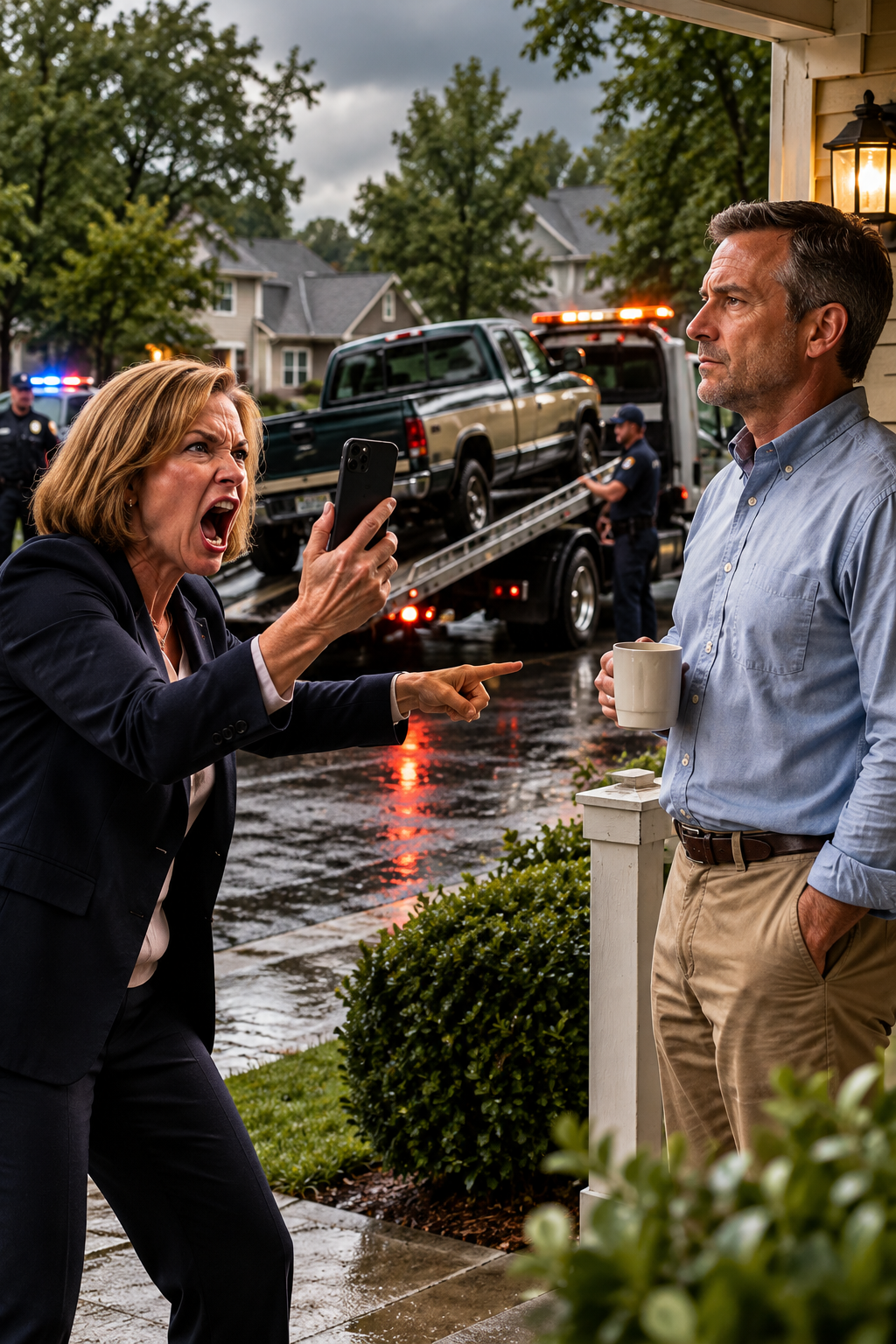
Four Summit trucks arrived on Elmwood Court shortly afterward, their warning lights flashing against the windows of neighboring houses. Linda stood beside her parked vehicle, filming as drivers began removing the cars she had identified, apparently delighted by the spectacle. Ryan was among the drivers, and he carefully recorded the condition and location of each vehicle before the equipment moved. Emily watched from the porch with her arms folded, refusing to give Linda the emotional performance she was desperate to capture. I stood beside my wife, thinking about the elderly teacher, the veteran, the single father, and every family whose suffering had made this moment much larger than our driveway.
When the last truck disappeared, Linda turned toward her camera and announced that nobody in Silver Creek Estates stood above the community’s rules. She added that she possessed complete authority over the towing agreement and would continue removing vehicles until every resident learned to comply. I said nothing, although I knew Patricia would find that recording particularly valuable when examining Linda’s claims about her enforcement powers. Later that afternoon, I received confirmation that the dispatch recordings, photographs, and work orders had been securely preserved. The next HOA meeting was three weeks away, and for the first time since moving to Silver Creek, I knew exactly how the confrontation would unfold.
Part 5: At a packed community meeting, the president loses control
The community room at Silver Creek Estates normally held fewer than thirty residents during monthly HOA meetings. On the evening Linda planned to expand her towing authority, every chair was occupied, people stood along the walls, and the parking lot overflowed into the adjoining street. Margaret Collins sat in the front row with her accordion folder resting on her knees, while Dave Patterson and Tom Reynolds waited nearby. Emily and I chose seats toward the middle, close enough to observe Linda without becoming the center of attention. At the front stood Linda and Ethan, wearing the confident expressions of people who believed the outcome had already been arranged.
Linda opened the meeting by announcing proposed changes that would allow broader vehicle enforcement with fewer advance warning requirements. She described the amendments as necessary improvements designed to preserve neighborhood standards and protect responsible homeowners from persistent offenders. Before she could call for a vote, Margaret raised her hand and requested permission to address the board. Linda replied that public comments would occur afterward and instructed her to remain seated until the appropriate agenda item. Margaret stood anyway, holding the folder that contained nearly three years of financial sacrifices.
For eleven minutes, Margaret spoke with the calm precision of a teacher delivering the most important lesson of her career. She described the repeated fines, the towing incidents, the unanswered appeals, and the expenses that had forced her to postpone medical care. She read exact dates and amounts, allowing the records to establish the pattern without resorting to insults or emotional exaggeration. Linda interrupted several times, but each interruption made Margaret’s composure appear stronger and the president’s authority less convincing. When Margaret finally sat down, the room remained silent for several seconds before Tom rose from his chair.
Tom described losing his delivery job opportunity because his car had been towed before a required inspection. Dave followed with the story of the federal contracting appointment he had missed after his truck was removed from his driveway. Sarah explained what it felt like to stand outside her home in labor while her husband desperately searched for transportation. Other residents began speaking about unexplained fees, inconsistent enforcement, threatening letters, and the anxiety of never knowing what accusation might arrive next. The meeting Linda had intended as a celebration of her authority became an accounting of the lives her decisions had damaged.
Ethan attempted to interrupt, arguing that residents were responsible for understanding the rules before purchasing property in the development. A woman near the back asked whether those rules included provisions that had already been repealed when fines were issued. Another homeowner demanded to know why identical landscaping received penalties on one street but remained acceptable on another. Linda tried to redirect the discussion toward the scheduled vote, but the room no longer responded to her commands. Someone finally called my name and asked whether I would explain why my family had been targeted so aggressively.
I walked to the podium carrying a slim folder containing three sets of documents. After introducing myself and giving my address, I explained that I was the founder and sole owner of Summit Holdings, the parent company of Summit Recovery Services. The room fell silent as I stated that the towing company Linda had used against dozens of residents belonged to the very homeowner she had repeatedly threatened. I placed the corporate ownership records beside the exclusive towing contract bearing Linda’s signature. Then I distributed a summary of the 158 towing orders and the ninety-one assignments containing internal notes questioning their circumstances.
Linda’s face changed so dramatically that even people standing at the back could see her composure beginning to collapse. She demanded to know whether I had deliberately concealed my ownership to entrap the association, but I reminded her that the corporate records were publicly available. I explained that our evidence had been provided to Patricia Haynes and the relevant authorities for review, including the disputed citations, towing records, and documentation of residents’ losses. I also acknowledged that Summit had responsibilities of its own and that the company was reviewing its procedures rather than attempting to escape scrutiny. My objective, I told the room, was accountability for everyone involved, including the business I owned.
I then described the morning Linda ordered four vehicles removed from my driveway and the dispatch recording in which she repeatedly asserted her control over the contract. Her own video showed her directing the operation while declaring that nobody could challenge her authority. Patricia had already received the recordings, and the lien against our home was being contested through the appropriate legal process. I did not threaten Linda or demand that anyone punish her before the evidence received proper examination. I simply asked the homeowners whether they wanted to grant additional enforcement powers to a board that had refused to answer such serious questions.
Nobody applauded immediately, and the silence felt heavier than any cheering could have. Gerald, one of the remaining board members, announced that he could no longer support the proposed amendments or continue serving without an independent review. Susan, another director, requested that the vote be postponed and that the association preserve all relevant records. Linda attempted to continue the meeting, but residents demanded answers she seemed unable to provide. When she finally gathered her papers and walked toward the exit with Ethan, nobody moved aside with the frightened urgency she had once commanded.
Part 6: The legal investigation uncovers years of calculated neighborhood harassment
The days following the meeting brought an extraordinary change to Silver Creek Estates. Neighbors who had previously avoided eye contact began speaking openly about their experiences, comparing notices, and discovering that many had received contradictory explanations for identical violations. Gerald resigned from the board, while Susan retained counsel and agreed to cooperate with the investigation into the association’s enforcement practices. Patricia filed civil claims on behalf of eighteen named homeowners, seeking appropriate relief for disputed charges and documented financial harm. The county also began examining whether the association had followed the procedural requirements governing its enforcement actions.
Linda responded through an attorney who described the allegations as a coordinated effort to undermine legitimate community governance. She insisted that the board had acted in good faith and that dissatisfied residents were exaggerating ordinary disagreements about property maintenance. Yet the documents told a story that became increasingly difficult to dismiss as isolated misunderstandings. Investigators identified citations referring to repealed provisions, inconsistent treatment of similar properties, and enforcement decisions that appeared closely connected to residents’ complaints. The more records they examined, the clearer it became that Silver Creek’s problems extended far beyond my family.
Margaret’s folder became particularly important because it established a detailed history of notices, payments, appeals, and threats stretching across more than two years. Her bank statements demonstrated the actual financial burden, while correspondence showed how repeatedly she had tried to resolve the disputes without confrontation. Tom provided evidence of his lost employment opportunity, including the inspection appointment and the fees he paid to recover his vehicle. Dave submitted records concerning his missed contracting appointment and the circumstances surrounding the towing of his truck. Their stories were no longer private disappointments whispered across kitchen tables, but documented claims receiving formal examination.
Summit’s internal records supplied another perspective on how the association’s instructions had affected residents. Ryan’s yellow-flag notes described questionable towing circumstances, including vehicles that appeared compliant and situations where drivers had expressed concern about the orders they received. Investigators compared those observations with the HOA’s written authorizations, notices, and governing provisions. Some assignments raised questions about whether proper notice had been provided, while others revealed discrepancies requiring further investigation. I authorized our company to cooperate fully and introduced procedures requiring higher-level review when drivers identified potentially improper enforcement requests.
The process was uncomfortable because I had to accept that the company I built had helped carry out actions that harmed innocent people. I could not stand before my neighbors demanding accountability from Linda while refusing to examine the business that physically removed their vehicles. Several residents appreciated that acknowledgment, although others understandably remained angry about the role Summit had played. I met with affected homeowners and listened without attempting to defend every decision made by managers I had trusted. The experience taught me that ownership meant accepting responsibility for problems you failed to notice, not merely celebrating the profits appearing in quarterly reports.
The court eventually set aside the disputed lien against our property after reviewing the challenge brought by Patricia. The ruling removed the immediate threat hanging over our home, but the broader litigation continued as residents sought compensation and institutional reforms. A county review produced findings describing serious deficiencies in the association’s enforcement practices, including inconsistent application of rules and failures to observe required procedures. Those findings strengthened the homeowners’ position and placed additional pressure on the association and its insurers to resolve the claims. Linda continued denying wrongdoing, but her influence over the community was shrinking with every document released.
Negotiations eventually produced a compensation arrangement addressing documented losses, with payments varying according to the evidence supporting individual claims. Margaret recovered money connected with improper charges, while Tom and Dave received compensation reflecting portions of the economic harm they had established. Other residents obtained reimbursements or settlements related to towing expenses, fines, and associated costs. The process did not erase the fear they had endured or restore every opportunity that had disappeared. Nevertheless, it represented a meaningful acknowledgment that the association’s actions had consequences beyond the numbers appearing on its financial statements.
Linda also faced formal restrictions on her future participation in HOA leadership following the relevant oversight proceedings. The resulting seven-year prohibition covered leadership and committee positions within the scope of the order, ending the authority she had treated as the foundation of her identity. Ethan disappeared from community meetings after the investigations intensified, leaving his mother to confront the consequences of the system they had defended together. I heard that Linda considered the outcome unfair and believed the neighborhood had betrayed her. What she never seemed willing to recognize was that residents had simply stopped accepting the idea that obedience mattered more than justice.
Part 7: A retired teacher rebuilds the neighborhood once ruled by fear
Margaret Collins became the new HOA president in an election that drew more residents than any community vote in recent memory. She accepted the position reluctantly, explaining that she had never wanted authority over her neighbors and considered the board’s purpose to be service rather than control. Her first proposal was to review every enforcement procedure that had allowed Linda to operate without meaningful accountability. Residents attended workshops, examined draft bylaws, and debated how to protect community standards without giving future board members unchecked discretion. The process was slower than Linda’s meetings, but nobody complained about the time required to make decisions openly.
The revised rules required two authorized board members to review towing requests before approval, except where genuine safety or legal emergencies justified different procedures. Residents would ordinarily receive written notice and an opportunity to correct violations before vehicles could be removed. Meeting minutes, enforcement policies, and major board decisions would be made accessible so homeowners could understand how the association exercised its powers. An independent resident panel would review contested fines before they became enforceable obligations under the revised process. Margaret insisted that transparency was not an inconvenience to good governance, but the very condition that made good governance possible.
At the first meeting under the new structure, sixty-three residents filled the community room where Linda had once silenced anyone who questioned her. Margaret opened by reminding everyone that the board existed to serve homeowners and that homeowners had a responsibility to hold their representatives accountable. Then she moved directly into ordinary business, including landscaping guidelines, maintenance schedules, and the annual budget. When someone mentioned that my flowering shrubs were finally included among the approved plant varieties, laughter spread naturally through the room. It was the first time I had heard that kind of relaxed laughter at an HOA meeting since moving to Silver Creek.
Emily squeezed my hand beneath the table, and I understood what she was thinking without needing to ask. We had spent so many months anticipating threatening letters that ordinary neighborhood conversations now felt almost unfamiliar. The simple act of attending a meeting without fear of retaliation had become something residents appreciated rather than took for granted. Afterward, people lingered in small groups, discussing gardens, school events, home repairs, and weekend plans. Nobody hurried away because they were worried that an innocent remark might be used against them later.
Margaret began hosting Saturday morning coffee gatherings on her porch, inviting residents to stop by without appointments or formal agendas. At first, only a handful attended, but within several months the group regularly included more than a dozen neighbors. Dave brought his dog, Tom occasionally arrived with his daughters, and Sarah shared photographs of the baby whose birth had nearly been complicated by the towing incident. These gatherings did not involve speeches about justice or dramatic declarations about overcoming oppression. They consisted of ordinary conversations, which was precisely what made them extraordinary after years of fear.
My relationship with Ryan Brooks changed as well, although he remained uncomfortable whenever anyone described his dispatch notes as heroic. He explained that he had written those observations because the assignments troubled him and because preserving accurate information seemed like the responsible thing to do. He had not expected the notes to become evidence in a major dispute or to help families recover money they desperately needed. I told him that integrity often began with documenting something uncomfortable when nobody was asking you to speak. Summit subsequently expanded its employee reporting procedures so concerns could reach managers before questionable assignments became repeated patterns.
One afternoon, Emily asked whether I regretted waiting so long to reveal my ownership of the towing company. I admitted that I had questioned my decisions, particularly after hearing how many residents had suffered while our business continued accepting the association’s instructions. The legal record eventually helped expose the larger problem, but that outcome did not mean every earlier decision had been perfect. Emily reminded me that accountability required learning from the past rather than pretending we could rewrite it. Her words stayed with me because they applied as much to my business as they did to the neighborhood we were rebuilding.
By late summer, Silver Creek Estates looked almost identical to the place we had purchased eighteen months earlier. The houses had not changed, the trees still shaded the sidewalks, and the same familiar mailboxes stood beside carefully maintained driveways. Yet children played outside longer, neighbors exchanged phone numbers, and homeowners stopped photographing every harmless detail of their properties for fear of another violation. People once again believed they could disagree with a board decision without risking financial punishment. The most important transformation was invisible from the street, but everyone who lived there could feel it.
Part 8: The man she underestimated discovers victory means finally living freely
On a Saturday morning in June, I stood on our front porch holding a cup of coffee that was still warm. My Ford F-150 rested in the driveway where it belonged, returned after the association’s towing arrangement had been terminated and the disputed enforcement actions reviewed. Across the street, Margaret knelt beside her flower beds, pulling weeds with the patient concentration of someone enjoying an ordinary morning. Dave walked past with his dog and raised a hand, while two children drew an elaborate roadway across the sidewalk using brightly colored chalk. Nothing about the scene would have interested a television reporter, yet it represented the ending I had wanted more than any courtroom victory.
Emily stepped outside carrying a small package wrapped in faded blue paper, which she had discovered beneath the rear seat of my truck. She explained that she had purchased it months earlier as an anniversary gift, then forgotten about it during the endless cycle of fines, legal correspondence, and towing disputes. Somehow, the package had traveled to the impound lot and back without being opened or damaged. I carefully removed the paper and found a handsome leather-bound journal with my initials pressed into the cover. Inside, Emily had written a message thanking me for building a life with her and reminding me that peace was worth protecting.
I held the journal for a long time, thinking about how close we had come to allowing Linda’s campaign to define our marriage. We had spent evenings discussing violations instead of books, checking security footage instead of watching movies, and worrying about property notices instead of planning vacations. Emily had supported me through every stage, but she had also paid an emotional price for a conflict neither of us wanted. I apologized for the nights when my determination to document everything had left too little room for ordinary happiness. She kissed my cheek and told me that the best way to honor what we had endured was to stop allowing it to occupy our future.
Later that morning, Ryan drove a Summit truck down Elmwood Court on his way to assist a homeowner whose vehicle had genuinely broken down. He slowed near our driveway, noticed me standing beside the pickup, and offered a brief wave through the open window. I raised my coffee cup, and he answered with a quick tap of the horn before continuing toward his assignment. The exchange lasted only seconds, but it reminded me of how much had changed since the morning he removed my truck under Linda’s instructions. He was still doing the same kind of work, yet the company now operated with stronger safeguards intended to prevent another association from exploiting its services.
The following month, Patricia invited several residents to a final meeting concerning the implementation of the settlement and the remaining administrative requirements. Margaret reviewed the compensation records, Tom confirmed that his payment had arrived, and Dave expressed relief that the legal proceedings were finally approaching completion. Nobody pretended the money could return lost time or erase the humiliation of being treated as powerless. Nevertheless, the settlement had helped families regain financial stability and established consequences for the practices that had caused their suffering. When the meeting ended, Patricia closed her folder and told us that the strongest cases were often built by ordinary people who refused to discard inconvenient evidence.
I thought about that observation while walking home beside Emily through the quiet neighborhood. Margaret had preserved her receipts because she believed the truth mattered, even when nobody seemed willing to listen. Ryan had written yellow-flag notes because he wanted an accurate record of assignments that troubled his conscience. Tom, Dave, Sarah, and other residents had kept documents connected to experiences they would rather have forgotten. My filing cabinet had provided a place to organize those records, but their courage had given the evidence meaning.
Linda’s greatest mistake had never been failing to investigate the ownership of Summit Recovery Services, although that oversight certainly accelerated her downfall. Her deeper mistake was believing that the people around her existed only as individuals she could intimidate, isolate, and punish. She had understood how to manipulate rules, but she had underestimated what could happen when frightened neighbors began trusting one another again. By making every disagreement personal and every punishment public, she had created the very record that eventually exposed her conduct. Her authority collapsed not because I was secretly wealthy, but because documented facts proved stronger than the fear she had spent years cultivating.
In the months that followed, I rarely heard Linda’s name mentioned outside occasional conversations about the past. Margaret focused on running transparent meetings, residents returned to their routines, and the association gradually became the modest administrative organization it should have been all along. Emily planted tomatoes behind our house, and I finally repaired the loose porch railing that had been waiting for my attention since before the first towing incident. We traveled to visit family, invited neighbors over for dinner, and began enjoying the home we had nearly allowed someone else to ruin. I realized that freedom was not simply the absence of threats, but the return of ordinary choices that fear had quietly taken away.
One evening, Margaret stopped by with a small basket of tomatoes from her garden and asked whether I ever imagined what Linda thought about the outcome. I admitted that I occasionally wondered whether she understood how much harm her decisions had caused, but I no longer needed an answer. Margaret smiled and said that she had stopped waiting for an apology too, because her life had become too full to organize around someone else’s regret. We stood together for a moment watching children race bicycles along the sidewalk, their laughter carrying through the warm evening air. Then she returned home, leaving me with the simple realization that the neighborhood’s recovery mattered far more than the downfall of its former president.
Years later, I would still remember the exact sound of the winch pulling my pickup onto that flatbed at on a Tuesday morning. I would remember Linda’s confident smile, Emily’s worried expression, and the frightened neighbors watching from behind their curtains. I would also remember the packed community room, Margaret’s trembling hands becoming steady as she spoke, and the moment dozens of residents realized they no longer had to remain silent. Those memories became reminders that power without accountability could damage a community, but shared courage could help repair it. And whenever someone asked why I had remained so calm while Linda ordered my truck removed, I gave them the same answer I had eventually learned to believe with all my heart.
“Because patience isn’t surrender, and silence doesn’t always mean defeat,” I would tell them. “Sometimes the person who looks powerless is simply waiting for the truth to become impossible to ignore.” I had owned the trucks, the company, and the contract Linda believed gave her control over our lives. But none of those things was the greatest victory I carried away from Silver Creek Estates. My greatest victory was sitting beside Emily on our porch, watching our neighbors live without fear, and realizing that the woman who had once occupied every corner of our thoughts no longer occupied even a single minute of our day.
✓ Lynn R. Adams
Part 2: Behind beautiful suburban homes, one woman built an empire of fear When Emily and I first visited Silver Creek Estates, the neighborhood looked like something from a real estate . Mature oak …