At 7:12 on a cold Oregon morning, retired engineer Ethan Cole watched a bulldozer
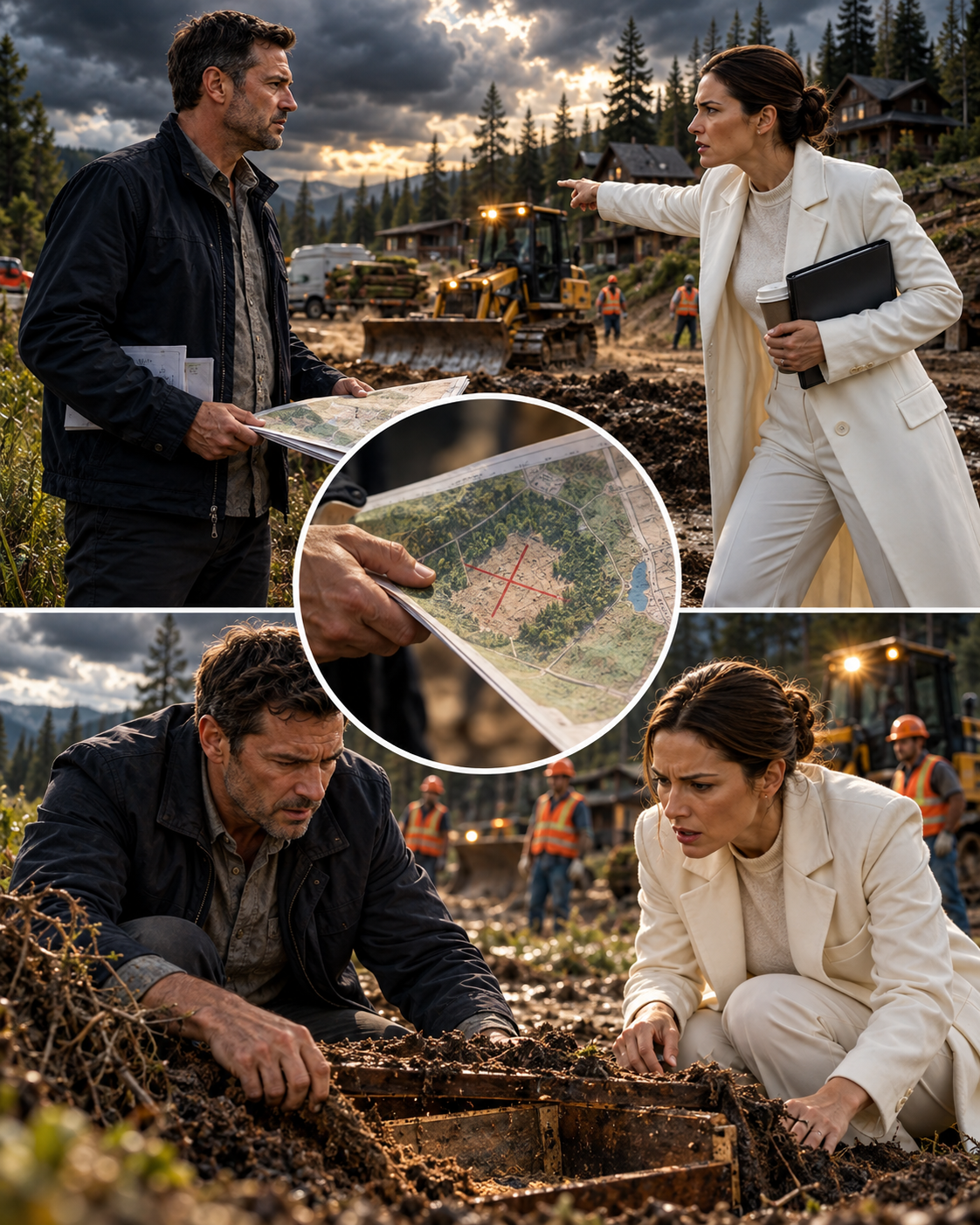
Part 2: Vanessa’s beautification campaign dismisses every warning from the engineer
The original engineers had designed Cedar Hollow for the land it occupied, not for a brochure photograph. Their drainage plan accounted for the way the north slope shed water quickly during long storms, especially when rain followed late-season snow. A major test came in 1996, when four inches fell in thirty-six hours on top of a heavy snowpack. The canal ran almost to its stone edges, but the cabins remained dry. Ethan had studied the original survey before buying his hillside cabin in 2016, and the soundness of the drainage system had been one reason he chose the property.
For six years, the resort’s homeowners association had been quiet and practical. Its board collected dues, repaired parking areas, and met only when something needed attention. Then Vanessa arrived in 2022, buying one of the larger cabins near the trailhead and the views featured in the resort’s listings. A luxury real estate broker, she spoke of “elevating the Cedar Hollow experience” and was elected president within months. Her instinct for staging beautiful properties had helped her sell homes across three states, but it also shaped her approach to the resort: make the visible parts look elegant, hide the functional parts, and remove whatever resisted.
Vanessa began with mismatched cabin paint, the rusting communal fire pit, and the simple utility lights along the trails. She called the weathered entrance sign “aggressively rustic” and treated each improvement like a renovation checklist. The canal soon became her most ambitious target because it was visible, rough around the edges, and impossible to conceal without destroying its purpose. In January 2024, the association newsletter announced the Mountain Walk beautification project, promising a stone path, ornamental plants, and solar lights. The announcement said almost nothing about drainage, describing the canal as an outdated trench that would be replaced by something more welcoming.
Ethan’s first warning arrived on February 7. He sent the full board a concise email with the county easement documentation and a one-page hydrology summary showing the basin size and estimated peak flows during a major storm. He explained that the channel was protected infrastructure and that runoff would seek a new route if the HOA blocked the old one. The five board members included Vanessa, longtime member Walter Boon, a retired teacher who remembered the 1996 storm, and three other residents. Ethan received no reply.
On February 22, he sent a second warning, copying the county water resources compliance office and the HOA’s property manager. He asked whether the association had applied for a county variance, since code section 14.3 prohibited modifying designated drainage corridors without approval from county engineers. The property manager sent an automated acknowledgment and nothing more. On March 4, Ethan mailed every board member a four-page certified letter describing his engineering credentials, the legal exposure, and the likely consequences of filling the channel. He made the distinction plain: this was not a cosmetic choice the HOA could settle by vote; it was a county matter involving public infrastructure.
Part 3: The board approves the trail, and evidence begins gathering around Ethan
The certified letter arrived at Cedar Hollow’s management office on March 6 at in the morning. Ethan kept the receipt. On March 12, he attended the board meeting with his folders and presented his concerns during the three-minute public comment period. He placed a copy of his materials before every member and outlined the county easement, the flow calculations, and the risk to lower cabins. Vanessa listened with folded hands and an expression that suggested the outcome had already been settled. When he finished, she thanked him for his diligence and said they were building beauty, not preparing for imaginary disasters.
The vote was four to one in favor of the project. Walter cast the only opposing vote and looked across the table at Ethan with an expression that held both apology and warning. Ethan gathered his papers and drove home through a light rain, then checked the forecast from the National Weather Service. An atmospheric river was expected to reach the Oregon coast within eighteen to twenty-two days. The Cedar Green Trail was finished in eleven. During a dry, cool stretch of late March, contractors filled the channel with compacted gravel and topsoil, buried or removed the fieldstone edges, and scraped away the sedge and wild iris.
Vanessa’s design included ornamental grasses, flowering shrubs, a smooth pale stone path, and low solar lights. At the canal’s upper end, the crew installed a cedar bench and a carved sign reading “Cedar Green Trail.” On a clear morning, Vanessa posed beside it for the April newsletter under the headline “Transforming Nature Into Elegance.” The photograph showed the path curving neatly among the trees and thanked the landscaping team, board, and community. Ethan’s name did not appear, though he had spent weeks trying to prevent the work. During construction, he had added two cameras near his property, aimed at the trail entrance and the lower section where the culvert used to receive the canal’s flow.
Two weeks after the trail opened, an HOA notice fined him $250 for unauthorized filming of common-area improvements and another $100 for interfering with beautification activities. The second charge seemed to refer to his calm question to a crew member about the drainage function of the channel they were filling. Ethan took his documentation to the county sheriff’s substation. Deputy Sandra, who had grown up in the next valley, examined his materials, asked several technical questions, and confirmed that he had warned the board three times. She could not compel the HOA to reverse its landscaping decision, but she recorded the documents and urged him to continue working through the county compliance office.
Ethan had already filed a formal complaint. That evening, he sent the county office the easement, engineering analysis, three warnings, meeting minutes, construction photographs, and the latest forecast, now upgraded to a rainfall advisory. Two weeks before the storm, Walter Boon came to his cabin with a manila folder and an apologetic, determined look. Inside was a memo from the HOA’s attorney, dated January and distributed to every board member. It warned that filling the canal likely violated the county easement, could expose individual board members to personal liability, and might fall outside the HOA’s insurance coverage. The attorney had recommended halting the project until the county reviewed it.
Part 4: Walter reveals the warning Vanessa received before the bulldozers arrived
Ethan read the attorney’s memo twice, slowly. Walter told him the board had discussed it during a closed session on January 21. Vanessa had argued that the attorney was being overly cautious and insisted the project proceed as planned. The vote behind closed doors had been three to one, with one abstention. Walter had been the one. The folder also contained the HOA reserve statement, showing a balance of just $58,000, and a court filing from Washington state involving a similar drainage feature that had been removed. In that case, flood damage led to a county restoration order and a civil judgment against board members; the settlement had exceeded $200,000.
“I thought you should know what we knew,” Walter said. Ethan looked at him and asked, “What she knew?” Walter nodded. After that, more neighbors began bringing him documents. A couple had been fined for painting their front door the wrong shade of gray. A remote worker had been threatened with penalties for keeping a work van in his driveway. A woman who installed a rain barrel for her garden had received a notice that it violated the community’s aesthetic standards. Cedar Hollow was not a close-knit place, but people had begun to compare their letters and question the way Vanessa used the association’s rules.
Ethan scanned the material, organized it by date, and saved it in three places. He was not collecting evidence out of resentment, he told himself. He was doing what an engineer did: building a reliable record before the moment it might be needed. Outside, the radar showed a broad band of rain moving east from the Pacific. The forecast changed twice, each update increasing the predicted duration and volume. By Wednesday evening, the notice called for a significant rainfall event across northwest Oregon.
The rain began at on Thursday morning in mid-April. Ethan was awake, checking his porch gauge and watching the barometer fall as the wind changed direction. The storm arrived all at once, a wall of cold water striking the roof and making the pines hiss. He had modeled atmospheric rivers professionally and knew their nature: not a brief downpour, but sustained delivery. Four or five inches in a day could saturate ground that had already absorbed a week of rain. He watched the hillside in the beam of his headlamp, seeing thin silver threads of runoff descend across the upper trail.
By six, the ground at the lower end of the new path was saturated. Water spread through the ornamental grasses and pressed into the compacted fill where the canal had run for more than forty years. The gravel and soil had never been designed to carry the mountain’s runoff. On Ethan’s camera feed, the first major failure appeared at , when a section of the trail buckled about thirty feet from its lower end. Water pushed through the opening, widening it with each passing minute. Within four minutes, the breach had grown to twelve feet, and the flow spilled across the resort road toward the cabins below.
Part 5: The flood follows its old path through the resort and cabins
The water moved with a slow, heavy certainty, spreading across the lower road and finding the lowest ground. By , the parking area stood under eight inches of water, and a black SUV sat partly submerged to its running boards. The low ornamental plants Vanessa had chosen for their appearance flattened beneath the current. The solar path lights had shorted out, their panels tilted into saturated soil. At eight, the water reached two cabins and began pushing under their foundation boards. A couple from Portland woke to the sound of water moving beneath their floor and found their car floating at the wheel wells.
The largest cabin in the lower row had a garage stocked with furniture, a kayak, and a generator. Fourteen inches of floodwater filled the space, ruining everything stored there. Across the road, a retaining wall built during an earlier landscaping project held for an hour before a fifteen-foot section gave way. Its loose fill joined the water already moving toward the lower properties. The carved Cedar Green Trail sign broke free from its post and drifted twenty yards down the road before catching against a retaining wall. The newsletter’s triumphant photograph had become an image of the very project the flood was undoing.
Ethan watched from his porch without feeling satisfaction. He had spent three months and three formal warnings trying to prevent what was happening. The feeling that settled over him was not vindication but verification, colder and more factual. Water remembered where it used to go; he had written as much in his warning letter. The mountain had not changed its logic because a board voted to bury its route. The storm was not a punishment or a message; it was simply water following gravity through the path left open to it.
At , Vanessa appeared at the foot of Ethan’s driveway. She wore a rain jacket over what looked like pajamas, her hair loose and her boots soaked through. The same woman who had arrived with a composed smile beside the bulldozer now stood in the rain, staring toward the flooded cabins. She called up to the porch and asked him how to stop it. Her voice held none of the brisk authority she had used at the meeting; it was strained and close to breaking. Ethan looked down at her and said, “You already stopped the thing that used to stop it.”
He told her to check on the neighbors while he made calls. Inside, he opened his laptop and sent three emails in eight minutes: one to county water compliance, one to his attorney, and one to the HOA’s insurance carrier. Each subject line read, “Predicted flood event confirmed.” He attached the hydrology analysis, his three warnings, the certified mail receipt bearing the signature, and the attorney’s memo Walter had brought him. Outside, the rain kept falling over Cedar Hollow, while residents carried soaked belongings out of cabins and tried to understand how a trail had become a channel.
Part 6: Residents learn the insurance policy excludes the damage the board caused
The emergency HOA meeting took place the following Tuesday in the resort’s cedar-and-glass community center, a room normally used for wine tastings and acoustic music. Nearly sixty people attended, more than the room had ever held, and no one came for a relaxed evening. Chairs faced a folding table where the board members sat, though two had notified the association they would attend only as private residents after consulting their attorneys. Vanessa sat at the center and opened with a prepared statement about an unprecedented historic weather event. She spoke of fairness and transparency, using the words “historic” and “unprecedented” several times.
Walter stood before she had finished. He was not large or loud, but after thirty-one years teaching high school history, he knew how to make a room pay attention. Holding the manila folder, he read the attorney’s memo aloud instead of summarizing it. He read the language about the easement, personal liability, and the insurance exclusion. Then he read Ethan’s three warnings, giving each date and the time on the certified mail receipt. When Walter reached Vanessa’s statement from the meeting—that they were building beauty, not preparing for imaginary disasters—he looked toward her before sitting down.
For several seconds the room was quiet. Then a woman in the third row asked about the insurance coverage. A representative from the carrier had driven up from Portland, and he explained that the policy contained the exclusion described in the attorney’s memo. The company would deny damage claims arising from the willful modification of protected drainage infrastructure, and a formal letter would arrive within five business days. Someone asked about the cost of restoration. The county’s preliminary estimate exceeded $240,000, not including individual property claims. Several residents began talking at once.
Vanessa said the association would appeal the insurance decision. Ethan, who had been sitting in the last row and had not spoken, stood and introduced himself as a licensed hydrological engineer. He gave his Oregon engineering license number and said nothing more. The room turned toward the board, and the board members turned toward Vanessa. She lowered her eyes to her hands. Her silence could not erase the memo or the receipt or the damage in the lower cabins.
On Thursday, Rachel Mendoza from the county water compliance office arrived with a photographer and a clipboard. She had reviewed Ethan’s complaint before the storm and flagged it for follow-up, but the county had not acted in time to prevent the flood. She did not make excuses. She walked the damaged trail, documented the exposed culvert, photographed the sediment lines on cabin foundations, and inspected the collapsed retaining wall. Then she sat at Ethan’s kitchen table, reviewed the three-inch binder he had assembled, and asked precise questions about the original canal design and the flow estimates. When she finished, she said, matter-of-factly, “An HOA vote doesn’t override gravity.”
Part 7: County findings place the restoration bill on the board members
The county issued its formal findings the following week. They confirmed a willful violation of easement code section 14.3 and identified the four board members who had voted for the project as individually liable for restoration costs and damages. The county ordered the canal rebuilt to its original specifications within ninety days. Its engineering contractor estimated the work would cost $242,000. The association’s reserve held only $58,000, leaving a gap of $184,000 that the responsible board members would have to address personally.
At the meeting where the county presented its findings, Vanessa said, “I didn’t know.” The words were entered into the official minutes. Rachel looked down at her paperwork and replied, “You signed for the certified warning letter at a.m. on March 6.” The minutes recorded an eleven-second pause before anyone spoke again. Vanessa sat at the center of the community room, the same place where she had once hosted wine tastings and celebrated the new trail. This time, no one rushed to defend her.
Five days later, the insurance denial arrived in a careful four-page letter with policy sections and exclusions quoted in full. Vanessa’s attorney filed a coverage dispute the following week, but the carrier’s response was brief and offered little hope. Within three weeks, two homeowners whose cabins had been damaged filed civil suits against the board members personally, citing their disregard of professional warnings. A third claim followed before the month ended. The HOA’s remaining board members voted to pursue a cross-claim against the former leadership for the cost of the county-ordered restoration.
The civil process moved slowly, through document requests, depositions, and long hours in conference rooms. Ethan was deposed twice in Eugene, answering questions about dates, flow rates, the easement code, and the professional standards that governed his warnings. He did not speculate about Vanessa’s motives or describe her character. He explained what he had observed, what he had calculated, and what he had sent to the board. His answers were as exact as the numbers in his report. He left interpretation to the lawyers and the county officials responsible for making findings.
The depositions lasted nine hours in total. Each time, Ethan drove home through the Coast Range, past second-growth fir and sword fern, and checked his porch weather station before making dinner. The restoration contractor, a civil engineering firm from Eugene, reviewed the original 1983 survey and remarked that he had not seen stonework of that quality in years. He asked who had designed it, but no one at Cedar Hollow knew the name. The contractor began rebuilding the canal in June, carefully matching the original fieldstone lining and clearing debris from the culvert beneath the county road.
Part 8: The canal is restored, while Vanessa quietly leaves Cedar Hollow
The restoration work took six weeks across June and July. The crew rebuilt the channel to its original specifications, reinforced the culvert, and cleared the sediment that had entered during the flood. When the work was complete, Walter, serving as interim HOA president, commissioned a small bronze plaque for a flat stone at the canal’s upper end. He considered adding a longer inscription, then decided the channel did not need an explanation. The plaque said only, “Restored 2026.” It marked the repair without turning the drainage system into a monument.
Vanessa listed her cabin for sale in August for $230,000 less than she had paid in 2022. The listing remained active for eleven weeks before a buyer appeared. By October, she had transferred her remaining obligations to her attorney and relocated to a city in California. She did not hold a farewell gathering or address the community before leaving. On a clear morning in late September, as the first autumn rains softened the ground, she drove out along the same service road the bulldozer had taken. Cedar Hollow watched her go without ceremony.
The following spring was wet, but not unusually so for the Oregon coast range. Rain arrived in steady waves over three weeks, filling creeks, saturating slopes, and testing drainage systems across the region. Ethan watched from his porch as the restored canal ran full, carrying water from the ridge beneath the county road and into the retention basin. Native sedge and iris held the banks and slowed the edge flow. The ornamental plants were gone, as were the solar lights, the cedar bench, and the carved sign. What remained was stone, water, and slope in the relationship they had maintained since 1983.
Cedar Hollow was quieter than it had been the previous year. Several cabins had new owners, and a new HOA board had been elected at a December meeting that drew more residents than any gathering in the resort’s history. The board reviewed the governing documents, rewrote the fine schedule, and added a rule requiring a licensed engineer to approve any change to drainage or grading. Ethan had been asked to serve, but he declined politely. His neighbors respected the decision. They had learned enough to value his expertise without expecting him to become responsible for every future choice.
Some residents had lost money, spent weeks with insurance adjusters, or watched contractors turn a place of refuge into a project requiring constant attention. None blamed Ethan. They had his letters, dates, calculations, and the signed receipt. More than one neighbor admitted they could have read the warnings themselves, but had allowed someone else to dismiss them on their behalf. That knowledge changed how people in Cedar Hollow regarded expertise and authority. They had seen what happened when aesthetic preference was mistaken for power over the physical laws of the land.
Part 9: The next spring confirms the mountain’s water has found its way home
Ethan’s neighbor Patricia had moved into Cedar Hollow after the flood and knew the disaster only through other people’s accounts. One spring afternoon, she came by for coffee and noticed two framed items on the wall above the kitchen shelf. One was a copy of Ethan’s third warning email, marked in one corner by a dried brown smear of mud. Beside it hung the original county easement map, creased at the folds and edged with a faint waterline. Patricia understood that they were documents, she said, but wondered why he had framed them.
Ethan considered his answer. He was not a theatrical man and had no wish to turn the map into a symbol. “Because people forget,” he said. “Water never does.” Patricia nodded, unsure whether he had offered wisdom or stubbornness. He let her decide. Outside, the canal carried the mountain’s runoff smoothly toward the retention basin, working without ceremony because the channel had been allowed to do its job.
There were no plaques for Ethan, no county commendation, and no public apology from the former board. Walter’s quiet acknowledgment at the emergency meeting had been the closest thing to one. Ethan did not need recognition. He had spent twenty-two years designing flood systems, and the best result was often invisible: the storm passed, the building stayed dry, and the people inside never had to think about what protected them. This spring, the cabins stayed dry. The canal ran where it was supposed to run.
At seven on a wet April morning, Ethan stood on the porch with coffee and listened to rain in the pines. The path beside the canal curved through the sedge twenty feet from the water’s edge. At the county’s request, he had helped design it one Sunday afternoon at his kitchen table, working from graph paper and a topographic map. It was functional rather than elegant, unlit and without a carved sign. It offered a route through the woods for people who wanted to walk, while respecting the drainage channel beside it. The path allowed the resort’s beauty and its infrastructure to exist together.
The mountain had its own aesthetic, older than anyone at Cedar Hollow, and it did not negotiate. Vanessa had arrived believing she could redesign a resort, but nothing she thought had changed the north ridge, the drainage basin, or the way gravity carried water downhill. The HOA had voted for beauty with four hands raised in a cedar-paneled room. The vote had been recorded in the minutes, but it had not changed the watershed. The rain had continued to fall, and the mountain had continued to send its water toward the lowest ground.
Some things in the world cannot be revised by committee. Gravity is one, and watersheds are another. The stone canal had held its place through decades of storms and seasons, through changes in ownership and shifting opinions about what looked attractive. It would remain long after the board members and their fine notices were forgotten. When the water came, it did what it had always done: carried the mountain’s runoff to where it belonged, one spring at a time. Ethan watched from the porch, and the cabins stayed dry.
✓ Lynn R. Adams
Part 2: Vanessa’s beautification campaign dismisses every warning from the engineer The original engineers had designed Cedar Hollow for the land it occupied, not for a brochure photograph. Their dra…