At 7:06 on a peaceful Tuesday morning, a powerful homeowners association president
Part 2: The quiet homeowner conceals a secret beneath his front lawn
People on Larkspur Court thought they knew me because they saw me mowing my own lawn, repairing my fence, and driving a faded blue pickup truck. They assumed I was a contractor or a mechanic, someone who worked long hours and preferred keeping to himself. Nobody knew that before moving into the neighborhood, I had spent fifteen years working in infrastructure development, reviewing property transfers, utility easements, and complicated agreements that most homeowners never encountered. I had managed projects involving millions of dollars in water systems, drainage networks, and private development rights. I had also learned that the most dangerous mistakes were often hidden inside paperwork everyone assumed someone else had already checked.
My grandfather, Samuel Mercer, had been a surveyor during the original development of the land surrounding Larkspur Court. Decades earlier, he had acquired a minority interest in a small company called Mercer Land and Utility Holdings, which retained ownership of several pieces of private infrastructure after the surrounding property was sold. Most of those assets eventually disappeared through ordinary transactions, leaving little more than old records, a narrow utility easement, and a secondary water connection beneath the future neighborhood. When my father died, the remaining company interests passed to me. I initially considered the inheritance almost worthless until I examined the records and realized that one important transfer had never been completed.
The discovery happened eight years before Marla ordered my water disconnected. I was reviewing county archives for an unrelated development project when I recognized my grandfather’s signature on a faded easement map. The map showed a private valve network serving several lots along the eastern edge of what later became Larkspur Court. Subsequent property transfers had moved most neighborhood infrastructure into municipal or association control, but the private secondary connection remained excluded. Its ownership had survived every redevelopment agreement because nobody had formally transferred it.
Two years later, I purchased the house at the end of Larkspur Court. I chose the property partly because it was quiet and partly because the old easement crossed the front lawn. I wasn’t planning to exploit the arrangement or charge my neighbors for something they had used peacefully for decades. I simply wanted to understand the condition of the infrastructure and preserve the legal records until a proper transfer or operating agreement could be arranged. The holding company remained dormant, and I paid my HOA assessments like everyone else.
My attorney, Quinn Holloway, warned me that the unresolved ownership could eventually create a dispute. Quinn was a forty-four-year-old real estate specialist with a talent for untangling historical property records and an almost unreasonable patience for bureaucratic confusion. She reviewed the original survey maps, recorded deeds, and utility agreements, then confirmed that the association’s ownership claims extended beyond what its documents actually supported. We agreed that the situation needed a lawful resolution, but we also knew the HOA would have to participate in any legitimate transfer. For years, the board showed little interest in examining the underlying records.
Marla Voss became association president three years after I moved in. She was forty-eight, a former corporate administrator who spoke constantly about maintaining neighborhood standards and protecting property values. At first, her changes seemed harmless enough: stricter landscaping inspections, standardized mailbox colors, and new procedures for requesting exterior improvements. But the rules soon became a way to punish people who questioned her decisions. A homeowner who challenged a fine might suddenly receive three more notices for unrelated issues.
I saw what happened to Daniel Pierce, a retired Army veteran who lived near the corner. Marla fined him for flying an American flag that she claimed violated the community’s approved color standards, even though she couldn’t produce a rule establishing the restriction. Another family was forced to remove a wheelchair ramp after the board declared it inconsistent with the neighborhood’s architectural appearance. I watched the father dismantle the ramp while his disabled mother sat inside, unable to reach the front steps safely. Those incidents convinced me that Marla’s behavior was no longer a collection of petty disagreements.
I began keeping copies of notices and meeting minutes whenever neighbors were willing to share them. I wasn’t searching for revenge, and I certainly didn’t want to become the neighborhood’s unofficial lawyer. But I understood how easily vague rules could become weapons when nobody demanded proof of authority. Marla interpreted every request for documentation as a personal insult, and my questions made me one of her favorite targets. By the time she shut off my water, I had already spent two years collecting evidence of a much larger problem.
Part 3: A desperate president threatens everything the homeowner legally owns
The morning after the disconnection, I woke to the unpleasant reality of living without running water. I had filled several containers the previous evening, but there was no pretending the situation was a minor inconvenience. I couldn’t shower normally, flush toilets without carrying water, or wash dishes without planning every movement. The association’s decision had turned basic household necessities into obstacles, and I knew that for an elderly resident or a family with young children, the consequences could have been much worse. I called the municipal water authority and reported an unauthorized shutoff involving a privately owned valve.
Before noon, Marla had called the same office with an entirely different story. She claimed I had tampered with a shared utility line, performed illegal repairs, and refused to comply with a lawful association directive. The clerk asked her to provide the valve identification number, which she read from a photograph taken by one of her employees. According to the call record later obtained during the investigation, the clerk paused after entering the number into the system. She asked Marla to confirm it because the identifier didn’t match the association-controlled network.
Marla insisted the number was correct and demanded immediate enforcement action against me. The clerk explained that a technician would need to inspect the equipment and verify the ownership records before the authority could proceed. Marla apparently interpreted that response as confirmation that her complaint had been taken seriously. She called several board members and announced that the municipal water authority was coming to investigate my unauthorized repairs. By early afternoon, she had assembled a small audience near my driveway.
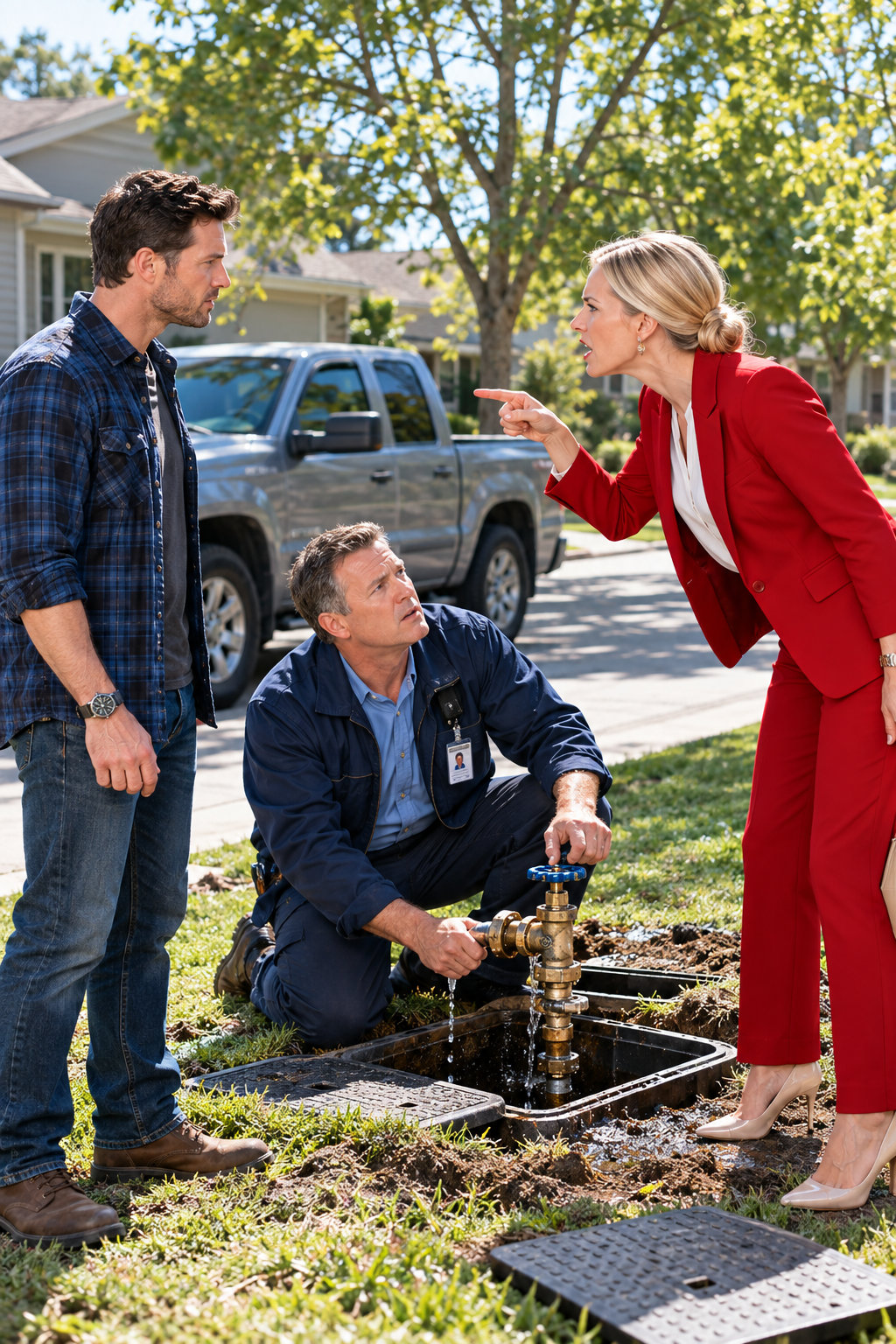
I was sitting on my porch when the white municipal utility truck arrived. The driver, Chief Dorian Vale, was a fifty-six-year-old engineer with gray hair, broad shoulders, and the calm expression of someone who had spent decades dealing with complicated problems. He ignored Marla’s attempt to greet him with a rehearsed explanation and walked directly toward the meter. After checking the identification number, he removed a handheld device and compared the valve against the authority’s digital records. His expression became increasingly serious as he examined the brass plate.
“Who authorized this valve to be closed?” he asked.
Marla stepped forward immediately and announced that she had ordered the work as president of the homeowners association. Dorian asked whether she possessed municipal authorization to interfere with the connection. She opened her folder and began explaining the association’s broad authority over neighborhood infrastructure. Dorian waited until she finished, then repeated the question in a quieter voice. When she couldn’t produce the authorization, he instructed everyone to leave the equipment untouched until its ownership and operating status could be verified.
For the first time, Marla looked uncertain. Her board members exchanged nervous glances, and the younger employee who had helped disconnect my water stared at the ground. Dorian examined the brass plate again, then turned toward me and asked whether I knew who had installed the valve. I told him I hadn’t installed it, but I possessed records identifying its original owner. He asked whether he could examine those documents, and I invited him inside.
I placed the metal box on my kitchen table and removed the old survey maps one by one. Dorian studied the recorded easement, checked the county seal, and compared the property boundaries against his tablet. When he reached the document reserving private utility ownership, he stopped turning pages. He read the company name aloud, then looked at me with an expression that suggested the entire dispute had suddenly changed shape. I explained that Mercer Land and Utility Holdings still held the relevant ownership rights and that I controlled the company through inheritance.
Dorian leaned back in his chair and exhaled slowly. He explained that the municipality would need to verify the records and determine the proper operating arrangements before anyone altered the valve again. Then he showed me a billing entry indicating that the homeowners association had been collecting an infrastructure maintenance charge from residents for years. The charge appeared to include equipment that the association had never legally acquired. We stared at the screen for several seconds, both understanding that the water shutoff was no longer the only issue.
Part 4: A forgotten family inheritance exposes years of HOA deception
Dorian returned to the municipal water authority with copies of the documents and promised to initiate a formal ownership review. I spent the afternoon contacting Quinn Holloway, who immediately understood the significance of the billing records. She had suspected that the association’s infrastructure claims were overstated, but we had never possessed such direct evidence that residents were being charged for specific equipment outside its ownership. She asked me to preserve every notice Marla had issued and avoid discussing confidential legal strategy with anyone on the board. I agreed, although I knew Marla would soon become increasingly aggressive.
That evening, an emergency HOA meeting took place at the clubhouse. Marla accused me of attempting to seize control of the neighborhood’s water supply and suggested that I had fabricated historical documents to escape my assessments. She claimed my real objective was to dismantle the association and enrich myself through control of the utility system. Several board members nodded automatically, but Judith Ashworth, a retired schoolteacher who had lived in the neighborhood for eighteen years, asked why the municipal engineer had questioned the association’s ownership. Marla dismissed the concern and insisted that her attorney would resolve the matter.
The attorney, Foster Reyes, began reviewing the records the following morning. Foster had represented the association for several years, although he had rarely been asked to examine the historical utility transfers in detail. He requested the deed establishing association ownership of the private valve network. Marla couldn’t produce one, and the county records contained no document transferring the relevant equipment from Mercer Land and Utility Holdings. Foster then requested evidence that the municipality had accepted ownership of the system, but no such transfer appeared in its files either.
Rather than admit the problem, Marla issued another notice against me. This one alleged unauthorized utility modifications, deliberate obstruction of association operations, and interference with common property. The final paragraph declared that my property access privileges were suspended pending compliance. I read the letter on my porch and almost laughed at the absurdity of an association claiming authority to restrict access to a home it didn’t own. Then I called Quinn and told her the situation had reached the point where private negotiations would no longer protect the other residents.
Quinn arrived that afternoon carrying a leather briefcase filled with historical documents. She spread the papers across my kitchen table and explained that her latest review had uncovered a sworn declaration signed by Marla several years earlier. The declaration acknowledged that questions existed concerning ownership of certain utility connections within Larkspur Court. It also stated that the association intended to investigate those questions before asserting permanent control over the disputed infrastructure. Marla had later claimed that no such uncertainty had ever existed.
The signature on the declaration was unmistakable. I compared it with the signatures on my recent violation notices and saw the same distinctive loop in the letter V. Quinn explained that the document had been recorded during an earlier administrative dispute and remained available in the county archives. Its existence didn’t automatically prove every later charge was unlawful, but it directly contradicted Marla’s insistence that ownership had always been clear. More importantly, it established that she had been warned about the problem long before ordering my water disconnected.
Quinn then produced an email from a retired association engineer named Harold Bennett. More than a year earlier, Bennett had reviewed the development’s utility maps and warned Marla that several private water connections had never been transferred into HOA ownership. He specifically cautioned against collecting maintenance charges based on ownership claims the association couldn’t substantiate. Marla had replied that she would address the issue during a future board review. No such review appeared in the meeting minutes.
I sat at the table studying the email while memories of my grandfather surfaced unexpectedly. Samuel Mercer had spent his life insisting that property boundaries and utility rights existed to protect people from confusion and abuse. He used to tell me that a document wasn’t important because it was old, but because it recorded a promise someone had made and someone else was entitled to rely upon. I wondered what he would think of the association using his forgotten infrastructure as an instrument of intimidation. For the first time, I felt that resolving the dispute was also a responsibility to the family whose work had created the system.
Quinn asked whether I wanted to file a lawsuit immediately. I told her I wanted the ownership confirmed, the water restored, the questionable fees independently reviewed, and the homeowners informed. If litigation became necessary, I would pursue it, but I didn’t want the neighborhood destroyed by legal expenses that could have been avoided. She nodded and began preparing a presentation for the next association meeting. We both understood that once the residents saw the documents, Marla would no longer control the story.
Part 5: The neighborhood discovers its president knew the truth all along
The following Tuesday, the Larkspur Court clubhouse filled beyond capacity. Residents stood along the walls, crowded near the doors, and gathered in the hallway because they had heard that the water dispute involved something much larger than an unpaid assessment. Marla arrived early and arranged her documents on the podium, determined to present herself as the victim of a homeowner’s elaborate scheme. She wore a dark blazer and a gold necklace that caught the fluorescent lights whenever she turned toward the audience. Her expression suggested that she expected another routine evening of accusations followed by reluctant compliance.
She began by describing me as a disruptive resident who had challenged the association from the moment he moved into the neighborhood. She accused me of attempting to exploit an obscure technicality to avoid paying legitimate fees and undermine the board’s authority. Several people murmured, but nobody applauded when she demanded that I acknowledge the association’s control over the disputed infrastructure. Judith Ashworth raised her hand and asked whether the board had obtained independent confirmation of that control. Marla ignored the question and continued speaking.
Then Dorian Vale entered the clubhouse carrying a folder marked with the municipal water authority’s seal. The room became noticeably quieter as he approached the front, and even Marla stopped talking. Dorian explained that his office had reviewed the valve identification, original development records, recorded easements, and municipal transfer documents. The available evidence showed that the disputed connection was not part of the association’s legally registered utility network. He added that the shutoff had been performed without the authorization required for that equipment.
Marla interrupted, insisting that the association had always maintained the system and therefore possessed authority over it. Dorian replied that maintenance activity and legal ownership were different matters. He explained that a long history of billing residents didn’t automatically create property rights, particularly when the recorded documents reserved those rights to another entity. The authority had referred the ownership questions for further legal review and directed that no additional unauthorized work occur. For several seconds, the only sound in the room was the hum of the air conditioner.
Quinn stepped forward and placed the recorded easement on the table. She identified Mercer Land and Utility Holdings as the company retaining the relevant rights, then explained that I had inherited control of that company through my family. A wave of astonishment moved through the room as neighbors turned toward me. They had known me for six years as the quiet man who repaired his own fence and drove an aging pickup. Nobody had imagined that the forgotten infrastructure beneath the street belonged to a company connected to the homeowner Marla had publicly humiliated.
I stood and confirmed Quinn’s explanation. I told the residents that I had never used the ownership to threaten anyone, impose private charges, or interfere with ordinary service. I had continued paying my assessments while trying to understand how the association was accounting for the infrastructure. My purpose was not to take control of their homes or water supply. I wanted the legal ownership recognized and the billing practices examined honestly.
Quinn displayed the infrastructure fee records next. For years, residents had paid quarterly assessments that included charges described as shared water system maintenance. Some expenses might have been legitimate, but the association’s descriptions included equipment it had never legally acquired. Quinn explained that an independent audit would be necessary to determine which charges were unsupported and whether refunds were owed. Residents began asking questions from every direction, their voices rising as they realized how long the issue had remained unresolved.
Judith asked Marla whether she had ever been warned about the ownership problem. Marla replied that the matter had been unclear and that she had acted according to her understanding of the governing documents. Quinn then produced the sworn declaration bearing Marla’s signature. She followed it with Harold Bennett’s email and Marla’s written acknowledgment of his warning. The room erupted as homeowners realized that the president had continued asserting ownership after receiving specific reasons to question it.
Marla stared at the documents as though seeing them for the first time. She tried to explain that the warnings had been preliminary and that no final determination had been made. Judith responded that uncertainty should have prompted investigation, not threats against homeowners. Bryce, a younger board member who had helped deliver several enforcement notices, lowered his head. I watched him recognize that obedience had allowed the problem to continue long after someone should have asked harder questions.
Part 6: A public reckoning shatters the president’s carefully constructed empire
The meeting descended into a storm of accusations, questions, and painful memories. Residents who had remained silent for years began describing fines, threats, and demands they had accepted because challenging the association seemed hopeless. Daniel Pierce stood and explained how Marla had threatened additional penalties over the flag outside his home. A mother described the wheelchair ramp her family had been forced to remove, her voice breaking when she explained how difficult daily life had become afterward. Another homeowner held up a stack of notices and asked whether any of them had been supported by actual governing provisions.
Marla attempted to restore order by pounding her hand against the podium. She declared that the meeting was becoming hostile and warned that continued disruptions would result in removal from the clubhouse. But the audience no longer responded to her threats with silence. Judith reminded everyone that the association existed to serve homeowners and that the board remained accountable to the people who elected it. Her words received the first sustained applause of the evening.
Foster Reyes, the association’s attorney, rose from his seat near the front. He explained that the board needed to preserve all financial and utility records and obtain an independent review before making further claims about the disputed infrastructure. He also advised that any enforcement actions based on uncertain ownership should be suspended pending examination. Marla looked at him with disbelief, clearly expecting her own attorney to defend her position without qualification. Foster calmly repeated that his professional obligation was to the association, not to any individual officer.
Bryce stood next. His face was pale, and he held a folded sheet of paper that trembled slightly in his hand. He admitted that he had questioned the water shutoff before it occurred but had remained silent because Marla seemed certain she was acting within her authority. He apologized to me and to the residents who had received threatening notices he had helped deliver. Then he announced that he would resign from the board rather than continue participating in a system he no longer trusted.
I didn’t enjoy watching Bryce struggle through his statement. He was young, inexperienced, and had made the mistake of confusing loyalty with obedience. But I respected that he was willing to acknowledge his role publicly instead of hiding behind Marla’s instructions. Several residents thanked him for speaking honestly, while others remained visibly angry. I understood both reactions because apologies mattered, but they didn’t erase the consequences of decisions already made.
Judith introduced a motion to suspend Marla from her leadership duties pending an independent financial audit and formal review of the association’s enforcement practices. Foster explained the voting procedures required by the governing documents, and the board members present considered the motion under those rules. After a tense discussion, the remaining directors voted to suspend her administrative authority while the homeowners initiated the process for a formal removal vote. A second motion authorized an independent attorney and accountant to review the disputed infrastructure charges. Both decisions passed without meaningful opposition.
Marla stood motionless beside the podium as the results were announced. The woman who had spent years controlling meetings through intimidation now found herself unable to command the room’s attention. She gathered her papers slowly, avoiding the faces of residents who had once greeted her with forced politeness. Her gold necklace caught the light as she stepped away from the podium, but the confident expression she had worn at the beginning of the evening was gone. She looked exhausted, smaller somehow, as though the authority she had relied upon had disappeared with the votes.
Near the exit, she stopped beside me. For a moment, I thought she might apologize, but her expression hardened with one final attempt to defend herself. She asked why I hadn’t told her about the private utility ownership before she ordered the water disconnected. I replied that I had repeatedly asked her to verify her authority and that she had chosen not to investigate. Then I added that the warning from her own engineer had been waiting in her files for more than a year.
She stared at me, searching for an answer that would restore some part of her certainty. I told her that I had never wanted to embarrass her or destroy the association, but I couldn’t protect her from the consequences of decisions she had made after being warned. She looked down at the folder in her hands and said nothing. I walked past her into the cool evening air, where neighbors were gathering beneath the parking lot lights. For the first time in years, they were speaking openly without checking whether Marla was listening.
Part 7: An independent audit exposes the true cost of unchecked authority
The audit began the following week, and it quickly became clear that the financial problems were more complicated than anyone had expected. The association’s records included years of infrastructure assessments, maintenance invoices, special fees, and administrative charges that had never been clearly separated. Some payments covered legitimate neighborhood expenses, while others referenced equipment the HOA didn’t own or services it couldn’t document. The independent accountant spent weeks matching invoices against bank records, property agreements, and utility maintenance logs. Every discrepancy required another question, another document request, and another explanation from people who had grown accustomed to approving expenses without scrutiny.
I cooperated with the review by providing historical ownership records and access to the relevant portions of the private system. Quinn helped establish a practical arrangement allowing authorized utility personnel to inspect and maintain the connection while the parties negotiated a permanent operating agreement. The municipal authority verified the conditions necessary for restoring service safely, and my household’s water was turned back on. I stood in my kitchen listening to the faucet run and felt an unexpected wave of relief. After weeks of inconvenience and uncertainty, something as ordinary as clean water flowing into a sink felt extraordinary.
The audit ultimately identified a portion of the infrastructure fees that lacked sufficient legal or contractual support. The new board approved a process for calculating refunds and credits, with independent counsel reviewing the association’s obligations. Homeowners received detailed statements explaining how their accounts had been assessed and what adjustments were being made. Some residents were surprised by the amounts, while others were more disturbed by how long the charges had continued without proper verification. The findings confirmed that the problem was not merely one mistaken work order but a prolonged failure of oversight.
Evelyn Brooks received a refund connected to several disputed maintenance charges. She came to my porch holding the statement and asked whether she should feel relieved or angry. I told her there was room for both emotions because getting money back didn’t erase the fear that had accompanied years of threatening notices. She sat beside me and admitted that she had considered selling her home rather than face another confrontation with the association. I was grateful she had stayed long enough to see the neighborhood begin changing.
The family with the wheelchair ramp also received renewed attention. Judith arranged for the architectural committee to review the circumstances under applicable accessibility requirements and the association’s governing documents. The family obtained approval for a compliant replacement ramp, and several neighbors volunteered to help with the installation. I spent a Saturday afternoon carrying lumber and fastening brackets while the grandmother watched from the doorway. When she rolled outside independently for the first time in months, her daughter began crying.
Daniel Pierce’s flag dispute was reviewed separately. The new board withdrew the unsupported penalty and issued a written clarification of the relevant rules. Daniel invited several neighbors to a small barbecue afterward, and for once the gathering had nothing to do with complaints or legal threats. Children played in the yard while adults talked about gardens, school schedules, and ordinary community concerns. It reminded me of what neighborhood life was supposed to feel like before Marla turned every disagreement into a contest of obedience.
The formal homeowner removal vote took place several weeks after the initial suspension. Marla had the opportunity to respond to the allegations, but the documentary record and audit findings had severely damaged her credibility. A substantial majority voted to remove her from office, and Judith Ashworth was elected to lead the association. Judith accepted reluctantly, explaining that she had never wanted power over her neighbors. She wanted the board to become predictable, transparent, and accountable.
Her first major reform required every violation notice to identify the specific rule allegedly violated and explain the process for challenging the assessment. The board also adopted clearer financial reporting standards and procedures for obtaining independent advice before taking action involving utilities or property rights. Homeowners were invited to review proposed rule changes before adoption, and meeting minutes became easier to access. These reforms weren’t dramatic enough to attract headlines, but they addressed the weaknesses that had allowed Marla’s behavior to continue. For the first time in years, residents began treating the HOA as an organization they could participate in rather than a threat they had to endure.
Part 8: A humbled community learns the difference between power and service
Winter arrived quietly on Larkspur Court, covering the lawns with frost and turning the oak trees into dark silhouettes against the morning sky. The neighborhood looked much as it always had, with matching mailboxes, tidy driveways, and carefully maintained houses. But the atmosphere had changed in ways no photograph could capture. People lingered outside to talk, questioned proposed rules without fear, and attended meetings because they believed their opinions mattered. The association’s authority had become more limited, but the community itself felt stronger.
Judith visited me one afternoon carrying a binder of proposed amendments to the HOA’s procedures. She wanted my opinion on the provisions involving utility infrastructure, although she made it clear that the board would obtain independent legal review before adopting anything. We sat at my kitchen table while I explained the difference between recorded property rights, operating agreements, and the practical responsibilities of maintaining a functioning system. Judith took notes and asked questions whenever something was unclear. Her willingness to admit what she didn’t know made her more effective than Marla had ever been.
The private valve network still required a permanent arrangement. Mercer Land and Utility Holdings retained its recorded ownership rights, but ownership alone didn’t resolve every operational and maintenance responsibility. Quinn worked with Foster and the municipal authority to draft an agreement establishing access, inspection procedures, emergency responsibilities, and clear limits on association involvement. The negotiations took several months because everyone wanted to avoid repeating the mistakes that had caused the dispute. Eventually, the parties reached terms that protected the infrastructure while ensuring residents wouldn’t face arbitrary service interruptions.
I chose not to use the ownership as leverage for personal profit. The holding company had remained dormant for decades, and I had no interest in transforming a forgotten valve into a source of conflict with my neighbors. Instead, we established a practical maintenance arrangement that identified who could authorize work and how legitimate costs would be allocated. The agreement also required advance notice to affected residents except in genuine emergencies. I considered that provision essential because nobody should discover that a basic utility has been disconnected simply because someone with a title decided to make a point.
Dorian Vale returned to inspect the valve after the agreement was finalized. He arrived without the crowd that had gathered during his first visit, and this time he seemed almost amused by the memory. He examined the identification plate, checked the updated records, and confirmed that the ownership information was properly documented. A small engraved marker had been installed beside the housing to prevent future confusion. It stated that the equipment was privately owned and that authorized personnel should consult the recorded agreement before performing work.
Dorian looked at the marker for a long moment. Then he asked whether I had known from the beginning that Marla’s claims would collapse once someone examined the records. I told him I had known the ownership was different from what the association claimed, but I hadn’t predicted every consequence. The investigation had uncovered billing problems, intimidation, and administrative failures that extended far beyond my property. I admitted that I wished the situation could have been resolved before anyone lost access to essential services.
He nodded and said that most serious failures began with someone assuming a fact that should have been verified. I thought about the younger HOA employee who had hesitated before turning the valve and Bryce’s admission that he had been afraid to question Marla. Their silence hadn’t caused every problem, but it had allowed a preventable mistake to proceed. I hoped the experience would remind them that professional responsibility sometimes required disagreeing with the person giving orders. Dorian shook my hand before leaving and told me the updated records should prevent another unauthorized shutoff.
That evening, I received an unexpected letter from Marla. It contained no threats, no demands, and no references to community standards. She wrote that she had spent months reconsidering the decisions she made while serving as president and that she regretted the fear her actions had caused. She didn’t ask me to excuse her behavior, and she acknowledged that she had ignored warnings because admitting uncertainty felt like surrendering authority. I read the letter twice before placing it in the metal box with the original documents.
I never replied. Perhaps one day I would, but at that moment, I believed the most meaningful apology would be the changes she made in her life rather than the words she sent to mine. The neighborhood had moved forward, and I wanted to do the same. I returned to repairing the fence beside my driveway, enjoying the simple satisfaction of tightening bolts and replacing weathered boards. After months of legal disputes, ordinary work felt like a kind of freedom.
Part 9: Years later, one hidden valve changes an entire neighborhood forever
Three years after Marla ordered my water shut off, Larkspur Court held its first neighborhood heritage celebration. Judith had proposed the event after discovering that many residents knew almost nothing about the history of the land beneath their homes. The community invited longtime homeowners, former developers, and local historians to share photographs and stories about the neighborhood’s earliest years. Children displayed drawings of the street, while adults contributed old maps and newspaper clippings. I brought several copies of my grandfather’s survey documents, carefully removing the originals from their protective sleeves.
The clubhouse filled with laughter rather than arguments. Tables were covered with homemade food, and the walls displayed photographs showing the neighborhood before the first houses were built. One picture showed my grandfather standing beside a surveying instrument on a muddy field, wearing a broad-brimmed hat and an expression of fierce concentration. I stared at the photograph longer than I expected, remembering the afternoons he had spent teaching me how to read maps. He would have been amazed to know that one forgotten line on one of his surveys had eventually changed the way an entire neighborhood governed itself.
Judith invited me to speak about the history of the private water system. I explained how the original development had included a secondary connection financed separately from the municipal network and how later property transfers had failed to include that infrastructure. I described the importance of accurate records and clear operating agreements without turning the presentation into another account of Marla’s mistakes. Several residents asked thoughtful questions about easements, ownership, and maintenance responsibilities. Their curiosity reminded me that the community had learned to value information over assumptions.
After the presentation, a young homeowner named Lucas approached me with his daughter beside him. He explained that he had recently moved into the neighborhood and had heard conflicting stories about the famous water valve at the end of Larkspur Court. Some neighbors claimed I had owned the entire water system, while others insisted I had discovered a loophole and used it to overthrow the HOA. Lucas wanted to know what had actually happened. I smiled and told him the truth was less spectacular but far more important.
I explained that my family controlled a narrow portion of private infrastructure and that the association had mistakenly claimed authority over it. When its president ignored warnings and ordered an unauthorized shutoff, the resulting investigation exposed broader problems in the neighborhood’s enforcement and billing practices. I hadn’t owned everyone’s water, and I hadn’t wanted to destroy the association. I had wanted the people making decisions to verify their authority and treat homeowners fairly. Lucas nodded, then looked down at his daughter as though deciding how to explain the lesson to her.
His daughter asked whether the woman who shut off my water had been a bad person. I considered the question carefully because children often deserve more honest answers than adults give them. I told her that people could make harmful choices without being entirely defined by those choices, but they still had to take responsibility for the damage they caused. I explained that Marla had ignored warnings, frightened neighbors, and used her position in ways that hurt people. The important lesson wasn’t that one person had been defeated, but that everyone needed to understand the difference between leadership and control.
The little girl thought about that for a moment. Then she asked whether I had been scared when my water stopped working. I admitted that I had been worried, not because I doubted the documents, but because I understood how much trouble the dispute could create for everyone involved. She seemed surprised that an adult who knew the answer could still feel afraid. I told her courage didn’t mean never feeling fear; it meant doing what was right even when the outcome remained uncertain.
Later that afternoon, Judith joined me outside the clubhouse. She had been reelected twice, although she continued insisting that she preferred teaching to administration. Under her leadership, the association had reduced unnecessary fines, improved financial transparency, and established clearer procedures for handling disputes. Homeowners still disagreed about landscaping, parking, and architectural changes, but those disagreements no longer carried the constant threat of retaliation. Judith said she hoped the next president would continue the reforms without needing another crisis to understand their importance.
I told her that the best systems didn’t depend on finding a perfect leader. They depended on rules that applied fairly, records people could examine, and neighbors willing to question decisions that didn’t make sense. Judith smiled and said I sounded like my grandfather, whose photographs she had spent the afternoon studying. I took that as a compliment. Samuel Mercer had always believed that careful work and honest documentation protected people long after the people who created them were gone.
As the celebration ended, I walked home beneath the evening sky. The houses along Larkspur Court glowed with warm light, and the sound of children playing drifted across the lawns. Daniel Pierce’s flag moved gently in the breeze, and the family with the wheelchair ramp sat outside enjoying the cool air. Mrs. Brooks waved from her porch and asked whether I wanted to join her for coffee the following morning. I promised I would stop by after finishing a few repairs.
When I reached my driveway, I paused beside the water meter. The small engraved marker was still firmly attached, its lettering clear beneath the porch light. I crouched and brushed a few fallen leaves away from the housing, remembering the sound of the wrench turning on that September morning. Marla had believed the valve represented her ability to punish a homeowner who refused to obey her. To me, it had become a reminder that ownership, authority, and responsibility were three different things.
I stood and looked down the quiet street. Three years earlier, the same houses had been filled with people afraid to question their own association. Now those residents attended meetings, examined records, challenged unsupported claims, and expected their leaders to explain important decisions. The change hadn’t come from destroying the institution that governed them. It had come from insisting that the institution remember whom it was supposed to serve.
Inside my house, I turned on the kitchen faucet and watched clear water fill a glass. The simple sound brought back memories of the morning everything began, when Marla’s confidence had seemed impossible to challenge and my silence had been mistaken for surrender. I thought of my grandfather, Quinn, Dorian, Judith, Bryce, and the neighbors who eventually found the courage to speak. Each had played a part in exposing a problem that might otherwise have remained buried beneath decades of paperwork. I drank the water slowly, grateful for the ordinary comfort of a home where no one could shut off an essential service simply to prove a point.
Before going to bed, I returned the old metal box to my study. The survey maps, recorded easement, brass key, and correspondence were arranged carefully inside, alongside the final operating agreement. I closed the lid and placed it on the shelf where it had rested for years before the dispute. The documents were no longer a secret waiting to be discovered. They were part of the neighborhood’s recorded history, available to anyone willing to ask the right questions.
And that, I realized, was the real victory. Marla had tried to teach the neighborhood that power belonged to whoever could issue the harshest order and inspire the greatest fear. Instead, the residents had learned that authority had to be earned through honesty, limited by law, and exercised with responsibility. The valve beneath my lawn hadn’t moved, the street looked much the same, and the water flowed as it always should have. But the people living above those buried pipes had changed forever, because they finally understood that no title, no letterhead, and no confident voice could turn something into yours simply because you declared it belonged to you.
✓ Lynn R. Adams
Part 2: The quiet homeowner conceals a secret beneath his front lawn People on Larkspur Court thought they knew me because they saw me mowing my own lawn, repairing my fence, and driving a faded blue…