At 5:17 a.m., eight trucks were…
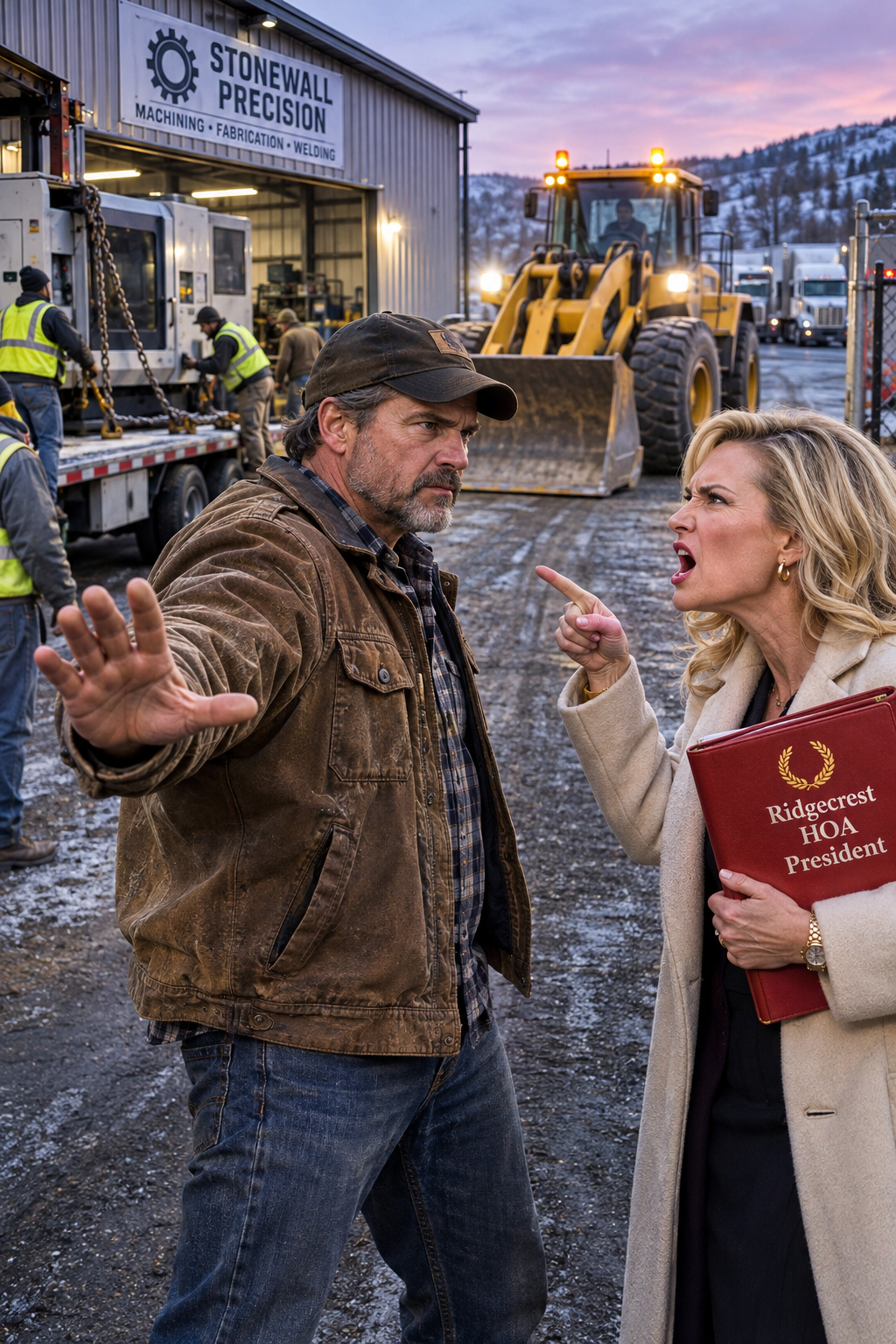
At a.m., eight trucks were stripping $700,000 in machinery from my workshop while the HOA president waved a red-stamped “seizure order.” I had one yellow loader, one narrow exit, and a decision to make….
My foreman called at on a freezing Friday morning. I was filling my coffee thermos when Hollis Keen’s name flashed across my kitchen counter. Hollis had worked beside me for more than ten years, and he wasn’t a man who panicked. That morning, though, his voice shook. “Everett, get down here. Eight trucks are in our yard. They’re taking the machines.”
I told him that couldn’t be right. Stonewall Precision had cameras, electronic locks, and a nine-foot fence. “They cut the gate lock,” Hollis said. “There’s a woman directing everybody. Somebody called her President Caldwell.” I knew exactly who he meant: Brin Caldwell, president of the Ridgecrest Homeowners Association, the woman who’d spent months trying to push me off my own property.
I called 911 as I headed to my pickup. I told Hollis to stay clear of the crews, not to touch anyone, and to copy our camera footage somewhere safe. Five minutes after his call, I reached the shop outside Redstone, Colorado, and found the front gate hanging from one hinge. The cut padlock was lying in the driveway.
Two lowboy trailers had backed up to the building. Three box trucks idled in the yard, two semis waited nearby, and an eighth truck stood apart by the supply shed. Men in reflective vests carried crates and rolled equipment out of the doors. Inside, a crew had chains around our five-axis CNC machining center—a $260,000 machine that held years of specialized programs and customer information.
I watched one of them point toward the winch. If they pulled that CNC from the wrong spots, they could destroy the spindle before it ever left the floor. “Stop!” I yelled. “Those machines belong to me.” A man with a clipboard asked whether I owned the shop. I said I did, and asked who had given him permission to come onto my land.
Then Brin stepped out of a white SUV in a fine wool coat, holding a red folder. She showed me a sheet bearing the words “emergency equipment removal authorization” under a bright red stamp. “We’re removing noncompliant property,” she said. “You’ve had plenty of warnings.” I asked for an actual county order. She pulled the paper away and told the workers to keep loading.
I had built Stonewall Precision from the ground up. After nearly twenty years working with metal and industrial equipment, I’d bought six acres along an old industrial road where manufacturing was permitted. I took loans, worked late shifts, hired good people, and gradually built a business making parts for farm equipment, industrial machinery, and structural steel. Twelve employees counted on those doors opening each morning.
Ridgecrest didn’t even exist when I bought that land. Years later, houses went up on the hill, and for a while we all got along. Some residents hired us to make railings and fences. I had no argument with people wanting a nice neighborhood. I just wanted to run the legal business I’d spent most of my adult life building.
Things changed when Brin became HOA president. She talked about a scenic boulevard, an event pavilion, and an exclusive residential center. Unfortunately for her plans, my property sat where she wanted an access route. She never made a reasonable offer for the land. Instead, I started receiving complaints about noise, dust, lights, and delivery trucks, followed by fines citing Ridgecrest rules.
I cooperated when county inspectors identified anything legitimate and fixed the few issues they found. But my deed, survey, zoning records, and permits made one thing plain: Stonewall Precision wasn’t part of Ridgecrest HOA. I sent those documents to Brin with a simple explanation. An association couldn’t enforce its private covenants against a business outside its boundaries. She answered with another notice and a larger fine.
One afternoon, she arrived with a hauling-company owner named Wade Strickland and offered $185,000 for machines worth roughly $700,000. She called it a fair deal because the equipment was used and difficult to move. Then she warned that restrictions would make things harder for me. I refused. She straightened her coat and said, “Then I’ll find another way.”
About two weeks before that Friday, things started feeling wrong. An unfamiliar truck lingered near the gate at night. Someone called to ask about the weight and resale value of the CNC. A hauling company asked if I needed eight industrial loads transported. Another caller, supposedly from an insurance company, tried to get Hollis to supply our complete equipment inventory.
We gave out nothing. I added cameras, backed up our files offsite, and made notes about the strange calls. Still, I thought Brin was trying to pressure me into a cheap sale, not arrange a convoy to empty my shop while I made breakfast. Seeing those chains on my equipment, I realized how badly I’d underestimated her.
Back in the yard, I took out my phone and began filming license plates, company names, faces, and the time. Brin moved a hand toward my camera. I stepped away and kept recording. The first flatbed, loaded with parts of our robotic welding system, began inching toward the exit. If it reached the highway, tracking down my equipment could become a fight across several states.
I stood in front of the cab long enough to tell the driver that police were on their way. He looked to Brin for instructions. “Drive,” she shouted. The driver hesitated. I wasn’t about to test whether a stranger in a truck would listen to her, and I wouldn’t risk my people in a physical fight with two dozen workers.
Across the gravel yard, under a security lamp, sat our yellow wheel loader. I’d operated heavy machinery for years, and I knew exactly how dangerous it could be near people. But I also knew there was only one proper road out of that yard. I called Hollis. “Keep everyone clear of the lane. Keep the cameras running. I’m closing the exit.”
I climbed into the loader, fastened my belt, started the diesel engine, and switched on its amber lights. Every head turned. Brin began shouting that I was threatening her contractors. I wasn’t going anywhere near them. I waited while Hollis warned the crew away from the roadway, then moved slowly with plenty of room around every worker and truck.
Through the windshield I could see the damaged gate, the flatbed waiting to leave, and Brin standing beside it with that red folder. I thought about our twelve employees and the families depending on their paychecks. I thought about what losing the CNC alone would do to our contracts. I wasn’t trying to punish anyone. I was trying to keep our life’s work in one place until the deputies arrived.
I turned the loader broadside at the narrowest part of the exit, lowered its bucket flat onto the concrete, and locked the controls. The first flatbed came to a halt. So did the convoy behind it. Brin lifted her phone and threatened to have me arrested for interfering with a lawful seizure. “Go ahead,” I told her through the open window. “I called the sheriff first.”
For the first time, she stopped talking. Eight trucks were trapped in my yard, but nobody had yet explained who had authorized them to take my property. And I couldn’t shake the feeling that the truck parked by the supply shed was there for something other than moving machines. Part 2…..
Wade Strickland, the hauling-company owner who’d come with Brin to make that insulting offer, approached the loader with a work order. He said his crews were only honoring a contract. I asked who had verified that any of my machines belonged to the HOA. His paper described them as property transferred to a “violation remediation contractor.” The equipment list looked alarmingly like my own inventory.
Brin ordered two HOA security guards to pull me out of the cab. One climbed the steps and hammered on the door; the other yelled from below. I locked it and held my phone to the glass. I kept my hands off the controls because a worker had wandered close to a tire. The second guard eventually backed away. He had agreed to patrol a subdivision, not drag a shop owner out of a loader on camera.
Hollis called from the building. The crew had loosened the CNC’s anchor bolts while its power and sensor connections were still attached. I used the loader’s loudspeaker to warn Wade that his name would be on the damage report if they kept pulling. Wade shouted for the lift to stop. Whatever Brin had promised him, he understood the cost of destroying a quarter-million-dollar machine.
From the cab, I saw two men carrying file boxes into truck eight. One held a clear bag of blank metal identification plates. When I zoomed in with my phone, they pulled the rolling door shut. Brin told the driver to leave by a side gate, but it was still chained. I asked Hollis not to confront them, only to film the truck and its plate.
Sirens finally came from the highway. Two patrol cars entered the yard, and I shut down the loader. Deputy Taryn Bellamy, whom I knew as a careful, levelheaded officer, told everyone to stay put. At her request I climbed down. She asked who owned the land, who hired the haulers, and what lawful authority allowed anyone to seize industrial equipment.
Brin handed over her red-stamped authorization. Taryn studied the header, then asked which county agency had issued it and who was authorized to execute it. Brin offered vague answers about compliance contractors. I showed Taryn my deed and survey, the zoning permits, purchase invoices, serial numbers, videos of the damaged gate, and the footage of men stripping equipment.
Taryn contacted the county records office. When the response came back, there was no order under the number Brin had displayed, no enforcement case against Stonewall Precision, and no valid authority behind the named signatory. The red stamp was just a red stamp. Brin insisted a lawyer had approved it, but couldn’t give Taryn the lawyer’s name.
Wade handed over his hauling agreement. His company had been promised $92,000 to disassemble, crate, and transport the equipment, with instructions to start before six in the morning. Taryn told the crews to stop all work and preserve the scene while investigators looked into trespass, damage, and a planned theft. Wade, suddenly aware of his exposure, offered his emails and paperwork.
Then Hollis called out that the men at truck eight were attempting to walk off with a box. Taryn stopped them and secured the situation. Wade confirmed the truck was in his fleet and cooperated with a review of his company’s shipping records. One agreement, signed nearly a month before the raid, recorded the sale of my machines as though someone else already owned them.
The supposed seller was Caldwell Recovery Services. The buyer was Blue Mesa Industrial Trading, a used-equipment dealer. The agreed price was $498,000 for my five-axis CNC, laser cutter, robotic welder, industrial lathe, hydraulic press, and laser measuring instruments. A transfer-yard clause would have allowed the machines to be separated and shipped onward. I had never authorized a single sale.
After investigators obtained the necessary legal authority to examine truck eight’s contents, they documented blank identification plates and certificates of origin bearing serial numbers that differed from mine by a digit or two. There was even a liquidation schedule for the machines. Whoever organized this wasn’t merely moving equipment out of the way. They were preparing to disguise its origin and resell it.
Wade admitted Brin had given him weights, dimensions, and a marked floor plan weeks earlier. She’d insisted the shop be emptied before I arrived and instructed him to keep the job quiet. My photos and Hollis’s recordings now showed exactly how that plan had unfolded. When I asked who would receive nearly half a million dollars, Wade pointed to the seller’s name: Caldwell Recovery Services.
An independent technical team joined Hollis to assess the damage. Several CNC anchors had been pulled, the robotic welder’s power connection was damaged, and parts from the first truck had to be inventoried and returned through proper procedures. The machines were still ours, but they couldn’t simply be switched back on. We had repairs, lost production, and customer deadlines to worry about.
I stood among the loose cables and remembered what I’d told Hollis for years: money can buy another machine, but earning a reputation takes a long time. He asked whether we could get the shop running soon enough. I told him we’d do everything possible. Stopping the trucks was only the first part of saving the business.
Part 3 That afternoon, Ridgecrest residents received a message accusing me of threatening workers with a loader and interfering with a community safety operation. Brin included a short video showing my loader crossing the driveway, but not the severed lock, the men pulling apart my machines, or the forged-looking order. The next morning, her lawyer demanded $350,000 in damages and told me to stop calling it theft.
I hired my own attorney and gave him every recording and document. Two days later, Brin held a press conference by the Ridgecrest entrance, played the edited footage again, and called me a dangerous man. Some homeowners believed her. Others wondered why a neighborhood association had needed eight heavy trucks before sunrise to deal with a supposedly unsafe workshop.
My attorney first made sure releasing footage wouldn’t interfere with the investigation. Then we gave a local news station the original recordings: the broken gate, Brin directing the crews, the men chaining my CNC, and the loader moving slowly into position without striking anyone. The station played the whole sequence. Homeowners began demanding the board explain the $92,000 hauling contract and what authority Brin thought she had.
Meanwhile, we were trying to keep our customers. The CNC needed careful realignment, the laser cutter’s optics needed inspection, and the welder needed recalibration. A contract worth more than a million dollars was coming due. Hollis suggested renting time at another shop, even though it would cost us dearly. I approved it. Our customer hadn’t hired us to explain excuses; they’d hired us to deliver parts.
Three days later, Brin came to the gate alone. With a camera recording, she offered to have the HOA stop its complaints and contribute $75,000 toward repairs if I’d drop the accusations. I asked her how seventy-five thousand dollars could undo the damage from an attempt to carry away seven hundred thousand dollars of equipment. She warned that fighting her could cost me my shop. I reminded her she’d already tried to take it.
That evening, a silver sedan pulled up. Daphne Ralston, Ridgecrest’s treasurer, asked to speak privately. Hollis sat with us in the conference room as she opened a folder of financial statements, wire records, and approval forms. She pointed to an amount circled in red: $410,000 missing from the association’s reserve fund. The auditors were due in eleven days.
Daphne explained that residents had paid into the fund for major repairs, but money had gone out under labels such as construction, consulting, landscaping, and an event project Brin promoted. Daphne couldn’t find proper approvals or receipts. Some forms appeared to carry Daphne’s signature, even though she said she’d never signed them. When she’d challenged Brin, she’d been told not to jeopardize Ridgecrest’s future.
One internal memo suggested Caldwell Recovery Services might reimburse the association for certain expenses. The planned reimbursement was close to the missing reserve money. I looked from that number to the $498,000 equipment sale agreement. If Brin could sell my machines, she might put $410,000 back before the audit and still leave money in the company that arranged the deal. It wouldn’t erase any wrongdoing, but it suggested a motive for the hurry.
I urged Daphne to get independent legal advice. She agreed to report the questionable signatures and supply records she was legally entitled to share. Rather than put unverified financial papers on social media, we took them to Taryn, who passed the possible financial crimes to the appropriate investigators. Daphne wasn’t trying to help me win an argument with an HOA. She was trying to find out what happened to her neighbors’ money.
The following day, Daphne was locked out of the association’s financial system. Brin called a special meeting to remove her as treasurer and bombarded her with calls. But Daphne had already preserved lawful copies of the reports with her attorney. Her answer to Brin was short: future conversations about the finances would go through counsel.
Investigators later confirmed that Brin controlled Caldwell Recovery Services. They traced HOA payments for work that had not been performed and identified a transfer linked to her private real estate interests. Blue Mesa confirmed that Brin had personally assured the dealer the machines were legally available for resale, and the dealer agreed to turn over its messages. The equipment deal and the reserve-fund shortage were no longer separate mysteries.
Brin’s attorney tried another approach, filing an emergency motion aimed at stopping me from using certain machines while ownership was supposedly disputed. Our lawyer responded with invoices, proof of payment, manufacturer serial numbers, and our property survey. The judge rejected the theory that an outside HOA could claim my equipment and instructed the parties to preserve evidence.
Hollis and I moved ahead with recovery. Specialists inspected, repaired, and recalibrated every affected machine to its required standards. I supervised the CNC’s alignment myself and saved every invoice, rental bill, and record of interrupted production. We replaced the broken gate, added another camera, and used our yellow loader to position concrete barriers along the entrance. This time, nobody would stroll in with eight trucks unnoticed.
Wade came back with his attorney and admitted he’d ignored warning signs. He gave us an email in which Brin instructed him not to put “Stonewall Precision” on any resale paperwork; Caldwell Recovery was to be listed as the transferring party. I told him that if he’d arrived and begun loading an hour earlier, I might never have caught them. He didn’t argue. I told him to give investigators everything he knew.
Part 4 Brin began shifting control of business accounts and mentioned taking a leave from the HOA for health reasons. Investigators sought orders to preserve relevant financial records and freeze assets as permitted by the court. I wanted the evidence handled correctly. I hadn’t taken anything of hers; I wasn’t going to risk the case by making a reckless move now.
Ridgecrest scheduled an emergency meeting. Brin wanted to convince the homeowners I was their enemy, but enough residents had signed a request under the bylaws to put the reserve fund on the agenda. Daphne would present the financial discrepancies, and I was invited to answer the claims about my shop. Hollis wondered whether walking into Brin’s territory was wise. I told him the facts would have to speak for themselves.
I put together a folder and a flash drive: the time-stamped camera footage, my deed, the boundary survey, photos of the cut lock, the lineup of eight trucks, the county’s response concerning the supposed seizure order, the signed transfer agreement, and an independent assessment of the equipment damage. I didn’t write a speech full of legal jargon. I made sure each document could be understood by someone who’d never visited our shop.
The afternoon before the meeting, Brin crossed my path outside the HOA office. She asked whether I really thought a few videos would end her career. I said her own decisions were what would be judged. She claimed Ridgecrest would believe its president over a man who blocked trucks with a loader. I told her the cameras, property records, and financial statements would matter more than either of our opinions.
That night Taryn called to say the investigation had reached a point where legal action could follow soon. I asked no questions she couldn’t answer. In the morning I checked on our repair work, spoke to the men covering an extra shift, and went to the community hall with my documents. More than a hundred homeowners had crowded inside.
Brin opened the meeting in a tailored suit and repeated her warnings about safety and disorder. She projected that same shortened loader clip and asked whether residents wanted a man like me threatening their neighborhood. I waited until she’d finished. Then I introduced myself, told them I wasn’t a Ridgecrest homeowner, and explained that her contractors had entered my business before dawn to remove machinery worth about $700,000.
I played the original recording. People saw the broken gate, the men chaining the CNC, Brin ordering them to keep loading, and my effort to stop the trucks without touching anyone. Someone asked why the HOA had excluded those moments from its video. Brin called the footage unverified. I pointed out the originals were already with investigators.
Next came my deed and a simple yard diagram. I explained which trailers were assigned to which machines and why truck eight, with sale documents and replacement identification plates, had raised alarm. Then I showed the agreement under which Caldwell Recovery Services had purported to sell my equipment to Blue Mesa before the raid ever occurred. A homeowner asked Brin who gave her the right to sell a stranger’s machines. She didn’t answer directly.
Daphne approached the microphone with a report that HOA members were entitled to see. She explained the reserve-fund discrepancies and the questionable signatures, and told everyone that the transactions were being investigated. When the figure $410,000 appeared, the room erupted. Brin tried to interrupt on grounds of confidentiality, but residents wanted to know what had happened to their dues.
A motion to suspend Brin’s financial authority pending removal proceedings and an independent audit passed overwhelmingly. Brin called the meeting a conspiracy, turned toward me, and said I’d done this to her. I answered that the documents were there because of the decisions she’d made. By then, the other board members had little to say in her defense.
As Brin reached for her bag, Taryn entered with two officers. They had a warrant for Brin’s arrest. Taryn informed her of the charges and her rights, and Brin kept insisting she was the HOA president. No one stepped forward to protect her. She was led out past the same homeowners she’d addressed moments earlier, while I stood holding a folder of evidence instead of celebrating.
I watched the patrol car leave. My shop still had bills to pay, and an arrest wasn’t a conviction. Ridgecrest still needed to learn whether its reserve money could be recovered. But at last the people affected by Brin’s decisions had been allowed to see the same facts, and the next part would happen in court rather than in the driveway of my workshop.
Final Eleven months later, the investigation had become a criminal case supported by financial records, videos, contracts, and witness testimony. Prosecutors charged Brin with financial fraud, document forgery, and conspiracy to commit theft. She maintained that she’d acted for the community, but the story didn’t fit the predated sales agreement, the false seizure paperwork, or the money missing from Ridgecrest’s reserve account.
Wade testified about Brin’s instructions to finish before I reached the shop, and investigators presented the ownership records and the $498,000 agreement with Blue Mesa. Faced with the evidence, Brin accepted a plea agreement. I sat in the gallery as she answered the judge’s questions. I didn’t feel victorious. I could still picture those strangers attaching chains to a CNC I’d spent years paying off.
The court sentenced Brin to prison and ordered restitution. Assets connected to the misappropriated funds were seized or applied toward repaying the homeowners under court supervision. My company’s losses were addressed through insurance, civil liability, and court-approved restoration expenses, including repairs, recalibration, lost production, and rented machine time. None of that money arrived instantly, but the process finally recognized what the raid had cost us.
Wade’s cooperation counted in his favor, though his company still had to help settle claims for damage caused by its crews. Ridgecrest formally removed Brin, installed new leadership, and hired an independent auditor to give residents a complete accounting. Daphne never wanted to be called a hero. She told me she wished she’d raised her concerns sooner, and I respected how hard it had been for her to speak up.
At Stonewall Precision, recovery took months. The CNC was aligned again, the welder ran properly, and the laser cutter returned to work. Hollis and the crew covered extra shifts, and we managed to keep nearly every customer. A new contract helped the revenue recover. I knew those twelve people had saved the business as surely as I had by blocking the driveway.
We held a dinner on the shop floor after things settled down. Hollis raised a glass to the boss who stopped eight trucks with one loader. I told everyone that without Hollis’s call, we’d have had no machinery left to repair. He grinned and said we’d still be out looking for the trucks without the loader. For the first time in almost a year, we could laugh about that morning.
One day, after the case had closed, a small package arrived with the old padlock cut from our gate. It had been released from evidence, and a deep gash still crossed its steel body. Hollis asked if I planned to throw it out. Instead, I mounted it in my office beside a photograph of the yellow loader parked across the driveway in front of the convoy.
Under the frame I put one line: “Eight trucks came to take everything. One man refused to move.” Then I walked back onto the shop floor, where the machines were running and our people were working. I didn’t need to watch Brin lose everything to feel that justice mattered. I needed to know the shop we’d built was still standing.
Outside, sunlight shone on our new gate. The eight trucks were long gone. The yellow loader was still in its corner of the yard, ready for an ordinary day’s work.
THE END. I’ve shared the complete story, and I truly hope it touched your heart. If this story moved you, please , like, and share the post. Thank you for reading! ❤️
✓ Lynn R. Adams
At a.m., eight trucks were stripping $700,000 in machinery from my workshop while the HOA president waved a red-stamped “seizure order.” I had one yellow loader, one narrow exit, and a decision to mak…