At 23, I was trying to keep my late father’s motorcycle shop open when nine
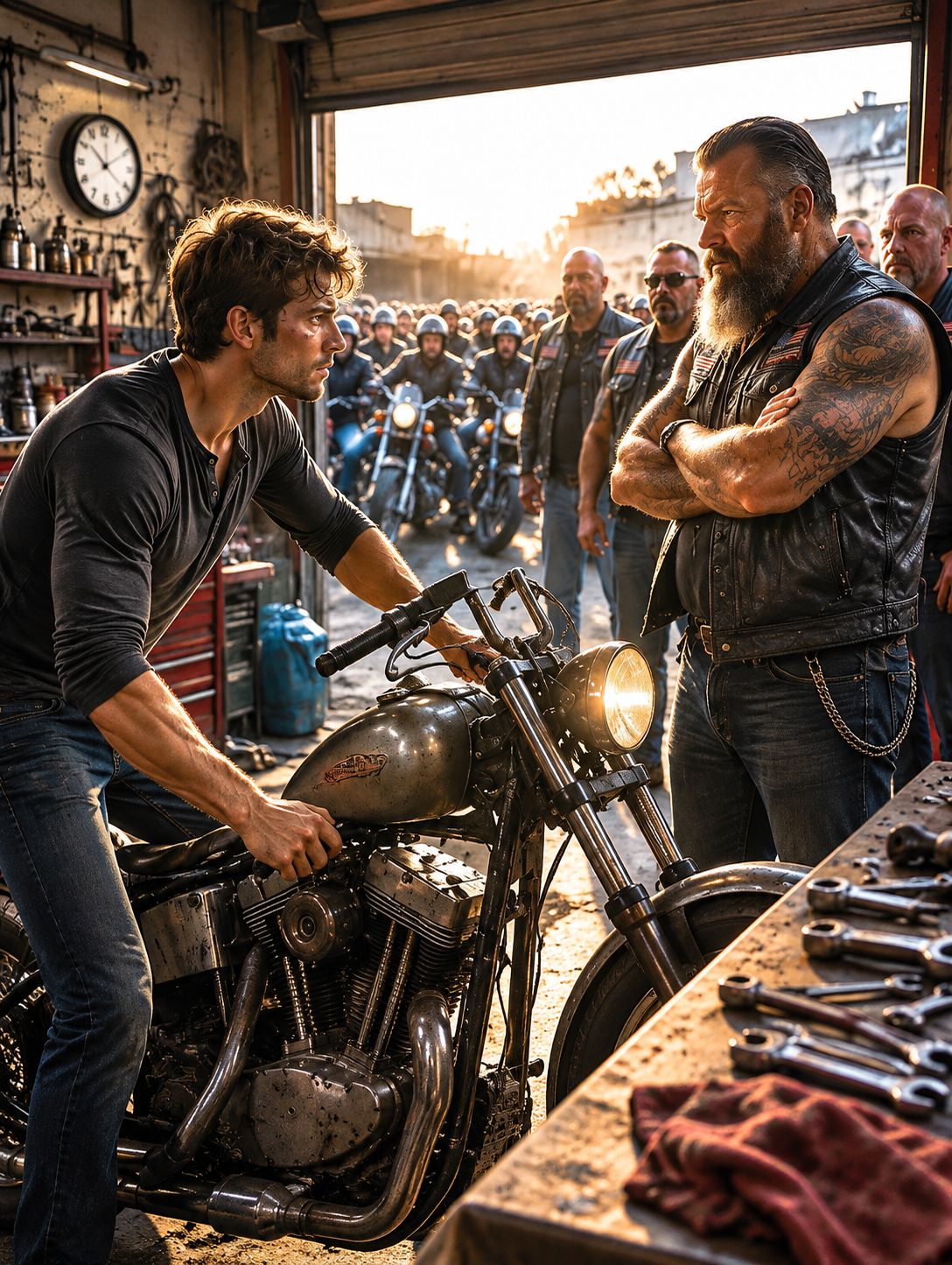
Part 2….. IF FACEBOOK BROUGHT YOU HERE, HERE’S THE CONTINUATION YOU’VE BEEN WAITING FOR. ENJOY! 👇 I photographed the grooves before doing anything else. I explained to Thorne that I could describe their shape and location, but an independent examination would be needed to establish exactly how they were made and by whom. He nodded without interrupting and told me to continue. I checked my welding setup on test pieces before touching the Harley’s frame. Dad had taught me that the neat appearance of a weld means very little if the underlying joint isn’t sound. When Thorne asked how he’d know I had done it properly, I told him I’d document the process and recommend an independent structural inspection before the motorcycle returned to service. “I’m putting my name on this,” I said. “And my father’s.” Thorne looked at the old equipment around us and told me Marcel had never handed him work that wasn’t exactly what he promised. I said that was the reason I was being careful. At 10:43, my phone began vibrating on the workbench. The caller was Patrice Gendron, who ran the Sudbury shop that had last seen the Harley. I knew him from parts trades and a swap meet, not well enough to expect five messages during a repair. His first text read, “Kieran, don’t touch that bike. I’m serious. Send it back today.” I turned the phone facedown, then reconsidered. If someone knew why this machine was dangerous, keeping that information from its owner would be wrong. I carried the phone to Thorne. He read the message twice and told me to keep working. I asked whether the people behind the damaged frame could threaten my shop, because somebody had just warned me away from a job I was already doing. Thorne said Patrice was frightened for me rather than trying to protect the damage. He didn’t offer an explanation for how he knew. I told him I wouldn’t keep working under a false sense of safety, and he promised that his people would watch the property while I concentrated on the machine. I returned to the welding bench with Gus holding a flashlight and Callum passing tools. They were surprisingly patient, even when I had to stop repeatedly to check fit and alignment. I worked through the steering head and then the rear rail junctions, inspecting each stage rather than trusting the clock. At 11:49, more messages arrived from Patrice. Somebody had called his shop asking whether he knew I had the Harley. His final warning said, “They know you have it.” I showed Thorne, who made a brief call and quietly instructed people outside to watch the approaches to the property. “How many people are out there?” I asked. “Enough,” he answered. It wasn’t reassuring, but I had a frame in pieces and no safe way to rush the work. I finished the welds and began checking them closely. Thorne came over and studied the clean joints. He asked whether I would ride the motorcycle myself. I told him I would not send anybody onto the highway merely because the weld beads looked good. The repaired frame still needed proper verification, and I wanted another qualified set of eyes on it before anyone trusted it at speed. Reassembly began after noon. Gus and Callum worked alongside me as I checked each connection and fastener. At , just as I tightened a final cover bolt, someone knocked on the side door leading to Dad’s cramped office. Thorne moved toward the door. The visitor called himself Bernard Cludier and said he had information about the motorcycle that couldn’t wait. He’d reached the property through a neighbor’s back fence because he didn’t want to be stopped outside. “I know who damaged that frame,” Bernard said through the door. “And I know why someone wanted it that way.” Thorne asked him to identify himself again, then let him in. Bernard was in his early 60s, a solidly built workingman whose face looked exhausted. He glanced at the nearly reassembled Superglide and seemed relieved. Then he told us a welder named Victor Arseno, who operated a shop in Elliot Lake, had worked on the frame roughly eight months earlier. Victor had been approached through the chapter network and told the work was authorized. Bernard admitted he’d helped make the introduction, believing it was an ordinary repair. He said Victor later told him the instructions had been to make the frame appear sound while ensuring it would fail under load. I kept my hands on the workbench because I didn’t trust myself to speak without anger. Thorne demanded to know who had authorized the job. Bernard hesitated, saying he didn’t want to involve me in what came next. Thorne told him to say the name, and Bernard did. I didn’t recognize it. Thorne did. His jaw tightened for an instant before he regained control, and Bernard said he had come forward because he was frightened and tired of remaining silent. I understood then that the motorcycle wasn’t the whole dispute. It was a tool someone had used against Thorne, and the danger had reached my father’s shop because I had found what others had left alone. Bernard and Thorne spoke privately while I completed the final checks. When Bernard left, Thorne asked whether the bike was ready. I told him the assembly was complete but that a proper structural clearance remained necessary. He agreed to keep it off the road until that could be arranged, and I documented the repair status rather than pretend a short ride could prove everything. At , Thorne stood beside the Superglide and asked what he owed me. I said I’d prepare an invoice at my regular rate, with the inspection and any further work accounted for separately. He made another phone call and told me someone important would arrive within the hour. I began sweeping the bay because I needed to do something ordinary. Thorne joined me and said the visitor, Raël Desaine, had known Dad for fourteen years. He’d even attended the funeral, standing at the back so his presence wouldn’t draw unwanted attention.
Part 3 Seven weeks after Dad died, an unmarked envelope had appeared at the shop. Inside was enough money to cover six weeks of overhead and a card calling Marcel an honest craftsman whose work would outlast him. I’d kept that card in Dad’s desk drawer, never knowing who had sent it. “Raël wrote it,” Thorne said. I leaned the broom against the wall and thought about all the nights that envelope had kept the lights on. Thorne warned me that Raël would ask what I’d found and advised me to stick to the metal, not guesses about the people involved. I washed my hands at the utility sink with Dad’s orange pumice soap. Then I heard engines approaching, far more than the nine that had arrived that morning. I walked to the open bay door and saw motorcycles filling the lot and lining the street in both directions, their riders settling into a remarkable silence. I counted thirty-five bikes before losing track. Men wearing patches from across the Ontario and Quebec network stood beside their motorcycles in the November cold. I was still in dirty work clothes, wondering why so many people had come to see a mechanic who could barely pay his bills. Raël Desaine entered the bay without any announcement. He was in his late 60s, quieter and less physically imposing than Thorne, but everybody seemed to make room for him. He placed a hand on the Superglide’s tank, then looked at me. “Marcel’s son?” he asked. I nodded, and he told me to describe the frame from the beginning. I explained the surface welds, the weak fusion, the suspicious grooves, and the corrective work, separating what I’d directly observed from what required outside confirmation. He listened without interrupting. When I finished, he said Bernard had identified the person who authorized the sabotage and that he had heard the same name. He needed a reliable technical account before deciding what to do with the information. I asked about the three shops that had returned the bike. Raël told me one had apparently missed the problem, while two had noticed something wrong and been pressured into silence. That made me think immediately of Patrice. “Was Patrice trying to protect me or protect whoever did this?” I asked. Raël said Patrice had found an anomaly in Sudbury and had been told to keep quiet. His warnings that morning, Raël believed, were genuine concern for me. Then he handed me an envelope containing a personal check for four times what I’d intended to charge. I told him it was too much. He said my regular invoice would still be paid and the additional money was a personal acknowledgment of the work and the risk I’d taken. Dad had always refused overpayments. I remembered him handing money back across this same counter, even when we needed it. But I also remembered the bank’s last call and the unopened bills in the office, and I accepted the gift with a quiet thank-you. Raël had another proposal. The network maintained eleven motorcycles across its Ontario chapters, and major mechanical work had been divided between two shops since Dad died. He wanted Dufresne Mechanical to become its primary maintenance shop. It meant reliable work and the chance to keep the business alive. It also meant a relationship with people whose internal disagreements had nearly cost a man his life. I thought about Dad telling me, years earlier, that Raël had earned his respect even when they disagreed. I agreed to take the work on professional terms, with safety and honest reporting nonnegotiable. Raël shook my hand. Then I asked whether he would consider bringing the evidence to the police instead of handling the sabotage inside the network. I told him that deliberate tampering with a motorcycle could be a serious criminal matter in Canada, but that a proper investigation would have to determine intent and responsibility. I offered to prepare a factual report and preserve the photographs. Raël was quiet for so long I wondered whether I’d pushed too far. “Your father told me the same thing fifteen years ago,” he finally said. He admitted he hadn’t listened then and still regretted the consequences. This time, he told me to write the report and keep copies. After he went outside, Thorne said Raël had brought a retired RCMP investigator with him and was already considering a formal complaint. I stood at Dad’s desk with a yellow legal pad and began recording the condition of the frame, my observations, the repair steps, and the limitations of what I could verify. I was four paragraphs in when the side door opened without a knock. A man in his mid-40s wearing a Hell’s Angels sergeant-at-arms patch stepped into the office. He introduced himself as Pat Devo from the Sault Ste. Marie North chapter. He said Victor Arseno worked in his chapter’s territory and had been deceived into doing a supposedly authorized repair. I told him I couldn’t determine Victor’s state of mind from the metal, but the scoring patterns were not consistent with an ordinary mistake. Devo watched me carefully. “The way you characterize it in your report matters,” he said. He wanted me to call the work negligent rather than deliberate, because that description might protect Victor from the consequences of what he’d done. I put down my pen. “I won’t write what you want,” I told him. “I’ll write what I found.” He said I was making a mistake. I stood and asked him to leave my shop, repeating myself when he tried to argue. After he left, I sat down and watched my fingers tremble for a few seconds. Then I went back to the report. Dad used to say a mechanic’s responsibility didn’t end when the customer wanted an easier answer. Thorne came into the office and asked whether Devo had visited. I told him exactly what had been said. He went outside immediately, and I heard hurried footsteps and low voices beyond the bay.
Part 4 I finished seven pages, checked the language, and made copies on Dad’s temperamental photocopier. One stayed in the desk drawer, another went into my pocket, and I carried the original to Raël. I could finally give him something more useful than a suspicion. Raël was waiting with Thorne and two men I hadn’t met. He read the report’s opening pages and asked me to repeat Devo’s request. I did, using his words as closely as I remembered them and making clear where I was paraphrasing. Raël told me Victor had been speaking with his people and had confirmed Bernard’s account. According to Victor, the person who ordered the damage had also coordinated pressure on the three repair shops. The plan hadn’t accounted for Thorne bringing the Harley to me through his father’s old connection. “You weren’t supposed to be looking,” Raël said. I glanced at the Superglide and realized that the only reason I’d found the grooves was because nobody had thought to warn me away before the motorcycle arrived. He introduced Claude Maro, a retired RCMP investigator now working privately. Claude explained that he could document my statement and help organize evidence for the authorities, but that he wasn’t acting as a police officer. I appreciated the distinction. Claude asked me to begin with the arrival that morning. For twenty-four minutes, I walked him through the trailer, the inspection, the messages from Patrice, Bernard’s visit, and Devo’s attempt to influence the report. He stopped me for clarification on times and on which conclusions were technical rather than personal. When he read the statement back, I corrected a time and a description of the metal. Then I signed it. Claude said the report, photographs, original messages, and witness accounts should be preserved for a formal investigation, not treated as proof of a completed criminal case. Raël told me I’d done good work, and I said I’d done what Dad taught me to do. I wasn’t trying to be brave. I’d been frightened most of the day, and my shoulders ached from holding that fear out of the way while I worked. Outside, more riders had arrived. I went to the bay entrance and looked at the sign Dad had put up in 1999. Dufresne Mechanical still had his name on it, but every invoice now carried mine. My phone buzzed with a message from an unknown number: “Your father would have done the same.” I never learned who sent it. I put the phone away and returned to the office to file the copies where they wouldn’t get lost among the bills. When I finally lowered the bay door, the accumulated tension caught up with me. My legs shook, and I stood in the quiet with one hand against the wall until it passed. Dad had always said the shaking after a difficult day was the body’s way of settling its accounts. Someone knocked. Thorne was standing outside alone and told me Raël wanted me in the lot. I followed him into the cold and saw motorcycles parked well beyond the shop, more than two hundred of them, with others still arriving. The riders were quiet, standing beside their machines rather than making a show of themselves. Raël waited near the middle of the gathering. I crossed toward him, feeling every eye on the grease still caught in the creases of my hands. He told me the person who had ordered the sabotage was being informed that the technical findings had been documented and that the network intended to pursue a legal response. Claude had already helped arrange for a preliminary account to reach contacts at the provincial level. “We’re taking it to the Ontario Provincial Police,” Raël said. He didn’t promise an arrest or a conviction. He said the investigators would have to examine the evidence and decide what charges, if any, could be supported. Then he looked at me. “You suggested that path, and I want you to know I heard you.” He spoke of Dad again, and the advice he’d ignored fifteen years earlier. “I’m not making that choice twice,” he said. I thought about the anonymous card and the money that had kept the shop operating after Dad’s death. The man in front of me wasn’t pretending he had always made the right decisions. That mattered more to me than another promise. Raël turned toward the gathered riders and announced that Dufresne Mechanical would become the Ontario network’s primary mechanical shop. Nobody applauded. Instead, engines began starting one after another until the noise rolled across the street and through my chest. Thorne leaned toward me and said I looked ready to fall over. He was right. I hadn’t eaten breakfast, and it was well past the time I usually stopped for lunch. He told me there was food at the clubhouse and that Raël wanted me there that evening to meet the people whose motorcycles I’d be maintaining. I asked whether I could decline. Thorne paused, then gave me the closest thing to a smile I’d seen from him all day. “Not really,” he said. I laughed, unexpectedly and for the first time since the riders arrived. Then I asked for five minutes alone in the shop.
Final I went back into the bay and stood beside the Superglide. The motorcycle was assembled and its defective welds had been replaced, but I had made sure everyone understood it still needed independent structural verification before being cleared for ordinary riding. Saving a man’s life wasn’t something I could claim on the strength of my own confidence. Dad’s old Miller welding machine stood in the corner. The torch cables were worn smooth where his hands had held them for years, and mine had added a little more wear that day. I looked around the room at the tools he’d maintained and the workbench he’d adjusted to exactly the height he liked. “I did it right, Dad,” I said to the empty shop. “I found it, and I didn’t bend.” There was no answer, of course, but I stood there long enough to hear the building settle around me. Outside, the convoy was preparing to leave. Callum offered me the key to a charter motorcycle for the evening, and I looked toward my pickup parked beside the building. He said nobody followed Raël in a pickup, and for once I decided not to argue. I rode in the second row wearing my stained work clothes, without a club patch and without any desire to earn one. I was still a 23-year-old mechanic whose father had died four months earlier, and tomorrow I would still have invoices to write and a bank to call. The work and the responsibility hadn’t disappeared just because the engines were loud. But the shop would have a chance. Thorne had a repaired motorcycle awaiting proper clearance, the evidence had been preserved for investigators, and the men who’d tried to keep the damage hidden no longer controlled the only account of what happened. What the authorities ultimately did was theirs to determine. As we rode through the November evening in Sault Ste. Marie, I thought about Thorne’s six-hour ultimatum and how close I’d come to giving him an answer he wanted instead of one I could stand behind. Dad had taught me that metal didn’t care about your excuses. A joint was sound or it wasn’t, and the person who trusted it deserved the truth. Behind us, Dufresne Mechanical stood locked beneath the old sign. The Superglide waited inside, and my father’s tools hung where he’d left them. I couldn’t bring him back, but I could keep doing the work in a way that would have made him willing to put his name beside mine. THE END. I’ve shared the complete story, and I truly hope it touched your heart. If this story moved you, please , like, and share the post. Thank you for reading! ❤️
✓ Lynn R. Adams
Part 2….. IF FACEBOOK BROUGHT YOU HERE, HERE’S THE CONTINUATION YOU’VE BEEN WAITING FOR. ENJOY! 👇 I photographed the grooves before doing anything else. I explained to Thorne that I could describe th…