At 21, I had three months……
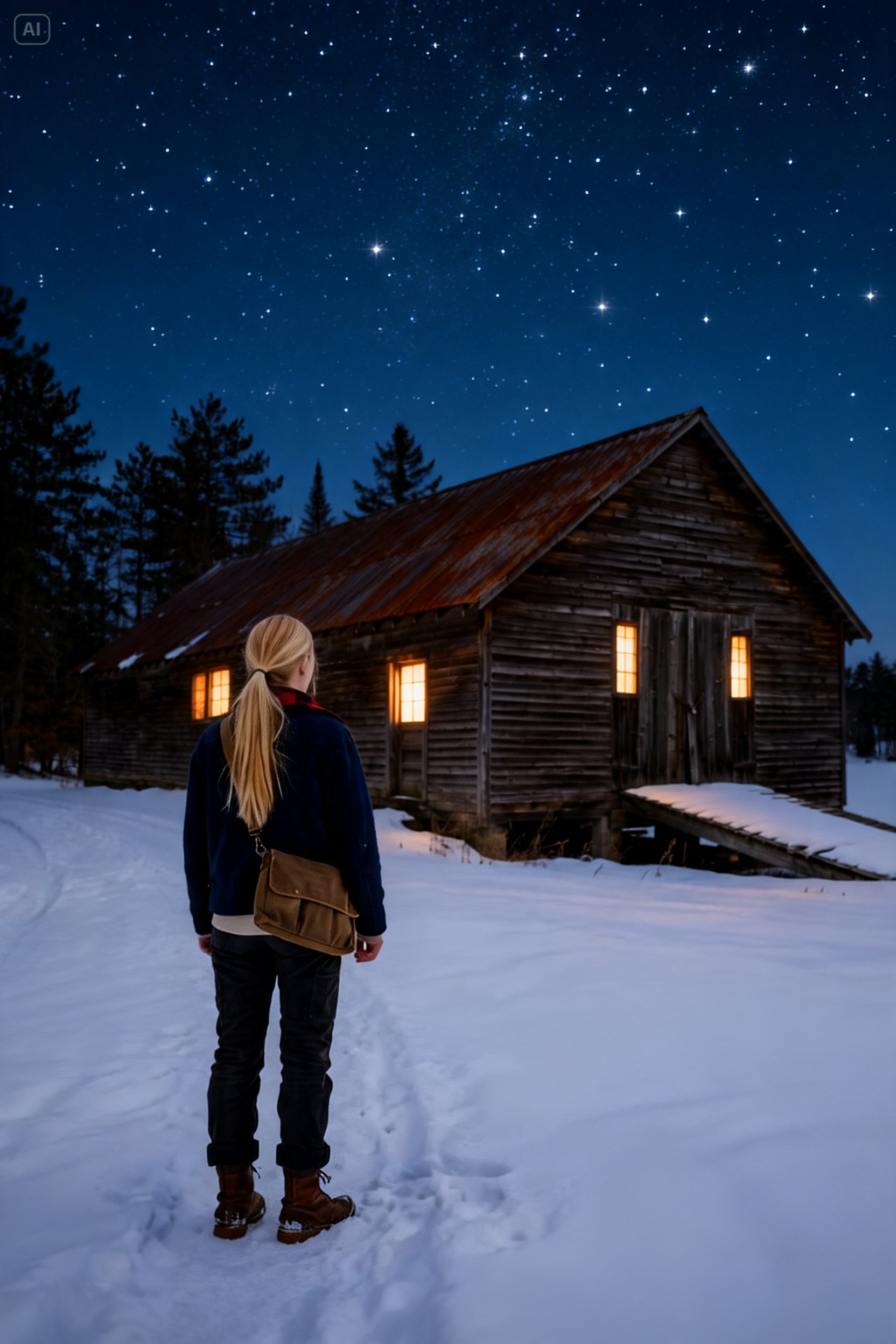
At 21, I had three months on a borrowed couch and $940 in savings. Then I found a $10 ice house my grandfather had locked decades earlier, and something inside its wall didn’t look right….
My aunt told me I needed to move out on a Tuesday evening in January. She didn’t raise her voice or blame me for anything. She set her tea down at our kitchen table in Eagle River, Wisconsin, and said she’d been accepted into an assisted living facility in Rhinelander. The house was being sold.
“I’ve arranged for you to stay with Helen Lindgren for up to three months,” she said. “I wish I could take you with me, Lark, but I can’t.” I was 21. Aunt Astrid was 78, and the stairs, snow shoveling, and troublesome furnace had become too much. I understood. It still hurt.
I had lived in that little white house since I was seven. My mother, Sigrid Engstrom, worked the front desk of a lakeside resort and died suddenly of a brain aneurysm one Sunday morning in March. My father, a seasonal fishing guide from Duluth, had left before he knew Mom was pregnant. Astrid brought me home after the funeral.
Astrid was a longtime librarian who believed a child’s world shouldn’t have to disappear along with her mother. She kept me in the same school and preserved my grandfather Gustav Engstrom’s things: his ice saw above the fireplace, his waxed canvas tool roll in the closet, and his worn 1934 Ice Harvester’s Handbook beside her chair.
Grandpa Gustav had been born in Eagle River in 1928 to Swedish immigrant parents. His family came north for logging, but he chose a different trade. From 1946 until 1961, he cut blocks of lake ice for resorts, fishing camps, butcher shops, and other customers who needed to keep things cold before electric refrigeration took over.
He worked on frozen lakes with hand saws and horse-drawn ice plows, then stored the blocks in buildings with thick, sawdust-filled walls. He cut ice on Catfish, Cranberry, Butternut, Long, and Anvil lakes. He spoke their names like they mattered.
Grandpa took me onto a frozen lake twice, once when I was four and once when I was five. He let me hold the handle of a saw too big for my arms. More important, he made me look down. “Clear blue-black ice is strong,” he told me. “White ice is weak. Gray ice is rotten. Don’t guess. Look.” He died while I was still five, but I never forgot that lesson.
Astrid read aloud from his penciled notes on winter nights. On my eighteenth birthday she gave me his tool roll, with the scoring chisel, small pick, block tongs, packing hook, and several saws still inside. “These are working tools,” she said. “Don’t hang them up as decorations, and don’t give them away.” I promised I wouldn’t, though I had no idea what I’d do with them.
After high school, I couldn’t afford college and didn’t want loans I couldn’t repay. I took a job at the same resort where Mom had worked, cleaning cabins and helping with repairs. I patched roofs, fixed docks, and replaced frozen pipes in old cabins. I liked leaving things sturdier than I found them.
I contributed what I could toward Astrid’s groceries and saved $940 over three years. I didn’t own a car. I’d been driving her old Subaru Forester, which was being sold with the house. When I moved into Helen’s finished basement on February 1, I carried my clothes, my laptop, and Grandpa’s tools. Helen was kind. Her couch was warm. But it wasn’t mine.
Helen had served with Astrid on the library board. She gave me a bathroom, a basement window, and time to plan. On a Wednesday evening in late February, I sat with black coffee and searched the Vilas County surplus-property listings. I wanted a place I could keep.
The fourth listing stopped me. It was a former commercial ice house on the north shore of Butternut Lake, eight miles south of Eagle River. The property included roughly 1.8 acres of lakefront land and a 2,400-square-foot timber building. Its asking price was ten dollars. I checked for missing zeroes.
The Butternut Lake Ice Company had built it in 1898. The cooperative used it until the final local commercial ice harvest in 1961, and the county eventually took the abandoned property for unpaid taxes in 1989. The county historical commission had delisted it in 2015. In the photograph, the cedar walls were dark with age and the loading ramp disappeared under snow.
I knew that lake. Grandpa had said its name to me while we stood on ice more than fifteen years earlier. I zoomed in on the old loading doors and the pine trees around the building. The roof looked rusty but whole. The walls appeared to lean a little. It needed work, and I couldn’t look away.
The next morning I borrowed Helen’s Subaru and went to the county clerk’s office. Arlen Nyquist, the white-haired clerk, studied my name when I asked about the property. “Your grandfather was Gustav Engstrom?” he said. I nodded, expecting a warning about repair costs or paperwork. Instead, he put his pen down.
“Gustav cut ice on Butternut Lake from 1946 to 1961,” Arlen told me. “He was the last man to use that building. My father kept the cooperative’s books. He said your grandfather locked the big doors after the last harvest and cried.” I’d never heard that story.
Arlen completed the deed paperwork and handed me an old iron key on a leather thong. He said it had been kept at the office since the county took the property. “It came from that ice house,” he explained. I paid ten dollars and sat in Helen’s car holding Grandpa’s old key.
That afternoon I drove to the turnoff. The seasonal lane hadn’t been plowed, so I parked near the county road and walked half a mile through knee-deep snow. Grandpa’s tool roll pulled at my shoulder. I wondered what I’d bought.
Then I saw it above the frozen lake: a long, low structure nearly eighty feet by thirty, with gray-brown cedar siding, a steep metal roof, and two tall oak loading doors at the lakeside end. White pines surrounded it. The ramp sloped straight toward the ice. I knew exactly why it had been built.
The doors were still held by a heavy chain and padlock. I fitted the iron key into the lock, worked it back and forth with stiff fingers, and felt something give. The chain dropped into the snow. I slid the oak doors apart on their iron track, thinking about the day Grandpa had shut them for the last time.
The inside was one enormous cold room, open to massive pine rafters overhead. The inner walls were closely fitted pine boards. Behind them, as Grandpa had explained long ago, were twelve-inch cavities packed with sawdust beneath the outer cedar siding. Even empty, the building held a deep, still cold. My breath clouded.
The floor was made of thick planks over gravel and sand, with narrow channels to drain melting water toward the lake. I could already see damaged sections near the loading doors, but the roof still seemed sound. I touched the boards, imagining sixty-three winters of ice blocks hauled through those doors.
Near the far end, on the north wall about four feet above the floor, I noticed three shorter planks. Their grain angled slightly away from the boards around them. The seams were almost invisible. Grandpa had taught me to notice differences.
I knelt and pressed my fingers along the edges. There were no nails in those three boards. I found a thin wooden lip at the top and pushed upward. The whole section shifted toward me on an old leather hinge. Behind it was a clean rectangular opening where the sawdust should have been, and something had been placed inside. Part 2…..
I reached into the hollow wall and drew out a small hand-built pine chest. A brass hasp held it shut, and the padlock was small enough to fit in my palm. For a minute I stayed kneeling on the old floor, listening to the wind outside. Whoever hid that chest had taken great care to leave the wall looking ordinary.
I carried it out to the loading ramp and sat beside it in the February daylight. Butternut Lake was frozen white below me. I unrolled Grandpa’s tools, chose the smallest ice pick, and worked at the old brass lock until it released. Under the lid, on a folded piece of waxed canvas, lay a little leather-bound book, a heavy canvas pouch, and a folded letter sealed with pine pitch.
I opened the book first. The pages were filled with dates, measurements, names, and neat handwritten columns. It was the cooperative’s harvest log, beginning in the winter of 1898 and continuing through 1961. Five ice masters had recorded the thickness of the ice, the air and water temperatures, blocks cut, crew members, customers, and even the condition of their saws.
I turned the pages and found resorts, fish camps, dairies, butcher shops, and a hospital in Rhinelander that received twenty blocks a week through many summers. Every entry was evidence of work nobody in town talked about anymore. The final page was dated March 8, 1961. I recognized Grandpa’s slanting handwriting before I read his name.
He had written that the ice measured fourteen inches, clear blue-black, and that the crew had cut 342 blocks in twelve-degree air. Four names were listed: G. Engstrom, R. Lindgren, T. Matson, and H. Bjork. He noted that the resorts had switched to electric refrigeration and that he would lock the building that night. Underneath was his signature: Gustav Engstrom, ice master.
The canvas pouch was heavier than I expected. Inside were silver dollars, old Morgan and Peace coins that I later counted: eighty-seven in all, dated from 1898 through 1960. I couldn’t begin to guess what they were worth as I sat there. What shook me wasn’t the money. It was the thought that Grandpa had left his final work and these coins behind a wall.
I broke the pitch seal on the letter. He addressed it to whoever found the chest and explained that he was thirty-three years old, the last ice master of the Butternut Lake Ice Company. His father, Nils, had worked there from 1928 through 1945, and the founding families had kept the cooperative going since 1898. The business had lasted sixty-three years.
The letter said the harvest log was the only complete record of those winters and that he couldn’t bring himself to destroy it. He trusted the ice house’s insulated, stable walls more than a bank vault or an archive. The silver, he explained, was an emergency-repair fund collected over the years by the Engstrom, Lindgren, Matson, and Bjork families. The emergency had never come, so the money had grown.
“Use it for the building if the building still stands,” Grandpa wrote. “Use it for yourself if the building has fallen.” He didn’t know who would find the chest or whether the wall would ever be opened. He wrote that working on lake ice had taught him patience with things he couldn’t control. At the end, in the same steady hand, were four words: “Read the ice clearly.”
I read his letter a second time. When I was four, Grandpa had jokingly told me not to cry out on the ice because salt weakened it. I hadn’t understood him then. I sat on that snowy ramp holding the letter and finally said, “Thank you, Grandpa. I’ll read it clearly.” I knew I couldn’t leave the building to rot.
A coin collector in Rhinelander later appraised the eighty-seven dollars at about $8,200, far above the roughly $2,000 value of their silver content. After his commission, I received $7,400. To someone with $940 in savings, it felt enormous. But I looked at the sagging floor, the weathered siding, and the long road in, and I knew the money had a job to do.
Part 3 The first repair wasn’t the rusty roof. It was still doing its job. The insulated walls, astonishingly, were sound too. The problem lay under my feet: the old drainage planks had rotted in three spots near the lakeside doors where melted snow had soaked into the gravel bed. I could push a tool into the soft gray wood. Grandpa’s warning about rotten ice came back to me.
I started in May. I pulled up the damaged planks, replaced the wet drainage material, and bought white pine boards from a small sawmill in Phelps. I spent long days fitting them into the old floor with tools Grandpa had held himself. The fresh boards looked pale beside the surrounding wood. His handbook said they’d darken with time, and I decided to believe it.
On Saturday mornings a retired carpenter named Rolf Matson drove up in a battered Ford pickup. He was seventy-four, and his grandfather had helped found the Butternut Lake cooperative. Rolf brought coffee, sat in a folding chair on the ramp, and answered questions when I asked them. He wouldn’t take payment. He didn’t grab the tools or tell me to step aside, either.
By late June, the floor was solid enough to walk across without worrying where to put my weight. Every sound plank made me feel that the building might survive another winter. I used part of the road end for a small living space, with a cot, a wood stove, a propane burner, and a composting toilet behind a partition. A cistern collected rainwater from the metal roof.
I left the cold room as it was. I didn’t want my need for a home to erase the reason the building existed. I built a protective, climate-controlled display case from reclaimed pine for the harvest log and set it near the entrance. When I opened the book, I could trace names back through generations, including Grandpa and his father. It belonged to more than just me.
In my second year, the Northwoods Ice Heritage Project, a small environmental education nonprofit based in Eagle River, hired me part-time as an educator and site interpreter. Rolf’s granddaughter had started the project in 2019. I talked to visiting school groups about commercial ice harvesting, let them examine Grandpa’s hand tools, and showed them why the old double walls mattered.
During January and February visits, I walked groups down the loading ramp toward the frozen lake and explained how to observe ice color, just as Grandpa had taught me. I made sure everyone understood that color alone wasn’t proof a lake was safe to walk on; conditions still had to be checked. The children loved the enormous saw, but many asked more questions about the people who had used it.
I told them about the crews who cut blocks in freezing weather, the customers waiting for ice in summer, and the day electricity made an entire trade unnecessary. I told them the log had survived because one man thought ordinary work deserved a record. Sometimes I looked at the old oak doors and remembered Arlen saying Grandpa had cried as he locked them. I no longer wondered why.
Final Astrid visited during my second summer. She was eighty by then, settled in Rhinelander and walking with a cane, but her eyes were as sharp as ever. She stood in the cold room without speaking for a long time. Then she looked at the great loading doors and said, “My father cried when he closed those. I always wondered what he left behind.”
I showed her the harvest log in its case. She leaned close to read the final entry, the fourteen inches of clear blue-black ice, the 342 blocks, and her father’s signature. “Gustav, you old Swede,” she murmured. “You sealed it in the wall.” I nodded. “He sealed it in the wall, Aunt Astrid.” We stayed there together until the light began to change.
When I was twenty-five, I sat on the loading ramp one clear evening in late September. Butternut Lake was still open water, dark blue in the fading light. The birches along the shore had begun turning gold, and a loon called across the lake. The old building behind me had a sound floor, a small home at one end, and its history preserved at the other.
I thought of Mom, who’d worked so hard and died before she could know what her father had hidden eight miles from home. I thought of Astrid, who’d given me a place to grow up and then, when she could no longer keep that house, helped me find my next foothold. And I thought of Grandpa guiding my little hands toward an ice saw I was too small to pull.
For years I believed his lesson was about telling strong ice from weak ice. That February afternoon, standing before three boards whose grain ran in a different direction, I finally understood more of it. He’d been teaching me to notice, to examine what was under my feet, and to trust what careful looking could tell me. I had needed every bit of that lesson.
I bought the old ice house for ten dollars when I was twenty-one and afraid I had nowhere of my own to go. What I found inside its wall helped pay for the repairs, but the log and Grandpa’s letter gave me something money couldn’t have bought: a way to keep a vanished trade alive and make a home without letting its story disappear. It was the best ten dollars I ever spent.
THE END. I’ve shared the complete story, and I truly hope it touched your heart. If this story moved you, please , like, and share the post. Thank you for reading! ❤️
✓ Lynn R. Adams
At 21, I had three months on a borrowed couch and $940 in savings. Then I found a $10 ice house my grandfather had locked decades earlier, and something inside its wall didn’t look right…. My aunt to…