At 20, She Bought an Abandoned Farm Trailer for $300 — But a Floorboard That Refused to Lift Exposed Her Family’s Darkest Secret
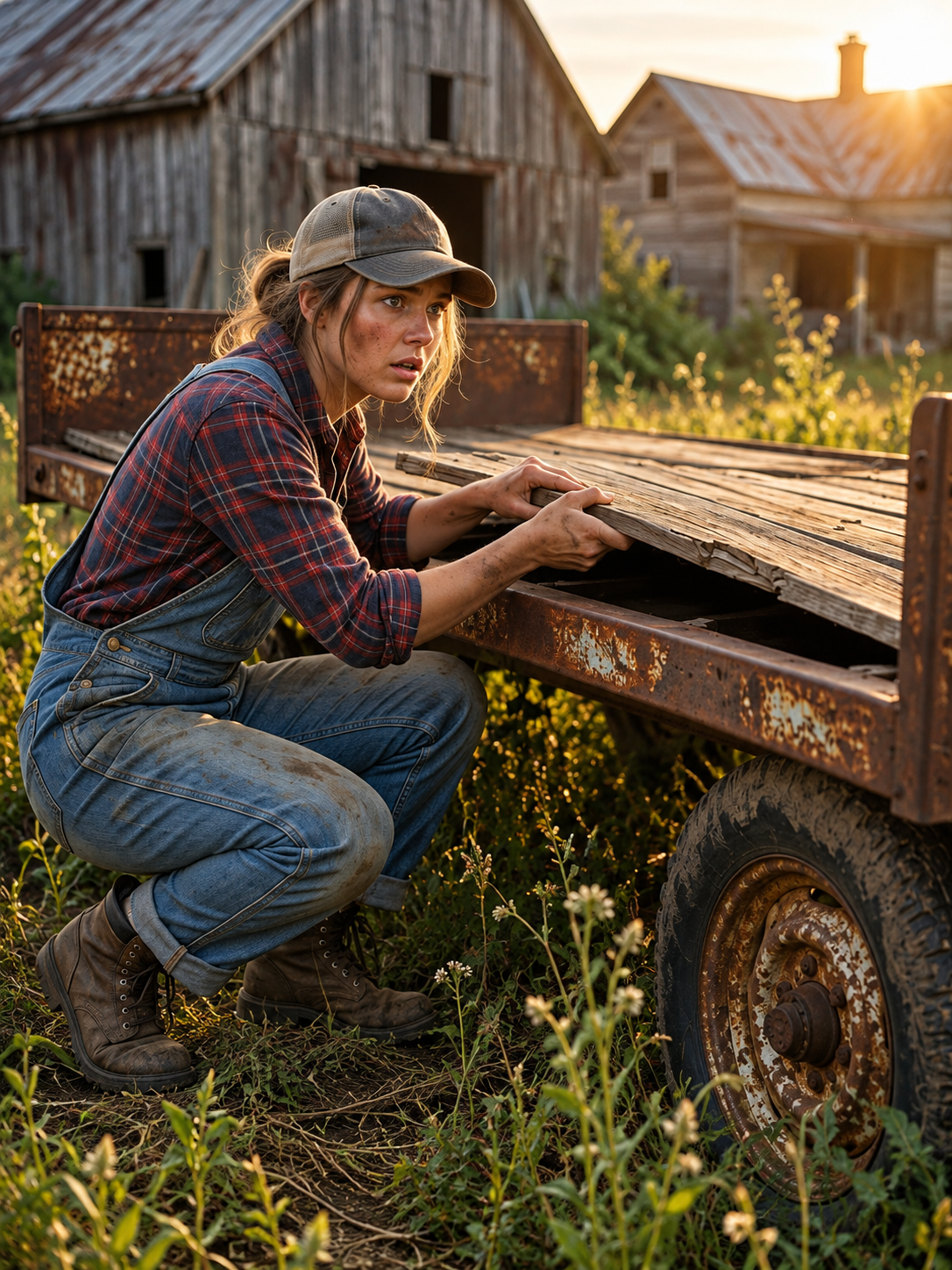
At 20, She Bought an Abandoned Farm Trailer for $300 — But a Floorboard That Refused to Lift Exposed Her Family’s Darkest Secret
The sheriff told me to burn the trailer before I found what was hidden beneath its floor.
My uncle offered me $25,000 to walk away from a home I had purchased for just $300.
And when I finally forced open the floorboard that wouldn’t move, I discovered a photograph of my mother standing beside a little girl everyone had told me was dead.
The worst part wasn’t the photograph.
It was the date written on the back.
October 17, 2004.
Three years after my mother supposedly died.
My name is Hannah Walker. I was twenty years old when I bought the ugliest farm trailer in eastern Kansas because it was the only place I could afford to call home.
I had $1,147 in savings, a 1998 Ford Ranger with a failing transmission, and two black trash bags containing almost everything I owned.
The trailer had broken windows, a roof that sagged in the middle, and a kitchen floor covered in mouse droppings.
But it sat on six acres of land outside Bell Creek, Kansas.
Six acres that came with a well, an old barn, a gravel driveway, and the possibility of never again having someone threaten to throw my belongings onto the street.
I thought I was buying a place to start over.
I thought the worst thing waiting inside was rotten wood.
I thought the strange scratches beneath the kitchen table were left by animals.
I thought the neighbors avoided the property because it was abandoned.
I thought my uncle was offering to help because he finally felt guilty.
I thought a locked floorboard was just another problem I could fix with a hammer.
By the end of my first night, I understood how wrong I had been.
Should I take my uncle’s money and leave while I still could, or open the one floorboard someone had spent twenty years making sure nobody could lift?
Three weeks earlier, my uncle Richard had stood in the doorway of his expensive farmhouse and told me I had thirty days to find somewhere else to live.
“You’re twenty years old, Hannah. It’s time you stopped expecting other people to take care of you.”
I had been washing his dinner dishes when he said it.
The faucet was running.
A chipped blue plate rested in my hands.
Behind him, my aunt Linda sat at the kitchen island scrolling through her phone.
I turned off the water.
“I pay you four hundred dollars every month.”
Richard shrugged.
“That doesn’t cover what you cost us.”
I looked at the refrigerator.
My grocery receipts were held there beneath a magnet shaped like a sunflower.
I bought most of my own food.
I paid for my truck.
I worked forty-eight hours a week at Miller’s Feed and Supply.
And every Saturday, I helped Richard repair fences on his cattle property without asking for a dime.
I didn’t argue.
I dried the plate and placed it in the cabinet.
“When do you want me gone?”
“End of the month.”
He seemed irritated by my answer.
“That’s all you’ve got to say?”
I picked up the dish towel.
“What would you prefer?”
He stared at me.
“You’ve got your mother’s stubborn streak.”
I looked directly at him.
“Then I suppose she taught me something useful.”
His expression changed.
My mother had been dead since I was four.
Or so I had always believed.
Her name was Rebecca Walker.
Richard was her older brother.
He and Linda had raised me after the accident that supposedly killed both my parents.
They had never allowed me to ask many questions.
Whenever I brought up my mother, Richard grew quiet.
Whenever I asked about my father, Linda changed the subject.
And whenever I asked to see the police report from the accident, Richard told me it had been lost in a courthouse flood.
By sixteen, I had stopped asking.
Not because I believed him.
Because I understood that people who control your home can make curiosity expensive.
The morning after Richard told me to leave, I saw the .
It was taped inside the window of a hardware store in Bell Creek.
OLD FARM TRAILER.
BUYER RESPONSIBLE FOR CLEANUP AND BACK TAXES.
CONTACT COUNTY LAND OFFICE.
I read it twice.
Then I laughed.
Six acres for three hundred dollars sounded like a joke.
Land didn’t sell for that price.
Not even in a county where half the farms had been struggling for years.
But the included a parcel number.
And I knew enough about property records from helping Richard with his taxes to understand that parcel numbers could be checked.
So I walked to the county administration building during my lunch break.
A clerk named Evelyn Brooks searched the computer.
She was about sixty, with silver hair and reading glasses hanging from a chain.
“Yes,” she said. “It’s available.”
“Why so cheap?”
“Tax foreclosure.”
“How much are the back taxes?”
“Two hundred and eighty-six dollars, forty cents.”
I did the math.
Five hundred eighty-six dollars and forty cents.
That would leave me just over five hundred dollars.
“Is the land actually included?”
She nodded.
“Six point two acres.”
“Any liens?”
“Nothing surviving the foreclosure sale that I can see, but you’ll want a title company to review it.”
I studied the map.
The property sat twelve miles northwest of Bell Creek.
A dirt lane led from County Road 19 to a small clearing.
The trailer was marked as a manufactured home from the early 1970s.
The land had once belonged to a man named Walter Grady.
He had died without heirs who wanted the property.
Or so the county file said.
“Has anyone inspected it?”
Evelyn gave me a look.
“Not recently.”
She hesitated.
“People don’t like going out there.”
I looked up.
“Because of the condition?”
“That too.”
“What else?”
She removed her glasses.
“Miss Walker, I’ve worked here thirty-one years. Sometimes a property carries more trouble than it’s worth.”
“I’m familiar with that kind of property.”
She didn’t smile back.
Instead, she looked at my driver’s license.
Then at me.
“Walker,” she said quietly.
“Are you related to Richard Walker?”
“He’s my uncle.”
Her fingers stopped moving.
For a moment, I thought she would say something.
Then she closed the file.
“You might want to discuss this with your family before buying.”
I shook my head.
“My family just told me to leave.”
Something moved across her face.
Pity, perhaps.
Or recognition.
She looked toward the office door.
Then she leaned forward.
“If you’re serious about buying that land, make sure every part of the transaction is documented.”
“I always do.”
“Keep copies.”
“And don’t accept anyone’s word about what belongs to you.”
I didn’t understand the last warning.
But I remembered it.
The next morning, I borrowed my coworker Tyler’s old utility trailer, drove out to the property, and inspected what I could from outside.
The lane was overgrown.
Tall weeds scraped against the truck doors.
A rusted gate leaned against a fence post.
Beyond it stood the farm trailer.
It was narrow, faded yellow, and streaked with black mildew.
One window had been boarded up.
Another was broken.
The porch had collapsed.
The roof looked like a tired animal trying to lie down.
But behind the trailer, the land opened into a grassy field.
A stand of cottonwood trees bordered a shallow creek.
There was a small barn with a metal roof.
And beyond the barn, I could see the rolling Kansas countryside stretching toward the horizon.
I walked the property with a notebook.
The well pump needed testing.
The electrical service had been disconnected.
The septic system would need inspection.
The driveway needed gravel.
The trailer might not be safe to occupy until repairs were made.
I made a list of costs.
Then I calculated what I could afford.
I didn’t have enough to renovate everything.
But I could buy the land.
I could clean the trailer.
I could work extra shifts.
And I could sleep in my truck temporarily while I made the place safe.
I had spent sixteen years living under someone else’s rules.
Six acres of weeds looked better than another month of being reminded I was unwanted.
So I bought it.
The county processed the sale three days later.
I received a receipt, a tax document, and instructions for recording the deed.
I paid an additional fee to have the paperwork reviewed.
Then I drove back to Richard’s farmhouse.
I found him sitting on the porch with a glass of iced tea.
“I found somewhere to live,” I said.
He looked surprised.
“That was quick.”
“I bought a place.”
He laughed.
“With what money?”
“My savings.”
“What place?”
“An old trailer outside Bell Creek.”
He waved one hand.
“Plenty of junk out there.”
“It’s on six acres.”
His hand stopped.
“Off County Road 19.”
His expression changed.
“Which property?”
“The old Grady place.”
The glass slipped slightly in his hand.
Tea spilled onto his jeans.
For several seconds, he didn’t speak.
Then he stood.
“You bought Walter Grady’s trailer?”
“County foreclosure sale.”
His face turned red.
“You had no business doing that.”
I stared at him.
“Because that place is dangerous.”
“I know it needs repairs.”
“You don’t understand.”
“Then explain.”
He looked past me toward the driveway.
Then back at my face.
“Get rid of it.”
I folded my arms.
“It’s already mine.”
“I’ll give you a thousand dollars.”
“A thousand. Cash. You sign it over to me.”
I studied him.
“Because I’m trying to save you from making a mistake.”
“You’ve never offered me a thousand dollars to solve a problem before.”
His jaw tightened.
“Don’t be clever.”
“I’m asking a reasonable question.”
He stepped closer.
“You’re a child, Hannah.”
“I’m twenty.”
“You don’t know anything about owning property.”
“Then it’s fortunate I’ve spent years helping you manage yours.”
That landed harder than I expected.
His expression darkened.
“You think you’re so smart?”
I picked up my truck keys.
“I think three hundred dollars was a fair price for six acres.”
I walked away.
Behind me, Richard shouted my name.
I didn’t turn around.
By the next evening, he had increased his offer to five thousand dollars.
Two days later, it was ten thousand.
Then twenty-five.
That was when I stopped thinking he was worried about rotten floors.
Something on that property mattered to him.
And whatever it was, he wanted it badly.
I told him no.
Then I moved out.
My first night at the trailer began with a thunderstorm.
Clouds rolled over the Kansas fields just after sunset.
Wind pushed against the cottonwoods.
Rain drummed on the metal roof.
I had spent the day removing trash, sweeping dead insects from the window tracks, and covering the broken window with plywood.
The electricity was still disconnected.
I had a battery lantern, a camping stove, and three gallons of drinking water.
The trailer smelled of old dust and damp wood.
I wasn’t planning to sleep inside until I knew the roof and floor were safe.
But I wanted to finish cleaning the kitchen before the storm became worse.
I swept beneath the table.
The broom struck something.
A raised edge in the linoleum.
I crouched.
One section of the floor seemed higher than the rest.
About twenty-four inches square.
I pressed it with my palm.
The surrounding floor flexed slightly under pressure.
This section didn’t move.
I scraped away the dirt.
A straight seam emerged beneath the linoleum.
Then another.
And another.
A perfect square.
I took out my pocketknife and carefully lifted the brittle covering.
Beneath it was a wooden panel.
Four screws held it in place.
Three looked old.
One looked newer.
I touched the newer screw.
Someone had replaced it.
Recently enough that the metal hadn’t rusted like the others.
I leaned closer.
There were faint scratches around the edges of the board.
Marks left by a tool.
Someone had tried to lift it before.
Or someone had forced it closed.
I went outside and brought in my toolbox.
I removed the screws.
Then I slipped a flat pry bar beneath the edge.
The board didn’t move.
I tried the opposite side.
I used more pressure.
The wood creaked.
But it held.
Forcing a mystery panel open in a fifty-year-old trailer during a storm was not the smartest thing I could do.
I needed to know what was underneath before breaking it.
So I took out my flashlight and inspected the seams.
There was a narrow gap near the back.
Just wide enough to see a dark line beneath the wood.
A steel plate had been fitted below the floorboard.
I tapped it with the pry bar.
The sound was dull and hollow.
I pressed my ear close.
For a moment, I heard nothing.
Then the wind dropped.
The rain softened.
And from somewhere beneath the kitchen floor came a faint metallic click.
Another click.
Then silence.
I stood slowly.
The trailer suddenly felt much smaller.
I listened.
Only the groan of old boards.
I told myself it could be loose metal shifting beneath the floor.
Then I looked toward the front window.
Headlights were moving along my driveway.
Deliberate.
I switched off the lantern.
The trailer fell into darkness.
Through a gap in the plywood, I watched the vehicle approach.
It was a black Chevrolet pickup.
The same model Richard drove.
The truck stopped fifty feet from the trailer.
The engine continued running.
For several seconds, nothing happened.
Then the driver’s door opened.
A man stepped out.
Broad shoulders.
Cowboy hat.
He stood in the rain, staring at the trailer.
Then he shouted.
I didn’t answer.
He called again.
“I know you’re in there!”
I remained still.
He approached the steps.
The rotten porch groaned beneath his weight.
“Open the door.”
I moved quietly to the kitchen counter.
My phone had one bar of service.
I opened the camera.
Started recording.
Then placed it where it could capture the doorway.
Richard knocked.
“Hannah, don’t make me break this door.”
I stepped beside the wall.
“It’s my property. Leave.”
Then his voice changed.
“Honey, I’m trying to help you.”
I almost laughed.
“You can help by going home.”
“You don’t know what’s in that trailer.”
My pulse quickened.
“Then tell me.”
He hesitated.
“It’s not safe.”
“I know. I’m having it inspected.”
“That’s not what I mean.”
I looked toward the exposed floorboard.
The pry bar lay beside it.
Richard spoke again.
“Did you tear up the kitchen floor?”
My blood chilled.
He couldn’t see inside.
The windows were covered.
The door was closed.
Yet that was the first thing he asked.
“Answer me.”
I kept my voice calm.
“Why does the kitchen floor matter?”
He didn’t answer.
Then I heard the porch creak.
He was moving toward the window.
I backed away.
“Richard, I’m calling the sheriff.”
He laughed bitterly.
“Go ahead.”
Then he said something that made my fingers turn cold.
“Sheriff Bell already knows about this place.”
I stared at the door.
“Knows what?”
Richard lowered his voice.
“Your mother should have burned it when she had the chance.”
For a moment, I forgot how to breathe.
The woman who died when I was four.
The woman Richard refused to discuss.
“What does my mother have to do with this trailer?”
Then the porch creaked again.
Richard stepped down.
I heard him walking through the mud.
The truck door slammed.
The engine revved.
Headlights swept across the wall.
Then disappeared.
I stood in the darkness for a long time.
My phone was still recording.
I saved the video.
Made a second copy.
Then sent it to an email account Richard didn’t know existed.
After that, I packed my tools.
Locked the trailer.
And spent the night in my truck, parked beside the barn where I could see anyone approaching.
I didn’t sleep much.
At dawn, the storm passed.
Mist rose from the field.
The cottonwood leaves glittered with water.
And my kitchen floor still had one board that refused to lift.
I made coffee on my camping stove.
Then called Miller’s Feed and Supply to say I’d be late.
My manager, Tom Miller, had known me since I was fifteen.
He had given me my first job unloading feed sacks.
He didn’t ask many questions.
“Everything okay, kid?”
“Working on the trailer.”
“You need help?”
“Bring me a list.”
Then I called the county land office.
Evelyn answered.
“County records.”
“Mrs. Brooks? It’s Hannah Walker.”
“Miss Walker.”
“I need to ask about the history of the Grady property.”
Then she said, “Can you come in?”
“Come before noon.”
Her voice dropped.
“Because someone came here yesterday asking to see your deed.”
My stomach tightened.
“Richard Walker.”
I stared toward the trailer.
“What did he want?”
“He asked whether the sale could be reversed.”
“Not simply because he doesn’t like it.”
I felt a small wave of relief.
Evelyn continued.
“But Hannah, he wasn’t alone.”
“Who was with him?”
She hesitated.
Then said, “Sheriff Bell.”
I looked at the exposed floor through the kitchen window.
The metal plate beneath the board.
The scratches.
The new screw.
Then I asked, “Mrs. Brooks, has anyone ever tried to buy that property before?”
She was quiet for several seconds.
“Your mother.”
The coffee cup almost slipped from my hand.
“My mother?”
“She came into this office years ago.”
I swallowed.
“October 2004.”
The same month written on the photograph I would later discover.
The same year my mother was supposed to have been dead for three years.
I gripped the phone.
“Are you certain?”
“What did she want?”
“To retrieve something she said belonged to her.”
I looked at the floorboard again.
Evelyn’s voice became barely audible.
“She wouldn’t tell me.”
I stood frozen.
Then she added, “Hannah, I think you need to come see the old file.”
I was at the courthouse forty minutes later.
Evelyn waited near the records room.
She led me past the public counter into a narrow office lined with filing cabinets.
On her desk sat a cardboard box.
The label read:
GRADY PROPERTY — HISTORICAL RECORDS.
She opened it.
Inside were tax notices, old inspection reports, a faded survey map, and several handwritten letters.
She handed me a photograph.
The trailer looked almost new.
Its siding was clean.
The porch was intact.
A young woman stood in front of it holding a little girl.
The woman had dark brown hair.
A narrow face.
And a familiar smile.
I recognized her from the two photographs Richard had allowed me to keep.
The little girl wore a yellow dress.
She had pigtails.
And a tiny gap between her front teeth.
I looked closer.
My throat tightened.
The girl looked like me.
But I didn’t remember that dress.
Or that trailer.
Or standing with my mother beside a field of sunflowers.
I turned the photograph over.
October 17, 2004.
My hands went numb.
“That can’t be right.”
Evelyn watched me.
“My mother died in 2001.”
Her expression changed.
I looked up.
“She died in a car accident. My father too.”
Evelyn sat slowly.
For several seconds, she said nothing.
Then she opened another folder.
Inside was a copy of a property access agreement.
It bore my mother’s signature.
Rebecca Walker.
Dated October 20, 2004.
Three days after the photograph.
I stared at it.
“Could the dates be wrong?”
Evelyn shook her head.
“The document was notarized.”
I looked at the seal.
County of Marshall.
October 20, 2004.
Then I saw the notary’s name.
Richard Walker.
I felt the room turn cold.
Evelyn spoke carefully.
“Richard was a notary back then.”
I nodded slowly.
“He signed this?”
“Then he knew my mother was alive.”
Evelyn didn’t answer.
She didn’t have to.
I studied the agreement.
It granted Rebecca Walker limited access to the Grady property for the purpose of retrieving personal effects.
But one paragraph had been crossed out.
I held the paper closer.
The original wording was faint.
Something about storage beneath the manufactured home.
Then a handwritten amendment.
ACCESS RESTRICTED TO EXTERIOR BUILDINGS.
I looked at Evelyn.
“Was my mother allowed inside the trailer?”
She shook her head.
“Not according to this.”
“Who restricted her?”
Evelyn pointed to the signature.
Richard Walker.
I sat very still.
Everything I believed about my childhood had begun to crack.
My mother had been alive in 2004.
Richard knew.
The trailer was connected to her.
And now he wanted it back badly enough to offer twenty-five thousand dollars.
I turned another page.
A handwritten note lay beneath the agreement.
It was addressed to Walter Grady.
If anything happens to me, please keep the box where we discussed. Richard has been asking questions, and I no longer believe he intends to honor our agreement.
I will return when it is safe.
There was no date.
But the handwriting looked like my mother’s.
I had seen it on birthday cards saved in an old tin box.
I stared at the note.
“Do you have the original?”
Evelyn nodded.
“In the archive.”
“I’d like a certified copy.”
“I can arrange that.”
I looked at her.
“Why are you helping me?”
She folded her hands.
“Because I was here when your mother came in.”
“She was frightened.”
My throat tightened.
“Did she say why?”
Evelyn looked toward the door.
Then back at me.
“She asked me whether a person could legally disappear.”
“What did you tell her?”
“That adults can move wherever they choose, but changing their identity or hiding from legal obligations can create serious problems.”
“And what did she say?”
Evelyn’s eyes grew moist.
“She said she wasn’t trying to escape the law.”
I leaned forward.
“What was she trying to escape?”
Evelyn’s voice shook.
“Her brother.”
I sat without moving.
Outside the office, a telephone rang.
Someone laughed in the hallway.
A printer began humming.
Ordinary sounds.
Inside that little room, my entire childhood was being rewritten.
I looked down at the photograph.
My mother’s hand rested on the little girl’s shoulder.
Her smile was gentle.
But her eyes were not.
They were watching something beyond the camera.
Something that frightened her.
I placed the photograph beside the access agreement.
“Mrs. Brooks, is there any record of what happened to Walter Grady?”
“He died in 2018.”
“Heart attack, according to the death certificate.”
“Did he have family?”
“A sister in Missouri. She declined the inheritance.”
“Did anyone investigate the trailer after he died?”
“Not that I know of.”
Then I asked for copies of everything.
Evelyn helped me organize the documents.
Before I left, she placed one more paper in front of me.
A faded newspaper clipping.
LOCAL WOMAN PRESUMED DEAD AFTER RIVER ACCIDENT.
The date was November 2, 2001.
A photograph of my mother appeared beneath the headline.
The article said Rebecca Walker and her husband, Daniel Walker, had disappeared after their vehicle plunged into the Republican River during heavy rain.
No bodies were recovered.
Authorities presumed both dead.
The investigation had been closed after several months.
I read the last paragraph.
The person who identified the vehicle and confirmed the couple’s travel plans was Rebecca’s brother.
Richard Walker.
I looked at Evelyn.
“Were there ever death certificates?”
“Yes. Issued following the court’s declarations of presumed death.”
“Can I get copies?”
“You can request them through the state.”
I folded the clipping.
Then I asked the question that had been growing inside me since I entered the room.
“Was there ever proof they were actually in the truck?”
Evelyn looked down.
“I don’t know.”
I left the courthouse carrying a folder that weighed less than a pound.
It felt heavier than anything I had ever held.
At Miller’s Feed and Supply, Tom listened while I explained the basics.
I didn’t tell him about the photograph.
But I told him Richard had been making offers for the trailer.
And that I had found a sealed compartment beneath the kitchen floor.
Tom leaned against the counter.
“How sealed?”
“Steel plate. Heavy board. Four screws.”
He rubbed his jaw.
“Could be an old storm shelter access.”
“Under a trailer?”
“Could be a storage pit. Farmers do strange things.”
“Someone replaced one screw recently.”
Tom’s expression changed.
He looked toward the back workshop.
“Got a cordless drill?”
“Reciprocating saw?”
He picked up a set of keys.
We walked into the tool room.
Tom opened a cabinet and handed me a compact inspection camera.
It had a flexible cable and a small screen.
“Use this before cutting anything.”
“You’re lending me that?”
“Bring it back.”
He added a set of drill bits.
“And Hannah?”
“If somebody’s willing to pay twenty-five grand for something you bought for three hundred, don’t assume it’s because they’re generous.”
I smiled faintly.
Tom nodded.
That afternoon, I returned to the trailer.
The sky was clear.
The fields smelled of wet earth.
I parked my truck near the barn and walked the property first.
No fresh tire tracks except mine.
No unfamiliar footprints.
No damaged locks.
Then I entered the trailer.
The kitchen was exactly as I had left it.
I photographed everything.
The screws.
The metal plate.
The scratches.
Then I fed the inspection camera through the narrow gap.
The screen flickered.
At first, I saw only dust and darkness.
Then the camera light illuminated a steel frame.
Beneath the floorboard was a rectangular compartment.
Approximately three feet long.
Two feet wide.
And perhaps eighteen inches deep.
There were no pipes.
No animals.
No loose wiring.
Just a metal box.
A large one.
Its lid was secured by two heavy brackets.
And along the front edge, I could see letters stamped into the steel.
My pulse quickened.
Rebecca Walker?
Richard Walker?
Both shared the same initials.
I adjusted the camera.
A second marking appeared.
PROPERTY OF W.G.
Walter Grady.
I stared at the screen.
Then I noticed something else.
One corner of the box had a newer weld.
Someone had repaired it.
Or sealed it.
I withdrew the camera.
Then inspected the board again.
The wood wasn’t merely screwed down.
It was attached to the metal compartment with two concealed bolts.
That’s why it wouldn’t lift.
I could remove the wood.
But I’d have to cut around the bolts.
I considered calling a professional.
Then remembered Richard’s visit.
The sheriff.
The offers.
The warning.
I decided to document everything and work carefully.
I placed my phone on a shelf, recording the floor.
Then I used a drill to remove the old fasteners.
I cut a narrow strip of wood around the concealed bolts.
The board loosened.
I lifted one corner.
A stale, metallic smell rose from beneath it.
Nothing unusual.
Then I lifted the board completely.
The compartment was real.
A steel box sat inside a reinforced cavity beneath the trailer.
Its lid was covered in dust.
Two steel brackets held it down.
The bolts were old.
But not rusted solid.
Someone had maintained them.
I photographed the box.
Then tried the first bolt.
The second was tighter.
I worked it loose.
Then removed the brackets.
The lid still wouldn’t open.
A locking bar ran along the front.
I inspected it.
There was a small keyhole.
I didn’t have a key.
But the bar was attached with exterior screws.
I removed them.
The lock assembly lifted away.
I put the screws in a plastic bag.
Then I took hold of the lid.
My fingers shook.
Breathed once.
And lifted.
Inside was a layer of oilcloth.
Beneath it, a wooden box.
A faded blue ribbon had been tied around the box.
I recognized that ribbon.
My mother used to tie blue ribbons around my hair.
It was one of the few memories I still had.
I reached down.
Lifted the wooden box.
Placed it on the kitchen table.
Then carefully untied the ribbon.
Inside were three things.
A leather journal.
A sealed envelope.
And a small brass key.
The envelope was addressed in handwriting I recognized.
When you are old enough to understand.
I stared at my name.
The room went silent around me.
For twenty years, I had believed my mother was dead.
For twenty years, I had lived in Richard’s house.
For twenty years, I had accepted his version of my family.
And now my mother had left me a letter hidden beneath the kitchen floor of a trailer I had bought by chance.
Except I no longer believed it was chance.
I opened the envelope.
Inside was a single sheet of paper.
My dearest Hannah,
If you are reading this, then you found the place Walter promised to keep safe.
I pray you are old enough now to understand why I left.
I did not abandon you.
I was forced to make a choice no mother should ever face.
Your uncle Richard knows more than he has ever admitted.
He will tell you I was unstable.
He will tell you I ran away.
He will tell you I chose my own freedom over you.
Do not believe him.
I have spent every day trying to find a way back.
But there is something about your father’s death that must remain hidden until I can prove the truth.
The journal contains the beginning.
The key opens what remains.
And Hannah, if Richard still controls the farm, do not let him know you found this.
There is one person you can trust.
Thomas Miller.
With all my love,
I read the letter twice.
Then I looked at the signature.
A word I had not spoken aloud in years.
I sat at the kitchen table.
My hands were cold.
But my thoughts were clear.
My mother had been alive after the accident.
She knew Richard was dangerous.
She trusted Tom Miller.
And she had left evidence.
I reached for the journal.
The cover was worn.
The pages smelled of old leather and dust.
The first entry was dated September 1999.
I opened it.
My mother’s handwriting filled the pages.
At first, the entries were ordinary.
Farm expenses.
Feed deliveries.
Notes about my father’s work.
Then the tone changed.
October 2000.
Richard approached Daniel again about selling the north acreage. Daniel refused. Richard became angry. He says the bank will take everything if we don’t cooperate. Daniel believes the numbers are wrong.
November 2000.
Daniel found discrepancies in the cattle accounts. Nearly $180,000 missing over four years. Richard insists it is an accounting mistake.
December 2000.
Daniel says Richard has been using our land as collateral without permission. The bank documents contain signatures that are not ours.
January 2001.
We met with an attorney in Lincoln. He advised us to preserve copies of everything.
February 2001.
Richard knows we went to the attorney.
March 2001.
Someone entered the house while we were away. The filing cabinet was opened. The original loan documents are missing.
April 2001.
Daniel says we need to leave.
My pulse quickened.
I turned the page.
Richard offered to buy our share of the farm. He claims it is worth almost nothing because of the debt. Daniel laughed at him. I’ve never seen Richard so angry.
Walter Grady agreed to store copies of the papers. He says Richard won’t think to look in the old trailer.
Daniel received a threatening letter. No signature. It said Hannah would be safer without him.
I was only three years old.
I turned another page.
September 2001.
Daniel has decided to report everything to the state investigators. He says we have enough proof. I am frightened, but he is right.
Then the final entry before the accident.
October 29, 2001.
Richard came to the house tonight. He was calm. Too calm. He said we could settle everything privately. Daniel refused. Richard looked at Hannah sleeping on the sofa and said families sometimes suffer because of stubborn men.
I held the journal tightly.
The next page was dated November 3, 2001.
Four days after the supposed accident.
Daniel is dead.
I am alive.
And Richard knows.
The words blurred.
I blinked hard and kept reading.
They found the truck in the river. They believe we were both inside.
But Daniel never reached the truck.
Richard came to the barn that night.
There was an argument.
I heard the shot.
By the time I reached Daniel, he was gone.
Richard said it was an accident.
Then he told me what would happen to Hannah if I spoke.
I had no choice but to run.
Walter is helping me.
I will come back.
I swear I will come back.
I stared at the page.
My father had not died in a river accident.
He had been shot.
And Richard had threatened me to keep my mother silent.
I closed the journal.
For a long moment, I listened to the wind outside.
Then I called Tom Miller.
He answered on the second ring.
“I found something.”
His voice changed.
“A letter from my mother.”
Then a chair scraped.
“Where are you?”
“At the trailer.”
“Are you alone?”
“Lock the door.”
I looked toward the kitchen window.
Locked the door.
Then returned to the phone.
His voice was low.
“Did you find the journal?”
My heart stopped.
“You know about the journal?”
I gripped the phone.
“My mother said I could trust you.”
Tom exhaled slowly.
“Then she finally kept her promise.”
I stared at the wall.
“What promise?”
He was quiet.
Then said, “That one day you’d know the truth.”
I swallowed.
“Did you know she was alive?”
The answer hurt more than I expected.
“All these years?”
“All these years, Tom?”
I closed my eyes.
He continued.
“I wanted to tell you. God knows I did.”
“Then why didn’t you?”
“Because Rebecca made me promise I wouldn’t put you in danger until there was enough evidence to protect you.”
I looked down at the journal.
“Richard killed my father.”
Tom was silent.
Then he said, “That’s what your mother believed.”
“Do you believe it?”
The word was quiet.
I sat down.
“Why didn’t anyone go to the police?”
“Your mother tried.”
“What happened?”
“Sheriff Bell was a deputy back then. He handled part of the investigation.”
I felt cold.
“Evidence disappeared.”
I looked toward the floor compartment.
“Tom, there’s a key.”
“What kind?”
“Small brass key.”
He inhaled sharply.
“Is there a number stamped on it?”
I turned it over.
A tiny number was engraved near the bow.
“Seventeen?”
My pulse quickened.
“How did you know?”
Tom’s voice became urgent.
“Hannah, listen carefully. Don’t take that key to Richard. Don’t take it to Sheriff Bell.”
“I wasn’t planning to.”
“And don’t go to the bank.”
“Why would I?”
He hesitated.
Then said, “Because the key belongs to a safe-deposit box.”
My eyes widened.
“Which bank?”
“First Prairie Bank in Bell Creek.”
I looked at the key.
“What’s inside?”
Tom was silent.
Then he said, “Your father’s original records.”
“The proof?”
“Then we need to get them.”
“Yes. But not today.”
“Because someone has been watching that box for years.”
I felt a chill.
Tom lowered his voice.
I looked toward the window.
The field was empty.
The barn stood quiet.
The driveway disappeared between the cottonwoods.
Then I noticed dust rising beyond the gate.
Coming fast.
“Someone’s here.”
“What kind of vehicle?”
“Black pickup.”
The truck turned into my driveway.
I could see two people inside.
Richard was driving.
The passenger wore a sheriff’s uniform.
Sheriff Bell.
“Tom, they’re both here.”
His voice sharpened.
“Do not open the door.”
“Where’s the journal?”
“In my hand.”
I looked around.
The trailer was small.
There were few places to hide anything.
Then I saw the toolbox.
I slipped the journal beneath the foam lining.
Placed the envelope and key inside my boot.
Then closed the toolbox.
The truck stopped outside.
Richard stepped out.
Sheriff Bell followed.
Both men approached the trailer.
Tom was still on the phone.
“Hannah, can you leave through the back?”
I looked toward the narrow rear door.
A rotten wooden step led to the grass.
I moved quietly.
Richard knocked on the front door.
Tom whispered, “Don’t answer.”
Richard knocked again.
“Hannah, open up. We need to talk.”
Sheriff Bell spoke.
“Miss Walker, this is Sheriff Bell. We’d like to ask you some questions.”
I looked at the rear door.
Then at the toolbox.
I could carry it.
But it would slow me down.
I slipped the journal into my backpack instead.
Then opened the rear door.
Cold air rushed inside.
The grass was wet.
The barn stood thirty yards away.
My truck was parked near it.
If I could reach the truck, I could drive to Tom’s store.
I stepped outside.
Then stopped.
A third vehicle was parked behind the barn.
A white SUV.
I hadn’t seen it arrive.
A man stood beside it.
He wore a dark jacket.
His face was unfamiliar.
He looked directly at me.
Then lifted his phone.
I stepped backward.
He started walking toward me.
Not quickly.
Not threateningly.
Just with the confidence of someone who believed I had nowhere to go.
I turned toward the trailer.
Richard was still at the front.
Sheriff Bell stood beside him.
The man behind the barn kept approaching.
I had three directions.
The driveway.
None was ideal.
I looked at the phone in my hand.
Tom was still connected.
“Tom,” I whispered.
“There’s another man.”
“Behind the barn. White SUV.”
A sharp silence.
Then Tom said, “Hannah, get back inside and lock the door.”
The stranger called after me.
“Miss Walker.”
I didn’t stop.
He spoke louder.
“My name is Daniel Cross. I’m with the state attorney general’s office.”
That made me pause.
Just pause.
He continued.
“I need to speak with you about your father.”
I stared at the grass.
The journal.
The hidden key.
The forged bank documents.
I turned slightly.
“Show me identification.”
The man stopped.
Then slowly reached into his jacket.
He produced a leather credential wallet.
Held it up.
I couldn’t read it from where I stood.
“Come closer,” he said.
He lowered the wallet.
“Fair enough.”
I looked toward the front of the trailer.
Richard had gone quiet.
Then I heard the sheriff speak sharply.
“Who is that?”
The stranger answered.
“Daniel Cross. State investigator.”
Sheriff Bell stepped around the trailer.
His face changed when he saw the man.
“What are you doing here?”
Cross looked at him.
“On whose authority?”
“The attorney general’s.”
Sheriff Bell’s jaw tightened.
“This is a county matter.”
“Not anymore.”
Richard appeared beside him.
His face went pale.
I watched the three men.
Cross turned toward me.
“Miss Walker, I believe you may be in possession of evidence connected to an old homicide investigation.”
My heart hammered.
“I might be.”
Richard stepped forward.
“Hannah, don’t say anything.”
I looked at him.
“Because you don’t understand what’s happening.”
I almost smiled.
“I understand more than you think.”
Sheriff Bell raised one hand.
“Everyone calm down.”
Cross looked at him.
“Sheriff, step away from the young woman.”
Bell’s face darkened.
“You don’t give orders on my property.”
Cross glanced at the trailer.
“This isn’t your property.”
Then he looked at Richard.
“And it isn’t yours either.”
A tense silence followed.
I watched Richard carefully.
His right hand hung near his belt.
Not reaching for a weapon.
His expression had changed.
The anger was gone.
Something colder had taken its place.
Calculation.
He looked toward the barn.
Then toward the road.
Then back at Cross.
“How long have you been investigating?”
Cross didn’t answer.
Richard gave a small, humorless laugh.
I realized then that Richard had known this day might come.
He wasn’t surprised by the investigation.
He was surprised it had reached me.
Cross turned toward me.
“Miss Walker, I’d like you to come with me voluntarily. We can take your statement at a secure location.”
I looked at him.
“Can Tom Miller come?”
He hesitated.
Then nodded.
“Can I bring my belongings?”
“Of course.”
I looked toward Richard.
He stared at me.
“Hannah,” he said quietly.
“You don’t have to do this.”
I thought of my mother.
The childhood questions nobody would answer.
The years spent working on Richard’s farm.
The twenty-five-thousand-dollar offer.
The floorboard.
The journal.
Then I said, “Yes, I do.”
I went inside.
Packed the journal.
The letter.
The photograph.
And the county records.
I zipped my backpack.
Then stepped outside.
Richard stood near the truck.
Sheriff Bell was speaking into his radio.
Cross waited beside the white SUV.
I walked toward him.
Then stopped.
Something had occurred to me.
“Mr. Cross.”
“How did you know I’d be here?”
He looked at me.
“We received information.”
“From whom?”
He hesitated.
“An anonymous source.”
I studied his face.
“Did the source mention the trailer?”
“The hidden compartment?”
His eyes narrowed.
I felt a chill.
Only a few people knew about the compartment.
And whoever had sealed it.
I looked toward my phone.
Tom was still connected.
I raised it.
His voice came through the speaker.
“Did you call the state attorney general?”
Then he answered.
My heart tightened.
“Years ago.”
I stared at the phone.
His voice was quiet.
“I’ve been sending them information about your father’s death for a long time.”
I looked at Cross.
“Mr. Miller has been cooperating with our investigation.”
I felt the world settle into a new shape.
Tom hadn’t simply helped me find a cheap tool.
He had been waiting for me to find the evidence.
He had known about the key.
The journal.
The trailer.
Perhaps even the sale.
I looked toward the six acres.
The cottonwoods.
The narrow driveway.
The place I had bought because I had nowhere else to go.
Then I asked Cross a question.
“Was the trailer really available by chance?”
He hesitated.
Richard let out a bitter laugh.
I turned toward him.
He shook his head.
“You really don’t understand, do you?”
Richard looked at Cross.
Then at me.
“That property was never supposed to be sold.”
I felt cold.
“Because Walter Grady left it to someone.”
My pulse quickened.
Richard’s eyes locked onto mine.
For several seconds, nobody spoke.
Then Cross said, “Mr. Walker, that’s enough.”
Richard ignored him.
He looked at me.
“You think you bought six acres for three hundred dollars? Your mother arranged for that land to belong to you years ago. Walter was supposed to keep it until you turned twenty-one.”
I stared at him.
“Then why was it sold?”
Richard’s expression darkened.
“Because somebody interfered.”
I looked toward Cross.
He didn’t deny it.
A slow, terrible understanding moved through me.
The sale hadn’t been random.
The hadn’t been an accident.
Someone had arranged for me to discover the property.
Someone had known I would be desperate enough to buy it.
And someone had known exactly what waited beneath the floor.
I looked at Tom’s name on my phone.
Then at Cross.
“Did you arrange the ?”
Cross hesitated.
“We helped ensure the property was publicly listed.”
“Because we needed you to legally possess it before Richard could interfere.”
I stared at him.
“You used me.”
His expression softened.
“We believed it was the safest way to recover evidence.”
“Safe for whom?”
He didn’t answer.
I looked toward Richard.
He was watching us with an expression I couldn’t read.
Then he said something unexpected.
“Hannah, ask him about the other box.”
“What other box?”
Cross went still.
Richard smiled faintly.
“The one your mother never found.”
Cross’s face changed.
My uncle ignored him.
“Ask him what happened to your father’s real records.”
I looked at Cross.
“What does he mean?”
Cross said nothing.
Then Richard laughed.
A low, bitter sound.
“You think I’m the only one who lied to you?”
I stepped back.
For the first time, I wasn’t sure which man was more dangerous.
The uncle who had threatened me.
Or the investigator who had carefully arranged for me to uncover evidence without telling me the truth.
Cross reached toward his belt.
Not for a gun.
For his phone.
He glanced at the screen.
Then his face hardened.
“Miss Walker, we need to leave. Now.”
“Because the situation has changed.”
Richard’s smile disappeared.
“What happened?”
Cross looked toward the road.
A dark sedan had appeared beyond the gate.
Then another.
Both moving fast.
Dust rose behind them.
Cross spoke into his radio.
“Unit Three, we have incoming vehicles. Unknown occupants. Request immediate support.”
Sheriff Bell stepped backward.
Richard turned pale.
I watched the cars approach.
The first sedan stopped near the gate.
The second blocked the driveway.
Four men stepped out.
They wore dark jackets.
No visible badges.
No uniforms.
One carried a shotgun.
Another held a radio.
Cross moved in front of me.
“Get behind the SUV.”
I didn’t argue.
I moved quickly.
Crouched beside the rear wheel.
Opened my backpack.
Checked the journal was still there.
The key pressed against my ankle inside my boot.
Then I heard a voice.
“Daniel Cross.”
The investigator froze.
The woman stepped out of the first sedan.
She wore a gray coat and dark trousers.
Her hair was silver.
Her face was lined.
And when she turned toward the trailer, I felt something inside me break open.
I knew that face.
Not from the photograph in my backpack.
From my earliest memories.
A woman kneeling beside a bathtub.
A woman singing while she brushed my hair.
A woman kissing my forehead before turning out the light.
The woman at the gate looked toward the white SUV.
Then she saw me.
Her mouth opened.
For one second, she seemed unable to breathe.
Then she whispered my name.
I stood slowly.
Cross turned.
His voice was sharp.
“Miss Walker, stay back.”
I didn’t move.
The woman stepped forward.
Her eyes filled with tears.
“Hannah, sweetheart.”
My throat closed.
I could barely speak.
Richard made a sound behind me.
Not surprise.
Not relief.
The woman looked toward him.
Her expression changed.
All tenderness vanished.
My uncle stepped backward.
“You’re supposed to be dead.”
She stared at him.
“You should have made certain.”
The air went still.
Cross drew his weapon.
The men by the sedans raised theirs.
Sheriff Bell crouched behind Richard’s truck.
And my mother, who had supposedly been dead for nineteen years, stood in the middle of my driveway.
She raised both hands.
“I’m not here to hurt anyone.”
Cross kept his gun trained.
“Rebecca, you need to stop.”
She looked at him.
“Did you tell her?”
Cross said nothing.
My mother turned toward me.
“Hannah, did he tell you what your father found?”
“The stolen money?”
She shook her head.
“The forged land documents?”
“Then what?”
Her eyes filled again.
“Your father discovered something hidden beneath this property.”
My heart hammered.
She shook her head.
“The box was only the beginning.”
Richard suddenly moved.
Cross shouted.
A gunshot cracked.
I dropped behind the SUV.
Glass shattered.
Someone screamed.
Then another shot.
Then silence.
I pressed myself against the rear tire.
My hands shook, but I forced myself to breathe.
I counted to three.
Then looked beneath the vehicle.
Richard was lying on the ground.
His hand pressed against his shoulder.
Sheriff Bell had dropped his gun.
Cross stood near the truck with his weapon raised.
My mother was still standing.
She looked directly at me.
“Hannah, listen carefully.”
I stared at her.
She nodded.
“Yes, baby.”
For a moment, her face softened.
Then she looked toward the trailer.
“The key you found opens a bank box.”
She shook her head.
“No. That’s what Richard wanted you to believe.”
My blood chilled.
I reached into my boot.
Pulled out the little brass key.
My mother stared at it.
Her face drained.
“Where did you find that?”
“Under the floor.”
She took a step toward me.
“Hannah, don’t give that key to anyone.”
Cross turned sharply.
“Rebecca, stop.”
She ignored him.
“That key doesn’t belong to First Prairie Bank.”
I looked at it.
“Then what does it open?”
My mother swallowed.
“The second compartment.”
“What second compartment?”
She pointed toward the old barn.
“Under the concrete floor.”
Richard groaned behind us.
Cross lowered his weapon slightly.
My mother looked at him.
“You told me you’d destroy the records.”
Cross’s face hardened.
“I told you we’d secure them.”
“You lied.”
She turned back to me.
“Hannah, the records in that barn are why your father was killed.”
My stomach tightened.
“What’s in them?”
She hesitated.
Then said something I would never forget.
“The names of thirty-seven children.”
I stared at her.
“Children?”
She nodded.
“Children who were taken from their families and given new identities.”
The world seemed to stop.
I looked at Richard.
At Sheriff Bell.
At the trailer.
The photographs.
The journal.
The county records.
Everything suddenly felt connected to something much larger.
My mother stepped closer.
“Hannah, your father wasn’t investigating cattle fraud. He was investigating what happened to those children.”
I could barely speak.
Her face crumpled.
“Because one of them was you.”
She reached toward me.
My voice was quiet.
“You need to explain.”
She nodded slowly.
Then a radio crackled from one of the sedans.
A man’s voice sounded.
“Control, we’ve located the secondary storage structure.”
My mother froze.
The voice continued.
“Multiple containers confirmed. One occupied.”
I stared at her.
“One occupied?”
Her eyes widened.
She turned toward the barn.
Then she whispered a name.
I felt cold.
“Who’s Emily?”
My mother didn’t answer.
She began running.
Toward the barn.
Toward the old concrete floor.
Toward the place where my key supposedly belonged.
Cross shouted for her to stop.
The men beside the sedans moved.
I followed.
My boots struck the wet grass.
The barn door hung crookedly on one hinge.
Inside, sunlight filtered through gaps in the roof.
Old hay lay scattered across the dirt.
A rusted tractor sat near the wall.
And in the center of the barn floor was a square steel hatch.
Fresh scratches surrounded its edges.
Someone had been trying to open it.
My mother dropped to her knees.
She reached for the key.
Then looked at me.
“Hannah, give it to me.”
I hesitated.
Not because I didn’t want to trust her.
Because I had trusted too many people who claimed to be protecting me.
“Tell me who Emily is.”
My mother’s face twisted.
Then she said, “Your sister.”
I felt my heart stop.
She looked toward the hatch.
“Your twin sister.”
The barn seemed to tilt.
I stared at her.
“I don’t have a sister.”
My mother’s eyes filled with tears.
“Yes, you do.”
I stepped backward.
Richard’s voice echoed from the doorway.
“Rebecca, don’t.”
He stood leaning against the frame, one hand pressed to his bleeding shoulder.
His face was gray.
“Don’t open that.”
My mother stared at him.
Richard shook his head.
“You don’t know what’s down there.”
She reached for the key again.
I stepped forward.
She looked at me.
“Is Emily alive?”
Her lips trembled.
“I don’t know.”
The radio crackled again.
“Control, movement detected beneath the floor.”
I looked down.
Then I heard it.
A faint sound.
Three knocks.
From beneath the concrete.
Three more knocks.
Then a woman’s voice.
Barely audible.
My mother covered her mouth.
I dropped to my knees beside the hatch.
“Who’s there?”
Then the voice came again.
My heart hammered.
“What’s your name?”
Then a whisper.
“Emily Walker.”
My mother began sobbing.
But I remained still.
My thoughts raced.
If someone was trapped below, we needed to open the hatch safely.
I looked at Cross.
“Call an ambulance. Now.”
He reached for his radio.
I turned the key in my hand.
The brass was cold.
I inserted it into the lock.
I turned it.
The mechanism clicked.
The hatch shifted.
Richard shouted from the doorway.
“Hannah, don’t!”
I ignored him.
With Cross’s help, I lifted the heavy steel lid.
Cold air rushed upward.
A narrow ladder descended into darkness.
A light flickered below.
Then I saw her.
A young woman.
About my age.
Dark brown hair.
Same mouth.
She stood at the bottom of the ladder, looking up at me.
For a moment, neither of us spoke.
Then she smiled weakly.
“You found me.”
My throat closed.
She nodded.
Tears ran down her cheeks.
“I knew you would.”
My mother cried out.
The young woman looked past me.
Her expression changed.
Not to relief.
Not to happiness.
She stepped backward.
My mother froze.
Emily shook her head.
“No, Hannah. Don’t let her come down.”
Emily pointed at our mother.
Her voice broke.
“She isn’t who you think she is.”
The barn went silent.
My mother stopped crying.
Cross slowly turned toward her.
Richard lowered his head.
And Emily whispered the words that made every hair on my arms rise.
“Hannah, that woman didn’t rescue us from the people who stole us.”
She looked directly into my eyes.
“She was the one who sold us.”
Then the radio crackled again.
A man’s voice shouted from outside.
“Investigator Cross, we found the original adoption files!”
Then the voice returned, shaken.
“Sir, there are three Walker daughters listed.”
I felt the world fall away.
My mother stepped backward.
Emily grabbed the bottom of the ladder.
And somewhere beneath the barn, beyond the narrow room where my sister stood, another voice began screaming.
A younger voice.
A frightened girl’s voice.
“HANNAH! DON’T BELIEVE THEM!”
I stared into the darkness.
Then Emily turned pale.
“Oh, God,” she whispered.
I looked at her.
She grabbed my wrist.
Her fingers were ice cold.
“Hannah, the girl in the next room isn’t our sister.”
My breath caught.
Emily’s eyes widened with terror.
“She’s the reason they kept me alive.”
Behind us, my mother reached slowly into her coat.
And the screaming beneath the barn suddenly stopped.
✓ Lynn R. Adams
At 20, She Bought an Abandoned Farm Trailer for $300 — But a Floorboard That Refused to Lift Exposed Her Family’s Darkest Secret The sheriff told me to burn the trailer before I found what was hidden…