At 11:47 p.m., a nine-year-old girl…
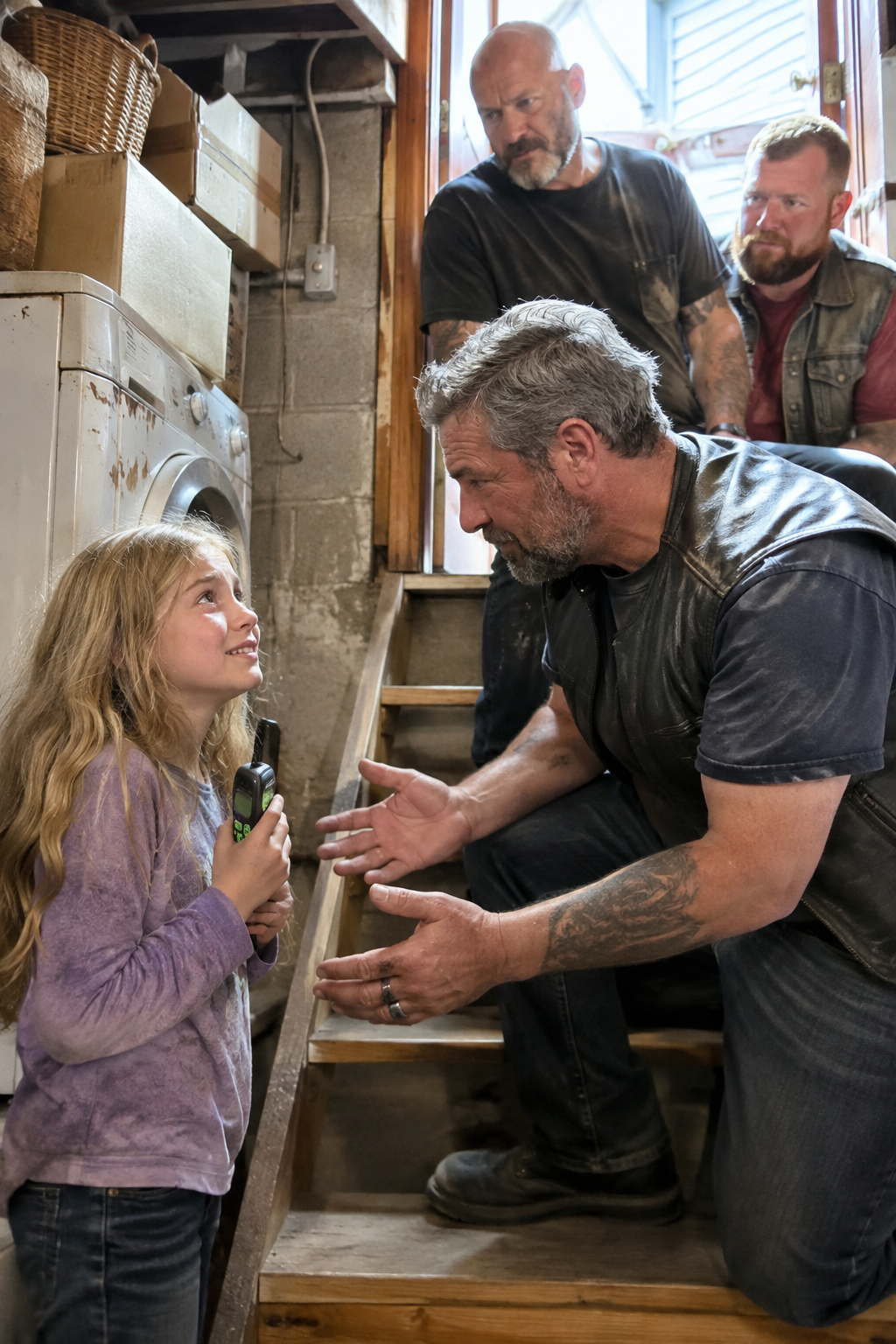
The basement lock clicked, and Lucy slipped into the narrow space between the washer and the wall. She pulled a dusty tarp over herself, just as I’d asked. Over the phone I heard a man’s voice call her name in a calm, almost conversational tone. It was that calmness that frightened me most.
Ray told her that her mother was “resting” and ordered her to come upstairs. Then he began counting. My brothers were already at the front entrance. We forced the door, called out that we were there to help, and heard Ray abandon the basement stairs and come running toward us.
There was a struggle in the hall. It ended with Ray on the floor, restrained with zip ties and watched by three of my brothers until officers could take over. I didn’t stay to argue with him. I headed for the basement, calling Lucy’s name so she would know the deep voice she’d heard on the telephone belonged to somebody real.
She appeared at the bottom of the stairs, a small, dusty figure trying to stand straight despite a hurt shoulder. I went down slowly with my hands where she could see them. “It’s Jax,” I said. She held still for half a second and then ran into my arms. I lifted her, and she clung to my vest with both hands.
Upstairs, we found Sarah motionless on the kitchen floor. Her injuries were severe, and one of the men had already called for an ambulance. I turned Lucy away from the sight while a brother checked that Sarah was breathing. “Is she dead?” Lucy asked. I said the only truthful thing I could: “She’s alive. The medics are coming.”
Then Lucy said something that changed the whole investigation. “He killed the others, didn’t he?” I asked what others she meant. She told me she’d once overheard Ray on a telephone saying he knew how to make accidents happen because he’d done it before. I remembered Margaret and Carol, and my stomach tightened.
I told Ghost to pass that information to the police, along with the names we’d found. It was evidence that needed investigating, not a verdict we had the right to deliver. The paramedics arrived, took over Sarah’s care, and prepared her for the hospital. Police officers came in soon afterward and took custody of Ray.
I gave the officers my name, told them about the call, and explained why so many motorcycles had gathered in the street. Nobody looked pleased about the broken door or the crowd of bikers, and we had questions to answer about what happened inside. But Lucy was out of the basement, Sarah was receiving emergency treatment, and the man who had threatened them was no longer free to reach them.
Lucy went with her mother in the ambulance. At the hospital I found her sitting under a blanket with a cup of cocoa cooling between her hands. She stared at the doors beyond which doctors were working on Sarah. One after another, my brothers came in until the waiting area seemed full of leather jackets and people who didn’t know how to comfort a frightened child.
“What’s taking so long?” Lucy asked me. I told her the doctors had a great deal to do. “What if they can’t fix her?” she said. I couldn’t promise that they could. I sat beside her and told her Sarah had spent years trying to protect her, and that right now the doctors were giving her the best chance they could.
“Why didn’t Mom leave?” Lucy asked later. She said Sarah always promised the latest assault would be the last, and then Ray would apologize or persuade her they had nowhere to go. I told Lucy leaving someone who uses fear, money, isolation, and threats to control a family isn’t simple. “Your mother didn’t make him hurt her,” I said. “He chose to do that.”
She said she hated Ray and sometimes wished he would die. I didn’t lecture her about a feeling she had every reason to have. I told her what mattered now was that he be held accountable and stopped from hurting anyone else. She asked if he would go to prison. I said the courts would decide, and that we would tell the investigators everything we knew.
The first three days brought a rush of interviews and records requests. Detectives reopened questions about Ray’s earlier marriages and examined the old death files. Margaret had supposedly fallen downstairs, but the renewed review of her injuries and witness accounts raised serious doubts about that explanation. A neighbor admitted hearing screams on the night she died and never reporting them.
Carol’s case opened up, too. Investigators looked again at the sleeping pills found in her system and the records of what she had actually been prescribed. Her sister produced journals describing Carol’s plan to leave Ray, along with information about a divorce lawyer she’d contacted shortly before her death. As the cases were reopened, the women who had died stopped looking like unrelated entries in public records.
Further forensic work, including exhumations and new autopsy reviews, strengthened the evidence that both deaths were homicides. That work and the legal process took longer than the dramatic headlines made it sound. By the time prosecutors brought the full case forward, Ray faced two first-degree murder charges in addition to the violent attack on Sarah, Lucy’s unlawful imprisonment, and charges arising from his treatment of the child.
Investigators also uncovered forged documents and financial misconduct connected to his marriages. Ray’s construction employer reported evidence of embezzlement. Suddenly the man neighbors described as ordinary was being examined for years of harm that had gone unnoticed. He was held without bail while the case proceeded.
A television report said Lucy had dialed 911 and the police had rescued her. It wasn’t what happened. I didn’t need my picture on the news, and neither did my brothers. But I wished the report had understood the part that mattered: a nine-year-old girl had asked for help, and she had kept herself hidden long enough for someone to reach her.
Part 3 On the fourth day, Sarah woke up. Doctors had kept her in a medically induced coma while treating a fractured skull, broken ribs, internal injuries, and other damage. Lucy had visited whenever she was allowed, holding her mother’s hand and talking even when there was no response. When Sarah finally recognized her, the first thing she tried to say was that she was sorry.
I was outside the room when Lucy told her, “You did protect me, Mom. We’re both safe now.” A nurse later said Sarah wanted to know how they had escaped. Lucy explained the basement, the old phone, 555-RIDE, and the motorcycles. Sarah listened, unable at first to believe that strangers had come because her daughter had called them.
Sarah asked to meet me. I walked into the room feeling less comfortable than I ever had in a fistfight. There was a tired woman in a hospital bed, bruised and hurting, and a child who believed I could fix things. Sarah held out her hand and thanked me for coming to the house. I told her the truth: Lucy had done the hard part by finding the phone and asking for help.
“Why did you answer?” Sarah asked. I sat down and told her about my sister, Emily. She was 16 when a boyfriend began hurting her. Twenty-seven years earlier, she’d called me crying and asked for help. I brushed her off. Three weeks later, he killed her. I had carried that conversation with me every day since.
“When Lucy called,” I said, “I heard my sister’s voice again. I couldn’t ignore it a second time.” Sarah reached over and took my hand. She didn’t try to excuse what I’d done to Emily, and I was grateful. She just said, “You answered my daughter.” Lucy, standing beside the bed, said I was a hero. I didn’t know what to do with that word.
Recovery took months. Sarah healed from the fractures and other injuries, but neither she nor Lucy could simply sleep through the night and wake up untouched by what had happened. Lucy dreamed she was locked downstairs again. Sarah woke frightened, reaching for a danger that was no longer in the room. They received help, and they learned to tell each other when a day was especially difficult.
The club found them an apartment in a building owned by a friend and covered the first six months’ rent without making a show of it. We helped arrange better locks and a security system. My brothers appeared for birthdays, holidays, and ordinary school nights. Some helped Lucy with homework; others just kept her company when Sarah had to work late.
I started dropping by every week. At first I told myself I was checking that the apartment was safe and that no one connected to Ray was bothering them. Then I’d stay for a cup of coffee, ask Lucy about school, and find myself not wanting to leave. It scared me how quickly the routine began to feel important.
Three months after the rescue, Sarah and I sat on her couch after Lucy went to bed. Our coffee had gone cold. She said I didn’t have to keep visiting; they were safe and I’d already done more than enough. I said, “I know. But I want to.” She studied me for a long moment, as though she was trying to decide whether those words could be trusted.
I told her I wasn’t asking her to be ready for anything. She had spent years with someone who made every kindness feel like a debt, and I didn’t want to become another man who demanded a place in her life. I said I would be there as long as she wanted me around. She put her hand over mine and said, “Stay. Not forever, not yet. Just stay.”
Six months after that terrible night, Ray went on trial. Lucy testified about the attack on her mother, the basement door, and the number she’d remembered from television. She told the jury she had been frightened and had called because she didn’t know who else to reach. When asked what happened after we arrived, she said simply that we got her out.
She looked toward Ray only once. “I was scared,” she said, “but I did what I could. My mom did, too.” I sat quietly listening. I had been terrified of what seeing him again might do to her, but Lucy had worked with the adults helping her prepare. She was telling the truth in her own words, and nobody in that room could take that from her.
The jury deliberated four hours and returned guilty verdicts on all counts. Ray received two life sentences for the murders and an additional 20 years for attempted murder, with more time for assault, unlawful imprisonment, and financial crimes. For Sarah and Lucy, the sentences meant there would be no next night waiting for his key in the door.
Lucy didn’t cheer when the judge finished. She walked into the hallway, took my hand, and asked, “Can we get ice cream?” I said yes. We went out, found a place with a light still on, and bought her the biggest scoop she wanted. After the courtroom, the ordinary sound of her deciding between flavors was almost too much for me.
Final Five years after the rescue, Lucy was 14 and had to give a class presentation about someone who changed her life. She chose an old photograph of herself surrounded by 38 bikers. The men looked stern enough to frighten a stranger, but in the middle was Lucy, grinning. It was her favorite picture.
I sat at the back of the classroom with Sarah, whom I’d married three years after that phone call. We had held the wedding at the clubhouse, with 38 bikers in attendance and Lucy serving as our flower girl. I still sometimes found it hard to believe that the woman who once thanked me from a hospital bed was now my wife, or that Lucy called me her stepdad.
Lucy told her classmates she had been nine when she memorized a number from a television commercial. She hadn’t known it connected to a motorcycle club. In the basement, it was simply the only number she could remember. She showed them a family photograph of me looking uncomfortable in a collared shirt, and the class laughed when she explained how many bikers had come to our wedding.
Then she grew serious. “People ask if I’m scared of these big guys with the tattoos,” she said. “I’m not. I know what someone dangerous can really look like. My stepfather looked ordinary. He smiled at neighbors and went to work. Nobody could see what he did inside our house.” Sarah slipped her hand into mine.
Lucy explained that the people who helped her hadn’t looked like heroes to anyone passing them on the street. They had looked like men in leather jackets on motorcycles. But one of them had answered when she was afraid, and the others had shown up when he called them. She said she’d learned to judge people by what they did when someone needed help.
On her last slide were the words 555-RIDE. The club had kept the number. Sometimes callers still reached us by accident; sometimes someone really needed assistance, and we took the call seriously and got appropriate help involved. I hoped no child would ever need to use it the way Lucy had. I’d much rather they know how to reach emergency services and trusted adults.
When her classmates applauded, I rubbed at my eyes and pretended the room was dusty. Sarah squeezed my hand and whispered, “Proud of her?” “More than I can say,” I answered. Sarah said Lucy got her courage from me, but we both knew better. The courage had been there in that basement, long before I arrived.
I once let a frightened girl down when she needed her brother. I can’t change what happened to Emily. But on one terrible night, another little girl reached my phone, and this time I listened. Lucy found a way to ask for help. All we did was answer—and keep our promise to come.
THE END. I’ve shared the complete story, and I truly hope it touched your heart. If this story moved you, please , like, and share the post. Thank you for reading! ❤️
✓ Lynn R. Adams
The basement lock clicked, and Lucy slipped into the narrow space between the washer and the wall. She pulled a dusty tarp over herself, just as I’d asked. Over the phone I heard a man’s voice call he…