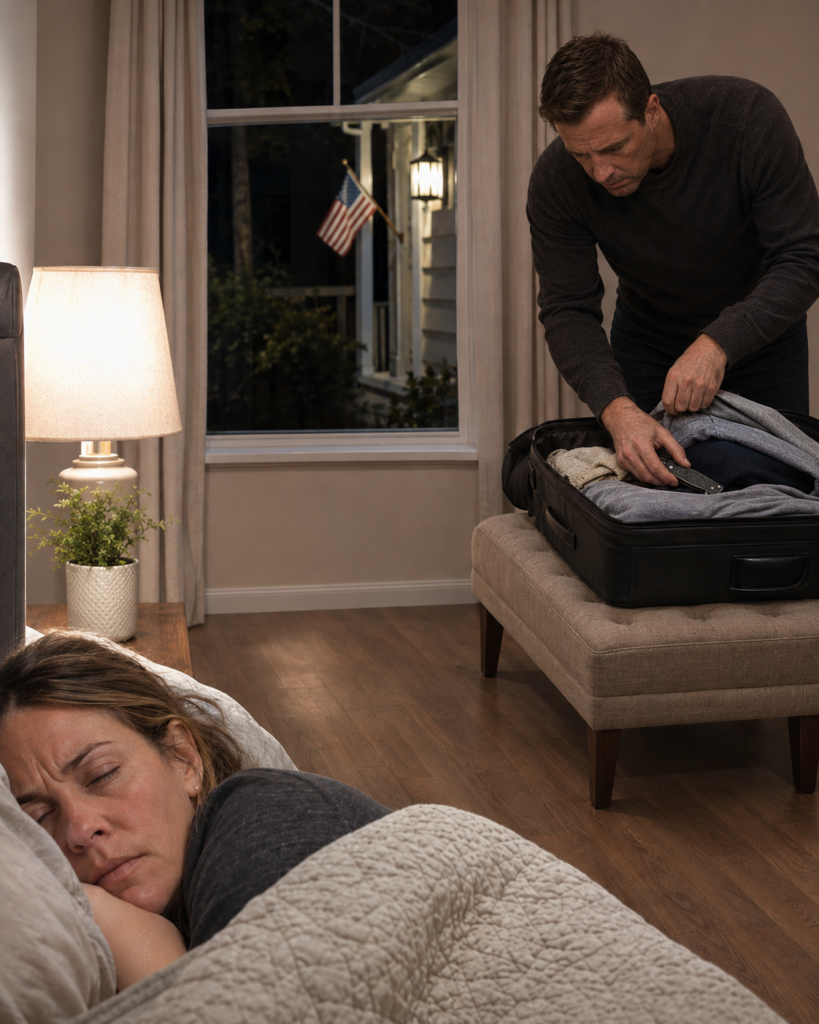
At 11:45 p.m., I heard my husband unzip my suitcase while he thought I was asleep. He slipped two weapons into the bag I was taking through airport security the next morning, then whispered into his phone, “It’s done. Tip off security at six.” We’d been married for twelve years, and he was deliberately trying to get me detained before an important business trip. I stayed still until he left. Hours later, I discovered what he’d hidden. But I couldn’t understand why he needed me unable to answer my phone that morning.
My Husband Hid Weapons in My Suitcase. At , I Saw Why He Needed Me Gone.
The notary picked up her stamp, studied the paper in front of her, and slowly put the stamp back down.
“I can’t proceed with this.”
I was sitting in my car a few houses away, watching the scene through the security camera in my dining room.
My husband, Nolan, leaned forward.
“What’s the problem?”
“The power of attorney doesn’t establish that your wife properly authorized you to sign these documents. I need that verified.”
Beside him, Sylvia Caldwell tapped a finger against a stack of closing papers.
“We’ve already explained the situation. The financing has to be approved today.”
“I understand there’s a deadline,” the notary said. “That doesn’t change what I’m required to verify.”
Nolan glanced toward the front window.
He had no idea I was watching.
He believed I was either detained at Charlotte Douglas Airport or on my way to Denver, too far away to interfere with whatever he was trying to accomplish.
He’d arranged it that way himself.
Less than fourteen hours earlier, I’d watched him open my suitcase while he thought I was asleep.
Now I was looking at a document with my supposed signature on it.
And the woman sitting beside him was a real estate agent I’d met only once.
I turned off the camera’s sound and called Veronica Hayes.
She answered immediately.
“There’s a notary in my house.”
“Are you inside?”
“No. I’m down the street.”
“Stay where you are for the moment.”
I told her what I’d seen.
Nolan and Sylvia were sitting at our dining table with documents concerning a $250,000 home equity application.
The notary had questioned a power of attorney supposedly signed by me.
And Nolan was telling everyone I was in airport custody because I’d become emotionally unstable.
Veronica was quiet for a moment.
Then she said, “Save the recording. And don’t sign or authorize anything.”
“I haven’t.”
“Good. Contact the lender’s fraud department again and tell them there’s an attempt to execute documents using authority you dispute. I’m going to help you find independent counsel for the personal and property issues. My work for your employer means I need to be careful about representing you privately.”
I looked toward our house.
“What if he convinces the notary?”
“She appears to be doing her job. The lender still has its own verification requirements. But we need to act quickly.”
I sent Veronica the recording.
Then I called the bank.
I explained that I was Giana Pierce, a joint owner of the property associated with the pending home equity application, and that I had not authorized my husband to act for me.
The representative transferred me to the fraud department.
I was answering security questions when the indoor camera alerted me to movement.
Nolan had stood up.
He was pacing beside our dining table, one hand pressed to his forehead.
Sylvia was talking to the notary.
I couldn’t hear the words while I was on the phone.
But I could see the notary closing her folder.
For the first time that day, I felt something close to relief.
The paperwork wasn’t going forward as Nolan had planned.
I still didn’t know how far he’d gone.
My name is Giana Pierce, and I’m a corporate logistics director in Charlotte, North Carolina.
For nearly fifteen years, my work has involved moving goods through complicated supply chains: warehouses, trucking routes, manufacturers, distribution centers, and all the problems that develop when one small delay affects a hundred other people.
I am not naturally suspicious.
My job requires me to trust people.
But it also requires me to verify information before making decisions that could cost a company millions.
I had somehow forgotten to apply that second principle to my marriage.
Nolan and I had been married for twelve years.
We met when I was still working my way up through operations management. He had a steady job in business administration, a dry sense of humor, and an ability to make even a miserable Monday feel manageable.
Our first date was at a neighborhood restaurant with uneven tables and paper napkins.
He spilled water on the menu, apologized three times, and then made me laugh so hard that I forgot how nervous I’d been.
We didn’t have an extravagant wedding.
We rented a small venue, invited the people closest to us, and spent more money on the food than the decorations.
I remember looking across the room that evening and seeing Nolan talking to my father.
They were laughing about something.
I felt safe.
That was the word I would have used then.
Over the years, we built a comfortable life.
My career advanced, and Nolan’s work provided stability when I was traveling or dealing with demanding projects.
We bought a house in a quiet Charlotte neighborhood with mature trees and a kitchen large enough for the two of us to cook without bumping elbows.
Neither of us came from a wealthy family.
We were careful with money.
When I received bonuses, we often put them toward the mortgage. Nolan did the same when his compensation allowed it.
We took ordinary vacations and drove our cars longer than most of our friends thought necessary.
Six years after buying the house, we made the final mortgage payment.
I still remember the afternoon we received the confirmation.
Nolan opened the letter at the kitchen counter.
He read it twice, then handed it to me.
“It’s really ours.”
“It was ours before.”
“You know what I mean.”
He pulled me into a hug.
For dinner, we ordered pizza and opened a bottle of wine we’d been saving for a special occasion.
We sat on the back porch and talked about what we might do with the money we no longer needed for mortgage payments.
Travel more.
Save for retirement.
Maybe renovate the kitchen someday.
Mostly, we talked about how good it felt to owe nothing on the house.
That mattered to me.
I had spent enough years working around financial emergencies to appreciate the freedom of having one large obligation behind us.
Two months before the suitcase incident, Nolan brought up a new idea.
He wanted to leave his management job and start a consulting business.
At first, I was interested.
He had years of experience, knew the industry, and had contacts who might eventually become clients.
I asked to see his business plan.
He showed me several pages of projected revenue and expenses.
The projections were optimistic.
Too optimistic, in my opinion.
“Where are the signed client agreements?” I asked.
“We’re still having conversations.”
“Then these are possibilities, not revenue.”
He frowned.
“That’s how businesses start.”
“I know. But we can’t build our entire financial plan around people who haven’t agreed to hire you.”
He tapped the paper.
“We have savings.”
“We have retirement savings. That’s not the same thing as money we can afford to lose.”
He leaned back in his chair.
“So you don’t believe in me.”
“That’s not what I said.”
“It sounds like it.”
I reached across the table.
“I believe you could build something good. I just want us to do it carefully.”
He pulled his hand away.
“I don’t want to spend the rest of my life waiting for permission.”
I wasn’t trying to control his career.
I was trying to protect the future we’d spent twelve years building.
We argued for nearly an hour.
Eventually, Nolan put the business plan away.
“Fine,” he said. “Forget it.”
I thought the conversation was over until he had a more realistic proposal.
I was wrong.
Around the same time, he began sleeping in our guest room.
He said my late-night work calls interrupted his sleep.
Then he blamed his allergies.
Later, he complained that I snored.
I bought an air purifier and placed it beside our bed.
I ordered nasal strips.
I even made an appointment to discuss the snoring with my doctor, although Nolan had never complained about it before.
Nothing helped.
Or rather, Nolan never gave any of it a chance to help.
He continued sleeping in the guest room with the door closed.
I told myself he was stressed about work.
Looking back, I remembered how often I heard his voice through the wall late at night.
I assumed he was watching videos or talking to colleagues overseas.
I didn’t ask.
He was my husband.
I thought I knew what he was doing.
The week before my Denver trip, my team was preparing to finalize a supply chain contract we’d spent six months negotiating.
It was the kind of agreement that required careful coordination among manufacturers, carriers, warehouse operators, and purchasing executives.
We had revised schedules, tested delivery models, and spent countless hours answering questions.
The Denver meeting was our opportunity to finalize the remaining terms.
I had a presentation ready and a folder containing the latest approved figures.
Nolan knew how important it was.
He watched me pack on Tuesday evening.
“Big day tomorrow?” he asked.
“Think you’ll get it signed?”
“I hope so. We’ve done the work.”
“Good luck.”
I remember feeling pleased that he’d asked.
We hadn’t been talking much lately.
A small gesture seemed meaningful.
I packed my carry-on and placed it beside the dresser.
Then I went to bed.
At 11:45, I woke to a faint sound.
At first, I thought Nolan was getting something from the closet.
Then I saw him standing beside my suitcase.
The bedroom was dark except for the light coming through the curtains.
He had his back to me.
He opened the suitcase and placed something inside.
I lay perfectly still.
Nolan closed the bag, took out his phone, and whispered, “It’s done. Tip off security at six.”
My stomach tightened.
For a moment, I wondered whether I had misunderstood him.
Then he slipped quietly out of the room.
I listened to his footsteps moving down the hallway.
The guest-room door closed.
I didn’t sleep again.
At three in the morning, I got out of bed and opened the suitcase.
Beneath my clothes were two objects that did not belong there.
A folding hunting knife.
And a heavy steel self-defense weapon.
I stared at them.
Neither belonged to me.
I had never packed them.
I had never even seen that particular knife before.
My husband had placed them inside the bag I intended to carry through airport security in a few hours.
I sat on the edge of the bed with my heart pounding.
Then I remembered the words he’d whispered.
Tip off security at six.
He wasn’t trying to surprise me.
He was trying to make sure somebody searched my luggage.
My first instinct was to confront him.
I wanted to march into the guest room, turn on the light, and demand an explanation.
Instead, I looked at the closed door.
I didn’t know what he might do if he realized I had discovered his plan.
I took photographs of the contents of the suitcase.
Then, in a state of fear and confusion, I removed the weapons and placed them in the side pocket of Nolan’s golf bag in the garage.
I replaced their weight in my luggage with a metal office stapler.
It was a foolish way to handle potential evidence, and I knew that later.
At the time, I was thinking only about getting those objects away from my travel bag without alerting Nolan.
I didn’t touch them again.
By four, I was dressed.
I left a note saying I was headed to the airport and would call after landing.
At , I drove toward Charlotte Douglas.
The city was still dark.
I parked, went into the terminal, and passed through security without incident.
No one stopped me.
No one questioned my bag.
I reached the gate and sat down.
My flight was scheduled to leave that morning, but I couldn’t make myself board.
I kept seeing Nolan leaning over the suitcase.
I kept hearing the words he’d whispered into his phone.
What frightened me most wasn’t only what he had tried to do.
It was the planning behind it.
He had waited until he thought I was asleep.
He had chosen objects likely to cause serious trouble at airport security.
And he’d arranged for someone to alert security at a specific time.
That wasn’t an impulsive argument.
It was deliberate.
At , my phone vibrated.
Have a safe flight. I love you.
I read the message several times.
Twelve years of marriage.
A house we’d worked hard to pay off.
Thousands of ordinary mornings when he’d kissed me goodbye and told me to be careful.
Now he was sending affectionate messages after trying to have me detained.
I didn’t answer.
When boarding began, I stood with the other passengers.
Then I stepped aside.
I watched them file onto the plane.
A gate agent asked whether I intended to board.
I told her I needed to change my plans.
She directed me to the airline’s service desk.
I contacted my team and explained that an urgent personal security issue would prevent me from taking the morning flight.
I didn’t tell them the whole story.
I asked my deputy director, Avery Chen, to keep the Denver meeting preparations moving and told him I would call as soon as I had a safe place to work.
He sounded concerned.
“Is everyone okay?”
“I don’t know yet.”
“Do you need me to reschedule?”
“Tell them I’m dealing with an emergency. Ask whether we can hold the remaining technical review remotely while we work out the final meeting.”
Avery agreed.
Then he said, “Giana, take care of yourself.”
I thanked him.
After my plane departed without me, I called Veronica Hayes.
Veronica was an attorney who worked with our company.
We’d collaborated on contracts and compliance matters for years.
I trusted her judgment.
When I told her what had happened, she didn’t interrupt.
Then she asked whether I was somewhere safe.
“I think so.”
“Where are you?”
“At the airport.”
“Do you have somewhere else you can stay?”
“Don’t go back to the house until you’ve thought through how to handle this safely.”
I explained that I had found the weapons in my suitcase and moved them.
Veronica was concerned.
She told me to preserve the photographs, avoid further handling of the objects, and report the incident accurately to the appropriate authorities.
Then she asked whether Nolan had access to our financial accounts.
“Of course. We’re married.”
“Does he have access to your personal accounts?”
“Some information. Not everything.”
“Review them. Look for unusual activity. But don’t assume every unfamiliar transaction means fraud. We need to separate what you know from what you suspect.”
That sounded like Veronica.
She also explained that because she represented my employer in certain matters, I should obtain independent legal advice for my marriage and property issues.
She offered to help me find an appropriate attorney.
I thanked her.
Then I checked into the airport Marriott.
I chose a room with a desk, closed the door, and opened my laptop.
I began with our finances.
The first unusual item was a credit inquiry from Bank of America dated three days earlier.
I hadn’t applied for a loan.
I checked the details.
Then I accessed our shared banking information.
There was a pending home equity application.
The requested amount was $250,000.
I stared at the screen.
Our home had been mortgage-free for six years.
We’d celebrated that achievement together.
Now Nolan was seeking a quarter of a million dollars against it.
Both our names appeared on the application.
But my final authorization was missing.
I downloaded the documents available to me and saved copies in a secure folder.
Then I called the bank.
The representative explained that the application was incomplete and had not resulted in any funds being released.
I said I had not consented to the application and requested that it be flagged for review.
The representative opened a case and gave me a reference number.
I wrote it in my notebook.
By then, my hands were shaking.
I thought of Nolan’s business plan.
The unsigned consulting contracts.
The optimistic projections.
The argument about risking our savings.
He’d stopped discussing the idea with me.
Apparently, he’d continued working on it without me.
I checked our credit card statements.
There were charges for business formation services.
Some were small.
Others involved filing fees, software subscriptions, and professional consultations.
Nothing by itself proved wrongdoing.
But I hadn’t known about any of them.
I searched the North Carolina business registry.
A newly formed consulting company appeared under Nolan’s name.
The other managing member was Sylvia Caldwell.
I recognized her immediately.
Sylvia was a real estate agent we’d met at an open house several months earlier.
She’d been friendly and polished, the sort of person who remembered names and made everyone feel as though they were already acquaintances.
I remembered how comfortably she’d spoken to Nolan.
At the time, I assumed they had met through work.
Now I wondered how long they had actually known each other.
I checked our phone records.
There was a late-night call from Nolan to Sylvia shortly after he’d tampered with my suitcase.
The call alone didn’t tell me what they’d discussed.
But I remembered the words I’d heard.
Tip off security at six.
I felt sick.
At nine, Nolan texted again.
He wrote that he’d heard there might have been trouble at airport security and wanted to know whether I was all right.
I stared at the message.
How had he supposedly heard about it?
I hadn’t told him.
No one had detained me.
I hadn’t even boarded the plane.
I decided not to reveal where I was yet.
I replied that security had delayed me but that I expected to travel soon and might be unreachable.
Nolan responded almost immediately.
I’m so relieved. I have some things to handle at the house today. Call when you can.
I set the phone down.
He was not relieved that I was safe.
He was relieved that he thought I would be unavailable.
I opened the messages synchronized through our shared household account.
We’d used that account for years to coordinate appointments, travel plans, and family matters.
Among the recent messages was a conversation between Nolan and his mother.
He had told her I was being detained at the airport.
He claimed I’d behaved erratically and had become emotionally unstable.
He said he needed to handle our banking matters alone until I was “feeling better.”
I read the messages twice.
The words were carefully chosen.
He wasn’t simply saying I had missed a flight.
He was creating a story in which I was incapable of making reasonable decisions.
A story that might explain why he was trying to sign financial documents without me.
I forwarded the messages to Veronica.
Then I saved copies for my own records.
I thought about calling Nolan’s mother immediately.
But I didn’t know how much she’d been told or whether Nolan had asked her to keep information from me.
I needed to move carefully.
By noon, I’d assembled the documents I could access: the pending loan application, the credit inquiry, the business registration, relevant banking records, and the messages Nolan had sent his mother.
None of it explained the entire plan.
But it gave me enough reason to believe that my husband had been working toward something far more serious than starting a small consulting business.
I called Avery again.
He said the Denver team had agreed to continue reviewing the remaining contract details remotely.
The final signing would require additional coordination, but the customer hadn’t withdrawn.
“Can you join the technical call tomorrow morning?” he asked.
“Are you sure?”
“Yes. I’ll be ready.”
I wanted desperately to tell him what was happening.
But I also wanted to protect the work we’d done.
I wasn’t going to let Nolan’s plan destroy six months of effort without trying to save it.
After lunch, I checked out of the hotel.
I drove toward our neighborhood.
I didn’t intend to enter the house.
I wanted to see whether Nolan was meeting someone and whether our security cameras might show what was happening.
We had installed the indoor cameras after a series of break-ins in nearby neighborhoods.
They covered the entryway and dining room.
Nolan knew they were there.
Apparently, he hadn’t thought about them that afternoon.
At , Sylvia’s white Lexus pulled into our driveway.
Another car arrived behind her.
A woman stepped out carrying a briefcase.
I recognized the general appearance of a mobile notary from the documents and supplies she brought inside.
A few minutes later, I opened the live camera feed.
Nolan and Sylvia were seated at our dining table.
The third woman sat opposite them.
Papers covered the table.
Nolan was explaining that I was in airport custody and had recently become emotionally unstable.
He told the notary that he needed to handle our financial affairs because I was unable to participate.
The woman examined a document.
A power of attorney.
I enlarged the video.
My name appeared on the page.
I had never signed a power of attorney giving Nolan authority to borrow against our house.
The notary questioned the document.
Nolan leaned forward.
Sylvia insisted the financing had to be approved before four o’clock.
Then the notary picked up her official stamp.
And stopped.
That was the moment I called Veronica again.
After the bank’s fraud department recorded my objection, I saved the camera footage and remained in the car.
I considered driving away.
The bank had flagged the application.
The notary was refusing to proceed.
I could leave the rest to the attorneys.
But I also knew Nolan would continue telling people I was detained and unstable unless I challenged that story.
I called a neighbor I trusted, a retired school administrator named Ruth.
She lived across the street from us and had known us for several years.
I told her I needed to retrieve some belongings and that there was a serious dispute involving documents in my home.
I didn’t ask her to confront Nolan.
I asked whether she could remain nearby while I went to the door.
She agreed.
I also sent Veronica a message confirming where I was and what I intended to do.
Then I walked up the driveway.
My own front door looked strange to me.
I’d left it believing I was beginning an ordinary business trip.
Now I was approaching it as though it belonged to someone else.
I used my key.
The door opened.
Nolan looked up from the dining table.
For several seconds, nobody moved.
Then Sylvia stood.
Nolan’s face had gone pale.
“What are you doing here?”
I set my handbag on the entryway table.
“I live here.”
He glanced toward the notary.
Then back at me.
“I thought you were in Denver.”
“No. You thought I was being detained at the airport.”
The notary looked between us.
“Mrs. Pierce?”
“My name is Denise Walker. I’m a mobile notary. Your husband has presented documents indicating that you’re unable to attend a financial signing.”
I looked at the papers on the table.
“I haven’t authorized him to sign for me.”
Nolan stepped forward.
“Giana, this is a misunderstanding.”
I pointed toward the document Denise was holding.
“Is that supposed to be my signature?”
He didn’t answer.
Sylvia moved beside him.
“Perhaps we should all calm down.”
I looked at her.
“Are you Sylvia Caldwell?”
“I’ve seen your name on the consulting company’s registration.”
Her expression tightened.
“This is a business matter.”
“Then why is my house involved?”
Nolan raised his hands.
“Please. Let me explain.”
I turned toward Denise.
“I have not signed a power of attorney authorizing Nolan to borrow against our property. I’ve already contacted the lender.”
Denise placed her stamp inside its case.
“Then I will not notarize anything related to this transaction.”
Sylvia exhaled sharply.
“We’ve spent weeks arranging this.”
Denise looked at her.
“I understand that. But I can’t certify a signature or authority that hasn’t been properly established.”
She began gathering her materials.
Nolan stood beside the table, staring at the documents.
I looked at him.
“Twelve years, Nolan.”
His jaw tightened.
“You put weapons in my suitcase.”
The room went silent.
Denise stopped moving.
Sylvia looked sharply at Nolan.
He stared at me.
“I don’t know what you’re talking about.”
I felt a wave of anger so strong that I had to grip the back of a chair.
“I woke up last night. I saw you open my bag.”
Nolan opened his mouth, then closed it.
I continued.
“I heard you tell someone to tip off airport security at six.”
Sylvia’s expression changed.
I couldn’t tell whether she was surprised by the accusation or frightened that I knew about it.
I looked at Nolan.
“You wanted me detained so I couldn’t stop this.”
He glanced at Denise.
“Giana, you’re making a scene in front of strangers.”
I almost laughed.
He was standing beside a stack of documents designed to let him act in my name.
And he was worried about appearances.
“I’m not discussing this further without legal advice,” I said.
Denise closed her briefcase.
“I think that’s wise.”
She gave me her business card and said she would preserve her records of the appointment.
Then she left.
Sylvia gathered her papers.
Nolan reached for one of the folders.
I stopped him.
“Those documents concern our house. Don’t destroy anything.”
He looked at me.
“You’re acting like I’m a criminal.”
“I’m acting like someone who found her name on documents she never signed.”
Sylvia spoke quietly.
“Nolan, we should stop.”
He turned toward her.
She took a step back.
I could see the strain between them.
Whatever they’d planned, they had not planned for me to walk into that room.
I looked around the dining table.
The same table where Nolan and I had celebrated paying off our mortgage.
The same table where we’d discussed retirement plans and vacations.
Now it was covered with papers for a $250,000 loan I hadn’t approved.
I felt something in me go very still.
“I need you to leave me alone while I collect my things,” I said.
Nolan frowned.
“Where are you going?”
“Somewhere safe.”
“This is our house.”
I looked directly at him.
“That is why you needed my permission.”
I went upstairs and packed a few essentials.
I took my laptop, identification, medications, and the records I’d already gathered.
I did not go into the garage or touch the weapons again.
When I came downstairs, Sylvia was gone.
Nolan stood in the kitchen.
He looked exhausted.
“Please don’t ruin my life over this,” he said.
I stopped beside the door.
“You tried to ruin mine.”
He stared at the floor.
Then he whispered, “I only needed a few hours.”
I looked at him.
“A few hours for what?”
He didn’t answer.
That evening, I met with an independent attorney recommended by Veronica.
Her name was Rachel Morgan, and she handled financial disputes and civil litigation.
I brought the application records, the business registration, the messages, and the camera footage.
I also told her exactly what I’d done with the weapons after finding them.
Rachel listened carefully.
Then she said, “We need to make sure the lender has a clear written notice that you dispute the application and any purported authority to sign for you.”
We prepared the statement.
Rachel also advised me to make a formal report about the suitcase incident.
I told her I was worried that moving the objects had complicated matters.
“It may,” she said. “That’s why you’ll tell the authorities exactly what happened. Don’t leave out the parts you wish you’d handled differently.”
I appreciated her honesty.
The following morning, I made the report.
An officer took my account and reviewed the photographs and available information.
I explained that I had moved the objects from my suitcase to Nolan’s golf bag before leaving home.
The officer told me not to handle them again while the matter was being reviewed.
There was no immediate arrest.
There was no dramatic announcement that the case had been solved.
The evidence would need to be assessed, and the people involved would have to be questioned.
That was frustrating.
But it was real.
I wanted the truth established properly, not simply declared because I was angry.
Rachel helped me address the disputed loan documents.
The bank confirmed that the $250,000 credit line had not been opened and that no funds had been released.
It continued reviewing the application and the authority Nolan had claimed.
Because our home was jointly owned, there were additional property and signing requirements that could not simply be bypassed by Nolan’s explanation that I was unavailable.
The power of attorney he’d presented raised serious questions.
Rachel explained that a valid authorization wasn’t created merely by putting someone’s name on a document.
The lender needed satisfactory evidence of authority, and the notary had been right to refuse a transaction she couldn’t verify.
I was relieved that Denise had asked questions.
I was also horrified by how close Nolan had come to putting me in a position where I would have to fight over documents I’d never approved.
For several nights, I barely slept.
I stayed in a hotel near the office, then moved temporarily into a furnished apartment.
I continued working remotely.
My colleagues were kind, although I told only Avery the basic facts of the emergency.
He had already handled much of the Denver coordination.
The customer agreed to another meeting the following week.
It wasn’t ideal.
We had lost time.
But the contract was still possible.
On Monday morning, I sat at the apartment’s small desk and joined a video call with my team.
Avery began by reviewing the final delivery schedules.
The customer raised concerns about one distribution route.
I answered the questions.
For nearly two hours, I was simply doing my job.
When the call ended, Avery stayed on the line.
“You were good,” he said.
“Thank you.”
“Do you want me to take the next meeting?”
I thought about it.
“No. I want to finish what we started.”
“Then we’ll finish it.”
That evening, Nolan’s mother called.
I had expected the conversation eventually.
I hadn’t expected her to sound so frightened.
“Are you all right?”
“Nolan told me you were having some kind of breakdown at the airport.”
I closed my eyes.
“That isn’t true.”
“He said you were detained.”
“I wasn’t.”
There was a pause.
“He said you couldn’t make decisions about the house because you weren’t well.”
I looked toward the stack of financial documents on my desk.
“I’m perfectly capable of making decisions.”
She began to cry.
“I don’t understand what’s happening.”
Neither did I, not completely.
I explained that Nolan had applied for a home equity credit line without my consent and had presented documents claiming authority to act for me.
I didn’t tell her every detail of the investigation.
But I told her enough to understand that her son had been giving her a false account.
She was silent for a long time.
Then she said, “He asked me whether I would confirm that you’d been behaving strangely.”
My stomach tightened.
“What did you tell him?”
“That I hadn’t seen you behaving strangely.”
She continued.
“He said you were under a lot of stress.”
“I was preparing for a major business meeting.”
Her voice shook.
“He made it sound as though you were in danger.”
I looked out the window.
We sat in silence for a moment.
Then she said, “I don’t know what to say.”
“You don’t have to say anything right now.”
“Is there something I should do?”
“If anyone asks you about my behavior or what Nolan told you, please be honest about what you know.”
After we hung up, I sat at the desk for nearly an hour.
Nolan hadn’t simply lied to me.
He had tried to shape other people’s understanding of my mental state.
That frightened me in a different way.
He wanted me to be absent.
But he also wanted a story ready to explain my absence.
The more I examined his decisions, the more deliberate they appeared.
Rachel advised me to preserve the messages and the account history.
We also discussed practical protections for my finances and home.
I changed passwords, reviewed account access, and made sure important notices were sent directly to me.
I did not try to take control of Nolan’s private accounts.
I focused on the information and property I had a right to protect.
During the following weeks, more of the financial picture emerged.
Nolan and Sylvia had formed their consulting company while he was still employed in management.
They’d spent money on setup costs and professional services.
They had a business plan, but the evidence available to me did not show the established client contracts Nolan had once claimed he needed before leaving his job.
The $250,000 credit line was intended to provide much of their initial operating capital.
Without it, their plans became far less certain.
That explained why Sylvia had been so anxious about the afternoon deadline.
It didn’t excuse what Nolan had done.
A business opportunity could be postponed.
A financial plan could be revised.
A marriage could not survive indefinitely if one person treated the other’s consent as an obstacle to remove.
The question of Sylvia’s relationship with Nolan remained painful.
I knew they’d been talking late at night.
I knew they were business partners.
I knew he’d hidden the company from me.
I didn’t know whether their relationship had become romantic, and I wasn’t going to invent certainty from a phone record.
Eventually, Nolan admitted that he had been spending substantial time with her while telling me he was working late.
He said they had grown close while developing the business.
He insisted the relationship had been about the project.
I didn’t argue.
By then, the distinction wasn’t the thing keeping me awake.
He had trusted Sylvia with the plans he hid from his wife.
He had made her a partner in the company.
And he had invited her into our dining room to help arrange financing against our home.
That was enough to break something essential.
One evening, Nolan asked to meet.
Rachel advised that we keep the conversation focused and that I avoid any discussion that could complicate the ongoing investigations.
I agreed to meet him in a public place with clear boundaries.
We chose a quiet café.
He arrived looking tired.
There were shadows beneath his eyes.
For a moment, I remembered the man I’d married.
The man who used to leave coffee on my desk before early flights.
The man who knew I always forgot to eat when a contract deadline approached.
Then he sat down, and I remembered the suitcase.
“Thank you for coming,” he said.
He looked down at his hands.
“I know you think I’ve become some kind of monster.”
“I think you made decisions that put me in serious danger.”
He swallowed.
“I never wanted you hurt.”
“You put weapons in my luggage.”
He looked away.
“I needed the closing to happen.”
The words came out quietly.
I stared at him.
“So you wanted security to stop me.”
He didn’t answer directly.
Instead, he began talking about the consulting company.
He said the opportunity with Sylvia could have changed everything.
He was tired of working for other people.
He wanted to build something that belonged to him.
He believed I was too cautious.
“Every time I brought it up, you had another reason to wait,” he said.
“Because we didn’t have signed clients.”
“We had prospects.”
“Prospects aren’t income.”
He rubbed his forehead.
“I thought once the financing was approved, you’d see that it was a real business.”
I looked at him.
“You thought borrowing $250,000 against our paid-off house would prove the business was real?”
“It would have given us room to start.”
“Without my permission.”
He went quiet.
I leaned forward.
“Nolan, why didn’t you just tell me you were going ahead with Sylvia?”
“Because you would have stopped me.”
I shook my head.
“I could have refused to use our house as collateral. That’s not the same thing as stopping you from working.”
He looked at me.
“You don’t understand what it feels like to have someone else making the big decisions.”
I felt a sharp pain in my chest.
“For twelve years, I’ve tried to make decisions with you.”
He stared at the table.
I continued.
“We paid off that house together. We celebrated together. You knew how much being debt-free meant to me.”
“I was going to repay the loan.”
“With what money?”
“The business would have grown.”
“And if it didn’t?”
He didn’t answer.
I had asked him almost the same question two months earlier.
He still had no answer.
Finally, I said, “You weren’t trying to convince me. You were trying to remove me from the decision.”
His eyes filled.
“I was desperate.”
“I didn’t think it would go this far.”
I thought of the knife in my suitcase.
The false story about my mental health.
The power of attorney.
The notary who had nearly been asked to validate documents in my absence.
“It went this far because you kept making another choice,” I said.
He covered his face with his hands.
For a moment, I felt the old impulse to comfort him.
I wanted to tell him things could still be fixed.
I wanted to reach across the table.
But I stayed where I was.
After a while, Nolan lowered his hands.
“What happens now?”
“I don’t know everything yet.”
“Can we come back from this?”
I looked at him.
“I don’t know how I could ever feel safe with you again.”
He nodded slowly.
I could see that he understood the words.
Whether he understood their full meaning was another question.
When we left the café, he walked toward his car without trying to stop me.
I sat behind the wheel for several minutes before starting the engine.
Then I called Rachel and told her the conversation had happened.
I described what Nolan had said as accurately as I could remember.
She asked me to write down the details while they were fresh.
The business trip remained unfinished.
I had rescheduled the final Denver meeting, and the customer had agreed to give us another opportunity.
My team had preserved the negotiation through careful work.
I owed them my full attention.
The following week, I flew to Denver.
This time, I checked my luggage myself before leaving the apartment.
I traveled with only the documents and personal items I needed.
At the airport, I felt nervous walking toward security.
I knew logically that I had done nothing wrong.
Still, the memory of Nolan opening my suitcase was difficult to shake.
I took a breath and continued.
Security was uneventful.
I boarded my flight.
When the plane lifted above Charlotte, I looked out the window and felt a surprising wave of relief.
I was going where I had intended to go.
Not because someone had permitted it.
Because it was my decision.
The Denver meeting took place in a conference room overlooking the city.
Our customer had questions about delivery schedules and contingency planning.
Avery handled the technical details.
I addressed the operational commitments and the consequences if our company failed to meet them.
There were difficult moments.
One executive wanted assurances we couldn’t honestly provide.
I told him so.
“We can commit to the service levels in the agreement,” I said. “I won’t promise something our operations team can’t deliver.”
He studied me.
Then he nodded.
“That’s what I wanted to hear.”
By late afternoon, we had resolved the remaining terms.
The contract was signed.
It wasn’t the largest agreement I’d ever worked on.
But it was one of the most satisfying.
My team had earned it through six months of difficult work.
And a personal crisis hadn’t erased that effort.
After the meeting, Avery and I stood outside the building while the evening traffic moved through downtown Denver.
He looked at me.
“You all right?”
I thought about the last two weeks.
“I’m getting there.”
We walked toward the hotel.
I had no desire to tell him every detail.
But I was grateful he hadn’t pressed.
Some kinds of support are quiet.
You don’t recognize how valuable they are until you need them.
Back in Charlotte, the investigation into the financial documents continued.
The lender confirmed that no home equity funds had been released.
The application was closed after my dispute and the review of the authorization issues.
The purported power of attorney had not been accepted as sufficient authority for the transaction.
The notary preserved her records and cooperated when information was requested.
The separate report concerning the weapons and the alleged attempt to cause an airport detention remained under review.
I didn’t receive the instant legal outcome that people often imagine happens in situations like this.
There were interviews, requests for records, and long periods when I heard nothing.
Rachel reminded me that different issues involved different evidence and procedures.
I couldn’t force investigators to reach a conclusion on my schedule.
What I could do was cooperate, preserve records, and make decisions about my own life.
I began discussing separation with a family-law attorney.
Because Nolan and I jointly owned the house, we had to address its value and our respective interests.
The fact that the mortgage had been paid off did not mean one of us could simply claim the property and exclude the other.
We also had retirement accounts, savings, and other financial matters to resolve.
It was painful to see twelve years of shared decisions reduced to lists and statements.
But I no longer wanted uncertainty about who could act in my name.
We established written arrangements for access to the house and for handling ongoing expenses while the process continued.
Eventually, we agreed that selling the house was the most practical solution.
I had loved that place.
I had planted herbs beside the back steps.
I’d spent evenings painting the guest room and choosing curtains.
I’d stood beside Nolan in the kitchen when we made the last mortgage payment.
Losing the house hurt.
But keeping it would have meant remaining tied to a place where I no longer felt secure.
The sale took time.
There were repairs, inspections, and negotiations.
I read every document carefully.
When something required my signature, I made sure I understood it.
After the sale closed, the proceeds were handled according to our settlement.
The consulting company Nolan had formed with Sylvia did not receive the $250,000 it had expected from our house.
Without that financing, its original plan became much harder to pursue.
I later learned that the business arrangement between them had changed substantially.
I didn’t ask for details.
I didn’t need to know whether Sylvia still wanted to build a company with him.
I needed to know that my name and my property were no longer being used without my consent.
Nolan faced financial and legal consequences from the decisions he’d made.
Some matters took longer to resolve than I wanted.
Others ended with agreements and restrictions rather than dramatic courtroom scenes.
I followed my attorneys’ advice and kept my records.
I stopped checking his messages unless they concerned something I needed to address.
That was harder than I expected.
For months, I’d been trying to understand every part of his plan.
Why he’d waited until I was asleep.
Why he’d chosen the airport.
Why he’d told his mother I was unstable.
Why he’d trusted Sylvia more than me.
Eventually, I realized I might never receive an explanation that made those decisions understandable.
Knowing the sequence of events wasn’t the same thing as being able to make peace with them.
Nolan sent several apologies.
Some were angry.
Others were more thoughtful.
He said he’d been ashamed of his business uncertainty and frightened of admitting that he wanted a different life.
He said he had convinced himself that the consulting company would succeed if he could just obtain enough money.
I believed he had been frightened.
I also believed that fear didn’t give him the right to put me in danger.
One Sunday afternoon, his mother called again.
She had been struggling with what he’d done.
“He says he didn’t think you’d actually be arrested,” she told me.
I looked at the phone.
“I can’t know what he thought.”
“He says he just wanted the security officers to hold you long enough for him to complete the paperwork.”
I sat very still.
She began crying.
“I don’t know what happened to my son.”
I didn’t either.
But I had stopped trying to answer that question for everyone.
“I know you love him,” I said.
“You can love him and still tell the truth about what happened.”
She was quiet for a moment.
Then she said, “I understand.”
We didn’t speak much after that.
I didn’t blame her for being Nolan’s mother.
But I needed distance from the entire situation.
Over time, I began rebuilding ordinary routines.
I found a smaller place to live.
It wasn’t as spacious as our old house, but it had a bright kitchen and a balcony overlooking a courtyard.
I bought a new desk.
I arranged my files in labeled folders.
I started cooking dinner for myself instead of eating in front of my laptop.
Some evenings, I sat outside with a book.
Other nights, I called friends I’d neglected during the worst months of the crisis.
I didn’t suddenly become happy.
There were days when I missed my marriage.
There were mornings when I reached for my phone to tell Nolan something funny before remembering that we no longer shared that kind of life.
I let myself feel those things.
I didn’t treat sadness as evidence that I’d made the wrong decision.
The hardest part was learning to trust my judgment again.
I had spent years believing I knew the man sleeping beside me.
I had dismissed the closed guest-room door, the late-night calls, and the sudden change in his attitude as ordinary stress.
I wondered whether I had been foolish.
Rachel told me something during one of our final meetings that stayed with me.
“You made decisions based on the information your husband chose to give you. That isn’t the same thing as consenting to what he concealed.”
I thought about those words often.
At work, I had always understood the importance of accurate information.
At home, I had assumed honesty was the starting point.
I couldn’t change what Nolan had hidden.
But I could stop blaming myself for not knowing things he’d deliberately kept from me.
Several months later, I was preparing for another trip.
This one was a routine operations conference in Chicago.
I had an early flight.
The evening before, I folded my clothes and placed them in my carry-on.
I checked the travel documents and set my alarm.
Then I paused beside the suitcase.
For a moment, I was back in the old bedroom, listening to a zipper move in the dark.
I could almost hear Nolan whispering into his phone.
I sat on the edge of the bed.
The memory hurt.
But it no longer told me what I had to do next.
I stood, finished packing, and placed the suitcase beside the door.
In the morning, I made coffee and checked my flight.
There were no urgent messages.
No unfamiliar financial documents.
No one asking me to explain why I hadn’t answered my phone.
I carried my bag downstairs, locked the apartment, and walked to my car.
The air was cool and clear.
At the airport, I joined the security line with business travelers, families, and people heading off on ordinary trips.
When my turn came, I placed my carry-on on the conveyor belt.
The bag moved forward.
I followed it through.
A few minutes later, I collected my belongings and walked toward the gate.
I bought a bottle of water, found a seat near the window, and opened the presentation I’d prepared for the conference.
My phone rang.
It was Avery.
“Morning, Giana. Everything on schedule?”
I looked at the departure board.
“Ready for Chicago?”
I closed my laptop and glanced at the suitcase standing beside my chair.
Then I picked up my bag and went to board my flight.
✓ Lynn R. Adams
My Husband Hid Weapons in My Suitcase. At , I Saw Why He Needed Me Gone. The notary picked up her stamp, studied the paper in front of her, and slowly put the stamp back down. “I can’t proceed with …