At 10:47 p.m., four weeks after becoming a mother
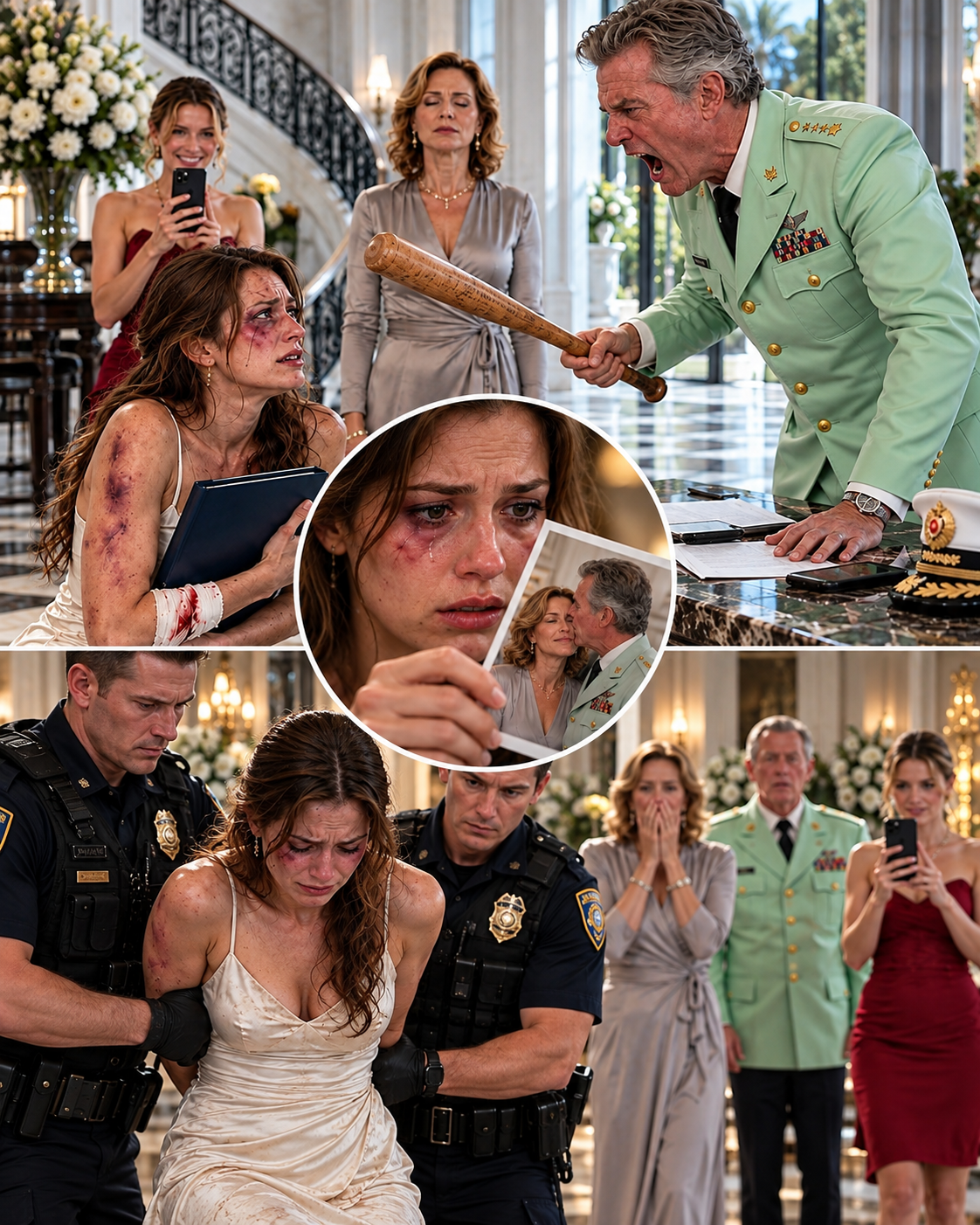
Part 2: A forced signature activates police and exposes a hidden theft
Three minutes later, Mark began rehearsing the story they would tell the hospital. He said I had fallen down the stairs while grieving, become hysterical, attacked Gillian, and hurt myself in the struggle. Yasmin suggested Dr. Vale could examine me after pain medication made my memory easier to challenge. I asked whether the psychiatrist had agreed to help. Mark said the doctor owed him. My brooch camera captured the admission. Gillian kept filming while Yasmin argued that they should remove anything in the room that made the incident look deliberate.
Mark lifted the bat again after I said my grandmother had known he was stealing from her. He called Abigail a manipulative old woman who had poisoned me against my own family. I said she had never needed to poison anything; he had spent years showing me exactly who he was. Before he could strike again, the front door crashed inward. Fremont officers rushed into the living room, ordering him to drop the weapon. Mark released the bat and instantly became the respectable businessman he showed the world. He said I had suffered an emotional breakdown and injured myself while he tried to protect everyone.
Yasmin grabbed the burgundy folder and ran for the kitchen, but an officer blocked her. Papers scattered across the marble floor. Gillian reached for her phone, then stopped when another officer told her to step back. Her own recording contained her laughter, Mark’s threats, and Yasmin’s part in the coercion. Attorney Ana Brennan arrived with a tablet showing the live footage from my brooch. Mark’s expression changed when he heard his own voice promising to break my other arm and use a psychiatrist to take away my legal capacity. He called the recording illegal, but Ana said the officers had arrived during an active violent extortion attempt. My injuries, the weapon, the documents, and Gillian’s video were separate evidence.
Yasmin insisted that the signature transferred the property. Ana picked up the top page and explained that it did no such thing. It authorized release of Abigail’s sealed accounting investigation, froze disputed estate accounts, notified independent trustees, and opened four years of transactions involving companies controlled by Mark and Yasmin. Nearly eight hundred thousand dollars had also passed through an account in Gillian’s name. Gillian looked stunned; Mark had told her the money was legitimate and meant to fund an acting career. Yasmin turned on him, shouting that he had promised the transactions could not be traced. As paramedics stabilized my arm, Mark leaned toward me and whispered that Abigail had lied about everything.
Inside the ambulance, Ana held my hand while I shook so violently that the paramedic asked whether shock was worsening. I said I had known help was coming, but a scheduled rescue did not make the violence feel less real. Ana confirmed the accounts were frozen, then hesitated when I repeated Mark’s accusation about Abigail. The audit had uncovered monthly transfers from my grandmother’s accounts beginning sixteen years earlier, shortly after my mother’s supposed death. The recipient account was not Mark’s. It belonged to a neurological care residence near Monterey. Ana turned her tablet toward me. A recent photograph showed a silver-haired woman with my mother’s face and the crescent-shaped scar above the left eyebrow I had inherited.
Part 3: Hospital records reveal my mother may still be alive
I said the photograph had to be fake. I remembered Miriam’s funeral, the closed casket, and Abigail explaining that the accident had damaged her body too badly for a child to see. I had spent sixteen years speaking to my mother only through framed pictures. Ana told me she had discovered the account three days earlier and waited to verify it before telling me. The records showed something worse: annual deposits came from an offshore company with authorization linked to Mark. He seemed to have known for years that the wife he publicly mourned remained alive somewhere near Monterey.
When investigators contacted the facility, administrators first claimed no patient named Miriam Darcy had ever lived there. Twenty-three minutes after officers entered our Fremont house, someone removed a woman matching Miriam’s description through a side exit and deleted portions of her file. A security image showed a person in a hood pushing the wheelchair toward a black SUV. A thin gold vine bracelet circled the person’s wrist—the same design Yasmin wore at family events. But police had Yasmin in custody at the exact time the woman left. Ana enlarged the reflection in the SUV’s rear window. The jaw, eyes, and familiar expression looked exactly like my father’s.
I stared at the image until the pain medication stopped mattering. Either the camera had created a perfect deception, or two people who looked alike had been moving through my life. Ana opened a sealed birth record from Abigail’s files and showed me two names separated by eleven minutes: Mark Elias Darcy and Martin Isaac Darcy. My father had an identical twin. Detective Samuel Reed later confirmed there were two sets of fingerprints on the bat. He also found a concealed passage behind the kitchen wall containing prepaid phones, clothes, medicine, surveillance photographs of me, and a recording device. One audio file captured Mark telling his brother he was supposed to frighten me. Martin replied that the broken arm made the performance believable.
The brothers discussed moving Miriam before Abigail’s people reached her. They said if I discovered the truth, I might understand why she had once begged them to let her daughter believe she was dead. That devastated me more than learning about Martin. Perhaps my mother had chosen sixteen years of silence rather than being helplessly trapped inside it. Then a hospital administrator brought Ana a card from an unidentified visitor waiting in the chapel. It contained one question: Did Alana remember the red music box? Miriam had given it to me three days before her supposed death. It played a slow version of “Blue Moon,” and almost nobody knew it existed.
Against medical advice, I went downstairs in a wheelchair with Ana and Detective Reed. The woman from the banking photograph sat alone in the chapel’s front pew. Her silver-streaked hair fell across the shoulders I remembered leaning against when I was six. She stood when she saw me and said my name. I asked why she had let me grow up believing she was dead. Miriam explained that the accident was an attempted murder arranged after she discovered Mark and Martin siphoning money from Abigail’s companies. Martin caused the crash. Miriam survived with a severe brain injury, and Abigail hid her in private neurological care because Mark believed she had died. She had only regained enough memory and independence two years earlier to understand the conspiracy.
Part 4: A forgotten twin explains the man wearing my father’s face
I asked who removed her from Monterey the night before. Miriam said Yasmin had an identical twin sister named Leila, and the bracelet belonged to whichever sister needed investigators to notice the substitution. Our reunion lasted only minutes before Martin stepped from behind the last pew with a gun. He demanded an authorization code Abigail had hidden inside my trust. Nearly forty-two million dollars stolen through Darcy businesses had been recovered into a protected account, he said, and the account required my signature and a six-digit key. He believed the music box held the clue because my mother had told me never to forget its song.
Before he could force an answer, the chapel lights failed. A gunshot echoed, and when the emergency lights came on Martin had escaped. Miriam lay near the altar with a bullet graze across her arm. Martin left a message ordering us to bring the music box to Lake Tahoe at midnight. A photograph showed Abigail alive in our family cabin, although the community had attended her funeral months earlier. Miriam admitted the coffin had never contained Abigail’s body. My grandmother had staged her death to keep collecting evidence after realizing both sons would destroy anyone between them and the stolen money. I could barely believe it, but the photograph was current.
At eleven thirty, snow fell over Lake Tahoe as Miriam and I approached the glowing cabin. Detective Reed positioned officers beyond the tree line while Ana listened through an earpiece. The door opened before we knocked. Mark’s face greeted us, and Abigail sat beside the fireplace, thinner and older but unmistakably alive. Relief nearly made me forget the danger. Then another identical man stepped from the shadows and put a knife beneath her chin. For the first time in my life, I saw Mark and Martin side by side. Neither wore the black ring that had once distinguished them.
They ordered me to identify my father. Abigail ended the game by revealing something Martin had never known: Mark had not betrayed him alone after the childhood fire. Both boys had admitted responsibility, and their father bribed a doctor to institutionalize Martin while Mark stayed home. Martin had spent decades believing Mark deliberately sacrificed him. Mark said he had been twelve, terrified, and controlled by their father, and later tried unsuccessfully to free his twin. The brothers had used their identical appearances for years to open accounts, create alibis, sign documents, and be in two places after crimes. Their arrangement had made them rich, but neither trusted the other enough to share what remained.
I opened the red music box. Its six-note version of “Blue Moon” began to play. Mark converted the notes into numbers and entered them, but the account denied access. Abigail smiled despite the knife at her throat. The melody had never been the code; “Blue Moon” meant two moons, two sons, and the second twin. Martin had been born eleven minutes after Mark, giving the numbers 022511. I entered them. The screen showed $41,782,604.18 and a command marked EXECUTE RECOVERY PLAN. Mark lunged for the phone. Martin attacked him, and the brothers crashed across the table. The music box shattered as a gunshot tore through the window from someone still controlling the game.
Part 5: Tahoe reveals a living grandmother and the brothers’ shared guilt
The shooter entering through the rear of the cabin looked like Yasmin, but Miriam called her Leila. The twin sisters had switched identities repeatedly for years. Leila said Yasmin had disappeared three years earlier after threatening to take the family ledgers to Abigail. Leila had continued living under her sister’s name to remain near Gillian and gather evidence. Mark coldly claimed he had solved the Yasmin problem when she threatened to expose him. Leila raised her rifle, intending to avenge her sister, only to find Abigail had removed its ammunition. Mark and Martin fought through the cabin doorway onto the snowy porch, where officers surrounded them.
Mark reached beneath his coat despite commands to stop. Detective Reed fired when he believed Mark was drawing another weapon. Martin surrendered. I recovered the phone and pressed EXECUTE RECOVERY PLAN. Forty-one million dollars began returning through court-supervised accounts to tenants, employees, investors, and family businesses the brothers had drained. A second message appeared, identifying Gillian as the beneficiary of a separate protected trust. Abigail explained the reason when police brought my stepsister into the cabin. Gillian was not Mark’s biological daughter. Leila had given birth at nineteen after a hidden relationship with Martin and allowed Yasmin to raise the baby.
Gillian stared at Leila, then at the rest of us, and demanded to know why everyone treated her life like another estate document. She turned on me and asked why I still received everything while she inherited only a conditional trust. I reminded her she had laughed while Mark threatened me and continued filming after my arm broke. Gillian pulled back her sleeve, revealing old bruises. Mark had threatened to hurt her the same way if she stopped recording. Her fear did not erase the cruelty she had shown me, but it made the family’s lessons visible: she had learned to laugh before powerful people discovered she knew how to cry.
Abigail’s secondary trust required Gillian to cooperate honestly with investigators and participate in counseling before receiving independent funds. Gillian called it another form of control. Abigail replied that offering someone a path away from violence was different from purchasing obedience. I told Gillian I could not forgive her that morning, but I would testify honestly about both what she had done to me and the injuries she had hidden. She started crying without asking me to change my answer. Martin later admitted he knew Gillian was his daughter but stayed away because Mark threatened the child. He could explain his choice, but not excuse it.
Federal agents soon uncovered a warehouse tied to the brothers. It held false identities, surveillance files, psychiatric evaluations, and evidence that Dr. Vale had declared wealthy people incompetent so relatives could seize their estates. My inheritance fight had not begun the operation; it was simply the largest case Abigail had managed to turn against them. Before emergency surgery for a heart crisis, my grandmother gave me a tiny brass key hidden beneath the music box’s lining. She said one final ledger remained in a Sacramento safety-deposit box. “Don’t trust whichever name you see,” she whispered. “Trust the handwriting.”
Part 6: My stepfamily’s secrets expose a daughter caught between them
Ana, Detective Reed, Miriam, and I opened box 417 the next morning. Inside were a black leather ledger, a flash drive, and a letter from Abigail telling us to compare signatures with the inscription inside my mother’s wedding ring. The ledger named Miriam’s supposedly dead father, Elias Dane, as financier of the network. But the handwriting did not match the inscription he had written in the ring years earlier. The flash drive contained videos beginning with a younger Mark discussing Miriam’s attempted murder with a woman whose reflection appeared in a mirror. The woman was Yasmin—the real Yasmin—alive long after Mark told Leila she was gone.
Other recordings showed Yasmin recruiting Dr. Vale, designing fraudulent guardianships, creating identities for Martin, and setting up schemes that let wealthy families take property from relatives declared incompetent. She had encouraged the brothers’ rivalry because twins made useful alibis. She manipulated Leila by threatening Gillian, forged Elias Dane’s name to direct investigators toward a dead man, and planned to treat every relative as expendable once Abigail’s recovered money returned to her control. Handwriting analysis confirmed Yasmin had written the ledger. As we read, the vault doors locked and smoke began to enter through the ventilation. Her voice came over the intercom: leave the ledger, or none of you would get out.
Abigail had chosen the bank carefully. The brass key that opened the deposit box also opened a maintenance panel behind the vault shelves. We crawled through the service passage and reached the underground garage before the smoke became overwhelming. Yasmin waited there, holding Gillian at gunpoint, while Leila knelt nearby with blood on her forehead. Yasmin claimed Abigail had destroyed their father after he discovered tax fraud. Leila shouted that he had confessed to stealing money, and Abigail had only exposed him. Gillian drove an elbow backward when Yasmin’s gun dipped. Yasmin fired toward her, and Leila threw herself into the path. The bullet struck Leila’s shoulder.
As Gillian pressed her hands against her biological mother’s wound and cried “Mom” for the first time, Detective Reed tackled Yasmin and Ana kicked the weapon away. I realized stolen money had been the fuel, but the engine was people turning old pain into permission to hurt someone new. Abigail survived surgery, as did Leila. Yasmin was taken into federal custody. Then my grandmother asked Miriam to tell me one last truth: Mark Darcy had never been my biological father. Before marrying him, Miriam had loved Daniel Brennan, Ana’s younger brother, an investigative journalist examining corruption around Dr. Vale and the companies tied to the Darcy fraud. Daniel died in what authorities called a boating accident before he could publish his work.
Mark later married Miriam and used the secret of my parentage to threaten that he could remove me from her life. Abigail had known from the beginning but always considered me her granddaughter, because kinship created responsibility while blood merely described biology. Ana discovered at the same moment that the girl she had protected as a client and Abigail’s heir was also her brother’s daughter. Daniel’s death explained why Abigail’s fight had become larger than saving properties. She had preserved fragments of his investigation and eventually realized Mark, Martin, Yasmin, and Dr. Vale belonged to the same criminal structure he had tried to expose.
Part 7: A second ledger names the woman who controlled them all
In the months that followed, Martin pleaded guilty to conspiracy, fraud, kidnapping, and assault. He gave investigators evidence against lawyers, bankers, judges, and medical professionals in exchange for a reduced sentence. He never asked Gillian to forgive him for staying away after learning she was his daughter. Dr. Vale was found outside the country and returned to face charges connected to twenty-seven people falsely declared mentally incompetent. Many had later regained control of property stolen through fraudulent guardianships. Yasmin received a sentence that would keep her under supervision for the rest of her life. At sentencing, she said I believed I had won because Abigail left me money. I answered that the victory was watching a courtroom where she no longer decided what happened to anyone else.
We sold the Fremont house instead of turning the place where my arm had broken into a shrine to survival. With my approval, Abigail used part of the proceeds to create the Daniel Brennan Foundation for victims of coercive guardianship, inheritance fraud, financial abuse, and relatives hidden inside private institutions. Ana became its director. Miriam joined the family-location program after rebuilding enough confidence to work again. I discovered that reuniting with my mother did not return the sixteen years we had lost. Sometimes I resented her survival as much as I loved having her back. She did not demand immediate forgiveness. Abigail finally stopped believing that secrecy automatically protected people. We began practicing something harder than exposing criminals: telling one another uncomfortable truths before a crisis forced them into daylight.
Gillian moved near Lake Tahoe with Leila, attended counseling, and cooperated fully with investigators. Slowly, she became someone I could speak with without hearing her laughter from the night Mark’s bat came down. Forgiveness did not arrive as a sudden declaration. It came as a gradual decision to stop letting our worst moments dictate every future one. One year after my father threatened me, I returned to the Tahoe house. Snow had covered the mountains, and the family gathered around a fireplace that had once belonged to a dead woman. Abigail argued with Ana about the foundation’s budget. Miriam cooked badly enough that Leila took over the kitchen. Gillian walked onto the terrace holding the phone she had used to record my assault.
She told me she had kept it because humiliating footage made her feel powerful in a family where she was secretly afraid. She placed it in my hand and said I could decide whether it became evidence, memory, or garbage. The criminal case no longer needed the phone; forensic copies were safe. I dropped it into the metal firepit and watched the screen disappear beneath the flames. Destroying the object could not destroy what happened, but I no longer needed to keep it to prove my story. Gillian apologized without mentioning Mark, fear, Leila, or childhood. That mattered. Accountability began when she stopped asking me to accept her pain as payment for the pain she caused.
Abigail placed six envelopes on the table and announced she had rewritten her will. No secret triggers, coded songs, emergency signatures, hidden twins, or grave-related surprises. Gillian asked if everyone could finally inherit something without first being kidnapped. Abigail divided her personal belongings among us, but transferred the major properties and companies into an independent trust benefiting the foundation, long-term employees, and tenants. No single relative could turn family wealth into a weapon again. She gave me a smaller wooden box containing Daniel Brennan’s brass compass. Miriam opened the back, and we found a tiny photograph of my biological father smiling beside her before his final investigation.
Part 8: My biological father’s past reshapes what inheritance means to me
Daniel had my eyes, Ana’s chin, and an open expression that made grief arrive alongside gratitude. For years I had believed my inheritance consisted of buildings, ranches, voting rights, and bank accounts. Abigail had fought to preserve something else: my ability to learn who I was without someone threatening me into accepting their version. Later that night, Miriam asked if I was happy. I told her happiness no longer meant forgetting. Pain could remain part of a life without being allowed to own its direction. From the house came Abigail arguing with Gillian about dessert, Leila laughing, and Ana calling us back inside. Those ordinary sounds felt more valuable than the millions everyone once believed justified destroying one another.
My phone vibrated with a message from Martin in prison. He had seen a headline about compensation reaching hundreds of victims and asked me to tell Gillian he had finally done one thing right by giving investigators everything he knew. A second message claimed Daniel Brennan had left another file proving his boating death involved sabotage by someone not yet identified. For a moment, my old reflex returned: chase the next secret immediately before it became dangerous. Abigail took the phone from my hand, switched it off, and said whatever waited in the file could survive until morning. After a lifetime of letting danger set our schedule, we were choosing dinner.
We walked back toward the warm house beneath the pale light over Lake Tahoe. Our family had not become perfect because the worst criminals were gone. Miriam still carried guilt, Leila still had nightmares, Gillian still had apologies to live rather than merely speak, and I sometimes woke believing I could hear a bat striking marble. But my arm had healed. The foundation was helping people recover property and legal identities. Abigail had finally let go of the idea that she had to control every truth in order to protect us. Even unanswered questions no longer felt powerful enough to ruin a good evening.
The signature my father forced from me had never surrendered an inheritance. It released the records that returned stolen money, exposed a criminal network, reunited a daughter with her mother, and revealed the father whose name had been erased from my life. It also stripped violent people of the authority they believed wealth granted them. Mark wanted more than the property; he wanted proof he could break me until I signed whatever story he placed in front of me. He failed. As I crossed the threshold into the house, I understood the last thing I inherited from Abigail was not money. It was the knowledge that no one else would ever again be allowed to sign my life away.
✓ Lynn R. Adams
Part 2: A forced signature activates police and exposes a hidden theft Three minutes later, Mark began rehearsing the story they would tell the hospital. He said I had fallen down the stairs while gr…