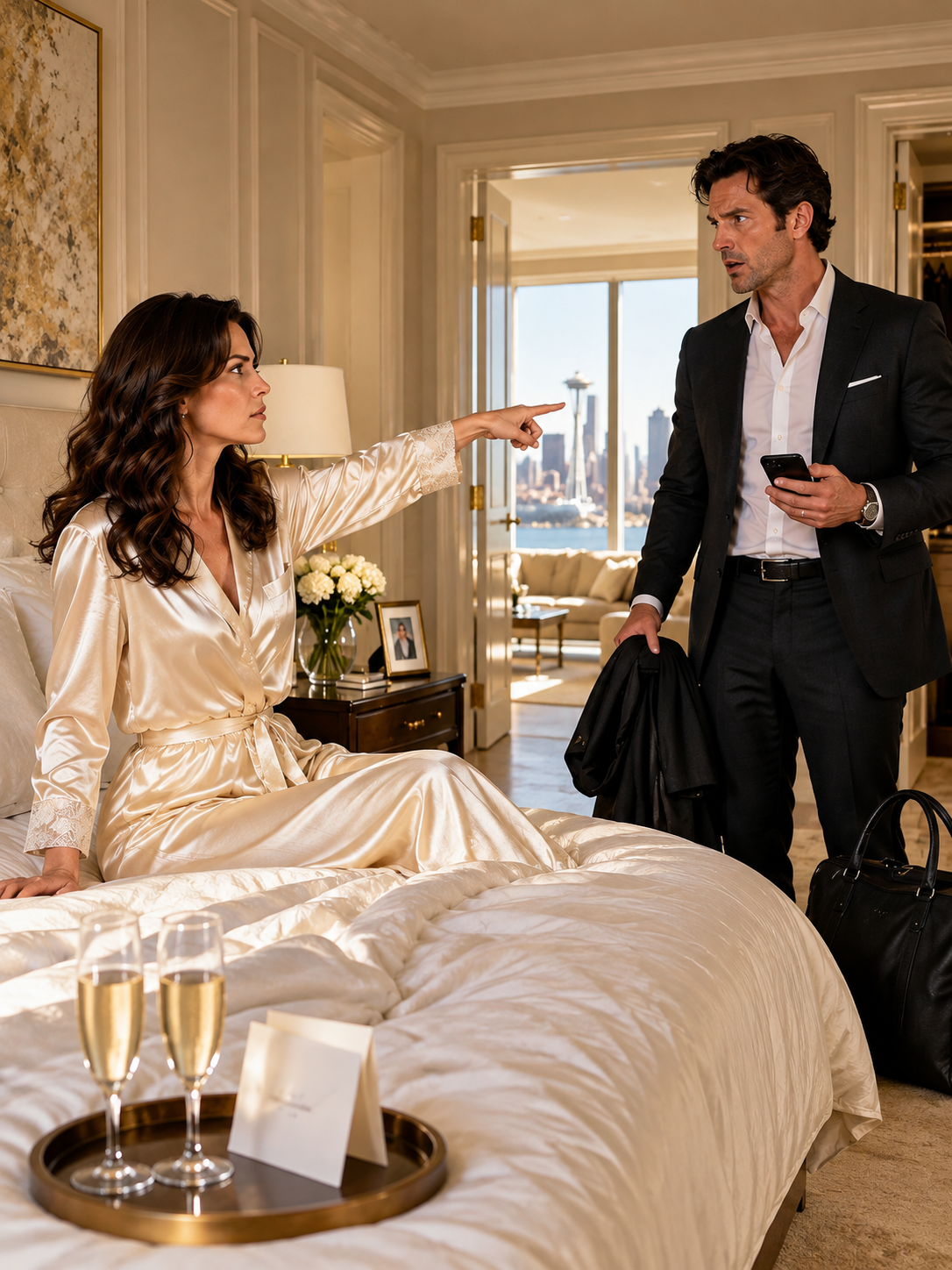
After we were intimate on our fifth anniversary, my husband fastened his cuff links and told me
IF FACEBOOK BROUGHT YOU HERE, HERE’S THE CONTINUATION YOU’VE BEEN WAITING FOR. ENJOY! 👇 I met Dad that afternoon in Beckett Studio’s conference room. Fresh plaster from a recent renovation mixed with the smell of old rolled drawings, and he sat turning a pencil end over end while I described the documents Zelda had reviewed. He was sixty-one, careful with money and generous with opinions, and for most of my life I’d trusted his judgment.
“You did this without calling me first,” he finally said. “I’m informing you, Dad, not asking permission.” He reminded me that Caldwell could cover two years of studio overhead. I told him I wasn’t trying to sabotage it; I wanted the parties to identify what Beckett Studio could legitimately license and what remained my own work.
“Did you know about Sabine?” I asked. Dad set down his pencil. He admitted he’d known Jonah was spending time with her since the previous spring and assumed it would resolve itself. That was when I’d finished the hinge model and Jonah had complained that I made everything about work.
“You protected the commission,” I said, “even when it meant leaving me in the dark.” He said he had been protecting the partnership. I promised to cooperate on a lawful solution for Caldwell, but I wouldn’t pose beside Jonah at another event while people credited him with the design. “If that costs the project, I can’t pretend otherwise.”
As I gathered my bag, I said my mother would have asked him why he hadn’t warned me. Dad didn’t argue. I left him in the conference room, surrounded by work he had taught me to care about and a choice I had never expected him to make.
At Oona’s apartment, leaving felt less like freedom than walking into a room where all the familiar objects were missing. I reached for my usual mug and remembered it was still in the house on East Lake Avenue. I slept badly, blamed the radiator, and knew the radiator wasn’t why I woke at three.
One evening Oona put aside her contractor’s tablet and told me she’d been angry with me for two years. I’d missed her job-site visits, a birthday dinner, and a housewarming because Jonah always needed me for another donor event. “I thought you forgot who you were outside the marriage,” she said.
“I didn’t forget,” I protested. “You hid,” she answered. “You stopped believing anybody wanted you around without a reason.” I apologized. She nodded and pushed a bowl of soup toward me, telling me to eat actual food before we turned the conversation into a ceremony.
Five weeks after I began the divorce process, an email arrived from Milo Carver. We had met at industry events and once disagreed over a loading-dock ordinance at a city permitting session. He was a structural engineer leading projects at Carver Plus Weld, a midsized firm known for difficult sites.
His message was brief. He was bidding on Meridian Crossing, a mixed-use development on a contaminated waterfront lot, and needed an architect experienced with complicated ground conditions. He offered standard professional rates and said he’d understand if I wasn’t available. There was nothing about Jonah, Sabine, or my divorce.
I agreed to review the brief. Carver Plus Weld worked from a converted warehouse in SoDo, full of site models and the smell of coffee and epoxy. Milo met me at a table covered with surveys, his dark hair graying at the temples, and waited without reaching for my portfolio.
“The ground floods in a fifty-year storm,” he explained. “The city wants the civic program to remain usable during a hundred-year event.” I crouched beside the model and noticed that the flood-risk benchmark ignored tidal surge compounded by storm-drain back pressure. He had the drainage records but no workable design.
“Move the civic program up one level,” I suggested. “Let the ground floor accommodate water instead of pretending it won’t come. Put mechanical systems on the roof, use permeable parking, and make a tidal garden part of the landscape.” Milo called an engineer over, and we spent forty minutes testing the proposal rather than arguing about whose idea it was.
He put a written offer before me. I asked for my own studio name on submissions and permit documents from the beginning, and for the Caldwell dispute to remain outside our work unless it affected the project. “Agreed,” he said to both. Then he told me to take the agreement home and decide without pressure.
I signed the next afternoon because the job interested me. A few nights later Jonah arrived unexpectedly at Oona’s door in a charcoal coat. She looked through the peephole and said he stood there as though he owned the building. I opened the door but didn’t invite him in; Oona stayed in the kitchen.
“You’re working with Milo Carver,” Jonah said, accusing me of helping a competitor obtain his company’s strategies. I told him professional knowledge wasn’t a stolen file and that any settlement question belonged with Zelda. He asked me to come home and proposed separate schedules or boundaries around Sabine, whatever would make me comfortable.
“You said, ‘That should hold you for a while,’” I reminded him. “You made what happened between us sound like an obligation you’d paid before going somewhere better. I will remember those words for a long time. A schedule cannot repair them.”
He looked down. “You were going to leave me carefully,” he said, almost to himself. I admitted I’d been trying to find a way to leave without destroying the Caldwell work. He nodded once and went away. After I shut the door, my shoulders shook; Oona gave me space until I could breathe.
I threw myself into Meridian’s difficult calculations and the record of Caldwell’s design ownership. I started therapy on Tuesdays and had dinner with Oona on Fridays. Milo kept his communications clear and professional, even when we disagreed, and didn’t treat my personal upheaval as a chance to draw closer.
After a permit meeting he told me I’d identified the flood-data problem in minutes when three engineers had missed it for months. I asked why he hadn’t said so in the meeting. “There were fourteen people there,” he replied, “and I didn’t know whether you preferred public acknowledgment.” “Out loud,” I said. “I prefer it out loud.” He said he would remember.
Part 3 Jonah’s attorney then sent a competing-interest claim concerning the hinge. Zelda responded with fourteen months of dated notes, models, photographs, and early designs that traced my contribution before the relevant Harland presentations. The dispute delayed the work and required formal exchanges; I couldn’t solve it by being certain I was right.
A mediator was proposed, but Zelda asked first for a concrete filing timetable and documentation from both sides. Jonah agreed shortly before the deadline. Meanwhile I kept the Meridian project separate, checking that no Caldwell material crossed into the new firm’s files.
In December a regional business reporter contacted me about what she called a dispute between Beckett Studio and Harland Group. Even that description made the person who’d drawn the hinge disappear. I gave one statement: the concept originated in my work as design architect, and the underlying records were available for review.
Three days after publication, the online article carried a correction crediting me. It wasn’t a dramatic headline, but it existed in the public record. I saved it beside the dated notebooks and returned to my site drawings.
Dad called after the correction. Beckett Studio would be identified as co-lead on the Caldwell submission, he told me, and my name would appear on the permit documents as design architect of record. “That’s what I was from the beginning,” I said. He agreed without trying to turn it into a favor.
Then he apologized for watching Jonah take credit while calling it collaboration. He’d treated my silence as consent because it preserved the partnership’s stability. I told him I didn’t know how quickly I could forgive him, but I wasn’t walking away from our studio’s work either.
He admitted he’d considered asking me back to manage Caldwell’s deliverables. “You were going to call that reconciliation,” I said. He paused and confessed he’d planned to wait a week before suggesting it. I laughed for the first time in months, not because the damage was fixed, but because he finally spoke without hiding his intentions.
In January Zelda called while I was studying tidal-model data in a conference room at Carver Plus Weld. The divorce decree was final. Outside the door a printer ran, someone debated a beam size, and phones rang; the world didn’t change its rhythm for the end of my marriage.
What changed was the quiet in my own head. For years I’d listened for clues about Jonah’s mood before going home, measuring whether an evening would require another apology or accommodation. After the call, I could hear the office without that constant second conversation running underneath it.
Milo appeared in the doorway, noticed my face, and asked whether the news was bad. “The divorce is final,” I said. He sat across from me and asked how I felt rather than congratulating me. “Relieved and sad,” I answered. “They can both be true,” he said.
Over lunch in February, without project drawings between us, he asked what I wanted to build in ten years. I described a small design practice where I would still have a hand in the work and where young architects could afford to train because we’d actually pay them. “That will make you expensive,” he said. “It should,” I replied.
He admitted he’d wanted to know me outside the office for weeks and didn’t want to disguise that interest as another project. I suggested dinner. Later I told Oona, who asked whether he was decent. “Almost aggressively,” I said, and she told me to stop searching for a hidden bargain in every honest offer.
We went to dinner, then three more. I learned about Milo’s father, a civil engineer who had built water systems in rural Montana, and told him about my mother Ruth. She had come to all my school presentations and sat in the back so I’d learn to speak to a whole room rather than only to somebody who already loved me.
Ruth died from pancreatic cancer before Caldwell, seven months after her diagnosis. Afterward I’d buried myself in studio work because it was the only place I felt present. That made it too easy to excuse sacrifices in a marriage supposedly serving the same work. Milo listened without trying to turn grief into a lesson.
In March the Caldwell permit was approved with Orla Beckett listed as design architect of record. The acknowledgment was quiet and bureaucratic, exactly the kind of permanent detail I had fought to preserve. Jonah’s publicist described the resolution as collaborative; I didn’t release a competing statement.
I was on the Meridian site in a hard hat when the news came. A foundation crew was setting footings to the corrected datum line, and I showed Milo where the tidal garden would run. The permit depicted the legal minimum for drainage, but I still wanted the landscape to do more than comply. He told me to speak to the landscape architect before she finalized her fee.
We had been seeing each other for weeks when Milo asked if I’d have dinner with him that Friday, making clear he meant something personal. I told him our last several dinners had been personal. “I know,” he said. “I just want the words to match.” That mattered more than he realized.
The Caldwell dispute continued to affect Harland Group. Officials asked for clearer design attribution on another permit, and partners wanted stronger intellectual-property agreements. Jonah did not lose the company, but he lost the easy assumption that his name alone answered those questions. I didn’t need anything more dramatic than that.
Sabine moved from Seattle to Portland that spring, according to a mutual acquaintance. I neither followed the details nor asked why. I had stopped measuring progress by where she and Jonah were, because there were new drawings on my own table and people waiting for my decisions.
Final In April I leased a ground-floor space in Pioneer Square, a former bookbindery with north-facing skylights, unreliable old freight equipment, and radiators that Oona declared suspicious but usable. I registered Orla Beckett Design and spent a weekend painting the walls a warm off-white. For the first time, I could choose how a studio looked without designing around someone else’s reputation.
Milo stopped by on a Sunday with an excuse about a nearby job site. He noticed the black lettering on the front glass and said, “I can see your name from the street.” I asked him to come closer and say it again. He crossed the empty studio and I kissed him while the radiators clanked behind us.
I hired two architects and a recent graduate who had been working without pay elsewhere. Oona took on our first built project, a residential addition with a complicated setback, and complained about the permit timeline while arriving earlier than anyone else on site. The office didn’t run without problems, but the problems belonged to work we’d chosen.
In June Jonah left a voicemail saying he was in the hospital waiting for surgery he’d been postponing. His condition had been caught early, he said, but he didn’t know whom else to call. I listened once and sat with it through the evening before discussing it with Zelda and Oona.
There was no legal obligation or unresolved settlement reason for me to go. Oona asked whether I wanted permission to care without reopening the marriage. Milo asked if I wanted him to come with me, then accepted my no. The next afternoon I went alone.
Jonah looked smaller in the hospital bed without a tailored coat, staff around him, or an agenda to control the room. “You came,” he said. “You called,” I answered. I sat by the window with my coat still on and told him to schedule the operation.
He asked whether I’d been happy during our marriage. “Sometimes, at the beginning,” I said, “when you still listened before deciding.” I told him I wasn’t available to manage his recovery, and I didn’t want to be the reason he chose treatment. That responsibility belonged to him and his family.
“I loved you,” he said. “I believe that,” I answered. “It didn’t make you careful with me.” He didn’t argue. I asked him again to arrange the surgery, then left the hospital and went back to my life.
He scheduled it the next day. In September his aunt, who helped manage the firm, sent a brief message that the procedure had gone well. I replied that I was glad. Then I returned to the tidal garden plans I’d been revising before her message arrived.
Meridian Crossing broke ground in October with a modest ceremony and an ordinary collection of hard hats. When a reporter asked about building on compromised waterfront ground, I told her you have to measure from the right benchmark or the building won’t survive its own weather. You also have to put your name on what you’ve designed and stand by it.
The following spring my studio expanded its paid apprenticeship program. Oona joined its advisory board and questioned applicants about structural loading even when their work had little to do with engineering. She believed architects should understand what they were asking someone else to build, and I couldn’t argue with that.
One Tuesday Milo asked me to come up to a scaffolded deck above the Meridian site. The tidal garden footprint was marked below in orange flags, and the city was continuing with its ordinary afternoon. He had a ring with a low-set stone the color of deep water, practical enough to wear while working.
“I don’t want to manage your life,” he said. “I want us to share a future neither of us has to disappear inside. If you want that too, marry me.” He didn’t kneel or prepare a speech about saving me. He asked, then gave me room to decide.
“I have conditions,” I said. We would keep separate firms, my studio would keep its lease, nobody would reorganize my bookshelves, and he’d have to help get the old elevator repaired before we hosted a client event. He laughed, then asked whether that meant yes.
I put the ring on my own finger and held out my hand. “That’s a yes.” I kissed him above a site we’d both worked to make sound, thinking how different an honest proposal felt from a promise that required me to become smaller. The city kept moving below, and I was happy to move with it.
THE END. I’ve shared the complete story, and I truly hope it touched your heart. If this story moved you, please , like, and share the post. Thank you for reading! ❤️
✓ Lynn R. Adams
IF FACEBOOK BROUGHT YOU HERE, HERE’S THE CONTINUATION YOU’VE BEEN WAITING FOR. ENJOY! 👇 I met Dad that afternoon in Beckett Studio’s conference room. Fresh plaster from a recent renovation mixed with…