After thirty years in the Army, I was minutes from briefing the president when a major grabbed my arm and escorted me out of the White House Situation Room, certain I couldn’t possibly belong there…
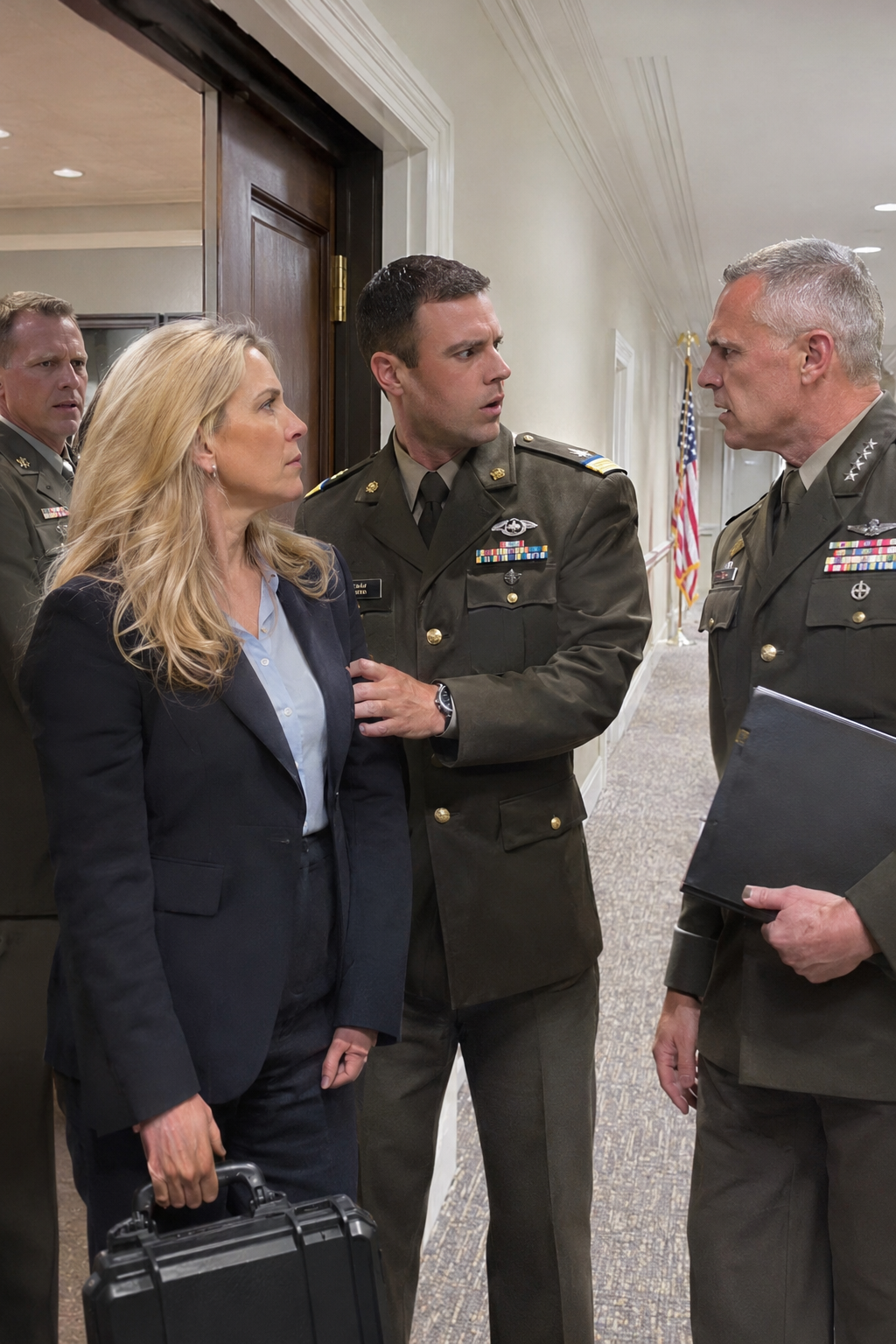
After thirty years in the Army, I was minutes from briefing the president when a major grabbed my arm and escorted me out of the White House Situation Room, certain I couldn’t possibly belong there…
I’m Vivian Castle. In February 2026, I was fifty years old, a brigadier general, and responsible for an intelligence briefing that couldn’t be late. Yet the moment a young major took hold of my arm, I felt twelve again, standing in my father’s house and being told there was a place I didn’t belong.
I grew up in Dayton, Ohio, where my father, an Army first sergeant, treated Saturday chores like military inspections. He had once carried a wounded man two miles, and that experience shaped his idea of service: a soldier wore muddy boots, carried a rifle, and brought other soldiers home.
I admired him. I also knew that his definition left little room for a daughter who loved books more than the rifle range. By ten, I could read in three languages, and my mother, Lorraine, kept my report cards in the drawer beside the telephone.
My father rarely opened that drawer. “Anybody can sit at a desk, Viv,” he’d say, as though the ability to understand something complicated didn’t count until you could lift it. My little brother, Dean, learned early to laugh at the same things Dad laughed at.
When I was twelve, Dad took nine-year-old Dean shooting and left me home to help Mom fold laundry. I hadn’t even wanted to fire a gun. I’d wanted to sit in the truck with them and be included in whatever made them laugh on the drive home.
At eighteen, in 1993, I enlisted in the Army as an intelligence analyst. A recruiter had looked at my language scores and told me they could make a difference. For the first time, someone had called the thing I was good at useful.
At dinner, Dad listened to my news and set down his fork. “So, a typing job,” he said. “In air conditioning.” Dean laughed, and Mom quietly squeezed my wrist beneath the table before passing the potatoes.
My father wasn’t a monster. He stood proudly when I enlisted and told the neighbors I wore the uniform. He simply believed the kind of work he understood was the only kind that truly mattered, and I spent years trying to change his mind without ever saying so.
In 1995, the Army selected me for a commissioning program. In May 1997, at twenty-two, I became a second lieutenant in military intelligence. Dad attended in a tie, shook my hand, and called me “Lieutenant,” and for one afternoon I thought he finally saw me.
Then I heard him at the reception praising Dean, who was preparing to enlist in the infantry. I stood nearby in my new uniform while Dad talked about the soldier his son was going to become. I smiled for the photographs and decided I would simply work harder.
By the fall of 2001, I was a captain doing counterterrorism intelligence work. The more responsibility I took on, the less I could explain at home. My family saw missed holidays and unanswered questions; they couldn’t see the people or decisions behind them.
I missed Christmas in 2002 because of an assignment I still cannot describe. I called from a secure line and heard wrapping paper, a football game, and everyone talking in Mom’s kitchen. Dad took the phone long enough to say he hoped my job was worth missing the things that mattered.
“It is,” I told him. After the call ended, I stood alone with the receiver in my hand, knowing I couldn’t tell him why. Every unexplained absence was becoming another reason for my family to think I considered myself too important for them.
Dean served honorably and left the Army in 2008 as a staff sergeant before going into private security contracting. I was proud of him. But at a cookout that summer, he stood beside the grill and announced, “Somebody’s got to run the PowerPoints while the rest of us are getting shot at.”
The cousins laughed, and I laughed too. I couldn’t explain that I’d been shot at too, or tell him whose lives those briefings had affected, without disclosing things I had sworn to protect. I told myself keeping the peace at a backyard barbecue was easier than trying to make him understand.
When I became a lieutenant colonel in 2014, Dad’s first question was whether I’d ever actually been in the field. “Yes,” I said. He changed the subject to the weather, and I let him, just as I had learned to do since childhood.
My friend Ranatada Sodto, whom I called Ranata, was another officer who understood the burden of silence and had less patience with my excuses. Over terrible coffee one day, she said, “You keep waiting for them to find out who you are, Viv. They aren’t looking.” I was angry because she was right.
In the summer of 2025, I pinned on my first star and took charge of a national intelligence fusion directorate. I began briefing senior national security officials, including the president. I didn’t tell my family the details; much of the work was classified, and I had stopped trying to turn every achievement into an argument at dinner.
On that February morning in 2026, I entered the lower level of the White House’s West Wing in a dark civilian suit. My briefing materials were secured in a locked case. I’d passed four separate checks, with my credentials examined and recorded, before I reached the Situation Room complex.
It wasn’t one enormous room like in the movies. It was a series of secure spaces where people arrived early, reviewed papers, and spoke quietly because the stakes were serious. I had made that walk more than a dozen times, and I knew exactly where I was supposed to stand.
I set my case near the head of the table, where I would brief, and arranged my materials in the order I’d rehearsed. My routine was simple: arrive before the room filled, check every page, and steady my voice before anyone needed an answer. That morning’s information was time-sensitive.
Major Aaron Vickers, the thirty-four-year-old watch officer, entered while I was preparing. He saw a woman in business clothes beside the head of the table and came straight toward me. He didn’t recognize me, but he was certain he knew what he was seeing.
“This room is restricted,” he said quietly. I told him I was there to give the briefing. He looked at my face, not the credentials on my case, and repeated that I couldn’t stay.
A few officers seated nearby glanced up from their notes. Some knew me, but none spoke before Vickers lost patience. “I don’t care who told you to wait,” he said, and reached for my upper arm.
His grip wasn’t violent, but it was firm enough to turn me toward the door. I could have stopped him and identified myself again. Instead, for a few awful seconds, I heard my father’s old verdict in my head and let the major escort me into the corridor.
I had spent thirty years proving myself in rooms my family couldn’t imagine, yet a stranger had decided in seconds that I didn’t belong in this one. Behind us, the officers who recognized me were rising from their chairs. The major kept walking.
Coming toward us was Lieutenant General Grant Develin, the senior military adviser to the National Security Council. He had sat across from me in briefings for eight months. His eyes went from Vickers’s hand to my face, and he stopped in the hallway.
“Major,” he said, his voice low and sharp, “that is Brigadier General Castle. The president is waiting on her briefing.” Vickers released my arm immediately, his face draining of color. I straightened my jacket, still holding my case, and knew the decision about what happened next would be mine. Part 2…..
IF FACEBOOK BROUGHT YOU HERE, HERE’S THE CONTINUATION YOU’VE BEEN WAITING FOR. ENJOY! 👇 Vickers stepped back so quickly he nearly struck the wall. “Ma’am, General, I didn’t—” he began, but no explanation came. I didn’t give him one, either; I had come to that building to do a job, and the job hadn’t become less urgent because I’d been humiliated.
I walked back into the room with my case. The officers who had watched the scene looked uncomfortable, but I didn’t stop to ask why no one had intervened. I put the folder square with the table’s edge, checked the sequence of my papers, and waited for the meeting to begin.
When the president and the other officials arrived, I delivered the briefing as planned. I answered the questions I could answer, kept to the information in front of me, and finished without my voice shaking. Nobody listening would have known what had happened to me minutes earlier.
For years, I’d considered that composure a gift. It helped me function under pressure and gave people confidence in the intelligence I presented. That morning I understood its other side: when you never show the hurt, people start believing there is no hurt.
Afterward, when the room had cleared, General Develin found me in a side office. He was angry, though he showed it in the controlled way senior officers often do. “Say the word,” he told me. “There’ll be a letter in his file. Maybe more.”
He reminded me that Vickers had put his hands on a general officer and interfered with a scheduled presidential briefing. I knew the incident deserved review; the major’s assumptions had created both a security problem and an unnecessary disruption. But I told Develin I didn’t want to decide the major’s future while I was still feeling his hand on my sleeve.
That night I called Ranata. She listened without interrupting while I described the room, the corridor, and the shock on Vickers’s face when Develin said my rank. “It landed so hard because it wasn’t new,” she said.
She was right. Vickers had looked at me and decided what I couldn’t possibly be, just as my father had done when I was a little girl with books in her arms. Dean had made the same judgment every time he turned my work into a punch line.
“So what will you do?” Ranata asked. I told her I didn’t know. A formal reprimand could have serious career consequences, and I wasn’t pretending that forgiveness erased what had happened.
At my desk, I considered the incident report and the options available through the proper chain of command. Part of me wanted Vickers to feel the weight of every dismissal I’d ever swallowed. Then I realized I was asking one man to answer for a family history he knew nothing about.
I went home without making the decision. Sleeping on it didn’t make his actions acceptable, but it helped me separate the professional failure from the anger that had followed me out of childhood. Whatever happened to Vickers needed to make the room safer, not merely make me feel vindicated.
A few days later, I asked to speak with him privately. He arrived standing stiffly at attention, looking as though he’d spent every waking hour preparing to have his career ended. I asked him to sit, and he perched on the edge of the chair without touching the back.
“You didn’t verify who I was,” I told him. “You guessed from what you expected a general officer to look like, and then you acted on the guess.” He lowered his eyes, but I asked him to look at me because I needed to know he was listening.
I explained that a watch officer had every right to question someone’s authorization, even mine. The failure was that he ignored the safeguards already available and used his own certainty in place of a credential check. In our line of work, trusting the wrong assumption could hurt far more than one person’s pride.
“Why aren’t you ending my career?” he asked at last. “With respect, ma’am, I know I’d have it coming.” I thought of Dad at the dinner table and of Dean laughing by the grill, both so sure they understood what counted.
“Because I know what it feels like to have someone decide your whole value in a few seconds,” I said. “I won’t pretend this didn’t happen. But I want you to learn to make a better decision the next time a person walks through that door.”
I supported an accountable corrective process through his leadership rather than seeking the harshest possible punishment. It included supervision, a review of access procedures, and time learning how briefers were vetted. He still had to own his mistake; a second chance was not a promise that mistakes carried no consequences.
Develin disagreed with me at first. He worried that officers would mistake restraint for weakness, especially when the person affected was a woman in senior command. I told him I had been misunderstood for thirty years and wasn’t going to let the fear of being misunderstood once more make this decision for me.
Around that time, Dean called with a story he’d heard from someone in the contracting world. He was chuckling about a general supposedly being escorted out of the Situation Room when he noticed I wasn’t laughing. “Wait,” he said. “Viv, was that you?”
“Yes,” I answered. For the first time, I didn’t rescue him from the awkwardness. “It was me, in the room you’ve spent years joking that I’m not important enough to enter. A man looked at me and decided I was nobody. You know how that works, Dean.”
He went silent. I could hear him breathing and then shifting the phone, waiting for me to soften what I’d said. I didn’t, because I hadn’t insulted him; I’d finally told him what his jokes had cost.
Dean had never asked many questions about my career, and I had rarely offered more than the bare outline. But afterward he started reading what he could about intelligence work, general officers, and the responsibilities of a national fusion directorate. He couldn’t get the classified facts, and he didn’t try.
He learned that I wasn’t somebody who clicked through slides while other people made decisions. Sometimes the president began a morning hearing my assessment of information that could influence those decisions. The significance finally reached him in a way my promotions never had.
When Dad heard the story, his first response was to ask whether I’d exaggerated. Dean didn’t repeat the accusation to me until much later. By then I had made another decision: I would stop treating my father’s approval as a hearing I had to prepare evidence for.
Mom had spent years watching the rest of us circle that same argument. When Dean asked her why nobody had explained my career to him, she said, “I tried telling your father. He’d already decided. And you weren’t listening either.” She reminded him of the report cards she’d saved, the little proofs she’d never thrown away.
Her words unsettled him. In the weeks that followed, he started looking at the difference between the sister he’d invented for family gatherings and the officer I’d actually become. I couldn’t make him accept it, and this time I didn’t chase him for an answer.
Vickers, meanwhile, showed up for every part of his corrective work. He observed the preparation behind high-level briefings and learned how much clearance, verification, and accumulated trust preceded a person’s arrival at that table. He stopped treating the process as a formality and started asking thoughtful questions.
Near the end, he came to me and said, “I keep thinking about how fast I decided. Four seconds, maybe less.” He remembered not checking the credentials on my case and recognized that he’d mistaken his expectation for evidence.
“The part that scares me,” he said, “is that I stopped thinking and called it doing my job.” I believed him. He didn’t ask me to excuse the incident, and I didn’t; it mattered more that he could finally explain it accurately.
Develin remained reserved about my choice until he saw the change for himself. Later, when he heard that Vickers had calmly verified an unfamiliar senior civilian’s credentials instead of making another snap judgment, he didn’t say I’d been right, but he stopped questioning whether the additional training had served its purpose. He began occasionally referring younger officers to me when they needed guidance.
Dean came to my house in person. He sat at the kitchen table, turned a coffee mug between his hands, and looked for the familiar joke that would normally get us through an uncomfortable silence. This time he decided not to make it.
Final “When you made lieutenant colonel, I looked up what it meant,” he confessed. “I knew you had more responsibility than I wanted to admit. So I kept making the joke because it made me feel less small.” The mug made a faint scraping sound each time he turned it.
He told me about a job site where a senior contractor had spoken with enormous respect about an intelligence officer. He’d gone home unsettled and picked a pointless argument with his wife. He hadn’t understood why until now: he resented being reminded that the work he mocked could carry responsibilities he didn’t understand.
“I made you the punch line so I wouldn’t have to feel like the little brother,” he said. “I told myself you thought you were better than us. Truth is, I was afraid you were.” He finally looked straight at me, and there wasn’t a grin anywhere on his face.
I could have told him everything he’d missed: the Christmas call, the cookouts, the promotions that became weather reports. Instead, I acknowledged something I hadn’t wanted to see in myself. “You made me the joke,” I said, “and I kept laughing because I thought that was the price of being part of this family.”
We agreed things would change. I’d tell him whatever I was permitted to tell him, and I would stop apologizing for the parts of my job I was required to keep private. In return, the jokes about my work were finished, even when other relatives were around.
The conversation didn’t erase fifteen years of small humiliations. But he began calling without an audience and asking questions without comparing our careers. There was room for both his honest service as a staff sergeant and mine as a general, without turning one into a verdict on the other.
Ranata heard the difference in my voice during an ordinary phone call. “You sound different,” she said. When I asked how, she answered, “You stopped auditioning.” I laughed then, not because it was funny, but because I knew exactly what she meant.
I’d spent most of my adult life performing competence for people who refused to watch. Now I could visit Mom, talk with Dean, and go to work without mentally drafting the speech that would finally persuade Dad. The quiet where that argument used to live felt strange at first.
Dad didn’t call right away. Dean told me later that our father had stood studying his old infantry shadow box and the empty wall beside it, wondering what he’d never asked about my service. Dean also mentioned that he’d begun asking what a one-star general actually did and how few officers ever reached that rank. He’d even wondered aloud whether he’d misunderstood me for years, but I left those questions for him to work through.
One Tuesday, an envelope appeared in my mailbox in Dad’s unmistakable block handwriting. He hadn’t written me a personal letter in my adult life. I took it inside, set it on the counter, and left it unopened for a full day because I couldn’t bear to find another judgment folded inside.
The next evening I opened it standing in my work clothes. It was a long letter, two pages written on both sides, and the sentences were as plain as the man who wrote them. For once, he wasn’t measuring me against his idea of a soldier; he was questioning the idea itself.
He wrote about carrying a wounded man, about believing a rifle and muddy boots defined courage, and about the years he’d spent dismissing the kind of service I performed. He admitted that he’d treated his own experience as the only standard, even while watching me rise through the Army.
“I measured you with the only ruler I had,” he wrote, “and the ruler was wrong.” He wrote that I had spent my career trying to keep men like him from needing to raise a rifle, and added, “You were the best soldier in this family and I was the last one to see it. I am proud of you, Viv.”
I sat down at the kitchen table and read those lines again. I didn’t feel like I’d won a thirty-year argument. I felt like I could finally put down an argument I’d been carrying even when nobody else knew it was happening.
Dad phoned a few days later. There were long pauses, but instead of announcing what he thought about my career, he asked me about it. I explained what I could, carefully staying within the boundaries of my work, and he waited while I finished each answer.
Then he said it must take a kind of courage to do important work nobody could see. Coming from a man who had spent his life honoring visible sacrifice, that sentence mattered more to me than any elaborate speech could have. It didn’t erase what came before, but it gave us somewhere honest to begin.
At a small family gathering weeks later, Dad asked again about the work I was allowed to discuss. Dean stood nearby and listened without interrupting. Mom watched us from across the room, and when I caught her eye she gave me the same quiet look she’d given me over the dinner table when I was eighteen.
Near the end of the evening, Dad followed me onto the back step where it was cold and quiet. He pushed his hands into his pockets and said he’d wasted years being too certain to ask questions. “I’m sorry it cost you so much,” he told me.
“We don’t have to settle all of it tonight,” I said. He nodded, and we stayed outside a little longer without forcing the conversation. I wasn’t suddenly the daughter who had never been hurt, and he wasn’t suddenly a father who had always known better.
But we were talking instead of issuing verdicts. I could appreciate the soldier he’d been without accepting his old belief that mine was a lesser kind of service. He could be proud of his son and daughter without making either one the measure of the other.
I think about Major Vickers sometimes, too. He made a serious mistake, then accepted the uncomfortable work of changing the habit behind it. Choosing not to reduce him to four bad seconds helped me stop reducing myself to other people’s opinions.
My father’s letter rests in a drawer beside the old report cards Mom eventually handed to me, still bundled as she’d kept them for years. She saw my abilities before anyone thought they mattered; Dad finally admitted he’d been looking with the wrong eyes. I treasure both, but I don’t need either piece of paper to prove I belong where I’ve earned my place.
For thirty years, I thought recognition would feel like being handed something I’d been denied. In the end, it felt more like setting down a weight I’d forgotten I was carrying. And the next time I stand at the head of a briefing table, I’ll know whose judgment I need to trust first: my own.
THE END. I’ve shared the complete story, and I truly hope it touched your heart. If this story moved you, please , like, and share the post. Thank you for reading! ❤️
✓ Lynn R. Adams
After thirty years in the Army, I was minutes from briefing the president when a major grabbed my arm and escorted me out of the White House Situation Room, certain I couldn’t possibly belong there… …