After They Cast Her Out With Nothing, She Inherited a Forgotten Farmhouse That Held the Truth They Buried
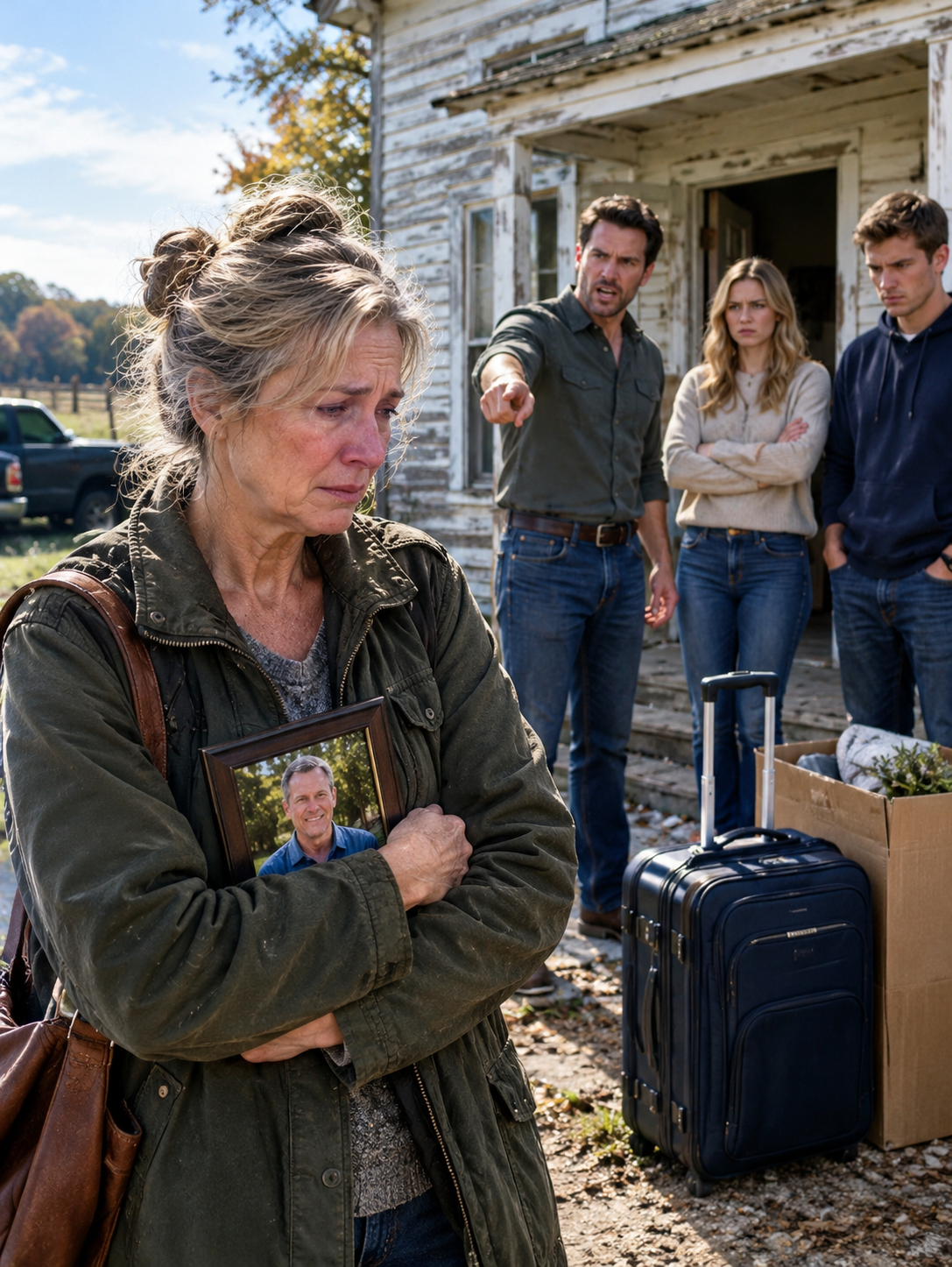
After They Cast Her Out With Nothing, She Inherited a Forgotten Farmhouse That Held the Truth They Buried
What would you do when the people who threw you away never dreamed the gift you’d been given would outshine everything they own?
The lawyer folded the paper and looked at me with eyes that said he’d seen this a hundred times before. “The will is clear,” he said. “The house, the accounts, every vehicle—all to the children. You’re left with your personal effects and best wishes.” Standing behind him, his daughter’s smile was sharp and bright. “You heard him, stepmother,” she said, cold as winter stone. “Pack your bags. You have until sunset.” I’d stood by Arthur’s bedside for ten years. I’d nursed him through sickness and joy and quiet days. And the moment he was gone, I was nothing to them.
I did not beg them to remember the nights I sat up with him. I did not list the meals I cooked or the wounds I dressed or the promises he made me. I did not scream or cry or fall apart in their hallway. I did not let them see how deeply their cruelty cut. I did not leave and let them believe they had won. I did not forget that love is not written only in names they choose to honor.
I walked out the door with one suitcase and held my head high. I did not look back. I did not give them the satisfaction of seeing me broken. I did not curse them or wish them harm. I simply walked away, knowing that truth has a way of finding its own time to rise.
I drove slowly, no destination, no plan, just the address Arthur had whispered to me on his last clear night. I did not know what waited there. I did not know why he left it to me. I only knew he had said, “It’s yours, Clara. It always was. Go home.”
My name is Clara Bennett. I was forty‑seven, homeless, and cast aside by the family I’d tended for a decade. The address led me three hours west, past paved roads into gravel, past neat farms into tangled woods, until the lane ended at a gate half‑swallowed by brambles. Beyond it stood the farmhouse—weathered white siding, a porch that sagged like a tired shoulder, windows dim with dust, and a roof that held strong despite the years. A rusted padlock yielded to the key Arthur had pressed into my palm. I pushed the gate open and stepped through.
The air smelled of cedar, damp earth, and forgotten things. I unlocked the front door and stepped inside. Sunlight slanted through the kitchen window in soft, golden beams. Dust motes danced in the light. The rooms were spare but solid. Furniture draped in sheets. A fireplace stacked with dried wood. A wooden table by the window, as if someone had just stepped out. On it sat a sealed envelope, addressed simply: To Clara.
I sat and opened it. Arthur’s handwriting, steady and familiar, filled the page.
My dearest Clara,
They will tell you I forgot you. They will say I left you nothing. They will be wrong. This house and these forty acres belonged to my parents—truly, to my mother, who loved this land more than any city street. I kept it hidden. I told my children it was worthless. I did it to protect it. To protect you. They do not know what is here. They do not know what it means. But you will. You will see what they cannot: that home is not where you are tolerated. It is where you belong.
Make it yours. Breathe life back into it. And when you are ready—look deeper. There is something I have kept from everyone. Something only you can find.
I folded the letter slowly. I traced his name. I set it beside me on the table. For the first time since he died, I breathed without pain.
I spent the first days clearing debris. Pulling weeds. Scrubbing floors. Opening windows to let fresh air chase out the stillness. I mended the porch step. I fixed the screen door. I planted seeds in the garden out back—turnips, kale, sunflowers—things that grow strong without much fuss. I slept on a mattress on the floor and ate soup from a single pot. I was tired, but I was at peace.
Word traveled slow in the valley. A week later, a woman knocked—gray hair tied back, eyes kind but curious. “I’m Mabel,” she said. “Knew Arthur’s mother. Folks said this place was empty.”
“Not anymore,” I said.
She stepped onto the porch and looked around. “Good. She’d be glad. She always said someone would come who understood.”
“Understood what?” I asked.
Mabel hesitated. “This land isn’t just dirt and timber. It holds water others can’t reach. It holds wood that heals. And it holds a story Arthur’s children never wanted told.”
She left me sitting with those words. That night, I went through the house more carefully. I opened drawers. I checked shelves. I ran my hand along every wall. In the back of a cupboard beneath the stairs, behind a stack of old linens, I found it: a small, leather‑bound journal. Arthur’s mother’s name—Eleanor—embossed in gold on the cover.
I read by lamplight. Page after page spoke of the land: where the springs ran deep, where rare herbs grew wild, where the soil stayed rich even in drought. But near the end, the tone changed. Her handwriting tightened.
Arthur’s father wanted to sell to the development company. Clear the woods. Drain the wetlands. Build luxury cabins. I refused. This valley feeds the creek that feeds the wells downstream. If they pave this ridge, the water shifts. The wells run dry. The families below will suffer. I hid the true surveys. I marked the protected zones where they would not look. And I made Arthur promise: never sell. Never tell. Guard it until someone comes who will understand.
I closed the journal. My chest felt tight. Arthur’s children—his son, Marcus, and daughter, Elena—had pressured him for years to sell every piece of land he owned. They’d called this place “a money pit.” “Useless.” “Worthless.” They’d wanted the cash. They’d never known what it really was.
The next morning, I walked the boundaries Eleanor had drawn. I found the springs—clear, cold, running steady. I found the wetlands thick with willow and native grasses. I found the stand of old‑growth hardwood that anchored the slope. And I understood: this was not just a farm. It was the heart of the valley’s water supply. If it fell to developers, the whole region would suffer.
I was not surprised when Marcus showed up three days later. He drove up in a shiny truck, stepped out, and looked around with a scowl. “What are you doing here?”
“Arthur left this to me,” I said.
He laughed—short, sharp, mean. “This dump? It’s been worthless for decades. Sign it over. Walk away quietly. Or we make things very difficult.”
“It’s not worthless,” I said. “And it’s mine.”
Elena arrived an hour later. “You’re nobody,” she said, standing on the porch like she owned it. “He was confused at the end. You manipulated him.”
“I cared for him,” I said. “I never asked for anything. He gave this freely.”
They left with threats. Lawyers. Audits. Claims. I did not flinch. I went to the county records office. I pulled the deeds. I cross‑referenced the surveys Eleanor had drawn with the official filings. And there it was: the true boundaries and environmental protections had been redacted from public records decades earlier. The developers had known. They’d pressured Arthur’s father. They’d pressured Arthur. And his children had been unwitting—until now.
I returned to the farmhouse with copies of every document. I laid them out on the kitchen table. Eleanor’s journal. The original surveys. The signed transfer to me. Everything was in order. Everything was clear.
Then I noticed something tucked between two pages of the journal—a folded map, faded and creased. It showed a section of the woods I hadn’t explored. A red X marked a spot near the highest spring. Beside it, in Arthur’s handwriting: I never told them. Go there when you are ready.
I went at dawn. The path wound through trees that had stood for generations. Ferns brushed my ankles. Birds sang in the canopy. I followed the stream upward, past pools that sparkled like glass, until I reached the clearing marked on the map. Beneath an ancient oak, half‑buried in moss and stone, was a small, iron‑bound chest.
I brushed away the dirt. The key was tied to the handle on a leather thong. I turned it. The lid opened with a soft, heavy creak.
Inside were documents I had never imagined—letters, receipts, handwritten accounts. They told a story that made my blood run cold.
Arthur’s father had not just been pressured to sell. He’d been bribed to falsify records. To declare the wetlands “dry.” To mark the springs as “seasonal.” The money had come from the same development group Marcus and Elena were now secretly negotiating with. And Arthur had known. He’d found the papers after his father died. He’d hidden them. And he’d kept the truth from his children to protect them—until he realized they were walking into the same trap.
He hadn’t left me just the land. He’d left me the evidence that would stop it all.
I sat on the ground beneath that great old tree and read every word. The names were powerful. The connections ran deep. The money was enormous. And the cost—the poisoned wells, the vanished wildlife, the families who would lose their homes—was incalculable.
I returned to the farmhouse to find Marcus and Elena waiting on the porch. They stood close together, faces tight with fury. “Our lawyer says the transfer is invalid,” Marcus said. “You tricked him. You took advantage.”
“Read this,” I said, handing them copies of the documents.
Elena scanned the first page. Her face paled. “What is this?”
“The truth,” I said. “Your grandfather took money to sell out the valley. Your father knew. And you were about to sign the same deal—without knowing what it really means.”
Marcus tossed the papers down. “Old lies. That was decades ago. Things are different now.”
“Are they?” I said. “The same company is involved. The same false surveys. The same promises that will vanish once the land is paved. If you sell, the wells run dry. The families downstream lose everything. And you—you’ll be blamed for every home abandoned, every well that fails.”
They stared at me. Doubt began to creep into their eyes. They hadn’t known. They’d only seen dollar signs.
“We need time,” Elena said quietly.
“Take it,” I said. “But do not sign anything. Not until you have read every page. Not until you have walked the land and seen what is truly at stake.”
They left without another word. For days, I saw them driving the roads. Talking to neighbors. Standing at the spring. They were learning what Arthur had wanted them to see all along.
Then came the knock at midnight. Not Marcus or Elena. A stranger in a dark coat. He stood in the doorway and did not step inside. “You have things that don’t belong to you,” he said, voice low and flat. “Give them back. Sign over the deed. And you can stay. Quietly. No trouble.”
“Or what?” I said.
“Or trouble finds you,” he said. “And not just you.”
He vanished into the dark. I locked the door. I checked the windows. I did not sleep. I knew this was bigger than a family dispute. The developers were watching. They were worried. And they would not stop at threats.
The next morning, Elena called. Her voice was shaking. “Marcus is gone. He took the original documents. He said he was meeting someone. That he could ‘fix this.’ He hasn’t come back. And the company just sent notice—they’re filing for immediate possession. They say the deed to you is fraudulent. They’re sending crews at dawn.”
I gripped the phone. “Where would he go?”
“To the old logging road,” she said. “That’s where they told him to meet.”
I grabbed the copies I’d kept hidden—the ones I’d stored in a safe deposit box in town. I called the county attorney. I called the sheriff. I told Elena to stay where she was. And I drove toward the road.
I found Marcus’s truck parked at the edge of the clearing. Empty. No sign of him. But taped to the steering wheel was a single note in handwriting I did not recognize: Walk away. The land has no secrets left.
I reached for my phone. No signal. Someone had jammed it. And from the trees behind me, I heard footsteps—slow, deliberate, and getting closer.
They didn’t just want the papers. They wanted to make sure no one ever told the story. And as I turned, I saw not one figure, but two—standing side by side, blocking the only way out. And one of them was the person Arthur had trusted most in the world.
✓ Lynn R. Adams
After They Cast Her Out With Nothing, She Inherited a Forgotten Farmhouse That Held the Truth They Buried What would you do when the people who threw you away never dreamed the gift you’d been given …