After my husband died, the bank…
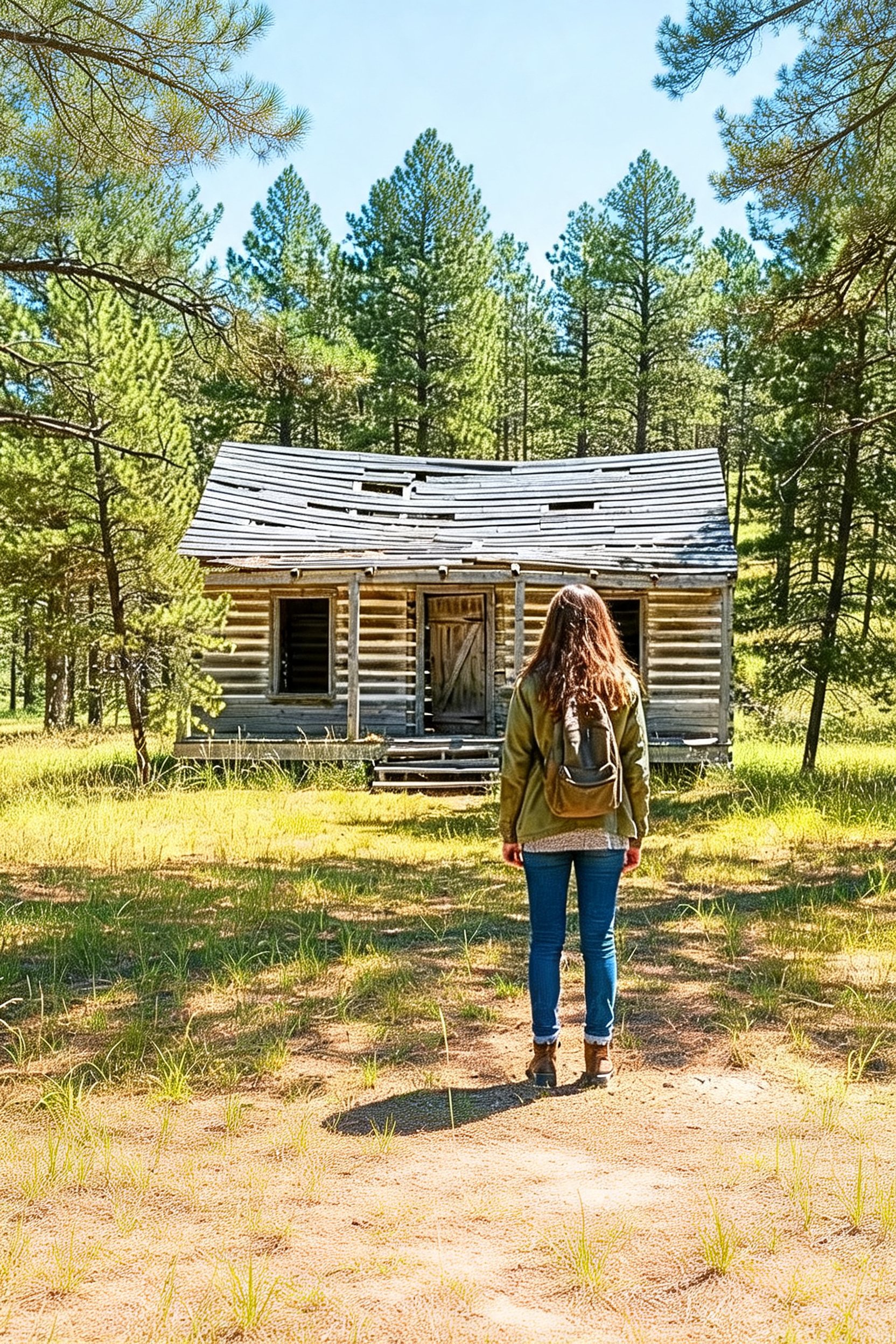
After my husband died, the bank took our Ohio home, and I drove my 11-year-old son to a forgotten Montana cabin. Then three knocks came from behind a workshop wall, and I found a hidden door….
I was 38 when my husband Samuel Bennett died. He repaired factory equipment and came home with grease on his hands and a joke for our son. We lived in a modest house in Columbus, Ohio. Money was tight, but I never imagined I couldn’t keep a roof over Caleb’s head.
Caleb was 11, old enough to understand his father was gone and too young to know what to do with that knowledge. Three days before the heart attack, Samuel had repaired his own father’s old wristwatch and placed it in Caleb’s palm. “Take care of this, buddy,” he told him. “Someday, you’ll understand how precious time really is.” Those words became the last gift Caleb could hold.
After the funeral, my boy kept setting a place for Samuel at dinner. Every evening I quietly carried the extra plate back to the cabinet, then waited until Caleb was asleep before I let myself cry. I worked double shifts, sold my wedding jewelry, and asked the bank for more time. The overdue notices continued coming. Eventually, we lost our house anyway.
On moving day, Caleb stood in his empty bedroom with that watch pressed against his chest. “Dad promised we’d always have a home,” he said. “Why couldn’t you keep his promise, Mom?” I knelt in front of him and tried to answer, but all I managed was “I’m sorry, sweetheart.” How could I explain a mortgage to a child who wanted his father back?
Three weeks later, we were living in a tiny rented apartment on the outskirts of Columbus. Caleb slept on a mattress near the window, beside a humming refrigerator. I was unpacking the last box of Samuel’s things when I found his faded flannel shirt. Underneath it sat a small wooden case I had never seen before.
Inside were several papers, an old photograph, and an envelope with my name on it. The handwriting wasn’t Samuel’s. The letter was from his grandfather, Oliver Bennett, who had spent much of his life building things in the mountains of western Montana. Oliver described a Bitterroot Mountains property: a cabin, workshop, storage building, and unfinished elevated passageway.
The passageway was meant to let someone reach tools and stored fuel when deep snow made walking outside dangerous. Oliver wrote that he hadn’t built the place to make anyone rich. He wanted his family to have somewhere to begin again if life became difficult. Near the end was a line I couldn’t stop reading: “If the world ever takes away the home you know, remember that another one may still be waiting for you.”
I was grateful for the possibility and angry at Samuel at the same time. We’d spent years worrying about money. Why had he never told me about this place? The next morning I mentioned the mountain road to Caleb, and he went quiet. Then he told me his father had driven him there once, shown him the road into the woods, and made him promise not to talk about it until Samuel was ready. Caleb started crying because he’d kept that promise from me. I held him and told him he hadn’t done anything wrong.
I called a law office in Montana, searched the property records, and learned that the land and cabin really existed. Oliver’s will showed that Samuel had inherited an interest in the property, although the paperwork still needed attention. No one could promise the buildings were livable. I spread a road map across our little kitchen table anyway. When Caleb asked what would happen if we had to leave another home, I took his hand. “Then we’ll face that together.”
A week later, we loaded our remaining belongings into an aging SUV and headed west. Four tiring days later, the paved highway gave way to a gravel road between tall pines. We had little money, no signal, and no backup plan. The road ended at a rusty iron gate. Beyond it stood a weathered cabin with a stone chimney and a porch heavy with fallen pine needles.
There was a workshop behind it and a smaller storage building. Between the structures rose the strangest thing I’d ever seen: wooden supports holding an elevated walkway, partly roofed and partly exposed to the sky. “Why would someone build a hallway outside?” Caleb asked. I explained what Oliver had written about the snow. When he asked why it had never been finished, I had no answer.
Inside, the cabin smelled of cedar, dust, and cold stone. White sheets covered old furniture. There was a cast-iron stove, neatly stacked firewood, labeled kitchen shelves, and handwritten instructions for the water system. Above the fireplace hung a clock stopped at , with three little marks scratched into its wooden frame. Caleb noticed them. I assumed someone had scratched them while repairing the clock.
We explored the workshop that afternoon. Oliver had left tools, spare parts, a worktable, and blueprints. His drawings showed how the raised passageway was supposed to keep people above deep snow and shield them from winter wind. The later pages were covered in unfinished calculations and increasingly shaky handwriting. He’d tried to build something practical for the people he loved, but hadn’t had the strength or time to complete it.
That first evening, Caleb pushed food around his plate. “I don’t like it here, Mom,” he admitted. “It’s lonely.” The wind scratched at the walls that night, and he said he heard three hollow knocks somewhere near the workshop. I blamed the sound on old boards expanding and contracting in the cold. The next day, I heard the same three knocks myself while looking for a lantern.
They came from behind a tall shelf against the workshop’s back wall. When I stepped closer, a thin thread of cold air touched my face. Before I could inspect a gap between the boards, Caleb called me outside. Dark clouds had gathered over the mountains, and heavy snowflakes were beginning to fall. We were farther from town than I’d ever been comfortable being, and I had brought my son there without knowing how to survive a Montana winter.
Soon eight inches of snow covered the ground. I spent each day carrying firewood, protecting the pipes, reading Oliver’s notes, and trying to understand the generator. Samuel would have known what to do. I stared at the unfinished passageway and dwindling supplies. In Oliver’s notebook I eventually found the name and telephone number of a man named Elliot Brooks, with a note saying to ask him for help.
I drove into town to make the call. Elliot was 67, a retired repairman who had known Oliver for nearly 20 years. He came to inspect the place, checked the generator, and studied the supports. He said the main structure was sound, but important connections and protective walls still needed work. His estimate was more than I could afford. He offered to help, but I refused. I was so tired of being the person who needed something.
Then Caleb slipped while carrying a box of screws, scattering them into the snow. I snapped at him. He shouted that I never listened, that I’d taken him away from his friends, and that he was tired of losing everything. I stood there kneeling among the screws, realizing that while I’d worried about keeping him physically safe, I’d scarcely let him tell me how frightened he was.
That night, I apologized beside the fire. Caleb said he wanted his dad back, and I told him I did too. For the first time, I admitted that I was scared and didn’t know whether we could stay. The next morning I accepted Elliot’s offer of help. We counted our supplies and agreed to leave for town if the cabin became unsafe. But a weather-radio warning soon announced a much stronger storm. We had only four or five days of fuel left.
The knocking started again the next morning. Caleb came with me to the workshop, carrying a flashlight. This time we followed the sound straight to that tall shelf. Behind it, one section of paneling had newer screws and boards that didn’t quite match. Caleb held the light as I removed the screws and pulled away the panel, revealing a narrow wooden door. My hand closed around its handle, and it turned. Part 2…..
When the hidden door swung open, the room beyond was no bigger than a walk-in closet. It smelled of cedar and old paper. A desk stood beneath a faded photograph, and I lifted Caleb’s flashlight toward it. My knees went weak. Samuel was in that picture, barely 20 years old, smiling beside an elderly man in front of the unfinished passageway. My husband had stood in this very place years before I ever heard of it.
“That’s Dad,” Caleb whispered. I could only nod. On the desk were notebooks, a metal box, a small key, and an envelope addressed to Samuel Bennett. I picked up the key and opened the box. Inside were carefully wrapped bundles of cash, property papers, and receipts for building materials. I counted the money twice, afraid I’d made a mistake. It wasn’t a fortune, and it couldn’t bring our old house back, but it could pay for the fuel, food, and repairs we’d been unable to afford.
I sat in the desk chair and covered my mouth. For months, envelopes had meant bills or warnings. Now a dusty box held the first bit of financial breathing room we’d had since Samuel died. Caleb touched my arm. “Mom, are we okay?” I pulled him close. “I think we have a chance, honey.” I didn’t promise him more than I knew.
The letter on the desk was from Oliver. He explained that the little room had been intended to protect emergency supplies and documents. The mysterious knocks came from a loose wooden cover over its ventilation opening, shifting whenever mountain winds blew through it. The sound that had frightened us was nothing supernatural. It was one more unfinished detail in the place Oliver had tried so hard to prepare.
His letter also explained something about Samuel. My husband had visited as a young man and wanted to finish the cabin someday, but he worried about moving a family far from schools, doctors, and the services they’d need. Oliver understood. He hadn’t meant his mountain home to become a trap for anyone. Then I read his final words aloud: “I couldn’t leave you a life without hardship. I could only leave you a place to begin again.”
I cried with Caleb’s arms around me, thinking about the hurt I’d carried because I believed Samuel had simply kept something valuable from us. The cabin was never a secret fortune waiting to solve our lives. It was an imperfect refuge, one my husband had known and struggled to decide what to do with. I still wished he could have told me himself. But beside Oliver’s notes I found pages marked with Samuel’s handwriting, and tracing those familiar letters made him feel close again.
There were drawings of the raised floor, instructions for bracing walls against wind, and calculations about snow on the roof. I called Elliot from town and told him what we’d found. He listened, then said Oliver had always wanted to leave something useful behind. I asked if he would help me finish the passageway. This time, I didn’t apologize for needing assistance.
Elliot came the next morning. We looked over the drawings, checked the old supports, made a materials list, and bought what was necessary. Over the following days, he showed me how to replace damaged connections and inspect each joint before moving on. I learned to measure carefully and stop when something didn’t seem safe. Caleb sorted screws, passed us small tools, and copied his great-grandfather’s instructions into his own notebook.
At one point Caleb held out Samuel’s wristwatch. “Dad said fixing things takes patience.” I told him that was true. He looked up at the nearly finished walls and asked if his father would be proud. I brushed snow from his jacket and said, “I think he’d be proud that we haven’t given up.” It was the first time in a long while that I’d seen him smile over something we’d made together.
By the end of the week, the walkway had a roof, raised floor, and protective side walls. It connected the cabin to the workshop without requiring us to cross the open yard in ordinary winter conditions. Elliot inspected the result, then warned us not to confuse protection with permission to take risks. We stocked food, blankets, firewood, batteries, and emergency supplies. He taught us to use a two-way radio and arranged regular check-ins.
The storm arrived with snow so thick the trees vanished. By nightfall, wind battered the walls and the temperature fell to 15 degrees below zero. I kept the stove burning. Caleb stayed near the weather radio, and we listened to the gusts rise and fall. On the second night the generator stopped, plunging the cabin into darkness. The stove still gave us heat, but the generator supported our backup equipment and battery charging. If we lost those, communicating could become harder.
I put on my winter coat and took a flashlight. Caleb said he was coming, and I told him his job was to stay inside with the radio. His face tightened. “What if something happens to you?” I knelt beside him, remembering how often I’d pretended not to be afraid. “I’m going to be careful,” I said. “And if that walkway doesn’t feel safe, I’ll come back. I promise.” He reluctantly nodded.
The wind shook the covered passage, and snow swirled through small openings, but the raised floor was still passable. In the workshop, I found a loose electrical connection and a damaged generator component. Elliot had helped me buy the spare part I needed. I worked slowly and got the machine running again. Then, outside, a cracking sound tore through the wind. A heavy pine branch crashed near the workshop end of the walkway, making the whole structure shudder.
Part 3 Back in the cabin, Caleb heard the impact. He later told me he grabbed his coat and almost rushed outside, but remembered our agreement and stopped. Instead, he reached for the radio. “Mom, can you hear me?” I heard his voice through the static while I stood inside the workshop, trying to tell whether the walkway had been hit badly. I pressed the button. “I’m here, sweetheart. I’m safe. Stay inside.”
I checked the passage from its sheltered end. The branch had damaged an outer railing, but missed the main supports. I didn’t assume that made everything perfect; I looked for movement and broken connections before carefully crossing back. When I opened the cabin door, Caleb wrapped both arms around my waist. I told him I had been scared too, and thanked him for using the radio instead of coming out into the storm.
The wind kept howling for another day. We rationed our supplies, kept the stove burning, and listened for Elliot at our agreed check-ins. Eventually the sound outside changed. The fierce gusts gave way to a silence so complete I could hear the clock ticking in the room. I opened the door to find snow piled several feet deep and broken branches across the yard. The cabin still stood. So did the passageway Oliver had imagined and Samuel had once hoped to complete.
Caleb stepped beside me, holding his father’s wristwatch. “We made it, Mom,” he said. I put my arm around him. “Yes, sweetheart. We did.” I knew then that we’d survived not because I’d somehow learned to do every job alone, but because Elliot had helped, Caleb had listened, and I’d finally allowed myself to ask for what we needed.
Spring took its time arriving in the Bitterroot Mountains. For weeks the snow clung to the roof and filled the woods. Then one morning I carried my coffee onto the porch and heard birds singing again. Caleb came outside wearing Samuel’s old flannel shirt. The sleeves hung past his hands. “You’re going to grow into that someday,” I told him. He asked whether his dad would mind him wearing it. “He’d love it,” I said.
We walked to the passageway and examined the storm damage. The railing needed repair and some boards would have to be replaced, but the structure had done its job. Caleb rested a hand on a support post and said Oliver really knew what he was doing. I told him his ancestor had left us more than a building. He’d left us a chance to start over, though it would still take work to turn that chance into a life.
When the roads reopened, I completed the legal paperwork confirming the family’s ownership of the property. With Elliot’s help, I repaired the damaged railing, checked the heating system, and started a little garden beside the cabin. I also found part-time remote work coordinating deliveries for a transportation company. The satellite internet wasn’t always reliable, and the wages were modest, but it meant I could work while living there with Caleb.
Nothing about that spring erased Samuel’s absence. I still reached across the bed some nights before remembering he wasn’t beside me. There were expenses we hadn’t expected, hard mornings, and long drives into town. But our problems were things we could work on now, rather than one awful loss following another. I didn’t need to tell Caleb that everything was fixed. He could see us making progress.
Caleb began attending a small school in the nearest town. At first he scarcely spoke to his classmates, worried they’d think he was strange for living so far in the woods. One day his teacher asked the children to share something their families had built. He took in a photograph of the passageway and explained its raised floor and wind-shielding walls. Afterward, several classmates gathered around to ask him questions.
When I picked him up, he climbed into the SUV with a grin. “Mom, they thought it was pretty cool.” I laughed, and for the first time in months, it sounded like our old laughter. He’d found a way to talk about where we lived without having to begin with what we’d lost.
Final As summer approached, Elliot visited more often. Sometimes he brought vegetables from his garden; sometimes he stayed for coffee and told Caleb stories about Oliver. He described the old man as stubborn but quick to help anyone in trouble. I teased Elliot that the description sounded familiar, and he chuckled. Before long, a few neighbors came to see the unusual covered walkway. I showed them Oliver’s plans and told them what Elliot had taught us, careful not to pretend I was an expert.
In early fall, Elliot mentioned an older neighbor who struggled to carry firewood from his shed when the weather turned slippery. Caleb spoke before I could answer. “Could we help him make a safer path?” I looked at my son and remembered him shouting that he was tired of losing everything. Now he was thinking about someone else’s winter.
With Elliot supervising, we helped clear the neighbor’s route, improve the lighting, and install a sturdy handrail along the slickest section. The man shook Caleb’s hand when the work was finished. “Your family must be proud of you, son.” Caleb glanced toward me. I was trying to keep my composure, but my face must have told him everything.
On the drive home, Caleb turned Samuel’s watch over in his palm. “Mom, I think I understand what Dad meant about time being precious,” he said. I waited. “I think we’re supposed to do something good with it.” I looked at the road ahead, then at the boy Samuel had loved so much. “I think you’re right,” I told him.
A few weeks later, the first snow of another winter floated down between the pines. We’d repaired the passageway, laid in supplies, and made plans for check-ins. We knew better than to take the mountains lightly, but we were no longer trying to face them alone. Caleb stood with me on the porch and slipped his hand into mine. “Do you think Dad would be proud of us?” he asked.
I remembered the empty bedroom in Ohio and how he’d asked why I couldn’t keep his father’s promise. I crouched and held him close. “I think he’d be proud of the person you’re becoming, sweetheart.” We stood together for a while, watching the warm light shine through the cabin windows. Then Caleb said, “I’m glad we came here, Mom.” I told him I was too.
For a long time, I thought losing our house meant I’d failed Samuel and Caleb. In Montana, I learned that a home isn’t guaranteed by an address, a deed, or the amount of money in a box. Oliver left us shelter and a chance; Samuel left his work, his watch, and the lessons he’d shared with our son. Elliot showed us what accepting help could look like. And Caleb reminded me that even after losing someone, we still have time to care for the people in front of us.
I cannot bring Samuel back. I can’t undo the fear Caleb felt when we left Ohio. But I can listen when he’s scared, tell him stories about his dad, and help him offer another person a hand. That is what this cabin became for us: not an escape from grief, but a place where love could keep doing its work. We had finally found our way home again.
THE END. I’ve shared the complete story, and I truly hope it touched your heart. If this story moved you, please , like, and share the post. Thank you for reading! ❤️
✓ Lynn R. Adams
After my husband died, the bank took our Ohio home, and I drove my 11-year-old son to a forgotten Montana cabin. Then three knocks came from behind a workshop wall, and I found a hidden door…. I was …