After major back surgery, I could barely carry a cup of coffee,
Part 2: Twelve grocery bags vanish while Karen claims neighborhood authority
My phone buzzed at 10:32 Wednesday morning with the delivery notification. The app showed a photograph of all twelve bags arranged in neat rows on my welcome mat, with my house number visible beside the front door. I waited until I had taken my medication, then started the slow trip downstairs, one hand on the railing and the other pressed against my lower back. It took me fifteen minutes to reach the door. When I opened it, the porch was empty.
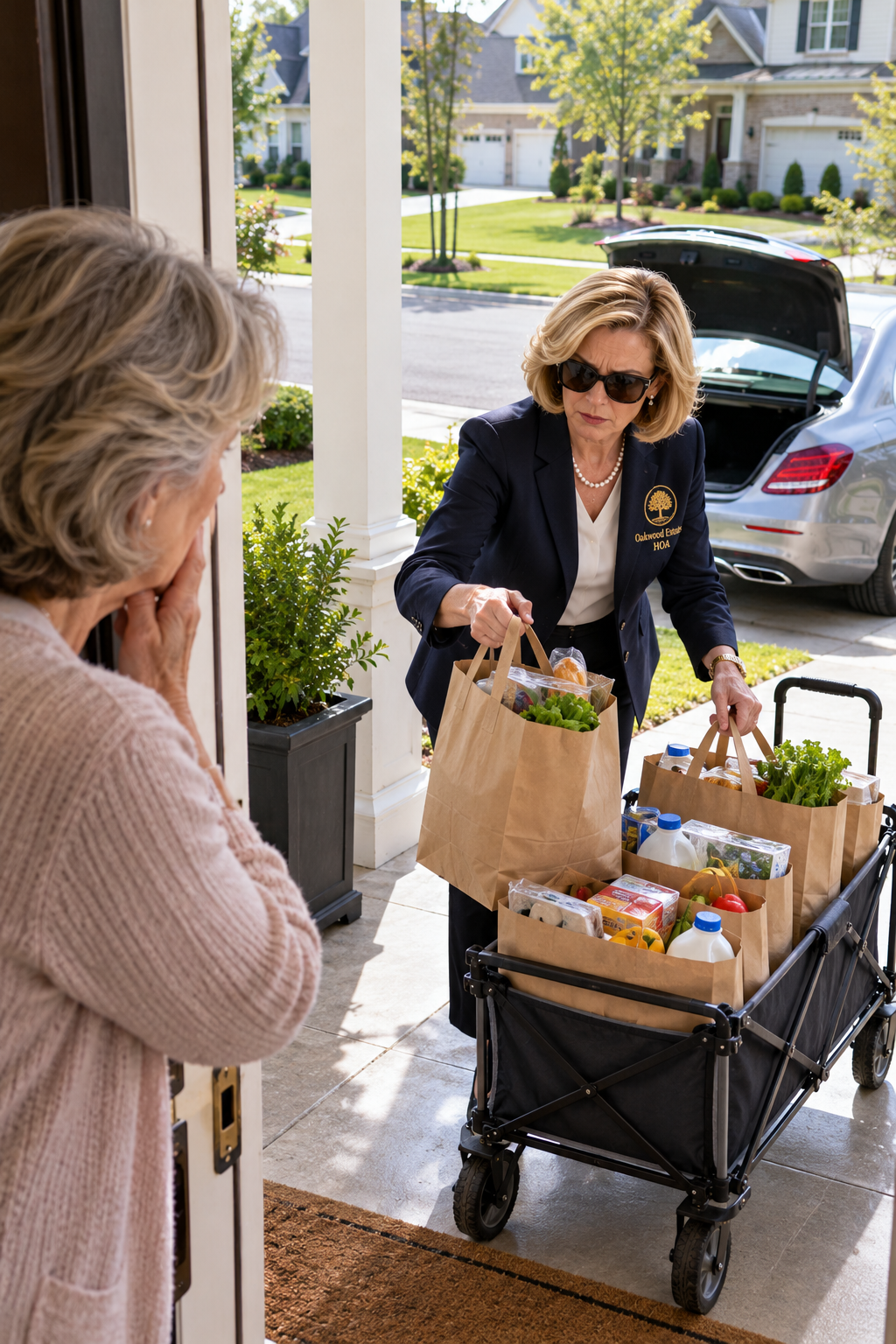
At first, I thought the driver had delivered to the wrong house. I checked the street, then the delivery photo again, and finally looked at the doorbell camera mounted above my porch. My hands began to shake as I opened the recording. At 10:45, Karen’s silver Mercedes rolled into my driveway and stopped beside the curb. She stepped out wearing a navy blazer embroidered with the Oakwood Estates crest, paused in front of my groceries, and studied them like an inspector assessing a violation.
Karen opened the trunk and pulled out a folding utility cart. She unfolded it, loaded every bag from my porch, and wheeled the cart down the sidewalk toward her house, three doors away. She moved with the calm efficiency of someone doing a routine errand. I watched the footage once, then again, then a third time, hoping I had misunderstood what I was seeing. The third time, I noticed her glance toward my doorbell camera before pushing the cart away.
I called her immediately. “Karen, my camera recorded you taking my entire grocery order. I need you to bring it back right now.” There was a pause long enough for me to hear the faint clatter of something on her end of the line. Then she said, “As I’ve explained, your ongoing porch violations cannot be tolerated.” She claimed the covenants allowed the association to remove items left in public view, and that twelve grocery bags were an “egregious eyesore” affecting the entire neighborhood’s curb appeal. I told her those were my groceries—milk, eggs, meat, and food I needed for the week.
Karen exhaled as if I were a child throwing a tantrum. “I’m upholding the standards every resident agreed to follow,” she said. “If you can’t manage deliveries without degrading our community, perhaps Oakwood Estates isn’t the right fit for you.” Then she hung up. I sat frozen for several seconds, my pulse pounding in my ears, before calling the police nonemergency number. The dispatcher listened as I explained what had happened, and I emailed the doorbell video while we were still on the phone.
While I waited for an officer, I opened the neighborhood Facebook group. Karen had already posted a “friendly reminder” about a supposed bylaw 4.13, claiming that excessive unattended deliveries could be removed to preserve the community’s appearance. Comments appeared almost immediately. A few neighbors asked what the bylaw actually said. Others offered support without asking a single question. Karen did not answer the requests for the wording, because there was no bylaw 4.13. The actual covenants required homeowners to keep their exteriors neat and orderly, but said nothing about groceries, delivery bags, or how long a resident could leave them on a porch.
Part 3: The footage leads officers from my empty porch to Karen’s garage
Two hours later, Officers Reynolds and Chen knocked on my door. I explained the surgery, the lifting restriction, the delivery, the missing groceries, and Karen’s phone call. I showed them the delivery photograph and then played the doorbell video on my phone. They watched without speaking, pausing the recording as Karen opened the trunk and loaded the bags. Officer Chen asked whether I knew Karen had taken the groceries into her home. I told her Karen had not denied taking them; she had claimed she was legally allowed to do it.
“Do you want to make a formal complaint?” Officer Reynolds asked. “Absolutely,” I said. My voice came out stronger than I felt. The officers took down my statement and asked me to forward the original video file so they could preserve it. Then they thanked me, stepped outside, and walked toward Karen’s house. From the upstairs bedroom window, I had a clear view of her front door and the driveway.
Karen opened the door with her familiar campaign smile, one hand already extended as if she expected the officers to congratulate her. The smile faded when Reynolds began asking questions. Her arms started moving in broad circles as she pointed toward my house, shook her head, and gestured toward the street. Even from inside my home, I could see her posture harden as she repeated her favorite phrases: “board authority,” “community standards,” and “protecting property values.” The officers stayed calm, taking turns speaking while Karen grew louder.
After several minutes, Reynolds pointed toward her garage. Karen looked at him, then at the officers, then toward the garage door. At last she marched over and raised it herself. My twelve grocery bags were inside, stacked in the folding cart exactly as they had been on my porch. A few bags looked lighter than before, and one had been opened. Officer Chen began photographing the scene while Reynolds asked Karen not to touch anything.
Karen reached for the garage-door button. Chen stopped the door with one hand and told her to step away. Instead, Karen grabbed two of the bags and tried to pull them farther into the garage. “They were abandoned on common-view property!” she shouted. “The association has full authority to remove them.” Reynolds caught her arm gently but firmly. “Ma’am, step back. You are under arrest for theft.”
Karen’s face changed in an instant. “Do you know who I am?” she screamed. “I’m the president of the homeowners association. You can’t arrest me for enforcing the covenants.” Neighbors began opening their front doors. One man stepped onto his lawn; another stood on his porch with his phone raised. Karen kept protesting as Reynolds handcuffed her and escorted her toward the patrol car. Meanwhile, Chen gathered the bags that remained and carried them to my front door.
Part 4: The arrest cracks open Karen’s carefully guarded HOA kingdom
Officer Chen helped me bring the groceries inside. Several items had been opened, and the frozen food had begun to thaw, but most of it was still usable. She apologized for the melted ice cream and the vegetables Karen had apparently handled. I thanked her, feeling the strange embarrassment of needing an officer to help me carry home my own food. Reynolds said they would need a formal statement from me the next day. Before he left, he added, “You might want to keep an eye on the next HOA meeting. I suspect the leadership roster may be changing.”
That afternoon, people began texting me screenshots from the neighborhood Facebook page. Karen’s post was still there, but she had disabled comments. The supposed bylaw number remained in the text, as though repeating a false rule often enough could make it real. Several residents had saved the post before she could delete it. Others sent me messages admitting that they had received similar notices over minor issues: a package left during a storm, a delivery that arrived while someone was at work, a cooler on a porch during a family gathering. No one had challenged her because they assumed the board had approved what she did.
The next morning, I gave my formal statement at the station. I brought the delivery confirmation, the violation notice, the email receipt for the video, and the call log showing when I had spoken with Karen. An officer asked for the names of anyone who had seen her take the groceries or heard the phone conversation. I explained that the camera had captured her alone, but the neighbors had watched the arrest. The officer confirmed that the police had documented the bags in Karen’s garage and taken photographs of the opened packaging. I left with a copy of my statement and a case number.
By the time I got home, our neighborhood group had become a storm of posts and replies. Residents were arguing about whether Karen had acted on behalf of the association or on her own. Some defended her, saying a president had to keep order. Others asked what exactly she had been authorized to do. One homeowner posted a photograph of the covenants, showing there was no language permitting the seizure of personal property. Another shared a notice Karen had sent over an “excessive number of packages” delivered during the holidays. A third resident asked why a president could invent a rule and use it to take food from a neighbor recovering from surgery.
Karen’s arrest had made people reconsider years of small, uncomfortable encounters. She had fined a family for leaving a child’s scooter beside their garage and threatened a couple who used an unapproved paint color on their shutters. She had treated every challenge as disrespect, and most residents had quietly backed away. Now the question was no longer whether she was strict. It was whether the board had permitted her to act as though she owned the neighborhood.
That evening, the interim vice president, a quiet man named Peter Hall, sent a notice calling an emergency meeting. The agenda included the incident at my home, the handling of deliveries, and Karen’s authority to issue citations. It also invited residents to submit written comments. I planned to attend, though sitting for long periods still hurt. Before I closed my laptop, I watched the video one more time. Karen had taken the bags in broad daylight, and she had looked directly at the camera. She had not acted like someone making a mistake. She had acted like someone who believed no one could stop her.
Part 5: Residents demand answers as the emergency meeting begins
The emergency HOA meeting was scheduled for Friday evening at the community center. I arrived early, carrying a cushion for my back and a folder with copies of the police report number, the violation notice, and the actual covenants. By the time the meeting began, every chair was taken. Residents stood along the walls, gathered near the doorway, and sat on the floor in the front row. Karen was not there; she had been released pending the court process, but the board had asked her to stay away from association business until the review was complete.
Peter Hall opened the meeting with an apology. He said the association had failed to respond appropriately to my complaint and that the board would cooperate with the police. Then he asked me to describe what had happened. I kept the account simple: my surgery, the delivery, the empty porch, the video, Karen’s explanation, and the bags in her garage. I did not call her names or ask the room to hate her. I showed the video and let the recording speak for itself.
When Karen appeared on the screen, the room grew quiet. Several people gasped when she loaded the bags into her cart. One woman covered her mouth when the video showed Karen glance toward the camera. The recording ended with her rolling away, leaving my porch empty. Afterward, a neighbor stood and asked whether the association had ever approved the removal of personal property. Peter said no. Another resident asked where bylaw 4.13 could be found. The board’s attorney, who had joined by video call, confirmed that no such bylaw existed.
The attorney explained that the association could issue notices under its governing documents, but could not claim authority it did not have or seize a resident’s belongings. He advised the board not to discuss Karen’s criminal case beyond the facts already documented. Instead, the board should preserve records and establish a clear process for violations and appeals. He also suggested that the association review every fine Karen had issued in the last two years. That recommendation drew a louder reaction than the video. Several residents began asking for copies of their own files.
Then the meeting turned personal. A woman named Denise stood and said Karen had left a notice on her door after her husband was hospitalized, claiming their porch furniture violated an obscure design standard. She had paid the fine because she feared a lien. Another neighbor said Karen had threatened to report him for “commercial activity” after he used his driveway to repair a flat tire. An older couple described receiving repeated letters about a package-delivery box they had used for years. No single story was as shocking as the groceries, but together they painted a picture of an association where one person’s judgment had replaced a fair process.
The board voted to suspend Karen’s authority to issue notices, access the association’s enforcement account, or represent Oakwood Estates while the investigation continued. They also voted to review all disputed fines and invite residents to submit documentation. The vote was unanimous. Peter asked everyone to keep the discussion civil and warned that no one should threaten Karen or contact her family. I appreciated that. Accountability mattered, but turning the neighborhood into a mob would not make anything right. As the meeting ended, residents came over to tell me they were sorry, and I realized that some had been waiting years for someone else to speak first.
Part 6: Court testimony reveals the truth behind Karen’s invented rule
Two weeks later, Karen appeared in court on charges of theft and trespassing. The courtroom was smaller than I expected, with hard wooden benches and a flag standing behind the judge’s bench. I sat near the back, careful not to twist my healing back as I lowered myself into the seat. Karen arrived with her attorney, wearing a gray suit instead of the navy HOA blazer. She looked composed, but her hands kept moving over the clasp of her purse.
Her attorney argued that Karen had believed she was acting within the scope of her duties as HOA president. He described the grocery bags as a temporary obstruction and said she had intended to protect community standards, not steal anything. The prosecutor asked whether Karen had ever received permission from the board to remove residents’ property. She said no, but claimed the covenants gave her authority to enforce standards. The prosecutor then asked her to identify the clause that permitted her to take groceries. Karen looked down at the documents in front of her and did not answer.
The prosecutor presented the actual covenants, the delivery photograph, and the doorbell footage. The video showed Karen’s car entering my driveway, her loading the bags, and her rolling them to her own home. Then the prosecutor showed the officers’ photographs of the groceries in her garage. Karen testified that she believed the bags had been left in a common area and that the association could remove them. When asked how a private porch could be considered common property, she said the bags were visible from the street. The judge looked up sharply and asked whether visibility made an item abandoned.
Karen’s attorney objected to the question, but the judge allowed the prosecutor to continue. Karen said the twelve bags had created an “aesthetic emergency” and that she had acted to preserve property values. That answer moved through the courtroom like a gust of cold air. The judge asked whether she had considered contacting me before removing the groceries. Karen said she had already spoken with me about my porch. The prosecutor reminded her that I had told her I was recovering from surgery and that she had received no permission to take the food. Karen insisted the board’s rules had to apply equally to everyone.
The judge reviewed the police report and the statements from the officers. The court found the evidence supported the charges, and Karen eventually accepted responsibility under a plea agreement rather than risk a trial. She was ordered to complete eighty hours of community service, pay five hundred dollars in restitution for the food and related costs, and serve six months of probation. The judge made clear that her position in the HOA gave her no special right to take another person’s property. Karen did not look at me when the sentence was read.
Outside the courtroom, reporters were not waiting, and nobody chased her down the steps. There was no dramatic speech, no triumphant crowd, just a few residents who had come to observe the case. Karen left with her attorney, her head lowered. I felt no urge to celebrate. I had wanted my groceries returned and the intimidation to stop; seeing a person face consequences did not undo the humiliation or the weeks of anxiety. But the ruling established something important for Oakwood Estates: a title in a neighborhood association did not put anyone above the law.
Part 7: A unanimous vote removes Karen and changes the rules
The association held another emergency meeting the week after court. This time, the community center was full before Peter even called the meeting to order. The board’s attorney presented the results of the initial records review. Several fines had been issued without proper documentation, and some homeowners had paid charges that were not supported by the covenants. The attorney recommended refunds where the board could verify the improper penalties. He also advised residents to challenge any notice they believed had been issued without authority.
The board then considered Karen’s future as a member. Technically, removing her from the presidency had not automatically removed her from the board, and the bylaws required a separate vote. Peter read the relevant section aloud, explaining the procedure before asking for discussion. Residents spoke one at a time. A few acknowledged that Karen had once volunteered to help with neighborhood projects, but said her service did not excuse what she had done. Others described the stress of years of notices, threats, and public scoldings.
When the vote came, every board member supported removing Karen from the board. Peter read the result clearly: unanimous. Karen had not attended, but a friend who was present later told me her face turned purple when she heard the outcome. She grabbed her purse and stormed toward the exit, calling the decision a conspiracy. The room erupted in applause, not because people wanted to humiliate her, but because they felt the spell of her authority had finally broken. As she pushed through the community-center door, the framed HOA mission statement slipped from its hook and crashed to the floor behind her.
The applause stopped. Peter picked up the frame and set it on the table. The moment felt almost too perfect, like something from a movie, but the glass had actually broken, and a volunteer swept it carefully into a dustpan. Then the meeting continued. The board established a written appeal process, required two board members to review any fine above a set amount, and prohibited the removal of personal property except where required for an immediate safety emergency and authorized by law. They also created a way to request temporary accommodations when a resident was ill, recovering from surgery, or caring for someone with a disability.
A new committee reviewed the old notices, and the association refunded several fines. Some residents received apologies; others were offered a chance to appeal. Not every dispute had a clean answer, and the board did not promise that every decision would make everyone happy. What changed was that residents had a transparent process and the chance to challenge decisions without going through Karen. The board published meeting minutes, posted the actual covenants online, and stopped using vague phrases like “community standards” as if they explained everything.
I received my five hundred dollars in restitution and an official letter acknowledging that the association had no authority to seize my groceries. The board also refunded the fifty-dollar porch fine. The money helped, but the more important part was the written admission that I had done nothing wrong by receiving a delivery while recovering from surgery. I kept the letter in a folder with the police report and the court paperwork. Not because I wanted to relive the experience, but because records mattered when someone with power tried to rewrite what had happened.
Part 8: The groceries are replaced, but Oakwood Estates never forgets
My back healed slowly. The first weeks were frustrating, and even after I could carry more than a coffee cup, I had to rebuild my strength one careful step at a time. A neighbor named Frank offered to bring in my deliveries until I could manage on my own. I accepted, though I made sure he knew I would return the favor when he needed help. Other residents created a quiet rotation for older neighbors and anyone recovering from an illness or injury. It was never an official HOA program. It was simply people deciding they did not want anyone else to struggle alone on a porch.
The next Wednesday delivery came on schedule. When the driver set down the bags, he glanced at my camera and gave a small wave. I took my time bringing everything inside, but I did not feel watched or judged. The front porch was plain and tidy, just as it had been before the notice appeared. Yet the place felt different. I had learned that a porch could become the center of a fight about dignity, power, and what a community owed its residents.
Karen completed her community service at a local food pantry. I heard that from someone who volunteered there, not from Karen herself. She stayed on probation and moved away from Oakwood Estates the following spring. Before she left, she mailed me a short letter apologizing for taking the groceries and for dismissing my surgery when I told her about it. She did not ask me to forgive her. I read the letter twice, folded it, and placed it in the same folder as the court records.
I did not hate Karen, but I did not need to excuse her, either. She had chosen to take my food, invent a rule to justify it, and use her position to frighten people who questioned her. The court handled the legal consequences, and the board handled the association’s failures. The rest belonged to her. Forgiveness, if it ever came, would be mine to offer in my own time, not something anyone could demand as the price of moving on.
Oakwood Estates changed in ways that outlasted the headlines in the neighborhood Facebook group. Residents began showing up to meetings. They read the bylaws before voting. They asked who had authorized a decision and where the rule could be found. The new board still sent notices when a real violation occurred, but it stopped treating every disagreement as a challenge to its authority. The association learned that fairness did not weaken a community; it made the rules easier to trust.
Months later, I found an old grocery receipt tucked inside the folder with Karen’s letter. It reminded me of that Wednesday: the empty porch, the video, the officers walking down the sidewalk, and the silver Mercedes parked in my driveway. At the time, I had been afraid that speaking up would make my life harder. Instead, the recording gave me a way to prove what had happened, and the neighbors’ testimony showed me I was not the only one who had been keeping quiet.
By the following year, I could carry my groceries in one trip if I packed the bags carefully. I still took my time. When I stood on the porch afterward, I could see the tidy lawns stretching down the street, the same trimmed edges and approved mailboxes Karen had once claimed to protect. But the neighborhood no longer belonged to whoever had the loudest voice or the most official-looking blazer. It belonged to the people who lived there. My groceries had been returned, the false rule had been exposed, and Oakwood Estates had learned what Karen never did: community standards mean nothing if they forget the people they are supposed to serve.
✓ Lynn R. Adams
Part 2: Twelve grocery bags vanish while Karen claims neighborhood authority My phone buzzed at 10:32 Wednesday morning with the delivery notification. The app showed a photograph of all twelve bags …