After Losing Everything, She Bought an Abandoned School — Then Found 4 Children Erased From Records
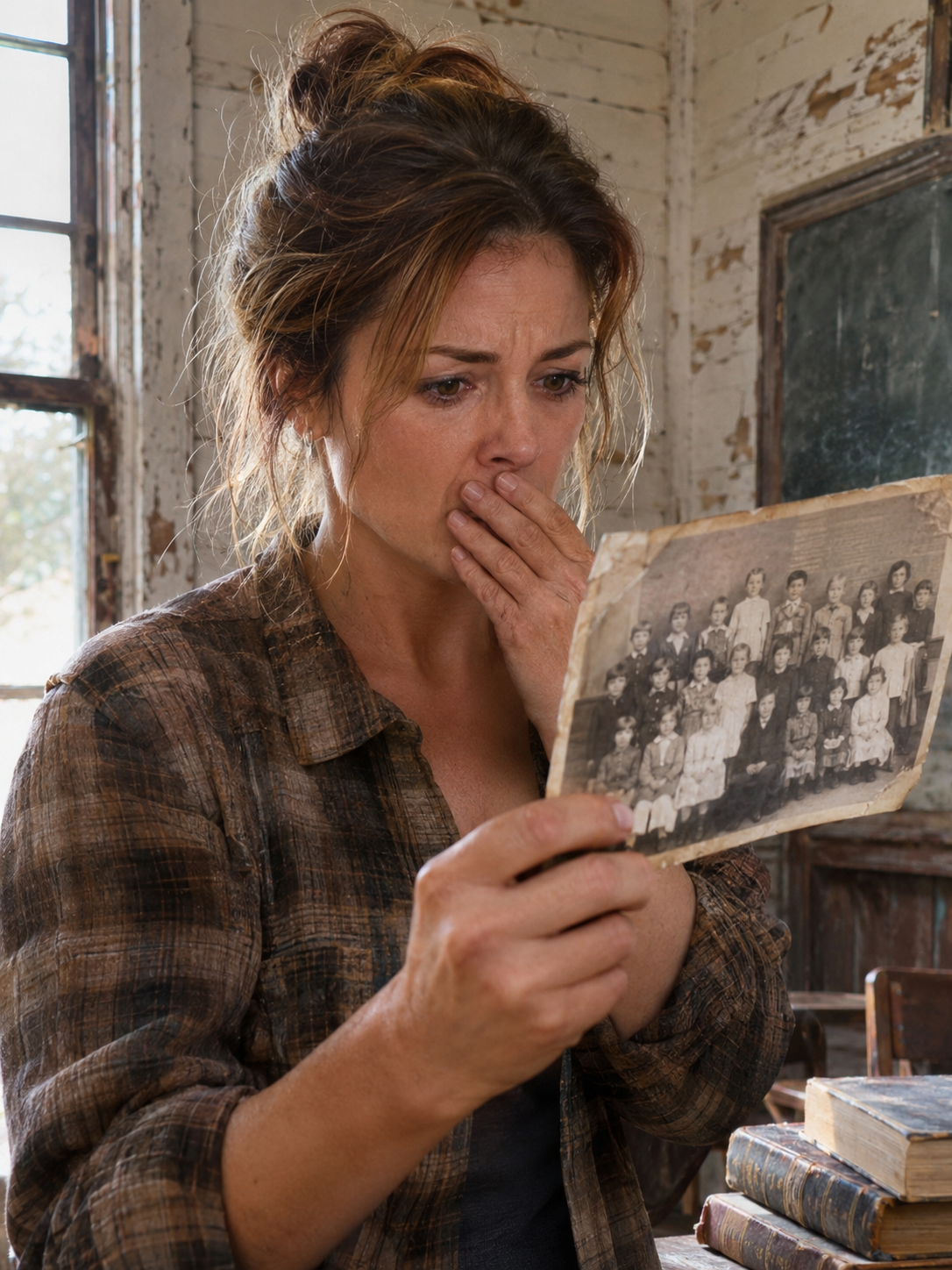
After my mother died, my brother gave me ten days to leave the house where I’d cared for her for seven years. I slept in my old Ford Escape until I spent my last $600 on an abandoned Oklahoma schoolhouse that drew laughter at the auction. The next afternoon, I found a photograph of 23 schoolchildren hanging above a list of only 19 names…
“It’s already listed,” my brother David said, sliding a folder across our mother’s kitchen table. Three weeks earlier, I’d held her hand while she took her last breath. Now he was telling me the house had to be sold, and I had ten days to get out.
I looked past him at Mom’s yellow ceramic mug beside the sink. “Ten days?” I asked, hoping I’d misunderstood. David nodded, and I picked up the mug because I couldn’t think of another thing to do with my hands.
My name is Rachel Ellison. I was 34 that fall, and for seven years I’d lived in that small brick house in Broken Arrow, Oklahoma, looking after my mother, Karen. Before she got sick, I’d managed operations for a regional nonprofit in Tulsa, rented a little duplex, and met two college friends for coffee on Sundays. It wasn’t a fancy life, but it belonged to me.
Then Mom began forgetting appointments and people’s names. Soon there were falls, prescription bottles, and frightened calls in the middle of the night. Sometimes she asked where my father, Michael, had gone, even though he’d been dead for years. I gave up my apartment and my job and moved home because someone needed to be there.
David lived three states away with his young family. He called now and then and always said, “If you need anything, just say the word.” I know he had a life to manage, too, but there were nights when I would’ve given anything for someone else to answer Mom’s call from the bedroom. Sometimes I left a plate of dinner untouched on the counter because the moment I sat down, she needed help again. I loved her. I was tired, too.
By the seventh year, I could recognize her eleven medicine bottles by touch. I knew how much honey she wanted in her tea and which floorboard squeaked outside her room. Once my former boss emailed about a director’s position in Tulsa. I stared at the offer until Mom cried out that a stranger was in the house, and I closed the laptop without replying.
There were good hours, though. We sat on the porch watching fireflies, and she’d tell me stories about Dad that I’d already heard a hundred times. I listened anyway. Repeating them seemed to help her hold on to something, and before long I understood that it helped me, too.
Three nights before she died, Mom whispered, “I think people disappear twice. Once when they die, and once when nobody remembers their name anymore.” I squeezed her hand and promised I’d remember hers. She managed a small smile and said she knew I would.
After the funeral, people brought casseroles and cards, then went back to their routines. I kept washing Mom’s mug and putting it by the sink. The house sounded different without her: no television drifting from the next room, no voice asking whether I’d eaten lunch. I kept catching myself listening for her. I hadn’t figured out what to do next when David came with that folder. I wasn’t told there was any way to stay, and I was too worn out to argue about the sale.
I packed Mom’s quilt, photographs, and the mug into a cardboard box. Ten days later, on a gray October morning, I left the key under the flowerpot as David and I had agreed. I stood for one last moment looking at the yard where Dad used to grill and the kitchen window where Mom always waved goodbye.
Everything I still owned fit into my aging Ford Escape. For several nights I slept in the reclined driver’s seat, with my coat pulled over me against the cold. When my friends in Tulsa called, I told them I was fine. I kept looking at rental listings from grocery store parking lots, but every place cost more than I could manage.
One morning, while I was waiting nearly two hours to see a housing counselor at a county office, a faded flyer by the door caught my eye. It advertised a Saturday property-tax auction. Near the bottom was Lot 22: Cedar Hollow School, built in 1919, vacant, structural repairs required, opening bid $600.
I’d once considered teaching in college, but that didn’t mean I had any business buying a school. That night I searched the address from a gas station parking lot. The pictures showed a low red-brick building at the end of an overgrown gravel road, half-boarded windows, weeds across the steps, and a rusted flagpole leaning in the yard.
The roof looked mostly intact. I knew photographs could hide serious damage, and I had no money to fix what I couldn’t see. I kept doing the math in my head: $600 was every dollar I had left, but I wasn’t finding a room I could afford. Two days later I sat in the back row of the auction room telling myself I was only there to watch.
When the auctioneer called Cedar Hollow, nobody raised a hand. A man up front muttered, “Bring a bulldozer,” and several people laughed. I thought about another cold night in the Escape, and about Mom’s mug rattling around in a box. Before I could talk myself out of it, I lifted my bidding card.
“Six hundred,” the auctioneer said. He asked for seven hundred. Nobody moved. I almost wished someone would outbid me and take the choice away, but the gavel fell, and just like that, I owned a schoolhouse in the Cookson Hills of eastern Oklahoma.
I drove there the next afternoon. Bare trees crowded the narrow road, and the brick had faded almost brown. Above the entrance, I could still make out the carved words Cedar Hollow School, 1919. When I opened the front door, damp plaster and old wood filled my nose, and my footsteps sounded much too loud.
Inside were uneven rows of little wooden desks, a chalkboard with the ghosts of lessons still on it, and initials cut into a desktop. I brushed dust off one desk with my sleeve and imagined the hands that had rested there while a teacher called attendance. For the first time in weeks, I found myself wondering about something besides where I’d sleep. Then I noticed a crooked photograph under cracked glass on the hallway wall.
It was a class portrait from 1968, with children lined up in three rows outside the building. I counted them once, then again: 23. Below the picture hung a typed list of students. I ran my finger down it and counted only 19 names.
I went back to the picture. Four children were there in plain sight, their faces as real as the others, but the list didn’t acknowledge them. I photographed the portrait with my phone and stood in that empty hallway wondering what had happened to those four names. Part 2…..
IF FACEBOOK BROUGHT YOU HERE, HERE’S THE CONTINUATION YOU’VE BEEN WAITING FOR. ENJOY! 👇 I told myself it could be an ordinary mistake. Old school records get lost, and families move without anyone updating a list. Still, I kept opening that picture on my phone and counting the children again, as though one of them might disappear when I looked away.
First I had to make the building safe enough to sleep in. I chose the old library room because its windows were the least damaged, and I bought an air mattress, cleaning supplies, and a secondhand space heater. I checked what I could before using the heater and kept it away from anything flammable. The first night, Mom’s yellow mug stood on a shelf beside my mattress.
The work was slow and dirty. I carried broken chairs into the yard, swept out years of leaves, and found a child’s mitten behind a radiator. On the fourth afternoon, rain was tapping the windows when I noticed the largest library bookshelf stood flush against the plaster, unlike the others.
I tried to push it aside. It wouldn’t budge. When I crouched with my flashlight, I found heavy old screws fastening the frame directly to the wall. Forty minutes later, after fighting each rusted screw, I managed to drag the shelf across the floor. Behind it was a narrow wooden door with a recessed latch.
I opened it and shined the light down a steep staircase. At the bottom was a small basement room with metal shelves and archive boxes marked by year. Some were ruined by damp, but several were still intact. My beam passed over 1964, 1965, 1966, 1967, and then 1968.
Inside the 1968 box were attendance sheets, report cards, permission slips, and photographs. In the March register, a section of one page had been cleanly cut out. On another, four lines were covered in thick black ink, pressed so hard it had nearly torn the paper. A 1967 book held an earlier class photograph with four handwritten names scratched almost beyond recognition.
I put my phone beside the register and stared between the picture upstairs and those damaged pages. The count wasn’t simply off. Somebody had taken trouble to make certain names difficult to recover. I didn’t know who had done it or why, and the difference mattered.
Near the bottom of another box, I found a small unlocked metal case. Among ordinary supply requests and furnace notes was an envelope marked “Private, do not file.” The letter inside appeared to be from a teacher who described families being pressured to leave and students vanishing from class without the usual transfer papers.
It didn’t say who was responsible or exactly what had happened. But the last lines were unmistakable: “If anyone ever finds these records, please don’t let them erase these children again. They had names. They were here. They mattered.” Beneath that were four initials.
I sat at the table with the paper trembling slightly in my hands. Mom’s words about disappearing twice came back so clearly I almost turned to see whether she was in the room. I copied the initials into a notebook, then kept searching instead of trying to make the letter mean more than it actually said.
An hour later, I found another photograph. A dark-haired girl of about nine stood outside the school, a faded ribbon holding back her hair and two books hugged to her chest. On the back, someone had written three words: “Please remember me.”
I couldn’t tell who had written them. I only knew that a child had once stood in front of that camera, and somebody had saved the picture. I set it beside the letter and said aloud, “I don’t know who you are, but I’ll try.”
A single clang rang out above me, like an old school bell. I stopped listening to the rain long enough to hear whether it would ring again. It didn’t. There were plenty of ways wind could have moved rusted hardware, so I gathered my papers and went upstairs rather than making a ghost story out of it.
That night I stared at the library ceiling while the space heater hummed. Mom’s mug was close enough to touch, but I kept thinking about the little girl’s photograph. In the morning I drove to the county library, determined to find something that matched those four initials.
The librarian helped me reach old yearbooks, local newspapers, property maps, and school programs. I found Cedar Hollow spelling bees, Christmas performances, and a 1966 canned-food drive. But the mentions thinned out around 1968, and by the following year there were hardly any. None of the names I copied resolved the four initials.
At a diner outside town, I asked an older man whether he remembered the school. His coffee cup stopped halfway to his mouth. “That place still standing?” he asked. When I mentioned missing children’s names, he put the cup down and said, “People had their reasons for keeping quiet.” He wouldn’t tell me what those reasons were.
A woman said I was too young to understand the county back then. A retired school employee closed his screen door before I’d finished my question. I began to see that asking about Cedar Hollow made some people uneasy, but uneasiness by itself wasn’t proof of anything.
I went back to the school and read the teacher’s letter once more. I remembered how people had spoken of Mom right after her funeral, then stopped mentioning her at all. I wanted somebody to know she loved honey in her tea and laughed at Dad’s worst jokes. Maybe somebody had wanted that for the girl with the ribbon.
Part 3 The next morning I took a manila folder to the Cookson Hills Register, a weekly newspaper wedged between a hardware store and a pharmacy. I asked the woman at the counter whether anyone knew the county’s older history. A man with silver hair and reading glasses in his shirt pocket stepped out of an office and said, “Depends which history.”
He was Grant Whitley, a reporter in his early sixties who had covered the area for nearly 35 years. He was planning to retire in the spring. When I put the class photograph on his desk, his expression changed, and he asked where I’d found it. “Cedar Hollow,” I said. “I bought the building.”
I showed him the damaged register and the teacher’s letter. Grant read everything before he spoke. “Missing records don’t automatically mean something terrible happened,” he said. “I know,” I answered. “I don’t want to accuse anyone. I just want to know their names.”
He asked me why. I thought of Mom’s mug, that child’s ribbon, and the simple words on the back of her picture. “Because somebody should remember them,” I said. Grant leaned back in his chair, looked at the photograph again, and agreed to help.
For the next two weeks we checked old property transfers, church bulletins, census notes, and newspapers on brittle microfilm. I sorted records at Cedar Hollow while Grant followed leads from his office. Streets had changed names, families had moved, and the documents didn’t always agree. We wrote down what we could confirm and kept the rest marked as uncertain.
Then he found Opal Nash, an 81-year-old woman living about 35 miles away. An old school program linked her to Cedar Hollow in the late 1960s. When I called, she fell silent at the school’s name, then asked whether I could bring a picture. “Come tomorrow,” she finally said.
Grant and I drove to her little blue house at the end of a gravel road. Opal moved carefully and made room for us at her kitchen table. Rather than start with all our questions, I laid down a copy of the 1968 class portrait and waited while she looked across the rows.
Her finger stopped on the girl with the ribbon. For a long time she said nothing, and then her hand began to shake. “That’s my sister,” she whispered. “Ruthie. Her name was Ruth Ann Cole.”
I wrote it down carefully. Ruthie was nine when the picture was taken. Opal remembered her drawing horses, refusing boiled okra, and laughing so hard she’d get hiccups. Those details made her more real to me than any number in a register ever could.
When Grant gently asked what had happened, Opal looked toward the window. Her family, she said, had faced pressure after refusing to sell land and mineral rights wanted by a coal company near Cedar Hollow. Opal had been sent to relatives two counties away while Ruthie stayed with their parents. Then the letters stopped.
By the time Opal was allowed back, the family home was empty. Adults discouraged questions, and nobody would give her a clear answer. She still didn’t know what had become of Ruthie or their parents. “They told me there wasn’t even a record of her at the school,” she said. “Sometimes I wondered whether I’d remembered things wrong.”
I turned over the separate photograph of the little girl with the books and showed her “Please remember me.” Opal pressed her hand over her mouth. After a while she went into another room and returned with a shoebox of family pictures and letters, including a crayon horse beneath a yellow sun with Ruthie’s name in the corner.
“I should’ve done more,” Opal said, her voice thin. I told her she’d carried her sister’s memory for more than fifty years, even when people told her not to trust it. I reached across the table, and she held my hand for a moment before looking at the picture again.
That evening Grant called to say he believed we had enough for a carefully written article: the mismatched records, the letter, and Opal’s account of Ruth Ann Cole. “No accusations we can’t support,” he reminded me. I asked what would happen if we made a mistake. “Then we correct it,” he said. “But someone might recognize the other three.”
Three days later his article appeared in the Register. Calls began arriving by that evening. Some readers offered memories, and others told him the past should be left alone. One former school employee agreed to talk, then canceled an hour before the meeting.
That same night, David called for the first time since I’d left Mom’s house. He didn’t ask how I was managing. “What exactly are you doing?” he demanded. “You’re putting our family name into some old scandal.” I looked around my bare library room and tried to understand how four forgotten children had suddenly become an embarrassment to him.
“I’m looking for three names,” I said. He reminded me that Mom had only just died and that people could see my name in the paper. I said, “I spent seven years making sure she wasn’t alone, David. Please don’t talk to me as if I’m the one who walked away from this family.” He went quiet, and I ended the call.
My hands shook afterward. But the next morning I made coffee in Mom’s yellow mug and went back to work. I didn’t check whether David had called again. For once, there was something I could choose without waiting for somebody else’s approval.
Part 4 Grant’s article reached people who hadn’t spoken about Cedar Hollow in decades. Letters came to the newspaper, and former students called with memories that sometimes conflicted. We listened, checked dates, and resisted filling gaps with guesses. A frightened child in 1968 could have remembered a departure very differently from an adult who’d been told a family moved away.
One afternoon, Harold Pruitt, an 87-year-old retired teacher, drove out to the school. He stood beneath the class portrait, studying the faces. “We knew children were leaving,” he finally said. “They told us the families had moved on.” I asked whether he believed it. He looked down and said, “I wanted to.”
That answer troubled me more than the people who’d slammed doors in my face. Some of them might have been frightened. Some might have felt ashamed. Grant and I began recording what witnesses remembered, keeping their accounts separate from what the documents actually proved.
Meanwhile, Cedar Hollow was becoming less of a ruin. I patched plaster, replaced cracked panes as I could, and rehung classroom doors. A retired carpenter brought lumber after reading the article. Somebody left three cans of paint on the front steps without a note, and I stood there looking at them for a long time before carrying them inside.
One Saturday a middle-aged couple arrived. The woman introduced herself as Angela Voss and said that one of the initials in the teacher’s letter matched her grandfather’s surname. She held out an old photograph of a boy beside a creek, gripping a fishing pole much too big for him.
“My grandmother kept this,” Angela said. “She never told us who he was. We thought he was a cousin.” I looked from her photograph to the school portrait and recognized the boy’s eyes and crooked, gap-toothed smile. Grant later found a church membership record that supported the connection: his name was Daniel Voss.
When I showed Angela where Daniel stood in the class picture, her eyes filled. “Grandma died thinking nobody remembered him,” she said. I put my hand over hers. The evidence couldn’t tell us everything about Daniel’s life, but at least we could say his name out loud.
Two names now: Ruth Ann Cole and Daniel Voss. Two more were still missing. After Angela left, I sat among the old desks and thought about what the last seven years had taken from me. I’d lost my career momentum, my savings, and the house I’d called home. I couldn’t pretend those losses hadn’t hurt.
But Mom had never had to wonder who would answer when she woke frightened in the night. I had been there, making her tea, sorting her medicine, and listening to Dad’s stories for the hundredth time. That didn’t undo losing the house. It did make me see that the years hadn’t been empty simply because I had no paycheck or deed to show for them.
That evening I sat on Cedar Hollow’s steps holding her mug. The wooded hills were turning gold, and for the first time I let myself imagine staying after the repairs were done. I no longer thought of it only as the place I’d bought because I couldn’t afford anywhere else.
Then Grant called. “Rachel, a package came to the office,” he said. “It’s from the son of a teacher who worked at Cedar Hollow in 1968.” I stood up before he’d finished. “What’s in it?” I asked. “An attendance sheet,” he answered. “With all twenty-three names.”
I drove straight to the Register. On Grant’s desk lay a photograph, several handwritten notes, and an attendance sheet dated March 1968. I sat beside him as he unfolded the page, afraid that a tear or a fold would hide what we’d been looking for.
There, in the same orderly list as the others, I found Ruth Ann Cole and Daniel Voss. Below them were the last two names we hadn’t been able to recover: Mary Fenwick and Thomas Riley. I read each one quietly, then read all four again.
“They were real,” I said, hearing how inadequate the words sounded. Grant touched the edge of the paper. “They always were.” He didn’t pretend the attendance sheet could tell us exactly where the children had gone or why their names had been altered elsewhere. It gave us something smaller, but solid: a record that they had belonged at Cedar Hollow.
Over the next several weeks, Grant checked the material against other surviving records before publishing a follow-up. Some questions remained unanswered. The teacher’s letter described pressure on families, Opal remembered the land dispute, and school registers had been tampered with, but none of that let us honestly claim to know the fate of every child.
The follow-up brought people to the school carrying yearbooks, church notices, letters, photographs, and stories. A hardware store donated paint, the carpenter helped with library windows, and former students mailed checks for five or twenty dollars. I had no grand renovation plan. I just wanted to keep the building standing and make room for what we’d found.
Final I cleaned the original desks and arranged them in one classroom. We put the 1968 class portrait behind fresh protective glass, with a new list beneath it containing every one of the twenty-three names. Nothing fancy hung on those walls. You could still see where the plaster had been patched, and I was glad of it.
On the morning we opened the room to visitors, I arrived before sunrise. I stood in front of the portrait, moving my finger slowly along the names. Ruth Ann Cole. Daniel Voss. Mary Fenwick. Thomas Riley. I wondered if the families would think we’d done enough.
“It is enough,” someone said behind me, as if she’d heard the question in my breathing. Opal stood in the doorway with her cane. I went to her, but she was already looking past me at the photograph, searching for the face she’d carried in her memory for more than fifty years.
She stopped in front of Ruthie and touched the glass. “There you are,” she whispered. Then she cried quietly, without trying to hide it, and I stood beside her until she reached for my hand. Nothing we’d discovered could give back the years she’d spent not knowing, but she no longer had to wonder whether her sister had been imagined or forgotten by everyone.
Later, former students walked through the rooms, pointing out where they used to sit. Grandparents told grandchildren about the school, and families compared photographs and memories. Cedar Hollow was full of voices again. I noticed that many of the people who’d come didn’t know each other until they began sharing what they remembered.
When the visitors had gone, I carried Mom’s yellow mug outside and sat on the steps. For months, I’d acted as though losing her house meant losing the last place where any part of her remained. But there she was in the way I listened to Opal, in the stories I wrote down carefully, and in my habit of making room for the people others stopped asking about.
I had bought Cedar Hollow for $600 because I needed somewhere to survive. Now I wanted to stay because the school had become a place where people could be remembered without anyone claiming to know more than the evidence allowed. The building still needed work, and I still had to figure out how to support myself. For the first time in a long while, those were problems attached to a future I wanted.
As the evening settled over the Cookson Hills, I lifted my mug. “I think I understand, Mom,” I said. Somewhere inside the school, the old bell gave one faint ring. It might have been the wind; I didn’t need it to be anything else.
Mom had been right that names can disappear when people stop speaking them. I had promised to remember hers, never imagining I’d someday add Ruth Ann, Daniel, Mary, and Thomas. I couldn’t tell Opal exactly what happened to her sister, or give them back the years when their names should have been spoken. I could make sure their names were there for the next person who walked into that room.
I still missed my mother every day. I missed the home she’d filled with stories and the life I’d had before she needed me. But when I looked back at the school, I no longer saw a last resort at the end of a gravel road. I saw somewhere I had chosen to belong.
THE END. I’ve shared the complete story, and I truly hope it touched your heart. If this story moved you, please , like, and share the post. Thank you for reading! ❤️
✓ Lynn R. Adams
After my mother died, my brother gave me ten days to leave the house where I’d cared for her for seven years. I slept in my old Ford Escape until I spent my last $600 on an abandoned Oklahoma schoolho…