After leaving a federal investigative career that had taught him to recognize corruption hiding
Part 2: The HOA president mistakes a deeded owner for an easy target
The notice arrived on official White Pine Lake Homeowners Association letterhead, complete with a deadline, a list of penalties, and rules governing everything from exterior paint to power-tool hours. Ethan read it twice, then drove to the county records office. He already knew what the documents would say; he had reviewed them before buying the property. Still, he requested certified copies of the deed, the parcel map, and the HOA’s recorded boundaries. His land sat outside the association’s jurisdiction by roughly forty feet.
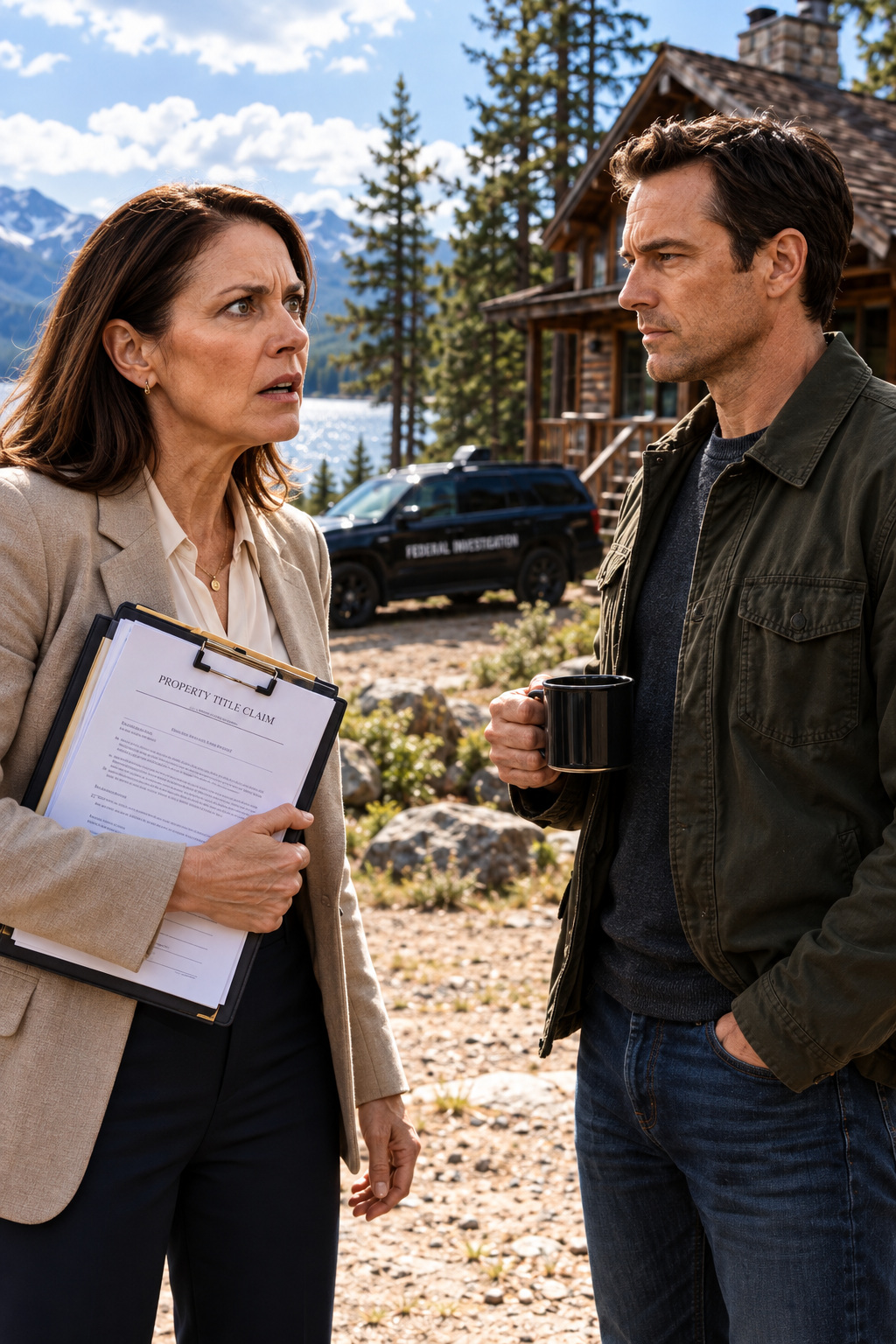
Three days later, a car he didn’t recognize turned into his driveway. Victoria Hayes stepped out in a belted linen blazer and carried a clipboard as if it were an extension of her authority. She introduced herself as the HOA president and began a polished speech about community standards, shared waterfront governance, and the obligations of lakefront property owners. She spoke without waiting for an invitation, confident that by the time she finished, Ethan would understand that paying the fee was easier than challenging her. He let her finish.
Then he went inside and returned with the certified map, the boundary records, and a letter from his attorney confirming that the HOA had no authority over his property. He laid the papers on the porch railing and explained them carefully. Victoria looked at the documents for a long moment. Her expression did not quite become embarrassment; it shifted into the quick, private calculation of someone revising a plan. She said she would consult the HOA’s attorney and turned toward her car.
Before getting in, she stopped and looked past the cabin, the truck, and the shed toward the dock. Her eyes stayed on the shoreline for several seconds longer than the rest of the visit could explain. Ethan watched her go, then stood on the porch listening as the lake’s quiet sounds returned: water against the pilings, a bird in the distance, wind moving through the pines. He thought about those extra seconds. Small details often pointed toward the real question.
The first police call came nine days later. A deputy arrived early in the morning to investigate a claim of illegal occupancy. He checked Ethan’s documents, walked around the property, and recorded that the titled owner lawfully lived there. A week after that came a noise complaint, followed by an allegation of unpermitted construction. Ethan produced the permits for his deck repairs, and the inspector found no violation. The visits were inconvenient, but each one ended the same way: with the complaint dismissed and a new entry in Ethan’s notebook.
By the eighth call, Deputy Ryan Cooper had begun requesting the White Pine Lake assignments when he could. He was young, deliberate, and increasingly uneasy with the repetition. At the twelfth call, a fire inspector searched Ethan’s shed after an anonymous tip alleged unsafe storage of flammable materials. When the inspector stepped inside, Ryan stayed in the driveway with Ethan. “It looks to me like somebody is working to build a record against you,” he said quietly. Ethan thanked him and wrote the visit down.
Part 3: False reports invade the home and unsettle a child
The next complaint reached further than the property line. A caseworker came to the cabin after someone reported that Emma was being left unsupervised near open water and that the family home presented multiple safety concerns. Sarah answered the door with the steady composure she used at work. Ethan watched her welcome the caseworker inside while Emma looked up from her homework, pencil tucked behind one ear. Sarah told her it was a routine county check and nothing to worry about. Emma studied her mother’s face before returning to her worksheet.
The caseworker was professional and clearly uncomfortable with the complaint, but she had to investigate it. She asked questions, looked through the home, and confirmed that Emma was safe and well cared for. The case was closed ten days later. A second report arrived the following month, repeating much of the same accusation. That investigation also found nothing and closed within two weeks. Neither report led to action, but Ethan could not forget the way Emma watched unfamiliar adults enter their home and question her parents.
That night, he stood in the hallway outside her room and saw her asleep beneath a blanket, her school notebook on the desk. Until then, he had been defending his family from each new interruption as it arrived. Now he made a different decision. He would find out who was behind the reports, why they had started, and what the person was trying to accomplish. He did not announce this to Sarah as a vow or a threat. He simply opened a fresh notebook and began.
Ethan started with documents anyone could request from the county. The HOA’s public financial disclosures were broad enough to hide irregularities, but not broad enough to hide every unusual pattern. Its infrastructure budget listed improvements to parts of the shoreline where no improvements could be seen. Its legal-services expenses had nearly quadrupled in a year, though there was no public record of a case large enough to explain the increase. Ethan requested three years of board minutes, compared the association’s membership list with county property records, and researched its officers.
Victoria’s background looked ordinary at first. She had lived in the area for years, worked in real estate and property management, and belonged to several civic groups. But her real estate experience mattered. People did not always seek control of an HOA for the pleasure of managing community paperwork. Sometimes they wanted influence over the things the association could regulate. Ethan kept reading, tracing names across records and matching meeting dates to financial entries. Then a planning commission application surfaced in a routine batch of zoning documents.
Filed six months before Ethan bought his property, the application described a luxury lakeside development: a private marina, an eighty-room resort, and docks for high-end boats. The development company had little public presence and was registered in Delaware. Ethan laid the plans beside the county parcel map. The project’s proposed lake access point sat directly on the rear boundary of his land. His property was not an incidental obstacle. The entire plan depended on gaining access across it.
Part 4: A hidden resort plan explains why Victoria wanted the shore
The planning application was only the beginning. Ethan traced the proposed access route through property records and found a recorded easement agreement. Victoria had signed it as HOA president, granting the development company rights along the White Pine Lake shoreline. The agreement had been filed as though it were valid, even though the HOA could not grant access to land it did not own. It had been recorded eight months before Victoria first demanded dues from Ethan. The timing made the demand look less like a misunderstanding and more like a first move.
The next piece came from corporate filings and a disclosure in an unrelated civil case. An operating account connected to the development company had sent seventy-five thousand dollars to a personal checking account in Victoria’s name. The transfer had cleared eleven months before the notice appeared on Ethan’s truck. He printed the record and placed it in a folder in his home office. He did not call Victoria or accuse her. He continued looking for evidence that could support more than a suspicion.
An amended planning application revealed the pressure behind the campaign. The company had promised the county it would deliver a fully executed and uncontested access agreement by the end of the first quarter of the following year. Four months remained. The landowner had refused to pay dues, refused to accept HOA control, and held the shoreline the resort needed. Once Ethan understood the deadline, the sudden burst of inspections made a terrible kind of sense. Victoria needed him out, compliant, or too overwhelmed to resist.
The pressure intensified. A building inspector came one Monday, an environmental officer on Wednesday, and a fire marshal on Friday. The next week brought another building inspection. Ryan appeared at some visits, sometimes officially and sometimes in his own car, watching without interfering. His presence did not stop the harassment, but Ethan understood what it meant: someone else was paying attention, and the visits were no longer invisible. Ethan installed additional hardwired cameras to cover the dock and rear property line.
At one November morning, the wireless cameras registered interference. Ethan watched the hardwired feeds as three figures emerged from the trees carrying plastic containers. They moved to the water’s edge, set the containers beside the dock, and slipped away without speaking. Before dawn, Ethan put on nitrile gloves, photographed the containers from several angles, recorded their GPS coordinates, and locked them in the shed. At , an environmental inspector arrived to investigate a claim of chemical contamination. The inspector found a clean shoreline and filed a no-violation report.
Three nights later, Ethan smelled accelerant before the smoke alarm sounded. He grabbed an extinguisher and reached the shed in time to stop the fire before it spread beyond an exterior wall. The restored boat inside remained untouched. Fire investigators confirmed deliberate ignition and collected a partially burned work glove. Ethan’s camera had recorded the attack. The hooded figure’s build, boots, and movement appeared consistent with Tyler Hayes, Victoria’s nephew, who had worked for seasonal maintenance contractors around the lake. Ethan recorded both his assessment and its limitations, then added the footage to the growing file.
Part 5: A forged accusation threatens Sarah’s career and reputation
The complaint against Sarah arrived through her bank’s official compliance channel. It accused her of falsifying compliance documents over several years, manipulating audit records, and misrepresenting her credentials. The allegations were specific enough to trigger an internal investigation, and Sarah was placed on administrative leave while the bank reviewed them. She told Ethan at the kitchen table, holding a cup of tea that had gone cold. Her voice was controlled, but he could see how much effort the control required. She had spent years earning the trust of colleagues who now had to investigate her.
Ethan listened without interrupting. When she finished, he told her the review would find nothing because there was nothing to find. He also said he would identify whoever had submitted the complaint. The words were not a promise made in anger. He spoke with the calm of someone who had already formed a hypothesis and intended to test it. Sarah reached for his hand. They would face the investigation together, but Ethan knew the attack had changed the stakes.
With Sarah’s attorney involved in the bank’s review, Ethan obtained metadata from the electronic complaint. The authoring workstation belonged to the HOA’s administrative office, and the credentials used were assigned to its secretary. The document had been created on a Sunday evening after business hours. But photographs taken by three people on three separate devices showed the secretary at a family gathering forty miles away throughout that evening. Someone had used her credentials while she was absent. The forgery had left its own trail.
By then, Ethan’s folder contained a timeline of police calls and inspections, records of the staged environmental complaint, the fire footage, the easement agreement, the development application, the money transfer, and the forged accusation against Sarah. He still needed to establish how the people involved connected to one another. He also needed to preserve each piece of evidence so it could withstand scrutiny. He knew better than to treat a compelling theory as proof. The sequence mattered, and so did the source of every document.
He left the shed door unlocked on a Friday evening. Under a work lamp, visible through the window, he placed a manila folder on the bench with “Victoria Hayes corruption evidence” written across it. Inside were public documents mixed with pages that contained nothing useful. The setup was a trap, and Ethan understood the risks. He made sure the hardwired cameras covered the shed from four angles and went to bed, watching the feeds from a monitor in the dark. He had told Sarah what he was doing; she had not liked the idea, but trusted his judgment.
At a.m., a man crossed the property and entered the shed. He went straight to the workbench, looked through the folder for several minutes, tucked it under his arm, and left. The cameras recorded his face clearly. Ethan identified him as Logan Hayes, Victoria’s son, whose name appeared on HOA board resolutions. The next morning, he reviewed the footage, documented the break-in, and added it to the record. The folder’s contents had been bait, but the act of taking it was real. His evidence now reached from the original financial arrangement to the family members who had acted on Victoria’s behalf.
Part 6: Ethan turns months of harassment into an evidence file
Ethan spent four days preparing a submission package. He did not just stack documents together; he arranged them so investigators could follow the story without having to guess at the connections. There was a chronological index of all twenty-three police and inspection incidents, with camera footage where available. There were photographs and location data for the containers, the fire investigator’s findings, and the video of the shed break-in. His written assessment of Tyler’s identity stated what the footage could support and what it could not.
He included the metadata linking Sarah’s forged complaint to the HOA office, the records showing the secretary had been elsewhere, the seventy-five-thousand-dollar transfer, the recorded easement, and the resort application. A thirty-page memorandum laid out the timeline in plain language, identifying the source of each fact and cross-referencing the records. Ethan knew how easy it was for a complicated case to be dismissed as a collection of unrelated incidents. His job was to show how the parts fit without asking anyone to accept an unsupported conclusion.
On Tuesday evening, he sent the package to the county prosecutor, the sheriff’s investigative division, the state attorney general’s financial-crimes unit, and the FBI field office with jurisdiction over the interstate transfer. He did not expect an instant response. Serious investigations moved at the pace of people checking facts, not at the pace of someone waiting for a phone to ring. The prosecutor’s office sent an acknowledgment on Wednesday. The sheriff’s division left a message on Thursday saying the submission was under active review. Ethan saved both communications in the file.
On Monday, an FBI agent called and spoke with him for forty minutes. The agent asked questions about the financial records, the development company, and the chain of custody for the footage. Ethan answered carefully and offered to provide originals when requested. Before ending the call, the agent told him, “We have what we need to move forward.” Ethan thanked her and returned to the shed. The boat’s final coat of varnish was curing cleanly under the work lights.
The investigation continued without public fanfare. Ethan received follow-up questions and responded with the relevant records. He did not contact Victoria, confront her son, or make any announcement to the neighbors. Sarah’s internal review continued at the bank, and Emma returned to the routines of school and the lake, though the family understood that routine did not mean the danger was over. Ryan Cooper stopped by once, not on official business, and sat with Ethan on the dock. They talked about fishing spots on the lake’s northern side.
By late January, the water had gone flat beneath a heavy gray sky. Ethan was on the porch with a cup of coffee before sunrise when government SUVs appeared at the far end of the road. A second vehicle followed, then a third. Ryan’s cruiser came last. Ethan watched the convoy disappear toward Victoria’s house and finished his coffee. He had done the part that belonged to him. The next steps belonged to the people who had received the evidence.
Part 7: Arrests expose the people behind the campaign
At that morning, investigators arrived at Victoria Hayes’s residence with search and arrest warrants. She was already awake at the kitchen table when they reached the door. She read the documents, then looked past the agents toward the road leading to the lake. “This is Ethan Brooks,” she said. “This is entirely something Ethan Brooks has done to me.” Ryan Cooper stood nearby, remembering the calls, the false inspections, and the family that had done nothing except buy a home beside the water. “Ma’am,” he replied, “you did this yourself.”
Victoria was not the only person arrested. HOA board members implicated in the conspiracy were taken into custody at their homes. Tyler Hayes was arrested at his apartment. Logan turned himself in before noon with an attorney, after what Ryan later described as a voluntary call. Investigators searched the HOA’s administrative offices and found the workstation and records that supported the metadata evidence. The case that had started with an improper demand for dues now involved alleged financial crimes, forgery, conspiracy, and arson.
Within forty-eight hours, the development company withdrew its planning application. The retreat was quiet and formal, without a public explanation. The HOA held an emergency meeting the following week. Its officers resigned, and the remaining board requested county-supervised governance and a comprehensive audit of the previous four years. The association that Victoria had used as a tool to pressure the Brooks family now had to answer for its own records and decisions. Residents who had once kept their distance began asking what had happened.
Sarah’s bank completed its review and cleared her of every allegation. The employer issued a written apology, confirmed the complaint had been fabricated by an outside party, and restored her to her position without condition. Her return was deliberately ordinary. She went back to her desk, reopened the work she had been forced to leave, and let the people who had known her best welcome her without a speech. The accusation had shaken her, but it had not erased the years of work she had done honestly.
Victoria was charged with wire fraud, extortion, forgery, criminal conspiracy, and bribery connected to a public proceeding. Tyler faced charges related to arson and conspiracy. Logan received a suspended sentence and probation after agreeing to cooperate with investigators. The development company’s withdrawal did not end the broader inquiry; Victoria’s plea agreement included cooperation in an investigation of the company’s activities in other states. Ethan had no role in that separate case and followed it only through the public record.
Emma was the first person in the family to mark the end of the worst months with something that felt uncomplicated. She entered the district science fair with a model of a layered camera network, complete with carefully positioned housings and a hand-drawn diagram showing how overlapping fields of view left no gaps. When a judge asked how she had learned so much about security design, Emma thought for a moment. “My dad taught me that you document everything and then you wait,” she said. The judges smiled, and Emma brought home a blue ribbon.
Part 8: The family begins to reclaim the quiet Victoria tried to steal
The sentencing took place in early spring, after the ice had broken up on White Pine Lake. Victoria received six years in federal prison on the primary charges, reduced through a plea arrangement that included cooperation with investigators examining the development company. Ethan did not attend. He had submitted his evidence, answered questions, and given a deposition in a courthouse room with a long table and a court reporter. He understood his part was finished. The outcome did not need an audience from him.
The weeks after the arrests were not instantly peaceful. Prosecutors asked for details about how footage had been stored and when it had been copied. There were questions about the containers, their location, and the sequence of events around the fire. Ethan answered them methodically. The process took time, but it was no longer a series of surprise intrusions into his home. It was a process moving forward with the evidence in view. For once, the institutions involved seemed to be doing the work they were meant to do.
Sarah returned to her job within a week of the bank’s apology. Her colleagues treated her return with the practical normalcy she preferred, and she resumed the compliance review that had been waiting for her. Emma began a school project on loon migration, recording the birds she saw from the dock in a field notebook Ethan had given her. She wrote down dates, weather, and where the birds appeared. Ethan noticed the care she took with each entry but did not make a lesson out of it. She had found her own way to pay attention.
Ryan visited once with a thermos of coffee. He had no official reason to be there. They sat on the dock and talked about fishing, the northern shore, and which spots held up when the water warmed. They did not need to revisit the arrests or list the calls. The record existed, the charges were solid, and the family was no longer waiting for another knock at the door. Ryan stayed about twenty minutes, then drove back toward town.
Near the end of March, Ethan finally put the restored boat in the water. Emma sat at the bow, Sarah at the stern, and Ethan checked the engine before easing away from the dock. The mahogany caught the cold sunlight, and the old motor ran smoothly beneath them. They circled the lake twice, then cut the engine and drifted in the clear water. Emma leaned over the side and said she could see the rocks below. Ethan rested his hand on the gunwale and felt the motion of the lake through the wood.
For months, even the ordinary sounds of the property had carried a shadow. A car on the road could mean another complaint; a knock could bring another official with another accusation. Now the same sounds were only sounds. Sarah’s cup clicked softly against the porch table in the morning. Emma’s kayak scraped the shore in the afternoon. The boat’s engine carried across the water and faded among the pines. Nothing had changed about the lake, but the family had begun to inhabit it again.
Part 9: Truth brings accountability, but peace takes time to rebuild
The quiet that followed Victoria’s conviction was different from the quiet Ethan had first found at White Pine Lake. Before the campaign began, the silence had been a promise: room to rest, to repair the boat, to watch Emma grow into a place that felt like home. Afterward, silence had to be earned back slowly. It came through ordinary days, through Sarah returning to work, Emma going to school, and the absence of official vehicles turning into the driveway. None of those things erased what had happened. Together, they made life feel like theirs again.
Ethan sometimes thought about how close he had come to reacting in the way Victoria wanted. There had been plenty of moments when anger would have been easy. A false report involving his daughter. A fire in the shed. A forged accusation aimed at Sarah’s career. Each incident invited him to lash out, to confront someone without proof, or to make a mistake that could be used against him. He had learned long ago that restraint was not surrender. It was the discipline to choose a response that would still matter later.
What protected the family was not a single clever maneuver. It was the accumulation of small, careful choices: checking the county map, saving each notice, recording each visit, installing cameras, preserving footage, and being precise about what the evidence did and did not show. Ethan had not needed to be louder than Victoria. He needed to make the facts clear enough that other people could act on them. The process was imperfect and slow, but it had finally taken the evidence seriously. The family’s relief came from that, not from revenge.
Emma’s blue ribbon remained on the refrigerator through spring and into summer. Her migration notebook filled with dates and small observations: a pair of loons near the eastern shore, a nest spotted beyond the reeds, a change in the wind before rain. Sarah’s work settled back into its old rhythm. The HOA, under new oversight, commissioned an audit and began answering questions from residents. The resort plan did not return. The shoreline remained what it had been before the developers drew lines across it: water, pines, and a narrow stretch of land that belonged to the family.
On a clear morning, Ethan sat with Sarah on the porch before the sun rose over the ridge. Emma was still asleep inside. Across the lake, loons moved along the far shore, their calls carrying over the still water. The restored boat was tied to the repaired dock, which no longer leaned to one side. Sarah’s hand rested near Ethan’s on the arm of the chair. Neither of them needed to fill the moment with words. The lake held the light as the morning opened around them.
Ethan knew peace was not something the world handed out simply because a person deserved it. People would always be tempted to use influence, paperwork, and fear to take what they wanted. But he had learned again that the truth, preserved carefully and delivered to the right people, could hold its ground. He had done the work, and the evidence had carried the case farther than anger ever could. When Emma’s alarm sounded faintly through the wall, Sarah smiled and reached for her coffee. Ethan looked at the water and knew, with a certainty he had not felt in months, that he was home.
✓ Lynn R. Adams
Part 2: The HOA president mistakes a deeded owner for an easy target The notice arrived on official White Pine Lake Homeowners Association letterhead, complete with a deadline, a list of penalties, a…